3 Wicked Problems
Anupam Saraph
Environmental
Degradation
• Rivers, streams and lakes exploited, encroached
and polluted
• Mountain ranges mined and razed down
• Forests disappearing through environmental
clearances to projects in forests
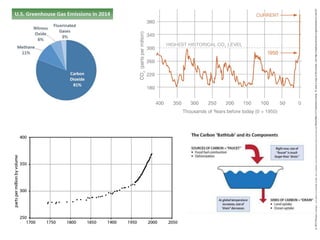
• Climate change
India’s Intended Nationally
Determined Contribution (INDC)
• Reduce the emissions intensity of its GDP by 33 to
35 % by 2030 from 2005 level
• Create an additional carbon sink of 2.5 to 3 billion
tonnes of CO2 equivalent through additional forest
and tree cover by 2030
Consumption
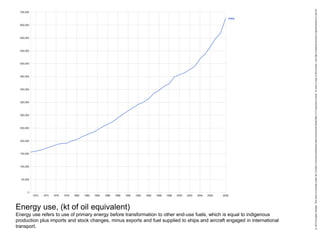
Energy use, (kt of oil equivalent)
Energy use refers to use of primary energy before transformation to other end-use fuels, which is equal to indigenous
production plus imports and stock changes, minus exports and fuel supplied to ships and aircraft engaged in international
transport.
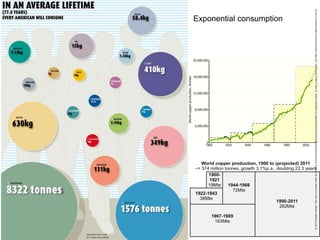
Exponential consumption
• Push for consumption as measure of worth
Growth
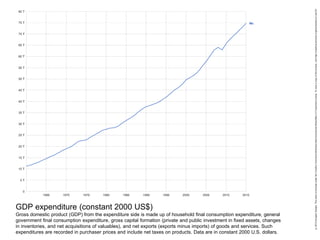
GDP expenditure (constant 2000 US$)
Gross domestic product (GDP) from the expenditure side is made up of household final consumption expenditure, general
government final consumption expenditure, gross capital formation (private and public investment in fixed assets, changes
in inventories, and net acquisitions of valuables), and net exports (exports minus imports) of goods and services. Such
expenditures are recorded in purchaser prices and include net taxes on products. Data are in constant 2000 U.S. dollars.
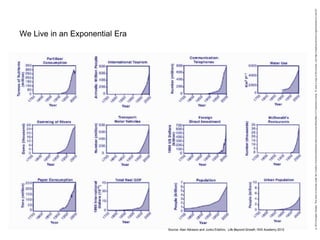
We Live in an Exponential Era
Source: Alan Atkisson and Junko Edahiro, Life Beyond Growth, ISIS Academy 2012
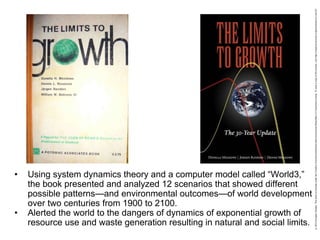
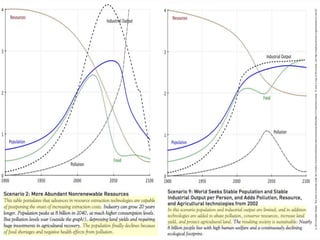
• Using system dynamics theory and a computer model called “World3,”
the book presented and analyzed 12 scenarios that showed different
possible patterns—and environmental outcomes—of world development
over two centuries from 1900 to 2100.
• Alerted the world to the dangers of dynamics of exponential growth of
resource use and waste generation resulting in natural and social limits.
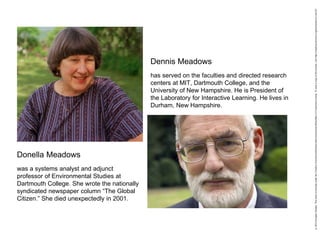
Dennis Meadows
Donella Meadows
was a systems analyst and adjunct
professor of Environmental Studies at
Dartmouth College. She wrote the nationally
syndicated newspaper column “The Global
Citizen.” She died unexpectedly in 2001.
has served on the faculties and directed research
centers at MIT, Dartmouth College, and the
University of New Hampshire. He is President of
the Laboratory for Interactive Learning. He lives in
Durham, New Hampshire.
• Population and industrial growth are inherently exponential;
and that exponential growth takes one to any existing limit
quickly, whatever its magnitude.
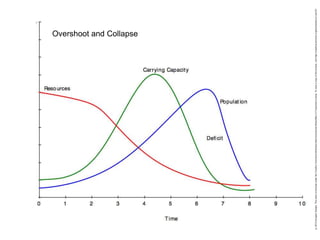
• Global society will most likely adjust to limits by overshoot and
collapse and not by S- shaped growth. However sustainable
development is possible, if important changes are made.
• Politics and the market are inherently unsuited to adopt
constructive policies that can lead to sustainable
development.
The Main Ideas of Limits to Growth
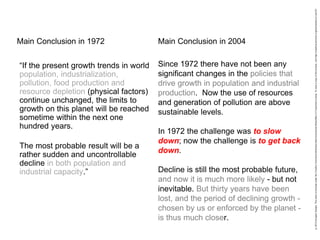
“If the present growth trends in world
population, industrialization,
pollution, food production and
resource depletion (physical factors)
continue unchanged, the limits to
growth on this planet will be reached
sometime within the next one
hundred years.
The most probable result will be a
rather sudden and uncontrollable
decline in both population and
industrial capacity.”
Main Conclusion in 1972
Since 1972 there have not been any
significant changes in the policies that
drive growth in population and industrial
production. Now the use of resources
and generation of pollution are above
sustainable levels.
In 1972 the challenge was to slow
down; now the challenge is to get back
down.
Decline is still the most probable future,
and now it is much more likely - but not
inevitable. But thirty years have been
lost, and the period of declining growth -
chosen by us or enforced by the planet -
is thus much closer.
Main Conclusion in 2004
Overshoot and Collapse
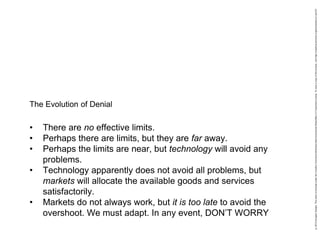
• There are no effective limits.
• Perhaps there are limits, but they are far away.
• Perhaps the limits are near, but technology will avoid any
problems.
• Technology apparently does not avoid all problems, but
markets will allocate the available goods and services
satisfactorily.
• Markets do not always work, but it is too late to avoid the
overshoot. We must adapt. In any event, DON’T WORRY
The Evolution of Denial
Addressing the
Problems
• Only a society that has in place informational, social, and
institutional mechanisms to keep in check the positive feedback
loops that cause exponential population and capital growth may
become sustainable.
• Sustainability does not mean zero growth.
• A sustainable society must provide sufficiency and security for all.
• Rules for sustainability would be put into place not to destroy
freedoms, but to create freedoms or protect them.
The Sustainable Society
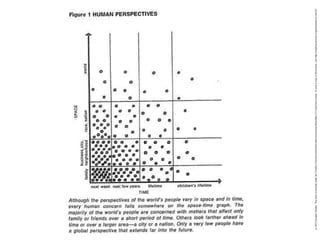
• Extend the planning horizon. Choose from options based on their
long-term costs and benefits.
• Take responsibility for others far away in time and space; adopt
collective rather than self-centered goals.
• Realize that change comes through complex inter-connections, not
simple cause and effect. Educate for systems thinking.
Perspectives
• Wicked Problems
• Environmental Degradation
• Consumption
• Growth
• Addressing the Problems

3 wicked problems

  • 1.
  • 2.
  • 3.
    • Rivers, streamsand lakes exploited, encroached and polluted • Mountain ranges mined and razed down • Forests disappearing through environmental clearances to projects in forests • Climate change
  • 5.
    India’s Intended Nationally DeterminedContribution (INDC) • Reduce the emissions intensity of its GDP by 33 to 35 % by 2030 from 2005 level • Create an additional carbon sink of 2.5 to 3 billion tonnes of CO2 equivalent through additional forest and tree cover by 2030
  • 6.
  • 7.
    Energy use, (ktof oil equivalent) Energy use refers to use of primary energy before transformation to other end-use fuels, which is equal to indigenous production plus imports and stock changes, minus exports and fuel supplied to ships and aircraft engaged in international transport.
  • 8.
  • 10.
    • Push forconsumption as measure of worth
  • 11.
  • 12.
    GDP expenditure (constant2000 US$) Gross domestic product (GDP) from the expenditure side is made up of household final consumption expenditure, general government final consumption expenditure, gross capital formation (private and public investment in fixed assets, changes in inventories, and net acquisitions of valuables), and net exports (exports minus imports) of goods and services. Such expenditures are recorded in purchaser prices and include net taxes on products. Data are in constant 2000 U.S. dollars.
  • 13.
    We Live inan Exponential Era Source: Alan Atkisson and Junko Edahiro, Life Beyond Growth, ISIS Academy 2012
  • 15.
    • Using systemdynamics theory and a computer model called “World3,” the book presented and analyzed 12 scenarios that showed different possible patterns—and environmental outcomes—of world development over two centuries from 1900 to 2100. • Alerted the world to the dangers of dynamics of exponential growth of resource use and waste generation resulting in natural and social limits.
  • 16.
    Dennis Meadows Donella Meadows wasa systems analyst and adjunct professor of Environmental Studies at Dartmouth College. She wrote the nationally syndicated newspaper column “The Global Citizen.” She died unexpectedly in 2001. has served on the faculties and directed research centers at MIT, Dartmouth College, and the University of New Hampshire. He is President of the Laboratory for Interactive Learning. He lives in Durham, New Hampshire.
  • 18.
    • Population andindustrial growth are inherently exponential; and that exponential growth takes one to any existing limit quickly, whatever its magnitude. • Global society will most likely adjust to limits by overshoot and collapse and not by S- shaped growth. However sustainable development is possible, if important changes are made. • Politics and the market are inherently unsuited to adopt constructive policies that can lead to sustainable development. The Main Ideas of Limits to Growth
  • 19.
    “If the presentgrowth trends in world population, industrialization, pollution, food production and resource depletion (physical factors) continue unchanged, the limits to growth on this planet will be reached sometime within the next one hundred years. The most probable result will be a rather sudden and uncontrollable decline in both population and industrial capacity.” Main Conclusion in 1972 Since 1972 there have not been any significant changes in the policies that drive growth in population and industrial production. Now the use of resources and generation of pollution are above sustainable levels. In 1972 the challenge was to slow down; now the challenge is to get back down. Decline is still the most probable future, and now it is much more likely - but not inevitable. But thirty years have been lost, and the period of declining growth - chosen by us or enforced by the planet - is thus much closer. Main Conclusion in 2004
  • 20.
  • 21.
    • There areno effective limits. • Perhaps there are limits, but they are far away. • Perhaps the limits are near, but technology will avoid any problems. • Technology apparently does not avoid all problems, but markets will allocate the available goods and services satisfactorily. • Markets do not always work, but it is too late to avoid the overshoot. We must adapt. In any event, DON’T WORRY The Evolution of Denial
  • 22.
  • 23.
    • Only asociety that has in place informational, social, and institutional mechanisms to keep in check the positive feedback loops that cause exponential population and capital growth may become sustainable. • Sustainability does not mean zero growth. • A sustainable society must provide sufficiency and security for all. • Rules for sustainability would be put into place not to destroy freedoms, but to create freedoms or protect them. The Sustainable Society
  • 25.
    • Extend theplanning horizon. Choose from options based on their long-term costs and benefits. • Take responsibility for others far away in time and space; adopt collective rather than self-centered goals. • Realize that change comes through complex inter-connections, not simple cause and effect. Educate for systems thinking. Perspectives
  • 26.
    • Wicked Problems •Environmental Degradation • Consumption • Growth • Addressing the Problems