A TOOL TO LEARN
AND PLAN FOR
DEGROWTH
By Amerissa Giannouli
Please note that it is marked with CC0 1.0. Universal License.
You are free to copy, modify, distribute, and use the content for any purpose, even for commercial use, without
asking for permission. To view a copy of this license, visit http://creativecommons.org/publicdomain/zero/1.0
HOW TO USE THIS TOOL
This tool serves as a participatory process for both educational purposes and policy design
involving diverse stakeholders. It is suitable for educators and facilitators interested in
exploring degrowth with their groups, academics aiming to connect research with the
general public and policymakers, as well as activists and practitioners designing degrowth
advocacy campaigns, or projects.
The process consists of five phases:
Phase 1: Participants reflect on the desirability and feasibility of growth.
Phase 2: Participants recognise hidden narratives and myths within public discourse that
promote the desirability and feasibility of growth (eg. green growth).
Phase 3: Participants understand what degrowth is about and transform the growth-
dependent narratives. They express them creatively as visions of degrowth-inspired
societies.
Phase 4: Participants map relevant actors, initiatives, institutions , and instruments that
respond to their visions. Participants propose new ones if existing options are
unsatisfactory.
NOTES
You will need to adjust the timing and content based on the type and size of the group
you are working with.
Updating some information with the latest academic resources, data resources and
developments is recommended.
Use supplementary resources and materials to elaborate on the information provided in
the cards. These could include (academic) articles, videos, podcasts, case studies, or any
kind of interactive tools.
Encourage participants to engage in discussions, share ideas, and collaborate through
group work and collective presentations.
What are the underlying assumptions, narratives and myths
that make economic growth necessary and desirable?
Can you think of examples where economic growth has led
to negative consequences for society and the planet?
TRICKLE-DOWN ECONOMICS DOESN'T WORK
Trickle-down economics assumes that concentrating wealth at the top will eventually
benefit everyone. In reality, it often leads to greater income inequality and fails to
adequately address the needs of the most socio-economically marginalised.
For example, Thomas Piketty (2014) has argued that wealth tends to accumulate and
concentrate in the hands of the rich over time.
Inequality is increasing both within countries and between countries despite of
economic growth increases (Coscieme et at. 2019).
According to the World Inequality Report (2022), global inequalities do not seem to be
very different compared to the period of Western imperialism in the early 20th century.
Sources: Piketty, T. (2014). Capital in the twenty-first century. Harvard University Press. | Coscieme, L., Sutton, P.,
Mortensen, L. F., Kubiszewski, I., Costanza, R., Trebeck, K., ... & Fioramonti, L. (2019). Overcoming the myths of
mainstream economics to enable a new wellbeing economy. Sustainability, 11(16), 4374. | Chancel, L., Piketty, T.,
Saez, E., & Zucman, G. (Eds.). (2022). World inequality report 2022. Harvard University Press.
LIMITS TO GROWTH
According to "The Limits to Growth" (1972), the earth systems cannot support the present
rates of economic and population growth.
Ecological limits: Economies should be analysed as open systems and in biophysical
terms as processes that transform flows of energy and materials into goods and services.
These processes are being constrained by the laws of physics (Bonaiuti, 2014).
Social limits: There is increased social inequality and conflicts which make growth
“uneconomic”. Growth does not necessarily increase access to positional goods
because their value depends on being scarce (Kallis, 2014).
Political limits: "The Limits to Growth" (1972) has been criticised for its intention. For
Degrowth the issue is not with population growth, but, among others, the distribution of
resources given the overconsumption of resources in the Global North. For Kallis (2019),
limits are not external restrictions but something that is socially constructed through
processes of collective self-determination.
Sources: Meadows, D. H., Meadows, D. L., Randers, J., & Behrens III, W. W. (1972). The limits to growth-club of
rome. | Bonaiuti, M. (2014). Bioeconomics. In Degrowth: A vocabulary of a new era (pp. 25-28). Routledge. | Kallis,
G. (2014). Social limits of growth. In Degrowth: A vocabulary of a new era (pp. 137-140). Routledge. | Kallis, G.
(2019). Limits: Why Malthus was wrong and why environmentalists should care. Stanford University Press.
THE GREAT ACCELERATION AND PLANETARY BOUNDARIES
It refers to a period of rapid and unprecedented changes in various aspects of the
Earth's system that began in the mid-20th century and continues into the present. It
signifies an intensification of human impacts on the environment.
From Anthropocene to Capitalocene: The role of capitalism in shaping the current
environmental challenges facing the planet should be examined. It is not just an issue of
“human” activity (Moore, 2017).
The framework of “Planetary Boundaries” identifies and quantifies critical environmental
points within which humanity can safely operate to maintain a stable and sustainable
Earth system. In 2023, all planetary boundaries mapped out for the first time and
indicated that 6 out of 9 have already been crossed.
However, boundaries and limits, similarly to economics, is a socio-political construct
(Brand et al. 2021). Collective self-limitation provides an alternative understanding about
human nature.
Sources: International Geosphere-Biosphere Programme (IGBP), https://tinyurl.com/38fyhh2b | Stockholm
Resilience Center, https://shorturl.at/akyO8 / Moore, J. W. (2017). The Capitalocene, Part I: on the nature and
origins of our ecological crisis. The Journal of peasant studies, 44(3), 594-630. | Brand, U., Muraca, B., Pineault, É.,
Sahakian, M., Schaffartzik, A., Novy, A., ... & Görg, C. (2021). From planetary to societal boundaries: an argument
for collectively defined self-limitation. Sustainability: science, practice and policy, 17(1), 264-291.
HAPPINESS AND THE EASTERLIN PARADOX
The Easterlin paradox suggests that increases in a society's income do not necessarily
result in higher levels of happiness or wellbeing. Empirical studies indicate that more is
not always better. In fact, there might be a positive correlation between GDP and quality
of life only up to a point. After this point, there are no wellbeing improvements. On the
contrary, socio-ecological costs are being increased (Coscieme et al. 2019).
Having GDP growth at the center of decision-making has led to the implementation of
neoliberal policies, such as privatisation of social services, which deepen inequalities and
negatively affect wellbeing (Schmelzer, Vetter and Vansintjan, 2022).
There have been alternative methods of measuring wellbeing, equality, and planetary
health. However, it is not just a question of identifying the perfect measurement. No
single measurement can capture the full complexity of wellbeing, sustainability, or
societal progress.
Sources: Coscieme, L., Sutton, P., Mortensen, L. F., Kubiszewski, I., Costanza, R., Trebeck, K., ... & Fioramonti, L.
(2019). Overcoming the myths of mainstream economics to enable a new wellbeing economy. Sustainability, 11(16),
4374. | Schmelzer, M., Vetter, A., & Vansintjan, A. (2022). Critiques of growth. In The future is degrowth: A guide
to a world beyond capitalism. Verso Books.
MONEY DOES NOT GUARANTEE A GREENER PLANET
The Kuznets Curve suggests that environmental degradation initially worsens as an
economy grows, but once it reaches a certain level of income, environmental protection
increases. This supports the discourse that the wealthiest countries have the potential to
achieve sustainable development. However, the Kuznets Curve oversimplifies ecological,
economic and global issues. It has been disproved (Coscieme, 2019). Moreover, in the
case of ecological damage, such as climate change, it may reach irreversible levels.
There's a misconception that being 'poor' implies caring less about the environment
(Anguelovski and Alier, 2014).
Green growth discourse is also based on the argument that technological innovation,
resources and energy efficiency stimulated by economic growth will address the
environmental problems. Empirically, this has not been proven and there are doubts that
absolute decoupling will happen fast enough in the future (Parrique et al., 2019).
Sources: Coscieme, L., Sutton, P., Mortensen, L. F., Kubiszewski, I., Costanza, R., Trebeck, K., ... & Fioramonti, L.
(2019). Overcoming the myths of mainstream economics to enable a new wellbeing economy. Sustainability, 11(16),
4374. Anguelovski, I., & Alier, J. M. (2014). The ‘Environmentalism of the Poor’revisited: Territory and place in
disconnected glocal struggles. Ecological Economics, 102, 167-176. | Parrique, T., Barth, J., Briens, F., Kerschner, C.,
Kraus-Polk, A., Kuokkanen, A., & Spangenberg, J. H. (2019). Decoupling debunked. Evidence and arguments
against green growth as a sole strategy for sustainability. A study edited by the European Environment Bureau
EEB.
COST-SHIFTING AND MARGINALISED COMMUNITIES
The history of colonialism (Hickel, 2020) has left a legacy of unequal exchange and
exploitation, shaping socio-economic and ecological disparities that persist today
(Hickel et al., 2022). Mainstream efforts for climate neutrality without addressing the
focus on economic growth reproduce colonial relationships and dependencies. For
example, 'green' technologies will require a vast amount of resources to meet increasing
energy demands, resulting in the creation of 'green sacrifice zones' and cost-shifting
onto the most vulnerable communities already facing the costs of the climate crisis
(Zografos and Robbins, 2020).
Rich countries may seem to follow a “greener” path but in reality, they do not take into
account trade effects throughout their global supply chains (Parrique et al., 2019).
"Greenwashing" is the result of misleading sustainability claims by corporations,
obscuring their true impact.
Sources: Hickel, J. (2020). Part One, Chapter One. In Less is more: How degrowth will save the world. Random
House. | Hickel, J., Dorninger, C., Wieland, H., & Suwandi, I. (2022). Imperialist appropriation in the world
economy: Drain from the global South through unequal exchange, 1990–2015. Global Environmental Change, 73,
102467. | Zografos, C., & Robbins, P. (2020). Green sacrifice zones, or why a green new deal cannot ignore the
cost shifts of just transitions. One Earth, 3(5), 543-546. | Parrique, T., Barth, J., Briens, F., Kerschner, C., Kraus-Polk,
A., Kuokkanen, A., & Spangenberg, J. H. (2019). Decoupling debunked. Evidence and arguments against green
growth as a sole strategy for sustainability. A study edited by the European Environment Bureau EEB.
FEMINIST PERSPECTIVES
Homo economicus, the rational self-interested individual, has shaped economic thinking
and policy. It fails to account for the unpaid labor, primarily done by (migrant) women,
such as caregiving and domestic work, contributing to socio-economic inequalities,
reinforcing the gender wage gap and exploitation (Berik and Kongar, 2021).
Ecofeminism examines the intersection of environmental and feminist issues, revealing
the links between exploitation of reproductive work and nature. When it is convenient for
the capitalist system, reproductive work and nature become commodified to internalise
the benefits. When it is not convenient, reproductive work and nature remain invisible
and bear the costs of socio-ecological exploitation.
Economic growth is possible at the expense of “others” and it is linked to colonialism and
patriarchal relations (Gregoratti and Raphael, 2019). Decolonial feminist critique of the
Western-centric models of development argues that these models do not consider the
diverse worldviews and knowledge systems of indigenous and local communities.
Sources: Berik, G., & Kongar, E. (2021). The Social Provisioning Approach in Feminist Economics. In The Routledge
Handbook of Feminist Economics. | Gregoratti, C., & Raphael, R. (2019). Maria Mies’s and Marilyn Waring’s
critiques of growth. Towards a political economy of degrowth, 83-98.
HIDDEN NARRATIVES AND MYTHS
Select a recent news article or media story about an environmental policy or situation (e.g., a
new law, initiative, or campaign).
What are the key messages or ideas presented in the piece?
Can you identify any messages or ideas that link to green growth or growth
dependency?
What kind of economic or political system underpins the perspective in the article?
What kind of socio-economic and ecological relationships contribute to the
policy or situation described?
What ideologies support this system (e.g., belief in infinite growth, techno-optimism,
or market solutions)?
What cultural stories, metaphors, or symbols reinforce these ideas? (e.g., "growth as
progress," "nature as a resource"). Think about things that feel natural and
emotionally driven.
This section is inspired by Sohail Inayatullah's Causal Layered Analysis and the EU-funded
strategic partnership project in the field of youth, Future Narratives (Project No: 2020-3-
SE02-KA205-003019).
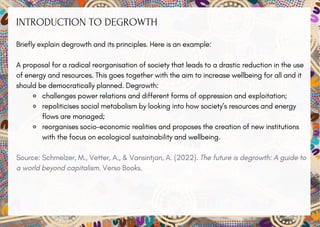
INTRODUCTION TO DEGROWTH
Briefly explain degrowth and its principles. Here is an example:
A proposal for a radical reorganisation of society that leads to a drastic reduction in the use
of energy and resources. This goes together with the aim to increase wellbeing for all and it
should be democratically planned. Degrowth:
challenges power relations and different forms of oppression and exploitation;
repoliticises social metabolism by looking into how society’s resources and energy
flows are managed;
reorganises socio-economic realities and proposes the creation of new institutions
with the focus on ecological sustainability and wellbeing.
Source: Schmelzer, M., Vetter, A., & Vansintjan, A. (2022). The future is degrowth: A guide to
a world beyond capitalism. Verso Books.
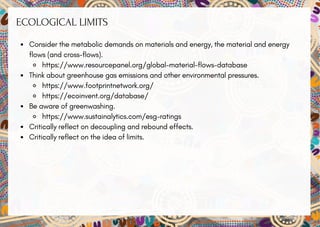
ECOLOGICAL LIMITS
Consider the metabolic demands on materials and energy, the material and energy
flows (and cross-flows).
https://www.resourcepanel.org/global-material-flows-database
Think about greenhouse gas emissions and other environmental pressures.
https://www.footprintnetwork.org/
https://ecoinvent.org/database/
Be aware of greenwashing.
https://www.sustainalytics.com/esg-ratings
Critically reflect on decoupling and rebound effects.
Critically reflect on the idea of limits.
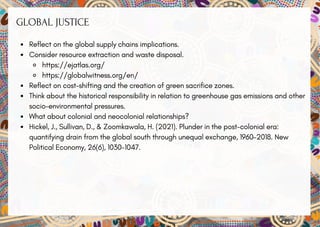
GLOBAL JUSTICE
Reflect on the global supply chains implications.
Consider resource extraction and waste disposal.
https://ejatlas.org/
https://globalwitness.org/en/
Reflect on cost-shifting and the creation of green sacrifice zones.
Think about the historical responsibility in relation to greenhouse gas emissions and other
socio-environmental pressures.
What about colonial and neocolonial relationships?
Hickel, J., Sullivan, D., & Zoomkawala, H. (2021). Plunder in the post-colonial era:
quantifying drain from the global south through unequal exchange, 1960–2018. New
Political Economy, 26(6), 1030-1047.
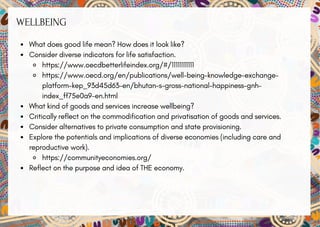
WELLBEING
What does good life mean? How does it look like?
Consider diverse indicators for life satisfaction.
https://www.oecdbetterlifeindex.org/#/11111111111
https://www.oecd.org/en/publications/well-being-knowledge-exchange-
platform-kep_93d45d63-en/bhutan-s-gross-national-happiness-gnh-
index_ff75e0a9-en.html
What kind of goods and services increase wellbeing?
Critically reflect on the commodification and privatisation of goods and services.
Consider alternatives to private consumption and state provisioning.
Explore the potentials and implications of diverse economies (including care and
reproductive work).
https://communityeconomies.org/
Reflect on the purpose and idea of THE economy.
DEMOCRACY
Consider the decision making processes.
https://iiasa.ac.at/models-tools-data/fairstream-toolkit-of-participatory-
approaches
Community Tool Box: https://ctb.ku.edu/en
https://www.participatorymethods.org/methodologies/
What kinds of policies influence economic, social, ecological, legal, political, and
technological developments?
What are the relevant institutions that support these processes?
Who makes policies and decisions?
Who is involved in decision-making, and how?
Be aware of the risks of tokenism and co-optation.
What does democracy mean? What does it look like?
VISIONS OF DEGROWTH-INSPIRED SOCIETIES
Revisit your previous activity and adapt it to align with the principles of degrowth.
Imagine a news article or media story about an environmental policy (e.g., a new law,
initiative, or campaign) or a situation that actively promotes degrowth.
How should it be framed?
What alternative narratives and myths would you like to create?
Build further on them and express them creatively!
Try to focus on a specific topic of interest and expertise (eg. education, health,
transportation, food systems, energy systems, businesses, fashion, etc.)
This section is inspired by Sohail Inayatullah's Causal Layered Analysis and the EU-funded
strategic partnership project in the field of youth, Future Narratives (Project No: 2020-3-
SE02-KA205-003019).
MAKE IT SPECIFIC!
Map relevant actors, initiatives, institutions, and instruments that respond to your visions.
Propose new ones if existing options are unsatisfactory.
What initiatives or projects could meet the objectives of your degrowth vision?
Who are the key actors working towards goals aligned with your degrowth vision (e.g.,
NGOs, grassroots movements, government bodies, or private organisations)?
Are there local, regional, or global institutions supporting these visions? If not, what is
missing?
Are there instruments (e.g., subsidies, taxes, bans, other incentives) that support your
degrowth vision?
Propose new and alternative actors, initiatives, institutions, and instruments to address
areas that remain unaddressed.
Alternatively, you could analyse existing policies and, after critically evaluating them, propose
alternative actors, initiatives, institutions, and instruments that promote degrowth within your
specific area of interest.
Degrowth Card Activity for group workshop

Degrowth Card Activity for group workshop

  • 1.
    A TOOL TOLEARN AND PLAN FOR DEGROWTH By Amerissa Giannouli Please note that it is marked with CC0 1.0. Universal License. You are free to copy, modify, distribute, and use the content for any purpose, even for commercial use, without asking for permission. To view a copy of this license, visit http://creativecommons.org/publicdomain/zero/1.0
  • 3.
    HOW TO USETHIS TOOL This tool serves as a participatory process for both educational purposes and policy design involving diverse stakeholders. It is suitable for educators and facilitators interested in exploring degrowth with their groups, academics aiming to connect research with the general public and policymakers, as well as activists and practitioners designing degrowth advocacy campaigns, or projects. The process consists of five phases: Phase 1: Participants reflect on the desirability and feasibility of growth. Phase 2: Participants recognise hidden narratives and myths within public discourse that promote the desirability and feasibility of growth (eg. green growth). Phase 3: Participants understand what degrowth is about and transform the growth- dependent narratives. They express them creatively as visions of degrowth-inspired societies. Phase 4: Participants map relevant actors, initiatives, institutions , and instruments that respond to their visions. Participants propose new ones if existing options are unsatisfactory.
  • 5.
    NOTES You will needto adjust the timing and content based on the type and size of the group you are working with. Updating some information with the latest academic resources, data resources and developments is recommended. Use supplementary resources and materials to elaborate on the information provided in the cards. These could include (academic) articles, videos, podcasts, case studies, or any kind of interactive tools. Encourage participants to engage in discussions, share ideas, and collaborate through group work and collective presentations.
  • 7.
    What are theunderlying assumptions, narratives and myths that make economic growth necessary and desirable?
  • 9.
    Can you thinkof examples where economic growth has led to negative consequences for society and the planet?
  • 11.
    TRICKLE-DOWN ECONOMICS DOESN'TWORK Trickle-down economics assumes that concentrating wealth at the top will eventually benefit everyone. In reality, it often leads to greater income inequality and fails to adequately address the needs of the most socio-economically marginalised. For example, Thomas Piketty (2014) has argued that wealth tends to accumulate and concentrate in the hands of the rich over time. Inequality is increasing both within countries and between countries despite of economic growth increases (Coscieme et at. 2019). According to the World Inequality Report (2022), global inequalities do not seem to be very different compared to the period of Western imperialism in the early 20th century. Sources: Piketty, T. (2014). Capital in the twenty-first century. Harvard University Press. | Coscieme, L., Sutton, P., Mortensen, L. F., Kubiszewski, I., Costanza, R., Trebeck, K., ... & Fioramonti, L. (2019). Overcoming the myths of mainstream economics to enable a new wellbeing economy. Sustainability, 11(16), 4374. | Chancel, L., Piketty, T., Saez, E., & Zucman, G. (Eds.). (2022). World inequality report 2022. Harvard University Press.

  • 13.
    LIMITS TO GROWTH Accordingto "The Limits to Growth" (1972), the earth systems cannot support the present rates of economic and population growth. Ecological limits: Economies should be analysed as open systems and in biophysical terms as processes that transform flows of energy and materials into goods and services. These processes are being constrained by the laws of physics (Bonaiuti, 2014). Social limits: There is increased social inequality and conflicts which make growth “uneconomic”. Growth does not necessarily increase access to positional goods because their value depends on being scarce (Kallis, 2014). Political limits: "The Limits to Growth" (1972) has been criticised for its intention. For Degrowth the issue is not with population growth, but, among others, the distribution of resources given the overconsumption of resources in the Global North. For Kallis (2019), limits are not external restrictions but something that is socially constructed through processes of collective self-determination. Sources: Meadows, D. H., Meadows, D. L., Randers, J., & Behrens III, W. W. (1972). The limits to growth-club of rome. | Bonaiuti, M. (2014). Bioeconomics. In Degrowth: A vocabulary of a new era (pp. 25-28). Routledge. | Kallis, G. (2014). Social limits of growth. In Degrowth: A vocabulary of a new era (pp. 137-140). Routledge. | Kallis, G. (2019). Limits: Why Malthus was wrong and why environmentalists should care. Stanford University Press.
  • 15.
    THE GREAT ACCELERATIONAND PLANETARY BOUNDARIES It refers to a period of rapid and unprecedented changes in various aspects of the Earth's system that began in the mid-20th century and continues into the present. It signifies an intensification of human impacts on the environment. From Anthropocene to Capitalocene: The role of capitalism in shaping the current environmental challenges facing the planet should be examined. It is not just an issue of “human” activity (Moore, 2017). The framework of “Planetary Boundaries” identifies and quantifies critical environmental points within which humanity can safely operate to maintain a stable and sustainable Earth system. In 2023, all planetary boundaries mapped out for the first time and indicated that 6 out of 9 have already been crossed. However, boundaries and limits, similarly to economics, is a socio-political construct (Brand et al. 2021). Collective self-limitation provides an alternative understanding about human nature. Sources: International Geosphere-Biosphere Programme (IGBP), https://tinyurl.com/38fyhh2b | Stockholm Resilience Center, https://shorturl.at/akyO8 / Moore, J. W. (2017). The Capitalocene, Part I: on the nature and origins of our ecological crisis. The Journal of peasant studies, 44(3), 594-630. | Brand, U., Muraca, B., Pineault, É., Sahakian, M., Schaffartzik, A., Novy, A., ... & Görg, C. (2021). From planetary to societal boundaries: an argument for collectively defined self-limitation. Sustainability: science, practice and policy, 17(1), 264-291.
  • 17.
    HAPPINESS AND THEEASTERLIN PARADOX The Easterlin paradox suggests that increases in a society's income do not necessarily result in higher levels of happiness or wellbeing. Empirical studies indicate that more is not always better. In fact, there might be a positive correlation between GDP and quality of life only up to a point. After this point, there are no wellbeing improvements. On the contrary, socio-ecological costs are being increased (Coscieme et al. 2019). Having GDP growth at the center of decision-making has led to the implementation of neoliberal policies, such as privatisation of social services, which deepen inequalities and negatively affect wellbeing (Schmelzer, Vetter and Vansintjan, 2022). There have been alternative methods of measuring wellbeing, equality, and planetary health. However, it is not just a question of identifying the perfect measurement. No single measurement can capture the full complexity of wellbeing, sustainability, or societal progress. Sources: Coscieme, L., Sutton, P., Mortensen, L. F., Kubiszewski, I., Costanza, R., Trebeck, K., ... & Fioramonti, L. (2019). Overcoming the myths of mainstream economics to enable a new wellbeing economy. Sustainability, 11(16), 4374. | Schmelzer, M., Vetter, A., & Vansintjan, A. (2022). Critiques of growth. In The future is degrowth: A guide to a world beyond capitalism. Verso Books.
  • 19.
    MONEY DOES NOTGUARANTEE A GREENER PLANET The Kuznets Curve suggests that environmental degradation initially worsens as an economy grows, but once it reaches a certain level of income, environmental protection increases. This supports the discourse that the wealthiest countries have the potential to achieve sustainable development. However, the Kuznets Curve oversimplifies ecological, economic and global issues. It has been disproved (Coscieme, 2019). Moreover, in the case of ecological damage, such as climate change, it may reach irreversible levels. There's a misconception that being 'poor' implies caring less about the environment (Anguelovski and Alier, 2014). Green growth discourse is also based on the argument that technological innovation, resources and energy efficiency stimulated by economic growth will address the environmental problems. Empirically, this has not been proven and there are doubts that absolute decoupling will happen fast enough in the future (Parrique et al., 2019). Sources: Coscieme, L., Sutton, P., Mortensen, L. F., Kubiszewski, I., Costanza, R., Trebeck, K., ... & Fioramonti, L. (2019). Overcoming the myths of mainstream economics to enable a new wellbeing economy. Sustainability, 11(16), 4374. Anguelovski, I., & Alier, J. M. (2014). The ‘Environmentalism of the Poor’revisited: Territory and place in disconnected glocal struggles. Ecological Economics, 102, 167-176. | Parrique, T., Barth, J., Briens, F., Kerschner, C., Kraus-Polk, A., Kuokkanen, A., & Spangenberg, J. H. (2019). Decoupling debunked. Evidence and arguments against green growth as a sole strategy for sustainability. A study edited by the European Environment Bureau EEB.
  • 21.
    COST-SHIFTING AND MARGINALISEDCOMMUNITIES The history of colonialism (Hickel, 2020) has left a legacy of unequal exchange and exploitation, shaping socio-economic and ecological disparities that persist today (Hickel et al., 2022). Mainstream efforts for climate neutrality without addressing the focus on economic growth reproduce colonial relationships and dependencies. For example, 'green' technologies will require a vast amount of resources to meet increasing energy demands, resulting in the creation of 'green sacrifice zones' and cost-shifting onto the most vulnerable communities already facing the costs of the climate crisis (Zografos and Robbins, 2020). Rich countries may seem to follow a “greener” path but in reality, they do not take into account trade effects throughout their global supply chains (Parrique et al., 2019). "Greenwashing" is the result of misleading sustainability claims by corporations, obscuring their true impact. Sources: Hickel, J. (2020). Part One, Chapter One. In Less is more: How degrowth will save the world. Random House. | Hickel, J., Dorninger, C., Wieland, H., & Suwandi, I. (2022). Imperialist appropriation in the world economy: Drain from the global South through unequal exchange, 1990–2015. Global Environmental Change, 73, 102467. | Zografos, C., & Robbins, P. (2020). Green sacrifice zones, or why a green new deal cannot ignore the cost shifts of just transitions. One Earth, 3(5), 543-546. | Parrique, T., Barth, J., Briens, F., Kerschner, C., Kraus-Polk, A., Kuokkanen, A., & Spangenberg, J. H. (2019). Decoupling debunked. Evidence and arguments against green growth as a sole strategy for sustainability. A study edited by the European Environment Bureau EEB.
  • 23.
    FEMINIST PERSPECTIVES Homo economicus,the rational self-interested individual, has shaped economic thinking and policy. It fails to account for the unpaid labor, primarily done by (migrant) women, such as caregiving and domestic work, contributing to socio-economic inequalities, reinforcing the gender wage gap and exploitation (Berik and Kongar, 2021). Ecofeminism examines the intersection of environmental and feminist issues, revealing the links between exploitation of reproductive work and nature. When it is convenient for the capitalist system, reproductive work and nature become commodified to internalise the benefits. When it is not convenient, reproductive work and nature remain invisible and bear the costs of socio-ecological exploitation. Economic growth is possible at the expense of “others” and it is linked to colonialism and patriarchal relations (Gregoratti and Raphael, 2019). Decolonial feminist critique of the Western-centric models of development argues that these models do not consider the diverse worldviews and knowledge systems of indigenous and local communities. Sources: Berik, G., & Kongar, E. (2021). The Social Provisioning Approach in Feminist Economics. In The Routledge Handbook of Feminist Economics. | Gregoratti, C., & Raphael, R. (2019). Maria Mies’s and Marilyn Waring’s critiques of growth. Towards a political economy of degrowth, 83-98.
  • 25.
    HIDDEN NARRATIVES ANDMYTHS Select a recent news article or media story about an environmental policy or situation (e.g., a new law, initiative, or campaign). What are the key messages or ideas presented in the piece? Can you identify any messages or ideas that link to green growth or growth dependency? What kind of economic or political system underpins the perspective in the article? What kind of socio-economic and ecological relationships contribute to the policy or situation described? What ideologies support this system (e.g., belief in infinite growth, techno-optimism, or market solutions)? What cultural stories, metaphors, or symbols reinforce these ideas? (e.g., "growth as progress," "nature as a resource"). Think about things that feel natural and emotionally driven. This section is inspired by Sohail Inayatullah's Causal Layered Analysis and the EU-funded strategic partnership project in the field of youth, Future Narratives (Project No: 2020-3- SE02-KA205-003019).
  • 27.
    INTRODUCTION TO DEGROWTH Brieflyexplain degrowth and its principles. Here is an example: A proposal for a radical reorganisation of society that leads to a drastic reduction in the use of energy and resources. This goes together with the aim to increase wellbeing for all and it should be democratically planned. Degrowth: challenges power relations and different forms of oppression and exploitation; repoliticises social metabolism by looking into how society’s resources and energy flows are managed; reorganises socio-economic realities and proposes the creation of new institutions with the focus on ecological sustainability and wellbeing. Source: Schmelzer, M., Vetter, A., & Vansintjan, A. (2022). The future is degrowth: A guide to a world beyond capitalism. Verso Books.
  • 29.
    ECOLOGICAL LIMITS Consider themetabolic demands on materials and energy, the material and energy flows (and cross-flows). https://www.resourcepanel.org/global-material-flows-database Think about greenhouse gas emissions and other environmental pressures. https://www.footprintnetwork.org/ https://ecoinvent.org/database/ Be aware of greenwashing. https://www.sustainalytics.com/esg-ratings Critically reflect on decoupling and rebound effects. Critically reflect on the idea of limits.
  • 31.
    GLOBAL JUSTICE Reflect onthe global supply chains implications. Consider resource extraction and waste disposal. https://ejatlas.org/ https://globalwitness.org/en/ Reflect on cost-shifting and the creation of green sacrifice zones. Think about the historical responsibility in relation to greenhouse gas emissions and other socio-environmental pressures. What about colonial and neocolonial relationships? Hickel, J., Sullivan, D., & Zoomkawala, H. (2021). Plunder in the post-colonial era: quantifying drain from the global south through unequal exchange, 1960–2018. New Political Economy, 26(6), 1030-1047.
  • 33.
    WELLBEING What does goodlife mean? How does it look like? Consider diverse indicators for life satisfaction. https://www.oecdbetterlifeindex.org/#/11111111111 https://www.oecd.org/en/publications/well-being-knowledge-exchange- platform-kep_93d45d63-en/bhutan-s-gross-national-happiness-gnh- index_ff75e0a9-en.html What kind of goods and services increase wellbeing? Critically reflect on the commodification and privatisation of goods and services. Consider alternatives to private consumption and state provisioning. Explore the potentials and implications of diverse economies (including care and reproductive work). https://communityeconomies.org/ Reflect on the purpose and idea of THE economy.
  • 35.
    DEMOCRACY Consider the decisionmaking processes. https://iiasa.ac.at/models-tools-data/fairstream-toolkit-of-participatory- approaches Community Tool Box: https://ctb.ku.edu/en https://www.participatorymethods.org/methodologies/ What kinds of policies influence economic, social, ecological, legal, political, and technological developments? What are the relevant institutions that support these processes? Who makes policies and decisions? Who is involved in decision-making, and how? Be aware of the risks of tokenism and co-optation. What does democracy mean? What does it look like?
  • 37.
    VISIONS OF DEGROWTH-INSPIREDSOCIETIES Revisit your previous activity and adapt it to align with the principles of degrowth. Imagine a news article or media story about an environmental policy (e.g., a new law, initiative, or campaign) or a situation that actively promotes degrowth. How should it be framed? What alternative narratives and myths would you like to create? Build further on them and express them creatively! Try to focus on a specific topic of interest and expertise (eg. education, health, transportation, food systems, energy systems, businesses, fashion, etc.) This section is inspired by Sohail Inayatullah's Causal Layered Analysis and the EU-funded strategic partnership project in the field of youth, Future Narratives (Project No: 2020-3- SE02-KA205-003019).
  • 39.
    MAKE IT SPECIFIC! Maprelevant actors, initiatives, institutions, and instruments that respond to your visions. Propose new ones if existing options are unsatisfactory. What initiatives or projects could meet the objectives of your degrowth vision? Who are the key actors working towards goals aligned with your degrowth vision (e.g., NGOs, grassroots movements, government bodies, or private organisations)? Are there local, regional, or global institutions supporting these visions? If not, what is missing? Are there instruments (e.g., subsidies, taxes, bans, other incentives) that support your degrowth vision? Propose new and alternative actors, initiatives, institutions, and instruments to address areas that remain unaddressed. Alternatively, you could analyse existing policies and, after critically evaluating them, propose alternative actors, initiatives, institutions, and instruments that promote degrowth within your specific area of interest.