Dr Rolph Payet What next for Climate Change & International Development?
Outline Juxtaposing Sustainable Development & Climate Change In the interest of Humankind! Life in 3D Politics, Power and People Conclusion: The Future of International Development
WHY IS CLIMATE CHANGE APPARENTLY SO DIFFICULT TO SOLVE? Juxtaposing Sustainable Development and Climate Change
Scholarly arguments "Most of the observed increase in globally-averaged temperatures since the mid-20th century is very likely due to the observed increase in anthropogenic GHG concentrations. It is likely there has been significant anthropogenic warming over the past 50 years averaged over each continent (except Antarctica). IPCC 4th Assessment Report, Climate Change 2007 … ., the latest estimates by the IPCC suggest that, for the world as a whole, the harmful effects over the next 50 years or more will barely—if at all—offset the benefits.– Bekerman W., 2002  Sustained economic growth is key to improved environment management – Goldin, I. (EBRD) Climate change is the greatest and widest-ranging market failure ever seen. The benefits of strong, early action considerably outweigh the costs.– Stern N. (2006)
The political argument ‘ Respect for the environment doesn’t go against economic growth aspirations’  Sarkozy 2008 There may still be disputes about exactly how much we're contributing to the warming of the earth's atmosphere and how much is naturally occurring, but what we can be scientifically certain of is that our continued use of fossil fuels is pushing us to a point of no return. Obama.  "It's a matter of survival for us. If our islands go under, we all go under," said President Anote Tong of Kiribati "We view associated problems of high frequency of abnormal climate, sea level rise, global warming and coastal degradation as matters affecting the economic and environmental security of all small island states,“ Timothy Harris, foreign minister of the Caribbean
The joe blog argument  ‘ It’s snowing like crazy in my garden, who is saying there is global warming?’ Blogger ‘ It’s  a scheme to get more tax payer money’  an average US worker. ‘ God is in charge and he will never let this happen’ Elderly pacific islander. ‘ It’s too far away you are talking 2100 – I would not even be there.’ my next door neighbour
The ICARUS Effect One root cause lies in the fact that present day modern economics/policies does not adequately convey these externalities; Multidisciplinary and integrated approaches are still uncommon and often too complex; Many politicians seem to understand the links but remain unsure as to the solutions Public myopia seems to be linked to social awakening Failure to drive technological innovation and markets through development
DOES PRESENT DAY ECONOMIC/POLICY SYSTEMS ADEQUATELY COVER ‘EXTERNALITIES’ ?  In the Interest of Humankind! Quote by Ted Turner, billionaire, founder of CNN and major UN donor: “A total population of 250-300 million people, a 95% decline from present levels, would be ideal.”
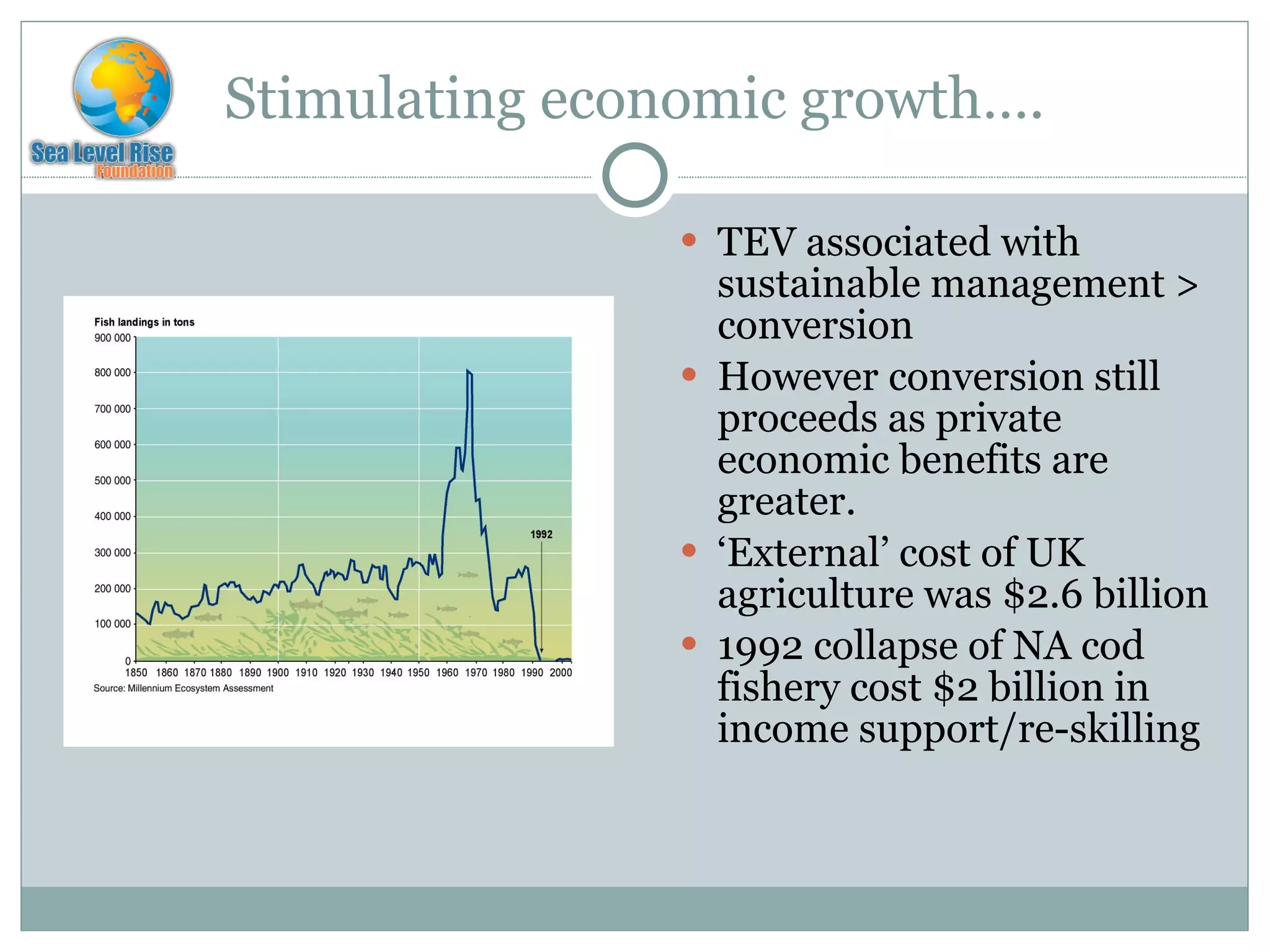
Stimulating economic growth…. TEV associated with sustainable management > conversion However conversion still proceeds as private economic benefits are greater. ‘ External’ cost of UK agriculture was $2.6 billion  1992 collapse of NA cod fishery cost $2 billion in income support/re-skilling
HOW DO WE MOVE AWAY FROM SILOS? Life in 3D
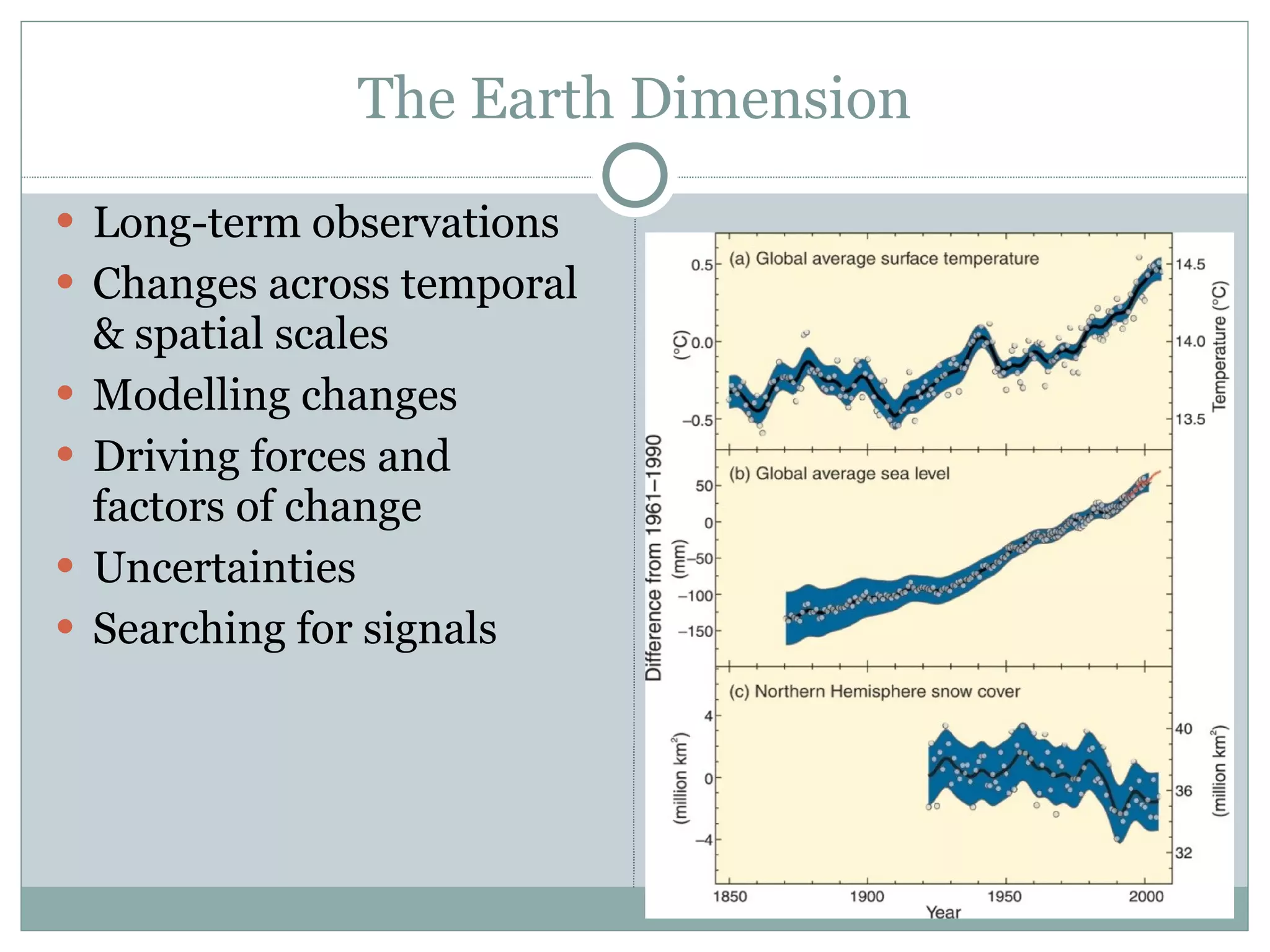
The Earth Dimension Long-term observations Changes across temporal & spatial scales Modelling changes Driving forces and factors of change Uncertainties Searching for signals
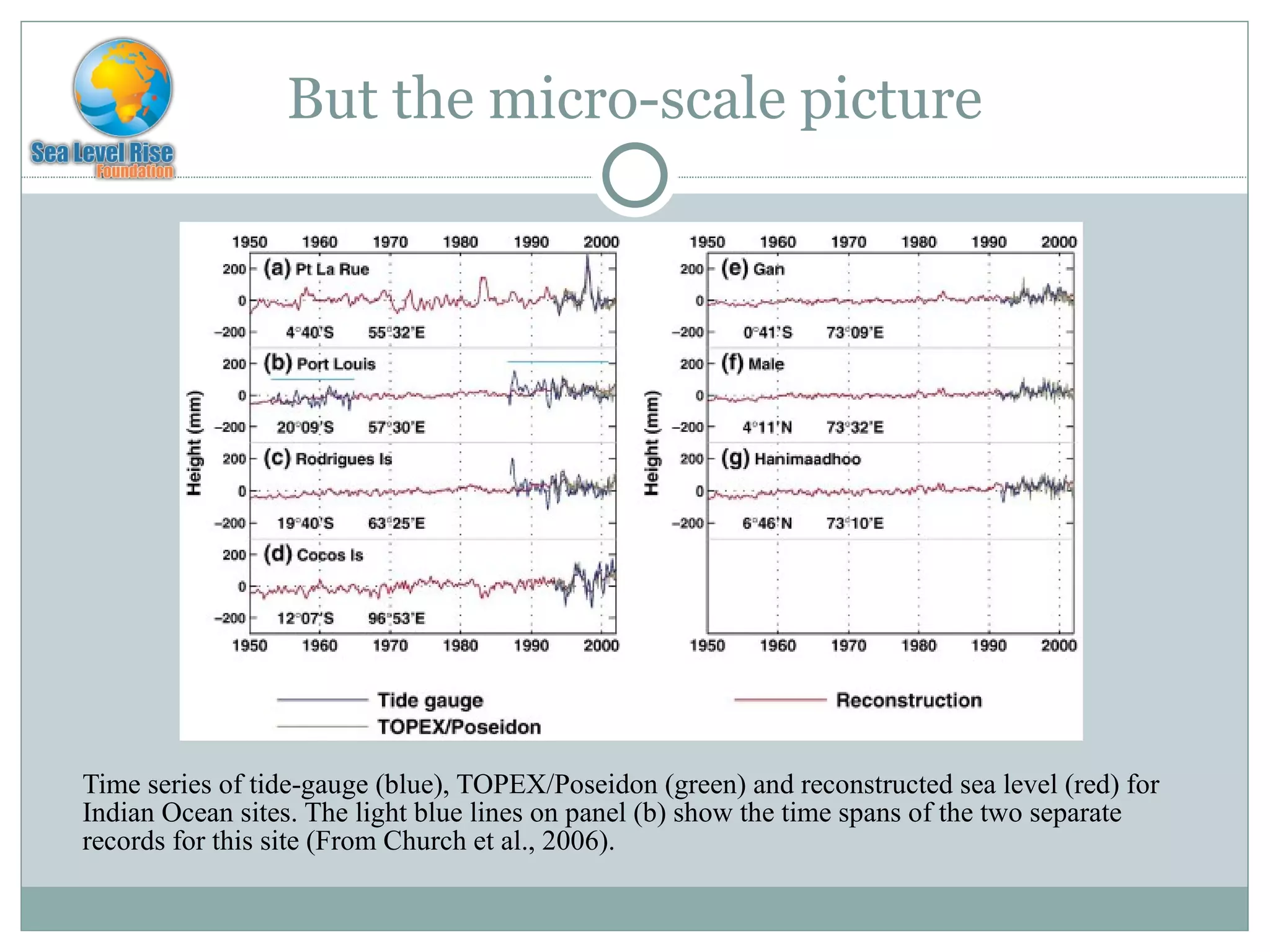
But the micro-scale picture Time series of tide-gauge (blue), TOPEX/Poseidon (green) and reconstructed sea level (red) for Indian Ocean sites. The light blue lines on panel (b) show the time spans of the two separate records for this site (From Church et al., 2006).
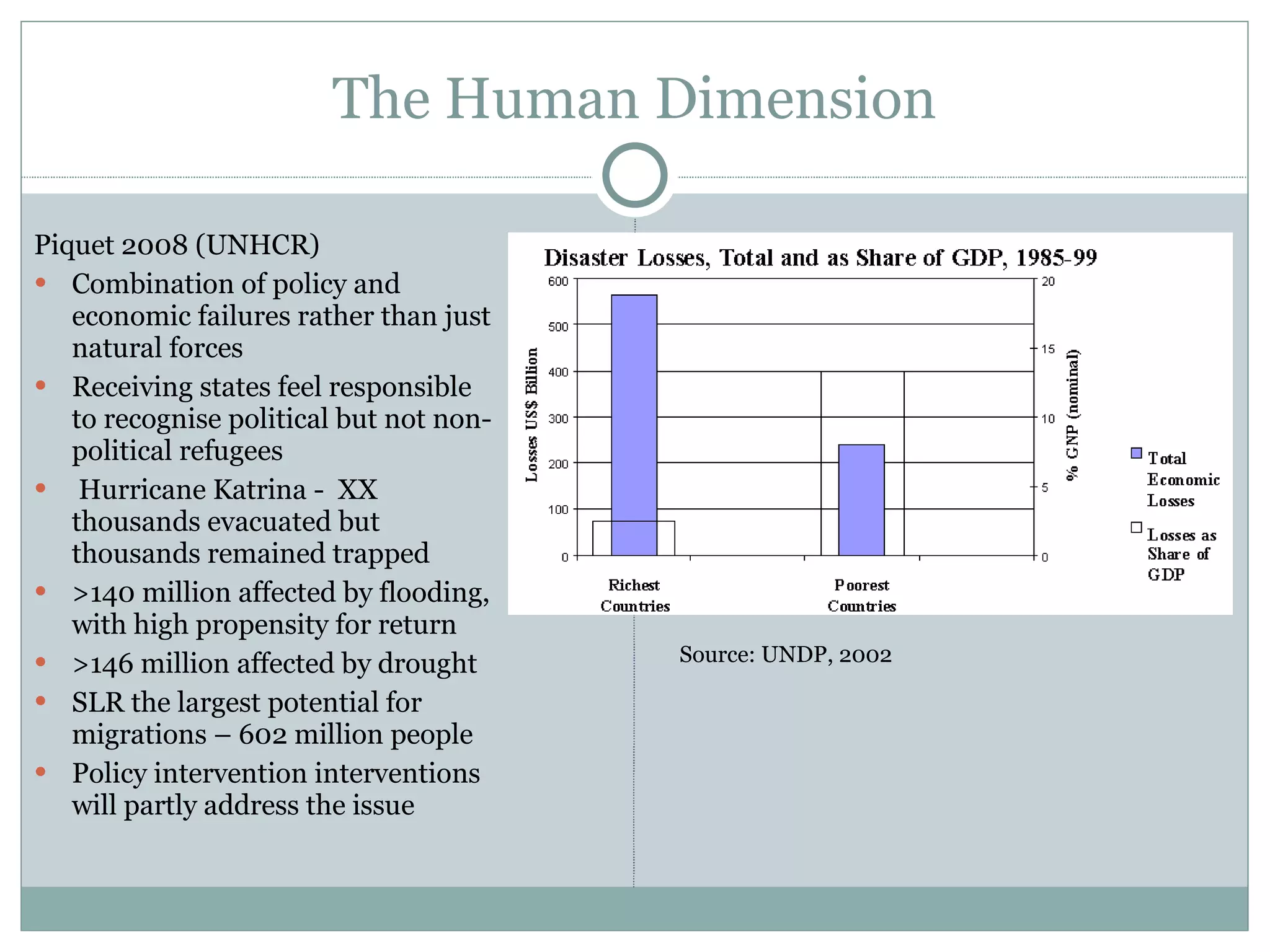
The Human Dimension Piquet 2008 (UNHCR) Combination of policy and economic failures rather than just natural forces Receiving states feel responsible to recognise political but not non-political refugees Hurricane Katrina -  XX thousands evacuated but thousands remained trapped >140 million affected by flooding, with high propensity for return >146 million affected by drought SLR the largest potential for migrations – 602 million people Policy intervention interventions will partly address the issue  Source: UNDP, 2002
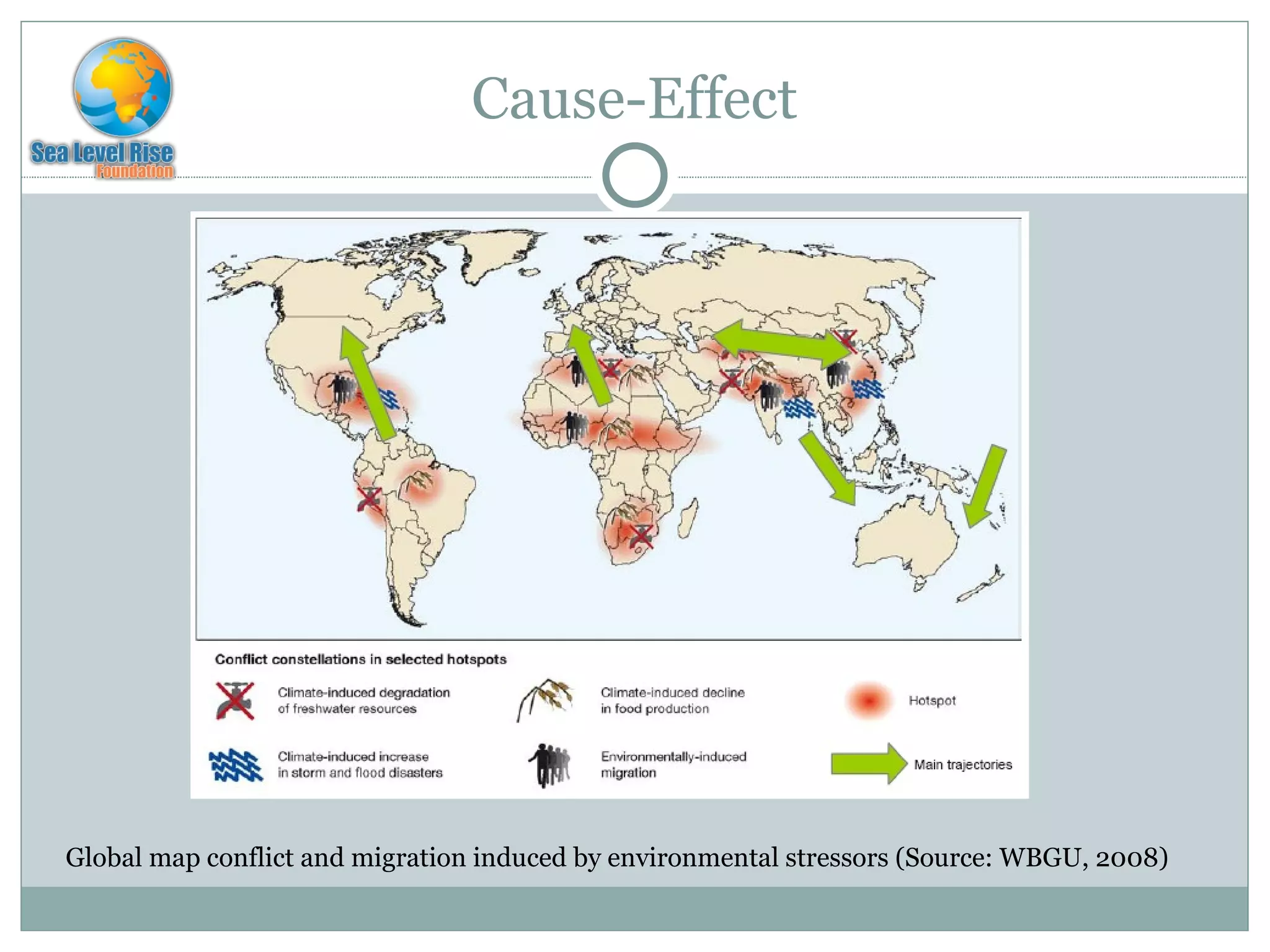
Cause-Effect Global map conflict and migration induced by environmental stressors (Source: WBGU, 2008)
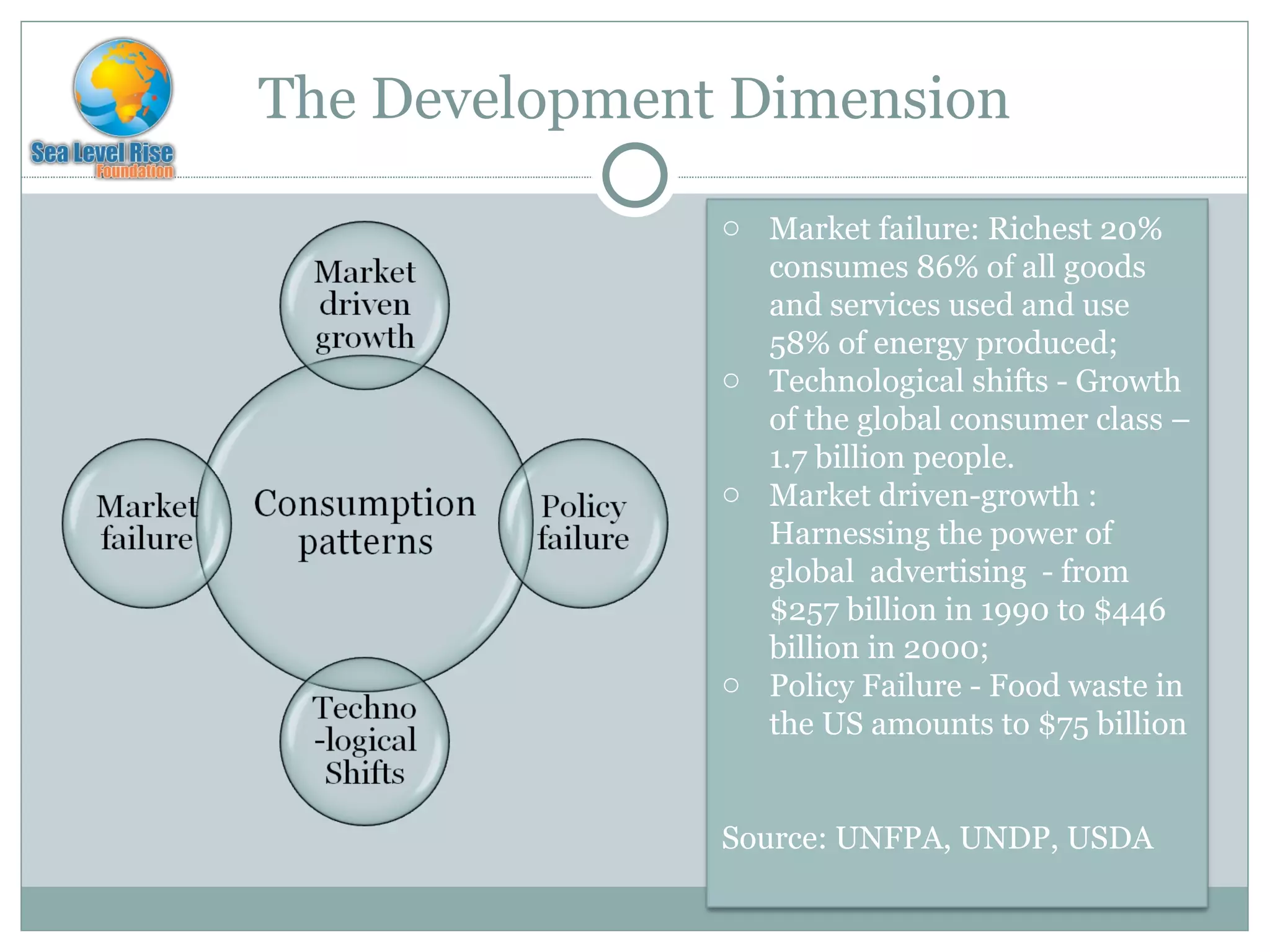
The Development Dimension Market failure: Richest 20% consumes 86% of all goods and services used and use 58% of energy produced; Technological shifts - Growth of the global consumer class – 1.7 billion people. Market driven-growth : Harnessing the power of global  advertising  - from $257 billion in 1990 to $446 billion in 2000; Policy Failure - Food waste in the US amounts to $75 billion  Source: UNFPA, UNDP, USDA
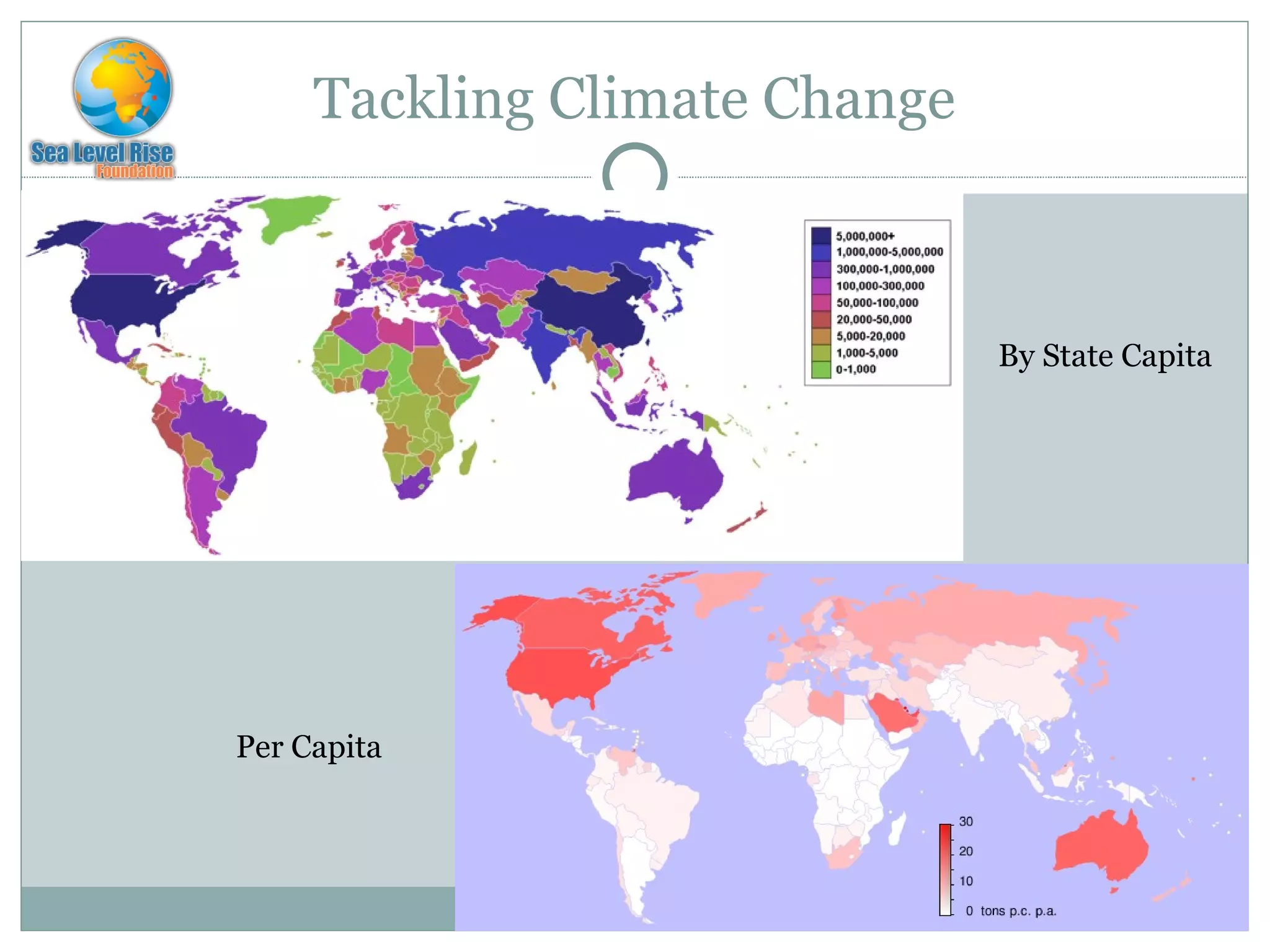
Tackling Climate Change Per Capita By State Capita
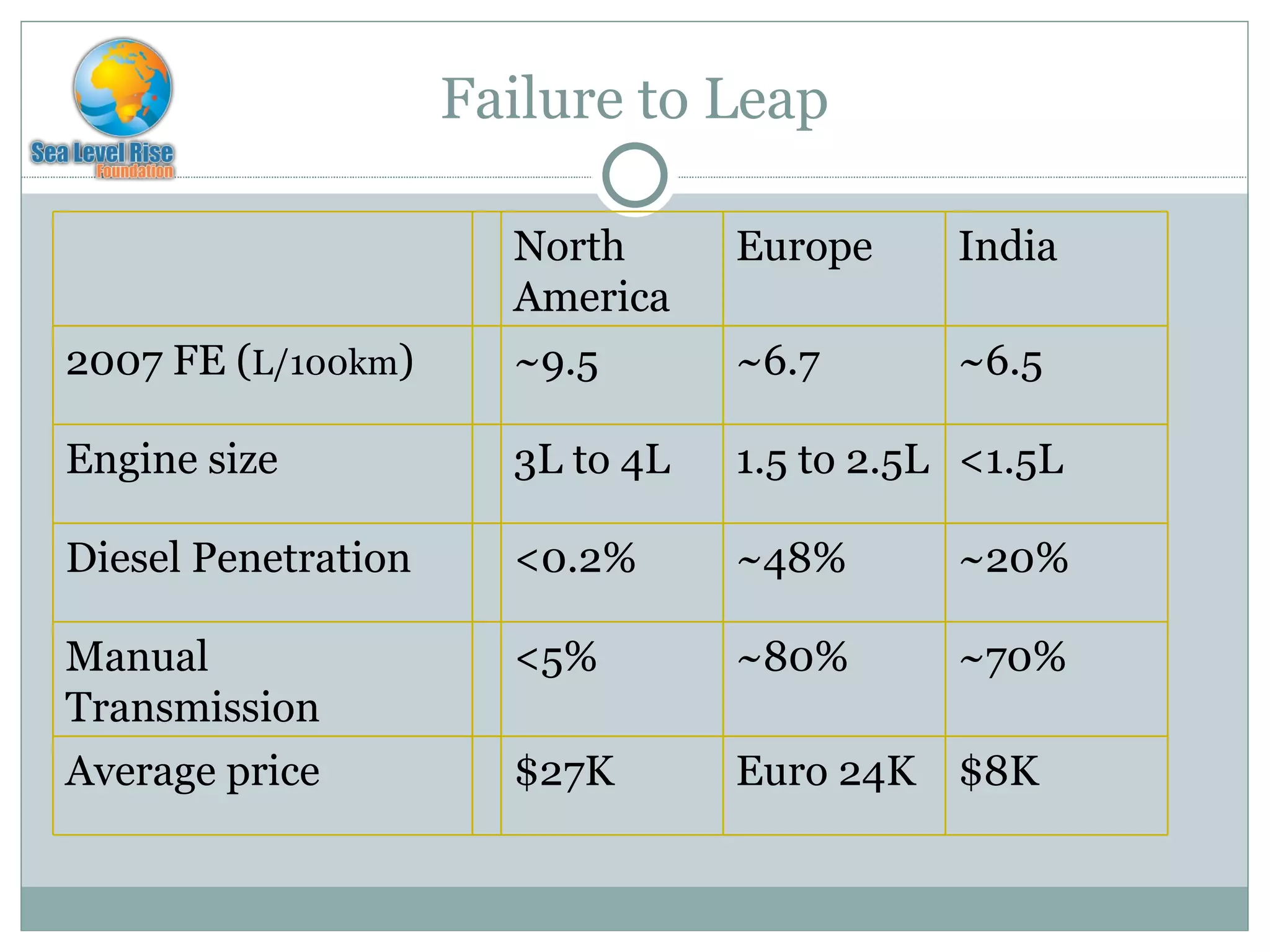
Failure to Leap North America Europe India 2007 FE ( L/100km ) ~9.5 ~6.7 ~6.5 Engine size 3L to 4L 1.5 to 2.5L <1.5L Diesel Penetration <0.2% ~48% ~20% Manual Transmission <5% ~80% ~70% Average price $27K Euro 24K $8K
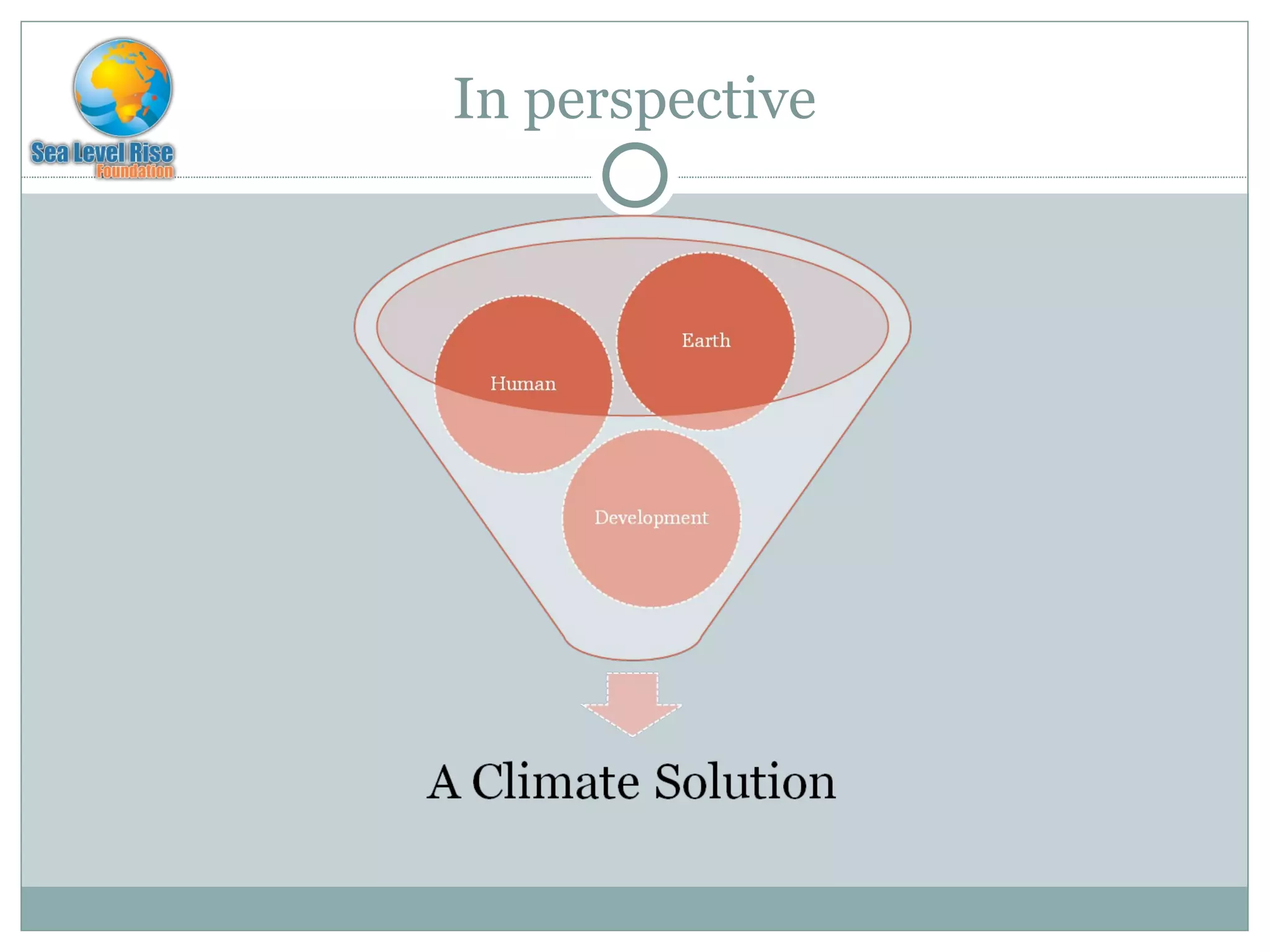
In perspective
CAN COPENHAGEN ADDRESS CLIMATE CHANGE? Politics, Power & People
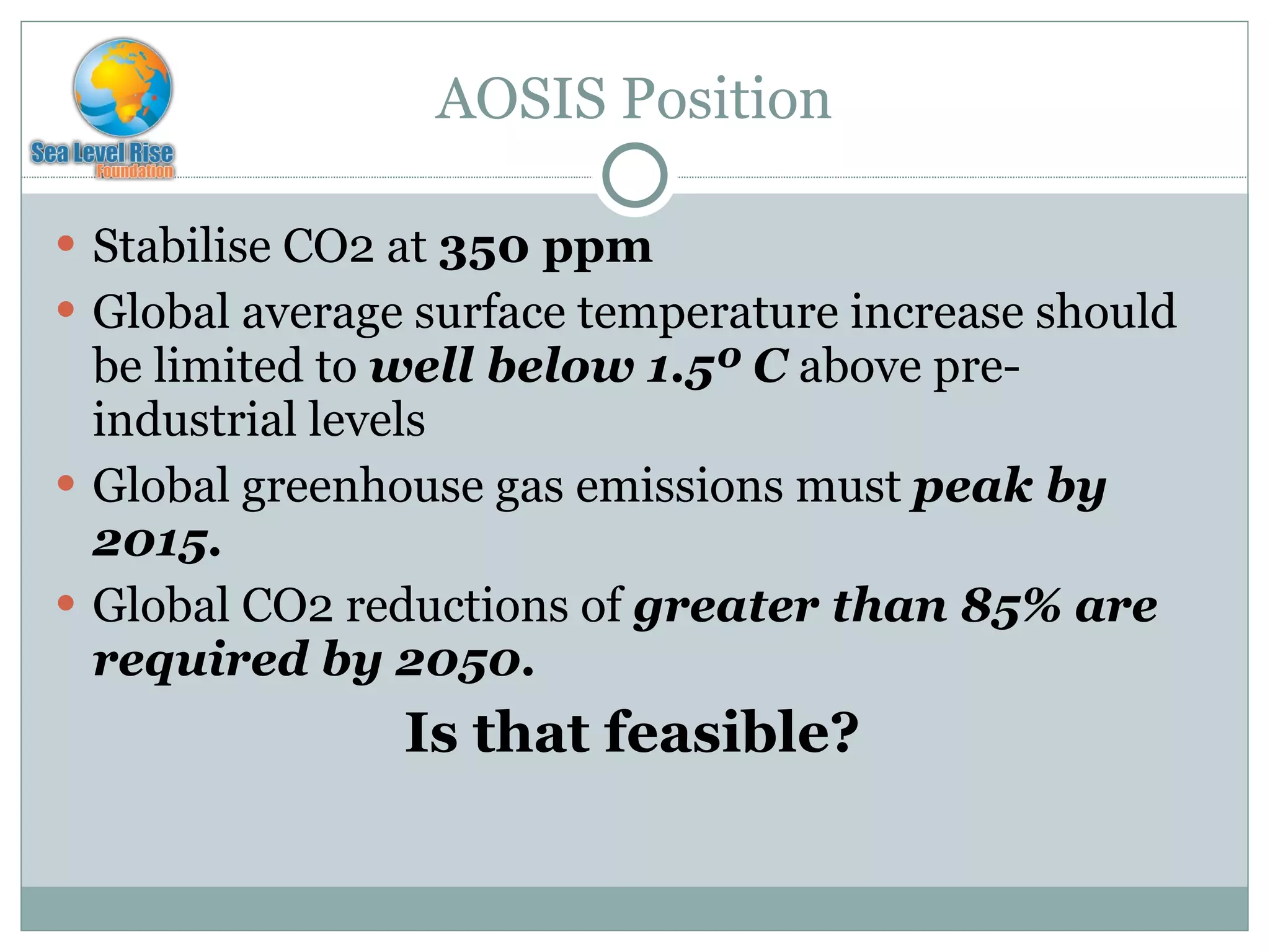
AOSIS Position Stabilise CO2 at  350 ppm Global average surface temperature increase should be limited to  well below 1.5º C  above pre-industrial levels Global greenhouse gas emissions must  peak by 2015. Global CO2 reductions of  greater than 85% are required by 2050. Is that feasible?
Address to Development Priorities To Sustain global economic growth Shift to low-carbon  energy economy Implement adaptation measures Address poverty Address trade distortions To Restore and Enhance Natural Capital Halt Forest Degradation Restore resilient ecosystems Protect existing natural capital Address social equity and basic rights
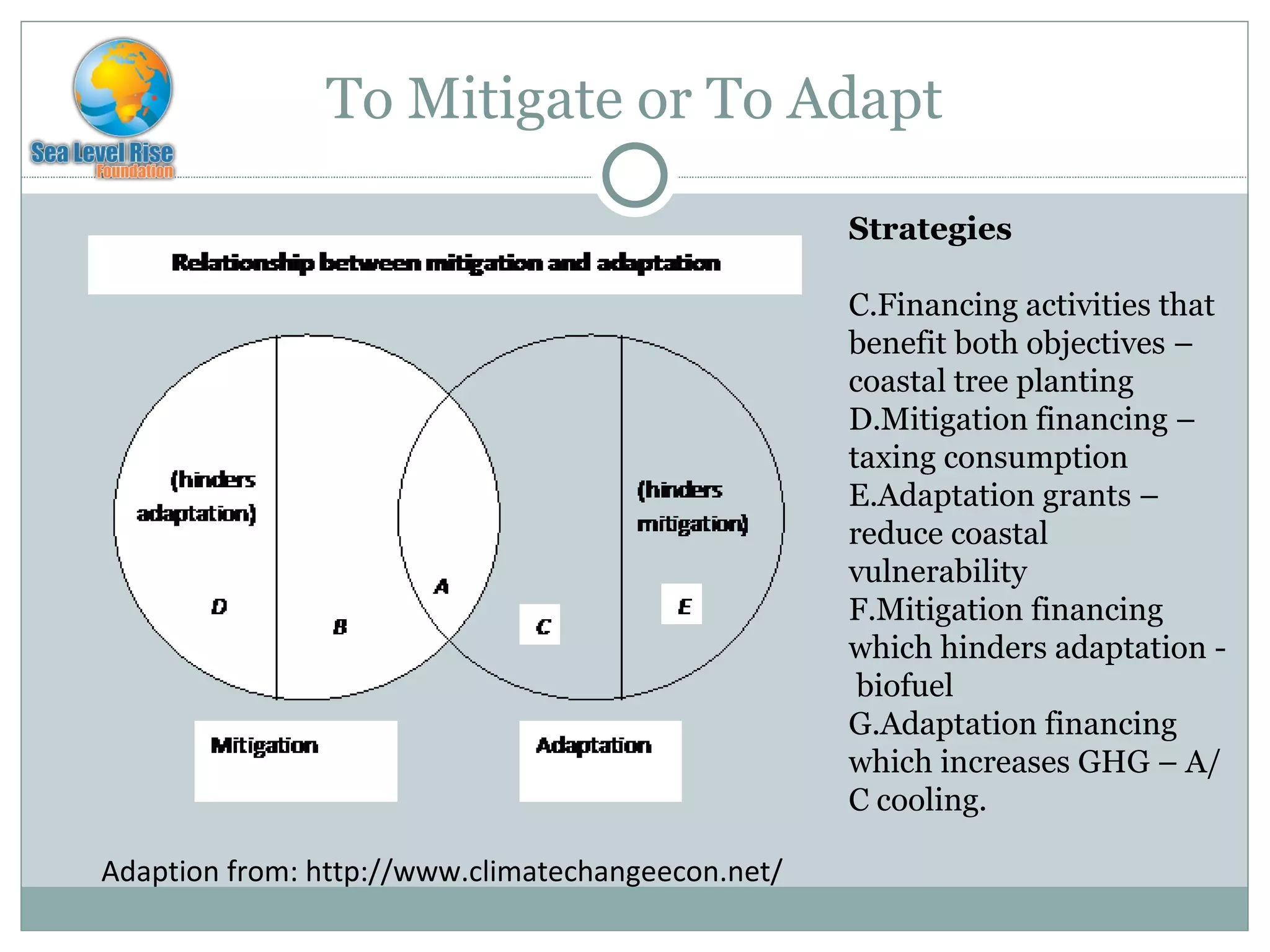
To Mitigate or To Adapt Strategies Financing activities that benefit both objectives – coastal tree planting Mitigation financing – taxing consumption Adaptation grants – reduce coastal vulnerability Mitigation financing which hinders adaptation -  biofuel Adaptation financing which increases GHG – A/C cooling. Adaption from: http://www.climatechangeecon.net/
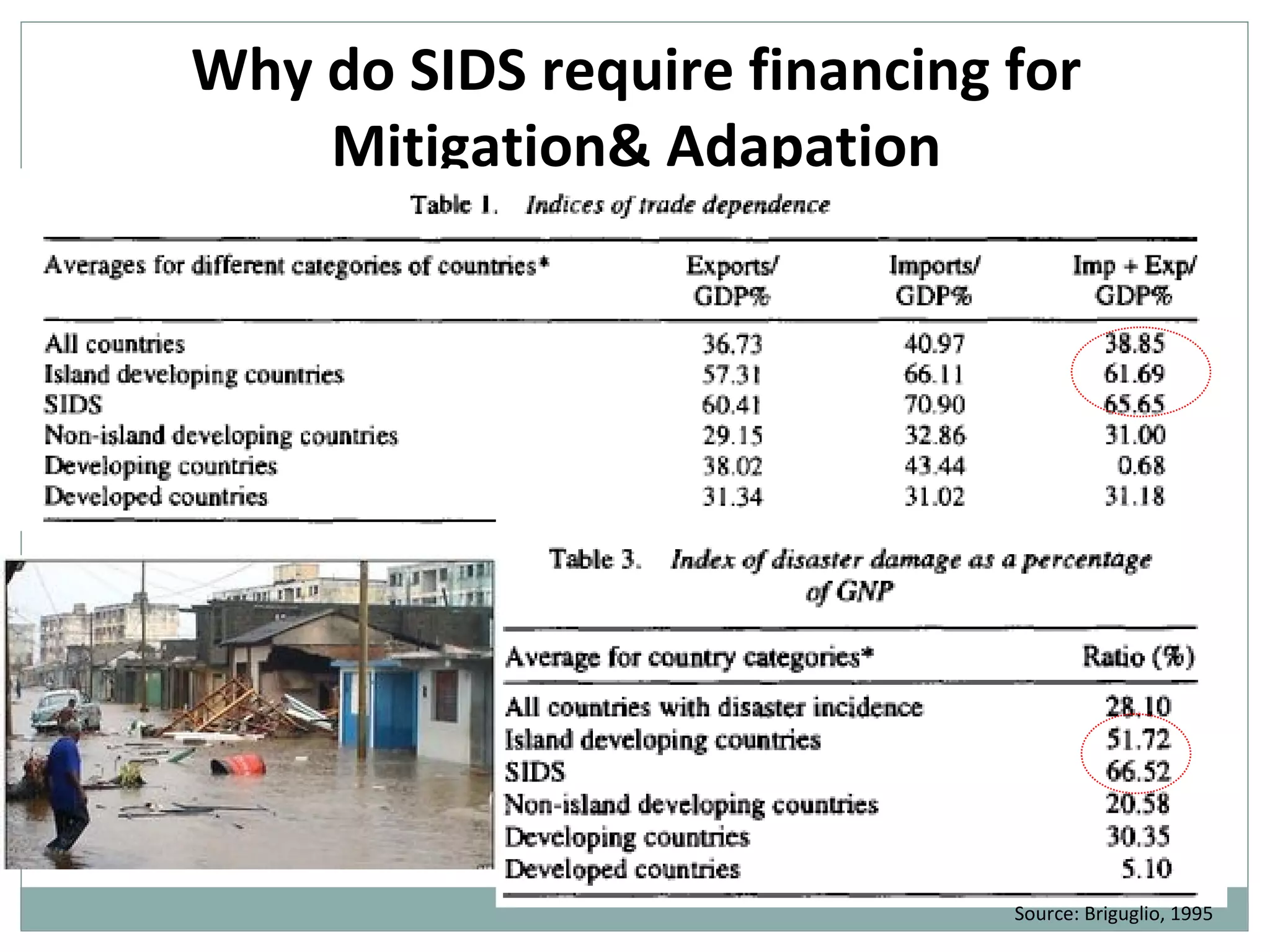
Why do SIDS require financing for Mitigation& Adapation Source: Briguglio, 1995
Green Power Shifting the world onto a low-carbon path could eventually benefit the economy by $2.5 trillion a year. (Stern, 2006) Unabated climate change could cost the world at least 5% of GDP each year; if more dramatic predictions come to pass, the cost could be more than 20% of GDP. By 2050, markets for low-carbon technologies could be worth at least $500bn.
Déjà Vu Disproportionate Wealth creation : Schemes which further enrich the rich and impoverish the poor – e.g. unfair IPR deals. Improper  reflection of externalities in policy: Schemes which cause further environmental damage – some biofuel subsidy schemes. Green jobs which generates more unsustainable consumption.  Taxes regimes causing welfare losses in the south – unfair long-haul tax on airlines Carbon trading – schemes which shift the opportunity cost burden to developing countries – some voluntary carbon schemes
HOW CAN INTERNATIONAL DEVELOPMENT DRIVE CLIMATE SOLUTIONS? The Future of International Development
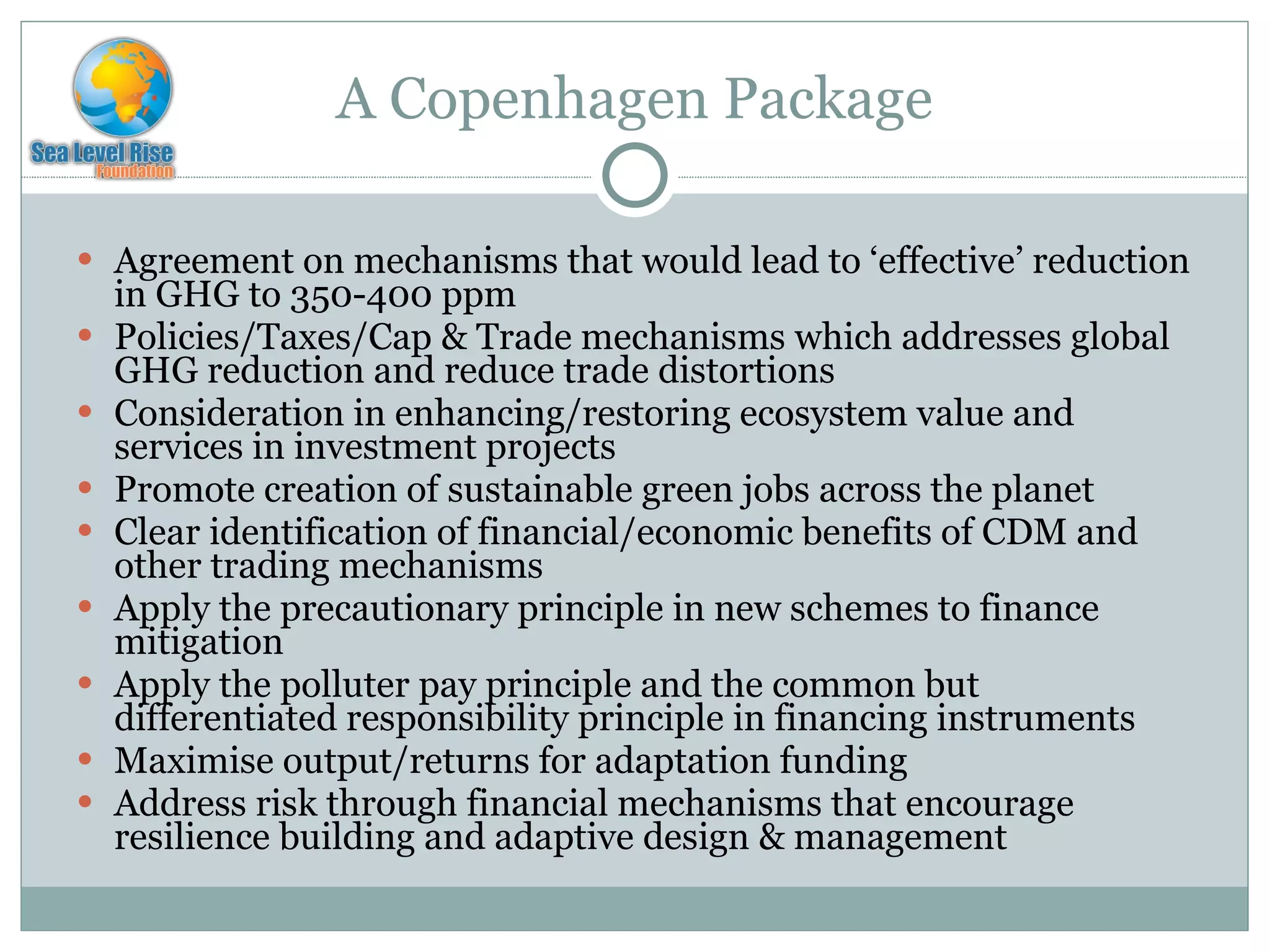
A Copenhagen Package Agreement on mechanisms that would lead to ‘effective’ reduction in GHG to 350-400 ppm Policies/Taxes/Cap & Trade mechanisms which addresses global GHG reduction and reduce trade distortions Consideration in enhancing/restoring ecosystem value and services in investment projects Promote creation of sustainable green jobs across the planet Clear identification of financial/economic benefits of CDM and other trading mechanisms Apply the precautionary principle in new schemes to finance mitigation Apply the polluter pay principle and the common but differentiated responsibility principle in financing instruments Maximise output/returns for adaptation funding Address risk through financial mechanisms that encourage resilience building and adaptive design & management
Just a thought “ We are running out of time, and we must combine our resources and know-how to avoid the physical damage and social and economic toll threatening all island societies. We must maintain and restore the natural protection provided by our healthy island ecosystems,” President James Michel of  Seychelles said at the launching of the Sea Level Rise Foundation in  the city of Rome. ”  James Michel, President of the Republic of Seychelles, Rome 2007
Thank You

What Next For Climate Change & International Development

  • 1.
    Dr Rolph PayetWhat next for Climate Change & International Development?
  • 2.
    Outline Juxtaposing SustainableDevelopment & Climate Change In the interest of Humankind! Life in 3D Politics, Power and People Conclusion: The Future of International Development
  • 3.
    WHY IS CLIMATECHANGE APPARENTLY SO DIFFICULT TO SOLVE? Juxtaposing Sustainable Development and Climate Change
  • 4.
    Scholarly arguments &quot;Mostof the observed increase in globally-averaged temperatures since the mid-20th century is very likely due to the observed increase in anthropogenic GHG concentrations. It is likely there has been significant anthropogenic warming over the past 50 years averaged over each continent (except Antarctica). IPCC 4th Assessment Report, Climate Change 2007 … ., the latest estimates by the IPCC suggest that, for the world as a whole, the harmful effects over the next 50 years or more will barely—if at all—offset the benefits.– Bekerman W., 2002 Sustained economic growth is key to improved environment management – Goldin, I. (EBRD) Climate change is the greatest and widest-ranging market failure ever seen. The benefits of strong, early action considerably outweigh the costs.– Stern N. (2006)
  • 5.
    The political argument‘ Respect for the environment doesn’t go against economic growth aspirations’ Sarkozy 2008 There may still be disputes about exactly how much we're contributing to the warming of the earth's atmosphere and how much is naturally occurring, but what we can be scientifically certain of is that our continued use of fossil fuels is pushing us to a point of no return. Obama. &quot;It's a matter of survival for us. If our islands go under, we all go under,&quot; said President Anote Tong of Kiribati &quot;We view associated problems of high frequency of abnormal climate, sea level rise, global warming and coastal degradation as matters affecting the economic and environmental security of all small island states,“ Timothy Harris, foreign minister of the Caribbean
  • 6.
    The joe blogargument ‘ It’s snowing like crazy in my garden, who is saying there is global warming?’ Blogger ‘ It’s a scheme to get more tax payer money’ an average US worker. ‘ God is in charge and he will never let this happen’ Elderly pacific islander. ‘ It’s too far away you are talking 2100 – I would not even be there.’ my next door neighbour
  • 7.
    The ICARUS EffectOne root cause lies in the fact that present day modern economics/policies does not adequately convey these externalities; Multidisciplinary and integrated approaches are still uncommon and often too complex; Many politicians seem to understand the links but remain unsure as to the solutions Public myopia seems to be linked to social awakening Failure to drive technological innovation and markets through development
  • 8.
    DOES PRESENT DAYECONOMIC/POLICY SYSTEMS ADEQUATELY COVER ‘EXTERNALITIES’ ? In the Interest of Humankind! Quote by Ted Turner, billionaire, founder of CNN and major UN donor: “A total population of 250-300 million people, a 95% decline from present levels, would be ideal.”
  • 9.
    Stimulating economic growth….TEV associated with sustainable management > conversion However conversion still proceeds as private economic benefits are greater. ‘ External’ cost of UK agriculture was $2.6 billion 1992 collapse of NA cod fishery cost $2 billion in income support/re-skilling
  • 10.
    HOW DO WEMOVE AWAY FROM SILOS? Life in 3D
  • 11.
    The Earth DimensionLong-term observations Changes across temporal & spatial scales Modelling changes Driving forces and factors of change Uncertainties Searching for signals
  • 12.
    But the micro-scalepicture Time series of tide-gauge (blue), TOPEX/Poseidon (green) and reconstructed sea level (red) for Indian Ocean sites. The light blue lines on panel (b) show the time spans of the two separate records for this site (From Church et al., 2006).
  • 13.
    The Human DimensionPiquet 2008 (UNHCR) Combination of policy and economic failures rather than just natural forces Receiving states feel responsible to recognise political but not non-political refugees Hurricane Katrina - XX thousands evacuated but thousands remained trapped >140 million affected by flooding, with high propensity for return >146 million affected by drought SLR the largest potential for migrations – 602 million people Policy intervention interventions will partly address the issue Source: UNDP, 2002
  • 14.
    Cause-Effect Global mapconflict and migration induced by environmental stressors (Source: WBGU, 2008)
  • 15.
    The Development DimensionMarket failure: Richest 20% consumes 86% of all goods and services used and use 58% of energy produced; Technological shifts - Growth of the global consumer class – 1.7 billion people. Market driven-growth : Harnessing the power of global advertising - from $257 billion in 1990 to $446 billion in 2000; Policy Failure - Food waste in the US amounts to $75 billion Source: UNFPA, UNDP, USDA
  • 16.
    Tackling Climate ChangePer Capita By State Capita
  • 17.
    Failure to LeapNorth America Europe India 2007 FE ( L/100km ) ~9.5 ~6.7 ~6.5 Engine size 3L to 4L 1.5 to 2.5L <1.5L Diesel Penetration <0.2% ~48% ~20% Manual Transmission <5% ~80% ~70% Average price $27K Euro 24K $8K
  • 18.
  • 19.
    CAN COPENHAGEN ADDRESSCLIMATE CHANGE? Politics, Power & People
  • 20.
    AOSIS Position StabiliseCO2 at 350 ppm Global average surface temperature increase should be limited to well below 1.5º C above pre-industrial levels Global greenhouse gas emissions must peak by 2015. Global CO2 reductions of greater than 85% are required by 2050. Is that feasible?
  • 21.
    Address to DevelopmentPriorities To Sustain global economic growth Shift to low-carbon energy economy Implement adaptation measures Address poverty Address trade distortions To Restore and Enhance Natural Capital Halt Forest Degradation Restore resilient ecosystems Protect existing natural capital Address social equity and basic rights
  • 22.
    To Mitigate orTo Adapt Strategies Financing activities that benefit both objectives – coastal tree planting Mitigation financing – taxing consumption Adaptation grants – reduce coastal vulnerability Mitigation financing which hinders adaptation - biofuel Adaptation financing which increases GHG – A/C cooling. Adaption from: http://www.climatechangeecon.net/
  • 23.
    Why do SIDSrequire financing for Mitigation& Adapation Source: Briguglio, 1995
  • 24.
    Green Power Shiftingthe world onto a low-carbon path could eventually benefit the economy by $2.5 trillion a year. (Stern, 2006) Unabated climate change could cost the world at least 5% of GDP each year; if more dramatic predictions come to pass, the cost could be more than 20% of GDP. By 2050, markets for low-carbon technologies could be worth at least $500bn.
  • 25.
    Déjà Vu DisproportionateWealth creation : Schemes which further enrich the rich and impoverish the poor – e.g. unfair IPR deals. Improper reflection of externalities in policy: Schemes which cause further environmental damage – some biofuel subsidy schemes. Green jobs which generates more unsustainable consumption. Taxes regimes causing welfare losses in the south – unfair long-haul tax on airlines Carbon trading – schemes which shift the opportunity cost burden to developing countries – some voluntary carbon schemes
  • 26.
    HOW CAN INTERNATIONALDEVELOPMENT DRIVE CLIMATE SOLUTIONS? The Future of International Development
  • 27.
    A Copenhagen PackageAgreement on mechanisms that would lead to ‘effective’ reduction in GHG to 350-400 ppm Policies/Taxes/Cap & Trade mechanisms which addresses global GHG reduction and reduce trade distortions Consideration in enhancing/restoring ecosystem value and services in investment projects Promote creation of sustainable green jobs across the planet Clear identification of financial/economic benefits of CDM and other trading mechanisms Apply the precautionary principle in new schemes to finance mitigation Apply the polluter pay principle and the common but differentiated responsibility principle in financing instruments Maximise output/returns for adaptation funding Address risk through financial mechanisms that encourage resilience building and adaptive design & management
  • 28.
    Just a thought“ We are running out of time, and we must combine our resources and know-how to avoid the physical damage and social and economic toll threatening all island societies. We must maintain and restore the natural protection provided by our healthy island ecosystems,” President James Michel of Seychelles said at the launching of the Sea Level Rise Foundation in the city of Rome. ” James Michel, President of the Republic of Seychelles, Rome 2007
  • 29.