The System Analyst
Systems Analysis and Design
• Systems Analysis
– The process of understanding and specifying in
detail what the information system should
accomplish
• Systems Design
– The process of specifying in detail how the many
components of the information system should be
physically implemented
The Systems Analyst
• The systems analyst is a business professional
who uses analysis and design techniques to
solve business problems using information
technology.
The Systems Analyst Approach to Problem Solving
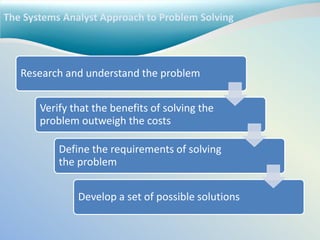
Research and understand the problem
Verify that the benefits of solving the
problem outweigh the costs
Define the requirements of solving
the problem
Develop a set of possible solutions
The Systems Analyst Approach to Problem Solving
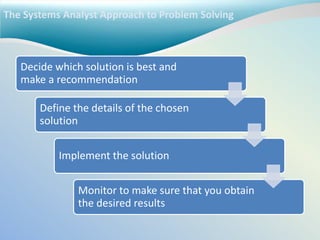
Decide which solution is best and
make a recommendation
Define the details of the chosen
solution
Implement the solution
Monitor to make sure that you obtain
the desired results
Fundamental Knowledge
• A systems analyst should understand the
fundamentals of the ff:
– COMPUTERS
– Devices that interact with computers
– Communication Networks
– Databases and DBMS
– Programming Languages
– Operating Systems and utilities
Tools to help develop analysis and design
specifications of a completed system
• Some tools used in system development
– Software packages such as MS Access, Oracle
Developer and IBM Data Studio
– Integrated Development Environments (IDEs) such
as Sun ONE Studio for Java or Microsoft Visual
Studio
– CASE Tools
– Program code generators
Techniques – strategies for completing
specific system development activities
• Examples of techniques include:
– Project Planning
– Cost-benefit analysis techniques
– Interviewing techniques
– Requirements modeling techniques
– Architectural Design techniques
– Network Configuration Techniques
– Database Design Techniques
Business Knowledge and Skills
• The analyst needs to know the ff:
– What business functions does an organization
perform?
– How are organizations structured?
– How are organizations managed?
– What type of work goes on in organizations?
People Knowledge and Skills
• It is critical that the analyst understand how
people
– Think
– Learn
– React to change
– Communicate
– Work
INTEGRITY AND ETHICS
• System Analysts are expected to uphold the
highest ethical standards when it comes to
private proprietary information they might
encounter on the job.
Types of Technology
• Desktop Systems
• Network desktop systems
• Client-server systems
• Large-scale centralized mainframe systems
• Systems using internet, intranet and extranet
technology
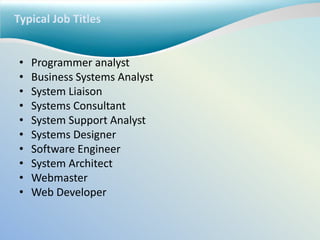
Typical Job Titles
• Programmer analyst
• Business Systems Analyst
• System Liaison
• Systems Consultant
• System Support Analyst
• Systems Designer
• Software Engineer
• System Architect
• Webmaster
• Web Developer

3 the system analyst

  • 1.
    The System Analyst SystemsAnalysis and Design
  • 2.
    Systems Analysis andDesign • Systems Analysis – The process of understanding and specifying in detail what the information system should accomplish • Systems Design – The process of specifying in detail how the many components of the information system should be physically implemented
  • 3.
    The Systems Analyst •The systems analyst is a business professional who uses analysis and design techniques to solve business problems using information technology.
  • 4.
    The Systems AnalystApproach to Problem Solving Research and understand the problem Verify that the benefits of solving the problem outweigh the costs Define the requirements of solving the problem Develop a set of possible solutions
  • 5.
    The Systems AnalystApproach to Problem Solving Decide which solution is best and make a recommendation Define the details of the chosen solution Implement the solution Monitor to make sure that you obtain the desired results
  • 6.
    Fundamental Knowledge • Asystems analyst should understand the fundamentals of the ff: – COMPUTERS – Devices that interact with computers – Communication Networks – Databases and DBMS – Programming Languages – Operating Systems and utilities
  • 7.
    Tools to helpdevelop analysis and design specifications of a completed system • Some tools used in system development – Software packages such as MS Access, Oracle Developer and IBM Data Studio – Integrated Development Environments (IDEs) such as Sun ONE Studio for Java or Microsoft Visual Studio – CASE Tools – Program code generators
  • 8.
    Techniques – strategiesfor completing specific system development activities • Examples of techniques include: – Project Planning – Cost-benefit analysis techniques – Interviewing techniques – Requirements modeling techniques – Architectural Design techniques – Network Configuration Techniques – Database Design Techniques
  • 9.
    Business Knowledge andSkills • The analyst needs to know the ff: – What business functions does an organization perform? – How are organizations structured? – How are organizations managed? – What type of work goes on in organizations?
  • 10.
    People Knowledge andSkills • It is critical that the analyst understand how people – Think – Learn – React to change – Communicate – Work
  • 11.
    INTEGRITY AND ETHICS •System Analysts are expected to uphold the highest ethical standards when it comes to private proprietary information they might encounter on the job.
  • 12.
    Types of Technology •Desktop Systems • Network desktop systems • Client-server systems • Large-scale centralized mainframe systems • Systems using internet, intranet and extranet technology
  • 13.
    Typical Job Titles •Programmer analyst • Business Systems Analyst • System Liaison • Systems Consultant • System Support Analyst • Systems Designer • Software Engineer • System Architect • Webmaster • Web Developer