Systems Development Life Cycle
Systems Analysis and Design
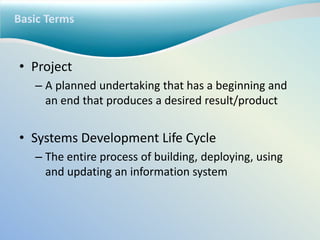
Basic Terms
• Project
– A planned undertaking that has a beginning and
an end that produces a desired result/product
• Systems Development Life Cycle
– The entire process of building, deploying, using
and updating an information system
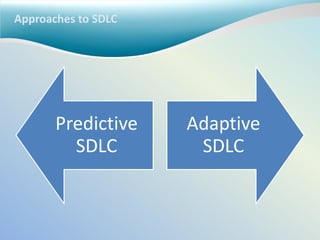
Approaches to SDLC
Predictive
SDLC
Adaptive
SDLC
Approaches to SDLC
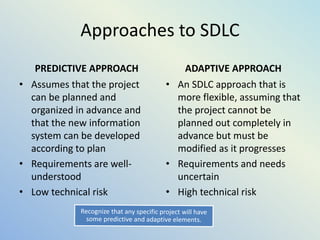
PREDICTIVE APPROACH
• Assumes that the project
can be planned and
organized in advance and
that the new information
system can be developed
according to plan
• Requirements are well-
understood
• Low technical risk
ADAPTIVE APPROACH
• An SDLC approach that is
more flexible, assuming that
the project cannot be
planned out completely in
advance but must be
modified as it progresses
• Requirements and needs
uncertain
• High technical risk
Traditional Approaches to SDLC:
The Waterfall Approach
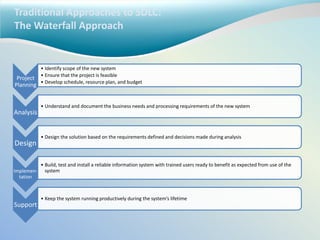
Project
Planning
• Identify scope of the new system
• Ensure that the project is feasible
• Develop schedule, resource plan, and budget
Analysis
• Understand and document the business needs and processing requirements of the new system
Design
• Design the solution based on the requirements defined and decisions made during analysis
Implemen-
tation
• Build, test and install a reliable information system with trained users ready to benefit as expected from use of the
system
Support
• Keep the system running productively during the system’s lifetime
Adaptive Approaches to SDLC:
Spiral Model
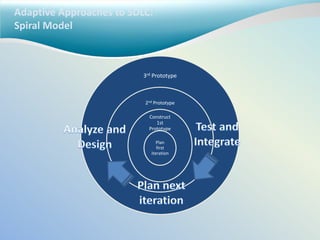
• Spiral Model
– An adaptive SDLC approach that cycles over and
over again through development activities until a
project is complete
Adaptive Approaches to SDLC:
Spiral Model
3rd Prototype
2nd Prototype
Construct
1st
Prototype
Plan
first
iteration
Adaptive Approaches to SDLC:
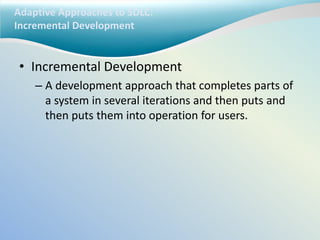
Incremental Development
• Incremental Development
– A development approach that completes parts of
a system in several iterations and then puts and
then puts them into operation for users.
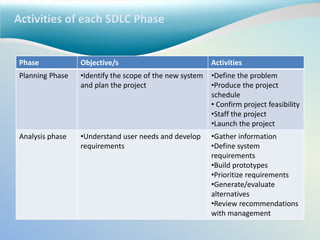
Activities of each SDLC Phase
Phase Objective/s Activities
Planning Phase •Identify the scope of the new system
and plan the project
•Define the problem
•Produce the project
schedule
• Confirm project feasibility
•Staff the project
•Launch the project
Analysis phase •Understand user needs and develop
requirements
•Gather information
•Define system
requirements
•Build prototypes
•Prioritize requirements
•Generate/evaluate
alternatives
•Review recommendations
with management
Activities of each SDLC Phase
Phase Objective/s Activities
Design Phase •Design programs and system •Design and integrate
•Network
•Application
architecture
•User Interfaces
•System Interfaces
•Database
•Prototype
•System Controls
Implementation
Phase
•The new system is programmed and
installed
•Construct software
components
•Verify and test
•Train users and document
the system
•Install the system
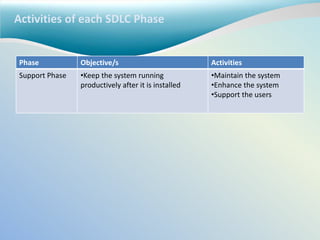
Activities of each SDLC Phase
Phase Objective/s Activities
Support Phase •Keep the system running
productively after it is installed
•Maintain the system
•Enhance the system
•Support the users
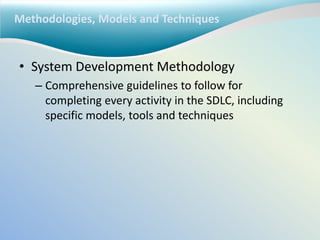
Methodologies, Models and Techniques
• System Development Methodology
– Comprehensive guidelines to follow for
completing every activity in the SDLC, including
specific models, tools and techniques
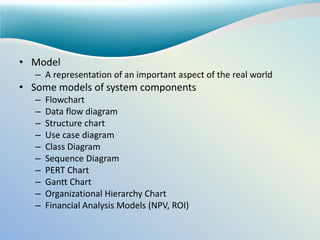
• Model
– A representation of an important aspect of the real world
• Some models of system components
– Flowchart
– Data flow diagram
– Structure chart
– Use case diagram
– Class Diagram
– Sequence Diagram
– PERT Chart
– Gantt Chart
– Organizational Hierarchy Chart
– Financial Analysis Models (NPV, ROI)
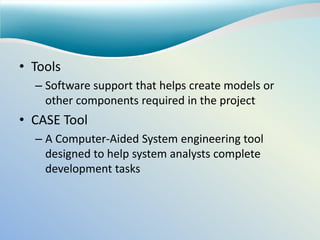
• Tools
– Software support that helps create models or
other components required in the project
• CASE Tool
– A Computer-Aided System engineering tool
designed to help system analysts complete
development tasks
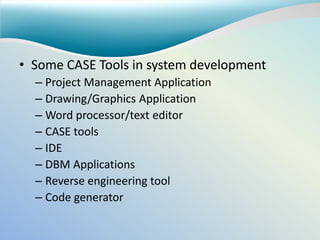
• Some CASE Tools in system development
– Project Management Application
– Drawing/Graphics Application
– Word processor/text editor
– CASE tools
– IDE
– DBM Applications
– Reverse engineering tool
– Code generator
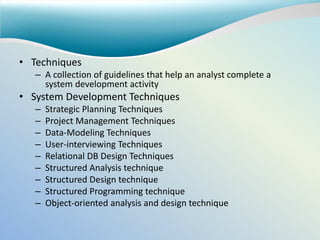
• Techniques
– A collection of guidelines that help an analyst complete a
system development activity
• System Development Techniques
– Strategic Planning Techniques
– Project Management Techniques
– Data-Modeling Techniques
– User-interviewing Techniques
– Relational DB Design Techniques
– Structured Analysis technique
– Structured Design technique
– Structured Programming technique
– Object-oriented analysis and design technique

2 sdlc

  • 1.
    Systems Development LifeCycle Systems Analysis and Design
  • 2.
    Basic Terms • Project –A planned undertaking that has a beginning and an end that produces a desired result/product • Systems Development Life Cycle – The entire process of building, deploying, using and updating an information system
  • 3.
  • 4.
    Approaches to SDLC PREDICTIVEAPPROACH • Assumes that the project can be planned and organized in advance and that the new information system can be developed according to plan • Requirements are well- understood • Low technical risk ADAPTIVE APPROACH • An SDLC approach that is more flexible, assuming that the project cannot be planned out completely in advance but must be modified as it progresses • Requirements and needs uncertain • High technical risk
  • 5.
    Traditional Approaches toSDLC: The Waterfall Approach Project Planning • Identify scope of the new system • Ensure that the project is feasible • Develop schedule, resource plan, and budget Analysis • Understand and document the business needs and processing requirements of the new system Design • Design the solution based on the requirements defined and decisions made during analysis Implemen- tation • Build, test and install a reliable information system with trained users ready to benefit as expected from use of the system Support • Keep the system running productively during the system’s lifetime
  • 6.
    Adaptive Approaches toSDLC: Spiral Model • Spiral Model – An adaptive SDLC approach that cycles over and over again through development activities until a project is complete
  • 7.
    Adaptive Approaches toSDLC: Spiral Model 3rd Prototype 2nd Prototype Construct 1st Prototype Plan first iteration
  • 8.
    Adaptive Approaches toSDLC: Incremental Development • Incremental Development – A development approach that completes parts of a system in several iterations and then puts and then puts them into operation for users.
  • 9.
    Activities of eachSDLC Phase Phase Objective/s Activities Planning Phase •Identify the scope of the new system and plan the project •Define the problem •Produce the project schedule • Confirm project feasibility •Staff the project •Launch the project Analysis phase •Understand user needs and develop requirements •Gather information •Define system requirements •Build prototypes •Prioritize requirements •Generate/evaluate alternatives •Review recommendations with management
  • 10.
    Activities of eachSDLC Phase Phase Objective/s Activities Design Phase •Design programs and system •Design and integrate •Network •Application architecture •User Interfaces •System Interfaces •Database •Prototype •System Controls Implementation Phase •The new system is programmed and installed •Construct software components •Verify and test •Train users and document the system •Install the system
  • 11.
    Activities of eachSDLC Phase Phase Objective/s Activities Support Phase •Keep the system running productively after it is installed •Maintain the system •Enhance the system •Support the users
  • 12.
    Methodologies, Models andTechniques • System Development Methodology – Comprehensive guidelines to follow for completing every activity in the SDLC, including specific models, tools and techniques
  • 13.
    • Model – Arepresentation of an important aspect of the real world • Some models of system components – Flowchart – Data flow diagram – Structure chart – Use case diagram – Class Diagram – Sequence Diagram – PERT Chart – Gantt Chart – Organizational Hierarchy Chart – Financial Analysis Models (NPV, ROI)
  • 14.
    • Tools – Softwaresupport that helps create models or other components required in the project • CASE Tool – A Computer-Aided System engineering tool designed to help system analysts complete development tasks
  • 15.
    • Some CASETools in system development – Project Management Application – Drawing/Graphics Application – Word processor/text editor – CASE tools – IDE – DBM Applications – Reverse engineering tool – Code generator
  • 16.
    • Techniques – Acollection of guidelines that help an analyst complete a system development activity • System Development Techniques – Strategic Planning Techniques – Project Management Techniques – Data-Modeling Techniques – User-interviewing Techniques – Relational DB Design Techniques – Structured Analysis technique – Structured Design technique – Structured Programming technique – Object-oriented analysis and design technique