PRESENTED BY:
LOIS EUNICE V. VIRTUDAZO
JAMIE A. CHAVARIA
RANCINE MOZELLE C. FAUSTO
DENISSE Y. RUBIO
26 
Then God said, “Let us make mankind in 
our image, in our likeness, so that they 
may rule over the fish in the sea and the 
birds in the sky, over the livestock and all 
the wild animals, and over all the creatures 
that move along the ground.”
27 
So God created mankind in his own 
image,
    in the image of God he created them;
    male and female he created them.
28 
God blessed them and said to 
them, “Be fruitful and increase in 
number ; fill the earth and subdue it. 
Rule over the fish in the sea and the 
birds in the sky and over every living 
creature that moves on the ground.”
29 
Then God said, “I give you every seed-
bearing plant on the face of the whole 
earth and every tree that has fruit with 
seed in it. They will be yours for food.
30 
And to all the beasts of the earth and all 
the birds in the sky and all the creatures 
that move along the ground—everything 
that has the breath of life in it—I give 
every green plant for food.” And it was so.
31 
God saw all that he had made, and it was 
very good. And there was evening, and 
there was morning—the sixth day.
Wildlife can be found in all ecosystems.
Wildlife traditionally refers to non-
domesticated animal species, but has come
to include all plants, fungi, and
other organisms that grow or live wild in
an area without
being introduced by humans.
Endangered mean seriously at risk
of extinction.
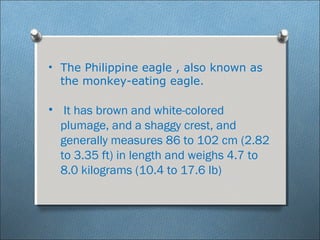
• The Philippine eagle , also known as 
the monkey-eating eagle.
•  It has brown and white-colored
plumage, and a shaggy crest, and
generally measures 86 to 102 cm (2.82
to 3.35 ft) in length and weighs 4.7 to
8.0 kilograms (10.4 to 17.6 lb)
• The Philippine eagle (Pithecophaga
jefferyi) is the world's largest eagle, and
one of the most threatened raptors
• The Philippine Eagle is endemic to the
Philippines and can be found on four
major islands: eastern Luzon, Samar,
Leyte and Mindanao. The largest number
of eagles resides on Mindanao, with
between 82 and 233 breeding pairs. Only
six pairs are found on Samar, two on
Leyte, and a few on Luzon.
• It is considered the largest of the extant 
eagles in the world in terms of length and 
wing surface.
•  It is critically endangered,  mainly due to 
massive loss of habitat due to 
deforestation in most of its range.
• Killing a Philippine eagle is punishable 
under Philippine law by 12 years in jail 
and heavy fines.
• Sea turtles sometimes called marine turtles.
• The species have been identified as "endangered" 
or "critically endangered.“
• Before laying her eggs, a female turtle will dig a 
hole in the sand with her hind flippers. She covers 
it with sand and returns to the ocean. 
• Incubation takes about 50–60 days or 2 months.
• The hatchling's gender depends on the sand 
temperature.
• reptiles of the order Testudines
• There are 7 types of sea turtle
a. Leatherback sea turtle
b. green sea turtle
c. loggerhead sea turtle
d. Kemp’s ridley sea turtle
e. hawksbill sea turtle
f.  flatback sea turtle
g.olive ridley sea turtle
 
a. The leatherback sea turtle (Dermochelys
coriacea), sometimes called the lute  
turtle or leathery turtle, is the largest of all 
living turtles and is the fourth-heaviest 
modern reptile behind three crocodilians.
b. The green sea turtle (Chelonia mydas), 
also known as the green turtle, black (sea) 
turtle, or Pacific green turtle, is a large sea 
turtle of the family Cheloniidae. 
c. The loggerhead sea turtle (Caretta caretta), 
or loggerhead, is an oceanic turtle distributed 
throughout the world. It is a marine reptile, 
belonging to the family Cheloniidae
d.  Kemp's ridley sea turtle (Lepidochelys
kempii), or Atlantic ridley sea turtle is the 
rarest sea turtle and is critically endangered. It is 
one of two living species in the 
genus Lepidochelys (the other one being L.
olivacea, the olive ridley sea turtle).
e. The hawksbill sea turtle (Eretmochelys imbricata) 
is a critically endangered sea turtle belonging to the 
family Cheloniidae. It is the only extant species in 
the genus Eretmochelys.
f. The flatback sea turtle (Natator depressus) is a sea 
turtle endemic to the continental shelf of Australia. 
The flatback turtle belongs to the sea 
turtle superfamily Cheloniidae and is the only species 
found in the genus Natator.
g.  The olive ridley sea turtle (Lepidochelys
olivacea), also known as the Pacific ridley sea 
turtle, is a medium-sized species of sea 
turtle found in warm and tropical waters, 
primarily in the Pacific and Indian Oceans.
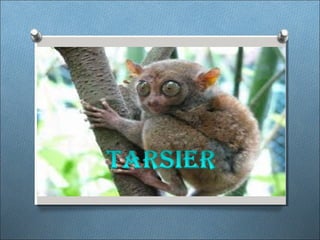
• The Philippine tarsier measures only about 85 to 
160 mm (3.35 to 6.30 in) in height, making it one 
of the smallest primates. The small size makes it 
difficult to spot.
• Like all tarsiers, the Philippine tarsier's eyes are 
fixed in its skull.
• Their eyes are disproportionately large, having the 
largest eye-to-body size ratio of all mammals. 
These huge eyes provide this nocturnal animal with 
excellent night vision.
• The Philippine tarsier has thin, rough fur which is 
colored gray to dark brown. The narrow tail, 
usually used for balance.
• It prefers dense, low-level vegetation in secondary 
forests, with perching sites averaging 2 m above 
the ground.
• Its habitat also includes tropical rainforest with 
dense vegetation and trees that offer it protection 
such as tall grasses, bushes, and bamboo shoots.
• Tarsiers are primates found only in the islands of 
Southeast Asia.
• Tarsiers are arboreal (tree living) and jump 
through the trees to catch their food, which is 
mainly insect based, although can include 
lizards, snakes and birds.
• Tarsiers are very shy animals that prefer to stay 
away from human contact.
• It occupies mainly forests and bush thickets. It 
has also been observed in mangrove forest
THANK YOU
FOR VIEWING
GOD BLESS!

Republic Act 9147 ("Wildlife Resources Conservation and Protection Act.)“