+


    3 POINT LIGHTING
    Photographic Imaging 1
+
                  Introduction to Lighting
   These are the 4 types of lighting:
   Key
   Fill
   Hair
   Edge
+
                     Window Lighting


           In window lighting,       The north light window
    concepts of contrast and light    attempt to emulate a classic
    angles were often influenced by   look.
    the light coming in a window.
+
                                    Key Light
       Key light is the primary or dominant source of light in a shot.

       It often suggests an out of frame source.

       Choice of fixture (hard or soft) and its position will help set the mood of the shot.
+
                              Soft Key Light
       Key light is a very soft Rifa-
        lite 88 fitted with a 1000-
        watt bulb and a soft Egg
        Crate to control its spill.


       Using this lighting in things
        like movies photos and tv
        shows you can change the
        look of a person.
+
                                         Hard Key Light


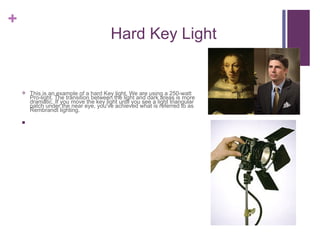
       This is an example of a hard Key light, We are using a 250-watt
        Pro-light. The transition between the light and dark areas is more
        dramatic. If you move the key light until you see a light triangular
        patch under the near eye, you've achieved what is referred to as
        Rembrandt lighting.

    
+
                 Key Light Techniques


       When you practice placing the Key Light on your subject, keep an
        eye on the shadow it creates from the nose.

       Now try placing your light so the nose shadow is nearly gone.

       Bringing the key light “face on”
+
+
+
+
+
+
               KEY LIGHT
       The primary or dominant source of light
        in a shot. It often suggests an out of
        frame source. Choice of fixture (hard or
        soft) and its position will help set the
        mood of the shot.
+
    Simple Light Setups
                  One light will do the work of both Key
        and Fill. A second small light from behind to add
        a little shine to the hair adds a finishing touch.
        You Can adjuct Distance.

    
           Single light (Omni-
           light 500 W) with
           umbrella, positioned
           to function as Key
           light, with enough
           softness to also act as
           Fill light.
           Single light result
+
    Fill Light

              Fill light defined: Fill is used to lighten shadows and control
        contrast ratios (the ratio of amount of Key to Fill light). Combined
        with the Key light, Fill light helps define the mood by lighting the
        shaded areas in a range of intensities. It can vary from none, to a
        level equaling the Key light.
+
    Fill Light
       Fill light aloneRifa 44, 250W Soft light

                     After setting the Key light, you may find that the
        darker side of the face is too dark for your tastes. There are
        several methods for adding Fill light to reduce the shadows.

    

        The amount of Fill that is added depends on your taste (or the
        preference of the person who hired you). Keep in mind the
        'look' you are attempting; especially if you are shooting
        something that is dramatic.

    
        Generally you can most easily alter the mood of a shot by raising
        and lowering the intensity of the Fill. In fact on some soap          Fill light alone
        operas the main difference in lighting between a daytime
        interior scene and a night setting is they drop the Fill almost all   Rifa 44, 250W Soft
        together and light the background a darker than normal.
                                                                              light
+
    Fill Light Techniques
    


                         When the Fill is directly over the camera it adds to
        the Key light's exposure so consider adjusting for it. The near-the-
        camera position can be considered when you want to both fill
        shadows and still maintain a little modeling on the subject. You will
        most often need a less intense light for the Fill side.


    


                                                                                 A) Lower ratio of Key to Fill light
                                                                                 B) B) Higher ratio of Key to Fill light
                                                                                 C) C) Double Nose Shadow
+
    Reflected Fill Light
                   Fill is by bouncing the Key light off of a
        reflector. A specular reflector will kick back nearly as
        much light as the Key light shining on it, in the same
        degree of hardness that strikes it.

    
        In the example shown, the soft Key light is being
        reflected. A stippled reflector surface will soften the
        reflected light more and give less chance of
        secondary shadows.

    
        Using a matte white card will provide a very soft          Specular Reflector bouncing Soft
        reflected fill at close range. You may have natural fill   Key light to create Fill
        already happening from light colored walls reflecting
        back to the subject.                                       Closeup detail
+
    Hair Light
             Hair light defined: A light
        from behind the subject, often
        weaker than the Key or Fill,
        aimed at the head & shoulders.
        It may also called a backlight. It
        creates a sense of separation
        between subject and
        background
+
    Hair Light Techniques
       Along with the amount of Fill light you use, you can continue to add finesse to the
        lighting to reveal the subjects form by using light from angles beyond what you use
        for the Fill. Both Hair lights and Edge lights fall into this category.

    
        Traditionally Hair lights are placed directly opposite the camera. It creates highlights
        and gives a nice shine to the hair. Small hard lights will make small hard lines and
        edges, which are appropriate if you are implying the motivation for the light is a hard
        source. Larger sources provide an even, gentle wash.

    
        With the advent of modern cameras there is less need for the really heavy use of hair
        light unless it is to appear as motivated or logical in the scene. Watch for programs
        done in film or HD and notice how natural these highlights are compared to older
        video programming.


                                                                                                   Hair light alone
                                                                                                   Rifa 44, 250W Soft
                                                                                                   light
+
    Edge Light

               Edge light defined: A light from behind the subject, often
        weaker than the Key or Fill, is placed to create an edge of definition
        between subject and background. Similar in practice to Hair light, it
        is also a form of backlight normally used to define one dark object
        from another, for example a dark jacket from a similarly dark
        background.
+
    Edge Light Techniques
                  Edge lights create subtle defining 'edges',
        and line-like highlights, which can be added to your
        setup to delineate the edge of your subject. You may
        hear them referred to as kickers, liners or edge
        lights.

    
        If your subject's dark hair or jacket seems to blend
        into a similarly dark background you can add an
        'edge' to visibly separate,


                                                                 Edge light alone
                                                                 L-light, 100W
+
    Background Light
            Background Light defined:
        Used for lighting the
        background of a set, as a whole
        or specific areas
+
    Background Light Techniques


                       How you deal with backgrounds depends on whether
        it is part of the story or just a neutral setting for your subject.
        Either way you may notice the background level is usually down, or
        less bright than the subject. However it is not unusual to highlight
        something in the background for interest. A plant or dim lamp is a
        common set dressing.

    
                                                                               Setup with cookaloris
                                                                               pattern
                                                                               Pro-light, 250W
+
    Background Light Options
       Slash Accent

                 It is also common to 'treat' the
        background using a slash of light made by
        putting two barndoors close together on
        a hard light source.

    


                                                     Setup with Slash
                                                     Accent
                                                     Omni-light 500W
                                                     focusable
+
    Background Light Options
       Highlight Accent

                A more practical approach to
        adding visual interest to the
        background would be to add a
        highlight to an object in the setting.

    


                                                 Setup with Highlight
                                                 AccentL-light with
                                                 100W lamp
+
 Background Light Options
    Color Background
           give the background a more
     obviously changed effect.
       It provides a contrast of color
       feel between the environment
     and the subject.
                                          Setup with Color
                                         background
                                          Omni-light 500W
                                          focusable
+

3 point lighting

  • 1.
    + 3 POINT LIGHTING Photographic Imaging 1
  • 2.
    + Introduction to Lighting  These are the 4 types of lighting:  Key  Fill  Hair  Edge
  • 3.
    + Window Lighting  In window lighting, The north light window concepts of contrast and light attempt to emulate a classic angles were often influenced by look. the light coming in a window.
  • 4.
    + Key Light  Key light is the primary or dominant source of light in a shot.  It often suggests an out of frame source.  Choice of fixture (hard or soft) and its position will help set the mood of the shot.
  • 5.
    + Soft Key Light  Key light is a very soft Rifa- lite 88 fitted with a 1000- watt bulb and a soft Egg Crate to control its spill.  Using this lighting in things like movies photos and tv shows you can change the look of a person.
  • 6.
    + Hard Key Light  This is an example of a hard Key light, We are using a 250-watt Pro-light. The transition between the light and dark areas is more dramatic. If you move the key light until you see a light triangular patch under the near eye, you've achieved what is referred to as Rembrandt lighting. 
  • 7.
    + Key Light Techniques  When you practice placing the Key Light on your subject, keep an eye on the shadow it creates from the nose.  Now try placing your light so the nose shadow is nearly gone.  Bringing the key light “face on”
  • 8.
  • 9.
  • 10.
  • 11.
  • 12.
  • 13.
    + KEY LIGHT  The primary or dominant source of light in a shot. It often suggests an out of frame source. Choice of fixture (hard or soft) and its position will help set the mood of the shot.
  • 14.
    + Simple Light Setups  One light will do the work of both Key and Fill. A second small light from behind to add a little shine to the hair adds a finishing touch. You Can adjuct Distance.  Single light (Omni- light 500 W) with umbrella, positioned to function as Key light, with enough softness to also act as Fill light. Single light result
  • 15.
    + Fill Light  Fill light defined: Fill is used to lighten shadows and control contrast ratios (the ratio of amount of Key to Fill light). Combined with the Key light, Fill light helps define the mood by lighting the shaded areas in a range of intensities. It can vary from none, to a level equaling the Key light.
  • 16.
    + Fill Light  Fill light aloneRifa 44, 250W Soft light  After setting the Key light, you may find that the darker side of the face is too dark for your tastes. There are several methods for adding Fill light to reduce the shadows.  The amount of Fill that is added depends on your taste (or the preference of the person who hired you). Keep in mind the 'look' you are attempting; especially if you are shooting something that is dramatic.  Generally you can most easily alter the mood of a shot by raising and lowering the intensity of the Fill. In fact on some soap Fill light alone operas the main difference in lighting between a daytime interior scene and a night setting is they drop the Fill almost all Rifa 44, 250W Soft together and light the background a darker than normal. light
  • 17.
    + Fill Light Techniques   When the Fill is directly over the camera it adds to the Key light's exposure so consider adjusting for it. The near-the- camera position can be considered when you want to both fill shadows and still maintain a little modeling on the subject. You will most often need a less intense light for the Fill side.  A) Lower ratio of Key to Fill light B) B) Higher ratio of Key to Fill light C) C) Double Nose Shadow
  • 18.
    + Reflected Fill Light  Fill is by bouncing the Key light off of a reflector. A specular reflector will kick back nearly as much light as the Key light shining on it, in the same degree of hardness that strikes it.  In the example shown, the soft Key light is being reflected. A stippled reflector surface will soften the reflected light more and give less chance of secondary shadows.  Using a matte white card will provide a very soft Specular Reflector bouncing Soft reflected fill at close range. You may have natural fill Key light to create Fill already happening from light colored walls reflecting back to the subject. Closeup detail
  • 19.
    + Hair Light  Hair light defined: A light from behind the subject, often weaker than the Key or Fill, aimed at the head & shoulders. It may also called a backlight. It creates a sense of separation between subject and background
  • 20.
    + Hair Light Techniques  Along with the amount of Fill light you use, you can continue to add finesse to the lighting to reveal the subjects form by using light from angles beyond what you use for the Fill. Both Hair lights and Edge lights fall into this category.  Traditionally Hair lights are placed directly opposite the camera. It creates highlights and gives a nice shine to the hair. Small hard lights will make small hard lines and edges, which are appropriate if you are implying the motivation for the light is a hard source. Larger sources provide an even, gentle wash.  With the advent of modern cameras there is less need for the really heavy use of hair light unless it is to appear as motivated or logical in the scene. Watch for programs done in film or HD and notice how natural these highlights are compared to older video programming. Hair light alone Rifa 44, 250W Soft light
  • 21.
    + Edge Light  Edge light defined: A light from behind the subject, often weaker than the Key or Fill, is placed to create an edge of definition between subject and background. Similar in practice to Hair light, it is also a form of backlight normally used to define one dark object from another, for example a dark jacket from a similarly dark background.
  • 22.
    + Edge Light Techniques  Edge lights create subtle defining 'edges', and line-like highlights, which can be added to your setup to delineate the edge of your subject. You may hear them referred to as kickers, liners or edge lights.  If your subject's dark hair or jacket seems to blend into a similarly dark background you can add an 'edge' to visibly separate, Edge light alone L-light, 100W
  • 23.
    + Background Light  Background Light defined: Used for lighting the background of a set, as a whole or specific areas
  • 24.
    + Background Light Techniques  How you deal with backgrounds depends on whether it is part of the story or just a neutral setting for your subject. Either way you may notice the background level is usually down, or less bright than the subject. However it is not unusual to highlight something in the background for interest. A plant or dim lamp is a common set dressing.  Setup with cookaloris pattern Pro-light, 250W
  • 25.
    + Background Light Options  Slash Accent  It is also common to 'treat' the background using a slash of light made by putting two barndoors close together on a hard light source.  Setup with Slash Accent Omni-light 500W focusable
  • 26.
    + Background Light Options  Highlight Accent  A more practical approach to adding visual interest to the background would be to add a highlight to an object in the setting.  Setup with Highlight AccentL-light with 100W lamp
  • 27.
    + Background LightOptions  Color Background  give the background a more obviously changed effect.  It provides a contrast of color  feel between the environment and the subject. Setup with Color  background Omni-light 500W focusable
  • 28.