ii
Name of theperson dedicating merit
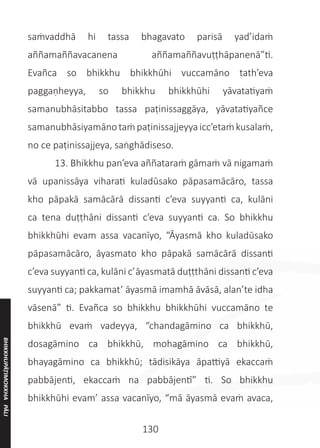
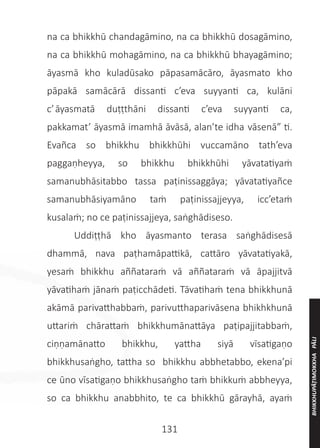
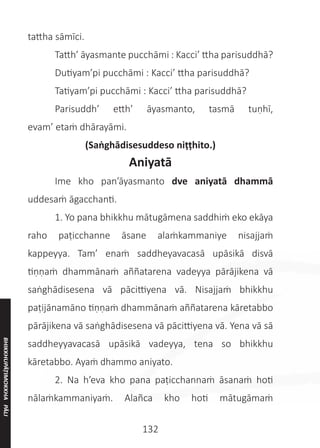
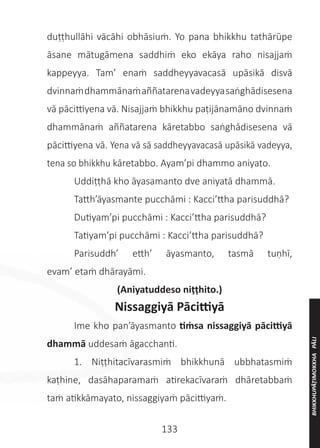
______________________________________________
______________________________________________
______________________________________________
Person for whom merit is dedicated to
______________________________________________
______________________________________________
______________________________________________
May this merit be shared with my parents.
May they be happy.
May this merit be shared with all my relatives.
May they be happy.
May this merit be shared with my teachers and
preceptors.
May they be happy.
May this merit be shared with all divine beings.
May they be happy.
หน้านี้ตั้งใจเว้นว่างไว้
This page is intentionally left blank.
4.
iii
แจกฟรีเป็นธรรมทาน
ร่วมเป็นเจ้าภาพจัดพิมพ์หนังสือปาฏิโมกข์ 3 เวอร์ชั่น
ราคาเล่มละ50 บาท หรือตามก�ำลังศรัทธา
As a gift of Dhamma, this book is for free distribution.
To become a sponsor for printing this Pāṭimokkha book of
three versions:
Each book is 50 baht, but any amount is welcomed.
ธนาคารกสิกรไทย
Kasikorn Bank Account
Number: 003-1-85764-3
Account name: Chaktorn Kajornchaikul
E-mail: atthadharo@gmail.com
หน้านี้ตั้งใจเว้นว่างไว้
This page is intentionally left blank.
v
Pāḷī
Pāḷī comesfrom the word bhāḷi which means ‘under
the custodianship of’ in the way that any language might
be a custodian of the Buddha’s teachings. Scholars believe
that the language called bhāḷi was used in the kingdom of
Magadh during the time of the Buddha to preserve the
Buddha’s teachings. The language of the Magadh people is
therefore called Pāḷī.
Pāḷī is dichotomized as an ancient language in the
Indo-European language family, one which records
Buddhist scripture. The Theravada sect of Pāḷī follows an
oral tradition that appears without a writing system, relying
on rote memory and chanting rituals as the method of its
continuance. When a writing system was developed, it
borrowed orthography from various countries and regions
for pronunciation. Examples include the Brahmi script, the
Devanagari script, the Lanna script, the Khmer script, the
Roman alphabet, and the Thai script. Additional diacritics
were assigned for pronunciation so that sound production
would replicate the original Pāḷī grammar as much as
possible.
ix
Preface
I havecompiled the Pāṭimokkha in Pali by way of
three versions, namely, in bindu form (virāma form), in Thai
form, and in romanized form. These versions are intended
for those aspiring to master memorization of the text. The
hope is that the practitioner can select the version that
best suits his learning preference.
I appreciate the perseverance of all practitioners
who recite the Pāṭimokkha from memory. In doing so, we
keep the oral tradition of the vinaya alive, in the way that it
was during the time of the Buddha.
A Pāṭimokkha reciting bhikku
January 2019
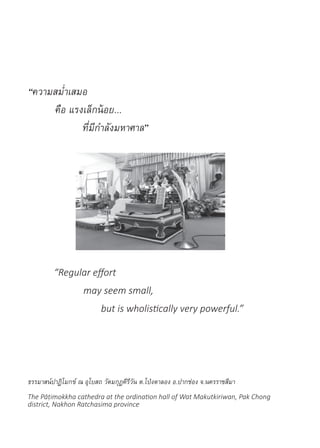
“ความสม�่ำเสมอ
คือ แรงเล็กน้อย...
ที่มีก�ำลังมหาศาล”
“Regulareffort
may seem small,
but is wholistically very powerful.”
ธรรมาสน์ปาฏิโมกข์ ณ อุโบสถ วัดมกุฏคีรีวัน ต.โป่งตาลอง อ.ปากช่อง จ.นครราชสีมา
The Pāṭimokkha cathedra at the ordination hall of Wat Makutkiriwan, Pak Chong
district, Nakhon Ratchasima province
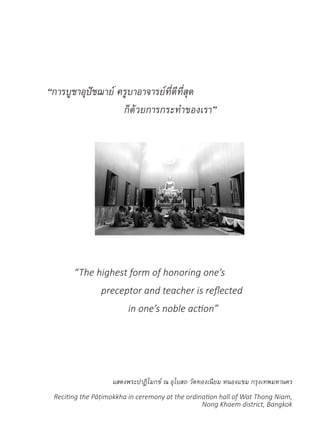
“การบูชาอุปัชฌาย์ ครูบาอาจารย์ที่ดีที่สุด
ก็ด้วยการกระท�ำของเรา”
“Thehighest form of honoring one’s
preceptor and teacher is reflected
in one’s noble action”
แสดงพระปาฏิโมกข์ ณ อุโบสถ วัดทองเนียม หนองแขม กรุงเทพมหานคร
Reciting the Pāṭimokkha in ceremony at the ordination hall of Wat Thong Niam,
Nong Khaem district, Bangkok
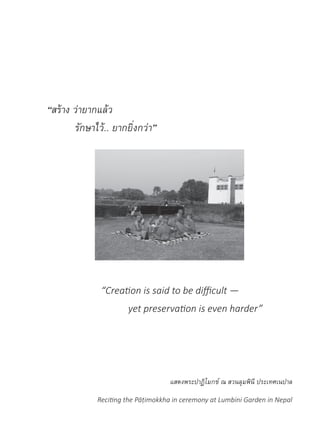
“สร้าง ว่ายากแล้ว
รักษาไว้.. ยากยิ่งกว่า”
“Creation is said to be difficult —
yet preservation is even harder”
แสดงพระปาฏิโมกข์ ณ สวนลุมพินี ประเทศเนปาล
Reciting the Pāṭimokkha in ceremony at Lumbini Garden in Nepal
113
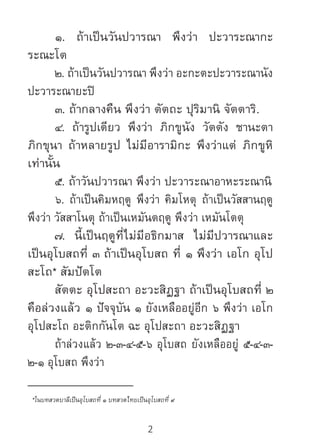
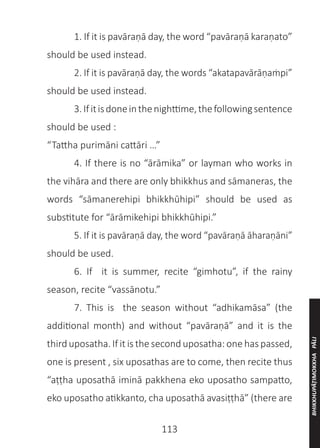
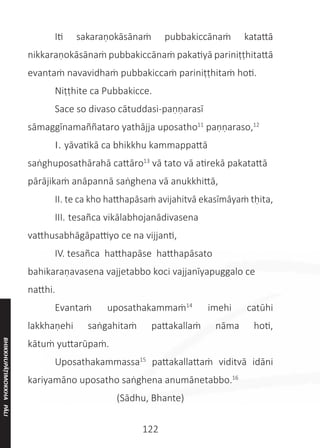
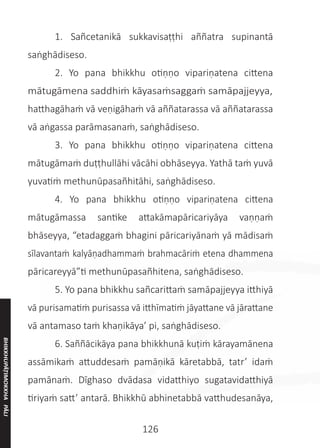
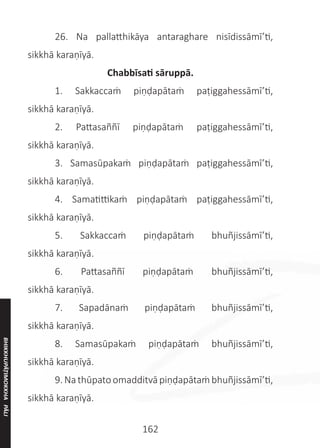
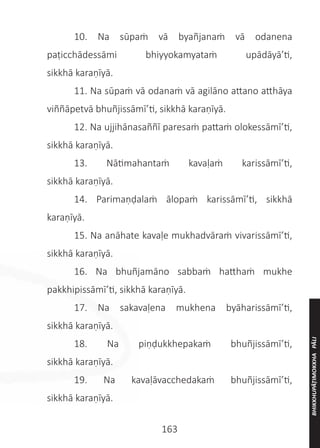
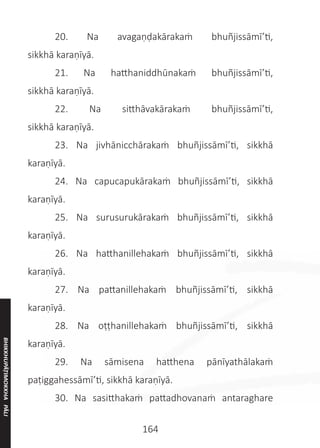
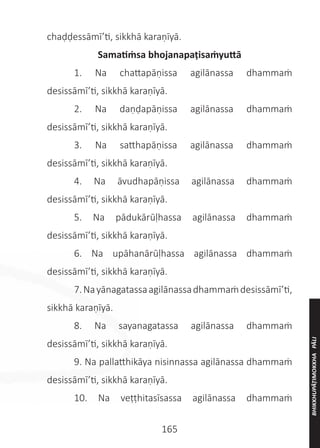
1. Ifit is pavāraṇā day, the word “pavāraṇā karaṇato”
should be used instead.
2. If it is pavāraṇā day, the words “akatapavārāṇaṁpi”
should be used instead.
3.Ifitisdoneinthenighttime,thefollowingsentence
should be used :
“Tattha purimāni cattāri …”
4. If there is no “ārāmika” or layman who works in
the vihāra and there are only bhikkhus and sāmaneras, the
words “sāmanerehipi bhikkhūhipi” should be used as
substitute for “ārāmikehipi bhikkhūhipi.”
5. If it is pavāraṇā day, the word “pavāraṇā āharaṇāni”
should be used.
6. If it is summer, recite “gimhotu”, if the rainy
season, recite “vassānotu.”
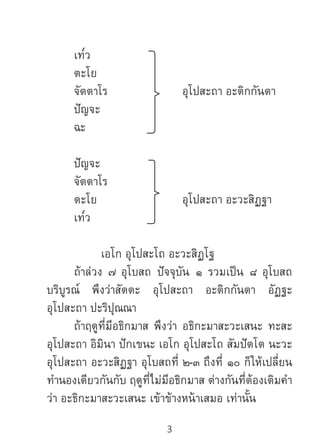
7. This is the season without “adhikamāsa” (the
additional month) and without “pavāraṇā” and it is the
third uposatha. If it is the second uposatha: one has passed,
one is present , six uposathas are to come, then recite thus
“aṭṭha uposathā iminā pakkhena eko uposatho sampatto,
eko uposatho atikkanto, cha uposathā avasiṭṭhā” (there are
BHIKKHUPĀṬIMOKKHA
PĀLI
129.
114
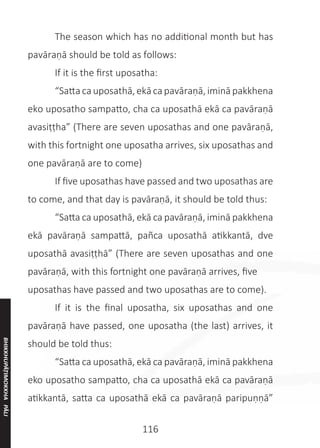
eight uposathas, withthis fortnight one uposatha has
arrived, one has passed, and six are left to come). If 2, 3, 4,
5, 6 have passed, 5, 4, 3, 2, 1 remain to come, recite
eko uposatho sampatto, 1 uposatha arrives
dve 2
tayo 3
cattāro uposathā 4 uposathas passed
pañca atikkantā 5
cha 6
pañca 5
cattāro uposathā 4 uposathas left
Tayo avasiṭṭhā 3 to come
dve 2
eko uposatho avasiṭṭhā 1 uposatha left to come
BHIKKHUPĀṬIMOKKHA
PĀLI
130.
115
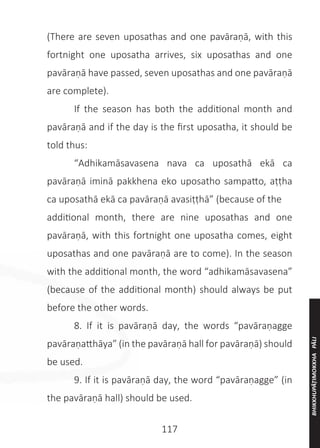
If sevenuposathas have passed and one arrives,
altogether being eight, recite : “aṭṭha uposathā, iminā
pakkhenaekouposathosampatto,sattauposathāatikkantā,
aṭṭha uposathā paripuṇṇā”. (There are eight uposathas,
withthisfortnightoneuposathaarrives,sevenhavepassed,
eight uposathas are complete).
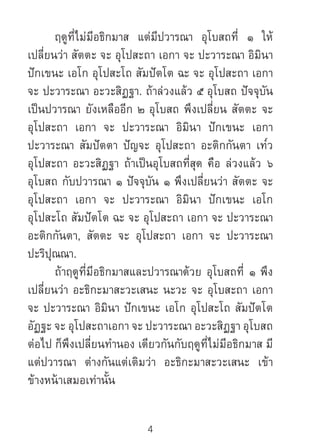
If it is the season with adhikamāsa (the additional
month), recite: “adhikamāsavasena dasa uposathā, iminā
pakkhenaekouposathosampatto,navauposathāavasiṭṭhā.
(There are ten uposathas because of the additional month,
with this fortnight one uposatha arrives and nine uposathas
are to come). If it is the 2nd, 3rd, etc, until the 10th
uposatha, change the words as in the season without
adhikamāsa, the difference being that one must always
add the word “adhikamāsavasena” (because of the
additional month) before the other words.
The additional month does not come in the eighth
lunar month every year (as fixed in the worldly lunar
calendar of Siam). It can come in any season according to
the calculation. It should be, therefore, declared in
accordance with the month and season in which it comes.
BHIKKHUPĀṬIMOKKHA
PĀLI
131.
116
The seasonwhich has no additional month but has
pavāraṇā should be told as follows:
If it is the first uposatha:
“Satta ca uposathā,ekā ca pavāraṇā,iminā pakkhena
eko uposatho sampatto, cha ca uposathā ekā ca pavāraṇā
avasiṭṭha” (There are seven uposathas and one pavāraṇā,
with this fortnight one uposatha arrives, six uposathas and
one pavāraṇā are to come)
If five uposathas have passed and two uposathas are
to come, and that day is pavāraṇā, it should be told thus:
“Satta ca uposathā, ekā ca pavāraṇā, iminā pakkhena
ekā pavāraṇā sampattā, pañca uposathā atikkantā, dve
uposathā avasiṭṭhā” (There are seven uposathas and one
pavāraṇā, with this fortnight one pavāraṇā arrives, five
uposathas have passed and two uposathas are to come).
If it is the final uposatha, six uposathas and one
pavāraṇā have passed, one uposatha (the last) arrives, it
should be told thus:
“Satta ca uposathā, ekā ca pavāraṇā, iminā pakkhena
eko uposatho sampatto, cha ca uposathā ekā ca pavāraṇā
atikkantā, satta ca uposathā ekā ca pavāraṇā paripuṇṇā”
BHIKKHUPĀṬIMOKKHA
PĀLI
132.
117
(There are sevenuposathas and one pavāraṇā, with this
fortnight one uposatha arrives, six uposathas and one
pavāraṇā have passed, seven uposathas and one pavāraṇā
are complete).
If the season has both the additional month and
pavāraṇā and if the day is the first uposatha, it should be
told thus:
“Adhikamāsavasena nava ca uposathā ekā ca
pavāraṇā iminā pakkhena eko uposatho sampatto, aṭṭha
ca uposathā ekā ca pavāraṇā avasiṭṭhā” (because of the
additional month, there are nine uposathas and one
pavāraṇā, with this fortnight one uposatha comes, eight
uposathas and one pavāraṇā are to come). In the season
with the additional month, the word “adhikamāsavasena”
(because of the additional month) should always be put
before the other words.
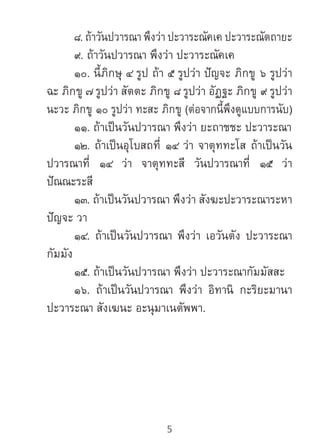
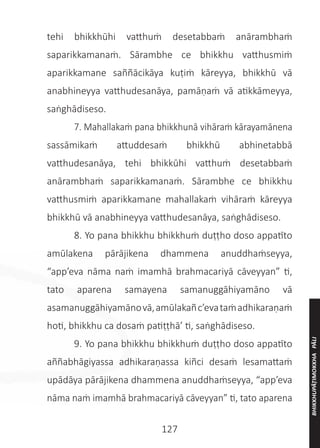
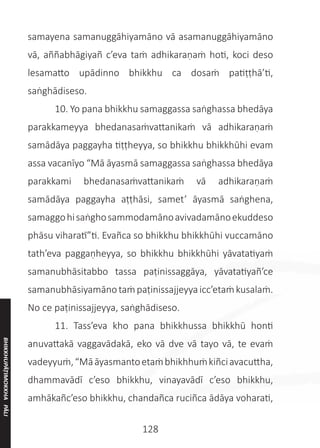
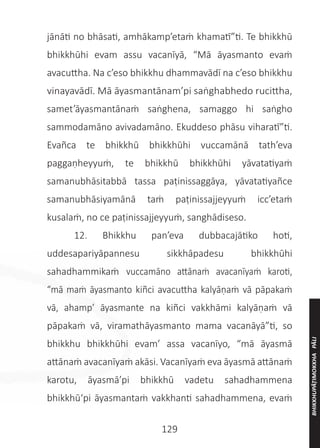
8. If it is pavāraṇā day, the words “pavāraṇagge
pavāraṇatthāya” (in the pavāraṇā hall for pavāraṇā) should
be used.
9. If it is pavāraṇā day, the word “pavāraṇagge” (in
the pavāraṇā hall) should be used.
BHIKKHUPĀṬIMOKKHA
PĀLI
133.
118
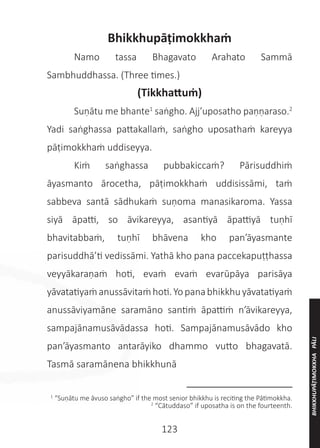
10. Thisis for four bhikkhus; if there are 5, 6, 7, 8, 9,
10 up to 19, or 20 bhikkhus, the Pāli word should be
changed as follows: pañca, cha, satta, aṭṭha, nava, dasa up
to ekūnavīsati or vīsati bhikkhū, respectively. The number
in Pāli language should be changed according to the
number of bhikkhus gathering in the uposatha or pavāraṇā
hall, as the case may be.
11.Ifitispavāraṇāday,theword“yathājjapavāraṇā”
(as today is pavāraṇā day) should be used.
12. If it is the 14th and uposatha day or the 14th and
pavāraṇā day or the 15th and pavāraṇā day, the Pāli words
should be changed into “cātuddaso” or “cātuddasī” or
“paṇṇarasī”, respectively.
13. If it is the pavāraṇā day, the words “Saṅghapavāra-
ṇārahā pañca vā” (5 or more than that who are appropriate
for saṅgha- pavāraṇā) should be used.
14. If it is pavāraṇā day, the words “evantaṁ
pavāraṇākammaṁ” should be used.
15.If itispavāraṇāday, theword“pavāraṇākammassa”
should be used.
16. If it is pavāraṇā day, the words “kariyamānā
pavāraṇā saṅghena anumānetabbā” should be used.
BHIKKHUPĀṬIMOKKHA
PĀLI
134.
119
NOTE
The fourCharacteristics of Uposathakamma
1. Four bhikkhus or more who are qualified, not
having fallen into Pārājika and not having been excluded by
the Saṅgha.
2. They do not leave “hatthapāsa” or forearm’s
length between each other.
3. They are in the same boundary.
4. There is no disqualified person in their gathering.
The Words of the Venerable Elder
(spoken by the most senior bhikkhu present in the
sangha to the Pāṭimokkha-reciter, but omitted if the most
senior bhikkhu is reciting the Pāṭimokkha).
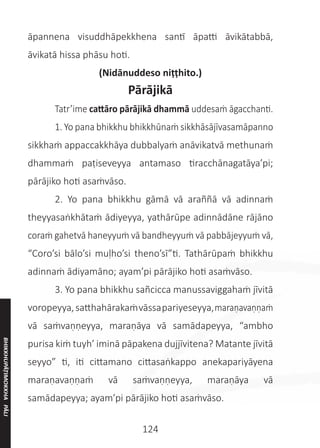
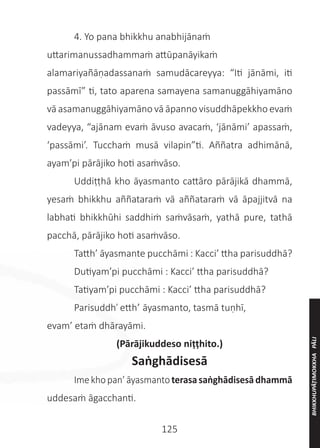
Pubbakaraṇa-pubbakiccāni samāpetvā imissa
nisinnassa bhikkhusaṅghassa anumatiyā pāṭimokkhaṁ
uddesituṁ* ajjhesanaṁ karomi.
With permission of the bhikkhusaṅgha who have
finished the preliminary works and duties and sat down
here, may I invite (you) to recite the Pāṭimokkha.
__________________
*
If it is pavāraṇā day, the words “pavāraṇā yattiṁ ṭhapetuṁ”
BHIKKHUPĀṬIMOKKHA
PĀLI
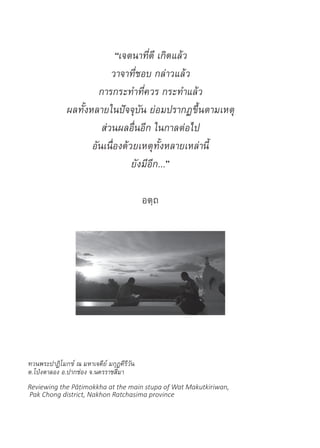
“เจตนาที่ดี เกิดแล้ว
วาจาที่ชอบ กล่าวแล้ว
การกระท�ำที่ควรกระท�ำแล้ว
ผลทั้งหลายในปัจจุบัน ย่อมปรากฏขึ้นตามเหตุ
ส่วนผลอื่นอีก ในกาลต่อไป
อันเนื่องด้วยเหตุทั้งหลายเหล่านี้
ยังมีอีก...”
อตฺถ
ทวนพระปาฏิโมกข์ ณ มหาเจดีย์ มกุฏคีรีวัน
ต.โป่งตาลอง อ.ปากช่อง จ.นครราชสีมา
Reviewing the Pāṭimokkha at the main stupa of Wat Makutkiriwan,
Pak Chong district, Nakhon Ratchasima province
190.
“When good intentionsare produced…
When noble speech is practiced…
When righteous actions are taken…
The collective outcomes in the present
often transpire from root causes.
For all that has not yet materialized—
in time, from due cause, their effect has yet to come.”
Attha
วิวจากวัดไทยธรรมศาลา รัฐหิมาจัลประเทศ สาธารณรัฐอินเดีย
The view from Wat Thai Dharamsala in Dharamshala, Himachal Pradesh, India