DEFINITION
The act ofrearranging element following
one or more rule.
กระบวนการแบ่งงานสําหรับบุคคล ซึ่งต้องอาศัย
ความถนัดหรือความชํานาญเฉพาะด้าน มีการจัด
วางโครงสร้างและความสัมพันธ์ระหว่างบุคคล
กลุ่มคน
ตลอดจนกําหนดอํานาจหน้าที่ ความรับผิดชอบ
ลดหลั่นกันไปตามสายบังคับบัญชา เพื่อให้ทุกคน
สามารถปฏิบัติงานให้บรรลุผลสําเร็จตามที่
องค์การกําหนดไว้
3
ความหมาย
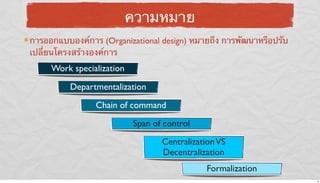
การออกแบบองค์การ (Organizational design)หมายถึง การพัฒนาหรือปรับ
เปลี่ยนโครงสร้างองค์การ
Work specialization
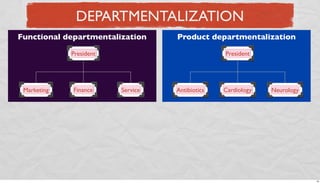
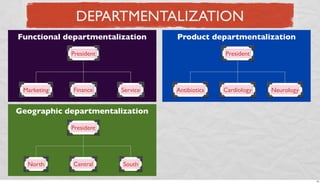
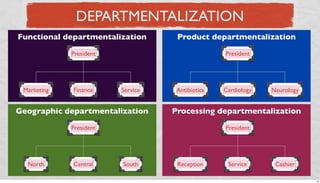
Departmentalization
Chain of command
Span of control
Centralization VS
Decentralization
6
29.
ความหมาย
การออกแบบองค์การ (Organizational design)หมายถึง การพัฒนาหรือปรับ
เปลี่ยนโครงสร้างองค์การ
Work specialization
Departmentalization
Chain of command
Span of control
Centralization VS
Decentralization
Formalization
6
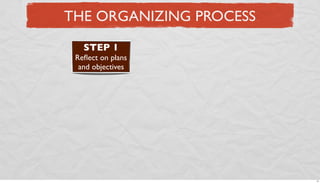
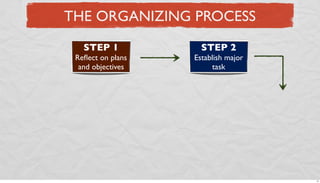
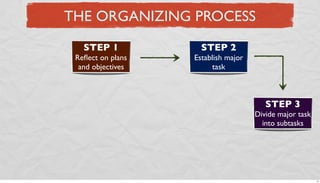
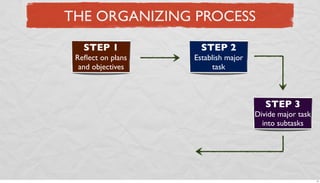
THE ORGANIZING PROCESS
STEP1
STEP 2
Reflect on plans
and objectives
Establish major
task
STEP 3
Divide major task
into subtasks
17
60.
THE ORGANIZING PROCESS
STEP1
STEP 2
Reflect on plans
and objectives
Establish major
task
STEP 3
Divide major task
into subtasks
17
61.
THE ORGANIZING PROCESS
STEP1
STEP 2
Reflect on plans
and objectives
Establish major
task
STEP 3
STEP 4
Divide major task
into subtasks
Allocate
resources and
directives for
subtasks
17
62.
THE ORGANIZING PROCESS
STEP1
STEP 2
Reflect on plans
and objectives
Establish major
task
STEP 3
STEP 4
Divide major task
into subtasks
Allocate
resources and
directives for
subtasks
17
63.
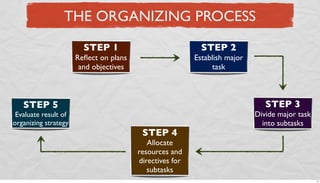
THE ORGANIZING PROCESS
STEP1
STEP 2
Reflect on plans
and objectives
Establish major
task
STEP 3
STEP 5
Evaluate result of
organizing strategy
STEP 4
Divide major task
into subtasks
Allocate
resources and
directives for
subtasks
17
64.
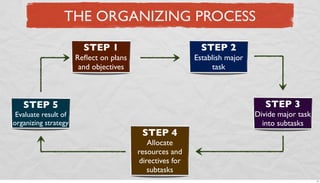
THE ORGANIZING PROCESS
STEP1
STEP 2
Reflect on plans
and objectives
Establish major
task
STEP 3
STEP 5
Evaluate result of
organizing strategy
STEP 4
Divide major task
into subtasks
Allocate
resources and
directives for
subtasks
17
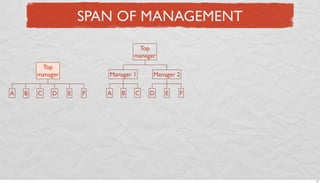
SPAN OF MANAGEMENT
Top
manager
A
B
C
D
Height
Top
manager
E
F
Manager1
A
B
C
Manager 2
D
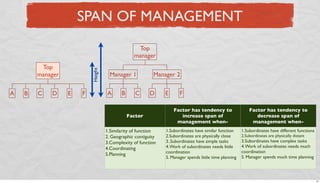
Factor
1.Similarity of function
2. Geographic contiguity
3.Complexity of function
4.Coordinating
5.Planning
E
F
Factor has tendency to
increase span of
management when-
1.Subordinates have similar function
2.Subordinates are physically close
3..Subordinates have simple tasks
4. Work of subordinates needs little
coordination
5. Manager spends little time planning
Factor has tendency to
decrease span of
management when1.Subordinates have different functions
2.Subordinates are physically distant
3.Subordinates have complex tasks
4. Work of subordinates needs much
coordination
5. Manager spends much time planning
21
CENTRALIZATION VS DECENTALIZATION
Morecentralization
More decentralization
Environment is stable
Environment is complex, uncertain.
Lower-level managers are not as capable or experienced at
making decision as upper-level managers
Lower-level managers are capable and experienced at making
decision.
Lower-level managers do not want to have a say in decisions.
Lower-level managers want a voice in decisions.
Decisions are significant.
Decisions are relatively minor
Organization is facing a crisis or the risk of company failure.
Corporate culture is open to allowing managers to have say
what happens
Company is large
Company is geographically dispersed
Effective implementary of company strategies depends on
manager retaining say over what happens.
Effective implementation of company strategies depends on
manager having involvement and flexibility to make decisions.
22
79.
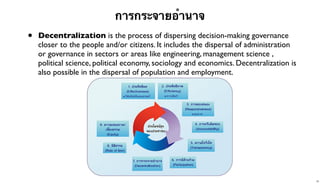
การกระจายอํานาจ
•
Decentralization is theprocess of dispersing decision-making governance
closer to the people and/or citizens. It includes the dispersal of administration
or governance in sectors or areas like engineering, management science ,
political science, political economy, sociology and economics. Decentralization is
also possible in the dispersal of population and employment.
23
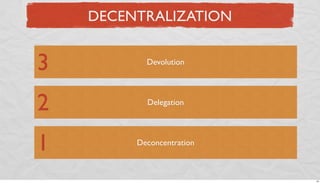
Administrative decentralization
Deconcentration
Deconcentration isthe weakest form of decentralization and is used most frequently in unitary
states—redistributes decision making authority and financial and management responsibilities
among different levels of the national government. It can merely shift responsibilities from
central government officials in the capital city to those working in regions, provinces or
districts, or it can create strong field administration or local administrative capacity under the
supervision of central government ministries.
Delegation
Delegation is a more extensive form of decentralization. Through delegation central governments transfer
responsibility for decision-making and administration of public functions to semi-autonomous organizations
not wholly controlled by the central government, but ultimately accountable to it. Governments delegate
responsibilities when they create public enterprises or corporations, housing authorities, transportation
authorities, special service districts, semi-autonomous school districts, regional development corporations,
or special project implementation units. Usually these organizations have a great deal of discretion in
decision-making. They may be exempted from constraints on regular civil service personnel and may be able
to charge users directly for services.
Devolution
Devolution is an administrative type of decentralisation. When governments devolve functions, they
transfer authority for decision-making, finance, and management to quasi-autonomous units of local
government with corporate status. Devolution usually transfers responsibilities for services to local
governments that elect their own elected functionaries and councils, raise their own revenues, and have
independent authority to make investment decisions. In a devolved system, local governments have clear and
legally recognized geographical boundaries over which they exercise authority and within which they
perform public functions. Administrative decentralization always underlies most cases of political
decentralization.
25
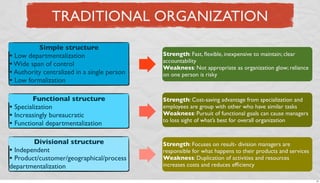
TRADITIONAL ORGANIZATION
Simple structure
•Low departmentalization
• Wide span of control
• Authority centralized in a single person
• Low formalization
Strength: Fast, flexible, inexpensive to maintain; clear
accountability
Weakness: Not appropriate as organization glow; reliance
on one person is risky
Functional structure
• Specialization
• Increasingly bureaucratic
• Functional departmentalization
Strength: Cost-saving advantage from specialization and
employees are group with other who have similar tasks
Weakness: Pursuit of functional goals can cause managers
to loss sight of what’s best for overall organization
Divisional structure
• Independent
• Product/customer/geographical/process
departmentalization
Strength: Focuses on result- division managers are
responsible for what happens to their products and services
Weakness: Duplication of activities and resources
increases costs and reduces efficiency
27
85.
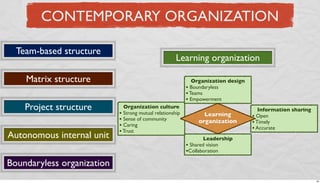
CONTEMPORARY ORGANIZATION
Team-based structure
Learningorganization
Matrix structure
Project structure
Autonomous internal unit
Organization design
• Boundaryless
• Teams
• Empowerment
Organization culture
• Strong mutual relationship
• Sense of community
• Caring
• Trust
Learning
organization
Information sharing
• Open
• Timely
• Accurate
Leadership
• Shared vision
•Collaboration
Boundaryless organization
28
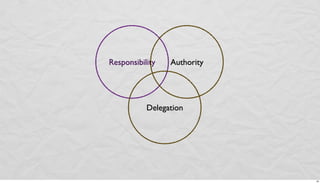
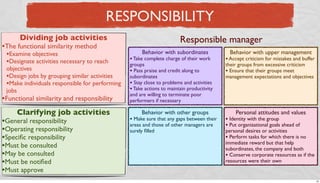
RESPONSIBILITY
Dividing job activities
•Thefunctional similarity method
•Examine objectives
•Designate activities necessary to reach
objectives
•Design jobs by grouping similar activities
•Make individuals responsible for performing
jobs
•Functional similarity and responsibility
Clarifying job activities
•General responsibility
•Operating responsibility
•Specific responsibility
•Must be consulted
•May be consulted
•Must be notified
•Must approve
Responsible manager
Behavior with subordinates
• Take complete charge of their work
groups
• Pass praise and credit along to
subordinates
• Stay close to problems and activities
• Take actions to maintain productivity
and are willing to terminate poor
performers if necessary
Behavior with other groups
• Make sure that any gaps between their
areas and those of other managers are
surely filled
Behavior with upper management
• Accept criticism for mistakes and buffer
their groups from excessive criticism
• Ensure that their groups meet
management expectations and objectives
Personal attitudes and values
• Identity with the group
• Put organizational goals ahead of
personal desires or activities
• Perform tasks for which there is no
immediate reward but that help
subordinates, the company and both
• Conserve corporate resources as if the
resources were their own
30
88.
AUTHORITY
Type of authority
Hospitalboard
• Line authority
• Staff authority
• Functional authority
Medical staff
Chief of staff
Medical staff
Executive committee
Medical
Surgical
Clinical
Pediatrics
department
Ob. Gyn.
Dental
CEO
Unit management team
Director
of nursing
services
Chief clinical nurse
Unit medical advisor
Services
departments
(Indirect)
Administrator assistant
hospital
31
89.
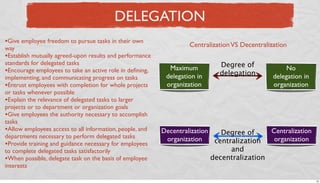
DELEGATION
•Give employee freedomto pursue tasks in their own
way
•Establish mutually agreed-upon results and performance
standards for delegated tasks
•Encourage employees to take an active role in defining,
implementing, and communicating progress on tasks
•Entrust employees with completion for whole projects
or tasks whenever possible
•Explain the relevance of delegated tasks to larger
projects or to department or organization goals
•Give employees the authority necessary to accomplish
tasks
•Allow employees access to all information, people, and
departments necessary to perform delegated tasks
•Provide training and guidance necessary for employees
to complete delegated tasks satisfactorily
•When possible, delegate task on the basis of employee
interests
Centralization VS Decentralization
Maximum
delegation in
organization
Degree of
delegation
No
delegation in
organization
Decentralization
Centralization
Degree of
organization
organization
centralization
and
decentralization
32