Textual analysis of three, Music Magazine genres 
Alessio Petulla 12S Miss Akindayini 
A genre is the category that a particular Media text falls under, based on the 
format of production and the styles and contents of production. 
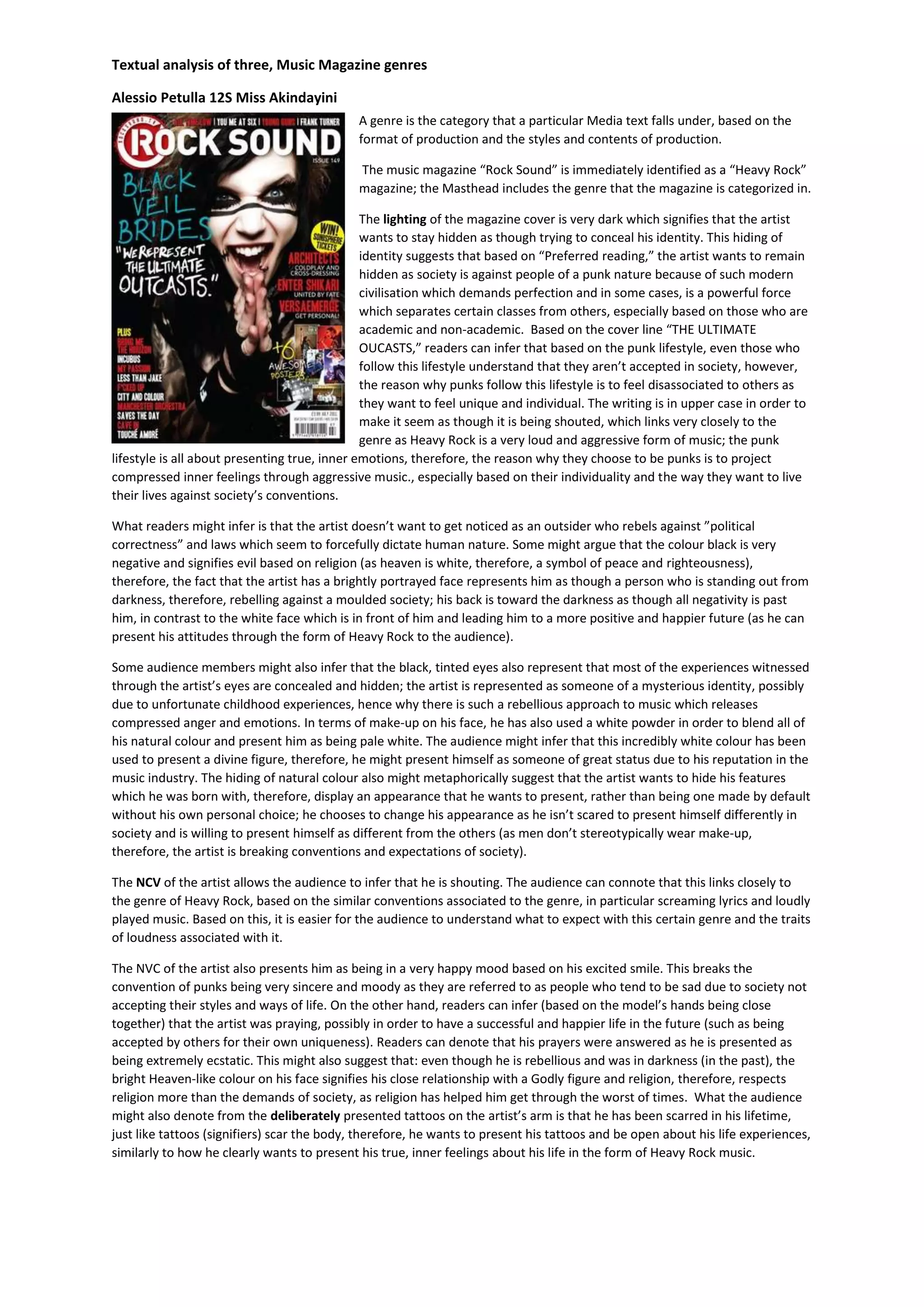
The music magazine “Rock Sound” is immediately identified as a “Heavy Rock” 
magazine; the Masthead includes the genre that the magazine is categorized in. 
The lighting of the magazine cover is very dark which signifies that the artist 
wants to stay hidden as though trying to conceal his identity. This hiding of 
identity suggests that based on “Preferred reading,” the artist wants to remain 
hidden as society is against people of a punk nature because of such modern 
civilisation which demands perfection and in some cases, is a powerful force 
which separates certain classes from others, especially based on those who are 
academic and non-academic. Based on the cover line “THE ULTIMATE 
OUCASTS,” readers can infer that based on the punk lifestyle, even those who 
follow this lifestyle understand that they aren’t accepted in society, however, 
the reason why punks follow this lifestyle is to feel disassociated to others as 
they want to feel unique and individual. The writing is in upper case in order to 
make it seem as though it is being shouted, which links very closely to the 
genre as Heavy Rock is a very loud and aggressive form of music; the punk 
lifestyle is all about presenting true, inner emotions, therefore, the reason why they choose to be punks is to project 
compressed inner feelings through aggressive music., especially based on their individuality and the way they want to live 
their lives against society’s conventions. 
What readers might infer is that the artist doesn’t want to get noticed as an outsider who rebels against ”political 
correctness” and laws which seem to forcefully dictate human nature. Some might argue that the colour black is very 
negative and signifies evil based on religion (as heaven is white, therefore, a symbol of peace and righteousness), 
therefore, the fact that the artist has a brightly portrayed face represents him as though a person who is standing out from 
darkness, therefore, rebelling against a moulded society; his back is toward the darkness as though all negativity is past 
him, in contrast to the white face which is in front of him and leading him to a more positive and happier future (as he can 
present his attitudes through the form of Heavy Rock to the audience). 
Some audience members might also infer that the black, tinted eyes also represent that most of the experiences witnessed 
through the artist’s eyes are concealed and hidden; the artist is represented as someone of a mysterious identity, possibly 
due to unfortunate childhood experiences, hence why there is such a rebellious approach to music which releases 
compressed anger and emotions. In terms of make-up on his face, he has also used a white powder in order to blend all of 
his natural colour and present him as being pale white. The audience might infer that this incredibly white colour has been 
used to present a divine figure, therefore, he might present himself as someone of great status due to his reputation in the 
music industry. The hiding of natural colour also might metaphorically suggest that the artist wants to hide his features 
which he was born with, therefore, display an appearance that he wants to present, rather than being one made by default 
without his own personal choice; he chooses to change his appearance as he isn’t scared to present himself differently in 
society and is willing to present himself as different from the others (as men don’t stereotypically wear make-up, 
therefore, the artist is breaking conventions and expectations of society). 
The NCV of the artist allows the audience to infer that he is shouting. The audience can connote that this links closely to 
the genre of Heavy Rock, based on the similar conventions associated to the genre, in particular screaming lyrics and loudly 
played music. Based on this, it is easier for the audience to understand what to expect with this certain genre and the traits 
of loudness associated with it. 
The NVC of the artist also presents him as being in a very happy mood based on his excited smile. This breaks the 
convention of punks being very sincere and moody as they are referred to as people who tend to be sad due to society not 
accepting their styles and ways of life. On the other hand, readers can infer (based on the model’s hands being close 
together) that the artist was praying, possibly in order to have a successful and happier life in the future (such as being 
accepted by others for their own uniqueness). Readers can denote that his prayers were answered as he is presented as 
being extremely ecstatic. This might also suggest that: even though he is rebellious and was in darkness (in the past), the 
bright Heaven-like colour on his face signifies his close relationship with a Godly figure and religion, therefore, respects 
religion more than the demands of society, as religion has helped him get through the worst of times. What the audience 
might also denote from the deliberately presented tattoos on the artist’s arm is that he has been scarred in his lifetime, 
just like tattoos (signifiers) scar the body, therefore, he wants to present his tattoos and be open about his life experiences, 
similarly to how he clearly wants to present his true, inner feelings about his life in the form of Heavy Rock music.
Textual analysis of three, Music Magazine genres 
Alessio Petulla 12S Miss Akindayini 
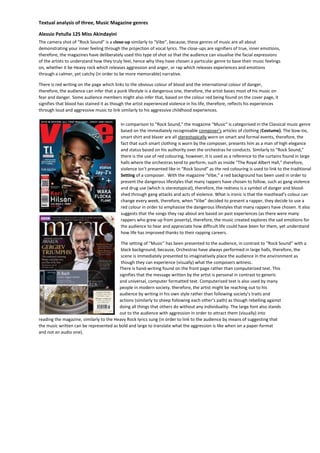
The camera shot of “Rock Sound” is a close-up similarly to “Vibe”, because, these genres of music are all about 
demonstrating your inner feeling through the projection of vocal lyrics. The close-ups are signifiers of true, inner emotions, 
therefore, the magazines have deliberately used this type of shot so that the audience can visualise the facial expressions 
of the artists to understand how they truly feel, hence why they have chosen a particular genre to base their music feelings 
on, whether it be Heavy rock which releases aggression and anger, or rap which releases experiences and emotions 
through a calmer, yet catchy (in order to be more memorable) narrative. 
There is red writing on the page which links to the obvious colour of blood and the international colour of danger, 
therefore, the audience can infer that a punk lifestyle is a dangerous one, therefore, the artist bases most of his music on 
fear and danger. Some audience members might also infer that, based on the colour red being found on the cover page, it 
signifies that blood has stained it as though the artist experienced violence in his life, therefore, reflects his experiences 
through loud and aggressive music to link similarly to his aggressive childhood experiences. 
In comparison to “Rock Sound,” the magazine “Music” is categorised in the Classical music genre 
based on the immediately recognisable composer’s articles of clothing (Costume). The bow-tie, 
smart shirt and blazer are all stereotypically worn on smart and formal events, therefore, the 
fact that such smart clothing is worn by the composer, presents him as a man of high elegance 
and status based on his authority over the orchestras he conducts. Similarly to “Rock Sound,” 
there is the use of red colouring, however, it is used as a reference to the curtains found in large 
halls where the orchestras tend to perform, such as inside “The Royal Albert Hall,” therefore, 
violence isn’t presented like in “Rock Sound” as the red colouring is used to link to the traditional 
Setting of a composer. With the magazine “Vibe,” a red background has been used in order to 
present the dangerous lifestyles that many rappers have chosen to follow, such as gang violence 
and drug use (which is stereotypical), therefore, the redness is a symbol of danger and blood-shed 
through gang attacks and acts of violence. What is ironic is that the masthead’s colour can 
change every week, therefore, when “Vibe” decided to present a rapper, they decide to use a 
red colour in order to emphasise the dangerous lifestyles that many rappers have chosen. It also 
suggests that the songs they rap about are based on past experiences (as there were many 
rappers who grew up from poverty), therefore, the music created explores the sad emotions for 
the audience to hear and appreciate how difficult life could have been for them, yet understand 
how life has improved thanks to their rapping careers. 
The setting of “Music” has been presented to the audience, in contrast to “Rock Sound” with a 
black background, because, Orchestras have always performed in large halls, therefore, the 
scene is immediately presented to imaginatively place the audience in the environment as 
though they can experience (visually) what the composers witness. 
There is hand-writing found on the front page rather than computerized text. This 
signifies that the message written by the artist is personal in contrast to generic 
and universal, computer formatted text. Computerized text is also used by many 
people in modern society, therefore, the artist might be reaching out to his 
audience by writing in his own style rather than following society’s traits and 
actions (similarly to sheep following each other’s path) as though rebelling against 
doing all things that others do without any individuality. The large font also stands 
out to the audience with aggression in order to attract them (visually) into 
reading the magazine, similarly to the Heavy Rock lyrics sung (in order to link to the audience by means of suggesting that 
the music written can be represented as bold and large to translate what the aggression is like when on a paper-format 
and not an audio one).
Textual analysis of three, Music Magazine genres 
Alessio Petulla 12S Miss Akindayini 
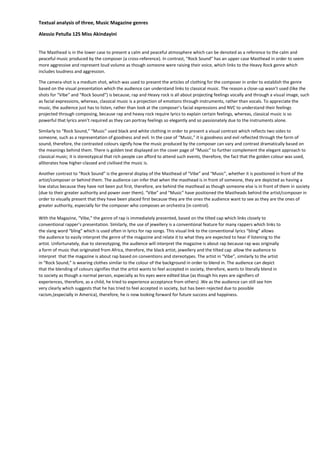
The Masthead is in the lower case to present a calm and peaceful atmosphere which can be denoted as a reference to the calm and 
peaceful music produced by the composer (a cross-reference). In contrast, “Rock Sound” has an upper case Masthead in order to seem 
more aggressive and represent loud volume as though someone were raising their voice, which links to the Heavy Rock genre which 
includes loudness and aggression. 
The camera-shot is a medium shot, which was used to present the articles of clothing for the composer in order to establish the genre 
based on the visual presentation which the audience can understand links to classical music. The reason a close-up wasn’t used (like the 
shots for “Vibe” and “Rock Sound”) is because, rap and Heavy rock is all about projecting feelings vocally and through a visual image, such 
as facial expressions, whereas, classical music is a projection of emotions through instruments, rather than vocals. To appreciate the 
music, the audience just has to listen, rather than look at the composer’s facial expressions and NVC to understand their feelings 
projected through composing, because rap and heavy rock require lyrics to explain certain feelings, whereas, classical music is so 
powerful that lyrics aren’t required as they can portray feelings so elegantly and so passionately due to the instruments alone. 
Similarly to “Rock Sound,” “Music” used black and white clothing in order to present a visual contrast which reflects two sides to 
someone, such as a representation of goodness and evil. In the case of “Music,” it is goodness and evil reflected through the form of 
sound, therefore, the contrasted colours signify how the music produced by the composer can vary and contrast dramatically based on 
the meanings behind them. There is golden text displayed on the cover page of “Music” to further complement the elegant approach to 
classical music; it is stereotypical that rich people can afford to attend such events, therefore, the fact that the golden colour was used, 
alliterates how higher-classed and civilised the music is. 
Another contrast to “Rock Sound” is the general display of the Masthead of “Vibe” and “Music”, whether it is positioned in front of the 
artist/composer or behind them. The audience can infer that when the masthead is in front of someone, they are depicted as having a 
low status because they have not been put first, therefore, are behind the masthead as though someone else is in front of them in society 
(due to their greater authority and power over them). “Vibe” and “Music” have positioned the Mastheads behind the artist/composer in 
order to visually present that they have been placed first because they are the ones the audience want to see as they are the ones of 
greater authority, especially for the composer who composes an orchestra (in control). 
With the Magazine, “Vibe,” the genre of rap is immediately presented, based on the tilted cap which links closely to 
conventional rapper’s presentation. Similarly, the use of jewellery is a conventional feature for many rappers which links to 
the slang word “bling” which is used often in lyrics for rap songs. This visual link to the conventional lyrics “bling” allows 
the audience to easily interpret the genre of the magazine and relate it to what they are expected to hear if listening to the 
artist. Unfortunately, due to stereotyping, the audience will interpret the magazine is about rap because rap was originally 
a form of music that originated from Africa, therefore, the black artist, jewellery and the tilted cap allow the audience to 
interpret that the magazine is about rap based on conventions and stereotypes. The artist in “Vibe”, similarly to the artist 
in “Rock Sound,” is wearing clothes similar to the colour of the background in order to blend in. The audience can depict 
that the blending of colours signifies that the artist wants to feel accepted in society, therefore, wants to literally blend in 
to society as though a normal person, especially as his eyes were edited blue (as though his eyes are signifiers of 
experiences, therefore, as a child, he tried to experience acceptance from others) .We as the audience can still see him 
very clearly which suggests that he has tried to feel accepted in society, but has been rejected due to possible 
racism,(especially in America), therefore, he is now looking forward for future success and happiness.

3 music magazine covers (semiotics, denotation and connotation)

  • 1.
    Textual analysis ofthree, Music Magazine genres Alessio Petulla 12S Miss Akindayini A genre is the category that a particular Media text falls under, based on the format of production and the styles and contents of production. The music magazine “Rock Sound” is immediately identified as a “Heavy Rock” magazine; the Masthead includes the genre that the magazine is categorized in. The lighting of the magazine cover is very dark which signifies that the artist wants to stay hidden as though trying to conceal his identity. This hiding of identity suggests that based on “Preferred reading,” the artist wants to remain hidden as society is against people of a punk nature because of such modern civilisation which demands perfection and in some cases, is a powerful force which separates certain classes from others, especially based on those who are academic and non-academic. Based on the cover line “THE ULTIMATE OUCASTS,” readers can infer that based on the punk lifestyle, even those who follow this lifestyle understand that they aren’t accepted in society, however, the reason why punks follow this lifestyle is to feel disassociated to others as they want to feel unique and individual. The writing is in upper case in order to make it seem as though it is being shouted, which links very closely to the genre as Heavy Rock is a very loud and aggressive form of music; the punk lifestyle is all about presenting true, inner emotions, therefore, the reason why they choose to be punks is to project compressed inner feelings through aggressive music., especially based on their individuality and the way they want to live their lives against society’s conventions. What readers might infer is that the artist doesn’t want to get noticed as an outsider who rebels against ”political correctness” and laws which seem to forcefully dictate human nature. Some might argue that the colour black is very negative and signifies evil based on religion (as heaven is white, therefore, a symbol of peace and righteousness), therefore, the fact that the artist has a brightly portrayed face represents him as though a person who is standing out from darkness, therefore, rebelling against a moulded society; his back is toward the darkness as though all negativity is past him, in contrast to the white face which is in front of him and leading him to a more positive and happier future (as he can present his attitudes through the form of Heavy Rock to the audience). Some audience members might also infer that the black, tinted eyes also represent that most of the experiences witnessed through the artist’s eyes are concealed and hidden; the artist is represented as someone of a mysterious identity, possibly due to unfortunate childhood experiences, hence why there is such a rebellious approach to music which releases compressed anger and emotions. In terms of make-up on his face, he has also used a white powder in order to blend all of his natural colour and present him as being pale white. The audience might infer that this incredibly white colour has been used to present a divine figure, therefore, he might present himself as someone of great status due to his reputation in the music industry. The hiding of natural colour also might metaphorically suggest that the artist wants to hide his features which he was born with, therefore, display an appearance that he wants to present, rather than being one made by default without his own personal choice; he chooses to change his appearance as he isn’t scared to present himself differently in society and is willing to present himself as different from the others (as men don’t stereotypically wear make-up, therefore, the artist is breaking conventions and expectations of society). The NCV of the artist allows the audience to infer that he is shouting. The audience can connote that this links closely to the genre of Heavy Rock, based on the similar conventions associated to the genre, in particular screaming lyrics and loudly played music. Based on this, it is easier for the audience to understand what to expect with this certain genre and the traits of loudness associated with it. The NVC of the artist also presents him as being in a very happy mood based on his excited smile. This breaks the convention of punks being very sincere and moody as they are referred to as people who tend to be sad due to society not accepting their styles and ways of life. On the other hand, readers can infer (based on the model’s hands being close together) that the artist was praying, possibly in order to have a successful and happier life in the future (such as being accepted by others for their own uniqueness). Readers can denote that his prayers were answered as he is presented as being extremely ecstatic. This might also suggest that: even though he is rebellious and was in darkness (in the past), the bright Heaven-like colour on his face signifies his close relationship with a Godly figure and religion, therefore, respects religion more than the demands of society, as religion has helped him get through the worst of times. What the audience might also denote from the deliberately presented tattoos on the artist’s arm is that he has been scarred in his lifetime, just like tattoos (signifiers) scar the body, therefore, he wants to present his tattoos and be open about his life experiences, similarly to how he clearly wants to present his true, inner feelings about his life in the form of Heavy Rock music.
  • 2.
    Textual analysis ofthree, Music Magazine genres Alessio Petulla 12S Miss Akindayini The camera shot of “Rock Sound” is a close-up similarly to “Vibe”, because, these genres of music are all about demonstrating your inner feeling through the projection of vocal lyrics. The close-ups are signifiers of true, inner emotions, therefore, the magazines have deliberately used this type of shot so that the audience can visualise the facial expressions of the artists to understand how they truly feel, hence why they have chosen a particular genre to base their music feelings on, whether it be Heavy rock which releases aggression and anger, or rap which releases experiences and emotions through a calmer, yet catchy (in order to be more memorable) narrative. There is red writing on the page which links to the obvious colour of blood and the international colour of danger, therefore, the audience can infer that a punk lifestyle is a dangerous one, therefore, the artist bases most of his music on fear and danger. Some audience members might also infer that, based on the colour red being found on the cover page, it signifies that blood has stained it as though the artist experienced violence in his life, therefore, reflects his experiences through loud and aggressive music to link similarly to his aggressive childhood experiences. In comparison to “Rock Sound,” the magazine “Music” is categorised in the Classical music genre based on the immediately recognisable composer’s articles of clothing (Costume). The bow-tie, smart shirt and blazer are all stereotypically worn on smart and formal events, therefore, the fact that such smart clothing is worn by the composer, presents him as a man of high elegance and status based on his authority over the orchestras he conducts. Similarly to “Rock Sound,” there is the use of red colouring, however, it is used as a reference to the curtains found in large halls where the orchestras tend to perform, such as inside “The Royal Albert Hall,” therefore, violence isn’t presented like in “Rock Sound” as the red colouring is used to link to the traditional Setting of a composer. With the magazine “Vibe,” a red background has been used in order to present the dangerous lifestyles that many rappers have chosen to follow, such as gang violence and drug use (which is stereotypical), therefore, the redness is a symbol of danger and blood-shed through gang attacks and acts of violence. What is ironic is that the masthead’s colour can change every week, therefore, when “Vibe” decided to present a rapper, they decide to use a red colour in order to emphasise the dangerous lifestyles that many rappers have chosen. It also suggests that the songs they rap about are based on past experiences (as there were many rappers who grew up from poverty), therefore, the music created explores the sad emotions for the audience to hear and appreciate how difficult life could have been for them, yet understand how life has improved thanks to their rapping careers. The setting of “Music” has been presented to the audience, in contrast to “Rock Sound” with a black background, because, Orchestras have always performed in large halls, therefore, the scene is immediately presented to imaginatively place the audience in the environment as though they can experience (visually) what the composers witness. There is hand-writing found on the front page rather than computerized text. This signifies that the message written by the artist is personal in contrast to generic and universal, computer formatted text. Computerized text is also used by many people in modern society, therefore, the artist might be reaching out to his audience by writing in his own style rather than following society’s traits and actions (similarly to sheep following each other’s path) as though rebelling against doing all things that others do without any individuality. The large font also stands out to the audience with aggression in order to attract them (visually) into reading the magazine, similarly to the Heavy Rock lyrics sung (in order to link to the audience by means of suggesting that the music written can be represented as bold and large to translate what the aggression is like when on a paper-format and not an audio one).
  • 3.
    Textual analysis ofthree, Music Magazine genres Alessio Petulla 12S Miss Akindayini The Masthead is in the lower case to present a calm and peaceful atmosphere which can be denoted as a reference to the calm and peaceful music produced by the composer (a cross-reference). In contrast, “Rock Sound” has an upper case Masthead in order to seem more aggressive and represent loud volume as though someone were raising their voice, which links to the Heavy Rock genre which includes loudness and aggression. The camera-shot is a medium shot, which was used to present the articles of clothing for the composer in order to establish the genre based on the visual presentation which the audience can understand links to classical music. The reason a close-up wasn’t used (like the shots for “Vibe” and “Rock Sound”) is because, rap and Heavy rock is all about projecting feelings vocally and through a visual image, such as facial expressions, whereas, classical music is a projection of emotions through instruments, rather than vocals. To appreciate the music, the audience just has to listen, rather than look at the composer’s facial expressions and NVC to understand their feelings projected through composing, because rap and heavy rock require lyrics to explain certain feelings, whereas, classical music is so powerful that lyrics aren’t required as they can portray feelings so elegantly and so passionately due to the instruments alone. Similarly to “Rock Sound,” “Music” used black and white clothing in order to present a visual contrast which reflects two sides to someone, such as a representation of goodness and evil. In the case of “Music,” it is goodness and evil reflected through the form of sound, therefore, the contrasted colours signify how the music produced by the composer can vary and contrast dramatically based on the meanings behind them. There is golden text displayed on the cover page of “Music” to further complement the elegant approach to classical music; it is stereotypical that rich people can afford to attend such events, therefore, the fact that the golden colour was used, alliterates how higher-classed and civilised the music is. Another contrast to “Rock Sound” is the general display of the Masthead of “Vibe” and “Music”, whether it is positioned in front of the artist/composer or behind them. The audience can infer that when the masthead is in front of someone, they are depicted as having a low status because they have not been put first, therefore, are behind the masthead as though someone else is in front of them in society (due to their greater authority and power over them). “Vibe” and “Music” have positioned the Mastheads behind the artist/composer in order to visually present that they have been placed first because they are the ones the audience want to see as they are the ones of greater authority, especially for the composer who composes an orchestra (in control). With the Magazine, “Vibe,” the genre of rap is immediately presented, based on the tilted cap which links closely to conventional rapper’s presentation. Similarly, the use of jewellery is a conventional feature for many rappers which links to the slang word “bling” which is used often in lyrics for rap songs. This visual link to the conventional lyrics “bling” allows the audience to easily interpret the genre of the magazine and relate it to what they are expected to hear if listening to the artist. Unfortunately, due to stereotyping, the audience will interpret the magazine is about rap because rap was originally a form of music that originated from Africa, therefore, the black artist, jewellery and the tilted cap allow the audience to interpret that the magazine is about rap based on conventions and stereotypes. The artist in “Vibe”, similarly to the artist in “Rock Sound,” is wearing clothes similar to the colour of the background in order to blend in. The audience can depict that the blending of colours signifies that the artist wants to feel accepted in society, therefore, wants to literally blend in to society as though a normal person, especially as his eyes were edited blue (as though his eyes are signifiers of experiences, therefore, as a child, he tried to experience acceptance from others) .We as the audience can still see him very clearly which suggests that he has tried to feel accepted in society, but has been rejected due to possible racism,(especially in America), therefore, he is now looking forward for future success and happiness.