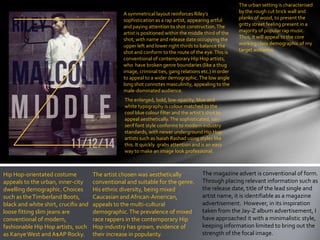
A symmetrical layout reinforces Riley’s
sophistication as a rap artist, appearing artful
and paying attention to shot construction.The
artist is positioned within the middle third of the
shot, with name and release date occupying the
upper left and lower right thirds to balance the
shot and conform to the route of the eye.This is
conventional of contemporary Hip Hop artists,
who have broken genre boundaries (like a thug
image, criminal ties, gang relations etc.) in order
to appeal to a wider demographic.The low angle
long shot connotes masculinity, appealing to the
male-dominated audience.
Hip Hop-orientated costume
appeals to the urban, inner-city
dwelling demographic. Choices
such as theTimberland Boots,
black and white shirt, crucifix and
loose fitting slim jeans are
conventional of modern,
fashionable Hip Hop artists, such
as KanyeWest and A$AP Rocky.
The enlarged, bold, low-opacity, blue and
white typography is colour matched to the
cool blue colour filter and the artist’s shirt to
appeal aesthetically.The sophisticated, san-
serif font style conforms to modern industry
standards, with newer underground Hip Hop
artists such as Isaiah Rashad using styles like
this. It quickly grabs attention and is an easy
way to make an image look professional.
The urban setting is characterised
by the rough cut brick wall and
planks of wood, to present the
gritty street feeling present in a
majority of popular rap music.
Thus, it will appeal to the core
working class demographic of my
target audience.
The artist chosen was aesthetically
conventional and suitable for the genre.
His ethnic diversity, being mixed
Caucasian andAfrican-American,
appeals to the multi-cultural
demographic.The prevalence of mixed
race rappers in the contemporary Hip
Hop industry has grown, evidence of
their increase in popularity.
The magazine advert is conventional of form.
Through placing relevant information such as
the release date, title of the lead single and
artist name, it is identifiable as a magazine
advertisement. However, in its inspiration
taken from the Jay-Z album advertisement, I
have approached it with a minimalistic style,
keeping information limited to bring out the
strength of the focal image.
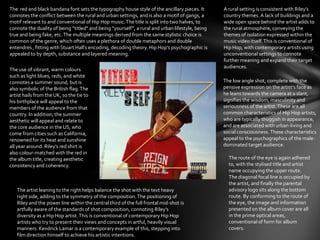
The use of vibrant, warm colours
such as light blues, reds, and white
connotes a summer sound, but is
also symbolic of the British flag.The
artist hails from the UK, so the tie to
his birthplace will appeal to the
members of the audience from that
country. In addition, the summer
aesthetic will appeal and relate to
the core audience in the US, who
come from cities such as California,
renowned for its heat and sunshine
all year around. Riley’s red shirt is
also colour-matched with the red in
the album title, creating aesthetic
consistency and coherency.
The low angle shot, complete with the
pensive expression on the artist’s face as
he leans towards the camera at a slant,
signifies the wisdom, masculinity and
seriousness of the artist.These are all
common characteristics of Hip Hop artists,
who are typically thuggish in appearance,
and are associated with urban-living and
social consciousness. These characteristics
appeal to the psychographics of the male-
dominated target audience.
The artist leaning to the right helps balance the shot with the text heavy
right side, adding to the symmetry of the composition.The positioning of
Riley and the power line within the central third of the full frontal mid-shot is
artfully aware of the standards of shot composition, connoting Riley’s
diversity as a Hip Hop artist.This is conventional of contemporary Hip Hop
artists who try to present their views and concepts in artful, heavily visual
manners. Kendrick Lamar is a contemporary example of this, stepping into
film direction himself to achieve his artistic intentions.
The route of the eye is again adhered
to, with the stylised title and artist
name occupying the upper route.
The diagonal focal line is occupied by
the artist, and finally the parental
advisory logo sits along the bottom
route. By conforming to the route of
the eye, the image and information
presented on the album cover are all
in the prime optical areas,
conventional of form for album
covers.
A rural setting is consistent with Riley’s
country themes. A lack of buildings and a
wide open space behind the artist adds to
the rural atmosphere, conveying the
themes of isolation expressed within the
music video itself.This is conventional of
Hip Hop, with contemporary artists using
unconventional settings to connote
further meaning and expand their target
audiences.
The red and black bandana font sets the typography house style of the ancillary pieces. It
connotes the conflict between the rural and urban settings, and is also a motif of gangs, a
motif relevant to and conventional of Hip Hop music.The title is split into two halves, to
connote the duality of being “titled” and being “yourself”, a rural and urban lifestyle, being
true and being fake, etc.The multiple meanings derived from the same stylistic choice is
common of the genre, which often uses a plethora of double metaphors and double
entendres , fitting with Stuart Hall’s encoding, decoding theory. Hip Hop’s psychographic is
appealed to by depth, substance and layered meaning.
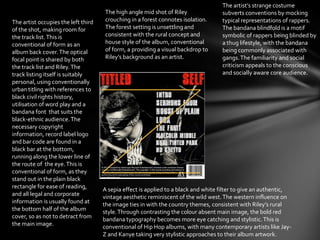
The artist occupies the left third
of the shot, making room for
the track list.This is
conventional of form as an
album back cover.The optical
focal point is shared by both
the track list and Riley.The
track listing itself is suitably
personal, using conventionally
urban titling with references to
black civil rights history,
utilisation of word play and a
bandana font that suits the
black-ethnic audience.The
necessary copyright
information, record label logo
and bar code are found in a
black bar at the bottom,
running along the lower line of
the route of the eye.This is
conventional of form, as they
stand out in the plain black
rectangle for ease of reading,
and all legal and corporate
information is usually found at
the bottom half of the album
cover, so as not to detract from
the main image.
The artist’s strange costume
subverts conventions by mocking
typical representations of rappers.
The bandana blindfold is a motif
symbolic of rappers being blinded by
a thug lifestyle, with the bandana
being commonly associated with
gangs.The familiarity and social
criticism appeals to the conscious
and socially aware core audience.
A sepia effect is applied to a black and white filter to give an authentic,
vintage aesthetic reminiscent of the wild west.The western influence on
the image ties in with the country themes, consistent with Riley’s rural
style.Through contrasting the colour absent main image, the bold red
bandana typography becomes more eye catching and stylistic.This is
conventional of Hip Hop albums, with many contemporary artists like Jay-
Z and Kanye taking very stylistic approaches to their album artwork.
The high angle mid shot of Riley
crouching in a forest connotes isolation.
The forest setting is unsettling and
consistent with the rural concept and
house style of the album, conventional
of form, a providing a visual backdrop to
Riley’s background as an artist.
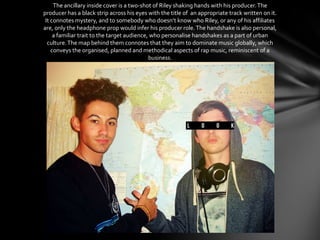
The ancillary inside cover is a two-shot of Riley shaking hands with his producer.The
producer has a black strip across his eyes with the title of an appropriate track written on it.
It connotes mystery, and to somebody who doesn’t know who Riley, or any of his affiliates
are, only the headphone prop would infer his producer role.The handshake is also personal,
a familiar trait to the target audience, who personalise handshakes as a part of urban
culture.The map behind them connotes that they aim to dominate music globally, which
conveys the organised, planned and methodical aspects of rap music, reminiscent of a
business.
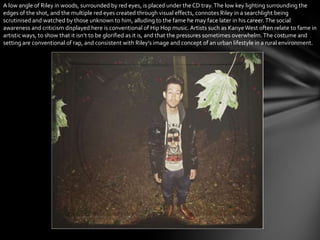
A low angle of Riley in woods, surrounded by red eyes, is placed under theCD tray.The low key lighting surrounding the
edges of the shot, and the multiple red eyes created through visual effects, connotes Riley in a searchlight being
scrutinised and watched by those unknown to him, alluding to the fame he may face later in his career.The social
awareness and criticism displayed here is conventional of Hip Hop music.Artists such as KanyeWest often relate to fame in
artistic ways, to show that it isn’t to be glorified as it is, and that the pressures sometimes overwhelm.The costume and
setting are conventional of rap, and consistent with Riley’s image and concept of an urban lifestyle in a rural environment.
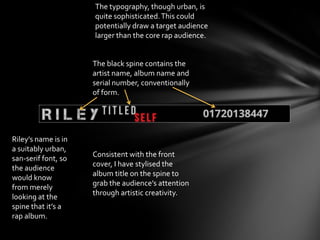
The black spine contains the
artist name, album name and
serial number, conventionally
of form.
Consistent with the front
cover, I have stylised the
album title on the spine to
grab the audience’s attention
through artistic creativity.
Riley’s name is in
a suitably urban,
san-serif font, so
the audience
would know
from merely
looking at the
spine that it’s a
rap album.
The typography, though urban, is
quite sophisticated.This could
potentially draw a target audience
larger than the core rap audience.

Evaluation media ancillary

  • 2.
    A symmetrical layoutreinforces Riley’s sophistication as a rap artist, appearing artful and paying attention to shot construction.The artist is positioned within the middle third of the shot, with name and release date occupying the upper left and lower right thirds to balance the shot and conform to the route of the eye.This is conventional of contemporary Hip Hop artists, who have broken genre boundaries (like a thug image, criminal ties, gang relations etc.) in order to appeal to a wider demographic.The low angle long shot connotes masculinity, appealing to the male-dominated audience. Hip Hop-orientated costume appeals to the urban, inner-city dwelling demographic. Choices such as theTimberland Boots, black and white shirt, crucifix and loose fitting slim jeans are conventional of modern, fashionable Hip Hop artists, such as KanyeWest and A$AP Rocky. The enlarged, bold, low-opacity, blue and white typography is colour matched to the cool blue colour filter and the artist’s shirt to appeal aesthetically.The sophisticated, san- serif font style conforms to modern industry standards, with newer underground Hip Hop artists such as Isaiah Rashad using styles like this. It quickly grabs attention and is an easy way to make an image look professional. The urban setting is characterised by the rough cut brick wall and planks of wood, to present the gritty street feeling present in a majority of popular rap music. Thus, it will appeal to the core working class demographic of my target audience. The artist chosen was aesthetically conventional and suitable for the genre. His ethnic diversity, being mixed Caucasian andAfrican-American, appeals to the multi-cultural demographic.The prevalence of mixed race rappers in the contemporary Hip Hop industry has grown, evidence of their increase in popularity. The magazine advert is conventional of form. Through placing relevant information such as the release date, title of the lead single and artist name, it is identifiable as a magazine advertisement. However, in its inspiration taken from the Jay-Z album advertisement, I have approached it with a minimalistic style, keeping information limited to bring out the strength of the focal image.
  • 3.
    The use ofvibrant, warm colours such as light blues, reds, and white connotes a summer sound, but is also symbolic of the British flag.The artist hails from the UK, so the tie to his birthplace will appeal to the members of the audience from that country. In addition, the summer aesthetic will appeal and relate to the core audience in the US, who come from cities such as California, renowned for its heat and sunshine all year around. Riley’s red shirt is also colour-matched with the red in the album title, creating aesthetic consistency and coherency. The low angle shot, complete with the pensive expression on the artist’s face as he leans towards the camera at a slant, signifies the wisdom, masculinity and seriousness of the artist.These are all common characteristics of Hip Hop artists, who are typically thuggish in appearance, and are associated with urban-living and social consciousness. These characteristics appeal to the psychographics of the male- dominated target audience. The artist leaning to the right helps balance the shot with the text heavy right side, adding to the symmetry of the composition.The positioning of Riley and the power line within the central third of the full frontal mid-shot is artfully aware of the standards of shot composition, connoting Riley’s diversity as a Hip Hop artist.This is conventional of contemporary Hip Hop artists who try to present their views and concepts in artful, heavily visual manners. Kendrick Lamar is a contemporary example of this, stepping into film direction himself to achieve his artistic intentions. The route of the eye is again adhered to, with the stylised title and artist name occupying the upper route. The diagonal focal line is occupied by the artist, and finally the parental advisory logo sits along the bottom route. By conforming to the route of the eye, the image and information presented on the album cover are all in the prime optical areas, conventional of form for album covers. A rural setting is consistent with Riley’s country themes. A lack of buildings and a wide open space behind the artist adds to the rural atmosphere, conveying the themes of isolation expressed within the music video itself.This is conventional of Hip Hop, with contemporary artists using unconventional settings to connote further meaning and expand their target audiences. The red and black bandana font sets the typography house style of the ancillary pieces. It connotes the conflict between the rural and urban settings, and is also a motif of gangs, a motif relevant to and conventional of Hip Hop music.The title is split into two halves, to connote the duality of being “titled” and being “yourself”, a rural and urban lifestyle, being true and being fake, etc.The multiple meanings derived from the same stylistic choice is common of the genre, which often uses a plethora of double metaphors and double entendres , fitting with Stuart Hall’s encoding, decoding theory. Hip Hop’s psychographic is appealed to by depth, substance and layered meaning.
  • 4.
    The artist occupiesthe left third of the shot, making room for the track list.This is conventional of form as an album back cover.The optical focal point is shared by both the track list and Riley.The track listing itself is suitably personal, using conventionally urban titling with references to black civil rights history, utilisation of word play and a bandana font that suits the black-ethnic audience.The necessary copyright information, record label logo and bar code are found in a black bar at the bottom, running along the lower line of the route of the eye.This is conventional of form, as they stand out in the plain black rectangle for ease of reading, and all legal and corporate information is usually found at the bottom half of the album cover, so as not to detract from the main image. The artist’s strange costume subverts conventions by mocking typical representations of rappers. The bandana blindfold is a motif symbolic of rappers being blinded by a thug lifestyle, with the bandana being commonly associated with gangs.The familiarity and social criticism appeals to the conscious and socially aware core audience. A sepia effect is applied to a black and white filter to give an authentic, vintage aesthetic reminiscent of the wild west.The western influence on the image ties in with the country themes, consistent with Riley’s rural style.Through contrasting the colour absent main image, the bold red bandana typography becomes more eye catching and stylistic.This is conventional of Hip Hop albums, with many contemporary artists like Jay- Z and Kanye taking very stylistic approaches to their album artwork. The high angle mid shot of Riley crouching in a forest connotes isolation. The forest setting is unsettling and consistent with the rural concept and house style of the album, conventional of form, a providing a visual backdrop to Riley’s background as an artist.
  • 5.
    The ancillary insidecover is a two-shot of Riley shaking hands with his producer.The producer has a black strip across his eyes with the title of an appropriate track written on it. It connotes mystery, and to somebody who doesn’t know who Riley, or any of his affiliates are, only the headphone prop would infer his producer role.The handshake is also personal, a familiar trait to the target audience, who personalise handshakes as a part of urban culture.The map behind them connotes that they aim to dominate music globally, which conveys the organised, planned and methodical aspects of rap music, reminiscent of a business.
  • 6.
    A low angleof Riley in woods, surrounded by red eyes, is placed under theCD tray.The low key lighting surrounding the edges of the shot, and the multiple red eyes created through visual effects, connotes Riley in a searchlight being scrutinised and watched by those unknown to him, alluding to the fame he may face later in his career.The social awareness and criticism displayed here is conventional of Hip Hop music.Artists such as KanyeWest often relate to fame in artistic ways, to show that it isn’t to be glorified as it is, and that the pressures sometimes overwhelm.The costume and setting are conventional of rap, and consistent with Riley’s image and concept of an urban lifestyle in a rural environment.
  • 7.
    The black spinecontains the artist name, album name and serial number, conventionally of form. Consistent with the front cover, I have stylised the album title on the spine to grab the audience’s attention through artistic creativity. Riley’s name is in a suitably urban, san-serif font, so the audience would know from merely looking at the spine that it’s a rap album. The typography, though urban, is quite sophisticated.This could potentially draw a target audience larger than the core rap audience.