Single Cell functional test
( SCFT )
SCFC‐1
• Pilot – Scrambling code – identify cell as per 
planned in cell 
• Cell info Message – broad cast name of area on• Cell info Message – broad cast name of area on 
mobile screen
• L‐M Complete‐ Land line to Mobile, to check 
workabilityworkability
• M‐L – Mobile to Land line, to check workability
• M‐M ( TTSL ) complete – TATA Mobile to TATA 
Mobile normally TATA 3G to TATA 2G / 3G (
All these info can be find 
from stationary test
Mobile , normally TATA 3G to TATA 2G / 3G ( 
depends on other phones in which technology )
• M‐M ( Other ) complete ‐ – TATA Mobile to Other 
Mobile normally TATA 3G to other 2G / 3G (
y
Mobile , normally TATA 3G to other 2G / 3G ( 
depends on other phones in which technology )
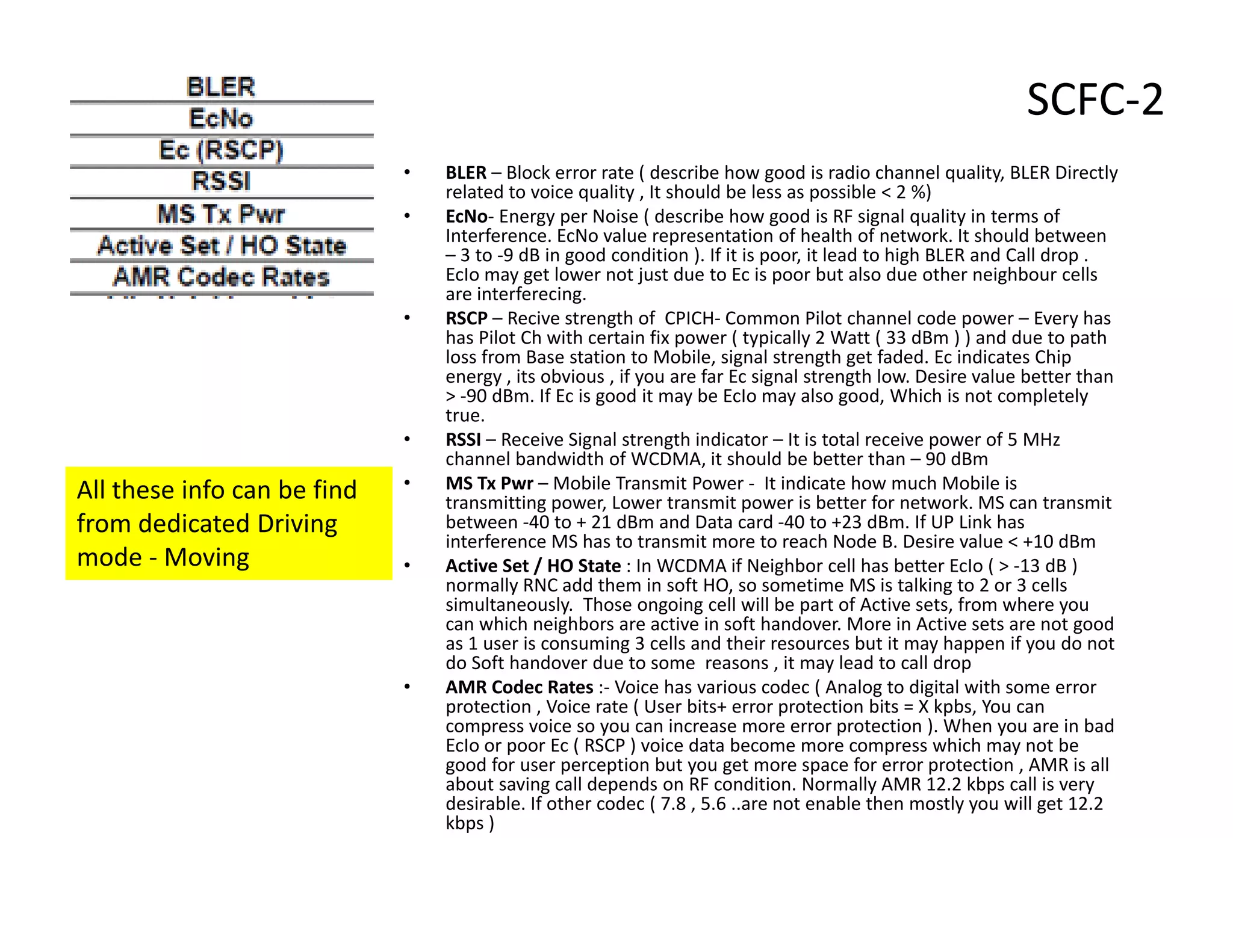
SCFC‐2
• BLER – Block error rate ( describe how good is radio channel quality BLER DirectlyBLER  Block error rate ( describe how good is radio channel quality, BLER Directly 
related to voice quality , It should be less as possible < 2 %)
• EcNo‐ Energy per Noise ( describe how good is RF signal quality in terms of 
Interference. EcNo value representation of health of network. It should between 
– 3 to ‐9 dB in good condition ). If it is poor, it lead to high BLER and Call drop . 
EcIo may get lower not just due to Ec is poor but also due other neighbour cells  
are interferecingare interferecing.
• RSCP – Recive strength of  CPICH‐ Common Pilot channel code power – Every has 
has Pilot Ch with certain fix power ( typically 2 Watt ( 33 dBm ) ) and due to path 
loss from Base station to Mobile, signal strength get faded. Ec indicates Chip 
energy , its obvious , if you are far Ec signal strength low. Desire value better than 
> ‐90 dBm. If Ec is good it may be EcIo may also good, Which is not completely 
truetrue.
• RSSI – Receive Signal strength indicator – It is total receive power of 5 MHz 
channel bandwidth of WCDMA, it should be better than – 90 dBm
• MS Tx Pwr – Mobile Transmit Power ‐ It indicate how much Mobile is 
transmitting power, Lower transmit power is better for network. MS can transmit 
between ‐40 to + 21 dBm and Data card ‐40 to +23 dBm. If UP Link has 
i f MS h i h N d B D i l 10 dB
All these info can be find 
from dedicated Driving 
interference MS has to transmit more to reach Node B. Desire value < +10 dBm
• Active Set / HO State : In WCDMA if Neighbor cell has better EcIo ( > ‐13 dB ) 
normally RNC add them in soft HO, so sometime MS is talking to 2 or 3 cells 
simultaneously.  Those ongoing cell will be part of Active sets, from where you 
can which neighbors are active in soft handover. More in Active sets are not good 
as 1 user is consuming 3 cells and their resources but it may happen if you do not 
d f h d d l d ll d
g
mode ‐ Moving
do Soft handover due to some  reasons , it may lead to call drop
• AMR Codec Rates :‐ Voice has various codec ( Analog to digital with some error 
protection , Voice rate ( User bits+ error protection bits = X kpbs, You can 
compress voice so you can increase more error protection ). When you are in bad 
EcIo or poor Ec ( RSCP ) voice data become more compress which may not be 
good for user perception but you get more space for error protection , AMR is all 
about saving call depends on RF condition. Normally AMR 12.2 kbps call is very 
desirable. If other codec ( 7.8 , 5.6 ..are not enable then mostly you will get 12.2 
kbps )
SCFC‐3
• Idle Neighbour List ‐ Network sends list of neighbor cells with their 
Scrambling code to MS in idle mode so MS can reselect best cells to 
b l h MS li i if d h kbe latch, so MS can listen paging messages if any and other network 
related broad casted parameter which MS require to understand 
network setting. So based on those all understanding of parameter 
MS take decision how to react in idle mode and also during initial 
h f O bj i d h h i hbphase of access. Our objective to note down who are the neighbor 
define from OSS and what we can see from system information 
during Drive test. Our job to compare what is define in OSS and 
what we are receiving in field and find out if any discrepancy or 
i t h
All these info can be find 
from idle stationary or  
dedicated driving mode mismatch.
• Handoff Parameter – in 3G, MS is not sending measured neighbor 
cells detail always, it will only send when it required ? When certain 
criteria fulfill for neighbor compare to serving cell then Mobile send 
All these info can be find 
from Driving mode ‐
dedicated driving mode
some measurement report to Node B and then Node B will send to 
RNC and based on Handover parameter setting and algorithm RNC 
will instruct Node B to inform Mobile to add or remove or replace 
neighbor cells. Handoff parameters can be seen from system 
g
Moving
information. Our job to compare what is define in OSS and what we 
are receiving in field and find out if any discrepancy or mismatch.
• HO from 1 to  ‐ 2nd or 3rd cell of same site, this test to check intra 
site Soft handovers are happening or not. 
• HO from 2 to  ‐ 1st  or 3rd cell of same site, this test to check intra 
site Soft handovers are happening or not. 
SCFC‐4
• Ho from 3 to – 1st  or 2nd cell of same site, this test to check intra site Soft 
handovers are happening or not. 
S f H h i if h i i hb ll h i b E I d h• Soft Ho to other sites – if other sites neighbor cells are having better EcIo and they 
satisfy parameter setting of Handover in that case, mobile send to send 1A event 
measurement report to RNC via Node B and then we have to add neighbor cell in 
to soft handover ( in active set ). Addition of neighbor cell only possible if it is 
define as neighbor in serving cell. If it is define we can see from Idle neighbor cell 
list or from OSS data base dump. Sometime Neighbor cell might has some p g g
hardware or congestion and addition may not be possible, so we need to observe 
and note it down whether Soft handover with other site’ cell got success or fail. 
Sometime other site might not radiating so in idle neighbor list all is define but 
Mobile cannot find it during measurement so it may be reason it was not possible 
and other far site’s cells are coming and those may not be define as neighbor which 
results in to poor serving EcIoresults in to poor serving EcIo.
• Hard HO – normally in WCDMA technology mostly handover are soft handover, but 
some type of handover like between cell belongs to different RNC or 3G to 2G 
handover for voice considered as hand handover.  We have to check is it happening 
or not ?
• 3G Voice call HO to 2G – if 3G load is high or EcIo or RSCP value is very poor than 
All these info can be find 
from dedicated Driving  g y p
some threshold value then it may trigger 3G to 2G handover. Means 3G cell has 
some 2G neighbors also to take care of voice call in case of poor condition.
• 3G Data call HO to 2G – if 3G load is high or EcIo or RSCP value is very poor than 
some threshold value then it may trigger 3G to 2G handover. Means 3G cell has 
some 2G neighbors also to take care of DATA  call in case of poor condition. 
Normally it called it as 3G to 2G Cell reselection as in Data call ( except 64 kbps
g
mode ‐ Moving
Normally it called it as 3G to 2G Cell reselection as in Data call ( except 64 kbps 
Video Data call ).
• 2G Voice Call HO to 3G – 2G cell layer is mostly to take care of voice but if you wish 
and 2G is loaded more than certain threshold you can shift calls to 3G if 3G cell has 
good RSCP and EcIo at that location. If such event occurs MS send Measurement 
report to 2G BSC and then as per neighbor define table BSC talk to RNC and get it p p g g
done. If from 2G to 3G neighbor is not define then Mobile doesn’t know about 3G 
and never scan and measure them and so there is no chance for 2g to 3g handover.
SCFC‐5
• 2G Data call HO to 3G – Normally 3G is good for better data throughput 
if Mobile is capable for 3G technology. If some how due to any reason 
b l d d / d hb d f dmobile is connect to 2G and doing GPRS/EDGE and 3G neighbor defined 
its desirable to switch from 2G to 3G and maximize data through put. 
There are certain condition where Mobile has to keep checking 
availability of 3G and if found with certain RSCP and EcIo and if 3G nbr is 
defined it may select 3G cell.
• Ping/Latency Test – when Mobile is in 3G data call, you might has 
different type of data channel size ( 32/64/128/256/386 kbps its 
depends on RF condition and Cell loading ). You have to do Ping test to 
specific IP address with that data channel size. In ping , what we do ? 
Ping command send certain size of packet from laptop to IP address –g p p p
server and server received it and send it back to Laptop. How fast you 
can get it back from laptop to server to laptop depends on how good is 
your data channel speed and RF condition. We call it as Round Trip Delay  
Time ( RTT ). Desired value < 200 ms. Latency means delay, certain 
services like video streaming, cannot be good if delay is more. So each 
All these info can be find 
from stationary Data call  g, g y
services has to fulfill certain QoS ( quality of service parameters ) to 
satisfy expectation of user experience.
• FTP Upload Throughput – FTP ( file transfer protocol ) – When you are 
on 3G data call, you can send specific size of file ( 1 / 2 MB ) to FTP 
server how much time it will take to upload to that ftp server depends
y
testing cell wise
server, how much time it will take to upload to that ftp server depends 
on RF condition, Data Channel ( DCH ) size and Network parameters. If 
you have good throughput, you can upload faster. Throughput depends 
on you are on Release 99 data call or Release 7(HSPA ) data call. We have 
see what is configuration of Data channel we are using during such 
uploading. We to monitor and calculate average thought to upload file.uploading. We to monitor and calculate average thought to upload file.
• HTTP Upload Throughput‐ Hyper link transfer protocol – when you 
access to internet browser and sending email or uploading photo during 
that time measuring throughput. Throughput depends on as mentioned 
above point.
SCFC‐6
• FTP Download Throughput – as above like upload, only 
different to get the file from server to your laptopdifferent to get the file from server to your laptop.
• HTTP Download Throughput – as above like upload, only 
different to download some video or big file or email to your 
local laptop
• SMS outgoing – When you are in 3G, You can send SMS to 
any phone and check whether this service working or not in 
each cell
• SMS incoming When you are in 3G You can receive SMS• SMS incoming – When you are in 3G, You can receive SMS 
from any phone and check whether this service working or 
not in each cell
• Video call ( voice CS 64 ) outgoing – Video call in 3G is Circuit 
All these info can be find 
from stationary Data call  g g
switch call like Voice, it takes fix 64 kbps dedicated end to 
end link. As long as you on video call, occupied channel 
cannot be share to downgrade. We have to check video calls 
are working or not when you do outgoing call.
y
testing cell wise
are working or not when you do outgoing call.
• Video call ( voice CS 64 ) incoming – Video call in 3G is Circuit 
switch call like Voice, it takes fix 64 kbps dedicated end to 
end link. As long as you on video call, occupied channel 
b h d d W h h k id llcannot be share to downgrade. We have to check video calls 
are working or not when you get incoming video call.
SCFC‐7
• Media On Demand ( PS64, PS128, PS384 ) – in 3G, 
specially Release 99 Packet data call has certain type of 
channel configuration/size. We have to check which 
channel size we are using whatever we do on such 
h lchannel.
All these info can be find 
from stationary Data call y
testing cell wise

3 g scft doc

  • 1.
  • 3.
    SCFC‐1 • Pilot – Scrambling code –identify cell as per  planned in cell  • Cell info Message – broad cast name of area on• Cell info Message – broad cast name of area on  mobile screen • L‐M Complete‐ Land line to Mobile, to check  workabilityworkability • M‐L – Mobile to Land line, to check workability • M‐M ( TTSL ) complete – TATA Mobile to TATA  Mobile normally TATA 3G to TATA 2G / 3G ( All these info can be find  from stationary test Mobile , normally TATA 3G to TATA 2G / 3G (  depends on other phones in which technology ) • M‐M ( Other ) complete ‐ – TATA Mobile to Other  Mobile normally TATA 3G to other 2G / 3G ( y Mobile , normally TATA 3G to other 2G / 3G (  depends on other phones in which technology )
  • 4.
    SCFC‐2 • BLER –Block error rate ( describe how good is radio channel quality BLER DirectlyBLER  Block error rate ( describe how good is radio channel quality, BLER Directly  related to voice quality , It should be less as possible < 2 %) • EcNo‐ Energy per Noise ( describe how good is RF signal quality in terms of  Interference. EcNo value representation of health of network. It should between  – 3 to ‐9 dB in good condition ). If it is poor, it lead to high BLER and Call drop .  EcIo may get lower not just due to Ec is poor but also due other neighbour cells   are interferecingare interferecing. • RSCP – Recive strength of  CPICH‐ Common Pilot channel code power – Every has  has Pilot Ch with certain fix power ( typically 2 Watt ( 33 dBm ) ) and due to path  loss from Base station to Mobile, signal strength get faded. Ec indicates Chip  energy , its obvious , if you are far Ec signal strength low. Desire value better than  > ‐90 dBm. If Ec is good it may be EcIo may also good, Which is not completely  truetrue. • RSSI – Receive Signal strength indicator – It is total receive power of 5 MHz  channel bandwidth of WCDMA, it should be better than – 90 dBm • MS Tx Pwr – Mobile Transmit Power ‐ It indicate how much Mobile is  transmitting power, Lower transmit power is better for network. MS can transmit  between ‐40 to + 21 dBm and Data card ‐40 to +23 dBm. If UP Link has  i f MS h i h N d B D i l 10 dB All these info can be find  from dedicated Driving  interference MS has to transmit more to reach Node B. Desire value < +10 dBm • Active Set / HO State : In WCDMA if Neighbor cell has better EcIo ( > ‐13 dB )  normally RNC add them in soft HO, so sometime MS is talking to 2 or 3 cells  simultaneously.  Those ongoing cell will be part of Active sets, from where you  can which neighbors are active in soft handover. More in Active sets are not good  as 1 user is consuming 3 cells and their resources but it may happen if you do not  d f h d d l d ll d g mode ‐ Moving do Soft handover due to some  reasons , it may lead to call drop • AMR Codec Rates :‐ Voice has various codec ( Analog to digital with some error  protection , Voice rate ( User bits+ error protection bits = X kpbs, You can  compress voice so you can increase more error protection ). When you are in bad  EcIo or poor Ec ( RSCP ) voice data become more compress which may not be  good for user perception but you get more space for error protection , AMR is all  about saving call depends on RF condition. Normally AMR 12.2 kbps call is very  desirable. If other codec ( 7.8 , 5.6 ..are not enable then mostly you will get 12.2  kbps )
  • 5.
    SCFC‐3 • Idle Neighbour List ‐ Network sends list of neighbor cells with their  Scrambling code to MS in idle mode so MS can reselect best cells to  bl h MS li i if d h kbe latch, so MS can listen paging messages if any and other network  related broad casted parameter which MS require to understand  network setting. So based on those all understanding of parameter  MS take decision how to react in idle mode and also during initial  h f O bj i d h h i hbphase of access. Our objective to note down who are the neighbor  define from OSS and what we can see from system information  during Drive test. Our job to compare what is define in OSS and  what we are receiving in field and find out if any discrepancy or  i t h All these info can be find  from idle stationary or   dedicated driving mode mismatch. • Handoff Parameter – in 3G, MS is not sending measured neighbor  cells detail always, it will only send when it required ? When certain  criteria fulfill for neighbor compare to serving cell then Mobile send  All these info can be find  from Driving mode ‐ dedicated driving mode some measurement report to Node B and then Node B will send to  RNC and based on Handover parameter setting and algorithm RNC  will instruct Node B to inform Mobile to add or remove or replace  neighbor cells. Handoff parameters can be seen from system  g Moving information. Our job to compare what is define in OSS and what we  are receiving in field and find out if any discrepancy or mismatch. • HO from 1 to  ‐ 2nd or 3rd cell of same site, this test to check intra  site Soft handovers are happening or not.  • HO from 2 to  ‐ 1st  or 3rd cell of same site, this test to check intra  site Soft handovers are happening or not. 
  • 6.
    SCFC‐4 • Ho from 3 to – 1st  or 2ndcell of same site, this test to check intra site Soft  handovers are happening or not.  S f H h i if h i i hb ll h i b E I d h• Soft Ho to other sites – if other sites neighbor cells are having better EcIo and they  satisfy parameter setting of Handover in that case, mobile send to send 1A event  measurement report to RNC via Node B and then we have to add neighbor cell in  to soft handover ( in active set ). Addition of neighbor cell only possible if it is  define as neighbor in serving cell. If it is define we can see from Idle neighbor cell  list or from OSS data base dump. Sometime Neighbor cell might has some p g g hardware or congestion and addition may not be possible, so we need to observe  and note it down whether Soft handover with other site’ cell got success or fail.  Sometime other site might not radiating so in idle neighbor list all is define but  Mobile cannot find it during measurement so it may be reason it was not possible  and other far site’s cells are coming and those may not be define as neighbor which  results in to poor serving EcIoresults in to poor serving EcIo. • Hard HO – normally in WCDMA technology mostly handover are soft handover, but  some type of handover like between cell belongs to different RNC or 3G to 2G  handover for voice considered as hand handover.  We have to check is it happening  or not ? • 3G Voice call HO to 2G – if 3G load is high or EcIo or RSCP value is very poor than  All these info can be find  from dedicated Driving  g y p some threshold value then it may trigger 3G to 2G handover. Means 3G cell has  some 2G neighbors also to take care of voice call in case of poor condition. • 3G Data call HO to 2G – if 3G load is high or EcIo or RSCP value is very poor than  some threshold value then it may trigger 3G to 2G handover. Means 3G cell has  some 2G neighbors also to take care of DATA  call in case of poor condition.  Normally it called it as 3G to 2G Cell reselection as in Data call ( except 64 kbps g mode ‐ Moving Normally it called it as 3G to 2G Cell reselection as in Data call ( except 64 kbps  Video Data call ). • 2G Voice Call HO to 3G – 2G cell layer is mostly to take care of voice but if you wish  and 2G is loaded more than certain threshold you can shift calls to 3G if 3G cell has  good RSCP and EcIo at that location. If such event occurs MS send Measurement  report to 2G BSC and then as per neighbor define table BSC talk to RNC and get it p p g g done. If from 2G to 3G neighbor is not define then Mobile doesn’t know about 3G  and never scan and measure them and so there is no chance for 2g to 3g handover.
  • 7.
    SCFC‐5 • 2G Data call HO to 3G – Normally 3G is good for better data throughput  if Mobile is capable for 3G technology. If some how due to any reason  bl d d / d hb d f dmobile is connect to 2G and doing GPRS/EDGE and 3G neighbor defined  its desirable to switch from 2G to 3G and maximize data through put.  There are certain condition where Mobile has to keep checking  availability of 3G and if found with certain RSCP and EcIo and if 3G nbr is  defined it may select 3G cell. • Ping/Latency Test – when Mobile is in 3G data call, you might has  different type of data channel size ( 32/64/128/256/386 kbps its  depends on RF condition and Cell loading ). You have to do Ping test to  specific IP address with that data channel size. In ping , what we do ?  Ping command send certain size of packet from laptop to IP address –g p p p server and server received it and send it back to Laptop. How fast you  can get it back from laptop to server to laptop depends on how good is  your data channel speed and RF condition. We call it as Round Trip Delay   Time ( RTT ). Desired value < 200 ms. Latency means delay, certain  services like video streaming, cannot be good if delay is more. So each  All these info can be find  from stationary Data call  g, g y services has to fulfill certain QoS ( quality of service parameters ) to  satisfy expectation of user experience. • FTP Upload Throughput – FTP ( file transfer protocol ) – When you are  on 3G data call, you can send specific size of file ( 1 / 2 MB ) to FTP  server how much time it will take to upload to that ftp server depends y testing cell wise server, how much time it will take to upload to that ftp server depends  on RF condition, Data Channel ( DCH ) size and Network parameters. If  you have good throughput, you can upload faster. Throughput depends  on you are on Release 99 data call or Release 7(HSPA ) data call. We have  see what is configuration of Data channel we are using during such  uploading. We to monitor and calculate average thought to upload file.uploading. We to monitor and calculate average thought to upload file. • HTTP Upload Throughput‐ Hyper link transfer protocol – when you  access to internet browser and sending email or uploading photo during  that time measuring throughput. Throughput depends on as mentioned  above point.
  • 8.
    SCFC‐6 • FTP Download Throughput – as above like upload, only  differentto get the file from server to your laptopdifferent to get the file from server to your laptop. • HTTP Download Throughput – as above like upload, only  different to download some video or big file or email to your  local laptop • SMS outgoing – When you are in 3G, You can send SMS to  any phone and check whether this service working or not in  each cell • SMS incoming When you are in 3G You can receive SMS• SMS incoming – When you are in 3G, You can receive SMS  from any phone and check whether this service working or  not in each cell • Video call ( voice CS 64 ) outgoing – Video call in 3G is Circuit  All these info can be find  from stationary Data call  g g switch call like Voice, it takes fix 64 kbps dedicated end to  end link. As long as you on video call, occupied channel  cannot be share to downgrade. We have to check video calls  are working or not when you do outgoing call. y testing cell wise are working or not when you do outgoing call. • Video call ( voice CS 64 ) incoming – Video call in 3G is Circuit  switch call like Voice, it takes fix 64 kbps dedicated end to  end link. As long as you on video call, occupied channel  b h d d W h h k id llcannot be share to downgrade. We have to check video calls  are working or not when you get incoming video call.
  • 9.