System Optimisation Group
China GSM Core Engineering
August 11, 2000
Jim Luan, Lin Mubao
System Optimisation Group
China GSM Core Engineering
02/01/12 Motorola Internal Use Only 2
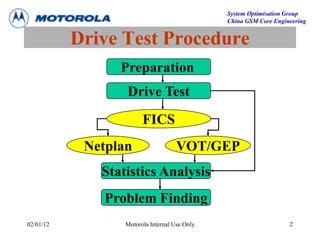
Drive Test Procedure
Drive Test
Netplan
FICS
Statistics Analysis
Problem Finding
VOT/GEP
Preparation
System Optimisation Group
China GSM Core Engineering
02/01/12 Motorola Internal Use Only 3
Preparation (1)
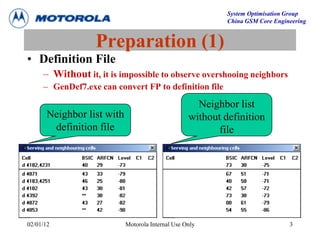
• Definition File
– Without it, it is impossible to observe overshooing neighbors
– GenDef7.exe can convert FP to definition file
Neighbor list with
definition file
Neighbor list
without definition
file
System Optimisation Group
China GSM Core Engineering
02/01/12 Motorola Internal Use Only 4
Preparation (2)
• Frequency Plan & Configuration map
• Software:TEMS, FICS, GEP, VOT
• Hardware: TEMS, GPS, Portable PC
• Test Problem Sheet
• Route
• Map
System Optimisation Group
China GSM Core Engineering
02/01/12 Motorola Internal Use Only 5
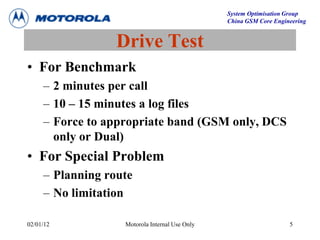
Drive Test
• For Benchmark
– 2 minutes per call
– 10 – 15 minutes a log files
– Force to appropriate band (GSM only, DCS
only or Dual)
• For Special Problem
– Planning route
– No limitation
System Optimisation Group
China GSM Core Engineering
02/01/12 Motorola Internal Use Only 6
TEMS Introduction
• Interface
• Functions
System Optimisation Group
China GSM Core Engineering
02/01/12 Motorola Internal Use Only 7
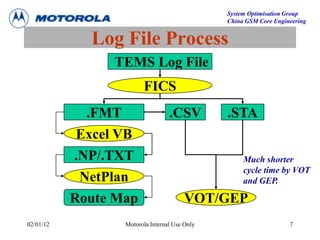
Log File Process
TEMS Log File
NetPlan
FICS
VOT/GEP
.CSV.FMT
Route Map
.STA
Excel VB
.NP/.TXT Much shorter
cycle time by VOT
and GEP.
System Optimisation Group
China GSM Core Engineering
02/01/12 Motorola Internal Use Only 8
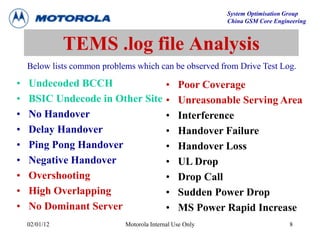
TEMS .log file Analysis
• Undecoded BCCH
• BSIC Undecode in Other Site
• No Handover
• Delay Handover
• Ping Pong Handover
• Negative Handover
• Overshooting
• High Overlapping
• No Dominant Server
• Poor Coverage
• Unreasonable Serving Area
• Interference
• Handover Failure
• Handover Loss
• UL Drop
• Drop Call
• Sudden Power Drop
• MS Power Rapid Increase
Below lists common problems which can be observed from Drive Test Log.
System Optimisation Group
China GSM Core Engineering
02/01/12 Motorola Internal Use Only 9
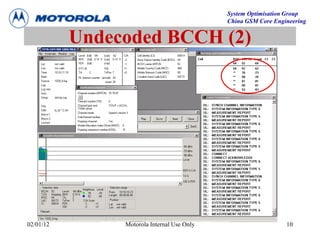
Undecoded BCCH (1)
Description:
– BSICs can’t be decoded in 5s
– Usually consider 3 strongest neighbors
Reason:
– GCLK shift, only decode same site BSICs
– Channel interference
– Non-BCCH carrier, no dedicated spectrum for
BCCH
System Optimisation Group
China GSM Core Engineering
02/01/12 Motorola Internal Use Only 10
Undecoded BCCH (2)
System Optimisation Group
China GSM Core Engineering
02/01/12 Motorola Internal Use Only 11
BSIC Undecode in Other Site
Description:
– BSIC in same site can be decoded but not for
other sites
– Handover can only happen in intra-site basis
– It is similar to former Undecoded BCCH case
Reason:
– GCLK shift
• GCLK recalibration is required
• No one monitors OMC-R alarms
System Optimisation Group
China GSM Core Engineering
02/01/12 Motorola Internal Use Only 12
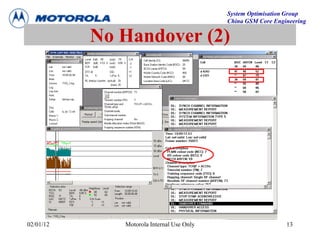
No Handover (1)
Description:
– Neighbor BSIC is decoded and COMMON handover requirement is
fulfilled but there is never a handover
Reason:
– Missing neighbor
• No such neighbor in CM database
– Incorrect external neighbor
• Target cell’s LAC/BCCH/BSIC in add_neighbor is different from those in
equip_rtf
• Engineer modifies external neighbor at MMI, not through GUI
• Never use OMC-R Proxy Cell to propagate external neighbor information
– N < hreqt. Great HO_MARGIN. Improper algorithm 1-7 setting
– Missing_rpt =1
– Serving cell overshoots/covers too far away
– Refer to GSM BSS Statistics Analysis Handbook
System Optimisation Group
China GSM Core Engineering
02/01/12 Motorola Internal Use Only 13
No Handover (2)
System Optimisation Group
China GSM Core Engineering
02/01/12 Motorola Internal Use Only 14
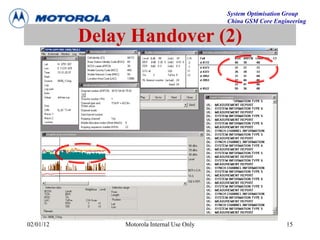
Delay Handover (1)
Description:
– Neighbor BSIC is decoded but handover occurs in
much later time
Reason:
– All possible neighbors suffer blocking
– Large hreqt * hreqave
– qual_power_flag is enabled, full BTS/MS power must
be reached before handover
– Large handover_recognized_period and bssmap_t7
setting
– Refer to GSM BSS Statistics Analysis Handbook
System Optimisation Group
China GSM Core Engineering
02/01/12 Motorola Internal Use Only 15
Delay Handover (2)
System Optimisation Group
China GSM Core Engineering
02/01/12 Motorola Internal Use Only 16
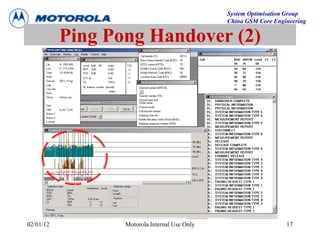
Ping Pong Handover (1)
Description:
– Lot of handovers between cells
– “Time between Handover” is around hreqt*hreqave of
such HO cause
Reason:
– Improper hardware calibration
– Hardware fault
– UL/DL interference
– Negative handover
– Different coverage footprint for antennas of a cell
System Optimisation Group
China GSM Core Engineering
02/01/12 Motorola Internal Use Only 17
Ping Pong Handover (2)
System Optimisation Group
China GSM Core Engineering
02/01/12 Motorola Internal Use Only 18
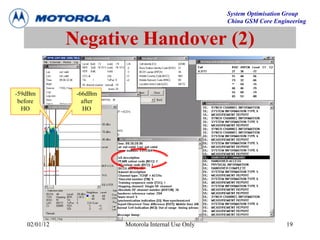
Negative Handover (1)
Description:
– Serving cell hands over to a weaker neighbor
Reason:
– ho_only_max_power is enabled
– qual_margin_flag is disabled
– ho_margin_usage_flag is enabled with negative
ho_margin_rxqual/rxlev
– Negative HO_MARGIN
– Micro-cellular algorithms are enabled, especially type 5
System Optimisation Group
China GSM Core Engineering
02/01/12 Motorola Internal Use Only 19
Negative Handover (2)
-59dBm
before
HO
-66dBm
after
HO
System Optimisation Group
China GSM Core Engineering
02/01/12 Motorola Internal Use Only 20
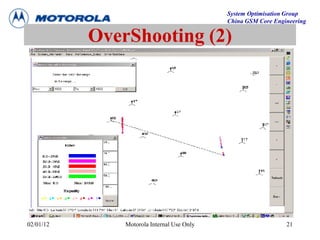
OverShooting (1)
Description:
– Cell shoots at far distance but that location has
closer cells around
Reason:
– Overshooting cell has small downtilt, 0 degree!
– Overshooting cell has too high altitude
– Closer cells have overshooting as well
– BSIC of closer cells can’t be decoded
System Optimisation Group
China GSM Core Engineering
02/01/12 Motorola Internal Use Only 21
OverShooting (2)
System Optimisation Group
China GSM Core Engineering
02/01/12 Motorola Internal Use Only 22
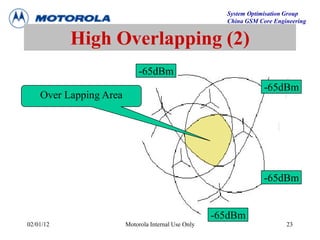
High Overlapping (1)
Description:
– Cells have major rxlevel difference within
5dB
Reason:
– Overshooting
– Too many cells in that area
– Poor antenna downtilt
System Optimisation Group
China GSM Core Engineering
02/01/12 Motorola Internal Use Only 23
High Overlapping (2)
Over Lapping Area
-65dBm
-65dBm
-65dBm
-65dBm
System Optimisation Group
China GSM Core Engineering
02/01/12 Motorola Internal Use Only 24
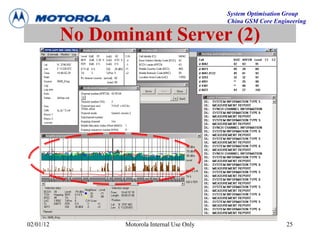
No Dominant Server (1)
Description:
– Rxlevel of best neighbors are close to that of
serving cell
Reason:
– Poor antenna downtilt
– Lack of near-by site
System Optimisation Group
China GSM Core Engineering
02/01/12 Motorola Internal Use Only 25
No Dominant Server (2)
System Optimisation Group
China GSM Core Engineering
02/01/12 Motorola Internal Use Only 26
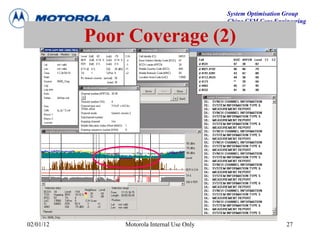
Poor Coverage (1)
Description:
– Low rxlevel with rxquality
– In rural area, rxlevel is less than 15 (-95dBm)
– In city center, rxlevel is less than 35 (-85dBm)
– Different location has different threshold, noise level is the key
point
Reason:
– Lack of cell site
– BSIC of dominant server can’t be decoded
– Dominant server has blocking or cell-bar
– Handover problem. E.g. missing & incorrect neighbor, negative
handover, no & delay handover
System Optimisation Group
China GSM Core Engineering
02/01/12 Motorola Internal Use Only 27
Poor Coverage (2)
System Optimisation Group
China GSM Core Engineering
02/01/12 Motorola Internal Use Only 28
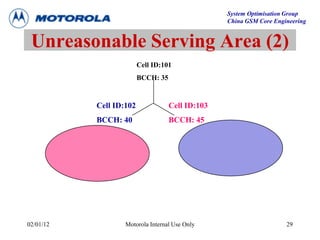
Unreasonable Serving Area (1)
Description:
– Coverage area of the cell is incoherent to the
antenna direction
Reason:
– Wrong cable connection to antennas
– Incorrect record of antenna orientation
– Incorrect ANTENNA_SELECT
System Optimisation Group
China GSM Core Engineering
02/01/12 Motorola Internal Use Only 29
Unreasonable Serving Area (2)
Cell ID:101
BCCH: 35
Cell ID:102
BCCH: 40
Cell ID:103
BCCH: 45
System Optimisation Group
China GSM Core Engineering
02/01/12 Motorola Internal Use Only 30
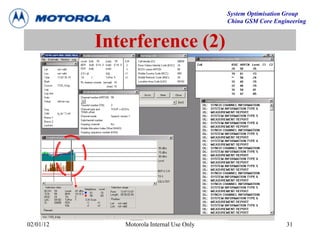
Interference (1)
Description:
– High rxlevel with rxquality
Reason:
– Channel interference
– Not using dominant server
– No handover
– Turn the corner with delay handover
System Optimisation Group
China GSM Core Engineering
02/01/12 Motorola Internal Use Only 31
Interference (2)
System Optimisation Group
China GSM Core Engineering
02/01/12 Motorola Internal Use Only 32
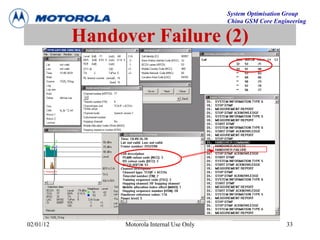
Handover Failure (1)
Description:
– MS fails to reach target cell, so return to source cell
– MS sends HO FAILURE and UL-SABM to source cell
and there is response
Reason:
– Channel interference
– Poor coverage
– External interference at UL, like wideband repeator
– Refer to GSM BSS Statistics Analysis Handbook
System Optimisation Group
China GSM Core Engineering
02/01/12 Motorola Internal Use Only 33
Handover Failure (2)
System Optimisation Group
China GSM Core Engineering
02/01/12 Motorola Internal Use Only 34
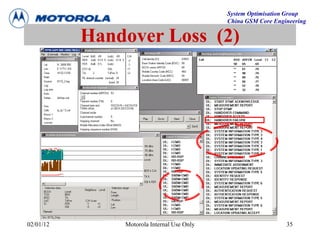
Handover Loss (1)
Description:
– MS fails to reach target cell, but can’t return to source
cell
– MS sends HO FAILURE and UL-SABM to source cell
but no response
Reason:
– Channel interference
– Poor coverage
– External interference at UL, like wideband repeator
– Refer to GSM BSS Statistics Analysis Handbook
System Optimisation Group
China GSM Core Engineering
02/01/12 Motorola Internal Use Only 35
Handover Loss (2)
System Optimisation Group
China GSM Core Engineering
02/01/12 Motorola Internal Use Only 36
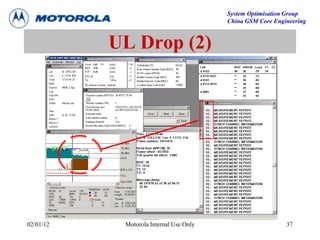
Description:
– BSS doesn’t receive UL SACCH for link_fail times
– BSS stops transmitting DL power
Reason:
– External interference
– Channel interference
– Faulty ancillary. UL path loss >>> DL path loss
– Refer to GSM BSS Statistics Analysis Handbook
UL Drop (1)
System Optimisation Group
China GSM Core Engineering
02/01/12 Motorola Internal Use Only 37
UL Drop (2)
System Optimisation Group
China GSM Core Engineering
02/01/12 Motorola Internal Use Only 38
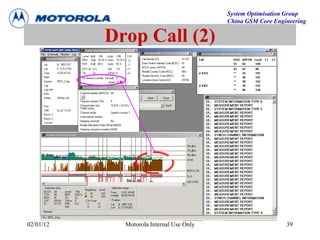
Drop Call (1)
Description:
– DL case: Radio_link_timeout counter decreases to 0
– UL case: link_fail counter decreases to 0
– Layer 2: BSS/MS send SABM/DISC in every T200 for
N200+1 times, and no response from recipient
Reason:
– All cases in this presentation
– Refer to GSM BSS Statistics Analysis Handbook
System Optimisation Group
China GSM Core Engineering
02/01/12 Motorola Internal Use Only 39
Drop Call (2)
System Optimisation Group
China GSM Core Engineering
02/01/12 Motorola Internal Use Only 40
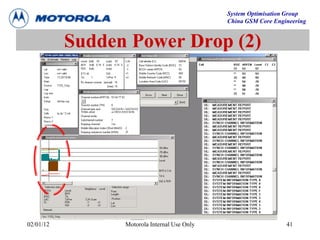
Sudden Power Drop (1)
Description:
– Dedicated ARFCN has significant non-power control
rxlevel difference from rxlevel of BCCH
Reason:
– No/improper TX power calibration
– Faulty ancillary. E.g. combiner, filter..
– Different cable lengths from BTS to antennas
– Due to air combing, so antennas have different
coverage footprints
System Optimisation Group
China GSM Core Engineering
02/01/12 Motorola Internal Use Only 41
Sudden Power Drop (2)
System Optimisation Group
China GSM Core Engineering
02/01/12 Motorola Internal Use Only 42
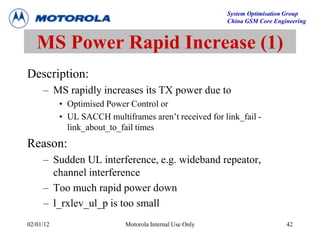
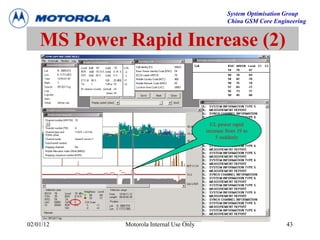
Description:
– MS rapidly increases its TX power due to
• Optimised Power Control or
• UL SACCH multiframes aren’t received for link_fail -
link_about_to_fail times
Reason:
– Sudden UL interference, e.g. wideband repeator,
channel interference
– Too much rapid power down
– l_rxlev_ul_p is too small
MS Power Rapid Increase (1)
System Optimisation Group
China GSM Core Engineering
02/01/12 Motorola Internal Use Only 43
MS Power Rapid Increase (2)
UL power rapid
increase from 19 to
5 suddenly
System Optimisation Group
China GSM Core Engineering
02/01/12 Motorola Internal Use Only 44
How GEP Help?
Help to identify below problem in VISUAL basis
• Co-channel interference
• Adjacent-Channel interference
• Mutual neighbor
• Missing neighbor
• Unreasonable neighbor
• Incorrect external neighbor
System Optimisation Group
China GSM Core Engineering
02/01/12 Motorola Internal Use Only 45
How VOT Help?
Help to identify below problem in VISUAL basis
• Ping pong HO
• Overshooting
• No dominant server
• Poor coverage
• Unreasonable serving area
• Interference
• HO failure
• HO loss
• Drop call
System Optimisation Group
China GSM Core Engineering
02/01/12 Motorola Internal Use Only 46
How CM Extractor Help?
Extract most BSS parameter for reference
• Cell – e.g. hreqave,hreqt,N,P…
• BTS – e.g. antenna_select…
• RTF – check any incorrect external neighbor
• Neighbor – e.g. ho_margin, delay_timer…
System Optimisation Group
China GSM Core Engineering
02/01/12 Motorola Internal Use Only 47
How NPM Help?
• Provide cell statistics for VOT display
• Provide BSS and system level 23 key statistics
• Provide detail troubleshooting statistics

Drive test analysis

  • 1.
    System Optimisation Group ChinaGSM Core Engineering August 11, 2000 Jim Luan, Lin Mubao
  • 2.
    System Optimisation Group ChinaGSM Core Engineering 02/01/12 Motorola Internal Use Only 2 Drive Test Procedure Drive Test Netplan FICS Statistics Analysis Problem Finding VOT/GEP Preparation
  • 3.
    System Optimisation Group ChinaGSM Core Engineering 02/01/12 Motorola Internal Use Only 3 Preparation (1) • Definition File – Without it, it is impossible to observe overshooing neighbors – GenDef7.exe can convert FP to definition file Neighbor list with definition file Neighbor list without definition file
  • 4.
    System Optimisation Group ChinaGSM Core Engineering 02/01/12 Motorola Internal Use Only 4 Preparation (2) • Frequency Plan & Configuration map • Software:TEMS, FICS, GEP, VOT • Hardware: TEMS, GPS, Portable PC • Test Problem Sheet • Route • Map
  • 5.
    System Optimisation Group ChinaGSM Core Engineering 02/01/12 Motorola Internal Use Only 5 Drive Test • For Benchmark – 2 minutes per call – 10 – 15 minutes a log files – Force to appropriate band (GSM only, DCS only or Dual) • For Special Problem – Planning route – No limitation
  • 6.
    System Optimisation Group ChinaGSM Core Engineering 02/01/12 Motorola Internal Use Only 6 TEMS Introduction • Interface • Functions
  • 7.
    System Optimisation Group ChinaGSM Core Engineering 02/01/12 Motorola Internal Use Only 7 Log File Process TEMS Log File NetPlan FICS VOT/GEP .CSV.FMT Route Map .STA Excel VB .NP/.TXT Much shorter cycle time by VOT and GEP.
  • 8.
    System Optimisation Group ChinaGSM Core Engineering 02/01/12 Motorola Internal Use Only 8 TEMS .log file Analysis • Undecoded BCCH • BSIC Undecode in Other Site • No Handover • Delay Handover • Ping Pong Handover • Negative Handover • Overshooting • High Overlapping • No Dominant Server • Poor Coverage • Unreasonable Serving Area • Interference • Handover Failure • Handover Loss • UL Drop • Drop Call • Sudden Power Drop • MS Power Rapid Increase Below lists common problems which can be observed from Drive Test Log.
  • 9.
    System Optimisation Group ChinaGSM Core Engineering 02/01/12 Motorola Internal Use Only 9 Undecoded BCCH (1) Description: – BSICs can’t be decoded in 5s – Usually consider 3 strongest neighbors Reason: – GCLK shift, only decode same site BSICs – Channel interference – Non-BCCH carrier, no dedicated spectrum for BCCH
  • 10.
    System Optimisation Group ChinaGSM Core Engineering 02/01/12 Motorola Internal Use Only 10 Undecoded BCCH (2)
  • 11.
    System Optimisation Group ChinaGSM Core Engineering 02/01/12 Motorola Internal Use Only 11 BSIC Undecode in Other Site Description: – BSIC in same site can be decoded but not for other sites – Handover can only happen in intra-site basis – It is similar to former Undecoded BCCH case Reason: – GCLK shift • GCLK recalibration is required • No one monitors OMC-R alarms
  • 12.
    System Optimisation Group ChinaGSM Core Engineering 02/01/12 Motorola Internal Use Only 12 No Handover (1) Description: – Neighbor BSIC is decoded and COMMON handover requirement is fulfilled but there is never a handover Reason: – Missing neighbor • No such neighbor in CM database – Incorrect external neighbor • Target cell’s LAC/BCCH/BSIC in add_neighbor is different from those in equip_rtf • Engineer modifies external neighbor at MMI, not through GUI • Never use OMC-R Proxy Cell to propagate external neighbor information – N < hreqt. Great HO_MARGIN. Improper algorithm 1-7 setting – Missing_rpt =1 – Serving cell overshoots/covers too far away – Refer to GSM BSS Statistics Analysis Handbook
  • 13.
    System Optimisation Group ChinaGSM Core Engineering 02/01/12 Motorola Internal Use Only 13 No Handover (2)
  • 14.
    System Optimisation Group ChinaGSM Core Engineering 02/01/12 Motorola Internal Use Only 14 Delay Handover (1) Description: – Neighbor BSIC is decoded but handover occurs in much later time Reason: – All possible neighbors suffer blocking – Large hreqt * hreqave – qual_power_flag is enabled, full BTS/MS power must be reached before handover – Large handover_recognized_period and bssmap_t7 setting – Refer to GSM BSS Statistics Analysis Handbook
  • 15.
    System Optimisation Group ChinaGSM Core Engineering 02/01/12 Motorola Internal Use Only 15 Delay Handover (2)
  • 16.
    System Optimisation Group ChinaGSM Core Engineering 02/01/12 Motorola Internal Use Only 16 Ping Pong Handover (1) Description: – Lot of handovers between cells – “Time between Handover” is around hreqt*hreqave of such HO cause Reason: – Improper hardware calibration – Hardware fault – UL/DL interference – Negative handover – Different coverage footprint for antennas of a cell
  • 17.
    System Optimisation Group ChinaGSM Core Engineering 02/01/12 Motorola Internal Use Only 17 Ping Pong Handover (2)
  • 18.
    System Optimisation Group ChinaGSM Core Engineering 02/01/12 Motorola Internal Use Only 18 Negative Handover (1) Description: – Serving cell hands over to a weaker neighbor Reason: – ho_only_max_power is enabled – qual_margin_flag is disabled – ho_margin_usage_flag is enabled with negative ho_margin_rxqual/rxlev – Negative HO_MARGIN – Micro-cellular algorithms are enabled, especially type 5
  • 19.
    System Optimisation Group ChinaGSM Core Engineering 02/01/12 Motorola Internal Use Only 19 Negative Handover (2) -59dBm before HO -66dBm after HO
  • 20.
    System Optimisation Group ChinaGSM Core Engineering 02/01/12 Motorola Internal Use Only 20 OverShooting (1) Description: – Cell shoots at far distance but that location has closer cells around Reason: – Overshooting cell has small downtilt, 0 degree! – Overshooting cell has too high altitude – Closer cells have overshooting as well – BSIC of closer cells can’t be decoded
  • 21.
    System Optimisation Group ChinaGSM Core Engineering 02/01/12 Motorola Internal Use Only 21 OverShooting (2)
  • 22.
    System Optimisation Group ChinaGSM Core Engineering 02/01/12 Motorola Internal Use Only 22 High Overlapping (1) Description: – Cells have major rxlevel difference within 5dB Reason: – Overshooting – Too many cells in that area – Poor antenna downtilt
  • 23.
    System Optimisation Group ChinaGSM Core Engineering 02/01/12 Motorola Internal Use Only 23 High Overlapping (2) Over Lapping Area -65dBm -65dBm -65dBm -65dBm
  • 24.
    System Optimisation Group ChinaGSM Core Engineering 02/01/12 Motorola Internal Use Only 24 No Dominant Server (1) Description: – Rxlevel of best neighbors are close to that of serving cell Reason: – Poor antenna downtilt – Lack of near-by site
  • 25.
    System Optimisation Group ChinaGSM Core Engineering 02/01/12 Motorola Internal Use Only 25 No Dominant Server (2)
  • 26.
    System Optimisation Group ChinaGSM Core Engineering 02/01/12 Motorola Internal Use Only 26 Poor Coverage (1) Description: – Low rxlevel with rxquality – In rural area, rxlevel is less than 15 (-95dBm) – In city center, rxlevel is less than 35 (-85dBm) – Different location has different threshold, noise level is the key point Reason: – Lack of cell site – BSIC of dominant server can’t be decoded – Dominant server has blocking or cell-bar – Handover problem. E.g. missing & incorrect neighbor, negative handover, no & delay handover
  • 27.
    System Optimisation Group ChinaGSM Core Engineering 02/01/12 Motorola Internal Use Only 27 Poor Coverage (2)
  • 28.
    System Optimisation Group ChinaGSM Core Engineering 02/01/12 Motorola Internal Use Only 28 Unreasonable Serving Area (1) Description: – Coverage area of the cell is incoherent to the antenna direction Reason: – Wrong cable connection to antennas – Incorrect record of antenna orientation – Incorrect ANTENNA_SELECT
  • 29.
    System Optimisation Group ChinaGSM Core Engineering 02/01/12 Motorola Internal Use Only 29 Unreasonable Serving Area (2) Cell ID:101 BCCH: 35 Cell ID:102 BCCH: 40 Cell ID:103 BCCH: 45
  • 30.
    System Optimisation Group ChinaGSM Core Engineering 02/01/12 Motorola Internal Use Only 30 Interference (1) Description: – High rxlevel with rxquality Reason: – Channel interference – Not using dominant server – No handover – Turn the corner with delay handover
  • 31.
    System Optimisation Group ChinaGSM Core Engineering 02/01/12 Motorola Internal Use Only 31 Interference (2)
  • 32.
    System Optimisation Group ChinaGSM Core Engineering 02/01/12 Motorola Internal Use Only 32 Handover Failure (1) Description: – MS fails to reach target cell, so return to source cell – MS sends HO FAILURE and UL-SABM to source cell and there is response Reason: – Channel interference – Poor coverage – External interference at UL, like wideband repeator – Refer to GSM BSS Statistics Analysis Handbook
  • 33.
    System Optimisation Group ChinaGSM Core Engineering 02/01/12 Motorola Internal Use Only 33 Handover Failure (2)
  • 34.
    System Optimisation Group ChinaGSM Core Engineering 02/01/12 Motorola Internal Use Only 34 Handover Loss (1) Description: – MS fails to reach target cell, but can’t return to source cell – MS sends HO FAILURE and UL-SABM to source cell but no response Reason: – Channel interference – Poor coverage – External interference at UL, like wideband repeator – Refer to GSM BSS Statistics Analysis Handbook
  • 35.
    System Optimisation Group ChinaGSM Core Engineering 02/01/12 Motorola Internal Use Only 35 Handover Loss (2)
  • 36.
    System Optimisation Group ChinaGSM Core Engineering 02/01/12 Motorola Internal Use Only 36 Description: – BSS doesn’t receive UL SACCH for link_fail times – BSS stops transmitting DL power Reason: – External interference – Channel interference – Faulty ancillary. UL path loss >>> DL path loss – Refer to GSM BSS Statistics Analysis Handbook UL Drop (1)
  • 37.
    System Optimisation Group ChinaGSM Core Engineering 02/01/12 Motorola Internal Use Only 37 UL Drop (2)
  • 38.
    System Optimisation Group ChinaGSM Core Engineering 02/01/12 Motorola Internal Use Only 38 Drop Call (1) Description: – DL case: Radio_link_timeout counter decreases to 0 – UL case: link_fail counter decreases to 0 – Layer 2: BSS/MS send SABM/DISC in every T200 for N200+1 times, and no response from recipient Reason: – All cases in this presentation – Refer to GSM BSS Statistics Analysis Handbook
  • 39.
    System Optimisation Group ChinaGSM Core Engineering 02/01/12 Motorola Internal Use Only 39 Drop Call (2)
  • 40.
    System Optimisation Group ChinaGSM Core Engineering 02/01/12 Motorola Internal Use Only 40 Sudden Power Drop (1) Description: – Dedicated ARFCN has significant non-power control rxlevel difference from rxlevel of BCCH Reason: – No/improper TX power calibration – Faulty ancillary. E.g. combiner, filter.. – Different cable lengths from BTS to antennas – Due to air combing, so antennas have different coverage footprints
  • 41.
    System Optimisation Group ChinaGSM Core Engineering 02/01/12 Motorola Internal Use Only 41 Sudden Power Drop (2)
  • 42.
    System Optimisation Group ChinaGSM Core Engineering 02/01/12 Motorola Internal Use Only 42 Description: – MS rapidly increases its TX power due to • Optimised Power Control or • UL SACCH multiframes aren’t received for link_fail - link_about_to_fail times Reason: – Sudden UL interference, e.g. wideband repeator, channel interference – Too much rapid power down – l_rxlev_ul_p is too small MS Power Rapid Increase (1)
  • 43.
    System Optimisation Group ChinaGSM Core Engineering 02/01/12 Motorola Internal Use Only 43 MS Power Rapid Increase (2) UL power rapid increase from 19 to 5 suddenly
  • 44.
    System Optimisation Group ChinaGSM Core Engineering 02/01/12 Motorola Internal Use Only 44 How GEP Help? Help to identify below problem in VISUAL basis • Co-channel interference • Adjacent-Channel interference • Mutual neighbor • Missing neighbor • Unreasonable neighbor • Incorrect external neighbor
  • 45.
    System Optimisation Group ChinaGSM Core Engineering 02/01/12 Motorola Internal Use Only 45 How VOT Help? Help to identify below problem in VISUAL basis • Ping pong HO • Overshooting • No dominant server • Poor coverage • Unreasonable serving area • Interference • HO failure • HO loss • Drop call
  • 46.
    System Optimisation Group ChinaGSM Core Engineering 02/01/12 Motorola Internal Use Only 46 How CM Extractor Help? Extract most BSS parameter for reference • Cell – e.g. hreqave,hreqt,N,P… • BTS – e.g. antenna_select… • RTF – check any incorrect external neighbor • Neighbor – e.g. ho_margin, delay_timer…
  • 47.
    System Optimisation Group ChinaGSM Core Engineering 02/01/12 Motorola Internal Use Only 47 How NPM Help? • Provide cell statistics for VOT display • Provide BSS and system level 23 key statistics • Provide detail troubleshooting statistics