



John Consigli & Lija Hogan
CX at Prudential: 3 techniques that
drive digital transformation
Prudential Workplace Solutions Group; Digital Products
April 25, 2018
CX at Prudential. 3 techniques. 2
John Consigli
john.consigli@prudential.com
Lija Hogan
Ihogan@usertesting.com
3CX at Prudential. 3 techniques.
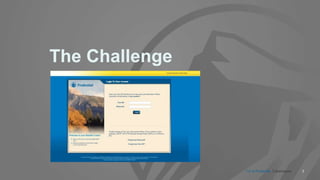
The Challenge
4
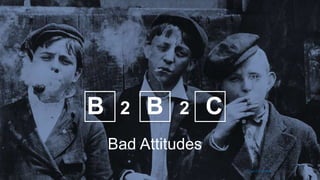
B 2 B 2 C
Bad Attitudes
CX at Prudential. 3 techniques.
5
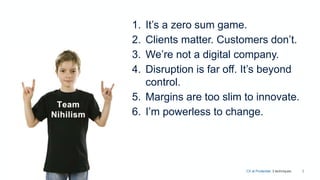
1. It’s a zero sum game.
2. Clients matter. Customers don’t.
3. We’re not a digital company.
4. Disruption is far off. It’s beyond
control.
5. Margins are too slim to innovate.
6. I’m powerless to change.
CX at Prudential. 3 techniques.
6CX at Prudential. 3 techniques.
7
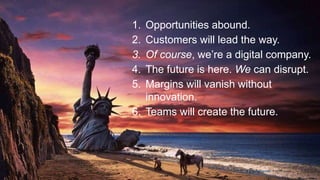
1. Opportunities abound.
2. Customers will lead the way.
3. Of course, we’re a digital company.
4. The future is here. We can disrupt.
5. Margins will vanish without
innovation.
6. Teams will create the future.
CX at Prudential. 3 techniques.
8
Focus on the Customer
Reasons for CX are understood, but how do we
start transforming our digital experiences into
ones our customers want and our businesses
need to grow?
CX at Prudential. 3 techniques.
9
What we’ve learned
Get Strategic
Adopt a strategic mindset at all levels
Design Sprint
Collaborate and test your boldest ideas
Become Agile
Embrace agility and experimentation
CX at Prudential. 3 techniques.
10
Technique 1: 3 Boxes / 3
Horizons
• Get Strategic. Take a bird’s eye view.
CX at Prudential. 3 techniques
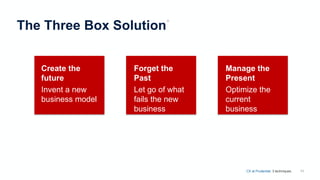
The Three Box Solution*
11
Create the
future
Invent a new
business model
Forget the
Past
Let go of what
fails the new
business
Manage the
Present
Optimize the
current
business
CX at Prudential. 3 techniques.
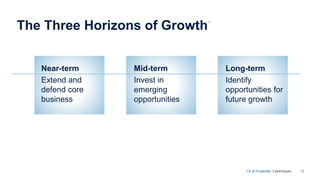
The Three Horizons of Growth*
12
Near-term
Extend and
defend core
business
Mid-term
Invest in
emerging
opportunities
Long-term
Identify
opportunities for
future growth
CX at Prudential. 3 techniques.
13
• You must destroy in order to create.
• A balance must be struck between the
three boxes / horizons.
• Measure opportunities by different
financial yardsticks.
3 Box/Horizon takeaways
CX at Prudential. 3 techniques.
14
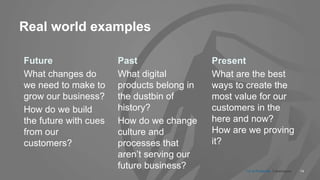
Real world examples
Future
What changes do
we need to make to
grow our business?
How do we build
the future with cues
from our
customers?
Past
What digital
products belong in
the dustbin of
history?
How do we change
culture and
processes that
aren’t serving our
future business?
Present
What are the best
ways to create the
most value for our
customers in the
here and now?
How are we proving
it?
CX at Prudential. 3 techniques.
15
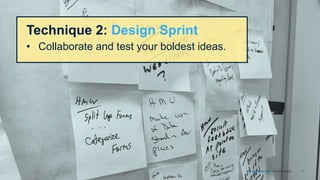
Technique 2: Design Sprint
• Collaborate and test your boldest ideas.
CX at Prudential. 3 techniques.
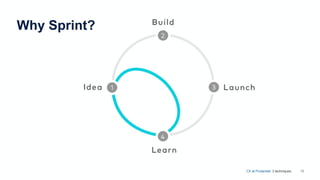
Why Sprint?
16CX at Prudential. 3 techniques.
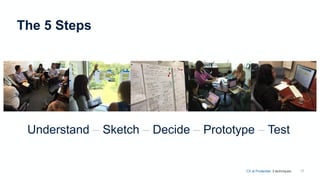
17
Understand – Sketch – Decide – Prototype – Test
The 5 Steps
CX at Prudential. 3 techniques.
18
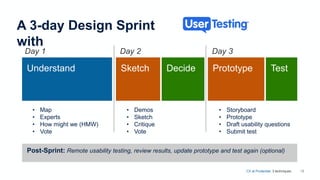
A 3-day Design Sprint
with
Understand Sketch Decide Prototype Test
Day 1 Day 2 Day 3
CX at Prudential. 3 techniques.
• Map
• Experts
• How might we (HMW)
• Vote
• Demos
• Sketch
• Critique
• Vote
• Storyboard
• Prototype
• Draft usability questions
• Submit test
Post-Sprint: Remote usability testing, review results, update prototype and test again (optional)
19
Real world examples
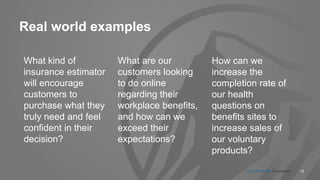
What kind of
insurance estimator
will encourage
customers to
purchase what they
truly need and feel
confident in their
decision?
What are our
customers looking
to do online
regarding their
workplace benefits,
and how can we
exceed their
expectations?
How can we
increase the
completion rate of
our health
questions on
benefits sites to
increase sales of
our voluntary
products?
CX at Prudential. 3 techniques.
20
Technique 3: Lean UX
• Embrace agility and experimentation.
CX at Prudential. 3 techniques.
21
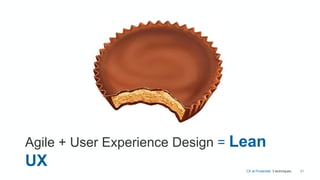
Agile + User Experience Design = Lean
UX CX at Prudential. 3 techniques.
The Lean UX process
22
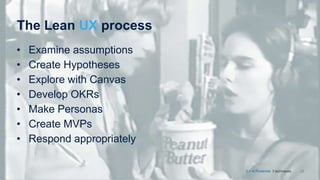
• Examine assumptions
• Create Hypotheses
• Explore with Canvas
• Develop OKRs
• Make Personas
• Create MVPs
• Respond appropriately
CX at Prudential. 3 techniques.
23CX at Prudential. 3 techniques.
24
Real world examples
We’re achieving
positive results on
complex pilot
projects where
experimentation is
critical. 
We’ve only begun
our journey.
Structures and
attitudes still
privilege
capabilities over
outcomes. 
We’re achieving
great success with
remote,
unmoderated
testing. UserTesting
synchs easily with
short sprint cycles.

CX at Prudential. 3 techniques.
25
Questions &
Comments
CX at Prudential. 3 techniques.
Get Strategic
Adopt a strategic mindset at all levels
Design Sprint
Collaborate and test your boldest ideas
Become Agile
Embrace agility and experimentation
Presentation Title Edit in Slide Master 26
Thank You!
For more information or if you have any additional
questions please contact:
webinars@usertesting.com

3 Digital Transformation Strategies Driving CX

  • 1.
    John Consigli &Lija Hogan CX at Prudential: 3 techniques that drive digital transformation Prudential Workplace Solutions Group; Digital Products April 25, 2018
  • 2.
    CX at Prudential.3 techniques. 2 John Consigli john.consigli@prudential.com Lija Hogan Ihogan@usertesting.com
  • 3.
    3CX at Prudential.3 techniques. The Challenge
  • 4.
    4 B 2 B2 C Bad Attitudes CX at Prudential. 3 techniques.
  • 5.
    5 1. It’s azero sum game. 2. Clients matter. Customers don’t. 3. We’re not a digital company. 4. Disruption is far off. It’s beyond control. 5. Margins are too slim to innovate. 6. I’m powerless to change. CX at Prudential. 3 techniques.
  • 6.
    6CX at Prudential.3 techniques.
  • 7.
    7 1. Opportunities abound. 2.Customers will lead the way. 3. Of course, we’re a digital company. 4. The future is here. We can disrupt. 5. Margins will vanish without innovation. 6. Teams will create the future. CX at Prudential. 3 techniques.
  • 8.
    8 Focus on theCustomer Reasons for CX are understood, but how do we start transforming our digital experiences into ones our customers want and our businesses need to grow? CX at Prudential. 3 techniques.
  • 9.
    9 What we’ve learned GetStrategic Adopt a strategic mindset at all levels Design Sprint Collaborate and test your boldest ideas Become Agile Embrace agility and experimentation CX at Prudential. 3 techniques.
  • 10.
    10 Technique 1: 3Boxes / 3 Horizons • Get Strategic. Take a bird’s eye view. CX at Prudential. 3 techniques
  • 11.
    The Three BoxSolution* 11 Create the future Invent a new business model Forget the Past Let go of what fails the new business Manage the Present Optimize the current business CX at Prudential. 3 techniques.
  • 12.
    The Three Horizonsof Growth* 12 Near-term Extend and defend core business Mid-term Invest in emerging opportunities Long-term Identify opportunities for future growth CX at Prudential. 3 techniques.
  • 13.
    13 • You mustdestroy in order to create. • A balance must be struck between the three boxes / horizons. • Measure opportunities by different financial yardsticks. 3 Box/Horizon takeaways CX at Prudential. 3 techniques.
  • 14.
    14 Real world examples Future Whatchanges do we need to make to grow our business? How do we build the future with cues from our customers? Past What digital products belong in the dustbin of history? How do we change culture and processes that aren’t serving our future business? Present What are the best ways to create the most value for our customers in the here and now? How are we proving it? CX at Prudential. 3 techniques.
  • 15.
    15 Technique 2: DesignSprint • Collaborate and test your boldest ideas. CX at Prudential. 3 techniques.
  • 16.
    Why Sprint? 16CX atPrudential. 3 techniques.
  • 17.
    17 Understand – Sketch– Decide – Prototype – Test The 5 Steps CX at Prudential. 3 techniques.
  • 18.
    18 A 3-day DesignSprint with Understand Sketch Decide Prototype Test Day 1 Day 2 Day 3 CX at Prudential. 3 techniques. • Map • Experts • How might we (HMW) • Vote • Demos • Sketch • Critique • Vote • Storyboard • Prototype • Draft usability questions • Submit test Post-Sprint: Remote usability testing, review results, update prototype and test again (optional)
  • 19.
    19 Real world examples Whatkind of insurance estimator will encourage customers to purchase what they truly need and feel confident in their decision? What are our customers looking to do online regarding their workplace benefits, and how can we exceed their expectations? How can we increase the completion rate of our health questions on benefits sites to increase sales of our voluntary products? CX at Prudential. 3 techniques.
  • 20.
    20 Technique 3: LeanUX • Embrace agility and experimentation. CX at Prudential. 3 techniques.
  • 21.
    21 Agile + UserExperience Design = Lean UX CX at Prudential. 3 techniques.
  • 22.
    The Lean UXprocess 22 • Examine assumptions • Create Hypotheses • Explore with Canvas • Develop OKRs • Make Personas • Create MVPs • Respond appropriately CX at Prudential. 3 techniques.
  • 23.
    23CX at Prudential.3 techniques.
  • 24.
    24 Real world examples We’reachieving positive results on complex pilot projects where experimentation is critical.  We’ve only begun our journey. Structures and attitudes still privilege capabilities over outcomes.  We’re achieving great success with remote, unmoderated testing. UserTesting synchs easily with short sprint cycles.  CX at Prudential. 3 techniques.
  • 25.
    25 Questions & Comments CX atPrudential. 3 techniques. Get Strategic Adopt a strategic mindset at all levels Design Sprint Collaborate and test your boldest ideas Become Agile Embrace agility and experimentation
  • 26.
    Presentation Title Editin Slide Master 26 Thank You! For more information or if you have any additional questions please contact: webinars@usertesting.com

Editor's Notes

  • #2 Tips: Plan everything ahead of time. When will Lija speak? Pick up the Energy every 5-7 minutes by adding room for Lija to participate. Have notes on the side. Have water in covered container. Avoid dairy. Think about speaking slowly. Presentation Manager: Log in about 20 mins before. Allow 15 mins for Q&A and room for Lija Alex presses chat button Click yellow buttons to forward / back Note – there’s a slight delay – so remember to pause
  • #3 Hi! I’m John Consigli, and I’m responsible for transforming the transactional and public websites and tools for Prudential’s Group Insurance Business. I’m happy to present this topic today, because I expect that a lot of us will be in this boat: Transforming our digital presence to grow our businesses and make the world a better place. Hi, I’m Lija Hogan, and I am part of the Professional services leadership team here at UserTesting. I partner with customers like John to help answer key business questions and understand customers needs.
  • #4 When I joined Prudential around 3 years ago, the sites and tools I inherited were old: Stop me if this sounds familiar: The sites were essentially untouched for a decade or so and had no official owner They weren’t designed by designers and weren’t tested with customers. Some of the architecture was mainframe: That means pre-internet! How did we get to this point?
  • #5 Now, this scenario may not be common to you your business, but it’s not uncommon in the world of B2B2C. That’s: Business to Business to Consumer. I’ve been in this environment for 15 years, and I can tell you: The biggest obstacle to our success is our culture. Let’s look at how certain attitudes create a culture that’s bad for business.
  • #6 Let’s break it apart: The market is closed with no new opportunities. Our clients purchase our service for their customers. Ipso facto: There’s no reason to do anything special for the end user. We don’t sell digital experiences. We sell X commodity. Ipso facto – we’re not a digital company. We’re too big to fail. We’ll probably be disrupted at some point in the distant future, but who knows how or when? Our revenue is big, but our profits are small. Investing in anything other than short-term success is too risky. And finally: No one else here cares, so why bother?
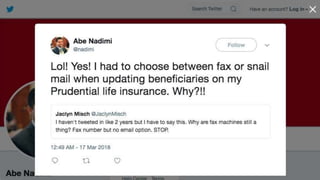
  • #7 Well, customers are paying attention. This is a great example. These two are having a great time poking fun of our B2B2C attitude. We’re lucky they have a sense of humor. A lot of our customers don’t think it’s funny. This is essentially a warning sign.
  • #8 Open up Photoshop and put your company’s logo on the left. This is where bad culture will lead you. The truth is: There’s never been a better time in history for creating new markets. We know that customer-led design makes the best digital experiences. You’re already a digital company. Just ask your customers and your IT departments. As William Gibson said: The future is already here — it's just not very evenly distributed. AND I’d add that we have an obligation to innovate for the future. The margin on lost business is zero. And finally, You’re not powerless to change. Team up with others who also want change.
  • #9 The reasons for Customer Experience are obvious. Companies that focus on the customer clearly outperform those that don’t. Customers will make or break our business. But – where do we start and how do get to where we need to be?
  • #10 We’re going to be taking a look at 3 different techniques that have been brewing for a few years and were published a couple of years ago: They are: “The Three-box Solution” by Vijay Govindarajan “Sprint” by Jake Knapp, John Zeratsky, and Braden Kowitz And “LeanUx” by Jeff Gothelf and Josh Seiden Lija: This is a great way to frame this conversation, John. I know that a lot of people that I work with are using at least one of these techniques - and probably more than one. Since we’re all here today, let’s get a sense of who is using these techniques now - and follow up at the end of the call with the stats. Poll: How many of you on the line have used any of these? The 3 Box Solution Design Sprints Lean UX
  • #11 The first technique is the 3-box Solution. It’s similar to McKinsey’s “3-horizons of growth” so we’ll take a quick look at both. The point is that we’ll need to adopt a strategic mindset all levels to make our businesses thrive now and in the future.
  • #12 The three box solution – by Vijay Govindarajan is a simple way to ensure that you’re doing all you can to help grow your business. The method works at all decision levels – from the CEO to the PO (Product Owner) The idea is that you need to strike a balance between the future, past, and present. Box 1 is where you create the future: Invest in a NEW business model. This is where you’ll experiment, get cues from customers, and measure quality. Box 2 is where you forget the past: You’ll need to “destroy” the things that will cause your new business to fail. This box is about changing culture and creating space. This is where you’ll make tough decisions and you should expect some resistance. Box 3 is where you manage the present. This is an essential activity, but it’s where most companies put too many of their eggs. Here, you’ll optimize your current business by focusing on improvement. You’ll want to set ambitious goals and measure success.
  • #13 The 3-Box model is similar to McKinsey’s “3-Horizons of Growth.” McKinsey discovered that successful companies keep all three horizons in sight when they plan, and they measure value differently for each. Near-term – The focus is on optimizing your current platform. Here, you’ll be measuring Return on Invested Capital – or the efficiency of an investment. There’s no “destroy” box, but there’s a Mid-term horizon. To succeed here, you’ll need to acquire or develop emerging capabilities. Here, you’ll be measuring Net Present Value – or the cash flow of an investment. Long-term, Innovation needs to take place in order for a company to truly succeed on that horizon. Here, you’ll be discovering and inventing capabilities that don’t yet exist. You’ll measure the quality of your options that allow your business to adapt and to flourish. Lija:The second box is probably the biggest challenge businesses face - changing culture and creating space. What are some of the things that you have been able to do as an organization that started you down the path to changing culture? What did you do to create space?  
  • #14 John: Sure! Here are some of our key takeaways: You have to destroy in order to create. A balance must be struck between the three boxes or horizons. And it’s especially important to measure your opportunities by different financial yardsticks: A lot of the time, we’re asked to provide ROI, but that’s a bad way to measure emerging opportunities, and it’s the absolute wrong way to estimate the value your innovations.
  • #15 These are some important questions our teams continually ask themselves thanks to the 3 boxes. I won’t read these out loud, but we’re always thinking about these three boxes and horizons and keeping them in balance. We never stop innovating. We don’t outsource this activity to agencies or leave it to special innovation teams. We’re always considering what we need to get rid of in terms of our products or mindset. In the Present: we’re thinking about how we can supercharge ease of doing business and engagement: Both of which we measure. Lija:When thinking about measuring value, what were your considerations? Who did you work with to create the measures? How is that information shared throughout the organization?
  • #16 The second technique is the Design Sprint. Design Sprints are great way to truly and quickly innovate by tapping into the amazing minds of the people around you. It’s how we “insource” our innovation.
  • #17 Google’s Design Sprint framework is perfect for tackling important business problems. It’s a bullet-proof, time-boxed design framework that anyone can use. As the diagram shows: You skip “build and launch” to learn faster with less attachment and bias.
  • #18 Here’s how it works: A facilitator brings together experts close to the problem for a series of consecutive days. In the Understand phase, the team diverges and converges to define a long-term goal, and to align on important challenges and opportunities. Sprinters diverge again in the sketch phase where everyone produces an idea that stands on it’s own merit. In the Decide phase, the ideas are evaluated, discussed, and the team converges on the most promising concepts. Everyone pitches in during the prototype phase to quickly create a realistic prototype and test script. Finally, the prototype is tested in front of a small group of subjects and the team learns what works and what doesn’t. It works amazingly well, and people love doing it. If nothing else, it’s a big culture changer!
  • #19 We’ve made some adaptations along the way: Sprints are 5 days, but we’ve found that shorter, 3-day sprints are more realistic for big companies. Google happens to agree. Their sprints now range from 5 days to as short as 1 day. We’ve replaced finding subjects on Craigslist (which used to terrify my boss) with UserTesting. Lija: How has UserTesting been a culture changer for you? Yes, so tell us a little about how you use UserTesting. UserTesting allows sprintmasters to shave time and conserve resources. It’s great that we can access subjects in their natural environment from different regions. And, spreadsheets, notes, and drag-and-drop video allow teams to share findings and continue their alignment. Leja: How would you summarize what Sprints help you to achieve? John: The learning is priceless. You get fast alignment on: An ambitious long-term goal Your greatest challenges Your biggest opportunities A realistic prototype of the team’s “best shot” And honest customer reactions to that idea.
  • #20 These are just 3 examples of the many sprints we’ve held. We got great answers to each of these big questions. Lija: Which one of these was yielded the biggest surprise to you? What kind of insurance estimator will encourage customers to purchase what they truly need and feel confident in their decision? What are our customers looking to do online regarding their workplace benefits, and how can we exceed their expectations? How can we increase the completion rate of our health questions on benefits sites to increase sales of our voluntary products?
  • #21 Our third, last but nor least technique is “Lean UX” by Eric Gothelf and Josh Seiden. Through Lean UX, we’re teaching the company to move away from the manufacturing mentality. We’re teaching ourselves to embrace agility and experimentation. Here, it’s important to value of the strategic contributions of your scrum teams, protect their autonomy, and make the User Experience part of their DNA.
  • #22 It’s like those old Reeses ads where chocolate and peanut butter come together. Agile is great because collaborative teams regularly deliver valuable software to customers. UX is great because it encourages customer-focused experimentation and learning. But, Alas, Agile and UX Design are often separated. Agile teams often expect fully designed UIs up front, and tend to focus on the development process. UX designers often work ahead of the sprint cycle and in isolation from engineering and product folks.
  • #23 The Lean UX framework changes all that. The team collectively examines underlying product and business assumptions They create Hypotheses Statements They work out and align on their greatest opportunities using a Lean canvas. (There’s one specifically for Lean UX) They develop OKRs (Objectives and Key Results.) They create and use personas to help identify needs and obstacles.   They create MVPs (Which aren’t always software!) to test their hypothesis statements. They carry the learning forward: They reprioritize and respond as needed.
  • #24 (OK, this is my last movie reference) So, what’s so great about Lean UX? Well, the technique helps you to unleash the full strategic and design potential of scrum team members. It’s like when Luke Skywalker lifts the X-wing out of the swamp. ;-) It’s focus on early validation with customers ensures you’re building the right products. The whole team measures success and failure along the axes of usability and business outcomes. Think about how valuable that is to the company! Lija; So, my students often ask me about how you balance the needs of users and business goals; as designers and researchers, out primary goal is to advocate for users, but you’re doing a balancing act in a corporate setting - and that can be tricky. How you strike the right balance between user needs and wants and hitting your business goals.
  • #25 We’re achieving positive results on complex pilot projects where experimentation is critical. We’ve only begun our journey. Structures and attitudes still privilege capabilities over outcomes. We’re achieving great success with remote, unmoderated testing. UserTesting synchs easily with short sprint cycles. Lija: John, Yes, I know that you rave about UserTesting and how it’s really helped this process. Can you tell us a little about that?  Yes! the benefits of UserTesting are tremendous here: Proto-personas can really be brought to life! One of our personas was a nurse from Tennessee, and we were actually able to find her and similar folks. UserTesting artifacts are essential in the communication necessary to make LeanUX work: Lean UX really depends on transparency and socializing the learning: UserTesting really allows that to happen with all it’s great artifacts like spreadsheets and video. Leja – thanks for the presentation and thanks!
  • #26 Seed Questions: You mentioned that these techniques really help the culture. Can you explain a little further? How mature you are as an agile practice? Can Agile and Waterfall be blended together? I’m not familiar with OKRs. Can you explain a little bit more about what they are and how you use them?