I Year B.Ed - CORE 3
LEARNING AND TEACHING
Ms R SRIDEVI
Assistant Professor, Pedagogy of Mathematics,
Loyola College of Education
Chennai 34
UNIT III
BEHAVOURIAL THEORIES OF
LEARNING
Classical Conditioning (Pavlov)
& Watson conditioning theory
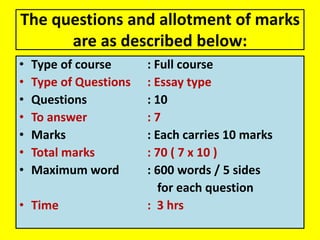
The questions and allotment of marks
are as described below:
• Type of course : Full course
• Type of Questions : Essay type
• Questions : 10
• To answer : 7
• Marks : Each carries 10 marks
• Total marks : 70 ( 7 x 10 )
• Maximum word : 600 words / 5 sides
for each question
• Time : 3 hrs
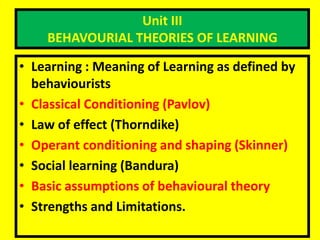
Unit III
BEHAVOURIAL THEORIES OF LEARNING
• Learning : Meaning of Learning as defined by
behaviourists
• Classical Conditioning (Pavlov)
• Law of effect (Thorndike)
• Operant conditioning and shaping (Skinner)
• Social learning (Bandura)
• Basic assumptions of behavioural theory
• Strengths and Limitations.
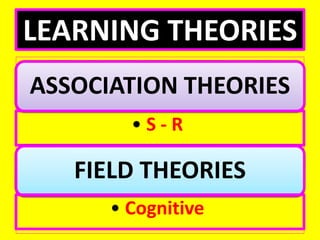
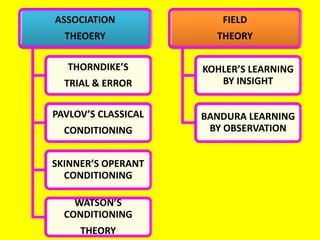
LEARNING THEORIES
ASSOCIATION THEORIES
• S - R
FIELD THEORIES
• Cognitive
ASSOCIATION
THEOERY
THORNDIKE’S
TRIAL & ERROR
PAVLOV’S CLASSICAL
CONDITIONING
SKINNER’S OPERANT
CONDITIONING
WATSON’S
CONDITIONING
THEORY
FIELD
THEORY
KOHLER’S LEARNING
BY INSIGHT
BANDURA LEARNING
BY OBSERVATION
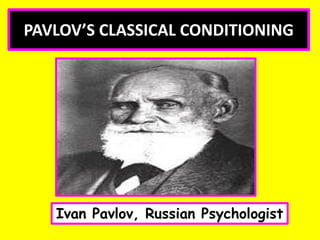
PAVLOV’S CLASSICAL CONDITIONING
Ivan Pavlov, Russian Psychologist
• Pavlov conducted a number of
experiments on dogs to study how the
stimuli and responses are associated.
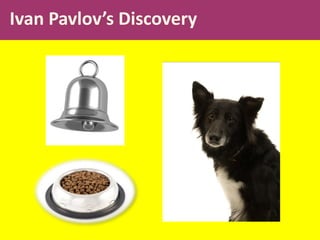
Ivan Pavlov’s Discovery
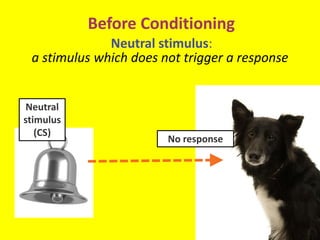
Before Conditioning
No response
Neutral
stimulus
(CS)
Neutral stimulus:
a stimulus which does not trigger a response
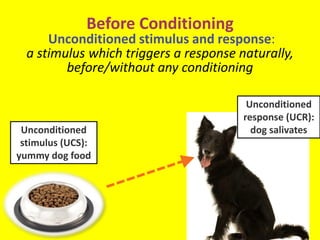
Unconditioned
response (UCR):
dog salivates
Unconditioned
stimulus (UCS):
yummy dog food
Before Conditioning
Unconditioned stimulus and response:
a stimulus which triggers a response naturally,
before/without any conditioning
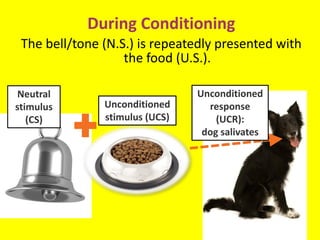
Unconditioned
response
(UCR):
dog salivates
Neutral
stimulus
(CS)
Unconditioned
stimulus (UCS)
During Conditioning
The bell/tone (N.S.) is repeatedly presented with
the food (U.S.).
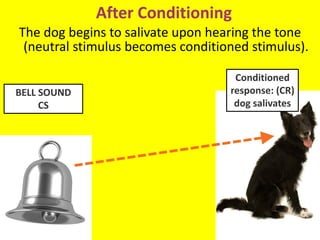
Conditioned
response: (CR)
dog salivates
After Conditioning
BELL SOUND
CS
The dog begins to salivate upon hearing the tone
(neutral stimulus becomes conditioned stimulus).
Ivan Pavlov’s Discovery
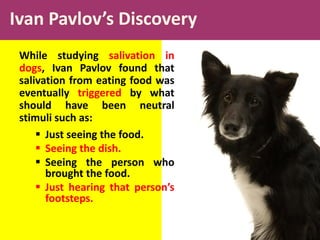
While studying salivation in
dogs, Ivan Pavlov found that
salivation from eating food was
eventually triggered by what
should have been neutral
stimuli such as:
 Just seeing the food.
 Seeing the dish.
 Seeing the person who
brought the food.
 Just hearing that person’s
footsteps.
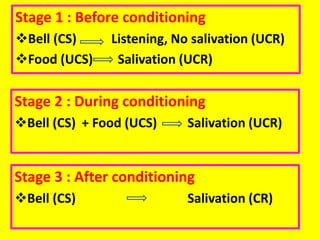
Stage 1 : Before conditioning
Bell (CS) Listening, No salivation (UCR)
Food (UCS) Salivation (UCR)
Stage 2 : During conditioning
Bell (CS) + Food (UCS) Salivation (UCR)
Stage 3 : After conditioning
Bell (CS) Salivation (CR)
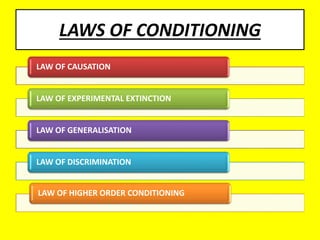
LAWS OF CONDITIONING
LAW OF CAUSATION
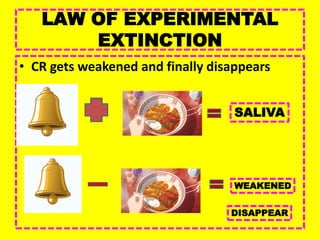
LAW OF EXPERIMENTAL EXTINCTION
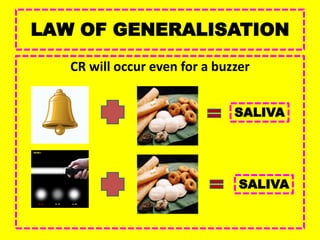
LAW OF GENERALISATION
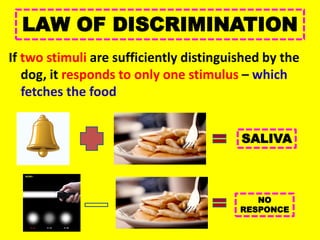
LAW OF DISCRIMINATION
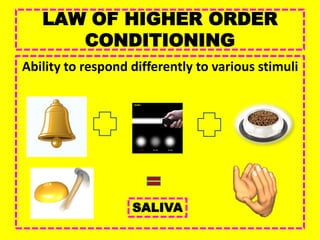
LAW OF HIGHER ORDER CONDITIONING
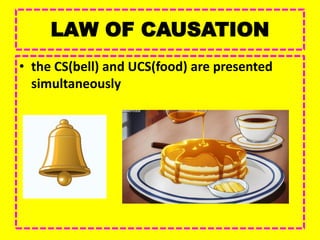
LAW OF CAUSATION
• the CS(bell) and UCS(food) are presented
simultaneously
LAW OF EXPERIMENTAL
EXTINCTION
• CR gets weakened and finally disappears
SALIVA
WEAKENED
DISAPPEAR
LAW OF GENERALISATION
CR will occur even for a buzzer
SALIVA
SALIVA
LAW OF DISCRIMINATION
If two stimuli are sufficiently distinguished by the
dog, it responds to only one stimulus – which
fetches the food
SALIVA
NO
RESPONCE
LAW OF HIGHER ORDER
CONDITIONING
Ability to respond differently to various stimuli
SALIVA
WATSON’S CONDITIONING
THEORY
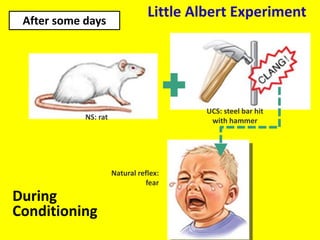
• Using Classical Conditioning Model, he made
a research on children’s emotion.
• According to Watson, human normally inherit
three kinds of basic emotions :
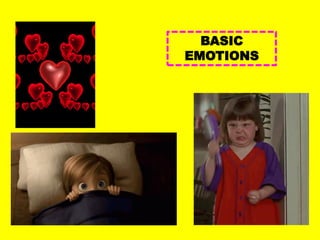
BASIC
EMOTIONS
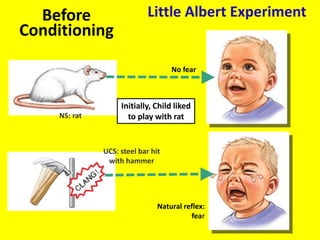
Before
Conditioning
NS: rat
No fear
UCS: steel bar hit
with hammer
Natural reflex:
fear
Little Albert Experiment
Initially, Child liked
to play with rat
During
Conditioning
NS: rat
UCS: steel bar hit
with hammer
Natural reflex:
fear
Little Albert Experiment
After some days
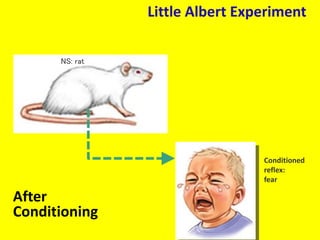
After
Conditioning
NS: rat
Conditioned
reflex:
fear
Little Albert Experiment
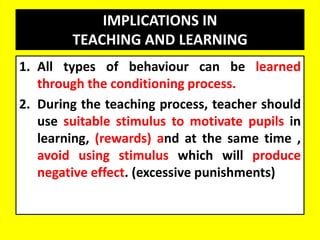
IMPLICATIONS IN
TEACHING AND LEARNING
1. All types of behaviour can be learned
through the conditioning process.
2. During the teaching process, teacher should
use suitable stimulus to motivate pupils in
learning, (rewards) and at the same time ,
avoid using stimulus which will produce
negative effect. (excessive punishments)
3. core 3 unit 3 pavlov and watson theory

3. core 3 unit 3 pavlov and watson theory