1 | P a g e
CHAPTER 1
INTRODUCTION
2 | P a g e
Introduction
India endowed with an abundant availability of natural fiber such as jute, pineapple, bamboo,
banana etc. has focused on the development of natural fiber composites primarily to explore
value-added application avenues. Such natural fiber composites are well suited as wood
substitutes in the housing and construction sector. The development of natural fiber composites
in India is based on two pronged strategy of preventing depletion of forest resources as well as
ensuring good economic returns for the cultivation of natural fibers. The developments in
composite material after meeting the challenges of aerospace sector have cascaded down for
catering to domestic and industrial applications. Composites, the wonder material with light-
weight; high strength-to-weight ratio and stiffness properties have come a long way in
replacing the conventional materials like metals, wood etc. The material scientists all over the
world focused their attention on natural composites reinforced with jute, pineapple etc.
primarily to cut down the cost of raw materials.
3 | P a g e
1.1 ABOUT BAMBOO COMPOSITS
Bamboo or Bambusa in botanical has 7-10 subfamilies of genres and there are 1575 difference
species ranging from the type of wood to bamboo herb. However, each particular species of bamboo
has different properties and qualities. Bamboo is easily accessible globally, 64% of bamboo
plantation, as can be seen below, originated from Southeast Asia, 33% grown in South America,
and the rest comes from Africa and Oceania. Bamboo productions dated back to thousands of years
ago and thus they are rich with traditional elements. Bamboo naturally, suitable for varieties of uses
and benefits.
Bamboo as the great potential to be used as solid wood substitute materials, especially in the
manufacturing, design, and construction usage. Bamboo properties of being lightweight and high-
strength has attracted researchers to investigate and explore, especially in the field of bio-composite
bamboo and is acknowledged as one of the green-technology that is fully responsible for eco-
products on the environment. Agricultural biomass solid wood made from bamboo have been
identified by many researchers as the largest source of natural fibre and cellulose fibre bio
composite, which are provided at minimal cost and will bring a new evolution into production chain
and manufacturing world.
High elasticity and strength of bamboo are suitable for the construction industry, and bamboo has
proven to serve as a foundation structure. The creation of bio-composite fibre board is also used in
wall construction and are potentially to contribute of making cost effective home possible. [9] Use
of bio-composite material is seen increasingly high and the use bamboo as an alternative can be seen
in productions such as furniture, automotive and other related productions. The natural colours of
bamboo is unique compared to solid wood and other materials. In fact, the effect of the texture and
tie on the outer skin of bamboo has the exotic value and at the same time creates a unique identity
in the design, particularly furniture.
4 | P a g e
1.2 THE ANATOMICAL STRUCTURE OF BAMBOO
Bamboo culms are hollow, and every culm from inner side is divided by several diaphragms which
are seen as rings on the outside. The part between two rings is called “Internode” where branches
grow. Distance between each node varies and it depends on the type of the species. The
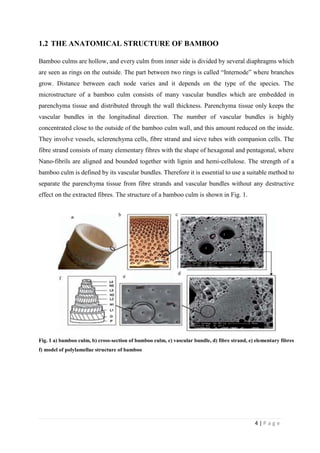
microstructure of a bamboo culm consists of many vascular bundles which are embedded in
parenchyma tissue and distributed through the wall thickness. Parenchyma tissue only keeps the
vascular bundles in the longitudinal direction. The number of vascular bundles is highly
concentrated close to the outside of the bamboo culm wall, and this amount reduced on the inside.
They involve vessels, sclerenchyma cells, fibre strand and sieve tubes with companion cells. The
fibre strand consists of many elementary fibres with the shape of hexagonal and pentagonal, where
Nano-fibrils are aligned and bounded together with lignin and hemi-cellulose. The strength of a
bamboo culm is defined by its vascular bundles. Therefore it is essential to use a suitable method to
separate the parenchyma tissue from fibre strands and vascular bundles without any destructive
effect on the extracted fibres. The structure of a bamboo culm is shown in Fig. 1.
Fig. 1 a) bamboo culm, b) cross-section of bamboo culm, c) vascular bundle, d) fibre strand, e) elementary fibres
f) model of polylamellae structure of bamboo
5 | P a g e
1.3 DEFINATION OF COMPOSITE
The most widely used meaning is the following one, which has been stated by Jartiz [1965]
“Composites are multifunctional material systems that provide characteristics not obtainable
from any discrete material. They are cohesive structures made by physically combining two or
more compatible materials, different in composition and characteristics and sometimes in
form”. Kelly [1967] very clearly stresses that the composites should not be regarded simple as
a combination of two materials. In the broader significance; the combination has its own
distinctive properties. In terms of strength to resistance to heat or some other desirable quality,
it is better than either of the components alone or radically different from either of them.
Beghezan [1966] defines as “The composites are compound materials which differ from alloys
by the fact that the individual components retain their characteristics but are so incorporated
into the composite as to take advantage only of their attributes and not of their short comings”,
in order to obtain improved materials. [1] J.Van Suchtelen [1972] explains composite materials
as heterogeneous materials consisting of two or more solid phases, which are in intimate
contact with each other on a microscopic scale. They can be also considered as homogeneous
materials on a microscopic scale in the sense that any portion of it will have the same physical
property.
1.4 CHARACTERISTICS OF THE COMPOSITES
Composites consist of one or more discontinuous phases embedded in a continuous phase. The
discontinuous phase is usually harder and stronger than the continuous phase and is called the
‘reinforcement’ or ‘reinforcing material’, whereas the continuous phase is termed as the
‘matrix’. Properties of composites are strongly dependent on the properties of their constituent
materials, their distribution and the interaction among them. The composite properties may be
the volume fraction sum of the properties of the constituents or the constituents may interact in
a synergistic way resulting in improved or better properties. Apart from the nature of the
constituent materials, the geometry of the reinforcement (shape, size and size distribution)
influences the properties of the composite to a great extent. The concentration distribution and
orientation of the reinforcement also affect the properties. The shape of the discontinuous phase
(which may by spherical, cylindrical, or rectangular cross-sectioned prisms or platelets), the
size and size distribution (which controls the texture of the material) and [10] volume fraction
6 | P a g e
determine the interfacial area, which plays an important role in determining the extent of the
interaction between the reinforcement and the matrix.
1.5 COMPONENTS OF A COMPOSITE MATERIAL
In its most basic form a composite material is one, which is composed of at least two elements
working together to produce material properties that are different to the properties of those
elements on their own. In practice, most composites consist of a bulk material (the ‘matrix’),
and a reinforcement of some kind, added primarily to increase the strength and stiffness of the
matrix.
 Matrix -Many materials when they are in a fibrous form exhibit very good strength
property but to achieve these properties the fibres should be bonded by a suitable
matrix. The matrix isolates the fibres from one another in order to prevent abrasion and
formation of new surface flaws and acts as a bridge to hold the fibres in place. A good
matrix should possess ability to deform easily under applied load, transfer the load onto
the fibres and evenly distributive stress concentration.
 Reinforcement-The role of the reinforcement in a composite material is fundamentally
one of increasing the mechanical properties of the neat resin system. All of the different
fibres used in composites have different properties and so affect the properties of the
composite in different ways. For most of the applications, the fibres need to be arranged
into some form of sheet, known as a fabric, to make handling possible. Different ways
for assembling fibres into sheets and the variety of fibre orientations possible to achieve
different characteristics.
 Interface-It has characteristics that are not depicted by any of the component in
isolation. Then interface is a bounding surface or zone where a discontinuity occurs,
whether physical, mechanical, chemical etc. The matrix material must “wet” the fibres.
Well “wetted” fibres increase the interface surfaces area. To obtain desirable properties
in a composite, the applied load should be effectively transferred from the matrix to the
fibres via the interface. This means that the interface must be large and exhibit strong
7 | P a g e
adhesion between fibres and matrix. Failure at the interface (called deboning) may or
may not be desirable.
1.6 CLASSIFICATIONS
Composite materials can be classified into many categories depending on the type of matrix
material, reinforcing material type etc. According to the type of matrix material they can be
classified as follows:
 Metal matrix type composites: MMC are composed of a metallic matrix (Al, Mg, Fe,
Co, Cu)
 Ceramic matrix composites: CMC is a material consisting of a ceramic combined with
a ceramic dispersed phase.
 Polymer matrix material: PMC are composed of a matrix from thermosetting
(unsaturated polyester, epoxy) or thermoplastic (nylon, polystyrene) and embedded
glass carbon, steel or Kerler fibres (dispersed phase).
 Particle composites- particle reinforced composites consist of a matrix reinforced by a
dispersed phase in the form of particles. It can be either of random orientation or
preferred orientation.
 Fibrous composite-.Short fibre: they consist of a matrix reinforced by a dispersed phase
in the form of discontinuous fibres either of random or preferred orientations.
 Long fibre- they consist of a matrix reinforced by a dispersed phase in the form of
continuous fibres. They can be either unidirectional or bidirectional.
 Laminate composites- when a fibre reinforced composite consists of several layers with
different fibre orientations, it is called multilayer composite.
8 | P a g e
Apart from that the two broad classes of composites are (1) Particulate composites and (2)
Fibrous composites. Fibrous Composite-A fibre is characterized by its length being much
greater compared to its cross-sectional dimensions. The dimensions of the reinforcement
determine its capability of contributing its properties to the composite. Man-made filaments or
fibres of non-polymeric materials exhibit much higher strength along their length since large
flaws, which may be present in the bulk material, are minimized because of the small cross-
sectional dimensions of the fibre. In the case of polymeric materials, orientation of the
molecular structure is responsible for high strength and stiffness. Fibres, because of their small
cross-sectional dimensions, are not directly usable in engineering applications. They are,
therefore, embedded in matrix materials to form fibrous composites.
9 | P a g e
CHAPTER 2
LITERATURE REVIEW
10 | P a g e
LITERATURE REVIEW
Composites have been a field of great interest in the last two decades and a lot of researchers
are working in this area. This becomes very important to discuss the prominent works related
to the polymer composites and their properties. The purpose of literature review is to provide
background information on the issues to be considered in this thesis and to emphasize the
relevance of the present study. Various aspects of polymer composites have been considered
with reference to development as well as characterization of polymer composites. Existing
literature related to the physical and chemical properties of the composites have been reviewed
and a special emphasis has been given to erosion wear characteristics. Knowledge gap in the
earlier investigations has been presented to outline the need and objectives of the present work.
11 | P a g e
2.1 BAMBOO FIBRE REINFORCED POLYMER COMPOSITES
Natural fibre reinforced polymer composites have raised a great attention and interest among
scientists and engineers in recent years due to the consideration of developing environmental
friendly materials. They are high specific strength and modulus materials, low priced,
recyclable and are easily available. It is known that natural fibres are non-uniform with
irregular cross sections which make their structures quite unique and much different with man-
made fibres such as glass fibres, carbon fibres etc. [11] various researchers have worked on the
natural fibres containing polyolefin, and polystyrene, polyester and epoxy resins. Properties
like low cost, light-weight, high specific strength, free from health hazard are the unique selling
points of these composites. Though the presence of hydroxyl and other polar groups in the
natural fibres leads to the weak interfacial bonding between the fibres and the hydrophobic
polymers, these properties can be significantly improved by interfacial treatment. Among the
various natural fibres, bamboo fibre is a good candidate for use as natural fibres in composite
materials. Jindal [2] has observed that tensile strength of bamboo-fibre reinforced plastic
(BFRP) composite is comparatively equivalent to that of the mild steel, whereas their density
is only 12% of that of the mild steel. Hence, the BFRP composites can be extremely useful in
structural applications. Jain and Kumar [3] have investigated that a uniform strength can be
achieved in all directions of the composites by using multidirectional orientation of fibres.
Considerable interest has been generated in the manufacturing of thermoplastic composites due
to their good fracture toughness and thermal stability. Thermoplastic matrix composites
materials offer an extended solution in different applications in automotive industry,
construction, electrical appliances and home/urban furniture. Bio-degradable resins have
received a considerable attention as earth conscious materials in the present day engineering
society. They offer very little environmental load because they can be resolved in both water
and carbon dioxide after perfect biodegradation by micro-organisms. However, most of the
biodegradable resins have relatively low strength, making them a poor choice for the high
strength structural applications. Thus, a lot of research is focused to strengthen the
biodegradable resins by combining with string natural fibres like hemp, bamboo, pineapple etc.
12 | P a g e
2.2 MECHANICAL PROPERTIES OF COMPOSITES
The attractive physical and mechanical properties that can be obtained with bamboo fibre
reinforced composites, such as high specific modulus, strength and thermal stability, have been
well documented in the literature. Jain et al [4] have compared the Bamboo fibre reinforced
epoxy composites (BFRP) epoxy with Bamboo fibre reinforced unsaturated polyester
composites (BFRP) USP in terms of their cost and mechanical strength. Cost of unsaturated
polyester (USP) was found to be only 20% to that of the epoxy resin, whereas the mechanical
properties of these two composite were comparable. Thus giving an edge to the USP based
composites. BFRP composites have shown more elongation and 10% high tensile strength.
These composites can be used for a variety of commercial application such as crash helmet,
low cost housing and wind mills. Kumar et al [5] have studied the effect of coating bamboo
fibres with Polyurethane (PU) and Polyurethane/Polystyrene.
Interpenetrating Network (PU/PSIPN) on tensile property of the composites. Both the untreated
/ alkali treated bamboo fibres were coated with polyethylene glycol based PU and its semi inter
penetrating network (SIPN) with PS. It was found that tensile strength of bamboo has increased
after coating with PU and PU/PS system. PU/PS coating on alkali treated bamboo fibres has
shown a rise (74%) in the tensile load at break than PU (11%) coating on alkali treated fibre.
These improvements were due to enhanced interfacial adhesion between polymer matrix and
bamboo fibre. Results of enzymatic degradation showed that biodegradability could be
adjusted by controlling degree of interfacial adhesion using LDI. They have observed that these
bio-composites are beneficial in areas where biocompatibility and environmentally responsible
design and construction are required.
Takagi et al. have studied the effect of fibre content and fibre length on mechanical properties
of bamboo fibre reinforced green composites (BFGC). Fibre length up to 15mm has given
positive effect on tensile strength and flexural strength. It was observed that tensile strength
and flexural strength increase with increase in fibre content. Mechanical properties of BFGC
were similar to those composites made from bamboo powder and biodegradable resin. These
results showed that bamboo fibre with aspect ratio of 20 acts as filler and not the reinforcement.
Tokoro et al [6] have chosen three different categories of bamboo fibre to prepare Bamboo
fibre-Polylactic acid composites and investigate the method to improve mechanical properties
13 | P a g e
of BF/PLA composites. Three types of bamboo fibres were extracted from raw bamboo by
either NaOH treatment or steam explosion. Amongst them, Highest bending strength was
obtained when steam exploded filaments were put into PLA matrix. Impact strength was
improved when medium length fibre bundles were put into PLA. Thermal properties and heat
resistance of composite were improved by annealing. Authors have studied the impact of steam
explosion technique on mechanical properties of bamboo composites. Tensile strength and
Young modulus of steam exploded BFEC increased about 15% and 30% respectively in
comparison with conventional BFEC. Thwea and Liao [12] have fabricated the bamboo
reinforced polypropylene (BFRP) and bamboo-glass reinforced Polypropylene (BGRP)
composites. They have studied the effect of fibre content, fibre length, bamboo to glass ratio,
coupling agent (Maleate polypropylene) on tensile and flexural properties of these composites.
They have also studied the sorption behaviour and retention in mechanical properties of
composite after environmental aging. It was observed that flexural strength, flexural modulus
and tensile modulus increases with increase in bamboo fibre length. They have reported that
poor adhesion between the matrix/fibre decreased tensile strength at higher bamboo fibre
content in BFRP. Fibre content increased the void formation during processing, which further
leads to micro crack information under loading, hence reducing the tensile strength.
Incorporation of glass fibre and Compatilizers has improved the tensile strength and tensile
modulus. It was reported that moisture absorption of BFRP during aging can be reduced by
replacing bamboo fibre with glass fibre and by using Compatilizers. Mechanical properties of
BFRP and BGRP have degraded after aging in water.
14 | P a g e
2.3 WATER ABSORPTION
New applications and end uses of composites for decking, flooring, and outdoor facilities with
strong exposure to atmosphere or contact with aqueous media have made it necessary to
evaluate the water uptake characteristics of natural fibre composites. Because of the
hygroscopic nature of natural fibres, water uptake of composites containing these fibres as
fillers and/or reinforcement can be a limiting parameter for a number of applications of the
composites. Water absorption can adversely affect a number of mechanical properties and can
also build up the moisture content in the fibre cell wall and in the fibre–matrix inter phase
region. Moisture build up in the cell wall could result in fibre swelling and affect the
dimensional stability of the product. If necessary, the moisture absorbed in the fibre cell wall
can be reduced through the acetylation of some of the hydroxyl groups present in the fibre.
Good wetting of the fibre by the matrix and adequate fibre–matrix bonding can decrease the
rate and amount of water absorbed in the interphone region of the composite. For water
absorption test, composite samples are weighed and then weighed samples are immersed in the
distilled water at room temperature. The samples are taken out periodically and weighed
immediately after wiping out the water on the surface of the sample, using a precise four digit
balance to find out the content of water absorbed.
All the Samples are dried until constant weight with four digit balance, previous to immersing
in water. Percentage of water uptake is calculated by the following equation-
W1 = initial weight of specimen gm.
W2= specimen weight after N hours of water soaking, gm.
Water absorption behaviour of natural fibre thermoplastic composites have been studied by a
number of researchers and the effectiveness in reducing the amount and rate of water
absorption. Tajvidi et al. [7] have investigated the long-term water absorption behaviour of
various natural fibre (wood flour, kenaf fibre, rice hulls, newsprint etc.) polypropylene
WA (%) = (W2 - W1) × 100
W1
15 | P a g e
composites and have also studied the effect of natural fibre type and fibre content. Authors
have found that the Chemical composition of the natural fibres is responsible for the different
water uptake behaviour. It appears that the RH/PP has the lowest water absorption. This
behaviour can be attributed to the higher amount of extract and ash and lower amount of
cellulose and pentose in rice hulls. Suharav Panthpulakkal et al [8] studied the water absorption
of injection-moulded short hemp fibre/glass fibre reinforced poly propylene hybrid composites.
Hybridization with glass fibre enhanced the Resistance to water absorption properties of the
hemp fibre composites.
16 | P a g e
CHAPTER 3
MATERIAL PREPARATION
17 | P a g e
MATERIAL PREPARATION
Raw materials are the starting point for development of new materials and quality of new
material itself is dependent upon the raw materials. Then come the role of processing
techniques to fabricate the new materials and characterizations techniques to ensure their
quality. This Section describes the materials and methods used for the processing of all the
composites under this investigation. It presents the details of the characterization techniques in
terms of mechanical and chemical properties of the composite samples under study. This
section describes about the material used in casting of hybrid composite, their physical
properties and chemical properties etc. In this section, the method used to determine the
mechanical, physical properties are also discussed.
3.1 MATERIALS REQUIRED
The materials which are used to fabricate the polymer composite material such as matrix,
reinforcing material and other materials which are used to modify the epoxy resin are discussed
below.
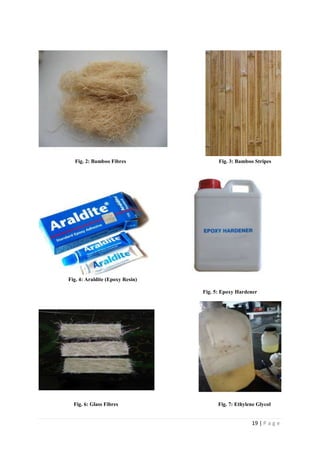
1. Bamboo Stripes
The bamboo Stripes Of required dimensions has been collected from the local market.
The bamboo should be raw and green bamboo.
2. Bamboo Fibres
The bamboos fibres are collected from the raw bamboo by using cutting tools and
some fibres are collected from the local community. Bamboo belongs to grass family
Bambusoideae. It is a natural Lignocellulose composite, in which cellulose fibres are
embedded in the lignin matrix.
3. Glass Fibres
Fiberglass (or fibreglass) is a type of fibre reinforced plastic where the reinforcement
fibre is specifically glass fibre. The glass fibre may be randomly arranged, flattened
into a sheet (called a chopped strand mat), or woven into a fabric. Glass Fibre is
collected from the market.
18 | P a g e
4. Matrix material
Matrix material is the material, which holds the relative position of the filler material.
The composites shape, surface appearance, environmental tolerance and overall
durability are dominated by it.
5. Epoxy resin
Epoxy resin has wide range of industrial applications because of their high strength and
mechanical adhesiveness characteristic. Araldite is a liquid solvent free epoxy resin.
Curing takes place at atmospheric pressure and room temperature after addition of
hardener.
TABLE-1 Physical and chemical properties of Araldite
Resin (Araldite)
Physical Properties Yellow-brown, odourless, tasteless and completely
nontoxic
Chemical Properties Plasticized condensation product of biphenyl-A and
Epichlorohydrin.
6. Hardener HY-951
Hardener HY-951 is a yellowish-green coloured liquid. Hardener (HY-951) was purchased
from Local market. In the present investigation 9 % wt. /wt. has been used in all material
developed.
7. Ethylene glycol
Ethylene glycol (IUPAC name: ethane-1, 2-diol) is an organic compound primarily
used as a raw material in the manufacture of polyester fibres and fabric industry, and
polyethylene terephthalate resins (PET) used in bottling. A small percent is also used
in industrial applications like antifreeze formulations and other industrial products. It
is an odourless, colourless, syrupy, sweet-tasting liquid. EG is primarily used as a raw
material in the manufacture of polyester fibres and fabric industry.
19 | P a g e
Fig. 2: Bamboo Fibres Fig. 3: Bamboo Stripes
Fig. 4: Araldite (Epoxy Resin)
Fig. 5: Epoxy Hardener
Fig. 6: Glass Fibres Fig. 7: Ethylene Glycol
20 | P a g e
3.2 METHODALOGY
3.2.1 Experimental Method
1. Preparation of Matrix composite using Bamboo Stripes
Following steps has been carried out in order to prepare it:-
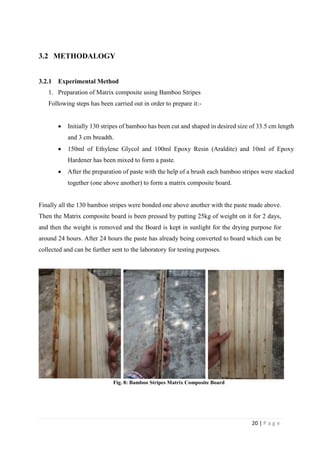
 Initially 130 stripes of bamboo has been cut and shaped in desired size of 33.5 cm length
and 3 cm breadth.
 150ml of Ethylene Glycol and 100ml Epoxy Resin (Araldite) and 10ml of Epoxy
Hardener has been mixed to form a paste.
 After the preparation of paste with the help of a brush each bamboo stripes were stacked
together (one above another) to form a matrix composite board.
Finally all the 130 bamboo stripes were bonded one above another with the paste made above.
Then the Matrix composite board is been pressed by putting 25kg of weight on it for 2 days,
and then the weight is removed and the Board is kept in sunlight for the drying purpose for
around 24 hours. After 24 hours the paste has already being converted to board which can be
collected and can be further sent to the laboratory for testing purposes.
Fig. 8: Bamboo Stripes Matrix Composite Board
21 | P a g e
2. Preparation of Matrix Composite using Bamboo Fibres and Glass Fibres
Following steps has been carried out in order to prepare it:-
 The process of fibre extraction is shown below:
 Preparing a Mould having a simple base and top made of plastic plate having
dimensions 220mm×200mm×20mm which was cut from plastic sheet all three sides of
sheet was surrounded by a thin strip of plastic having dimension: 2 strips of dimension
220mm×30mm×5mm and 2 strips having dimensions 140mm×30mm×5mm which are
fixed to the strip through nut and bolts.
 Initially 200 grams of Bamboo Fibres is taken in a beaker. After that paste of Ethylene
Glycol, Epoxy Resin and Hardener of around 300ml is being prepared and added to
the Bamboo Fibres of taken quantity.
 First a layer of paste is poured into the mould and then a layer of Glass Fibre [13]
weighing around 20 grams is being kept above it and then another layer of paste is
poured. After that Bamboo Fibre is added and then again one layer of paste is poured
and again a layer of glass Fibre is added.
Dried in Oven at 100 degree to remove Moisture
Cut Fibres length of 10mm
Fibres dried in sun for 1 day
Hand Peeling of Fibres from wet sticks
Soaked Bamboo Sticks in NaOH Solution for a day
Collecting Bamboo Sticks
22 | P a g e
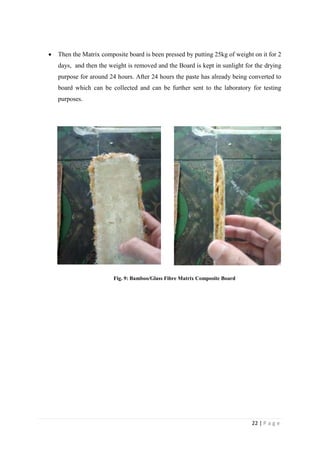
 Then the Matrix composite board is been pressed by putting 25kg of weight on it for 2
days, and then the weight is removed and the Board is kept in sunlight for the drying
purpose for around 24 hours. After 24 hours the paste has already being converted to
board which can be collected and can be further sent to the laboratory for testing
purposes.
Fig. 9: Bamboo/Glass Fibre Matrix Composite Board
23 | P a g e
CHAPTER 4
RESULTS AND DISCUSSIONS
24 | P a g e
4.1 MECHANICAL PROPERTY OF BAMBOO MATRIX
COMPOSITE BOARD
1. Tensile Test
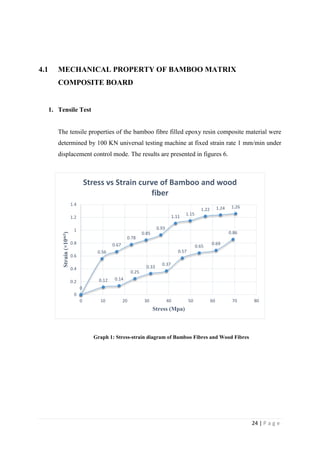
The tensile properties of the bamboo fibre filled epoxy resin composite material were
determined by 100 KN universal testing machine at fixed strain rate 1 mm/min under
displacement control mode. The results are presented in figures 6.
Graph 1: Stress-strain diagram of Bamboo Fibres and Wood Fibres
0
0.12 0.14
0.25
0.33
0.37
0.57
0.65
0.69
0.86
0
0.56
0.67
0.78
0.85
0.93
1.11
1.15
1.22 1.24 1.26
0
0.2
0.4
0.6
0.8
1
1.2
1.4
0 10 20 30 40 50 60 70 80
Strain(×10m3)
Stress (Mpa)
Stress vs Strain curve of Bamboo and wood
fiber
25 | P a g e
Load
(Kn)
Area
(mm2
)
Stress
(Mpa)
Displacement
(mm)
Strain
(×10m3
)
(mm/mm)
0 104 0 0 0
0.88 104 9.6 0.15 0.56
1.32 104 16.3 0.18 0.67
1.76 104 23 0.21 0.78
2.64 104 29.7 0.23 0.85
3.52 104 36.4 0.25 0.93
5.28 104 43.1 0.3 1.11
7.48 104 49.8 0.31 1.15
9.68 104 56.7 0.33 1.22
11 104 63.6 0.335 1.24
12.32 104 70.5 0.34 1.26
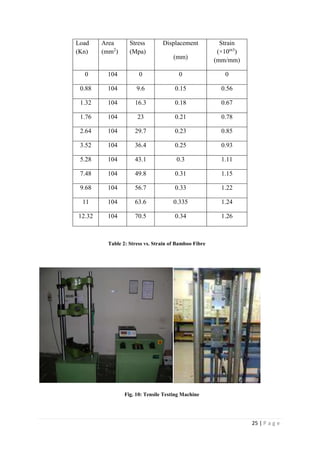
Table 2: Stress vs. Strain of Bamboo Fibre
Fig. 10: Tensile Testing Machine
26 | P a g e
Load
(Kn)
Area
(mm2
)
Stress
(Mpa)
Displacement
(mm)
Strain
(×10m3
)
(mm/mm)
0 104 0 0 0
0.88 104 10.2 0.03 0.12
1.76 104 17.4 0.04 0.14
2.64 104 24.6 0.06 0.25
3.52 104 31.8 0.08 0.33
4.4 104 39 0.09 0.37
5.28 104 46.2 0.14 0.57
6.16 104 53.9 0.16 0.65
7.04 104 61.6 0.17 0.69
7.92 104 69.3 0.21 0.86
8.8 104 76.8 0.24 0.9
Table 3: Stress vs. Strain of Wood Fibre
One year old bamboo had the lowest of 16.1 Mpa compressive stress and a five year old
bamboo had the highest compressive stress and in terms of highest compressive stress and
highest Young’s` modulus than the middle and bottom . As a result it was noted that
compression properties parallel to the longitudinal direction were significantly higher than that
perpendicular to the longitudinal direction and vascular bundles distribution had the highest
concentration in the outer layer of bamboo. University of Southern California Los Angeles,(
CA 90089-2531 ) by [14] Andrea Carrasco, Jojn Fronda and Brain Macrae on the mechanical
properties , define bamboo as a lightest material and strengthen extreme product of nature
which is stable and because of its cavities an extreme light and elastic building materials ,noted
that the lignifying cell construction of the bamboo texture and its technical conditions are
similar to the original texture of wood whereas wood has got a hard centre and becomes weaker
toward the outer parts.
27 | P a g e
2. Water Absorption Test
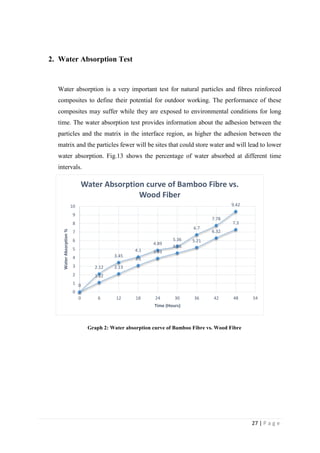
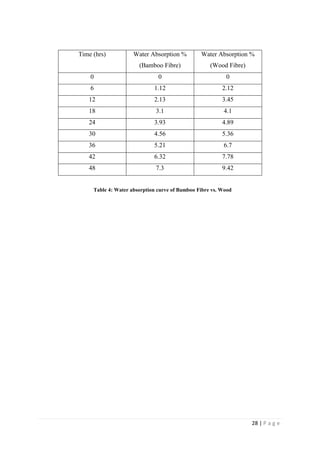
Water absorption is a very important test for natural particles and fibres reinforced
composites to define their potential for outdoor working. The performance of these
composites may suffer while they are exposed to environmental conditions for long
time. The water absorption test provides information about the adhesion between the
particles and the matrix in the interface region, as higher the adhesion between the
matrix and the particles fewer will be sites that could store water and will lead to lower
water absorption. Fig.13 shows the percentage of water absorbed at different time
intervals.
Graph 2: Water absorption curve of Bamboo Fibre vs. Wood Fibre
0
1.12
2.13
3.1
3.93
4.56
5.21
6.32
7.3
0
2.12
3.45
4.1
4.89
5.36
6.7
7.78
9.42
0
1
2
3
4
5
6
7
8
9
10
0 6 12 18 24 30 36 42 48 54
WaterAbsorption%
Time (Hours)
Water Absorption curve of Bamboo Fibre vs.
Wood Fiber
28 | P a g e
Time (hrs) Water Absorption %
(Bamboo Fibre)
Water Absorption %
(Wood Fibre)
0 0 0
6 1.12 2.12
12 2.13 3.45
18 3.1 4.1
24 3.93 4.89
30 4.56 5.36
36 5.21 6.7
42 6.32 7.78
48 7.3 9.42
Table 4: Water absorption curve of Bamboo Fibre vs. Wood
29 | P a g e
4.2 MECHANICAL PROPERTY OF BAMBOO FIBRE vs.
BAMBOO/GLASS FIBRE HYBRID BOARD
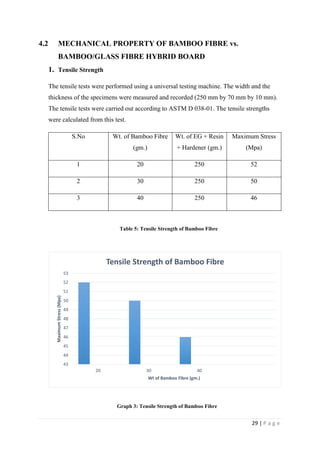
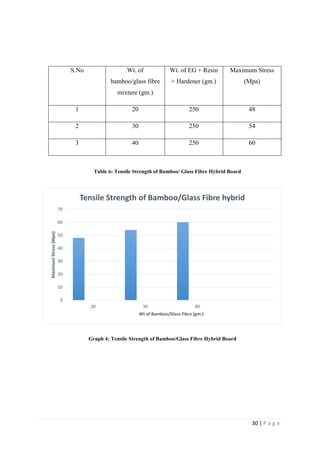
1. Tensile Strength
The tensile tests were performed using a universal testing machine. The width and the
thickness of the specimens were measured and recorded (250 mm by 70 mm by 10 mm).
The tensile tests were carried out according to ASTM D 038-01. The tensile strengths
were calculated from this test.
S.No Wt. of Bamboo Fibre
(gm.)
Wt. of EG + Resin
+ Hardener (gm.)
Maximum Stress
(Mpa)
1 20 250 52
2 30 250 50
3 40 250 46
Table 5: Tensile Strength of Bamboo Fibre
Graph 3: Tensile Strength of Bamboo Fibre
43
44
45
46
47
48
49
50
51
52
53
20 30 40
MaximumStress(Mpa)
Wt of Bamboo Fibre (gm.)
Tensile Strength of Bamboo Fibre
30 | P a g e
S.No Wt. of
bamboo/glass fibre
mixture (gm.)
Wt. of EG + Resin
+ Hardener (gm.)
Maximum Stress
(Mpa)
1 20 250 48
2 30 250 54
3 40 250 60
Table 6: Tensile Strength of Bamboo/ Glass Fibre Hybrid Board
Graph 4: Tensile Strength of Bamboo/Glass Fibre Hybrid Board
0
10
20
30
40
50
60
70
20 30 40
MaximumStress(Mpa)
Wt of Bamboo/Glass Fibre (gm.)
Tensile Strength of Bamboo/Glass Fibre hybrid
31 | P a g e
2. Impact Strength
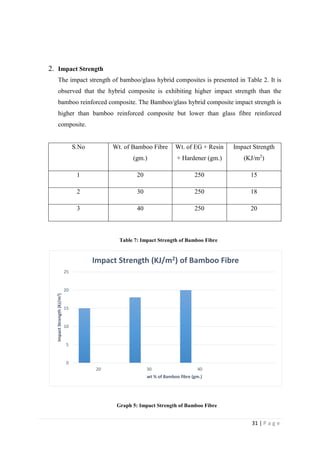
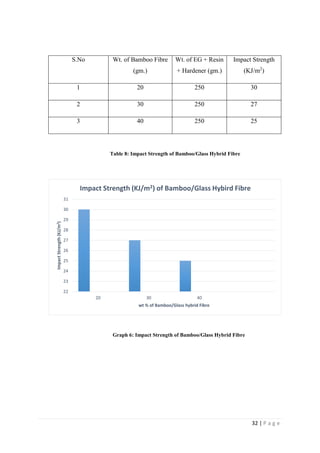
The impact strength of bamboo/glass hybrid composites is presented in Table 2. It is
observed that the hybrid composite is exhibiting higher impact strength than the
bamboo reinforced composite. The Bamboo/glass hybrid composite impact strength is
higher than bamboo reinforced composite but lower than glass fibre reinforced
composite.
S.No Wt. of Bamboo Fibre
(gm.)
Wt. of EG + Resin
+ Hardener (gm.)
Impact Strength
(KJ/m2
)
1 20 250 15
2 30 250 18
3 40 250 20
Table 7: Impact Strength of Bamboo Fibre
Graph 5: Impact Strength of Bamboo Fibre
0
5
10
15
20
25
20 30 40
ImpactStrength(KJ/m2)
wt % of Bamboo fibre (gm.)
Impact Strength (KJ/m2) of Bamboo Fibre
32 | P a g e
S.No Wt. of Bamboo Fibre
(gm.)
Wt. of EG + Resin
+ Hardener (gm.)
Impact Strength
(KJ/m2
)
1 20 250 30
2 30 250 27
3 40 250 25
Table 8: Impact Strength of Bamboo/Glass Hybrid Fibre
Graph 6: Impact Strength of Bamboo/Glass Hybrid Fibre
22
23
24
25
26
27
28
29
30
31
20 30 40
ImpactStrength(KJ/m2)
wt % of Bamboo/Glass hybrid Fibre
Impact Strength (KJ/m2) of Bamboo/Glass Hybird Fibre
33 | P a g e
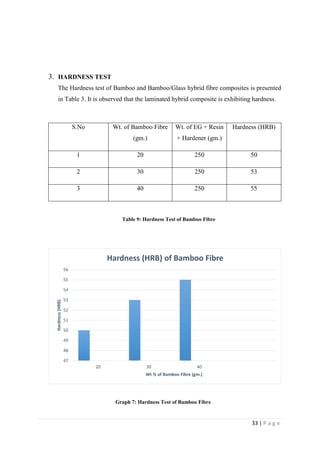
3. HARDNESS TEST
The Hardness test of Bamboo and Bamboo/Glass hybrid fibre composites is presented
in Table 3. It is observed that the laminated hybrid composite is exhibiting hardness.
S.No Wt. of Bamboo Fibre
(gm.)
Wt. of EG + Resin
+ Hardener (gm.)
Hardness (HRB)
1 20 250 50
2 30 250 53
3 40 250 55
Table 9: Hardness Test of Bamboo Fibre
Graph 7: Hardness Test of Bamboo Fibre
47
48
49
50
51
52
53
54
55
56
20 30 40
Hardness(HRB)
Wt % of Bamboo Fibre (gm.)
Hardness (HRB) of Bamboo Fibre
34 | P a g e
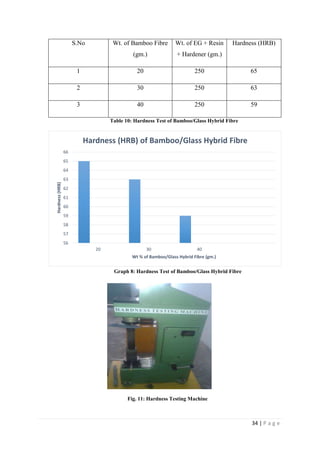
S.No Wt. of Bamboo Fibre
(gm.)
Wt. of EG + Resin
+ Hardener (gm.)
Hardness (HRB)
1 20 250 65
2 30 250 63
3 40 250 59
Table 10: Hardness Test of Bamboo/Glass Hybrid Fibre
Graph 8: Hardness Test of Bamboo/Glass Hybrid Fibre
Fig. 11: Hardness Testing Machine
56
57
58
59
60
61
62
63
64
65
66
20 30 40
Hardness(HRB)
Wt % of Bamboo/Glass Hybrid Fibre (gm.)
Hardness (HRB) of Bamboo/Glass Hybrid Fibre
35 | P a g e
CONCLUSIONS
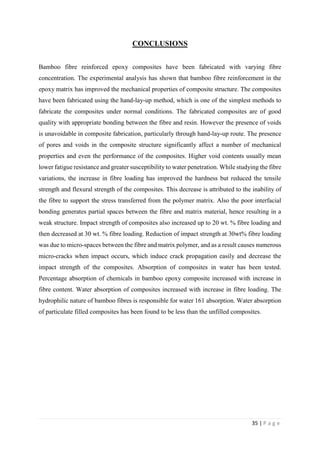
Bamboo fibre reinforced epoxy composites have been fabricated with varying fibre
concentration. The experimental analysis has shown that bamboo fibre reinforcement in the
epoxy matrix has improved the mechanical properties of composite structure. The composites
have been fabricated using the hand-lay-up method, which is one of the simplest methods to
fabricate the composites under normal conditions. The fabricated composites are of good
quality with appropriate bonding between the fibre and resin. However the presence of voids
is unavoidable in composite fabrication, particularly through hand-lay-up route. The presence
of pores and voids in the composite structure significantly affect a number of mechanical
properties and even the performance of the composites. Higher void contents usually mean
lower fatigue resistance and greater susceptibility to water penetration. While studying the fibre
variations, the increase in fibre loading has improved the hardness but reduced the tensile
strength and flexural strength of the composites. This decrease is attributed to the inability of
the fibre to support the stress transferred from the polymer matrix. Also the poor interfacial
bonding generates partial spaces between the fibre and matrix material, hence resulting in a
weak structure. Impact strength of composites also increased up to 20 wt. % fibre loading and
then decreased at 30 wt. % fibre loading. Reduction of impact strength at 30wt% fibre loading
was due to micro-spaces between the fibre and matrix polymer, and as a result causes numerous
micro-cracks when impact occurs, which induce crack propagation easily and decrease the
impact strength of the composites. Absorption of composites in water has been tested.
Percentage absorption of chemicals in bamboo epoxy composite increased with increase in
fibre content. Water absorption of composites increased with increase in fibre loading. The
hydrophilic nature of bamboo fibres is responsible for water 161 absorption. Water absorption
of particulate filled composites has been found to be less than the unfilled composites.
36 | P a g e
RECOMMENDATIONS
Manufacturers and engineers are always on the look for the new materials and improved
processes to use in the manufacturing of better products, and thus increase their profit margin.
The developed composites are a good substitute for a number of petroleum based products and
form a very much sustainable resource. They have lot of advantages like low density, low price,
recyclable, biodegradable, low abrasive wear, CO2 neutral and environment friendly. Natural
fibre composites are being used in a large number of applications in automotive, constructions,
marine, electronic and aerospace. These composite have a lot potential as a low cost polymeric
composite material for tribological applications also. Bamboo epoxy composites form a new
class of bio-fibre reinforced composites, which may find potential applications in:
 Conveyor belt rollers
 Passenger seat frames (replacing wood/steel) in railway coaches / automobiles
 Pipes carrying pulverized coal in power plants
 Pump and impeller blades
 Household furniture and also as low cost housing materials.
 Helicopter fan blades
 Trim parts in dashboards
 Door panels and Seat Cushions
 Parcel shelves
 Seat cushions 165
 Backrests and Cabin linings
37 | P a g e
FUTURE SCOPE OF WORK
Bamboo-Epoxy composites have a lot of research potential, considering the present day
environmental concerns. The work of the present thesis can be extended by a number of
different ways. Considering the raw materials, unidirectional short bamboo fibres has been
used for fabrication of the composites in the present work. However bi-directional bamboo can
also be used as reinforcement in the composites. Fibre length can be one of the variables in the
composite fabrication and their effect can be studied on the mechanical, chemical and erosive
properties. Other thermosetting polymers like polyesters polyurethane and thermoplastics like
polypropylene can also be used as resins in the bamboo based polymer composites. As far as
the fabrication method is concerned, the hand up layup method has been used for fabrication
of composites in the present work. It is recommended that the use of injection moulding to
fabricate composites samples for testing is more precise and it reduces much of human errors.
The chemical resistance and water absorption of composites have been studied in the present
work; however the effect of temperature on the water absorption can be explored as future
work. Effect of chemicals on the mechanical properties of the composites can also be a good
problem to study. Other chemical properties like Moisture absorption and swelling behaviour
of bamboo epoxy composites can also be studied wear behaviour of composite can also be
explored.
38 | P a g e
REFERENCES
[1] J. Van Suchtelen (1972). Philips Res. Rep., 27, 28. T.S Srivatsan and E.J. Lavernia (1992).
J. Materials Sci., 27, 5965. N.S. Stalaff (year). In Advances in composite Materials Applied
Sci. Pub., London, P. 247
[2] U.C.Jindal, (1986) Development and testing of bamboo fibres reinforced plastic
Composites. Journal of Composite material, Vol. 20, pp. 19-29.
[3] Seema Jain, Rakesh Kumar (1992) Mechanical behaviour of bamboo and bamboo
composite. Journal of Material Science, Vol.27, pp.4598- 4604.
[4] Jain et al, U C. Jindal, Rakesh Kumar (1993) Development and fracture mechanism Of
bamboo /polyester resin composite. Journal of Materials Science Letters, Vol. 12, pp. 558-560.
[5] H. Kumar, Siddaramaiah, 2005, “Study of Chemical and Tensile Properties of PU and
PU/PS Coated Bamboo Fibres”, Polymer-Plastics Technology and Engineering, Vol. 44,
pp.1369–1377.
[6] Tokoro et al, P Reichert, H Ro Mling, and R.Mulhaupt (2000) Influence of compatibilizers
on the surface hardness, water uptake and the mechanical properties of poly(propylene) wood
flour composites prepared by reactive extrusion. Macromolecular Material and Engineering,
Vol. 276/277, pp.51-58.
[7] Tajvidi et al and Yohie Ichihara (2004) Effect of fibre length on mechanical properties of
green composites using starch based resin and short bamboo fibres. ISME International
journal, Series A Vol.47, No.4, pp.551- 555.
[8] S Panthapulakkal, M Sain (2007) Injection-Molded Short Hemp Fibre/Glass Fibre-
Reinforced Polypropylene Hybrid Composites- Mechanical, Water Absorption and Thermal
Properties. Journal of Applied Polymer Science, Vol. 103, pp. 2432-2441.
39 | P a g e
[9] R M Rowell, A M Tillman, R Simonson (1986) A Simplified Procedure for the Acetylation
of Hardwood and Softwood Flaxes for Flake board Production. Journal of Wood Chemistry
and Technology, Vol.6, pp.427- 448.
[10] Kazua Okubo, Toru Fuzii, Naoya Yamashita (2005) Improvement of interfacial adhesion
in bamboo Polymer composite enhanced with micro fibrillated cellulose. JSME International
journal, Series A, Vol.48, No.4, pp.199-20.
[11] J. M. G. Martiner, J. Taranco, O. Laguna, and E. P. Collar (1994) Modification of
polyolefin, and polystyrene, polyester and epoxy resins. Study on the Reaction Conditions
Using a Batch Process. International. Polymer. Processing IX, Vol. 3, pp.246-251;
[12] Thwea and Liao (2003) Natural fibres: can they replace glass in fibre reinforced plastics.
Composites Science and Technology, Vol.63.
[13] P. Wambua, J. Ivens, and I. Verpoest, "Natural fibres: can they replace glass in fibre
reinforced plastics?" composites science and technology, vol. 63, 2003.
[14] Andrea Carrasco, Jojn Fronda and Brain Macrae, University of Southern California Los
Angeles, (CA 90089-2531) “Fibre Texture and Mechanical Graded Structure of Bamboo”,
Composites Part B, Vol.288, 1997.

3. chapter 1

  • 1.
    1 | Pa g e CHAPTER 1 INTRODUCTION
  • 2.
    2 | Pa g e Introduction India endowed with an abundant availability of natural fiber such as jute, pineapple, bamboo, banana etc. has focused on the development of natural fiber composites primarily to explore value-added application avenues. Such natural fiber composites are well suited as wood substitutes in the housing and construction sector. The development of natural fiber composites in India is based on two pronged strategy of preventing depletion of forest resources as well as ensuring good economic returns for the cultivation of natural fibers. The developments in composite material after meeting the challenges of aerospace sector have cascaded down for catering to domestic and industrial applications. Composites, the wonder material with light- weight; high strength-to-weight ratio and stiffness properties have come a long way in replacing the conventional materials like metals, wood etc. The material scientists all over the world focused their attention on natural composites reinforced with jute, pineapple etc. primarily to cut down the cost of raw materials.
  • 3.
    3 | Pa g e 1.1 ABOUT BAMBOO COMPOSITS Bamboo or Bambusa in botanical has 7-10 subfamilies of genres and there are 1575 difference species ranging from the type of wood to bamboo herb. However, each particular species of bamboo has different properties and qualities. Bamboo is easily accessible globally, 64% of bamboo plantation, as can be seen below, originated from Southeast Asia, 33% grown in South America, and the rest comes from Africa and Oceania. Bamboo productions dated back to thousands of years ago and thus they are rich with traditional elements. Bamboo naturally, suitable for varieties of uses and benefits. Bamboo as the great potential to be used as solid wood substitute materials, especially in the manufacturing, design, and construction usage. Bamboo properties of being lightweight and high- strength has attracted researchers to investigate and explore, especially in the field of bio-composite bamboo and is acknowledged as one of the green-technology that is fully responsible for eco- products on the environment. Agricultural biomass solid wood made from bamboo have been identified by many researchers as the largest source of natural fibre and cellulose fibre bio composite, which are provided at minimal cost and will bring a new evolution into production chain and manufacturing world. High elasticity and strength of bamboo are suitable for the construction industry, and bamboo has proven to serve as a foundation structure. The creation of bio-composite fibre board is also used in wall construction and are potentially to contribute of making cost effective home possible. [9] Use of bio-composite material is seen increasingly high and the use bamboo as an alternative can be seen in productions such as furniture, automotive and other related productions. The natural colours of bamboo is unique compared to solid wood and other materials. In fact, the effect of the texture and tie on the outer skin of bamboo has the exotic value and at the same time creates a unique identity in the design, particularly furniture.
  • 4.
    4 | Pa g e 1.2 THE ANATOMICAL STRUCTURE OF BAMBOO Bamboo culms are hollow, and every culm from inner side is divided by several diaphragms which are seen as rings on the outside. The part between two rings is called “Internode” where branches grow. Distance between each node varies and it depends on the type of the species. The microstructure of a bamboo culm consists of many vascular bundles which are embedded in parenchyma tissue and distributed through the wall thickness. Parenchyma tissue only keeps the vascular bundles in the longitudinal direction. The number of vascular bundles is highly concentrated close to the outside of the bamboo culm wall, and this amount reduced on the inside. They involve vessels, sclerenchyma cells, fibre strand and sieve tubes with companion cells. The fibre strand consists of many elementary fibres with the shape of hexagonal and pentagonal, where Nano-fibrils are aligned and bounded together with lignin and hemi-cellulose. The strength of a bamboo culm is defined by its vascular bundles. Therefore it is essential to use a suitable method to separate the parenchyma tissue from fibre strands and vascular bundles without any destructive effect on the extracted fibres. The structure of a bamboo culm is shown in Fig. 1. Fig. 1 a) bamboo culm, b) cross-section of bamboo culm, c) vascular bundle, d) fibre strand, e) elementary fibres f) model of polylamellae structure of bamboo
  • 5.
    5 | Pa g e 1.3 DEFINATION OF COMPOSITE The most widely used meaning is the following one, which has been stated by Jartiz [1965] “Composites are multifunctional material systems that provide characteristics not obtainable from any discrete material. They are cohesive structures made by physically combining two or more compatible materials, different in composition and characteristics and sometimes in form”. Kelly [1967] very clearly stresses that the composites should not be regarded simple as a combination of two materials. In the broader significance; the combination has its own distinctive properties. In terms of strength to resistance to heat or some other desirable quality, it is better than either of the components alone or radically different from either of them. Beghezan [1966] defines as “The composites are compound materials which differ from alloys by the fact that the individual components retain their characteristics but are so incorporated into the composite as to take advantage only of their attributes and not of their short comings”, in order to obtain improved materials. [1] J.Van Suchtelen [1972] explains composite materials as heterogeneous materials consisting of two or more solid phases, which are in intimate contact with each other on a microscopic scale. They can be also considered as homogeneous materials on a microscopic scale in the sense that any portion of it will have the same physical property. 1.4 CHARACTERISTICS OF THE COMPOSITES Composites consist of one or more discontinuous phases embedded in a continuous phase. The discontinuous phase is usually harder and stronger than the continuous phase and is called the ‘reinforcement’ or ‘reinforcing material’, whereas the continuous phase is termed as the ‘matrix’. Properties of composites are strongly dependent on the properties of their constituent materials, their distribution and the interaction among them. The composite properties may be the volume fraction sum of the properties of the constituents or the constituents may interact in a synergistic way resulting in improved or better properties. Apart from the nature of the constituent materials, the geometry of the reinforcement (shape, size and size distribution) influences the properties of the composite to a great extent. The concentration distribution and orientation of the reinforcement also affect the properties. The shape of the discontinuous phase (which may by spherical, cylindrical, or rectangular cross-sectioned prisms or platelets), the size and size distribution (which controls the texture of the material) and [10] volume fraction
  • 6.
    6 | Pa g e determine the interfacial area, which plays an important role in determining the extent of the interaction between the reinforcement and the matrix. 1.5 COMPONENTS OF A COMPOSITE MATERIAL In its most basic form a composite material is one, which is composed of at least two elements working together to produce material properties that are different to the properties of those elements on their own. In practice, most composites consist of a bulk material (the ‘matrix’), and a reinforcement of some kind, added primarily to increase the strength and stiffness of the matrix.  Matrix -Many materials when they are in a fibrous form exhibit very good strength property but to achieve these properties the fibres should be bonded by a suitable matrix. The matrix isolates the fibres from one another in order to prevent abrasion and formation of new surface flaws and acts as a bridge to hold the fibres in place. A good matrix should possess ability to deform easily under applied load, transfer the load onto the fibres and evenly distributive stress concentration.  Reinforcement-The role of the reinforcement in a composite material is fundamentally one of increasing the mechanical properties of the neat resin system. All of the different fibres used in composites have different properties and so affect the properties of the composite in different ways. For most of the applications, the fibres need to be arranged into some form of sheet, known as a fabric, to make handling possible. Different ways for assembling fibres into sheets and the variety of fibre orientations possible to achieve different characteristics.  Interface-It has characteristics that are not depicted by any of the component in isolation. Then interface is a bounding surface or zone where a discontinuity occurs, whether physical, mechanical, chemical etc. The matrix material must “wet” the fibres. Well “wetted” fibres increase the interface surfaces area. To obtain desirable properties in a composite, the applied load should be effectively transferred from the matrix to the fibres via the interface. This means that the interface must be large and exhibit strong
  • 7.
    7 | Pa g e adhesion between fibres and matrix. Failure at the interface (called deboning) may or may not be desirable. 1.6 CLASSIFICATIONS Composite materials can be classified into many categories depending on the type of matrix material, reinforcing material type etc. According to the type of matrix material they can be classified as follows:  Metal matrix type composites: MMC are composed of a metallic matrix (Al, Mg, Fe, Co, Cu)  Ceramic matrix composites: CMC is a material consisting of a ceramic combined with a ceramic dispersed phase.  Polymer matrix material: PMC are composed of a matrix from thermosetting (unsaturated polyester, epoxy) or thermoplastic (nylon, polystyrene) and embedded glass carbon, steel or Kerler fibres (dispersed phase).  Particle composites- particle reinforced composites consist of a matrix reinforced by a dispersed phase in the form of particles. It can be either of random orientation or preferred orientation.  Fibrous composite-.Short fibre: they consist of a matrix reinforced by a dispersed phase in the form of discontinuous fibres either of random or preferred orientations.  Long fibre- they consist of a matrix reinforced by a dispersed phase in the form of continuous fibres. They can be either unidirectional or bidirectional.  Laminate composites- when a fibre reinforced composite consists of several layers with different fibre orientations, it is called multilayer composite.
  • 8.
    8 | Pa g e Apart from that the two broad classes of composites are (1) Particulate composites and (2) Fibrous composites. Fibrous Composite-A fibre is characterized by its length being much greater compared to its cross-sectional dimensions. The dimensions of the reinforcement determine its capability of contributing its properties to the composite. Man-made filaments or fibres of non-polymeric materials exhibit much higher strength along their length since large flaws, which may be present in the bulk material, are minimized because of the small cross- sectional dimensions of the fibre. In the case of polymeric materials, orientation of the molecular structure is responsible for high strength and stiffness. Fibres, because of their small cross-sectional dimensions, are not directly usable in engineering applications. They are, therefore, embedded in matrix materials to form fibrous composites.
  • 9.
    9 | Pa g e CHAPTER 2 LITERATURE REVIEW
  • 10.
    10 | Pa g e LITERATURE REVIEW Composites have been a field of great interest in the last two decades and a lot of researchers are working in this area. This becomes very important to discuss the prominent works related to the polymer composites and their properties. The purpose of literature review is to provide background information on the issues to be considered in this thesis and to emphasize the relevance of the present study. Various aspects of polymer composites have been considered with reference to development as well as characterization of polymer composites. Existing literature related to the physical and chemical properties of the composites have been reviewed and a special emphasis has been given to erosion wear characteristics. Knowledge gap in the earlier investigations has been presented to outline the need and objectives of the present work.
  • 11.
    11 | Pa g e 2.1 BAMBOO FIBRE REINFORCED POLYMER COMPOSITES Natural fibre reinforced polymer composites have raised a great attention and interest among scientists and engineers in recent years due to the consideration of developing environmental friendly materials. They are high specific strength and modulus materials, low priced, recyclable and are easily available. It is known that natural fibres are non-uniform with irregular cross sections which make their structures quite unique and much different with man- made fibres such as glass fibres, carbon fibres etc. [11] various researchers have worked on the natural fibres containing polyolefin, and polystyrene, polyester and epoxy resins. Properties like low cost, light-weight, high specific strength, free from health hazard are the unique selling points of these composites. Though the presence of hydroxyl and other polar groups in the natural fibres leads to the weak interfacial bonding between the fibres and the hydrophobic polymers, these properties can be significantly improved by interfacial treatment. Among the various natural fibres, bamboo fibre is a good candidate for use as natural fibres in composite materials. Jindal [2] has observed that tensile strength of bamboo-fibre reinforced plastic (BFRP) composite is comparatively equivalent to that of the mild steel, whereas their density is only 12% of that of the mild steel. Hence, the BFRP composites can be extremely useful in structural applications. Jain and Kumar [3] have investigated that a uniform strength can be achieved in all directions of the composites by using multidirectional orientation of fibres. Considerable interest has been generated in the manufacturing of thermoplastic composites due to their good fracture toughness and thermal stability. Thermoplastic matrix composites materials offer an extended solution in different applications in automotive industry, construction, electrical appliances and home/urban furniture. Bio-degradable resins have received a considerable attention as earth conscious materials in the present day engineering society. They offer very little environmental load because they can be resolved in both water and carbon dioxide after perfect biodegradation by micro-organisms. However, most of the biodegradable resins have relatively low strength, making them a poor choice for the high strength structural applications. Thus, a lot of research is focused to strengthen the biodegradable resins by combining with string natural fibres like hemp, bamboo, pineapple etc.
  • 12.
    12 | Pa g e 2.2 MECHANICAL PROPERTIES OF COMPOSITES The attractive physical and mechanical properties that can be obtained with bamboo fibre reinforced composites, such as high specific modulus, strength and thermal stability, have been well documented in the literature. Jain et al [4] have compared the Bamboo fibre reinforced epoxy composites (BFRP) epoxy with Bamboo fibre reinforced unsaturated polyester composites (BFRP) USP in terms of their cost and mechanical strength. Cost of unsaturated polyester (USP) was found to be only 20% to that of the epoxy resin, whereas the mechanical properties of these two composite were comparable. Thus giving an edge to the USP based composites. BFRP composites have shown more elongation and 10% high tensile strength. These composites can be used for a variety of commercial application such as crash helmet, low cost housing and wind mills. Kumar et al [5] have studied the effect of coating bamboo fibres with Polyurethane (PU) and Polyurethane/Polystyrene. Interpenetrating Network (PU/PSIPN) on tensile property of the composites. Both the untreated / alkali treated bamboo fibres were coated with polyethylene glycol based PU and its semi inter penetrating network (SIPN) with PS. It was found that tensile strength of bamboo has increased after coating with PU and PU/PS system. PU/PS coating on alkali treated bamboo fibres has shown a rise (74%) in the tensile load at break than PU (11%) coating on alkali treated fibre. These improvements were due to enhanced interfacial adhesion between polymer matrix and bamboo fibre. Results of enzymatic degradation showed that biodegradability could be adjusted by controlling degree of interfacial adhesion using LDI. They have observed that these bio-composites are beneficial in areas where biocompatibility and environmentally responsible design and construction are required. Takagi et al. have studied the effect of fibre content and fibre length on mechanical properties of bamboo fibre reinforced green composites (BFGC). Fibre length up to 15mm has given positive effect on tensile strength and flexural strength. It was observed that tensile strength and flexural strength increase with increase in fibre content. Mechanical properties of BFGC were similar to those composites made from bamboo powder and biodegradable resin. These results showed that bamboo fibre with aspect ratio of 20 acts as filler and not the reinforcement. Tokoro et al [6] have chosen three different categories of bamboo fibre to prepare Bamboo fibre-Polylactic acid composites and investigate the method to improve mechanical properties
  • 13.
    13 | Pa g e of BF/PLA composites. Three types of bamboo fibres were extracted from raw bamboo by either NaOH treatment or steam explosion. Amongst them, Highest bending strength was obtained when steam exploded filaments were put into PLA matrix. Impact strength was improved when medium length fibre bundles were put into PLA. Thermal properties and heat resistance of composite were improved by annealing. Authors have studied the impact of steam explosion technique on mechanical properties of bamboo composites. Tensile strength and Young modulus of steam exploded BFEC increased about 15% and 30% respectively in comparison with conventional BFEC. Thwea and Liao [12] have fabricated the bamboo reinforced polypropylene (BFRP) and bamboo-glass reinforced Polypropylene (BGRP) composites. They have studied the effect of fibre content, fibre length, bamboo to glass ratio, coupling agent (Maleate polypropylene) on tensile and flexural properties of these composites. They have also studied the sorption behaviour and retention in mechanical properties of composite after environmental aging. It was observed that flexural strength, flexural modulus and tensile modulus increases with increase in bamboo fibre length. They have reported that poor adhesion between the matrix/fibre decreased tensile strength at higher bamboo fibre content in BFRP. Fibre content increased the void formation during processing, which further leads to micro crack information under loading, hence reducing the tensile strength. Incorporation of glass fibre and Compatilizers has improved the tensile strength and tensile modulus. It was reported that moisture absorption of BFRP during aging can be reduced by replacing bamboo fibre with glass fibre and by using Compatilizers. Mechanical properties of BFRP and BGRP have degraded after aging in water.
  • 14.
    14 | Pa g e 2.3 WATER ABSORPTION New applications and end uses of composites for decking, flooring, and outdoor facilities with strong exposure to atmosphere or contact with aqueous media have made it necessary to evaluate the water uptake characteristics of natural fibre composites. Because of the hygroscopic nature of natural fibres, water uptake of composites containing these fibres as fillers and/or reinforcement can be a limiting parameter for a number of applications of the composites. Water absorption can adversely affect a number of mechanical properties and can also build up the moisture content in the fibre cell wall and in the fibre–matrix inter phase region. Moisture build up in the cell wall could result in fibre swelling and affect the dimensional stability of the product. If necessary, the moisture absorbed in the fibre cell wall can be reduced through the acetylation of some of the hydroxyl groups present in the fibre. Good wetting of the fibre by the matrix and adequate fibre–matrix bonding can decrease the rate and amount of water absorbed in the interphone region of the composite. For water absorption test, composite samples are weighed and then weighed samples are immersed in the distilled water at room temperature. The samples are taken out periodically and weighed immediately after wiping out the water on the surface of the sample, using a precise four digit balance to find out the content of water absorbed. All the Samples are dried until constant weight with four digit balance, previous to immersing in water. Percentage of water uptake is calculated by the following equation- W1 = initial weight of specimen gm. W2= specimen weight after N hours of water soaking, gm. Water absorption behaviour of natural fibre thermoplastic composites have been studied by a number of researchers and the effectiveness in reducing the amount and rate of water absorption. Tajvidi et al. [7] have investigated the long-term water absorption behaviour of various natural fibre (wood flour, kenaf fibre, rice hulls, newsprint etc.) polypropylene WA (%) = (W2 - W1) × 100 W1
  • 15.
    15 | Pa g e composites and have also studied the effect of natural fibre type and fibre content. Authors have found that the Chemical composition of the natural fibres is responsible for the different water uptake behaviour. It appears that the RH/PP has the lowest water absorption. This behaviour can be attributed to the higher amount of extract and ash and lower amount of cellulose and pentose in rice hulls. Suharav Panthpulakkal et al [8] studied the water absorption of injection-moulded short hemp fibre/glass fibre reinforced poly propylene hybrid composites. Hybridization with glass fibre enhanced the Resistance to water absorption properties of the hemp fibre composites.
  • 16.
    16 | Pa g e CHAPTER 3 MATERIAL PREPARATION
  • 17.
    17 | Pa g e MATERIAL PREPARATION Raw materials are the starting point for development of new materials and quality of new material itself is dependent upon the raw materials. Then come the role of processing techniques to fabricate the new materials and characterizations techniques to ensure their quality. This Section describes the materials and methods used for the processing of all the composites under this investigation. It presents the details of the characterization techniques in terms of mechanical and chemical properties of the composite samples under study. This section describes about the material used in casting of hybrid composite, their physical properties and chemical properties etc. In this section, the method used to determine the mechanical, physical properties are also discussed. 3.1 MATERIALS REQUIRED The materials which are used to fabricate the polymer composite material such as matrix, reinforcing material and other materials which are used to modify the epoxy resin are discussed below. 1. Bamboo Stripes The bamboo Stripes Of required dimensions has been collected from the local market. The bamboo should be raw and green bamboo. 2. Bamboo Fibres The bamboos fibres are collected from the raw bamboo by using cutting tools and some fibres are collected from the local community. Bamboo belongs to grass family Bambusoideae. It is a natural Lignocellulose composite, in which cellulose fibres are embedded in the lignin matrix. 3. Glass Fibres Fiberglass (or fibreglass) is a type of fibre reinforced plastic where the reinforcement fibre is specifically glass fibre. The glass fibre may be randomly arranged, flattened into a sheet (called a chopped strand mat), or woven into a fabric. Glass Fibre is collected from the market.
  • 18.
    18 | Pa g e 4. Matrix material Matrix material is the material, which holds the relative position of the filler material. The composites shape, surface appearance, environmental tolerance and overall durability are dominated by it. 5. Epoxy resin Epoxy resin has wide range of industrial applications because of their high strength and mechanical adhesiveness characteristic. Araldite is a liquid solvent free epoxy resin. Curing takes place at atmospheric pressure and room temperature after addition of hardener. TABLE-1 Physical and chemical properties of Araldite Resin (Araldite) Physical Properties Yellow-brown, odourless, tasteless and completely nontoxic Chemical Properties Plasticized condensation product of biphenyl-A and Epichlorohydrin. 6. Hardener HY-951 Hardener HY-951 is a yellowish-green coloured liquid. Hardener (HY-951) was purchased from Local market. In the present investigation 9 % wt. /wt. has been used in all material developed. 7. Ethylene glycol Ethylene glycol (IUPAC name: ethane-1, 2-diol) is an organic compound primarily used as a raw material in the manufacture of polyester fibres and fabric industry, and polyethylene terephthalate resins (PET) used in bottling. A small percent is also used in industrial applications like antifreeze formulations and other industrial products. It is an odourless, colourless, syrupy, sweet-tasting liquid. EG is primarily used as a raw material in the manufacture of polyester fibres and fabric industry.
  • 19.
    19 | Pa g e Fig. 2: Bamboo Fibres Fig. 3: Bamboo Stripes Fig. 4: Araldite (Epoxy Resin) Fig. 5: Epoxy Hardener Fig. 6: Glass Fibres Fig. 7: Ethylene Glycol
  • 20.
    20 | Pa g e 3.2 METHODALOGY 3.2.1 Experimental Method 1. Preparation of Matrix composite using Bamboo Stripes Following steps has been carried out in order to prepare it:-  Initially 130 stripes of bamboo has been cut and shaped in desired size of 33.5 cm length and 3 cm breadth.  150ml of Ethylene Glycol and 100ml Epoxy Resin (Araldite) and 10ml of Epoxy Hardener has been mixed to form a paste.  After the preparation of paste with the help of a brush each bamboo stripes were stacked together (one above another) to form a matrix composite board. Finally all the 130 bamboo stripes were bonded one above another with the paste made above. Then the Matrix composite board is been pressed by putting 25kg of weight on it for 2 days, and then the weight is removed and the Board is kept in sunlight for the drying purpose for around 24 hours. After 24 hours the paste has already being converted to board which can be collected and can be further sent to the laboratory for testing purposes. Fig. 8: Bamboo Stripes Matrix Composite Board
  • 21.
    21 | Pa g e 2. Preparation of Matrix Composite using Bamboo Fibres and Glass Fibres Following steps has been carried out in order to prepare it:-  The process of fibre extraction is shown below:  Preparing a Mould having a simple base and top made of plastic plate having dimensions 220mm×200mm×20mm which was cut from plastic sheet all three sides of sheet was surrounded by a thin strip of plastic having dimension: 2 strips of dimension 220mm×30mm×5mm and 2 strips having dimensions 140mm×30mm×5mm which are fixed to the strip through nut and bolts.  Initially 200 grams of Bamboo Fibres is taken in a beaker. After that paste of Ethylene Glycol, Epoxy Resin and Hardener of around 300ml is being prepared and added to the Bamboo Fibres of taken quantity.  First a layer of paste is poured into the mould and then a layer of Glass Fibre [13] weighing around 20 grams is being kept above it and then another layer of paste is poured. After that Bamboo Fibre is added and then again one layer of paste is poured and again a layer of glass Fibre is added. Dried in Oven at 100 degree to remove Moisture Cut Fibres length of 10mm Fibres dried in sun for 1 day Hand Peeling of Fibres from wet sticks Soaked Bamboo Sticks in NaOH Solution for a day Collecting Bamboo Sticks
  • 22.
    22 | Pa g e  Then the Matrix composite board is been pressed by putting 25kg of weight on it for 2 days, and then the weight is removed and the Board is kept in sunlight for the drying purpose for around 24 hours. After 24 hours the paste has already being converted to board which can be collected and can be further sent to the laboratory for testing purposes. Fig. 9: Bamboo/Glass Fibre Matrix Composite Board
  • 23.
    23 | Pa g e CHAPTER 4 RESULTS AND DISCUSSIONS
  • 24.
    24 | Pa g e 4.1 MECHANICAL PROPERTY OF BAMBOO MATRIX COMPOSITE BOARD 1. Tensile Test The tensile properties of the bamboo fibre filled epoxy resin composite material were determined by 100 KN universal testing machine at fixed strain rate 1 mm/min under displacement control mode. The results are presented in figures 6. Graph 1: Stress-strain diagram of Bamboo Fibres and Wood Fibres 0 0.12 0.14 0.25 0.33 0.37 0.57 0.65 0.69 0.86 0 0.56 0.67 0.78 0.85 0.93 1.11 1.15 1.22 1.24 1.26 0 0.2 0.4 0.6 0.8 1 1.2 1.4 0 10 20 30 40 50 60 70 80 Strain(×10m3) Stress (Mpa) Stress vs Strain curve of Bamboo and wood fiber
  • 25.
    25 | Pa g e Load (Kn) Area (mm2 ) Stress (Mpa) Displacement (mm) Strain (×10m3 ) (mm/mm) 0 104 0 0 0 0.88 104 9.6 0.15 0.56 1.32 104 16.3 0.18 0.67 1.76 104 23 0.21 0.78 2.64 104 29.7 0.23 0.85 3.52 104 36.4 0.25 0.93 5.28 104 43.1 0.3 1.11 7.48 104 49.8 0.31 1.15 9.68 104 56.7 0.33 1.22 11 104 63.6 0.335 1.24 12.32 104 70.5 0.34 1.26 Table 2: Stress vs. Strain of Bamboo Fibre Fig. 10: Tensile Testing Machine
  • 26.
    26 | Pa g e Load (Kn) Area (mm2 ) Stress (Mpa) Displacement (mm) Strain (×10m3 ) (mm/mm) 0 104 0 0 0 0.88 104 10.2 0.03 0.12 1.76 104 17.4 0.04 0.14 2.64 104 24.6 0.06 0.25 3.52 104 31.8 0.08 0.33 4.4 104 39 0.09 0.37 5.28 104 46.2 0.14 0.57 6.16 104 53.9 0.16 0.65 7.04 104 61.6 0.17 0.69 7.92 104 69.3 0.21 0.86 8.8 104 76.8 0.24 0.9 Table 3: Stress vs. Strain of Wood Fibre One year old bamboo had the lowest of 16.1 Mpa compressive stress and a five year old bamboo had the highest compressive stress and in terms of highest compressive stress and highest Young’s` modulus than the middle and bottom . As a result it was noted that compression properties parallel to the longitudinal direction were significantly higher than that perpendicular to the longitudinal direction and vascular bundles distribution had the highest concentration in the outer layer of bamboo. University of Southern California Los Angeles,( CA 90089-2531 ) by [14] Andrea Carrasco, Jojn Fronda and Brain Macrae on the mechanical properties , define bamboo as a lightest material and strengthen extreme product of nature which is stable and because of its cavities an extreme light and elastic building materials ,noted that the lignifying cell construction of the bamboo texture and its technical conditions are similar to the original texture of wood whereas wood has got a hard centre and becomes weaker toward the outer parts.
  • 27.
    27 | Pa g e 2. Water Absorption Test Water absorption is a very important test for natural particles and fibres reinforced composites to define their potential for outdoor working. The performance of these composites may suffer while they are exposed to environmental conditions for long time. The water absorption test provides information about the adhesion between the particles and the matrix in the interface region, as higher the adhesion between the matrix and the particles fewer will be sites that could store water and will lead to lower water absorption. Fig.13 shows the percentage of water absorbed at different time intervals. Graph 2: Water absorption curve of Bamboo Fibre vs. Wood Fibre 0 1.12 2.13 3.1 3.93 4.56 5.21 6.32 7.3 0 2.12 3.45 4.1 4.89 5.36 6.7 7.78 9.42 0 1 2 3 4 5 6 7 8 9 10 0 6 12 18 24 30 36 42 48 54 WaterAbsorption% Time (Hours) Water Absorption curve of Bamboo Fibre vs. Wood Fiber
  • 28.
    28 | Pa g e Time (hrs) Water Absorption % (Bamboo Fibre) Water Absorption % (Wood Fibre) 0 0 0 6 1.12 2.12 12 2.13 3.45 18 3.1 4.1 24 3.93 4.89 30 4.56 5.36 36 5.21 6.7 42 6.32 7.78 48 7.3 9.42 Table 4: Water absorption curve of Bamboo Fibre vs. Wood
  • 29.
    29 | Pa g e 4.2 MECHANICAL PROPERTY OF BAMBOO FIBRE vs. BAMBOO/GLASS FIBRE HYBRID BOARD 1. Tensile Strength The tensile tests were performed using a universal testing machine. The width and the thickness of the specimens were measured and recorded (250 mm by 70 mm by 10 mm). The tensile tests were carried out according to ASTM D 038-01. The tensile strengths were calculated from this test. S.No Wt. of Bamboo Fibre (gm.) Wt. of EG + Resin + Hardener (gm.) Maximum Stress (Mpa) 1 20 250 52 2 30 250 50 3 40 250 46 Table 5: Tensile Strength of Bamboo Fibre Graph 3: Tensile Strength of Bamboo Fibre 43 44 45 46 47 48 49 50 51 52 53 20 30 40 MaximumStress(Mpa) Wt of Bamboo Fibre (gm.) Tensile Strength of Bamboo Fibre
  • 30.
    30 | Pa g e S.No Wt. of bamboo/glass fibre mixture (gm.) Wt. of EG + Resin + Hardener (gm.) Maximum Stress (Mpa) 1 20 250 48 2 30 250 54 3 40 250 60 Table 6: Tensile Strength of Bamboo/ Glass Fibre Hybrid Board Graph 4: Tensile Strength of Bamboo/Glass Fibre Hybrid Board 0 10 20 30 40 50 60 70 20 30 40 MaximumStress(Mpa) Wt of Bamboo/Glass Fibre (gm.) Tensile Strength of Bamboo/Glass Fibre hybrid
  • 31.
    31 | Pa g e 2. Impact Strength The impact strength of bamboo/glass hybrid composites is presented in Table 2. It is observed that the hybrid composite is exhibiting higher impact strength than the bamboo reinforced composite. The Bamboo/glass hybrid composite impact strength is higher than bamboo reinforced composite but lower than glass fibre reinforced composite. S.No Wt. of Bamboo Fibre (gm.) Wt. of EG + Resin + Hardener (gm.) Impact Strength (KJ/m2 ) 1 20 250 15 2 30 250 18 3 40 250 20 Table 7: Impact Strength of Bamboo Fibre Graph 5: Impact Strength of Bamboo Fibre 0 5 10 15 20 25 20 30 40 ImpactStrength(KJ/m2) wt % of Bamboo fibre (gm.) Impact Strength (KJ/m2) of Bamboo Fibre
  • 32.
    32 | Pa g e S.No Wt. of Bamboo Fibre (gm.) Wt. of EG + Resin + Hardener (gm.) Impact Strength (KJ/m2 ) 1 20 250 30 2 30 250 27 3 40 250 25 Table 8: Impact Strength of Bamboo/Glass Hybrid Fibre Graph 6: Impact Strength of Bamboo/Glass Hybrid Fibre 22 23 24 25 26 27 28 29 30 31 20 30 40 ImpactStrength(KJ/m2) wt % of Bamboo/Glass hybrid Fibre Impact Strength (KJ/m2) of Bamboo/Glass Hybird Fibre
  • 33.
    33 | Pa g e 3. HARDNESS TEST The Hardness test of Bamboo and Bamboo/Glass hybrid fibre composites is presented in Table 3. It is observed that the laminated hybrid composite is exhibiting hardness. S.No Wt. of Bamboo Fibre (gm.) Wt. of EG + Resin + Hardener (gm.) Hardness (HRB) 1 20 250 50 2 30 250 53 3 40 250 55 Table 9: Hardness Test of Bamboo Fibre Graph 7: Hardness Test of Bamboo Fibre 47 48 49 50 51 52 53 54 55 56 20 30 40 Hardness(HRB) Wt % of Bamboo Fibre (gm.) Hardness (HRB) of Bamboo Fibre
  • 34.
    34 | Pa g e S.No Wt. of Bamboo Fibre (gm.) Wt. of EG + Resin + Hardener (gm.) Hardness (HRB) 1 20 250 65 2 30 250 63 3 40 250 59 Table 10: Hardness Test of Bamboo/Glass Hybrid Fibre Graph 8: Hardness Test of Bamboo/Glass Hybrid Fibre Fig. 11: Hardness Testing Machine 56 57 58 59 60 61 62 63 64 65 66 20 30 40 Hardness(HRB) Wt % of Bamboo/Glass Hybrid Fibre (gm.) Hardness (HRB) of Bamboo/Glass Hybrid Fibre
  • 35.
    35 | Pa g e CONCLUSIONS Bamboo fibre reinforced epoxy composites have been fabricated with varying fibre concentration. The experimental analysis has shown that bamboo fibre reinforcement in the epoxy matrix has improved the mechanical properties of composite structure. The composites have been fabricated using the hand-lay-up method, which is one of the simplest methods to fabricate the composites under normal conditions. The fabricated composites are of good quality with appropriate bonding between the fibre and resin. However the presence of voids is unavoidable in composite fabrication, particularly through hand-lay-up route. The presence of pores and voids in the composite structure significantly affect a number of mechanical properties and even the performance of the composites. Higher void contents usually mean lower fatigue resistance and greater susceptibility to water penetration. While studying the fibre variations, the increase in fibre loading has improved the hardness but reduced the tensile strength and flexural strength of the composites. This decrease is attributed to the inability of the fibre to support the stress transferred from the polymer matrix. Also the poor interfacial bonding generates partial spaces between the fibre and matrix material, hence resulting in a weak structure. Impact strength of composites also increased up to 20 wt. % fibre loading and then decreased at 30 wt. % fibre loading. Reduction of impact strength at 30wt% fibre loading was due to micro-spaces between the fibre and matrix polymer, and as a result causes numerous micro-cracks when impact occurs, which induce crack propagation easily and decrease the impact strength of the composites. Absorption of composites in water has been tested. Percentage absorption of chemicals in bamboo epoxy composite increased with increase in fibre content. Water absorption of composites increased with increase in fibre loading. The hydrophilic nature of bamboo fibres is responsible for water 161 absorption. Water absorption of particulate filled composites has been found to be less than the unfilled composites.
  • 36.
    36 | Pa g e RECOMMENDATIONS Manufacturers and engineers are always on the look for the new materials and improved processes to use in the manufacturing of better products, and thus increase their profit margin. The developed composites are a good substitute for a number of petroleum based products and form a very much sustainable resource. They have lot of advantages like low density, low price, recyclable, biodegradable, low abrasive wear, CO2 neutral and environment friendly. Natural fibre composites are being used in a large number of applications in automotive, constructions, marine, electronic and aerospace. These composite have a lot potential as a low cost polymeric composite material for tribological applications also. Bamboo epoxy composites form a new class of bio-fibre reinforced composites, which may find potential applications in:  Conveyor belt rollers  Passenger seat frames (replacing wood/steel) in railway coaches / automobiles  Pipes carrying pulverized coal in power plants  Pump and impeller blades  Household furniture and also as low cost housing materials.  Helicopter fan blades  Trim parts in dashboards  Door panels and Seat Cushions  Parcel shelves  Seat cushions 165  Backrests and Cabin linings
  • 37.
    37 | Pa g e FUTURE SCOPE OF WORK Bamboo-Epoxy composites have a lot of research potential, considering the present day environmental concerns. The work of the present thesis can be extended by a number of different ways. Considering the raw materials, unidirectional short bamboo fibres has been used for fabrication of the composites in the present work. However bi-directional bamboo can also be used as reinforcement in the composites. Fibre length can be one of the variables in the composite fabrication and their effect can be studied on the mechanical, chemical and erosive properties. Other thermosetting polymers like polyesters polyurethane and thermoplastics like polypropylene can also be used as resins in the bamboo based polymer composites. As far as the fabrication method is concerned, the hand up layup method has been used for fabrication of composites in the present work. It is recommended that the use of injection moulding to fabricate composites samples for testing is more precise and it reduces much of human errors. The chemical resistance and water absorption of composites have been studied in the present work; however the effect of temperature on the water absorption can be explored as future work. Effect of chemicals on the mechanical properties of the composites can also be a good problem to study. Other chemical properties like Moisture absorption and swelling behaviour of bamboo epoxy composites can also be studied wear behaviour of composite can also be explored.
  • 38.
    38 | Pa g e REFERENCES [1] J. Van Suchtelen (1972). Philips Res. Rep., 27, 28. T.S Srivatsan and E.J. Lavernia (1992). J. Materials Sci., 27, 5965. N.S. Stalaff (year). In Advances in composite Materials Applied Sci. Pub., London, P. 247 [2] U.C.Jindal, (1986) Development and testing of bamboo fibres reinforced plastic Composites. Journal of Composite material, Vol. 20, pp. 19-29. [3] Seema Jain, Rakesh Kumar (1992) Mechanical behaviour of bamboo and bamboo composite. Journal of Material Science, Vol.27, pp.4598- 4604. [4] Jain et al, U C. Jindal, Rakesh Kumar (1993) Development and fracture mechanism Of bamboo /polyester resin composite. Journal of Materials Science Letters, Vol. 12, pp. 558-560. [5] H. Kumar, Siddaramaiah, 2005, “Study of Chemical and Tensile Properties of PU and PU/PS Coated Bamboo Fibres”, Polymer-Plastics Technology and Engineering, Vol. 44, pp.1369–1377. [6] Tokoro et al, P Reichert, H Ro Mling, and R.Mulhaupt (2000) Influence of compatibilizers on the surface hardness, water uptake and the mechanical properties of poly(propylene) wood flour composites prepared by reactive extrusion. Macromolecular Material and Engineering, Vol. 276/277, pp.51-58. [7] Tajvidi et al and Yohie Ichihara (2004) Effect of fibre length on mechanical properties of green composites using starch based resin and short bamboo fibres. ISME International journal, Series A Vol.47, No.4, pp.551- 555. [8] S Panthapulakkal, M Sain (2007) Injection-Molded Short Hemp Fibre/Glass Fibre- Reinforced Polypropylene Hybrid Composites- Mechanical, Water Absorption and Thermal Properties. Journal of Applied Polymer Science, Vol. 103, pp. 2432-2441.
  • 39.
    39 | Pa g e [9] R M Rowell, A M Tillman, R Simonson (1986) A Simplified Procedure for the Acetylation of Hardwood and Softwood Flaxes for Flake board Production. Journal of Wood Chemistry and Technology, Vol.6, pp.427- 448. [10] Kazua Okubo, Toru Fuzii, Naoya Yamashita (2005) Improvement of interfacial adhesion in bamboo Polymer composite enhanced with micro fibrillated cellulose. JSME International journal, Series A, Vol.48, No.4, pp.199-20. [11] J. M. G. Martiner, J. Taranco, O. Laguna, and E. P. Collar (1994) Modification of polyolefin, and polystyrene, polyester and epoxy resins. Study on the Reaction Conditions Using a Batch Process. International. Polymer. Processing IX, Vol. 3, pp.246-251; [12] Thwea and Liao (2003) Natural fibres: can they replace glass in fibre reinforced plastics. Composites Science and Technology, Vol.63. [13] P. Wambua, J. Ivens, and I. Verpoest, "Natural fibres: can they replace glass in fibre reinforced plastics?" composites science and technology, vol. 63, 2003. [14] Andrea Carrasco, Jojn Fronda and Brain Macrae, University of Southern California Los Angeles, (CA 90089-2531) “Fibre Texture and Mechanical Graded Structure of Bamboo”, Composites Part B, Vol.288, 1997.