Cephalosporins
Classified under following category
↠Beta lactam antibiotics
↠Inhibit cell wall synthesis
↠Primarily bactericidal
↠Obtained from fungi
Cephalosporins
↠Group of semisynthetic antibiotics derived from
“cephalosporin- C”
↠Obtained from the fungus “cephalosporium”
↠Chemically same as penicillin
↠The nucleus consists of a β- lactam ring fused to
a dihydrothiazine ring,
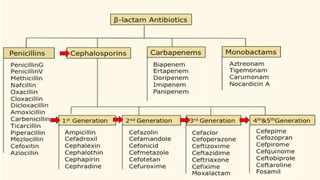
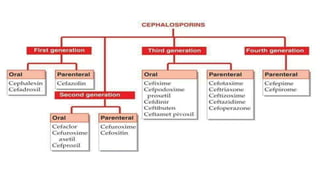
↠Conventionally devided into 4 generation
Classification
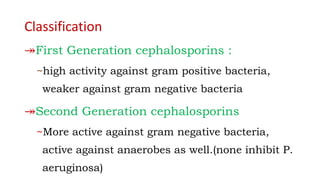
↠First Generation cephalosporins :
~high activity against gram positive bacteria,
weaker against gram negative bacteria
↠Second Generation cephalosporins
~More active against gram negative bacteria,
active against anaerobes as well.(none inhibit P.
aeruginosa)
Classification
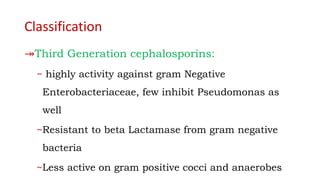
↠Third Generation cephalosporins:
~ highly activity against gram Negative
Enterobacteriaceae, few inhibit Pseudomonas as
well
~Resistant to beta Lactamase from gram negative
bacteria
~Less active on gram positive cocci and anaerobes
Classification
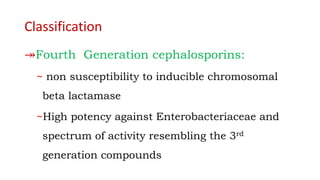
↠Fourth Generation cephalosporins:
~ non susceptibility to inducible chromosomal
beta lactamase
~High potency against Enterobacteriaceae and
spectrum of activity resembling the 3rd
generation compounds
Mechanism of action
↠Inhibit cell wall synthesis
↠Primarily bactericidal
↠Action same as penicillin
↠Bind to different protein than those which
bind penicillins
Mechanism of action
↠Cephalosporins are typically bactericidal and are similar to penicillin in their
action within the cell wall.
↠Cephalosporins are sometimes grouped into “generations” by their antimicrobial
properties.
↠The 1st-generation drugs are effective mainly against gram-positive organisms.
↠Higher generations generally have expanded spectra against aerobic gram-
negative bacilli.
↠The 5th-generation cephalosporins are active against methicillin-resistant
Staphylococcus aureus (MRSA) or other complicated infections.
Route
↠PO: Administer without regard to food; if GI
distress, give with food
↠IV: Reconstitute drug with sterile water or
normal saline; shake well until dissolved.
Inject into large vein or free-flowing IV
solution over 3-5 minutes
Indictaion
↠Cephalosporins are used to treat
~skin and skin-structure infections,
~bone infections,
~genitourinary infections,
~otitis media, and
~community-acquired respiratory tract
infections.
Indication
↠Meningitis
↠Surgical prophylaxis
↠Gonorrhea caused by penicillin producing
organism
↠Typhoid
↠Mixed aerobic and anerobic infections in cancer
patients
Indication
↠Hospital acquired infections
↠Prophylaxis and treatment of infection in
neutropenic patients
Drug interaction
↠ Patients who are allergic to pencillins may also be
allergic to cephalosporins.
↠Patients who consume cephalosporins while drinking
alcoholic beverages may experience disulfiram-like
reactions including severe headache, flushing, nausea,
vomiting, etc.
↠Additionally, like penicillins, cephalosporins may
interfere with coagulability and increase a patient’s risk
of bleeding.
Drug interaction
↠Cephalosporin dosing may require
adjustment for patients experiencing renal
impairment.
↠Blood urea nitrogen (BUN) and creatinine
should be monitored carefully to identify
signs of nephrotoxicity.
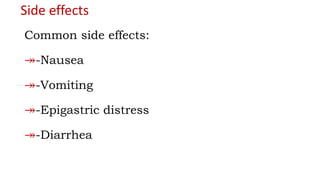
Side effects
Common side effects:
↠-Nausea
↠-Vomiting
↠-Epigastric distress
↠-Diarrhea
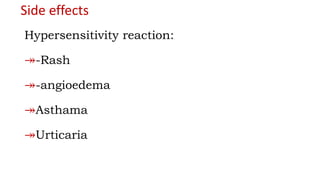
Side effects
Hypersensitivity reaction:
↠-Rash
↠-angioedema
↠Asthama
↠Urticaria
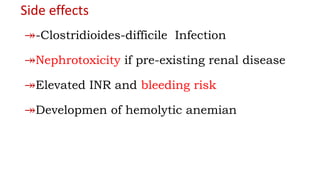
Side effects
↠-Clostridioides-difficile Infection
↠Nephrotoxicity if pre-existing renal disease
↠Elevated INR and bleeding risk
↠Developmen of hemolytic anemian
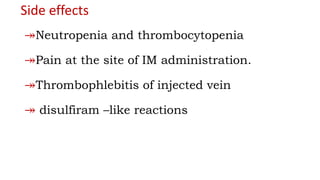
Side effects
↠Neutropenia and thrombocytopenia
↠Pain at the site of IM administration.
↠Thrombophlebitis of injected vein
↠ disulfiram –like reactions
Toxicity
↠More toxic than penicillin
↠Nephrotoxicity if pre-existing renal disease
↠Impairement in BUN
Role of nurse
↠Check for allergies, including if allergic to
penicillin
↠Dosage adjustment if renal impairment
↠Use with caution with seizure disorder
Role of nurse
↠Patients who are prescribed cephalosporins should be
specifically cautioned about a disulfiram reaction, which can
occur when alcohol is ingested while taking the medication.
↠Additionally, individuals should be instructed to monitor for
rash and signs of superinfection (such as black, furry
overgrowth on tongue; vaginal itching or discharge; loose or foul-
smelling stool) and report to the prescribing provider.
Role of nurse
↠It is also important to note that
cephalosporin can enter breastmilk and may
alter bowel flora of the infant. Thus, use
during breastfeeding is often discouraged.
Role of nurse
Monitor for systemic signs of infection:
↠WBCs
↠ Fever
↠Monitor actual site of infection
↠Monitor culture results, if obtained
↠n

3. Cephalosporins.pptx

  • 1.
  • 2.
    Classified under followingcategory ↠Beta lactam antibiotics ↠Inhibit cell wall synthesis ↠Primarily bactericidal ↠Obtained from fungi
  • 4.
    Cephalosporins ↠Group of semisyntheticantibiotics derived from “cephalosporin- C” ↠Obtained from the fungus “cephalosporium” ↠Chemically same as penicillin ↠The nucleus consists of a β- lactam ring fused to a dihydrothiazine ring, ↠Conventionally devided into 4 generation
  • 6.
    Classification ↠First Generation cephalosporins: ~high activity against gram positive bacteria, weaker against gram negative bacteria ↠Second Generation cephalosporins ~More active against gram negative bacteria, active against anaerobes as well.(none inhibit P. aeruginosa)
  • 7.
    Classification ↠Third Generation cephalosporins: ~highly activity against gram Negative Enterobacteriaceae, few inhibit Pseudomonas as well ~Resistant to beta Lactamase from gram negative bacteria ~Less active on gram positive cocci and anaerobes
  • 8.
    Classification ↠Fourth Generation cephalosporins: ~non susceptibility to inducible chromosomal beta lactamase ~High potency against Enterobacteriaceae and spectrum of activity resembling the 3rd generation compounds
  • 9.
    Mechanism of action ↠Inhibitcell wall synthesis ↠Primarily bactericidal ↠Action same as penicillin ↠Bind to different protein than those which bind penicillins
  • 10.
    Mechanism of action ↠Cephalosporinsare typically bactericidal and are similar to penicillin in their action within the cell wall. ↠Cephalosporins are sometimes grouped into “generations” by their antimicrobial properties. ↠The 1st-generation drugs are effective mainly against gram-positive organisms. ↠Higher generations generally have expanded spectra against aerobic gram- negative bacilli. ↠The 5th-generation cephalosporins are active against methicillin-resistant Staphylococcus aureus (MRSA) or other complicated infections.
  • 11.
    Route ↠PO: Administer withoutregard to food; if GI distress, give with food ↠IV: Reconstitute drug with sterile water or normal saline; shake well until dissolved. Inject into large vein or free-flowing IV solution over 3-5 minutes
  • 12.
    Indictaion ↠Cephalosporins are usedto treat ~skin and skin-structure infections, ~bone infections, ~genitourinary infections, ~otitis media, and ~community-acquired respiratory tract infections.
  • 13.
    Indication ↠Meningitis ↠Surgical prophylaxis ↠Gonorrhea causedby penicillin producing organism ↠Typhoid ↠Mixed aerobic and anerobic infections in cancer patients
  • 14.
    Indication ↠Hospital acquired infections ↠Prophylaxisand treatment of infection in neutropenic patients
  • 15.
    Drug interaction ↠ Patientswho are allergic to pencillins may also be allergic to cephalosporins. ↠Patients who consume cephalosporins while drinking alcoholic beverages may experience disulfiram-like reactions including severe headache, flushing, nausea, vomiting, etc. ↠Additionally, like penicillins, cephalosporins may interfere with coagulability and increase a patient’s risk of bleeding.
  • 16.
    Drug interaction ↠Cephalosporin dosingmay require adjustment for patients experiencing renal impairment. ↠Blood urea nitrogen (BUN) and creatinine should be monitored carefully to identify signs of nephrotoxicity.
  • 17.
    Side effects Common sideeffects: ↠-Nausea ↠-Vomiting ↠-Epigastric distress ↠-Diarrhea
  • 18.
  • 19.
    Side effects ↠-Clostridioides-difficile Infection ↠Nephrotoxicityif pre-existing renal disease ↠Elevated INR and bleeding risk ↠Developmen of hemolytic anemian
  • 20.
    Side effects ↠Neutropenia andthrombocytopenia ↠Pain at the site of IM administration. ↠Thrombophlebitis of injected vein ↠ disulfiram –like reactions
  • 21.
    Toxicity ↠More toxic thanpenicillin ↠Nephrotoxicity if pre-existing renal disease ↠Impairement in BUN
  • 22.
    Role of nurse ↠Checkfor allergies, including if allergic to penicillin ↠Dosage adjustment if renal impairment ↠Use with caution with seizure disorder
  • 23.
    Role of nurse ↠Patientswho are prescribed cephalosporins should be specifically cautioned about a disulfiram reaction, which can occur when alcohol is ingested while taking the medication. ↠Additionally, individuals should be instructed to monitor for rash and signs of superinfection (such as black, furry overgrowth on tongue; vaginal itching or discharge; loose or foul- smelling stool) and report to the prescribing provider.
  • 24.
    Role of nurse ↠Itis also important to note that cephalosporin can enter breastmilk and may alter bowel flora of the infant. Thus, use during breastfeeding is often discouraged.
  • 25.
    Role of nurse Monitorfor systemic signs of infection: ↠WBCs ↠ Fever ↠Monitor actual site of infection ↠Monitor culture results, if obtained
  • 26.

Editor's Notes

  • #7 Pseudomonas aeruginosa
  • #18 Clostridioides difficile or C. difficile
  • #19 Clostridioides difficile or C. difficile
  • #20 Clostridioides difficile or C. difficile
  • #21 Clostridioides difficile or C. difficile