Lecture 1
The Earth and its Atmosphere
Overview
Composition
[Radiosonde launch]
Vertical Structure
topic one
Overview of the
atmosphere
What does it do for us?
Overview of the Earth’s
Atmosphere
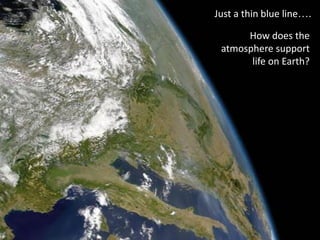
Just a thin blue line….
How does the
atmosphere support
life on Earth?
 Without the atmosphere the Earth would not have lakes
or rivers (moisture transport), sound (medium), or life
(oxygen, protection from harmful UV radiation).
 Radiant energy from the sun energizes the atmosphere
driving day to day weather.
 Our atmosphere is unique amongst the planets of our
solar system. This is partly due to its position relative to
the Sun, but also due to the processes that formed the
atmosphere.
Overview of the Atmosphere
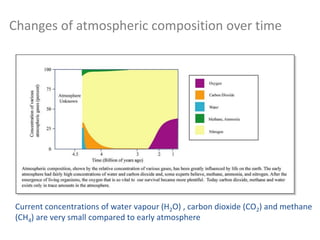
Changes of atmospheric composition over time
Source: MIT OpenCourseWare
Current concentrations of water vapour (H2O) , carbon dioxide (CO2) and methane
(CH4) are very small compared to early atmosphere
Where did the atmosphere come from?
First Atmosphere (4.6 billion years ago!): Probably hydrogen and
helium. These were lost to space early in Earth’s history
because Earth’s gravity not strong enough to hold them (no
magnetic field).
Second Atmosphere: Produced by volcanic out gassing
water vapour,
carbon dioxide (CO2), carbon monoxide (CO)
sulphur dioxide (SO2),
methane (CH4), ammonia (NH3), nitrogen (N2) …and others
Ocean Formation - As the Earth cooled, H2O vapour produced by
out gassing could condense allowing oceans to form. Large
amounts of CO2 dissolved in the oceans and became locked up
in carbonate sedimentary rocks (e.g. limestone)
Oxygen
Today, the atmosphere is ≈21% free oxygen. How did oxygen
reach these levels in the atmosphere?
Oxygen Production
Photochemical dissociation of water (H2O) (1-2%)
Photosynthesis (all the rest)
Oxygen Consumers
Chemical Weathering (oxidation, earlier consumer)
Animal Respiration (later)
Burning of Fossil Fuels (much later)
If rocks sufficiently oxidised, O2 can remain in the atmosphere.
Present levels of O2 were probably not achieved until several
hundred million years ago.
topic two
Composition of the
atmosphere
99% of the atmosphere is within 30 km of the Earth’s surface
and comprises almost all the weather-giving activity we
experience.
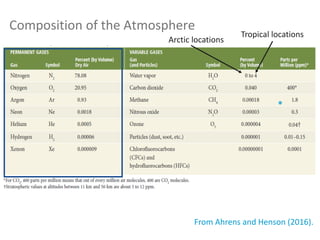
Composition of the Atmosphere
99% of the atmosphere is within 30 km of the Earth’s surface
N2 78% and O2 21% (of dry air, fairly constant up to 80 km)
“Permanent”: The percentages represent a constant amount of gas
with cycles of destruction and production constantly maintaining
this amount.
N2: Denitrification mostly via biological processes (food chain)
returned to atmosphere by decaying of plant and animal matter
02: Organic matter decays, oxidation, respiration
returned to atmosphere e.g. photosynthesis
Many other gases are present with concentrations that vary on a
variety of timescales. Examples? [time out]
From Ahrens and Henson (2016).
*
Composition of the Atmosphere
Tropical locations
Arctic locations
Carbon Dioxide
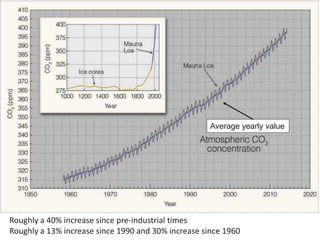
 Carbon Dioxide is a well-mixed gas but its concentration
changes over time.
 Estimates are that the oceans hold more than 50 times the
CO2 of the atmosphere.
 It has increased since pre-industrial times due to the burning
of fossil fuels.
 How much has CO2 increased (in %) since:
 1990 ?
 1960 ?
 1700 ?
[time out]
Average yearly value
Roughly a 40% increase since pre-industrial times
Roughly a 13% increase since 1990 and 30% increase since 1960
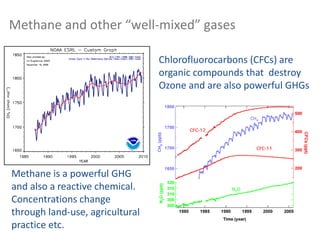
Methane and other “well-mixed” gases
Methane is a powerful GHG
and also a reactive chemical.
Concentrations change
through land-use, agricultural
practice etc.
Chlorofluorocarbons (CFCs) are
organic compounds that destroy
Ozone and are also powerful GHGs
Water vapour
 Water vapour – a natural greenhouse gas
 It is a variable gas following the hydrological cycle
 Which physical processes determine how much
water vapour is in a ‘parcel’ of air?
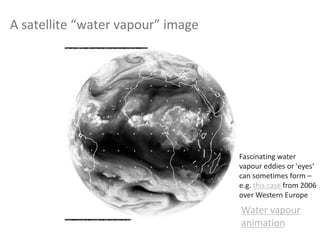
A satellite “water vapour” image
Water vapour
animation
Fascinating water
vapour eddies or 'eyes‘
can sometimes form –
e.g. this case from 2006
over Western Europe
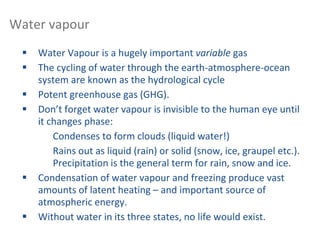
 Water Vapour is a hugely important variable gas
 The cycling of water through the earth-atmosphere-ocean
system are known as the hydrological cycle
 Potent greenhouse gas (GHG).
 Don’t forget water vapour is invisible to the human eye until
it changes phase:
Condenses to form clouds (liquid water!)
Rains out as liquid (rain) or solid (snow, ice, graupel etc.).
Precipitation is the general term for rain, snow and ice.
 Condensation of water vapour and freezing produce vast
amounts of latent heating – and important source of
atmospheric energy.
 Without water in its three states, no life would exist.
Water vapour
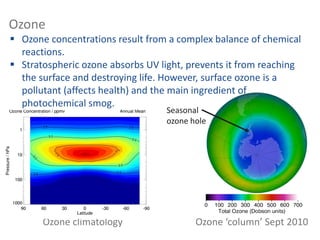
Ozone ‘column’ Sept 2010
Ozone
Ozone climatology
 Ozone concentrations result from a complex balance of chemical
reactions.
 Stratospheric ozone absorbs UV light, prevents it from reaching
the surface and destroying life. However, surface ozone is a
pollutant (affects health) and the main ingredient of
photochemical smog.
Seasonal
ozone hole
Aerosols
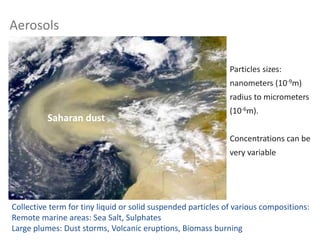
Saharan dust
Particles sizes:
nanometers (10-9m)
radius to micrometers
(10-6m).
Concentrations can be
very variable
Collective term for tiny liquid or solid suspended particles of various compositions:
Remote marine areas: Sea Salt, Sulphates
Large plumes: Dust storms, Volcanic eruptions, Biomass burning
Aerosols spewed into the atmosphere
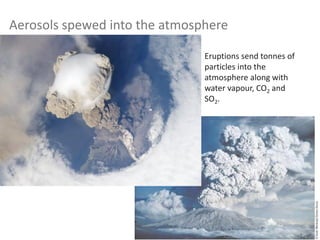
Eruptions send tonnes of
particles into the
atmosphere along with
water vapour, CO2 and
SO2.
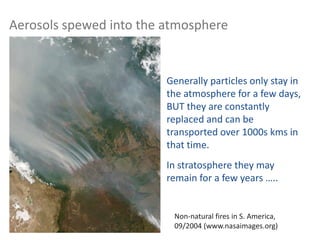
Non-natural fires in S. America,
09/2004 (www.nasaimages.org)
Generally particles only stay in
the atmosphere for a few days,
BUT they are constantly
replaced and can be
transported over 1000s kms in
that time.
In stratosphere they may
remain for a few years …..
Aerosols spewed into the atmosphere
 Aerosols are very important in the water-cycle.
 They act as sites onto which water vapour can condense –
leading to cloud and precipitation formation.
 They also have an impact on the Earth’s radiation budget –
reflecting sunlight back out to space.
 They can also affect human health. Small aerosols from
engine exhausts can be harmful to the lungs.
Aerosols
Radiosonde
 Time to go and launch a Weather Balloon.
 What do we measure?
 Why is the vertical structure of the atmosphere so
important?
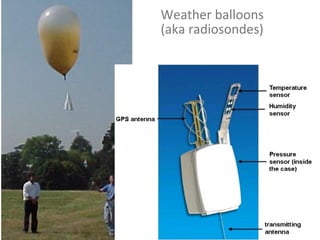
Weather balloons
(aka radiosondes)
RS9
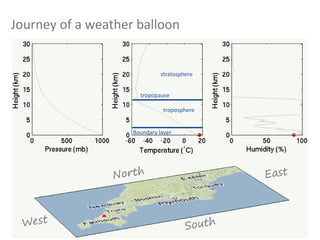
Journey of a weather balloon
troposphere
stratosphere
tropopause
Boundary layer
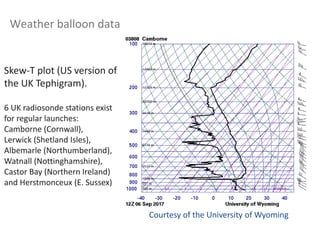
Weather balloon data
Courtesy of the University of Wyoming
Skew-T plot (US version of
the UK Tephigram).
6 UK radiosonde stations exist
for regular launches:
Camborne (Cornwall),
Lerwick (Shetland Isles),
Albemarle (Northumberland),
Watnall (Nottinghamshire),
Castor Bay (Northern Ireland)
and Herstmonceux (E. Sussex)
topic three
Vertical structure of
the atmosphere
Pressure, density, temperature and humidity profiles
characterize vertical structure.
Vertical Structure of the Atmosphere:
Pressure Profile
Quick review:
Weight = mass x gravity – this is a force.
Density = mass/volume
Pressure = force/area
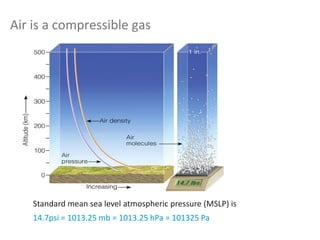
Pressure decreases with increasing height, rapidly at first then
more slowly.
Standard mean sea level atmospheric pressure (MSLP) is
14.7psi = 1013.25 mb = 1013.25 hPa = 101325 Pa
Air is a compressible gas
Density Profile
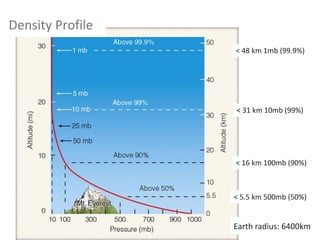
 Density falls continuously with increasing height.
e.g. 1.2 kg m-3 at surface
1x10⁻¹⁰ kg m-3 a few hundred km above.
 90% of the weight of the atmosphere in lowest 16 km.
 There are several ways of quantifying the change of
pressure (or density) with height
One way is to define a decadal scale height – the height over
which pressure decreases by a factor of 10. This is about 16
km.
< 16 km 100mb (90%)
< 48 km 1mb (99.9%)
< 5.5 km 500mb (50%)
< 31 km 10mb (99%)
Earth radius: 6400km
Density Profile
Temperature Profile
Commonly used terms:
 Lapse rate = change in temperature with a change
in height – typically about 6.5 K km-1 in the lower
atmosphere.
 Isothermal environment = no change in
temperature with height
 Inversion layer = change in the sign of the lapse
rate
What is happening here? [time out]
A temperature inversion (temperature
increase with height) prevents ascent of air
Four main layers related to the average profile of the air
temperature above the surface:
1. Troposphere: decrease in temperature, day to day
weather, tropopause.
2. Stratosphere: increase in temperature, ozone,
stratopause.
3. Mesosphere: decrease in temperature, mesopause.
4. Thermosphere: increase in temperature, sun’s strongest
radiation.
Temperature Profile
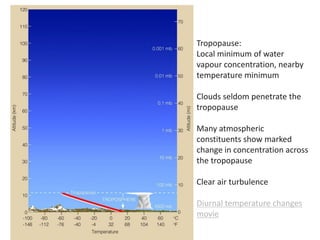
Tropopause:
Local minimum of water
vapour concentration, nearby
temperature minimum
Clouds seldom penetrate the
tropopause
Many atmospheric
constituents show marked
change in concentration across
the tropopause
Clear air turbulence
Diurnal temperature changes
movie
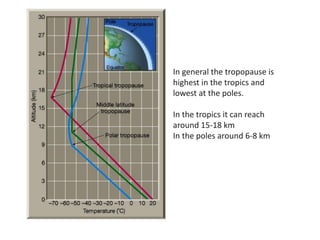
In general the tropopause is
highest in the tropics and
lowest at the poles.
In the tropics it can reach
around 15-18 km
In the poles around 6-8 km
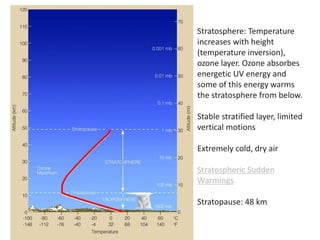
Stratosphere: Temperature
increases with height
(temperature inversion),
ozone layer. Ozone absorbes
energetic UV energy and
some of this energy warms
the stratosphere from below.
Stable stratified layer, limited
vertical motions
Extremely cold, dry air
Stratospheric Sudden
Warmings
Stratopause: 48 km
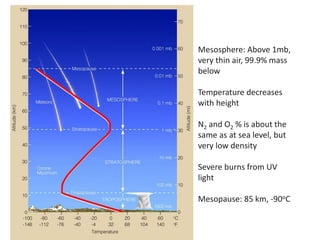
Mesosphere: Above 1mb,
very thin air, 99.9% mass
below
Temperature decreases
with height
N2 and O2 % is about the
same as at sea level, but
very low density
Severe burns from UV
light
Mesopause: 85 km, -90oC
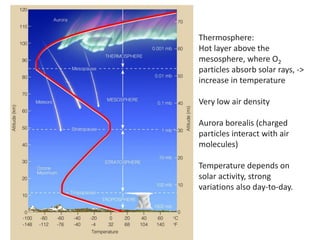
Thermosphere:
Hot layer above the
mesosphere, where O2
particles absorb solar rays, ->
increase in temperature
Very low air density
Aurora borealis (charged
particles interact with air
molecules)
Temperature depends on
solar activity, strong
variations also day-to-day.
Vertical Structure of the Atmosphere
The Ionosphere
 Not a true layer, but an electrified region sitting mostly
in the thermosphere. Extends from about 60 km to the
top of the atmosphere (1000 km).
 Molecules are ionized by absorption of solar radiation.
 Ions = molecule which has lost or gained one or more
electrons.
 The presence of free electrons strongly affects radio
wave propagation.
 Major role in AM radio communications: F,E,D
ionization layers (with different characteristics).
 Sunlight creates layers, D & E layers weaken at night =>
less interference with AM radio transmissions at night.
Summary
 The composition of the atmosphere has a massive bearing
on life on Earth.
 The atmosphere consists of several layers which have very
different properties.
 Most of our weather occurs in the troposphere (although it
can be affected by events in the stratosphere and other
layers).
 For most of MT11C we shall be considering things that
happen in the troposphere.

composition_function_structure_of_Atmosphere.pdf

  • 1.
    Lecture 1 The Earthand its Atmosphere Overview Composition [Radiosonde launch] Vertical Structure
  • 2.
    topic one Overview ofthe atmosphere What does it do for us?
  • 3.
    Overview of theEarth’s Atmosphere Just a thin blue line…. How does the atmosphere support life on Earth?
  • 4.
     Without theatmosphere the Earth would not have lakes or rivers (moisture transport), sound (medium), or life (oxygen, protection from harmful UV radiation).  Radiant energy from the sun energizes the atmosphere driving day to day weather.  Our atmosphere is unique amongst the planets of our solar system. This is partly due to its position relative to the Sun, but also due to the processes that formed the atmosphere. Overview of the Atmosphere
  • 5.
    Changes of atmosphericcomposition over time Source: MIT OpenCourseWare Current concentrations of water vapour (H2O) , carbon dioxide (CO2) and methane (CH4) are very small compared to early atmosphere
  • 6.
    Where did theatmosphere come from? First Atmosphere (4.6 billion years ago!): Probably hydrogen and helium. These were lost to space early in Earth’s history because Earth’s gravity not strong enough to hold them (no magnetic field). Second Atmosphere: Produced by volcanic out gassing water vapour, carbon dioxide (CO2), carbon monoxide (CO) sulphur dioxide (SO2), methane (CH4), ammonia (NH3), nitrogen (N2) …and others Ocean Formation - As the Earth cooled, H2O vapour produced by out gassing could condense allowing oceans to form. Large amounts of CO2 dissolved in the oceans and became locked up in carbonate sedimentary rocks (e.g. limestone)
  • 7.
    Oxygen Today, the atmosphereis ≈21% free oxygen. How did oxygen reach these levels in the atmosphere? Oxygen Production Photochemical dissociation of water (H2O) (1-2%) Photosynthesis (all the rest) Oxygen Consumers Chemical Weathering (oxidation, earlier consumer) Animal Respiration (later) Burning of Fossil Fuels (much later) If rocks sufficiently oxidised, O2 can remain in the atmosphere. Present levels of O2 were probably not achieved until several hundred million years ago.
  • 8.
    topic two Composition ofthe atmosphere 99% of the atmosphere is within 30 km of the Earth’s surface and comprises almost all the weather-giving activity we experience.
  • 9.
    Composition of theAtmosphere 99% of the atmosphere is within 30 km of the Earth’s surface N2 78% and O2 21% (of dry air, fairly constant up to 80 km) “Permanent”: The percentages represent a constant amount of gas with cycles of destruction and production constantly maintaining this amount. N2: Denitrification mostly via biological processes (food chain) returned to atmosphere by decaying of plant and animal matter 02: Organic matter decays, oxidation, respiration returned to atmosphere e.g. photosynthesis Many other gases are present with concentrations that vary on a variety of timescales. Examples? [time out]
  • 10.
    From Ahrens andHenson (2016). * Composition of the Atmosphere Tropical locations Arctic locations
  • 11.
    Carbon Dioxide  CarbonDioxide is a well-mixed gas but its concentration changes over time.  Estimates are that the oceans hold more than 50 times the CO2 of the atmosphere.  It has increased since pre-industrial times due to the burning of fossil fuels.  How much has CO2 increased (in %) since:  1990 ?  1960 ?  1700 ? [time out]
  • 12.
    Average yearly value Roughlya 40% increase since pre-industrial times Roughly a 13% increase since 1990 and 30% increase since 1960
  • 13.
    Methane and other“well-mixed” gases Methane is a powerful GHG and also a reactive chemical. Concentrations change through land-use, agricultural practice etc. Chlorofluorocarbons (CFCs) are organic compounds that destroy Ozone and are also powerful GHGs
  • 14.
    Water vapour  Watervapour – a natural greenhouse gas  It is a variable gas following the hydrological cycle  Which physical processes determine how much water vapour is in a ‘parcel’ of air?
  • 15.
    A satellite “watervapour” image Water vapour animation Fascinating water vapour eddies or 'eyes‘ can sometimes form – e.g. this case from 2006 over Western Europe
  • 16.
     Water Vapouris a hugely important variable gas  The cycling of water through the earth-atmosphere-ocean system are known as the hydrological cycle  Potent greenhouse gas (GHG).  Don’t forget water vapour is invisible to the human eye until it changes phase: Condenses to form clouds (liquid water!) Rains out as liquid (rain) or solid (snow, ice, graupel etc.). Precipitation is the general term for rain, snow and ice.  Condensation of water vapour and freezing produce vast amounts of latent heating – and important source of atmospheric energy.  Without water in its three states, no life would exist. Water vapour
  • 17.
    Ozone ‘column’ Sept2010 Ozone Ozone climatology  Ozone concentrations result from a complex balance of chemical reactions.  Stratospheric ozone absorbs UV light, prevents it from reaching the surface and destroying life. However, surface ozone is a pollutant (affects health) and the main ingredient of photochemical smog. Seasonal ozone hole
  • 18.
    Aerosols Saharan dust Particles sizes: nanometers(10-9m) radius to micrometers (10-6m). Concentrations can be very variable Collective term for tiny liquid or solid suspended particles of various compositions: Remote marine areas: Sea Salt, Sulphates Large plumes: Dust storms, Volcanic eruptions, Biomass burning
  • 19.
    Aerosols spewed intothe atmosphere Eruptions send tonnes of particles into the atmosphere along with water vapour, CO2 and SO2.
  • 20.
    Non-natural fires inS. America, 09/2004 (www.nasaimages.org) Generally particles only stay in the atmosphere for a few days, BUT they are constantly replaced and can be transported over 1000s kms in that time. In stratosphere they may remain for a few years ….. Aerosols spewed into the atmosphere
  • 21.
     Aerosols arevery important in the water-cycle.  They act as sites onto which water vapour can condense – leading to cloud and precipitation formation.  They also have an impact on the Earth’s radiation budget – reflecting sunlight back out to space.  They can also affect human health. Small aerosols from engine exhausts can be harmful to the lungs. Aerosols
  • 22.
    Radiosonde  Time togo and launch a Weather Balloon.  What do we measure?  Why is the vertical structure of the atmosphere so important?
  • 23.
  • 24.
    Journey of aweather balloon troposphere stratosphere tropopause Boundary layer
  • 25.
    Weather balloon data Courtesyof the University of Wyoming Skew-T plot (US version of the UK Tephigram). 6 UK radiosonde stations exist for regular launches: Camborne (Cornwall), Lerwick (Shetland Isles), Albemarle (Northumberland), Watnall (Nottinghamshire), Castor Bay (Northern Ireland) and Herstmonceux (E. Sussex)
  • 26.
    topic three Vertical structureof the atmosphere Pressure, density, temperature and humidity profiles characterize vertical structure.
  • 27.
    Vertical Structure ofthe Atmosphere: Pressure Profile Quick review: Weight = mass x gravity – this is a force. Density = mass/volume Pressure = force/area Pressure decreases with increasing height, rapidly at first then more slowly.
  • 28.
    Standard mean sealevel atmospheric pressure (MSLP) is 14.7psi = 1013.25 mb = 1013.25 hPa = 101325 Pa Air is a compressible gas
  • 29.
    Density Profile  Densityfalls continuously with increasing height. e.g. 1.2 kg m-3 at surface 1x10⁻¹⁰ kg m-3 a few hundred km above.  90% of the weight of the atmosphere in lowest 16 km.  There are several ways of quantifying the change of pressure (or density) with height One way is to define a decadal scale height – the height over which pressure decreases by a factor of 10. This is about 16 km.
  • 30.
    < 16 km100mb (90%) < 48 km 1mb (99.9%) < 5.5 km 500mb (50%) < 31 km 10mb (99%) Earth radius: 6400km Density Profile
  • 31.
    Temperature Profile Commonly usedterms:  Lapse rate = change in temperature with a change in height – typically about 6.5 K km-1 in the lower atmosphere.  Isothermal environment = no change in temperature with height  Inversion layer = change in the sign of the lapse rate
  • 32.
    What is happeninghere? [time out] A temperature inversion (temperature increase with height) prevents ascent of air
  • 33.
    Four main layersrelated to the average profile of the air temperature above the surface: 1. Troposphere: decrease in temperature, day to day weather, tropopause. 2. Stratosphere: increase in temperature, ozone, stratopause. 3. Mesosphere: decrease in temperature, mesopause. 4. Thermosphere: increase in temperature, sun’s strongest radiation. Temperature Profile
  • 34.
    Tropopause: Local minimum ofwater vapour concentration, nearby temperature minimum Clouds seldom penetrate the tropopause Many atmospheric constituents show marked change in concentration across the tropopause Clear air turbulence Diurnal temperature changes movie
  • 35.
    In general thetropopause is highest in the tropics and lowest at the poles. In the tropics it can reach around 15-18 km In the poles around 6-8 km
  • 36.
    Stratosphere: Temperature increases withheight (temperature inversion), ozone layer. Ozone absorbes energetic UV energy and some of this energy warms the stratosphere from below. Stable stratified layer, limited vertical motions Extremely cold, dry air Stratospheric Sudden Warmings Stratopause: 48 km
  • 37.
    Mesosphere: Above 1mb, verythin air, 99.9% mass below Temperature decreases with height N2 and O2 % is about the same as at sea level, but very low density Severe burns from UV light Mesopause: 85 km, -90oC
  • 38.
    Thermosphere: Hot layer abovethe mesosphere, where O2 particles absorb solar rays, -> increase in temperature Very low air density Aurora borealis (charged particles interact with air molecules) Temperature depends on solar activity, strong variations also day-to-day.
  • 39.
    Vertical Structure ofthe Atmosphere The Ionosphere  Not a true layer, but an electrified region sitting mostly in the thermosphere. Extends from about 60 km to the top of the atmosphere (1000 km).  Molecules are ionized by absorption of solar radiation.  Ions = molecule which has lost or gained one or more electrons.  The presence of free electrons strongly affects radio wave propagation.  Major role in AM radio communications: F,E,D ionization layers (with different characteristics).  Sunlight creates layers, D & E layers weaken at night => less interference with AM radio transmissions at night.
  • 40.
    Summary  The compositionof the atmosphere has a massive bearing on life on Earth.  The atmosphere consists of several layers which have very different properties.  Most of our weather occurs in the troposphere (although it can be affected by events in the stratosphere and other layers).  For most of MT11C we shall be considering things that happen in the troposphere.