THE ANKLE
AND FOOT COMPLEX
1
Recommended book
Joint structure and function
Pamela K. Levangie
INTRODUCTION
• permit both stability and mobility.
• Foot is able to Sustain large weight bearing stress.
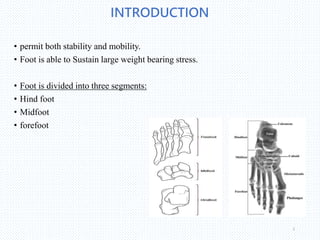
• Foot is divided into three segments:
• Hind foot
• Midfoot
• forefoot
2
BONES OF THE FOOT
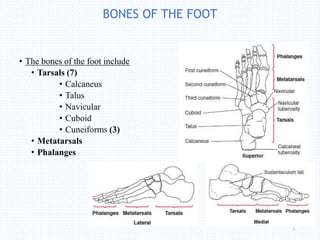
• The bones of the foot include
• Tarsals (7)
• Calcaneus
• Talus
• Navicular
• Cuboid
• Cuneiforms (3)
• Metatarsals
• Phalanges
3
MOTIONS AT ANKLE JOINT
• Dorsiflexion / Plantar flexion
• Eversion / Inversion
• Abduction : accompany eversion
• Adduction: accompany inversion
• “Composite” motions that have components of
each of the cardinal motions.
• Supination
• Combination of plantar flexion, inversion, and
adduction.
• Pronation
• Combination of dorsiflexion, eversion, and abduction
4
MOTION OF THE ANKLE/FOOT
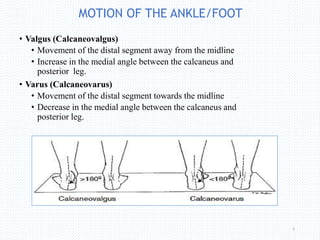
• Valgus (Calcaneovalgus)
• Movement of the distal segment away from the midline
• Increase in the medial angle between the calcaneus and
posterior leg.
• Varus (Calcaneovarus)
• Movement of the distal segment towards the midline
• Decrease in the medial angle between the calcaneus and
posterior leg.
5
TALOCRURAL JOINT
6
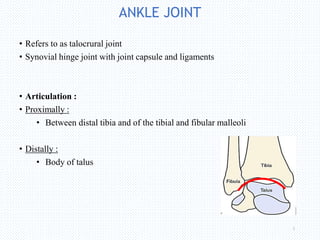
ANKLE JOINT
• Refers to as talocrural joint
• Synovial hinge joint with joint capsule and ligaments
• Articulation :
• Proximally :
• Between distal tibia and of the tibial and fibular malleoli
• Distally :
• Body of talus
7
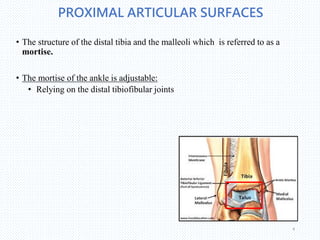
PROXIMAL ARTICULAR SURFACES
• The structure of the distal tibia and the malleoli which is referred to as a
mortise.
• The mortise of the ankle is adjustable:
• Relying on the distal tibiofibular joints
8
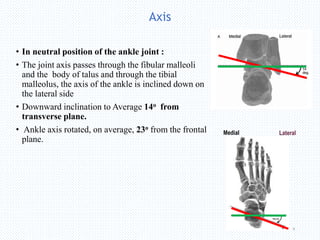
Axis
• In neutral position of the ankle joint :
• The joint axis passes through the fibular malleoli
and the body of talus and through the tibial
malleolus, the axis of the ankle is inclined down on
the lateral side
• Downward inclination to Average 14o from
transverse plane.
• Ankle axis rotated, on average, 23o from the frontal
plane.
9
Lateral
Medial
LIGAMENTS
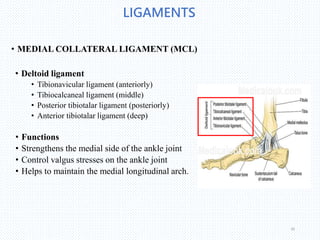
• MEDIAL COLLATERAL LIGAMENT (MCL)
• Deltoid ligament
• Tibionavicular ligament (anteriorly)
• Tibiocalcaneal ligament (middle)
• Posterior tibiotalar ligament (posteriorly)
• Anterior tibiotalar ligament (deep)
• Functions
• Strengthens the medial side of the ankle joint
• Control valgus stresses on the ankle joint
• Helps to maintain the medial longitudinal arch.
10
LIGAMENTS
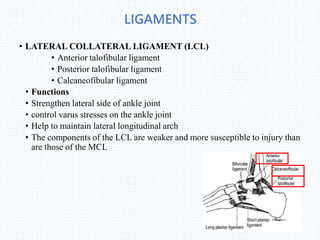
• LATERAL COLLATERAL LIGAMENT (LCL)
• Anterior talofibular ligament
• Posterior talofibular ligament
• Calcaneofibular ligament
• Functions
• Strengthen lateral side of ankle joint
• control varus stresses on the ankle joint
• Help to maintain lateral longitudinal arch
• The components of the LCL are weaker and more susceptible to injury than
are those of the MCL
11
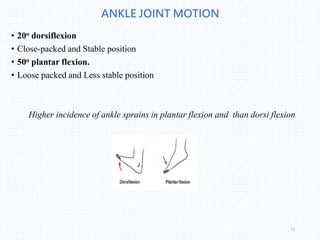
ANKLE JOINT MOTION
• 20o dorsiflexion
• Close-packed and Stable position
• 50o plantar flexion.
• Loose packed and Less stable position
Higher incidence of ankle sprains in plantar flexion and than dorsi flexion
12
ARTHROKINEMATIC
• The concave articulating surface is the mortise articulate with the convex
articulating surface is the body of the talus.
• With physiological motions of the foot, the articulating surface of the talus
slides in the opposite direction
• Dorsi flexion : Rolling anteriorly , sliding posteriorly
• Planter flexion : rolling posteriorly , sliding anteriorly
13
SABTALAR JOINT/ TALOCALCANEAL
JOINT
14
SUBTALAR JOINT STRUCTURE
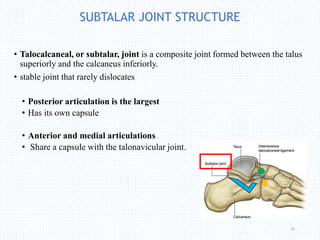
• Talocalcaneal, or subtalar, joint is a composite joint formed between the talus
superiorly and the calcaneus inferiorly.
• stable joint that rarely dislocates
• Posterior articulation is the largest
• Has its own capsule
• Anterior and medial articulations
• Share a capsule with the talonavicular joint.
15
LIGAMENTS
• Calcaneofibular ligament
• Lateral talo calcaneal ligament
• Cervical ligament
• Interosseous talocalcaneal ligament
• Collateral ligaments
16
SUBTALAR JOINT FUNCTION
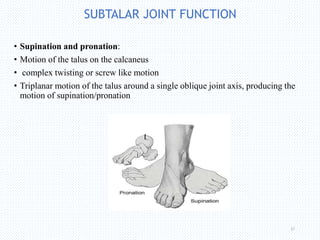
• Supination and pronation:
• Motion of the talus on the calcaneus
• complex twisting or screw like motion
• Triplanar motion of the talus around a single oblique joint axis, producing the
motion of supination/pronation
17
Axis
• Supination / pronation
• (A) inclined up from the transverse plane approximately 42o
• (B) inclined medially from an A-P axis approximately 16o.
18
ARTHROKINEMATIC
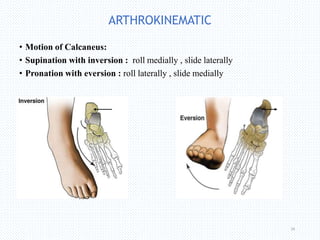
• Motion of Calcaneus:
• Supination with inversion : roll medially , slide laterally
• Pronation with eversion : roll laterally , slide medially
19
PLANTAR ARCHES
• Longitudinal arch
• Medial longitudinal arch
• Lateral longitudinal arch
• Transverse arch
20
MEDIAL LONGITUDINAL ARCH
• Largest & Highest
• Composed of Calcaneus, Talus, Navicular, Medial Cuneiform and First
Metatarsal
• Talus is the Keystone of the arch
• All weight transmitted from body to heel and forefoot must pass through
Talus
• Arch depresses during weight-bearing,
• Then recoils when the weight is removed
• Normally, it never flattens or touches the ground.
21
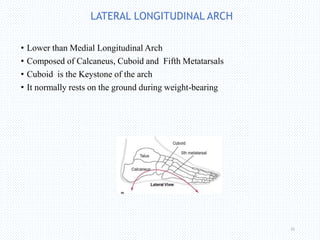
LATERAL LONGITUDINAL ARCH
• Lower than Medial Longitudinal Arch
• Composed of Calcaneus, Cuboid and Fifth Metatarsals
• Cuboid is the Keystone of the arch
• It normally rests on the ground during weight-bearing
22
Transverse Arch
• Concave from medial to lateral
• Composed of Three Cuneiforms and Cuboid.
• Middle Cuneiform is the keystone of this arch
23
Frontal view
At the level of the middle
of the metatarsals
Weight-bearing Surfaces And Support
• Main weight-bearing surfaces are:
• Structures of the bones provide stability to arches,
• But additional support is provided by Ligaments and Muscles
24
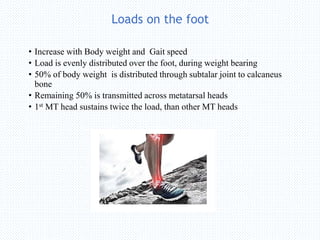
Loads on the foot
• Increase with Body weight and Gait speed
• Load is evenly distributed over the foot, during weight bearing
• 50% of body weight is distributed through subtalar joint to calcaneus
bone
• Remaining 50% is transmitted across metatarsal heads
• 1st MT head sustains twice the load, than other MT heads
THANKYOU
26

3- ANKLE JOINT.pptx

  • 1.
    THE ANKLE AND FOOTCOMPLEX 1 Recommended book Joint structure and function Pamela K. Levangie
  • 2.
    INTRODUCTION • permit bothstability and mobility. • Foot is able to Sustain large weight bearing stress. • Foot is divided into three segments: • Hind foot • Midfoot • forefoot 2
  • 3.
    BONES OF THEFOOT • The bones of the foot include • Tarsals (7) • Calcaneus • Talus • Navicular • Cuboid • Cuneiforms (3) • Metatarsals • Phalanges 3
  • 4.
    MOTIONS AT ANKLEJOINT • Dorsiflexion / Plantar flexion • Eversion / Inversion • Abduction : accompany eversion • Adduction: accompany inversion • “Composite” motions that have components of each of the cardinal motions. • Supination • Combination of plantar flexion, inversion, and adduction. • Pronation • Combination of dorsiflexion, eversion, and abduction 4
  • 5.
    MOTION OF THEANKLE/FOOT • Valgus (Calcaneovalgus) • Movement of the distal segment away from the midline • Increase in the medial angle between the calcaneus and posterior leg. • Varus (Calcaneovarus) • Movement of the distal segment towards the midline • Decrease in the medial angle between the calcaneus and posterior leg. 5
  • 6.
  • 7.
    ANKLE JOINT • Refersto as talocrural joint • Synovial hinge joint with joint capsule and ligaments • Articulation : • Proximally : • Between distal tibia and of the tibial and fibular malleoli • Distally : • Body of talus 7
  • 8.
    PROXIMAL ARTICULAR SURFACES •The structure of the distal tibia and the malleoli which is referred to as a mortise. • The mortise of the ankle is adjustable: • Relying on the distal tibiofibular joints 8
  • 9.
    Axis • In neutralposition of the ankle joint : • The joint axis passes through the fibular malleoli and the body of talus and through the tibial malleolus, the axis of the ankle is inclined down on the lateral side • Downward inclination to Average 14o from transverse plane. • Ankle axis rotated, on average, 23o from the frontal plane. 9 Lateral Medial
  • 10.
    LIGAMENTS • MEDIAL COLLATERALLIGAMENT (MCL) • Deltoid ligament • Tibionavicular ligament (anteriorly) • Tibiocalcaneal ligament (middle) • Posterior tibiotalar ligament (posteriorly) • Anterior tibiotalar ligament (deep) • Functions • Strengthens the medial side of the ankle joint • Control valgus stresses on the ankle joint • Helps to maintain the medial longitudinal arch. 10
  • 11.
    LIGAMENTS • LATERAL COLLATERALLIGAMENT (LCL) • Anterior talofibular ligament • Posterior talofibular ligament • Calcaneofibular ligament • Functions • Strengthen lateral side of ankle joint • control varus stresses on the ankle joint • Help to maintain lateral longitudinal arch • The components of the LCL are weaker and more susceptible to injury than are those of the MCL 11
  • 12.
    ANKLE JOINT MOTION •20o dorsiflexion • Close-packed and Stable position • 50o plantar flexion. • Loose packed and Less stable position Higher incidence of ankle sprains in plantar flexion and than dorsi flexion 12
  • 13.
    ARTHROKINEMATIC • The concavearticulating surface is the mortise articulate with the convex articulating surface is the body of the talus. • With physiological motions of the foot, the articulating surface of the talus slides in the opposite direction • Dorsi flexion : Rolling anteriorly , sliding posteriorly • Planter flexion : rolling posteriorly , sliding anteriorly 13
  • 14.
  • 15.
    SUBTALAR JOINT STRUCTURE •Talocalcaneal, or subtalar, joint is a composite joint formed between the talus superiorly and the calcaneus inferiorly. • stable joint that rarely dislocates • Posterior articulation is the largest • Has its own capsule • Anterior and medial articulations • Share a capsule with the talonavicular joint. 15
  • 16.
    LIGAMENTS • Calcaneofibular ligament •Lateral talo calcaneal ligament • Cervical ligament • Interosseous talocalcaneal ligament • Collateral ligaments 16
  • 17.
    SUBTALAR JOINT FUNCTION •Supination and pronation: • Motion of the talus on the calcaneus • complex twisting or screw like motion • Triplanar motion of the talus around a single oblique joint axis, producing the motion of supination/pronation 17
  • 18.
    Axis • Supination /pronation • (A) inclined up from the transverse plane approximately 42o • (B) inclined medially from an A-P axis approximately 16o. 18
  • 19.
    ARTHROKINEMATIC • Motion ofCalcaneus: • Supination with inversion : roll medially , slide laterally • Pronation with eversion : roll laterally , slide medially 19
  • 20.
    PLANTAR ARCHES • Longitudinalarch • Medial longitudinal arch • Lateral longitudinal arch • Transverse arch 20
  • 21.
    MEDIAL LONGITUDINAL ARCH •Largest & Highest • Composed of Calcaneus, Talus, Navicular, Medial Cuneiform and First Metatarsal • Talus is the Keystone of the arch • All weight transmitted from body to heel and forefoot must pass through Talus • Arch depresses during weight-bearing, • Then recoils when the weight is removed • Normally, it never flattens or touches the ground. 21
  • 22.
    LATERAL LONGITUDINAL ARCH •Lower than Medial Longitudinal Arch • Composed of Calcaneus, Cuboid and Fifth Metatarsals • Cuboid is the Keystone of the arch • It normally rests on the ground during weight-bearing 22
  • 23.
    Transverse Arch • Concavefrom medial to lateral • Composed of Three Cuneiforms and Cuboid. • Middle Cuneiform is the keystone of this arch 23 Frontal view At the level of the middle of the metatarsals
  • 24.
    Weight-bearing Surfaces AndSupport • Main weight-bearing surfaces are: • Structures of the bones provide stability to arches, • But additional support is provided by Ligaments and Muscles 24
  • 25.
    Loads on thefoot • Increase with Body weight and Gait speed • Load is evenly distributed over the foot, during weight bearing • 50% of body weight is distributed through subtalar joint to calcaneus bone • Remaining 50% is transmitted across metatarsal heads • 1st MT head sustains twice the load, than other MT heads
  • 26.

Editor's Notes

  • #5 Composite means “ made up of several parts and elements”
  • #14 Mortise is distal tibiofibular ligament