Welcome to our Bible
Study
2nd
Sunday of Advent C
6 December 2015
In preparation for this Sunday’s liturgy
In aid of focusing of homilies and sharing
Prepared by Fr. Cielo R. Almazan, OFM
1st
reading: Baruch 5,1-9
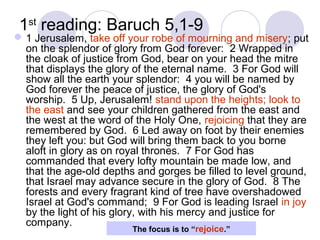
1 Jerusalem, take off your robe of mourning and misery; put
on the splendor of glory from God forever: 2 Wrapped in
the cloak of justice from God, bear on your head the mitre
that displays the glory of the eternal name. 3 For God will
show all the earth your splendor: 4 you will be named by
God forever the peace of justice, the glory of God's
worship. 5 Up, Jerusalem! stand upon the heights; look to
the east and see your children gathered from the east and
the west at the word of the Holy One, rejoicing that they are
remembered by God. 6 Led away on foot by their enemies
they left you: but God will bring them back to you borne
aloft in glory as on royal thrones. 7 For God has
commanded that every lofty mountain be made low, and
that the age-old depths and gorges be filled to level ground,
that Israel may advance secure in the glory of God. 8 The
forests and every fragrant kind of tree have overshadowed
Israel at God's command; 9 For God is leading Israel in joy
by the light of his glory, with his mercy and justice for
company.
The focus is to “rejoice.”
1st
reading: Baruch 5,1-9
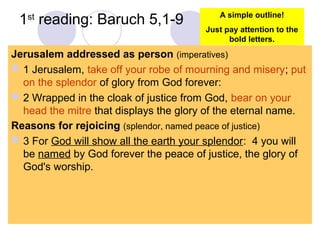
Jerusalem addressed as person (imperatives)
1 Jerusalem, take off your robe of mourning and misery; put
on the splendor of glory from God forever:
2 Wrapped in the cloak of justice from God, bear on your
head the mitre that displays the glory of the eternal name.
Reasons for rejoicing (splendor, named peace of justice)
3 For God will show all the earth your splendor: 4 you will
be named by God forever the peace of justice, the glory of
God's worship.
A simple outline!
Just pay attention to the
bold letters.
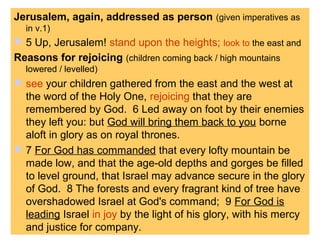
Jerusalem, again, addressed as person (given imperatives as
in v.1)
5 Up, Jerusalem! stand upon the heights; look to the east and
Reasons for rejoicing (children coming back / high mountains
lowered / levelled)
see your children gathered from the east and the west at
the word of the Holy One, rejoicing that they are
remembered by God. 6 Led away on foot by their enemies
they left you: but God will bring them back to you borne
aloft in glory as on royal thrones.
7 For God has commanded that every lofty mountain be
made low, and that the age-old depths and gorges be filled
to level ground, that Israel may advance secure in the glory
of God. 8 The forests and every fragrant kind of tree have
overshadowed Israel at God's command; 9 For God is
leading Israel in joy by the light of his glory, with his mercy
and justice for company.
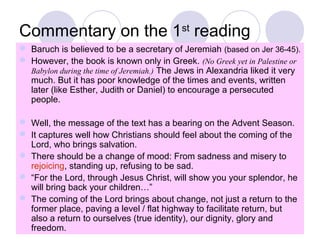
Commentary on the 1st
reading
 Baruch is believed to be a secretary of Jeremiah (based on Jer 36-45).
 However, the book is known only in Greek. (No Greek yet in Palestine or
Babylon during the time of Jeremiah.) The Jews in Alexandria liked it very
much. But it has poor knowledge of the times and events, written
later (like Esther, Judith or Daniel) to encourage a persecuted
people.
 Well, the message of the text has a bearing on the Advent Season.
 It captures well how Christians should feel about the coming of the
Lord, who brings salvation.
 There should be a change of mood: From sadness and misery to
rejoicing, standing up, refusing to be sad.
 “For the Lord, through Jesus Christ, will show you your splendor, he
will bring back your children…”
 The coming of the Lord brings about change, not just a return to the
former place, paving a level / flat highway to facilitate return, but
also a return to ourselves (true identity), our dignity, glory and
freedom.
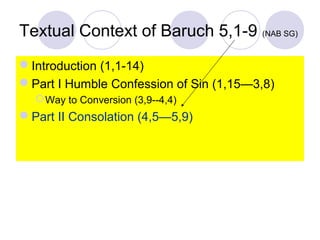
Textual Context of Baruch 5,1-9 (NAB SG)
Introduction (1,1-14)
Part I Humble Confession of Sin (1,15—3,8)
Way to Conversion (3,9--4,4)
Part II Consolation (4,5—5,9)
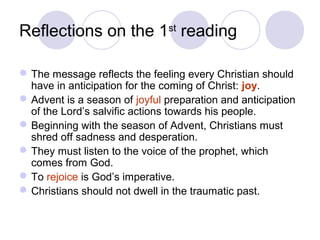
Reflections on the 1st
reading
The message reflects the feeling every Christian should
have in anticipation for the coming of Christ: joy.
Advent is a season of joyful preparation and anticipation
of the Lord’s salvific actions towards his people.
Beginning with the season of Advent, Christians must
shred off sadness and desperation.
They must listen to the voice of the prophet, which
comes from God.
To rejoice is God’s imperative.
Christians should not dwell in the traumatic past.
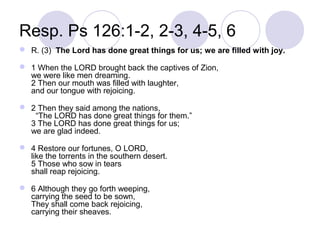
Resp. Ps 126:1-2, 2-3, 4-5, 6
 R. (3) The Lord has done great things for us; we are filled with joy.
 1 When the LORD brought back the captives of Zion,
we were like men dreaming.
2 Then our mouth was filled with laughter,
and our tongue with rejoicing.
 2 Then they said among the nations,
“The LORD has done great things for them.”
3 The LORD has done great things for us;
we are glad indeed.
 4 Restore our fortunes, O LORD,
like the torrents in the southern desert.
5 Those who sow in tears
shall reap rejoicing.
 6 Although they go forth weeping,
carrying the seed to be sown,
They shall come back rejoicing,
carrying their sheaves.
Resp. Ps 126:1-2, 2-3, 4-5, 6
 R. (3) The Lord has done great
things for us; we are filled with joy.
 1 When the LORD brought back the
captives of Zion,
we were like men dreaming.
2 Then our mouth was filled with
laughter,
and our tongue with rejoicing.
 2 Then they said among the nations,
“The LORD has done great things
for them.”
3 The LORD has done great things
for us;
we are glad indeed.
 4 Restore our fortunes, O LORD,
like the torrents in the southern
desert.
5 Those who sow in tears
shall reap rejoicing.
 6 Although they go forth weeping,
carrying the seed to be sown,
They shall come back rejoicing,
carrying their sheaves.
Commentary
 The psalm was composed after the
Exile as v.1 indicates.
 V.1 expresses the feeling of a liberated
person.
 God has done a tremendous favor to
his people, of restoring them to
Jerusalem after years of Exile.
Unbelievable!
 In v.2, the people cannot control their
emotions. Spontaneously they are
filled with laughter and joy.
 Vv.2b-3 articulate how great the favor
God has given them.
 V.4 is a prayer to restore the fortunes
of Israel.
 Vv.5-6 show how God will turn the
sorrows of his people.
 They find life difficult now, but later, as
they persevere, they will reap the fruits
of their labor and sacrifices.
Reflections on the Psalm
Joy comes as a result of God’s liberating action
towards us, who once were rejected and driven
away.
Joy is God’s promise to those who are willing to
take up the challenges now and to make the
necessary sacrifices to make their work
succeed.
It is just a matter of time when they will reap the
fruits.
Some fruits come out after we retire (or after we have
died).
2nd
reading: Philippians 1,4-6.8-11
4 I pray always with joy in my every prayer for all of you,
5 because of your partnership for the gospel from the
first day until now. 6 I am confident of this, that the one
who began a good work in you will continue to complete
it until the day of Christ Jesus.
8 For God is my witness, how I long for all of you with
the affection of Christ Jesus. 9 And this is my prayer:
that your love may increase ever more and more in
knowledge and every kind of perception, 10 to discern
what is of value, so that you may be pure and blameless
for the day of Christ, 11 filled with the fruit of
righteousness that comes through Jesus Christ for the
glory and praise of God.
The focus is the day of Jesus Christ.
2nd
reading: Philippians 1,4-6.8-11
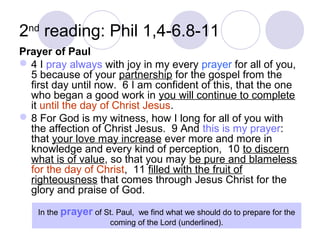
Prayer of Paul
4 I pray always with joy in my every prayer for all of you,
5 because of your partnership for the gospel from the
first day until now. 6 I am confident of this, that the one
who began a good work in you will continue to complete
it until the day of Christ Jesus.
8 For God is my witness, how I long for all of you with
the affection of Christ Jesus. 9 And this is my prayer:
that your love may increase ever more and more in
knowledge and every kind of perception, 10 to discern
what is of value, so that you may be pure and blameless
for the day of Christ, 11 filled with the fruit of
righteousness that comes through Jesus Christ for the
glory and praise of God.
We find in the prayer of St. Paul what we should do for the coming of
the Lord.
2nd
reading: Phil 1,4-6.8-11
Prayer of Paul
4 I pray always with joy in my every prayer for all of you,
5 because of your partnership for the gospel from the
first day until now. 6 I am confident of this, that the one
who began a good work in you will continue to complete
it until the day of Christ Jesus.
8 For God is my witness, how I long for all of you with
the affection of Christ Jesus. 9 And this is my prayer:
that your love may increase ever more and more in
knowledge and every kind of perception, 10 to discern
what is of value, so that you may be pure and blameless
for the day of Christ, 11 filled with the fruit of
righteousness that comes through Jesus Christ for the
glory and praise of God.
In the prayer of St. Paul, we find what we should do to prepare for the
coming of the Lord (underlined).
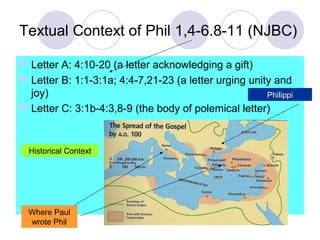
Textual Context of Phil 1,4-6.8-11 (NJBC)
Letter A: 4:10-20 (a letter acknowledging a gift)
Letter B: 1:1-3:1a; 4:4-7,21-23 (a letter urging unity and
joy)
Letter C: 3:1b-4:3,8-9 (the body of polemical letter)
Where Paul
wrote Phil
Philippi
Historical Context
2nd
reading: Philippians 1,4-6.8-11
Prayer of Paul
 4 I pray always with joy in my
every prayer for all of you, 5
because of your partnership
for the gospel from the first
day until now. 6 I am
confident of this, that the one
who began a good work in
you will continue to complete
it until the day of Christ
Jesus.
 8 For God is my witness, how
I long for all of you with the
affection of Christ Jesus. 9
And this is my prayer: that
your love may increase ever
more and more in knowledge
and every kind of perception,
10 to discern what is of value,
so that you may be pure and
blameless for the day of
Christ, 11 filled with the fruit
of righteousness that comes
through Jesus Christ for the
glory and praise of God.
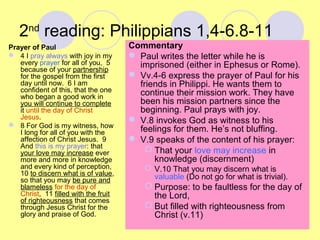
Commentary
 Paul writes the letter while he is
imprisoned (either in Ephesus or Rome).
 Vv.4-6 express the prayer of Paul for his
friends in Philippi. He wants them to
continue their mission work. They have
been his mission partners since the
beginning. Paul prays with joy.
 V.8 invokes God as witness to his
feelings for them. He’s not bluffing.
 V.9 speaks of the content of his prayer:
 That your love may increase in
knowledge (discernment)
 V.10 That you may discern what is
valuable (Do not go for what is trivial).
 Purpose: to be faultless for the day of
the Lord,
 But filled with righteousness from
Christ (v.11)
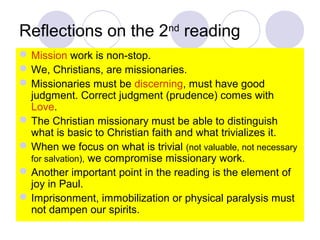
Reflections on the 2nd
reading
Mission work is non-stop.
We, Christians, are missionaries.
Missionaries must be discerning, must have good
judgment. Correct judgment (prudence) comes with
Love.
The Christian missionary must be able to distinguish
what is basic to Christian faith and what trivializes it.
When we focus on what is trivial (not valuable, not necessary
for salvation), we compromise missionary work.
Another important point in the reading is the element of
joy in Paul.
Imprisonment, immobilization or physical paralysis must
not dampen our spirits.
Gospel Reading: Luke 3,1-6
1 In the fifteenth year of the reign of Tiberius Caesar,
when Pontius Pilate was governor of Judea, and Herod
was tetrarch of Galilee, and his brother Philip tetrarch of
the region of Ituraea and Trachonitis, and Lysanias was
tetrarch of Abilene, 2 during the high priesthood of
Annas and Caiaphas, the word of God came to John the
son of Zechariah in the desert. 3 He went throughout
(the) whole region of the Jordan, proclaiming a baptism
of repentance for the forgiveness of sins, 4 as it is
written in the book of the words of the prophet Isaiah: "A
voice of one crying out in the desert: 'Prepare the way of
the Lord, make straight his paths. 5 Every valley shall
be filled and every mountain and hill shall be made low.
The winding roads shall be made straight, and the rough
ways made smooth, 6 and all flesh shall see the
salvation of God.'"
The focus is on John the Baptist and his message.
Gospel Reading: Luke 3,1-6
Political Background
 1 In the fifteenth year of the reign of Tiberius Caesar, when Pontius
Pilate was governor of Judea, and Herod was tetrarch of Galilee, and
his brother Philip tetrarch of the region of Ituraea and Trachonitis, and
Lysanias was tetrarch of Abilene,
Religious Background
 2 during the high priesthood of Annas and Caiaphas, the word of God
came to John, the son of Zechariah, in the desert.
The mission of John
 3 He went throughout (the) whole region of the Jordan, proclaiming a
baptism of repentance for the forgiveness of sins,
Isaiah’s Prophecy
 4 as it is written in the book of the words of the prophet Isaiah: "A
voice of one crying out in the desert: 'Prepare the way of the Lord,
make straight his paths. 5 Every valley shall be filled and every
mountain and hill shall be made low. The winding roads shall be
made straight, and the rough ways made smooth, 6 and all flesh
shall see the salvation of God.'"
A simple Outline!
Gospel Reading: Luke 3,1-6
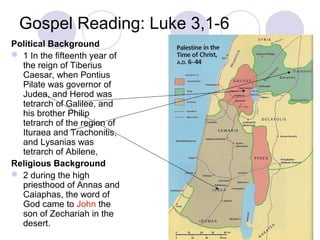
Political Background
 1 In the fifteenth year of
the reign of Tiberius
Caesar, when Pontius
Pilate was governor of
Judea, and Herod was
tetrarch of Galilee, and
his brother Philip
tetrarch of the region of
Ituraea and Trachonitis,
and Lysanias was
tetrarch of Abilene,
Religious Background
 2 during the high
priesthood of Annas and
Caiaphas, the word of
God came to John the
son of Zechariah in the
desert.
Gospel Reading: Luke 3,1-6
The mission of John
 3 He went throughout (the)
whole region of the Jordan,
proclaiming a baptism of
repentance for the
forgiveness of sins,
Commentary
 Luke begins his story with a political
and religious background. He exhibits
awareness of the socio-political and
religious environment during his time.
 He situates the mission of John
against the political and religious
leaders (vv.1-2) with their names
mentioned.
 The mission of John consists in
preaching baptism of repentance.
 Why repentance? For the forgiveness
of sins (v.3)
 His area of apostolate is along the
Jordan River (not in the cities), but in
the desert (a place where it is easier
to listen).
Gospel Reading: Luke 3,1-6
John’s Mission
fullfillment of Isaiah’s
Prophecy
 4 as it is written in the
book of the words of the
prophet Isaiah: "A voice
of one crying out in the
desert: 'Prepare the way
of the Lord, make
straight his paths. 5
Every valley shall be
filled and every mountain
and hill shall be made
low. The winding roads
shall be made straight,
and the rough ways
made smooth, 6 and all
flesh shall see the
salvation of God.'"
 V.4 interprets the preaching of John
as the fulfillment of Isaiah’s
prophecy.
 The prophecy is very similar to the
first reading, (chronologically speaking
Isaiah came first before Baruch).
 The main point of the prophecy is to
facilitate the coming of the Lord.
 The Lord is none other than Jesus
who brings salvation to all (v.6)
 Salvation is universal.
Further commentary
John prepares the people to welcome Jesus, when he
comes. It is just a matter of time now. John is six months
older than Jesus.
John does it by baptizing (by immersion) people who
respond to his words.
Baptism is a sign of repentance.
What is repentance here?
 It is the turning away from sin.
Sin is being absent from God.
Sin is also wanting to know God but turning the wrong
way, having a wrong approach (not that of Jesus).
 The Jews wanted to know God, but they refused to accept his
anointed One, but those who anointed themselves.
Reflections on the gospel readingReflections on the gospel reading
Repentance is the first step towards God. Repentance is
turning back to God, setting your direction to him.
Metanoia.
You cannot follow Christ without having first repented.
Repentance can be done again later if there are
infractions.
Repentance means cleansing ourselves from sin.
Repentance paves the way to become closer to God
through Christ.
Tying the 3 readings and the Psalm
The first reading calls each Christian to be joyful.
 There should be no place for sadness, for the Lord is
coming.
The psalm expresses joy over God’s intervention to
restore his people.
The second reading calls each Christian practitioner to
increase their love, to continue his/her mission and to be
discerning, intelligent (not tactless).
The gospel reading calls each person to repent, to turn
to God.
How to develop your homilies and sharing
Begin by telling a story about Manny Pacquiao
preparing for a fight. (Exercise, practice, discipline,
training, good food, good rest, good attitude, fighting
spirit, sacrifices).
In this season of Advent, we must make the
necessary preparations to encounter Jesus who
is coming to teach us.
The readings give us hints on how to do it.
The first reading enjoins us to keep up the good
and fighting spirit, shrug off sadness and
negative energy and be more optimistic.
We bank on God’s promises to restore us into
his care.
Joy must prevail over despair.
Inability to rejoice is a sign of lack of faith and
confidence in oneself and in God.
In God, there is no place for cynism.
The second reading challenges us to increase
our love.
We must embrace more people into our inner
circle, not contented with the same people that
give us comfort and make sipsip (always affirming us to
a fault, beware when people say good words about you).
We must go to missions to meet different faces,
cultures, challenges, and places where we are
nobody. We engage in New Evangelization.
Like Paul, we must pray with joy, even if we are
under intense pressure or undergoing hardships.
The gospel reading calls us to go deeper into
our spiritual life, by turning away from sin and
turning to God, through Jesus.
We facilitate the coming of the Lord. We don’t
make his journey toward us difficult. We do not
evade him. We do not make a lot of excuses “I
am not yet ready. I am busy. Next time na lang.”
We don’t postpone our conversion.
We listen to the voice of the prophet as he
speaks to us right now, through the readings and
sermon.
What happens if there is no conversion in this season of
Advent?
There won’t be any change also in the days to come.
Christmas will be trivialized, seen only as a social event or
just a holiday, devoid of religious meaning.
If we do not change our value system (show signs of
repentance), our celebrations will be exercises of futility.
Christmas never becomes a source of inner joy and an
expression of thanksgiving.
Christmas will just make us poorer and miserable.
This season of Advent should lead us to go
deeper into ourselves and see
what keeps us away from God,
why we can’t pray or enjoy praying,
why our relationships with our loved ones are not
getting better,
why we don’t feel the presence of God in our midst.
In this season of Advent, we must diligently
examine ourselves.
We cannot engage in the New Evangelization if
we are unrepentant.
The eucharist is for those who are converted to
the Lord.
We encounter the Lord in the eucharist, if we
become repentant sinners.
And if we really feel we are helped by God in the
eucharist, let us encourage others to receive the
same, to join in our eucharistic communities and
actively participate in the life and mission of the
Church.
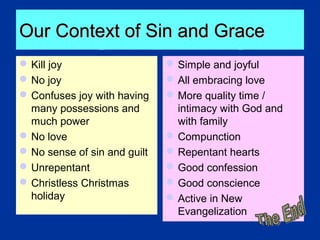
Our Context of Sin and GraceOur Context of Sin and Grace
Kill joy
No joy
Confuses joy with having
many possessions and
much power
No love
No sense of sin and guilt
Unrepentant
Christless Christmas
holiday
Simple and joyful
All embracing love
More quality time /
intimacy with God and
with family
Compunction
Repentant hearts
Good confession
Good conscience
Active in New
Evangelization
Suggested Songs
Make Straight the Path
http://www.youtube.com/watch?v=XWlq2ouoEMg
Yesteryears’ Curse
http://www.youtube.com/watch?v=NlKeY-Ikk2U
Dear brothers and sisters,

We prepare for the Lord's coming by
being converted. We can't engage in the
New Evangelization without conversion.
Fr. Cielo


2nd Advent C

  • 1.
    Welcome to ourBible Study 2nd Sunday of Advent C 6 December 2015 In preparation for this Sunday’s liturgy In aid of focusing of homilies and sharing Prepared by Fr. Cielo R. Almazan, OFM
  • 2.
    1st reading: Baruch 5,1-9 1Jerusalem, take off your robe of mourning and misery; put on the splendor of glory from God forever: 2 Wrapped in the cloak of justice from God, bear on your head the mitre that displays the glory of the eternal name. 3 For God will show all the earth your splendor: 4 you will be named by God forever the peace of justice, the glory of God's worship. 5 Up, Jerusalem! stand upon the heights; look to the east and see your children gathered from the east and the west at the word of the Holy One, rejoicing that they are remembered by God. 6 Led away on foot by their enemies they left you: but God will bring them back to you borne aloft in glory as on royal thrones. 7 For God has commanded that every lofty mountain be made low, and that the age-old depths and gorges be filled to level ground, that Israel may advance secure in the glory of God. 8 The forests and every fragrant kind of tree have overshadowed Israel at God's command; 9 For God is leading Israel in joy by the light of his glory, with his mercy and justice for company. The focus is to “rejoice.”
  • 3.
    1st reading: Baruch 5,1-9 Jerusalemaddressed as person (imperatives) 1 Jerusalem, take off your robe of mourning and misery; put on the splendor of glory from God forever: 2 Wrapped in the cloak of justice from God, bear on your head the mitre that displays the glory of the eternal name. Reasons for rejoicing (splendor, named peace of justice) 3 For God will show all the earth your splendor: 4 you will be named by God forever the peace of justice, the glory of God's worship. A simple outline! Just pay attention to the bold letters.
  • 4.
    Jerusalem, again, addressedas person (given imperatives as in v.1) 5 Up, Jerusalem! stand upon the heights; look to the east and Reasons for rejoicing (children coming back / high mountains lowered / levelled) see your children gathered from the east and the west at the word of the Holy One, rejoicing that they are remembered by God. 6 Led away on foot by their enemies they left you: but God will bring them back to you borne aloft in glory as on royal thrones. 7 For God has commanded that every lofty mountain be made low, and that the age-old depths and gorges be filled to level ground, that Israel may advance secure in the glory of God. 8 The forests and every fragrant kind of tree have overshadowed Israel at God's command; 9 For God is leading Israel in joy by the light of his glory, with his mercy and justice for company.
  • 5.
    Commentary on the1st reading  Baruch is believed to be a secretary of Jeremiah (based on Jer 36-45).  However, the book is known only in Greek. (No Greek yet in Palestine or Babylon during the time of Jeremiah.) The Jews in Alexandria liked it very much. But it has poor knowledge of the times and events, written later (like Esther, Judith or Daniel) to encourage a persecuted people.  Well, the message of the text has a bearing on the Advent Season.  It captures well how Christians should feel about the coming of the Lord, who brings salvation.  There should be a change of mood: From sadness and misery to rejoicing, standing up, refusing to be sad.  “For the Lord, through Jesus Christ, will show you your splendor, he will bring back your children…”  The coming of the Lord brings about change, not just a return to the former place, paving a level / flat highway to facilitate return, but also a return to ourselves (true identity), our dignity, glory and freedom.
  • 6.
    Textual Context ofBaruch 5,1-9 (NAB SG) Introduction (1,1-14) Part I Humble Confession of Sin (1,15—3,8) Way to Conversion (3,9--4,4) Part II Consolation (4,5—5,9)
  • 7.
    Reflections on the1st reading The message reflects the feeling every Christian should have in anticipation for the coming of Christ: joy. Advent is a season of joyful preparation and anticipation of the Lord’s salvific actions towards his people. Beginning with the season of Advent, Christians must shred off sadness and desperation. They must listen to the voice of the prophet, which comes from God. To rejoice is God’s imperative. Christians should not dwell in the traumatic past.
  • 8.
    Resp. Ps 126:1-2,2-3, 4-5, 6  R. (3) The Lord has done great things for us; we are filled with joy.  1 When the LORD brought back the captives of Zion, we were like men dreaming. 2 Then our mouth was filled with laughter, and our tongue with rejoicing.  2 Then they said among the nations, “The LORD has done great things for them.” 3 The LORD has done great things for us; we are glad indeed.  4 Restore our fortunes, O LORD, like the torrents in the southern desert. 5 Those who sow in tears shall reap rejoicing.  6 Although they go forth weeping, carrying the seed to be sown, They shall come back rejoicing, carrying their sheaves.
  • 9.
    Resp. Ps 126:1-2,2-3, 4-5, 6  R. (3) The Lord has done great things for us; we are filled with joy.  1 When the LORD brought back the captives of Zion, we were like men dreaming. 2 Then our mouth was filled with laughter, and our tongue with rejoicing.  2 Then they said among the nations, “The LORD has done great things for them.” 3 The LORD has done great things for us; we are glad indeed.  4 Restore our fortunes, O LORD, like the torrents in the southern desert. 5 Those who sow in tears shall reap rejoicing.  6 Although they go forth weeping, carrying the seed to be sown, They shall come back rejoicing, carrying their sheaves. Commentary  The psalm was composed after the Exile as v.1 indicates.  V.1 expresses the feeling of a liberated person.  God has done a tremendous favor to his people, of restoring them to Jerusalem after years of Exile. Unbelievable!  In v.2, the people cannot control their emotions. Spontaneously they are filled with laughter and joy.  Vv.2b-3 articulate how great the favor God has given them.  V.4 is a prayer to restore the fortunes of Israel.  Vv.5-6 show how God will turn the sorrows of his people.  They find life difficult now, but later, as they persevere, they will reap the fruits of their labor and sacrifices.
  • 10.
    Reflections on thePsalm Joy comes as a result of God’s liberating action towards us, who once were rejected and driven away. Joy is God’s promise to those who are willing to take up the challenges now and to make the necessary sacrifices to make their work succeed. It is just a matter of time when they will reap the fruits. Some fruits come out after we retire (or after we have died).
  • 11.
    2nd reading: Philippians 1,4-6.8-11 4I pray always with joy in my every prayer for all of you, 5 because of your partnership for the gospel from the first day until now. 6 I am confident of this, that the one who began a good work in you will continue to complete it until the day of Christ Jesus. 8 For God is my witness, how I long for all of you with the affection of Christ Jesus. 9 And this is my prayer: that your love may increase ever more and more in knowledge and every kind of perception, 10 to discern what is of value, so that you may be pure and blameless for the day of Christ, 11 filled with the fruit of righteousness that comes through Jesus Christ for the glory and praise of God. The focus is the day of Jesus Christ.
  • 12.
    2nd reading: Philippians 1,4-6.8-11 Prayerof Paul 4 I pray always with joy in my every prayer for all of you, 5 because of your partnership for the gospel from the first day until now. 6 I am confident of this, that the one who began a good work in you will continue to complete it until the day of Christ Jesus. 8 For God is my witness, how I long for all of you with the affection of Christ Jesus. 9 And this is my prayer: that your love may increase ever more and more in knowledge and every kind of perception, 10 to discern what is of value, so that you may be pure and blameless for the day of Christ, 11 filled with the fruit of righteousness that comes through Jesus Christ for the glory and praise of God. We find in the prayer of St. Paul what we should do for the coming of the Lord.
  • 13.
    2nd reading: Phil 1,4-6.8-11 Prayerof Paul 4 I pray always with joy in my every prayer for all of you, 5 because of your partnership for the gospel from the first day until now. 6 I am confident of this, that the one who began a good work in you will continue to complete it until the day of Christ Jesus. 8 For God is my witness, how I long for all of you with the affection of Christ Jesus. 9 And this is my prayer: that your love may increase ever more and more in knowledge and every kind of perception, 10 to discern what is of value, so that you may be pure and blameless for the day of Christ, 11 filled with the fruit of righteousness that comes through Jesus Christ for the glory and praise of God. In the prayer of St. Paul, we find what we should do to prepare for the coming of the Lord (underlined).
  • 14.
    Textual Context ofPhil 1,4-6.8-11 (NJBC) Letter A: 4:10-20 (a letter acknowledging a gift) Letter B: 1:1-3:1a; 4:4-7,21-23 (a letter urging unity and joy) Letter C: 3:1b-4:3,8-9 (the body of polemical letter) Where Paul wrote Phil Philippi Historical Context
  • 15.
    2nd reading: Philippians 1,4-6.8-11 Prayerof Paul  4 I pray always with joy in my every prayer for all of you, 5 because of your partnership for the gospel from the first day until now. 6 I am confident of this, that the one who began a good work in you will continue to complete it until the day of Christ Jesus.  8 For God is my witness, how I long for all of you with the affection of Christ Jesus. 9 And this is my prayer: that your love may increase ever more and more in knowledge and every kind of perception, 10 to discern what is of value, so that you may be pure and blameless for the day of Christ, 11 filled with the fruit of righteousness that comes through Jesus Christ for the glory and praise of God. Commentary  Paul writes the letter while he is imprisoned (either in Ephesus or Rome).  Vv.4-6 express the prayer of Paul for his friends in Philippi. He wants them to continue their mission work. They have been his mission partners since the beginning. Paul prays with joy.  V.8 invokes God as witness to his feelings for them. He’s not bluffing.  V.9 speaks of the content of his prayer:  That your love may increase in knowledge (discernment)  V.10 That you may discern what is valuable (Do not go for what is trivial).  Purpose: to be faultless for the day of the Lord,  But filled with righteousness from Christ (v.11)
  • 16.
    Reflections on the2nd reading Mission work is non-stop. We, Christians, are missionaries. Missionaries must be discerning, must have good judgment. Correct judgment (prudence) comes with Love. The Christian missionary must be able to distinguish what is basic to Christian faith and what trivializes it. When we focus on what is trivial (not valuable, not necessary for salvation), we compromise missionary work. Another important point in the reading is the element of joy in Paul. Imprisonment, immobilization or physical paralysis must not dampen our spirits.
  • 17.
    Gospel Reading: Luke3,1-6 1 In the fifteenth year of the reign of Tiberius Caesar, when Pontius Pilate was governor of Judea, and Herod was tetrarch of Galilee, and his brother Philip tetrarch of the region of Ituraea and Trachonitis, and Lysanias was tetrarch of Abilene, 2 during the high priesthood of Annas and Caiaphas, the word of God came to John the son of Zechariah in the desert. 3 He went throughout (the) whole region of the Jordan, proclaiming a baptism of repentance for the forgiveness of sins, 4 as it is written in the book of the words of the prophet Isaiah: "A voice of one crying out in the desert: 'Prepare the way of the Lord, make straight his paths. 5 Every valley shall be filled and every mountain and hill shall be made low. The winding roads shall be made straight, and the rough ways made smooth, 6 and all flesh shall see the salvation of God.'" The focus is on John the Baptist and his message.
  • 18.
    Gospel Reading: Luke3,1-6 Political Background  1 In the fifteenth year of the reign of Tiberius Caesar, when Pontius Pilate was governor of Judea, and Herod was tetrarch of Galilee, and his brother Philip tetrarch of the region of Ituraea and Trachonitis, and Lysanias was tetrarch of Abilene, Religious Background  2 during the high priesthood of Annas and Caiaphas, the word of God came to John, the son of Zechariah, in the desert. The mission of John  3 He went throughout (the) whole region of the Jordan, proclaiming a baptism of repentance for the forgiveness of sins, Isaiah’s Prophecy  4 as it is written in the book of the words of the prophet Isaiah: "A voice of one crying out in the desert: 'Prepare the way of the Lord, make straight his paths. 5 Every valley shall be filled and every mountain and hill shall be made low. The winding roads shall be made straight, and the rough ways made smooth, 6 and all flesh shall see the salvation of God.'" A simple Outline!
  • 19.
    Gospel Reading: Luke3,1-6 Political Background  1 In the fifteenth year of the reign of Tiberius Caesar, when Pontius Pilate was governor of Judea, and Herod was tetrarch of Galilee, and his brother Philip tetrarch of the region of Ituraea and Trachonitis, and Lysanias was tetrarch of Abilene, Religious Background  2 during the high priesthood of Annas and Caiaphas, the word of God came to John the son of Zechariah in the desert.
  • 20.
    Gospel Reading: Luke3,1-6 The mission of John  3 He went throughout (the) whole region of the Jordan, proclaiming a baptism of repentance for the forgiveness of sins, Commentary  Luke begins his story with a political and religious background. He exhibits awareness of the socio-political and religious environment during his time.  He situates the mission of John against the political and religious leaders (vv.1-2) with their names mentioned.  The mission of John consists in preaching baptism of repentance.  Why repentance? For the forgiveness of sins (v.3)  His area of apostolate is along the Jordan River (not in the cities), but in the desert (a place where it is easier to listen).
  • 21.
    Gospel Reading: Luke3,1-6 John’s Mission fullfillment of Isaiah’s Prophecy  4 as it is written in the book of the words of the prophet Isaiah: "A voice of one crying out in the desert: 'Prepare the way of the Lord, make straight his paths. 5 Every valley shall be filled and every mountain and hill shall be made low. The winding roads shall be made straight, and the rough ways made smooth, 6 and all flesh shall see the salvation of God.'"  V.4 interprets the preaching of John as the fulfillment of Isaiah’s prophecy.  The prophecy is very similar to the first reading, (chronologically speaking Isaiah came first before Baruch).  The main point of the prophecy is to facilitate the coming of the Lord.  The Lord is none other than Jesus who brings salvation to all (v.6)  Salvation is universal.
  • 22.
    Further commentary John preparesthe people to welcome Jesus, when he comes. It is just a matter of time now. John is six months older than Jesus. John does it by baptizing (by immersion) people who respond to his words. Baptism is a sign of repentance. What is repentance here?  It is the turning away from sin. Sin is being absent from God. Sin is also wanting to know God but turning the wrong way, having a wrong approach (not that of Jesus).  The Jews wanted to know God, but they refused to accept his anointed One, but those who anointed themselves.
  • 23.
    Reflections on thegospel readingReflections on the gospel reading Repentance is the first step towards God. Repentance is turning back to God, setting your direction to him. Metanoia. You cannot follow Christ without having first repented. Repentance can be done again later if there are infractions. Repentance means cleansing ourselves from sin. Repentance paves the way to become closer to God through Christ.
  • 24.
    Tying the 3readings and the Psalm The first reading calls each Christian to be joyful.  There should be no place for sadness, for the Lord is coming. The psalm expresses joy over God’s intervention to restore his people. The second reading calls each Christian practitioner to increase their love, to continue his/her mission and to be discerning, intelligent (not tactless). The gospel reading calls each person to repent, to turn to God.
  • 25.
    How to developyour homilies and sharing Begin by telling a story about Manny Pacquiao preparing for a fight. (Exercise, practice, discipline, training, good food, good rest, good attitude, fighting spirit, sacrifices). In this season of Advent, we must make the necessary preparations to encounter Jesus who is coming to teach us. The readings give us hints on how to do it.
  • 26.
    The first readingenjoins us to keep up the good and fighting spirit, shrug off sadness and negative energy and be more optimistic. We bank on God’s promises to restore us into his care. Joy must prevail over despair. Inability to rejoice is a sign of lack of faith and confidence in oneself and in God. In God, there is no place for cynism.
  • 27.
    The second readingchallenges us to increase our love. We must embrace more people into our inner circle, not contented with the same people that give us comfort and make sipsip (always affirming us to a fault, beware when people say good words about you). We must go to missions to meet different faces, cultures, challenges, and places where we are nobody. We engage in New Evangelization. Like Paul, we must pray with joy, even if we are under intense pressure or undergoing hardships.
  • 28.
    The gospel readingcalls us to go deeper into our spiritual life, by turning away from sin and turning to God, through Jesus. We facilitate the coming of the Lord. We don’t make his journey toward us difficult. We do not evade him. We do not make a lot of excuses “I am not yet ready. I am busy. Next time na lang.” We don’t postpone our conversion. We listen to the voice of the prophet as he speaks to us right now, through the readings and sermon.
  • 29.
    What happens ifthere is no conversion in this season of Advent? There won’t be any change also in the days to come. Christmas will be trivialized, seen only as a social event or just a holiday, devoid of religious meaning. If we do not change our value system (show signs of repentance), our celebrations will be exercises of futility. Christmas never becomes a source of inner joy and an expression of thanksgiving. Christmas will just make us poorer and miserable.
  • 30.
    This season ofAdvent should lead us to go deeper into ourselves and see what keeps us away from God, why we can’t pray or enjoy praying, why our relationships with our loved ones are not getting better, why we don’t feel the presence of God in our midst. In this season of Advent, we must diligently examine ourselves. We cannot engage in the New Evangelization if we are unrepentant.
  • 31.
    The eucharist isfor those who are converted to the Lord. We encounter the Lord in the eucharist, if we become repentant sinners. And if we really feel we are helped by God in the eucharist, let us encourage others to receive the same, to join in our eucharistic communities and actively participate in the life and mission of the Church.
  • 32.
    Our Context ofSin and GraceOur Context of Sin and Grace Kill joy No joy Confuses joy with having many possessions and much power No love No sense of sin and guilt Unrepentant Christless Christmas holiday Simple and joyful All embracing love More quality time / intimacy with God and with family Compunction Repentant hearts Good confession Good conscience Active in New Evangelization
  • 33.
    Suggested Songs Make Straightthe Path http://www.youtube.com/watch?v=XWlq2ouoEMg Yesteryears’ Curse http://www.youtube.com/watch?v=NlKeY-Ikk2U
  • 34.
    Dear brothers andsisters,  We prepare for the Lord's coming by being converted. We can't engage in the New Evangelization without conversion. Fr. Cielo 