Welcome to our Bible
Study
32nd
Sunday in the Ordinary Time
8 November 2015
In preparation for this Sunday’s liturgy
In aid of focusing our homilies and sharing
Prepared by Fr. Cielo R. Almazan, OFM
1st
reading: 1 Kgs 17:10-16
 10 In those days, Elijah the prophet left and went to Zarephath. As
he arrived at the entrance of the city, a widow was gathering sticks
there; he called out to her, "Please bring me a small cupful of
water to drink.” 11 She left to get it, and he called out after her,
"Please bring along a bit of bread.“ 12 "As the LORD, your God,
lives," she answered, "I have nothing baked; there is only a
handful of flour in my jar and a little oil in my jug. Just now I was
collecting a couple of sticks, to go in and prepare something for
myself and my son; when we have eaten it, we shall die.” 13 "Do
not be afraid," Elijah said to her. "Go and do as you propose. But
first make me a little cake and bring it to me. Then you can
prepare something for yourself and your son. 14 For the LORD,
the God of Israel, says, 'The jar of flour shall not go empty, nor the
jug of oil run dry, until the day when the LORD sends rain upon the
earth.’” 15 She left and did as Elijah had said. She was able to eat
for a year, and he and her son as well; 16 The jar of flour did not
go empty, nor the jug of oil run dry, as the LORD had foretold
through Elijah.
The focus is on generosity.
1st
reading: 1 Kgs 17:10-16
Elijah and the widow
 10 In those days, Elijah the prophet left and went to Zarephath. As he
arrived at the entrance of the city, a widow was gathering sticks there; he
called out to her, "Please bring me a small cupful of water to drink.” 11 She
left to get it, and he called out after her, "Please bring along a bit of bread.”
The widow preparing for the last meal and for death
 12 "As the LORD, your God, lives," she answered, "I have nothing baked;
there is only a handful of flour in my jar and a little oil in my jug. Just now I
was collecting a couple of sticks, to go in and prepare something for myself
and my son; when we have eaten it, we shall die.”
Elijah’s assurance
 13 "Do not be afraid," Elijah said to her. "Go and do as you propose. But first
make me a little cake and bring it to me. Then you can prepare something
for yourself and your son. 14 For the LORD, the God of Israel, says, 'The jar
of flour shall not go empty, nor the jug of oil run dry, until the day when the
LORD sends rain upon the earth.’” 15 She left and did as Elijah had said.
Promised fulfilled
 She was able to eat for a year, and he and her son as well; 16 The jar of
flour did not go empty, nor the jug of oil run dry, as the LORD had foretold
through Elijah.
A simple outline!
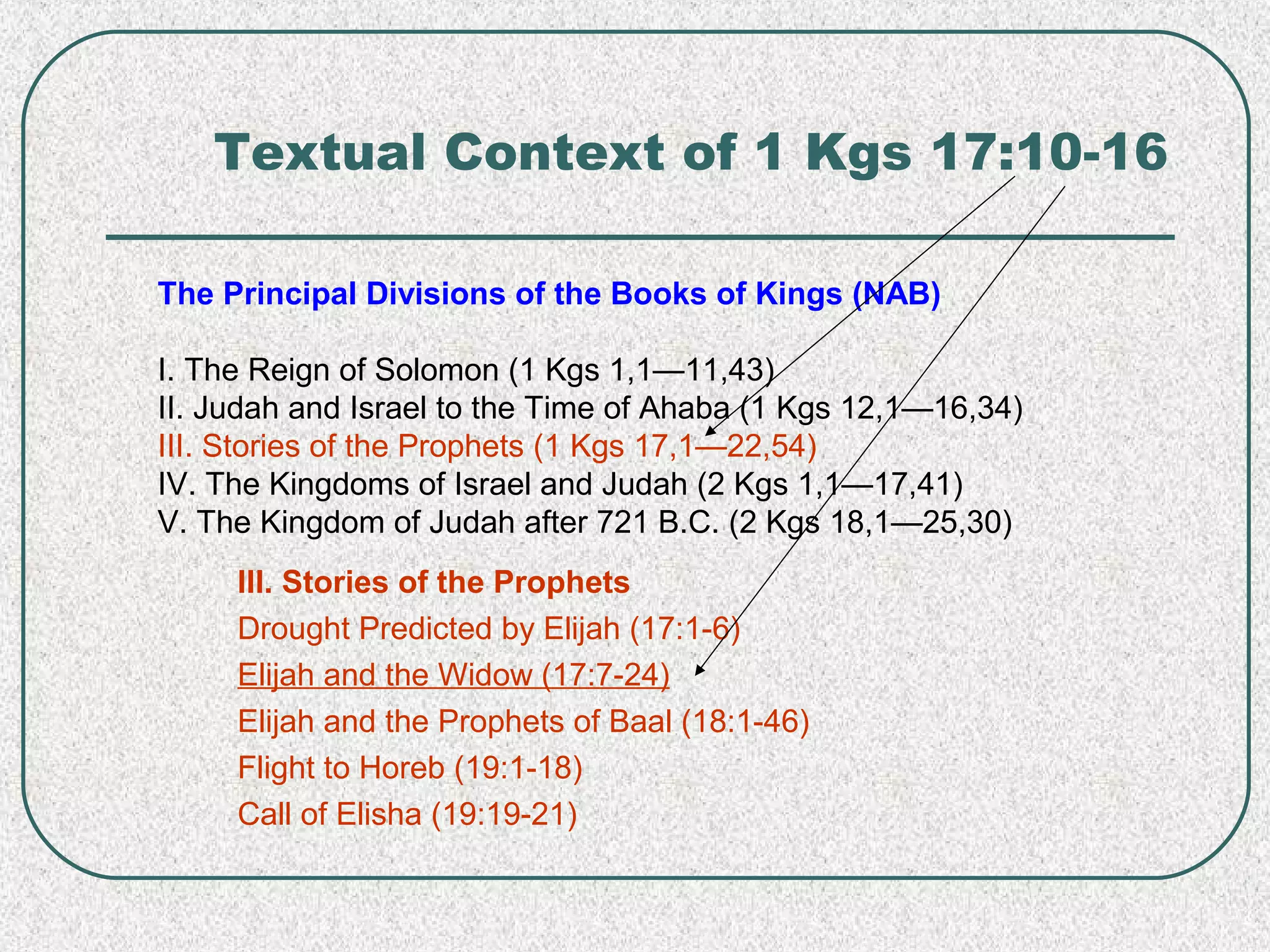
Textual Context of 1 Kgs 17:10-16
The Principal Divisions of the Books of Kings (NAB)
I. The Reign of Solomon (1 Kgs 1,1—11,43)
II. Judah and Israel to the Time of Ahaba (1 Kgs 12,1—16,34)
III. Stories of the Prophets (1 Kgs 17,1—22,54)
IV. The Kingdoms of Israel and Judah (2 Kgs 1,1—17,41)
V. The Kingdom of Judah after 721 B.C. (2 Kgs 18,1—25,30)
III. Stories of the Prophets
Drought Predicted by Elijah (17:1-6)
Elijah and the Widow (17:7-24)
Elijah and the Prophets of Baal (18:1-46)
Flight to Horeb (19:1-18)
Call of Elisha (19:19-21)
Elijah
1st
reading: 1 Kgs 17:10-16
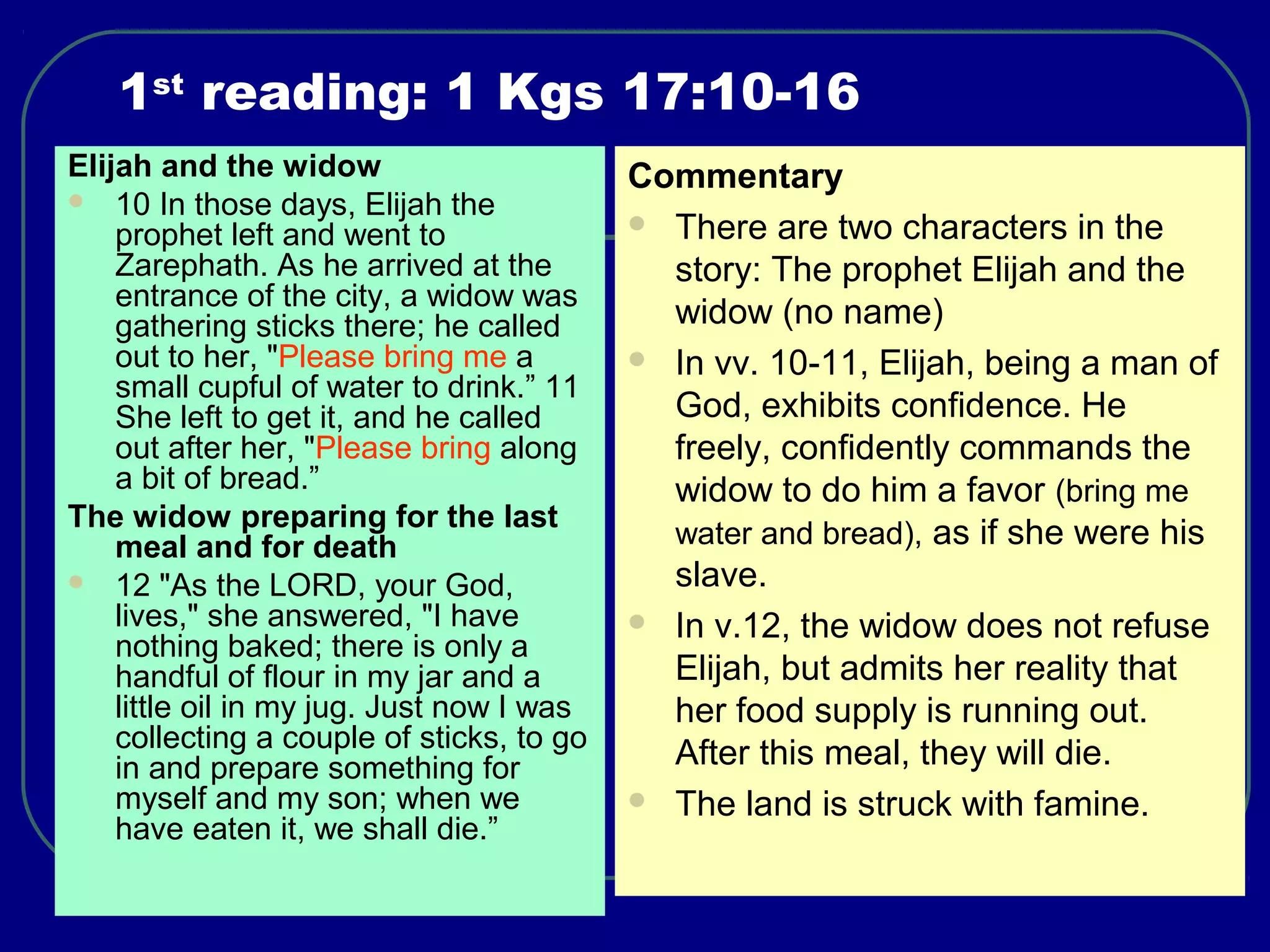
Elijah and the widow
 10 In those days, Elijah the
prophet left and went to
Zarephath. As he arrived at the
entrance of the city, a widow was
gathering sticks there; he called
out to her, "Please bring me a
small cupful of water to drink.” 11
She left to get it, and he called
out after her, "Please bring along
a bit of bread.”
The widow preparing for the last
meal and for death
 12 "As the LORD, your God,
lives," she answered, "I have
nothing baked; there is only a
handful of flour in my jar and a
little oil in my jug. Just now I was
collecting a couple of sticks, to go
in and prepare something for
myself and my son; when we
have eaten it, we shall die.”
Commentary
 There are two characters in the
story: The prophet Elijah and the
widow (no name)
 In vv. 10-11, Elijah, being a man of
God, exhibits confidence. He
freely, confidently commands the
widow to do him a favor (bring me
water and bread), as if she were his
slave.
 In v.12, the widow does not refuse
Elijah, but admits her reality that
her food supply is running out.
After this meal, they will die.
 The land is struck with famine.
1st
reading: 1 Kgs 17:10-16
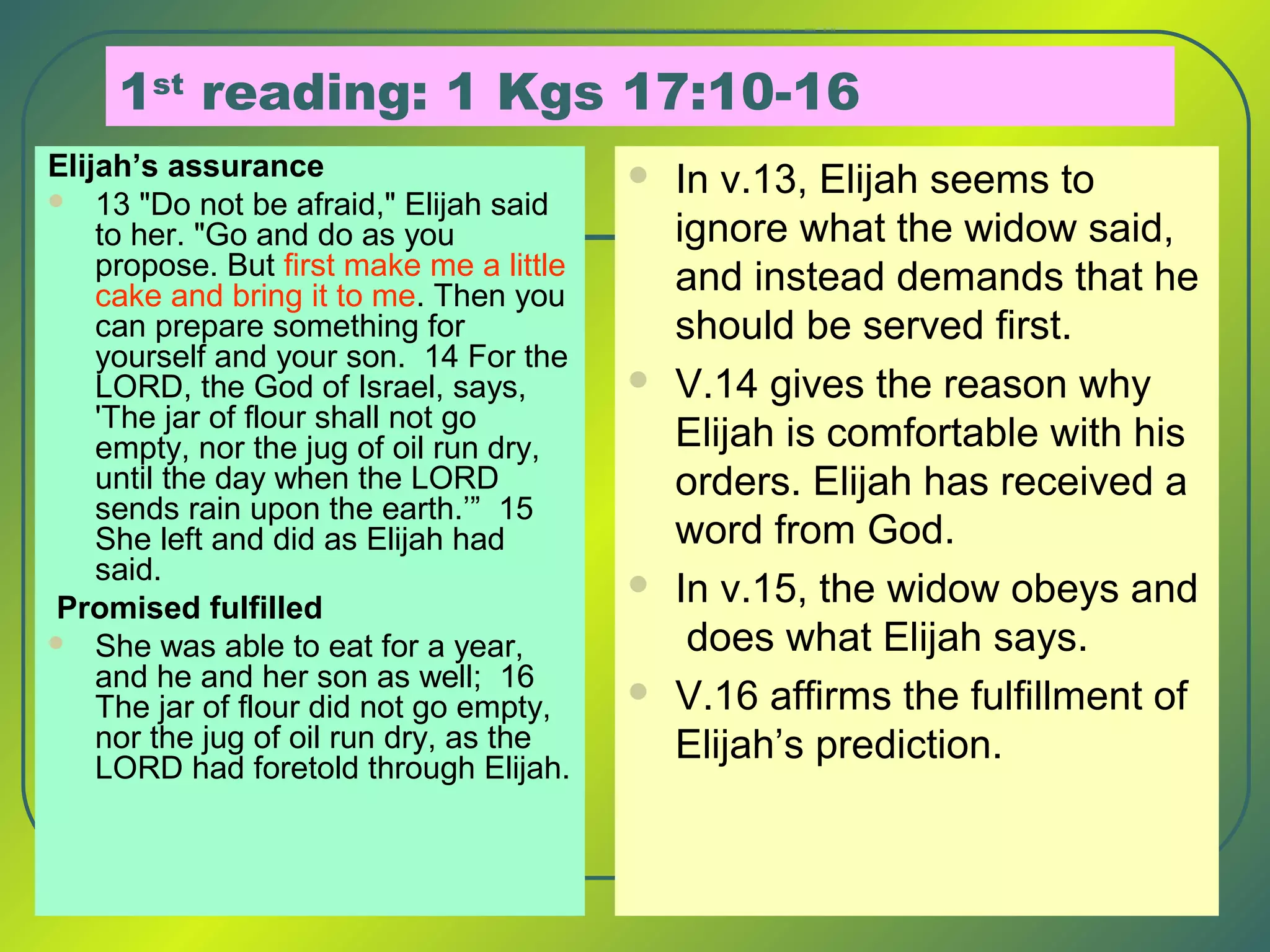
Elijah’s assurance
 13 "Do not be afraid," Elijah said
to her. "Go and do as you
propose. But first make me a little
cake and bring it to me. Then you
can prepare something for
yourself and your son. 14 For the
LORD, the God of Israel, says,
'The jar of flour shall not go
empty, nor the jug of oil run dry,
until the day when the LORD
sends rain upon the earth.’” 15
She left and did as Elijah had
said.
Promised fulfilled
 She was able to eat for a year,
and he and her son as well; 16
The jar of flour did not go empty,
nor the jug of oil run dry, as the
LORD had foretold through Elijah.
 In v.13, Elijah seems to
ignore what the widow said,
and instead demands that he
should be served first.
 V.14 gives the reason why
Elijah is comfortable with his
orders. Elijah has received a
word from God.
 In v.15, the widow obeys and
does what Elijah says.
 V.16 affirms the fulfillment of
Elijah’s prediction.
Reflections on the 1st
reading
 We can put ourselves into the shoes of Elijah. We, as
God’s children, can be put into a difficult situation. We also
experience “famine.” (No money).
 God leads our way too, provided, we cooperate and move
on. Who knows we will encounter our own “widow”, whom
God will send to rescue us.
 We may also put ourselves into the shoes of the widow.
 In our poverty, we can still become instruments of God in
saving those in difficult situations, in saving a prophet, in
saving a man of God, a priest, or, a parish worker.
 In times of need, we must be open to possibilities, we
must move on because God is generous to the generous.
Responsorial Ps 146:7, 8-9, 9-10
 R. (1b) Praise the Lord, my soul!
 7 The LORD keeps faith forever,
secures justice for the oppressed,
gives food to the hungry.
The LORD sets captives free.
 8 The LORD gives sight to the blind.
The LORD raises up those who were bowed down;
the LORD loves the just.
9 The LORD protects strangers.
 The fatherless and the widow he sustains,
but the way of the wicked he thwarts.
10 The LORD shall reign forever;
your God, O Zion, through all generations. Alleluia.
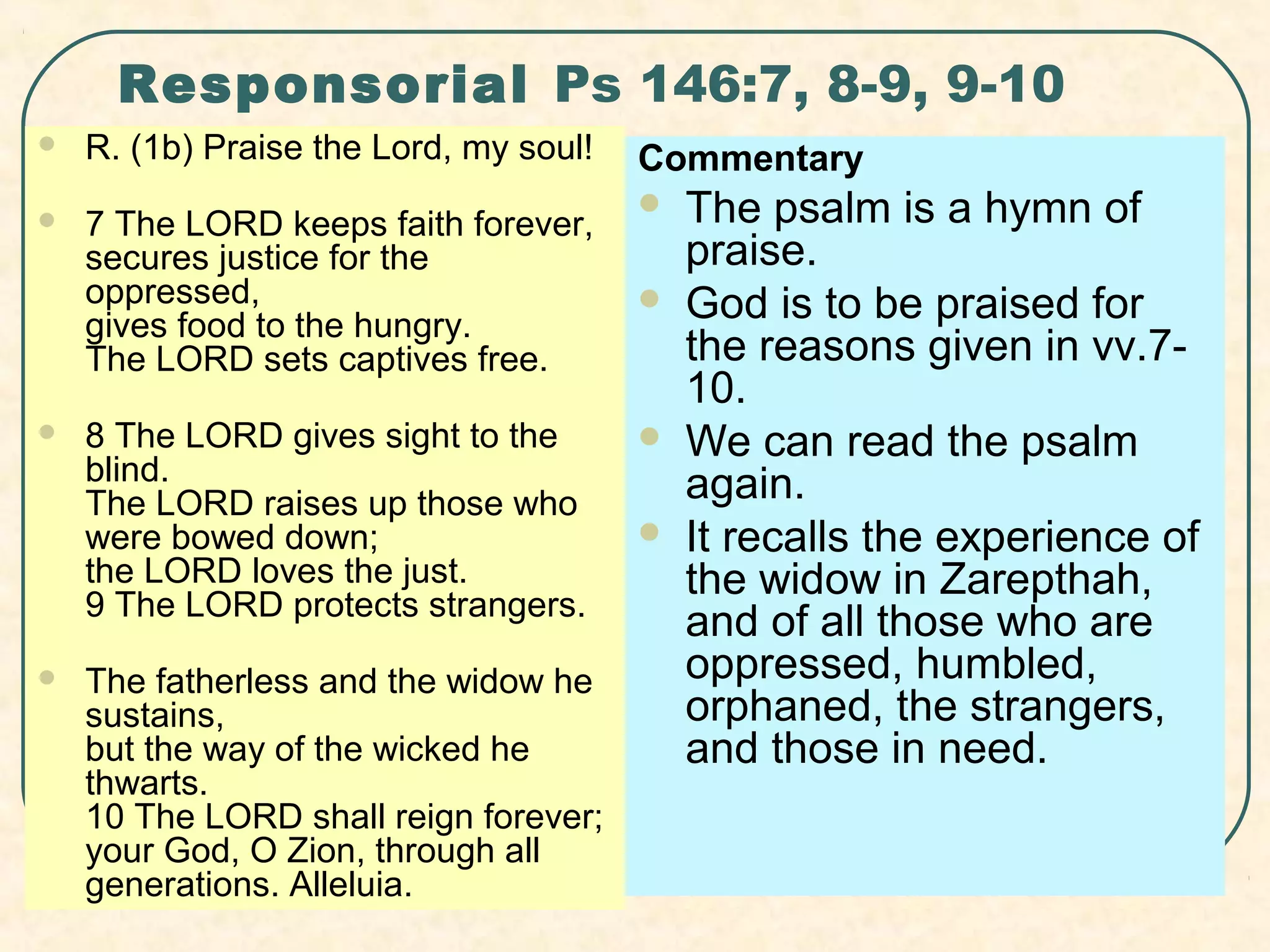
Responsorial Ps 146:7, 8-9, 9-10
 R. (1b) Praise the Lord, my soul!
 7 The LORD keeps faith forever,
secures justice for the 
oppressed,
gives food to the hungry.
The LORD sets captives free.
 8 The LORD gives sight to the 
blind.
The LORD raises up those who 
were bowed down;
the LORD loves the just.
9 The LORD protects strangers.
 The fatherless and the widow he 
sustains,
but the way of the wicked he 
thwarts.
10 The LORD shall reign forever;
your God, O Zion, through all 
generations. Alleluia.
Commentary
 The psalm is a hymn of 
praise.
 God is to be praised for 
the reasons given in vv.7-
10.
 We can read the psalm 
again.
 It recalls the experience of 
the widow in Zarepthah, 
and of all those who are 
oppressed, humbled, 
orphaned, the strangers, 
and those in need.
Reflections on the PsalmReflections on the Psalm
 God has a special heart for the poor.
 He lifts them up.
 He is the number one activist and defender of 
the poor and their advocate.
 God has no heart for the wicked, who makes 
people poor. 
 The wicked must make up their minds if they 
want to be saved.
2nd
Reading: Hebrews 9:24-28
 24 For Christ did not enter into a sanctuary made by 
hands, a copy of the true one, but heaven itself, that 
he might now appear before God on our behalf. 25 
Not that he might offer himself repeatedly, as the 
high priest enters each year into the sanctuary with 
blood that is not his own; 26 if that were so, he would 
have had to suffer repeatedly from the foundation of 
the world. But now once for all he has appeared at 
the end of the ages to take away sin by his sacrifice. 
27 Just as it is appointed that human beings die 
once, and after this the judgment, 28 so also Christ, 
offered once to take away the sins of many, will appear a 
second time, not to take away sin but to bring salvation to 
those who eagerly await him. 
The focus is the non-repetitious character of Christ’s action as high priest.
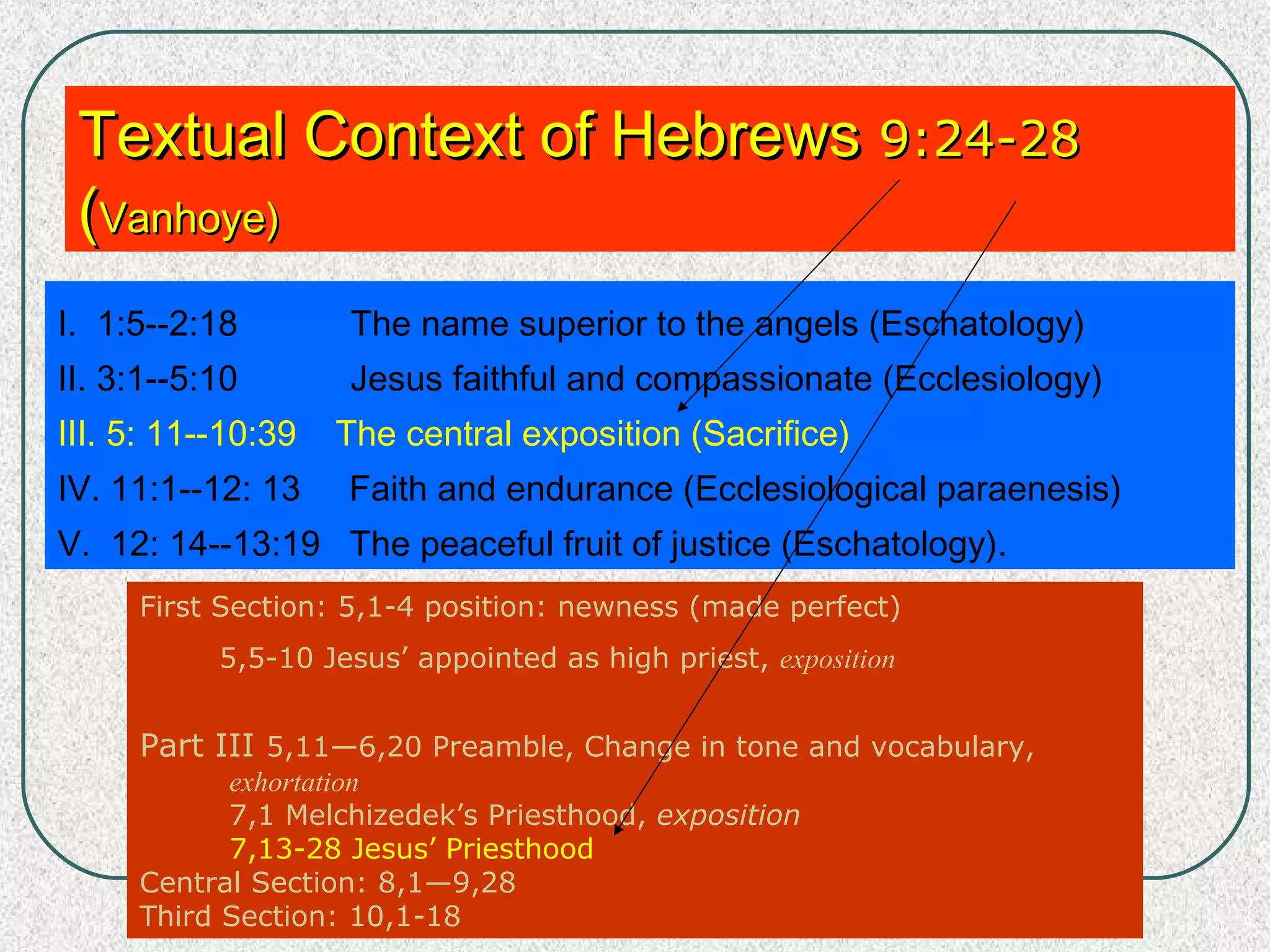
I. 1:5--2:18 The name superior to the angels (Eschatology)
II. 3:1--5:10 Jesus faithful and compassionate (Ecclesiology)
III. 5: 11--10:39 The central exposition (Sacrifice)
IV. 11:1--12: 13 Faith and endurance (Ecclesiological paraenesis)
V. 12: 14--13:19 The peaceful fruit of justice (Eschatology).
Textual Context of HebrewsTextual Context of Hebrews 9:24-289:24-28
((Vanhoye)Vanhoye)
First Section: 5,1-4 position: newness (made perfect)
5,5-10 Jesus’ appointed as high priest, exposition
Part III 5,11—6,20 Preamble, Change in tone and vocabulary,
exhortation
7,1 Melchizedek’s Priesthood, exposition
7,13-28 Jesus’ Priesthood
Central Section: 8,1—9,28
Third Section: 10,1-18
2nd
Reading: Hebrews 9:24-28
 24 For Christ did not enter into 
a sanctuary made by hands, a 
copy of the true one, but 
heaven itself, that he might now 
appear before God on our 
behalf. 25 Not that he might 
offer himself repeatedly, as the 
high priest enters each year 
into the sanctuary with blood 
that is not his own; 26 if that 
were so, he would have had to 
suffer repeatedly from the 
foundation of the world. But 
now once for all he has 
appeared at the end of the 
ages to take away sin by his 
sacrifice. 27 Just as it is 
appointed that human beings 
die once, and after this the 
judgment, 28 so also Christ, 
offered once to take away the 
sins of many, will appear a 
second time, not to take away 
sin but to bring salvation to 
those who eagerly await him. 
Commentary
 The reading reflects on the mystery of 
Christ as a high priest. This high priest is 
now in heaven, not in the Temple of 
Jerusalem.
 V.24 specifies the sanctuary as “not made 
by human hands,” different from the OT 
temple.
 V.24 states the purpose of Christ’s 
entrance: to appear before God on our 
behalf (mediator, intercessor).
 V.25 states what Christ does not do in 
heaven: to offer repeatedly, in contrast to 
OT high priest (annually he goes to the 
Holy of Holies) (v.26a)
 V.26b is emphatic on the “once for all” 
thing. In one click Christ saved the world.
 V.27 makes clear his point on the “once for 
all” by using the reality of death on our part 
as human beings. We die once.
 V.28 continues to develop the point and 
adds something new: the second time 
appearance, to bring salvation, not to die 
again.
Reflections on the 2nd
reading
 Christ’s actions as high priest are effective and 
efficacious.
 He does not need to repeat suffering and dying 
in order to save us from our sins, as if the first 
instance did not bring the desired effect.
 Christ’s high priesthood is salvific, once and for 
all.
 Do you believe in the priesthood of Christ?
Gospel: Mk 12:38-44 or 12:41-44
 38 In the course of his teaching he said, "Beware of the 
scribes, who like to go around in long robes and accept 
greetings in the marketplaces, 39 seats of honor in 
synagogues, and places of honor at banquets. 40 They 
devour the houses of widows and, as a pretext, recite 
lengthy prayers. They will receive a very severe 
condemnation." 41 He sat down opposite the treasury 
and observed how the crowd put money into the 
treasury. Many rich people put in large sums. 42 A poor 
widow also came and put in two small coins worth a 
few cents. 43 Calling his disciples to himself, he said to 
them, "Amen, I say to you, this poor widow put in more 
than all the other contributors to the treasury. 44 For 
they have all contributed from their surplus wealth, but 
she, from her poverty, has contributed all she had, her 
whole livelihood." 
The focus is on generosity.
Gospel: Mk 12:38-44 or 12:41-44
The victimizing scribes (not generous)
 38 In the course of his teaching he said, "Beware of the scribes,
who like to go around in long robes and accept greetings in the
marketplaces, 39 seats of honor in synagogues, and places of
honor at banquets. 40 They devour the houses of widows and,
as a pretext, recite lengthy prayers. They will receive a very
severe condemnation."
The generous widow
 41 He sat down opposite the treasury and observed how the
crowd put money into the treasury. Many rich people put in large
sums. 42 A poor widow also came and put in two small coins
worth a few cents. 43 Calling his disciples to himself, he said to
them, "Amen, I say to you, this poor widow put in more than all
the other contributors to the treasury. 44 For they have all
contributed from their surplus wealth, but she, from her poverty,
has contributed all she had, her whole livelihood."
A simple outline!
Textual Context of Mark 12:38-44
Part I The Mystery of the Messiah: Revelation of Jesus' Person (1,14--8,30)
Three sections, each beginning with a summary of the activity of Jesus and a
narrative concerning the disciples and concluding with the adoption of an attitude
in regard to Jesus.
A. Jesus and the Crowds 1,14--3,6 (1,14f, 16-20; 3,60)
B. Jesus and his Own 3,7--6,6a (3,7-12.13-19; 6,1-6a)
C. Jesus, the Disciples and the Gentiles 6,6b- 8,30 (6,6b; 6,7-31; 8,27-30)
Conclusion and Transition 8,27-33
Confession of Peter
First Prophecy of the Passion
Correction of Peter
Part II The Mystery of the Son of Man: Revelation of Jesus' sufferings 8,31-16,8
A. The Way of the Son of Man 8,31--10,52
Indicated by 3 announcements of the fate of the Son of Man and 3 instructions on
the lot of the disciples.
B. Jesus in Jerusalem 11,1--13,37
C. Passion and Resurrection 14,1--16,8
The Later Ending 16,9-20
Jesus in Jerusalem
11,1 Entry into Jerusalem
Jesus curses the Fig Tree
Cleansing of the Temple
Fig Tree dried up
Faith in God
Jesus’ Authority questioned
by the Chief priests in the
Temple
12,1 Parable of the Vineyard
Some Pharisees and
Herodians question on taxes
Some Sadducees question
on the resurrection
One of the scribes asks
which is the great
commandments
Jesus teaches about the
Messiah as Son of David
Warning about hypocrisy
Widow’s Mite
13,1 Going out of the
Temple, big stones Used with permission from PBS/UBS
Gospel: Mk 12:38-44 or 12:41-44
The victimizing scribes
 38 In the course of his teaching he
said, "Beware of the scribes, who like
to go around in long robes and accept
greetings in the marketplaces, 39 seats
of honor in synagogues, and places of
honor at banquets. 40 They devour the
houses of widows and, as a pretext,
recite lengthy prayers. They will receive
a very severe condemnation."
The generous widow
 41 He sat down opposite the treasury
and observed how the crowd put
money into the treasury. Many rich
people put in large sums. 42 A poor
widow also came and put in two small
coins worth a few cents. 43 Calling his
disciples to himself, he said to them,
"Amen, I say to you, this poor widow
put in more than all the other
contributors to the treasury. 44 For they
have all contributed from their surplus
wealth, but she, from her poverty, has
contributed all she had, her whole
livelihood."
Commentary
 Vv.38-40 talk about the unbecoming
behavior of the scribes:
• Wear long robes (exaggerated, for a show)
• Accept greetings in the marketplaces
• Seats of honor (enjoy having reserved seats
always)
• Devour houses of widows (They are like
vultures.)
 The last line indicates their
punishment: severe condemnation
(v.40b)
 Vv.41-44 make a contrast between the
rich and the poor widow.
 The rich give large sums; the poor
widow, two small coins (kusing)
 For Jesus, the widow who gave more
(the one last coin she needs to
survive) exceeds all in generosity.
 That is the way how to be generous.
Reflections on the gospel
 The gospel reading is a call to generosity.
 There is no excuse for being un-generous, for even a
poor widow can be generous.
 Christians should not behave like the scribes
mentioned in the gospel: they devour, they act for
their selfish interest, they seek recognition. They do
these things at the expense of the poor.
 God knows how generous we are. He knows where
we are coming from (from our bounty or from our
poverty).
 In generosity, we deprive ourselves of something we
need and give it to others.
Tying the 3 readings and the Psalm
 The first reading talks about the loving care of God (generosity)
in the life of endangered Elijah and the widow.
 The psalm affirms God’s providence to those in need.
 The second reading reflects on the non-repetitious acts of
Christ as high priest (suffering, death = salvation). These are
supreme acts of generosity, total giving of oneself.
 The gospel reading warns the people of the Scribes and the
Pharisees, who victimize them; in contrast, he commends the
widow, who is so generous to a fault. She is more generous
than the rich.
Based on the focuses (foci) of the three readings, we must
develop the theme of generosity.
How to develop your homily and sharing
 Begin by relating an experience of generosity
• when you needed money, food, help, medicine and
someone came to your rescue.
 Discuss the meaning of generosity according to
the readings.
 We are called to be generous with our talents,
time and treasure.
 The 1st
reading teaches that we can practice
generosity in times of famine, poverty and want,
like the widow in Zarepthah.
 Even in her poverty, she accommodates Elijah.
 Because of her generosity to Elijah, the widow
and her son also survive.
 Supply does not run out, when there is generosity.
 God himself is generous. God shows the way to
survive in times of severe need.
 We can obtain God’s help if we listen to him, if we
do what he commands.
 The 2nd
reading talks about Christ’s generosity to
us, through his powerful act to save us.
 He shows his generosity by interceding for us.
 In his total self-giving and supreme sacrifice
(generosity), he effects salvation to us all, once
and for all.
 His generosity is complete. He does not withhold
anything from us.
 In the gospel, Jesus teaches us to be generous.
 He highly approves of the generosity of the widow.
 She shows that poverty is not a hindrance to
practice generosity.
 The generosity of the poor surpasses that of the
rich.
 Giving out of excess is ok, but it is more ok to give
out what you need.
 Generosity is doing charity even if it hurts.
 Nobody goes hungry when everybody is generous.
 When people focus their minds on how to multiply
and keep their money and property, many go
hungry. Generosity is dead.
 We are spiritually dead, even if our stomach is
bloated with food, if we are devoid of generosity.
 The gospel reading abhors the unkind acts of the
scribes (they devour). They take advantage of the poor.
 They seek honor (self-seeking, self-aggrandizing).
 We must be reminded that Christians are first of all,
disciples (imitators) of Christ, who is generous, who
never used people to enrich himself.
 The psalm acclaims God as generous.
 It shows an awareness of God’s generous acts to
the poor, to the widow and the orphans, to the sick,
to the strangers, etc.
 The eucharist reminds us of God’s generosity to us.
 In the eucharist, Jesus gives himself generously to
us.
 He nurtures us with his body and blood in the form of
bread and wine.
 In the eucharist, he promises eternal life to all of us,
who try to live generous lives.
Our Context of Sin and Grace
 Stingy
 Vultures, crocodiles
(greedy people)
 Materialistic
 Unbridled capitalism
 Always thinking how to
make profit
 Unable to give justifying
that he worked hard to
obtain it, not believing
that whatever he has is
a gift from God;
therefore sharing is
ruled out.
 Generous only when
there is publicity
 Philantrophists
 Generous benefactors
 Accommodating
 Hospitable
 Alay Kapwa
 Spirituality of Stewardship
(giving even if there is no need;
giving is a form of worship to God)
 Gives donations
 Supports church’s program for
the poor (scholarships,
feeding)
Suggested Songs
 Maghandog ng AlayMaghandog ng Alay
• http://www.youtube.com/watch?v=JRWqJuXVAP0
 Francis’ DreamFrancis’ Dream
• http://www.youtube.com/watch?v=SBe4GJV_5TU
 Only Selfless LoveOnly Selfless Love
• http://www.youtube.com/watch?v=Jn5QXhaLA28
 Ang Mabuhay sa Pag-ibigAng Mabuhay sa Pag-ibig
 PananagutanPananagutan
 SharingSharing
• http://www.youtube.com/watch?v=q1ij6D6EyeIhttp://www.youtube.com/watch?v=q1ij6D6EyeI

32nd Sunday B

  • 1.
    Welcome to ourBible Study 32nd Sunday in the Ordinary Time 8 November 2015 In preparation for this Sunday’s liturgy In aid of focusing our homilies and sharing Prepared by Fr. Cielo R. Almazan, OFM
  • 2.
    1st reading: 1 Kgs17:10-16  10 In those days, Elijah the prophet left and went to Zarephath. As he arrived at the entrance of the city, a widow was gathering sticks there; he called out to her, "Please bring me a small cupful of water to drink.” 11 She left to get it, and he called out after her, "Please bring along a bit of bread.“ 12 "As the LORD, your God, lives," she answered, "I have nothing baked; there is only a handful of flour in my jar and a little oil in my jug. Just now I was collecting a couple of sticks, to go in and prepare something for myself and my son; when we have eaten it, we shall die.” 13 "Do not be afraid," Elijah said to her. "Go and do as you propose. But first make me a little cake and bring it to me. Then you can prepare something for yourself and your son. 14 For the LORD, the God of Israel, says, 'The jar of flour shall not go empty, nor the jug of oil run dry, until the day when the LORD sends rain upon the earth.’” 15 She left and did as Elijah had said. She was able to eat for a year, and he and her son as well; 16 The jar of flour did not go empty, nor the jug of oil run dry, as the LORD had foretold through Elijah. The focus is on generosity.
  • 3.
    1st reading: 1 Kgs17:10-16 Elijah and the widow  10 In those days, Elijah the prophet left and went to Zarephath. As he arrived at the entrance of the city, a widow was gathering sticks there; he called out to her, "Please bring me a small cupful of water to drink.” 11 She left to get it, and he called out after her, "Please bring along a bit of bread.” The widow preparing for the last meal and for death  12 "As the LORD, your God, lives," she answered, "I have nothing baked; there is only a handful of flour in my jar and a little oil in my jug. Just now I was collecting a couple of sticks, to go in and prepare something for myself and my son; when we have eaten it, we shall die.” Elijah’s assurance  13 "Do not be afraid," Elijah said to her. "Go and do as you propose. But first make me a little cake and bring it to me. Then you can prepare something for yourself and your son. 14 For the LORD, the God of Israel, says, 'The jar of flour shall not go empty, nor the jug of oil run dry, until the day when the LORD sends rain upon the earth.’” 15 She left and did as Elijah had said. Promised fulfilled  She was able to eat for a year, and he and her son as well; 16 The jar of flour did not go empty, nor the jug of oil run dry, as the LORD had foretold through Elijah. A simple outline!
  • 4.
    Textual Context of1 Kgs 17:10-16 The Principal Divisions of the Books of Kings (NAB) I. The Reign of Solomon (1 Kgs 1,1—11,43) II. Judah and Israel to the Time of Ahaba (1 Kgs 12,1—16,34) III. Stories of the Prophets (1 Kgs 17,1—22,54) IV. The Kingdoms of Israel and Judah (2 Kgs 1,1—17,41) V. The Kingdom of Judah after 721 B.C. (2 Kgs 18,1—25,30) III. Stories of the Prophets Drought Predicted by Elijah (17:1-6) Elijah and the Widow (17:7-24) Elijah and the Prophets of Baal (18:1-46) Flight to Horeb (19:1-18) Call of Elisha (19:19-21)
  • 5.
  • 6.
    1st reading: 1 Kgs17:10-16 Elijah and the widow  10 In those days, Elijah the prophet left and went to Zarephath. As he arrived at the entrance of the city, a widow was gathering sticks there; he called out to her, "Please bring me a small cupful of water to drink.” 11 She left to get it, and he called out after her, "Please bring along a bit of bread.” The widow preparing for the last meal and for death  12 "As the LORD, your God, lives," she answered, "I have nothing baked; there is only a handful of flour in my jar and a little oil in my jug. Just now I was collecting a couple of sticks, to go in and prepare something for myself and my son; when we have eaten it, we shall die.” Commentary  There are two characters in the story: The prophet Elijah and the widow (no name)  In vv. 10-11, Elijah, being a man of God, exhibits confidence. He freely, confidently commands the widow to do him a favor (bring me water and bread), as if she were his slave.  In v.12, the widow does not refuse Elijah, but admits her reality that her food supply is running out. After this meal, they will die.  The land is struck with famine.
  • 7.
    1st reading: 1 Kgs17:10-16 Elijah’s assurance  13 "Do not be afraid," Elijah said to her. "Go and do as you propose. But first make me a little cake and bring it to me. Then you can prepare something for yourself and your son. 14 For the LORD, the God of Israel, says, 'The jar of flour shall not go empty, nor the jug of oil run dry, until the day when the LORD sends rain upon the earth.’” 15 She left and did as Elijah had said. Promised fulfilled  She was able to eat for a year, and he and her son as well; 16 The jar of flour did not go empty, nor the jug of oil run dry, as the LORD had foretold through Elijah.  In v.13, Elijah seems to ignore what the widow said, and instead demands that he should be served first.  V.14 gives the reason why Elijah is comfortable with his orders. Elijah has received a word from God.  In v.15, the widow obeys and does what Elijah says.  V.16 affirms the fulfillment of Elijah’s prediction.
  • 8.
    Reflections on the1st reading  We can put ourselves into the shoes of Elijah. We, as God’s children, can be put into a difficult situation. We also experience “famine.” (No money).  God leads our way too, provided, we cooperate and move on. Who knows we will encounter our own “widow”, whom God will send to rescue us.  We may also put ourselves into the shoes of the widow.  In our poverty, we can still become instruments of God in saving those in difficult situations, in saving a prophet, in saving a man of God, a priest, or, a parish worker.  In times of need, we must be open to possibilities, we must move on because God is generous to the generous.
  • 9.
    Responsorial Ps 146:7,8-9, 9-10  R. (1b) Praise the Lord, my soul!  7 The LORD keeps faith forever, secures justice for the oppressed, gives food to the hungry. The LORD sets captives free.  8 The LORD gives sight to the blind. The LORD raises up those who were bowed down; the LORD loves the just. 9 The LORD protects strangers.  The fatherless and the widow he sustains, but the way of the wicked he thwarts. 10 The LORD shall reign forever; your God, O Zion, through all generations. Alleluia.
  • 10.
    Responsorial Ps 146:7,8-9, 9-10  R. (1b) Praise the Lord, my soul!  7 The LORD keeps faith forever, secures justice for the  oppressed, gives food to the hungry. The LORD sets captives free.  8 The LORD gives sight to the  blind. The LORD raises up those who  were bowed down; the LORD loves the just. 9 The LORD protects strangers.  The fatherless and the widow he  sustains, but the way of the wicked he  thwarts. 10 The LORD shall reign forever; your God, O Zion, through all  generations. Alleluia. Commentary  The psalm is a hymn of  praise.  God is to be praised for  the reasons given in vv.7- 10.  We can read the psalm  again.  It recalls the experience of  the widow in Zarepthah,  and of all those who are  oppressed, humbled,  orphaned, the strangers,  and those in need.
  • 11.
    Reflections on thePsalmReflections on the Psalm  God has a special heart for the poor.  He lifts them up.  He is the number one activist and defender of  the poor and their advocate.  God has no heart for the wicked, who makes  people poor.   The wicked must make up their minds if they  want to be saved.
  • 12.
    2nd Reading: Hebrews 9:24-28 24 For Christ did not enter into a sanctuary made by  hands, a copy of the true one, but heaven itself, that  he might now appear before God on our behalf. 25  Not that he might offer himself repeatedly, as the  high priest enters each year into the sanctuary with  blood that is not his own; 26 if that were so, he would  have had to suffer repeatedly from the foundation of  the world. But now once for all he has appeared at  the end of the ages to take away sin by his sacrifice.  27 Just as it is appointed that human beings die  once, and after this the judgment, 28 so also Christ,  offered once to take away the sins of many, will appear a  second time, not to take away sin but to bring salvation to  those who eagerly await him.  The focus is the non-repetitious character of Christ’s action as high priest.
  • 13.
    I. 1:5--2:18 Thename superior to the angels (Eschatology) II. 3:1--5:10 Jesus faithful and compassionate (Ecclesiology) III. 5: 11--10:39 The central exposition (Sacrifice) IV. 11:1--12: 13 Faith and endurance (Ecclesiological paraenesis) V. 12: 14--13:19 The peaceful fruit of justice (Eschatology). Textual Context of HebrewsTextual Context of Hebrews 9:24-289:24-28 ((Vanhoye)Vanhoye) First Section: 5,1-4 position: newness (made perfect) 5,5-10 Jesus’ appointed as high priest, exposition Part III 5,11—6,20 Preamble, Change in tone and vocabulary, exhortation 7,1 Melchizedek’s Priesthood, exposition 7,13-28 Jesus’ Priesthood Central Section: 8,1—9,28 Third Section: 10,1-18
  • 14.
    2nd Reading: Hebrews 9:24-28 24 For Christ did not enter into  a sanctuary made by hands, a  copy of the true one, but  heaven itself, that he might now  appear before God on our  behalf. 25 Not that he might  offer himself repeatedly, as the  high priest enters each year  into the sanctuary with blood  that is not his own; 26 if that  were so, he would have had to  suffer repeatedly from the  foundation of the world. But  now once for all he has  appeared at the end of the  ages to take away sin by his  sacrifice. 27 Just as it is  appointed that human beings  die once, and after this the  judgment, 28 so also Christ,  offered once to take away the  sins of many, will appear a  second time, not to take away  sin but to bring salvation to  those who eagerly await him.  Commentary  The reading reflects on the mystery of  Christ as a high priest. This high priest is  now in heaven, not in the Temple of  Jerusalem.  V.24 specifies the sanctuary as “not made  by human hands,” different from the OT  temple.  V.24 states the purpose of Christ’s  entrance: to appear before God on our  behalf (mediator, intercessor).  V.25 states what Christ does not do in  heaven: to offer repeatedly, in contrast to  OT high priest (annually he goes to the  Holy of Holies) (v.26a)  V.26b is emphatic on the “once for all”  thing. In one click Christ saved the world.  V.27 makes clear his point on the “once for  all” by using the reality of death on our part  as human beings. We die once.  V.28 continues to develop the point and  adds something new: the second time  appearance, to bring salvation, not to die  again.
  • 15.
    Reflections on the2nd reading  Christ’s actions as high priest are effective and  efficacious.  He does not need to repeat suffering and dying  in order to save us from our sins, as if the first  instance did not bring the desired effect.  Christ’s high priesthood is salvific, once and for  all.  Do you believe in the priesthood of Christ?
  • 16.
    Gospel: Mk 12:38-44or 12:41-44  38 In the course of his teaching he said, "Beware of the  scribes, who like to go around in long robes and accept  greetings in the marketplaces, 39 seats of honor in  synagogues, and places of honor at banquets. 40 They  devour the houses of widows and, as a pretext, recite  lengthy prayers. They will receive a very severe  condemnation." 41 He sat down opposite the treasury  and observed how the crowd put money into the  treasury. Many rich people put in large sums. 42 A poor  widow also came and put in two small coins worth a  few cents. 43 Calling his disciples to himself, he said to  them, "Amen, I say to you, this poor widow put in more  than all the other contributors to the treasury. 44 For  they have all contributed from their surplus wealth, but  she, from her poverty, has contributed all she had, her  whole livelihood."  The focus is on generosity.
  • 17.
    Gospel: Mk 12:38-44or 12:41-44 The victimizing scribes (not generous)  38 In the course of his teaching he said, "Beware of the scribes, who like to go around in long robes and accept greetings in the marketplaces, 39 seats of honor in synagogues, and places of honor at banquets. 40 They devour the houses of widows and, as a pretext, recite lengthy prayers. They will receive a very severe condemnation." The generous widow  41 He sat down opposite the treasury and observed how the crowd put money into the treasury. Many rich people put in large sums. 42 A poor widow also came and put in two small coins worth a few cents. 43 Calling his disciples to himself, he said to them, "Amen, I say to you, this poor widow put in more than all the other contributors to the treasury. 44 For they have all contributed from their surplus wealth, but she, from her poverty, has contributed all she had, her whole livelihood." A simple outline!
  • 18.
    Textual Context ofMark 12:38-44 Part I The Mystery of the Messiah: Revelation of Jesus' Person (1,14--8,30) Three sections, each beginning with a summary of the activity of Jesus and a narrative concerning the disciples and concluding with the adoption of an attitude in regard to Jesus. A. Jesus and the Crowds 1,14--3,6 (1,14f, 16-20; 3,60) B. Jesus and his Own 3,7--6,6a (3,7-12.13-19; 6,1-6a) C. Jesus, the Disciples and the Gentiles 6,6b- 8,30 (6,6b; 6,7-31; 8,27-30) Conclusion and Transition 8,27-33 Confession of Peter First Prophecy of the Passion Correction of Peter Part II The Mystery of the Son of Man: Revelation of Jesus' sufferings 8,31-16,8 A. The Way of the Son of Man 8,31--10,52 Indicated by 3 announcements of the fate of the Son of Man and 3 instructions on the lot of the disciples. B. Jesus in Jerusalem 11,1--13,37 C. Passion and Resurrection 14,1--16,8 The Later Ending 16,9-20
  • 19.
    Jesus in Jerusalem 11,1Entry into Jerusalem Jesus curses the Fig Tree Cleansing of the Temple Fig Tree dried up Faith in God Jesus’ Authority questioned by the Chief priests in the Temple 12,1 Parable of the Vineyard Some Pharisees and Herodians question on taxes Some Sadducees question on the resurrection One of the scribes asks which is the great commandments Jesus teaches about the Messiah as Son of David Warning about hypocrisy Widow’s Mite 13,1 Going out of the Temple, big stones Used with permission from PBS/UBS
  • 20.
    Gospel: Mk 12:38-44or 12:41-44 The victimizing scribes  38 In the course of his teaching he said, "Beware of the scribes, who like to go around in long robes and accept greetings in the marketplaces, 39 seats of honor in synagogues, and places of honor at banquets. 40 They devour the houses of widows and, as a pretext, recite lengthy prayers. They will receive a very severe condemnation." The generous widow  41 He sat down opposite the treasury and observed how the crowd put money into the treasury. Many rich people put in large sums. 42 A poor widow also came and put in two small coins worth a few cents. 43 Calling his disciples to himself, he said to them, "Amen, I say to you, this poor widow put in more than all the other contributors to the treasury. 44 For they have all contributed from their surplus wealth, but she, from her poverty, has contributed all she had, her whole livelihood." Commentary  Vv.38-40 talk about the unbecoming behavior of the scribes: • Wear long robes (exaggerated, for a show) • Accept greetings in the marketplaces • Seats of honor (enjoy having reserved seats always) • Devour houses of widows (They are like vultures.)  The last line indicates their punishment: severe condemnation (v.40b)  Vv.41-44 make a contrast between the rich and the poor widow.  The rich give large sums; the poor widow, two small coins (kusing)  For Jesus, the widow who gave more (the one last coin she needs to survive) exceeds all in generosity.  That is the way how to be generous.
  • 21.
    Reflections on thegospel  The gospel reading is a call to generosity.  There is no excuse for being un-generous, for even a poor widow can be generous.  Christians should not behave like the scribes mentioned in the gospel: they devour, they act for their selfish interest, they seek recognition. They do these things at the expense of the poor.  God knows how generous we are. He knows where we are coming from (from our bounty or from our poverty).  In generosity, we deprive ourselves of something we need and give it to others.
  • 22.
    Tying the 3readings and the Psalm  The first reading talks about the loving care of God (generosity) in the life of endangered Elijah and the widow.  The psalm affirms God’s providence to those in need.  The second reading reflects on the non-repetitious acts of Christ as high priest (suffering, death = salvation). These are supreme acts of generosity, total giving of oneself.  The gospel reading warns the people of the Scribes and the Pharisees, who victimize them; in contrast, he commends the widow, who is so generous to a fault. She is more generous than the rich. Based on the focuses (foci) of the three readings, we must develop the theme of generosity.
  • 23.
    How to developyour homily and sharing  Begin by relating an experience of generosity • when you needed money, food, help, medicine and someone came to your rescue.  Discuss the meaning of generosity according to the readings.  We are called to be generous with our talents, time and treasure.
  • 24.
     The 1st readingteaches that we can practice generosity in times of famine, poverty and want, like the widow in Zarepthah.  Even in her poverty, she accommodates Elijah.  Because of her generosity to Elijah, the widow and her son also survive.  Supply does not run out, when there is generosity.  God himself is generous. God shows the way to survive in times of severe need.  We can obtain God’s help if we listen to him, if we do what he commands.
  • 25.
     The 2nd readingtalks about Christ’s generosity to us, through his powerful act to save us.  He shows his generosity by interceding for us.  In his total self-giving and supreme sacrifice (generosity), he effects salvation to us all, once and for all.  His generosity is complete. He does not withhold anything from us.
  • 26.
     In thegospel, Jesus teaches us to be generous.  He highly approves of the generosity of the widow.  She shows that poverty is not a hindrance to practice generosity.  The generosity of the poor surpasses that of the rich.  Giving out of excess is ok, but it is more ok to give out what you need.  Generosity is doing charity even if it hurts.
  • 27.
     Nobody goeshungry when everybody is generous.  When people focus their minds on how to multiply and keep their money and property, many go hungry. Generosity is dead.  We are spiritually dead, even if our stomach is bloated with food, if we are devoid of generosity.
  • 28.
     The gospelreading abhors the unkind acts of the scribes (they devour). They take advantage of the poor.  They seek honor (self-seeking, self-aggrandizing).  We must be reminded that Christians are first of all, disciples (imitators) of Christ, who is generous, who never used people to enrich himself.  The psalm acclaims God as generous.  It shows an awareness of God’s generous acts to the poor, to the widow and the orphans, to the sick, to the strangers, etc.
  • 29.
     The eucharistreminds us of God’s generosity to us.  In the eucharist, Jesus gives himself generously to us.  He nurtures us with his body and blood in the form of bread and wine.  In the eucharist, he promises eternal life to all of us, who try to live generous lives.
  • 30.
    Our Context ofSin and Grace  Stingy  Vultures, crocodiles (greedy people)  Materialistic  Unbridled capitalism  Always thinking how to make profit  Unable to give justifying that he worked hard to obtain it, not believing that whatever he has is a gift from God; therefore sharing is ruled out.  Generous only when there is publicity  Philantrophists  Generous benefactors  Accommodating  Hospitable  Alay Kapwa  Spirituality of Stewardship (giving even if there is no need; giving is a form of worship to God)  Gives donations  Supports church’s program for the poor (scholarships, feeding)
  • 31.
    Suggested Songs  Maghandogng AlayMaghandog ng Alay • http://www.youtube.com/watch?v=JRWqJuXVAP0  Francis’ DreamFrancis’ Dream • http://www.youtube.com/watch?v=SBe4GJV_5TU  Only Selfless LoveOnly Selfless Love • http://www.youtube.com/watch?v=Jn5QXhaLA28  Ang Mabuhay sa Pag-ibigAng Mabuhay sa Pag-ibig  PananagutanPananagutan  SharingSharing • http://www.youtube.com/watch?v=q1ij6D6EyeIhttp://www.youtube.com/watch?v=q1ij6D6EyeI