WWeelclcoome tme too oourur BBibliblee StStuuddyy
21st
Sunday in Ordinary Time C
21 August 2016
In preparation for this Sunday’s liturgy
As aid in focusing our homilies and sharing
Prepared by Fr. Cielo R. Almazan, OFM
11stst
reading: Isaiah 66,18-21reading: Isaiah 66,18-21
18Thus says the LORD: I know their works and
their thoughts, I come to gather nations of every
language; they shall come and see my glory. 19
I will set a sign among them; from them I will
send fugitives to the nations: to Tarshish, Put and
Lud, Mosoch, Tubal and Javan, to the distant
coastlands that have never heard of my fame, or
seen my glory; and they shall proclaim my glory
among the nations. 20 They shall bring all your
brethren from all the nations as an offering to the
LORD, on horses and in chariots, in carts, upon
mules and dromedaries, to Jerusalem, my holy
mountain, says the LORD, just as the Israelites
bring their offering to the house of the LORD in
clean vessels. 21 Some of these I will take as
priests and Levites, says the LORD.
The focus is on gathering the nations..
11stst
reading: Isaiah 66,18-21reading: Isaiah 66,18-21
18Thus says the LORD: I know their works and
their thoughts, I come to gather nations of every
language; they shall come and see my glory. 19
I will set a sign among them; from them I will
send fugitives to the nations: to Tarshish, Put and
Lud, Mosoch, Tubal and Javan, to the distant
coastlands that have never heard of my fame, or
seen my glory; and they shall proclaim my glory
among the nations. 20 They shall bring all your
brethren from all the nations as an offering to the
LORD, on horses and in chariots, in carts, upon
mules and dromedaries, to Jerusalem, my holy
mountain, says the LORD, just as the Israelites
bring their offering to the house of the LORD in
clean vessels. 21 Some of these I will take as
priests and Levites, says the LORD.
Take note of the nations as object of prepositions.
11stst
reading: Isaiah 66,18-21reading: Isaiah 66,18-21
18Thus says the LORD: I know their works and
their thoughts, I come to gather nations of every
language; they shall come and see my glory. 19
I will set a sign among them; from them I will
send fugitives to the nations: to Tarshish, Put and
Lud, Mosoch, Tubal and Javan, to the distant
coastlands that have never heard of my fame, or
seen my glory; and they shall proclaim my glory
among the nations. 20 They shall bring all your
brethren from all the nations as an offering to the
LORD, on horses and in chariots, in carts, upon
mules and dromedaries, to Jerusalem, my holy
mountain, says the LORD, just as the Israelites
bring their offering to the house of the LORD in
clean vessels. 21 Some of these I will take as
priests and Levites, says the LORD.
The purpose of gathering nations is to see God’s gloryglory.
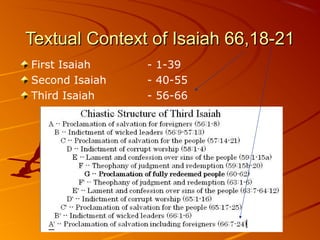
Textual Context of Isaiah 66,18-21Textual Context of Isaiah 66,18-21
First Isaiah - 1-39
Second Isaiah - 40-55
Third Isaiah - 56-66
11stst
reading: Isaiah 66,18-21reading: Isaiah 66,18-21
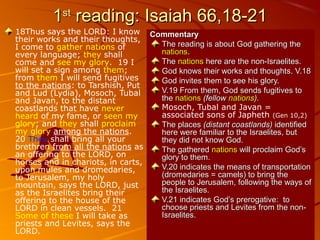
18Thus says the LORD: I know
their works and their thoughts,
I come to gather nations of
every language; they shall
come and see my glory. 19 I
will set a sign among them;
from them I will send fugitives
to the nations: to Tarshish, Put
and Lud (Lydia), Mosoch, Tubal
and Javan, to the distant
coastlands that have never
heard of my fame, or seen my
glory; and they shall proclaim
my glory among the nations.
20 They shall bring all your
brethren from all the nations as
an offering to the LORD, on
horses and in chariots, in carts,
upon mules and dromedaries,
to Jerusalem, my holy
mountain, says the LORD, just
as the Israelites bring their
offering to the house of the
LORD in clean vessels. 21
Some of these I will take as
priests and Levites, says the
LORD.
CommentaryCommentary
The reading is about God gathering theThe reading is about God gathering the
nationsnations..
TheThe nationsnations here are the non-Israelites.here are the non-Israelites.
God knows their works and thoughts. V.18God knows their works and thoughts. V.18
God invites them to see his glory.God invites them to see his glory.
V.19 From them, God sends fugitives toV.19 From them, God sends fugitives to
thethe nationsnations (fellow(fellow nationsnations).).
Mosoch, Tubal and Javan =
associated sons of Japheth (Gen 10,2)
The placesThe places (distant coastlands)(distant coastlands) identifiedidentified
here were familiar to the Israelites, buthere were familiar to the Israelites, but
they did not know God.they did not know God.
The gatheredThe gathered nationsnations will proclaim God’swill proclaim God’s
glory to them.glory to them.
V.20 indicates the means of transportationV.20 indicates the means of transportation
(dromedaries = camels) to bring the(dromedaries = camels) to bring the
people to Jerusalem, following the ways ofpeople to Jerusalem, following the ways of
the Israelites.the Israelites.
V.21 indicates God’s prerogative: toV.21 indicates God’s prerogative: to
choose priests and Levites from the non-choose priests and Levites from the non-
Israelites.Israelites.
Reflections on the 1Reflections on the 1stst
readingreading
The reading proclaims the universality of
salvation.
Salvation is not limited to the Israelite people.
The nations (non-Israelites) are called by God to
see his glory.
They, too, will have a mission.
Beware of those who claim that they are the only
ones who are saved.
Beware of those who claim that they are the only
ones sent.
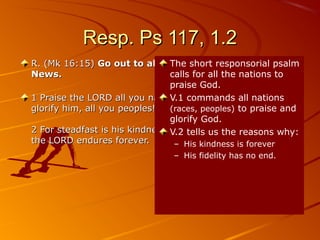
Resp. Ps 117, 1.2Resp. Ps 117, 1.2
R. (Mk 16:15)R. (Mk 16:15) Go out to all the world and tellGo out to all the world and tell
the Good News.the Good News.
1 Praise the LORD all you nations;1 Praise the LORD all you nations;
glorify him, all you peoples!glorify him, all you peoples!
2 For steadfast is his kindness toward us, and the2 For steadfast is his kindness toward us, and the
fidelity of the LORD endures forever.fidelity of the LORD endures forever.
Resp. Ps 117, 1.2Resp. Ps 117, 1.2
R. (Mk 16:15)R. (Mk 16:15) Go out to all the world and tell the GoodGo out to all the world and tell the Good
News.News.
1 Praise the LORD all you nations;1 Praise the LORD all you nations;
glorify him, all you peoples!glorify him, all you peoples!
2 For steadfast is his kindness toward us, and the fidelity of2 For steadfast is his kindness toward us, and the fidelity of
the LORD endures forever.the LORD endures forever.
The short responsorial psalm
calls for all the nations to
praise God.
V.1 commands all nations
(races, peoples) to praise and
glorify God.
V.2 tells us the reasons why:
– His kindness is forever
– His fidelity has no end.
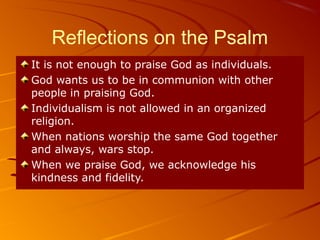
Reflections on the Psalm
It is not enough to praise God as individuals.
God wants us to be in communion with other
people in praising God.
Individualism is not allowed in an organized
religion.
When nations worship the same God together
and always, wars stop.
When we praise God, we acknowledge his
kindness and fidelity.
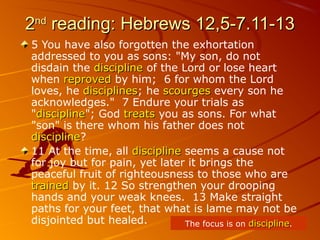
22ndnd
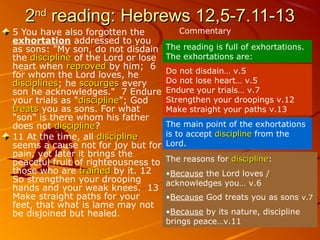
reading: Hebrews 12,5-7.11-13reading: Hebrews 12,5-7.11-13
5 You have also forgotten the exhortation
addressed to you as sons: "My son, do not
disdain the disciplinediscipline of the Lord or lose heart
when reprovedreproved by him; 6 for whom the Lord
loves, he disciplinesdisciplines; he scourgesscourges every son he
acknowledges." 7 Endure your trials as
"disciplinediscipline"; God treatstreats you as sons. For what
"son" is there whom his father does not
disciplinediscipline?
11 At the time, all disciplinediscipline seems a cause not
for joy but for pain, yet later it brings the
peaceful fruit of righteousness to those who are
trainedtrained by it. 12 So strengthen your drooping
hands and your weak knees. 13 Make straight
paths for your feet, that what is lame may not be
disjointed but healed. The focus is on disciplinediscipline.
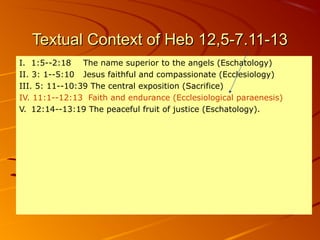
Textual Context of Heb 12,5-7.11-13Textual Context of Heb 12,5-7.11-13
I. 1:5--2:18 The name superior to the angels (Eschatology)
II. 3: 1--5:10 Jesus faithful and compassionate (Ecclesiology)
III. 5: 11--10:39 The central exposition (Sacrifice)
IV. 11:1--12:13 Faith and endurance (Ecclesiological paraenesis)
V. 12:14--13:19 The peaceful fruit of justice (Eschatology).
22ndnd
reading: Hebrews 12,5-7.11-13reading: Hebrews 12,5-7.11-13
5 You have also forgotten the
exhortation addressed to you
as sons: "My son, do not disdain
the disciplinediscipline of the Lord or lose
heart when reprovedreproved by him; 6
for whom the Lord loves, he
disciplinesdisciplines; he scourgesscourges every
son he acknowledges." 7 Endure
your trials as "disciplinediscipline"; God
treatstreats you as sons. For what
"son" is there whom his father
does not disciplinediscipline?
11 At the time, all disciplinediscipline
seems a cause not for joy but for
pain, yet later it brings the
peaceful fruit of righteousness to
those who are trainedtrained by it. 12
So strengthen your drooping
hands and your weak knees. 13
Make straight paths for your
feet, that what is lame may not
be disjoined but healed.
Commentary
The reading is full of exhortations.
The exhortations are:
Do not disdain… v.5
Do not lose heart… v.5
Endure your trials… v.7
Strengthen your droopings v.12
Make straight your paths v.13
The main point of the exhortations
is to accept disciplinediscipline from the
Lord.
The reasons for disciplinediscipline:
•Because the Lord loves /
acknowledges you… v.6
•Because God treats you as sons v.7
•Because by its nature, discipline
brings peace…v.11
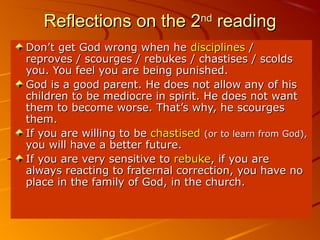
Reflections on the 2Reflections on the 2ndnd
readingreading
Don’t get God wrong when heDon’t get God wrong when he disciplinesdisciplines //
reproves / scourges / rebukes / chastises / scoldsreproves / scourges / rebukes / chastises / scolds
you. You feel you are being punished.you. You feel you are being punished.
God is a good parent. He does not allow any of hisGod is a good parent. He does not allow any of his
children to be mediocre in spirit. He does not wantchildren to be mediocre in spirit. He does not want
them to become worse. That’s why, he scourgesthem to become worse. That’s why, he scourges
them.them.
If you are willing to beIf you are willing to be chastisedchastised (or to learn from God),(or to learn from God),
you will have a better future.you will have a better future.
If you are very sensitive toIf you are very sensitive to rebukerebuke, if you are, if you are
always reacting to fraternal correction, you have noalways reacting to fraternal correction, you have no
place in the family of God, in the church.place in the family of God, in the church.
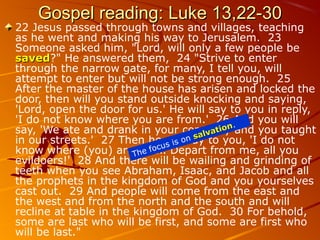
Gospel reading: Luke 13,22-30Gospel reading: Luke 13,22-30
22 Jesus passed through towns and villages, teaching
as he went and making his way to Jerusalem. 23
Someone asked him, "Lord, will only a few people be
savedsaved?" He answered them, 24 "Strive to enter
through the narrow gate, for many, I tell you, will
attempt to enter but will not be strong enough. 25
After the master of the house has arisen and locked the
door, then will you stand outside knocking and saying,
'Lord, open the door for us.' He will say to you in reply,
'I do not know where you are from.' 26 And you will
say, 'We ate and drank in your company and you taught
in our streets.' 27 Then he will say to you, 'I do not
know where (you) are from. Depart from me, all you
evildoers!' 28 And there will be wailing and grinding of
teeth when you see Abraham, Isaac, and Jacob and all
the prophets in the kingdom of God and you yourselves
cast out. 29 And people will come from the east and
the west and from the north and the south and will
recline at table in the kingdom of God. 30 For behold,
some are last who will be first, and some are first who
will be last."
The focus is on salvation
salvation.
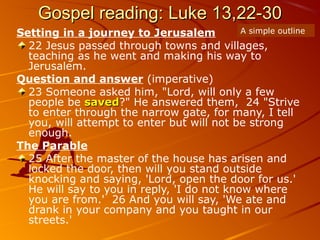
Gospel reading: Luke 13,22-30Gospel reading: Luke 13,22-30
Setting in a journey to Jerusalem
22 Jesus passed through towns and villages,
teaching as he went and making his way to
Jerusalem.
Question and answer (imperative)
23 Someone asked him, "Lord, will only a few
people be savedsaved?" He answered them, 24 "Strive
to enter through the narrow gate, for many, I tell
you, will attempt to enter but will not be strong
enough.
The Parable
25 After the master of the house has arisen and
locked the door, then will you stand outside
knocking and saying, 'Lord, open the door for us.'
He will say to you in reply, 'I do not know where
you are from.' 26 And you will say, 'We ate and
drank in your company and you taught in our
streets.'
A simple outline
The reason for the rejection
27 Then he will say to you, 'I do not know where
(you) are from. Depart from me, all you
evildoers!'
The Punishment
28 And there will be wailing and grinding of teeth
when you see Abraham, Isaac, and Jacob and all
the prophets in the kingdom of God and you
yourselves cast out.
The reward of the righteous
29 And people will come from the east and the
west and from the north and the south and will
recline at table in the kingdom of God.
The saying
30 For behold, some are last who will be first, and
some are first who will be last."
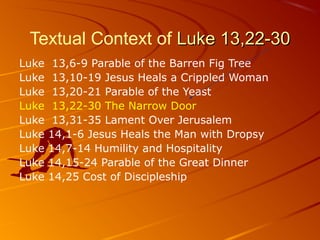
Textual Context of Luke 13,22-30Luke 13,22-30
Luke 13,6-9 Parable of the Barren Fig Tree
Luke 13,10-19 Jesus Heals a Crippled Woman
Luke 13,20-21 Parable of the Yeast
Luke 13,22-30 The Narrow Door
Luke 13,31-35 Lament Over Jerusalem
Luke 14,1-6 Jesus Heals the Man with Dropsy
Luke 14,7-14 Humility and Hospitality
Luke 14,15-24 Parable of the Great Dinner
Luke 14,25 Cost of Discipleship
Gospel reading: Luke 13,22-30Gospel reading: Luke 13,22-30Setting in a journey to
Jerusalem
22 Jesus passed through
towns and villages, teaching
as he went and making his
way to Jerusalem.
Question and answer
(imperative)
23 Someone asked him,
"Lord, will only a few people
be savedsaved?" He answered
them, 24 "Strive to enter
through the narrow gate, for
many, I tell you, will attempt
to enter but will not be
strong enough.
The Parable
25 After the master of the
house has arisen and locked
the door, then will you stand
outside knocking and saying,
'Lord, open the door for us.'
He will say to you in reply, 'I
do not know where you are
from.' 26 And you will say,
'We ate and drank in your
company and you taught in
our streets.'
Commentary
Our reading belongs to the long journey
narrative of Luke.
Jesus is going to Jerusalem after his ministry
in Galilee.
On the way, he meets a lot of people with
different concerns.
In v.23, someone asks if a few people will be
saved.
In v.24, Jesus does not directly entertain the
question. He is more concerned with the
man who questions him. “Strive to enter
through the narrow gate… You better be one of the
few if it is the case. Be strong.” It is not that easy
to be saved.
The parable follows up the importance of
entering the door that the Lord opens.
Jesus does not open the door to evildoers.
Evildoers are the ones who eat and drink
with Jesus and are seemingly taught by him,
but do not learn how to do good.
The reason for the
rejection
27 Then he will say to
you, 'I do not know
where (you) are from.
Depart from me, all you
evildoers!'
The Punishment
28 And there will be
wailing and grinding of
teeth when you see
Abraham, Isaac, and
Jacob and all the
prophets in the kingdom
of God and you
yourselves cast out.
The reward of the
righteous
29 And people will come
from the east and the
west and from the north
and the south and will
recline at table in the
kingdom of God.
The saying
30 For behold, some are
last who will be first, and
some are first who will
be last."
In v.27, Jesus does not entertain evildoers.
They are unfit for the kingdom of God. They
have not been serious with his teachings.
In our catechism and homilies, we seldom hear
of punishment being mentioned. Here, the
punishment for evildoers is wailing and grinding
of teeth. Sometimes it is needed in order to warn
people to shape up.
The evildoers will feel jealous of Abraham, Isaac,
Jacob and all the prophets entering the door,
while they, the evildoers are rejected. V.28
The righteous, from all corners of the
world, will sit at the banquet table in the
kingdom of God. Great is the reward of the
doers of good and God’s will. v.29
The saying in v.30 affirms the salvation of
those who are serious in listening and
doing the will of God, even if they realize
quite late. Hopeless are the persons who
claim they have been associating with
Jesus but, in fact, producing no good fruit.
Salvation is not barkadahan.
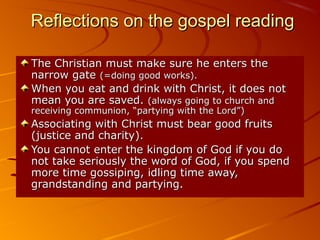
Reflections on the gospel readingReflections on the gospel reading
The Christian must make sure he enters theThe Christian must make sure he enters the
narrow gatenarrow gate (=doing good works).(=doing good works).
When you eat and drink with Christ, it does notWhen you eat and drink with Christ, it does not
mean you are saved.mean you are saved. (always going to church and(always going to church and
receiving communion, “partying with the Lord”)receiving communion, “partying with the Lord”)
Associating with Christ must bear good fruitsAssociating with Christ must bear good fruits
(justice and charity).(justice and charity).
You cannot enter the kingdom of God if you doYou cannot enter the kingdom of God if you do
not take seriously the word of God, if you spendnot take seriously the word of God, if you spend
more time gossiping, idling time away,more time gossiping, idling time away,
grandstanding and partying.grandstanding and partying.
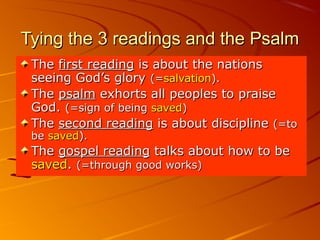
Tying the 3 readings and the PsalmTying the 3 readings and the Psalm
TheThe first readingfirst reading is about the nationsis about the nations
seeing God’s gloryseeing God’s glory (=(=salvationsalvation).).
TheThe psalmpsalm exhorts all peoples to praiseexhorts all peoples to praise
God.God. (=sign of being(=sign of being savedsaved))
TheThe second readingsecond reading is about disciplineis about discipline (=to(=to
bebe savedsaved).).
TheThe gospel readinggospel reading talks about how to betalks about how to be
savedsaved.. (=through good works)(=through good works)
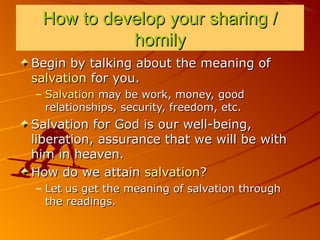
How to develop your sharing /How to develop your sharing /
homilyhomily
Begin by talking about the meaning ofBegin by talking about the meaning of
salvationsalvation for you.for you.
– SalvationSalvation may be work, money, goodmay be work, money, good
relationships, security, freedom, etc.relationships, security, freedom, etc.
Salvation for God is our well-being,Salvation for God is our well-being,
liberation, assurance that we will be withliberation, assurance that we will be with
him in heaven.him in heaven.
How do we attainHow do we attain salvationsalvation??
– Let us get the meaning of salvation throughLet us get the meaning of salvation through
the readings.the readings.
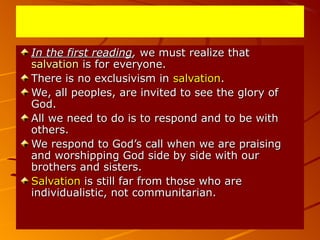
In the first readingIn the first reading,, we must realize thatwe must realize that
salvationsalvation is for everyone.is for everyone.
There is no exclusivism inThere is no exclusivism in salvationsalvation..
We, all peoples, are invited to see the glory ofWe, all peoples, are invited to see the glory of
God.God.
All we need to do is to respond and to be withAll we need to do is to respond and to be with
others.others.
We respond to God’s call when we are praisingWe respond to God’s call when we are praising
and worshipping God side by side with ourand worshipping God side by side with our
brothers and sisters.brothers and sisters.
SalvationSalvation is still far from those who areis still far from those who are
individualistic, not communitarian.individualistic, not communitarian.
In the second readingIn the second reading,, we attainwe attain salvationsalvation byby
subjecting ourselves to chastisements.subjecting ourselves to chastisements.
We willingly submit ourselves to God’s discipline.We willingly submit ourselves to God’s discipline.
We should not be reacting if we are corrected.We should not be reacting if we are corrected.
God may be using our lola, friend or the priest toGod may be using our lola, friend or the priest to
point out our mistakes.point out our mistakes.
If we reject corrections and punishments, we areIf we reject corrections and punishments, we are
still far fromstill far from salvationsalvation..
TheThe gospel readinggospel reading asks each Christian to enterasks each Christian to enter
the narrow path.the narrow path.
The way toThe way to salvationsalvation is not cheap. The narrowis not cheap. The narrow
path is doingpath is doing good deedsgood deeds..
Can you mention theCan you mention the good deedsgood deeds you are doing?you are doing?
– Helping the poor, visiting the sick and imprisoned,Helping the poor, visiting the sick and imprisoned,
teaching catechism to children, works of mercy, etc.teaching catechism to children, works of mercy, etc.
If you cannot think of any good deed, you mustIf you cannot think of any good deed, you must
be an evildoer. You will be like one of those whobe an evildoer. You will be like one of those who
knock but will be refused entranceknock but will be refused entrance
The Christian must never fail toThe Christian must never fail to do gooddo good..
No one should get tired of doing good and givingNo one should get tired of doing good and giving
good examples.good examples.
Blessed are our communities and parishes, whenBlessed are our communities and parishes, when
our leaders and members spend time thinking,our leaders and members spend time thinking,
planning and implementing programs for theplanning and implementing programs for the
good of the Church and society.good of the Church and society.
Are you involved in social work and teaching theAre you involved in social work and teaching the
faith?faith?
Unhappy is our Church, when the leaders andUnhappy is our Church, when the leaders and
members spend more time bickering, strugglingmembers spend more time bickering, struggling
for power, or, just sitting down remembering thefor power, or, just sitting down remembering the
good ol’ days.good ol’ days.
This Church needs fresh blood.This Church needs fresh blood.
In theIn the eucharist,eucharist, we acknowledge thatwe acknowledge that
Jesus is the source of our salvation.Jesus is the source of our salvation.
TheThe eucharisteucharist is the sacrament of unity.is the sacrament of unity.
TheThe eucharisteucharist is the narrow path tois the narrow path to
heaven, for not just anyone can receive it,heaven, for not just anyone can receive it,
but only the doers of good.but only the doers of good.
No evil doer is allowed to receive theNo evil doer is allowed to receive the
eucharisteucharist. It is a contradiction in terms.. It is a contradiction in terms.
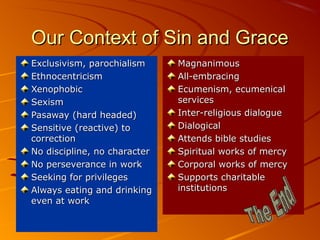
Our Context of Sin and GraceOur Context of Sin and Grace
Exclusivism, parochialismExclusivism, parochialism
EthnocentricismEthnocentricism
XenophobicXenophobic
SexismSexism
Pasaway (hard headed)Pasaway (hard headed)
Sensitive (reactive) toSensitive (reactive) to
correctioncorrection
No discipline, no characterNo discipline, no character
No perseverance in workNo perseverance in work
Seeking for privilegesSeeking for privileges
Always eating and drinkingAlways eating and drinking
even at workeven at work
MagnanimousMagnanimous
All-embracingAll-embracing
Ecumenism, ecumenicalEcumenism, ecumenical
servicesservices
Inter-religious dialogueInter-religious dialogue
DialogicalDialogical
Attends bible studiesAttends bible studies
Spiritual works of mercySpiritual works of mercy
Corporal works of mercyCorporal works of mercy
Supports charitableSupports charitable
institutionsinstitutions
Suggested SongsSuggested Songs
Go Tell EveryoneGo Tell Everyone
Ikaw Ngayon BukasIkaw Ngayon Bukas
– http://www.youtube.com/watch?v=RLXGRycu6kohttp://www.youtube.com/watch?v=RLXGRycu6ko
Kahit Isang KusingKahit Isang Kusing
– http://www.youtube.com/watch?v=xKPih205uVQhttp://www.youtube.com/watch?v=xKPih205uVQ
Dear sisters and brothers,
God wants salvation of all, not just
ours or yours. Worshiping together is
a sign of having accepted God's
design.
Fr. Cielo

21st Sunday C

  • 1.
    WWeelclcoome tme toooourur BBibliblee StStuuddyy 21st Sunday in Ordinary Time C 21 August 2016 In preparation for this Sunday’s liturgy As aid in focusing our homilies and sharing Prepared by Fr. Cielo R. Almazan, OFM
  • 2.
    11stst reading: Isaiah 66,18-21reading:Isaiah 66,18-21 18Thus says the LORD: I know their works and their thoughts, I come to gather nations of every language; they shall come and see my glory. 19 I will set a sign among them; from them I will send fugitives to the nations: to Tarshish, Put and Lud, Mosoch, Tubal and Javan, to the distant coastlands that have never heard of my fame, or seen my glory; and they shall proclaim my glory among the nations. 20 They shall bring all your brethren from all the nations as an offering to the LORD, on horses and in chariots, in carts, upon mules and dromedaries, to Jerusalem, my holy mountain, says the LORD, just as the Israelites bring their offering to the house of the LORD in clean vessels. 21 Some of these I will take as priests and Levites, says the LORD. The focus is on gathering the nations..
  • 3.
    11stst reading: Isaiah 66,18-21reading:Isaiah 66,18-21 18Thus says the LORD: I know their works and their thoughts, I come to gather nations of every language; they shall come and see my glory. 19 I will set a sign among them; from them I will send fugitives to the nations: to Tarshish, Put and Lud, Mosoch, Tubal and Javan, to the distant coastlands that have never heard of my fame, or seen my glory; and they shall proclaim my glory among the nations. 20 They shall bring all your brethren from all the nations as an offering to the LORD, on horses and in chariots, in carts, upon mules and dromedaries, to Jerusalem, my holy mountain, says the LORD, just as the Israelites bring their offering to the house of the LORD in clean vessels. 21 Some of these I will take as priests and Levites, says the LORD. Take note of the nations as object of prepositions.
  • 4.
    11stst reading: Isaiah 66,18-21reading:Isaiah 66,18-21 18Thus says the LORD: I know their works and their thoughts, I come to gather nations of every language; they shall come and see my glory. 19 I will set a sign among them; from them I will send fugitives to the nations: to Tarshish, Put and Lud, Mosoch, Tubal and Javan, to the distant coastlands that have never heard of my fame, or seen my glory; and they shall proclaim my glory among the nations. 20 They shall bring all your brethren from all the nations as an offering to the LORD, on horses and in chariots, in carts, upon mules and dromedaries, to Jerusalem, my holy mountain, says the LORD, just as the Israelites bring their offering to the house of the LORD in clean vessels. 21 Some of these I will take as priests and Levites, says the LORD. The purpose of gathering nations is to see God’s gloryglory.
  • 5.
    Textual Context ofIsaiah 66,18-21Textual Context of Isaiah 66,18-21 First Isaiah - 1-39 Second Isaiah - 40-55 Third Isaiah - 56-66
  • 6.
    11stst reading: Isaiah 66,18-21reading:Isaiah 66,18-21 18Thus says the LORD: I know their works and their thoughts, I come to gather nations of every language; they shall come and see my glory. 19 I will set a sign among them; from them I will send fugitives to the nations: to Tarshish, Put and Lud (Lydia), Mosoch, Tubal and Javan, to the distant coastlands that have never heard of my fame, or seen my glory; and they shall proclaim my glory among the nations. 20 They shall bring all your brethren from all the nations as an offering to the LORD, on horses and in chariots, in carts, upon mules and dromedaries, to Jerusalem, my holy mountain, says the LORD, just as the Israelites bring their offering to the house of the LORD in clean vessels. 21 Some of these I will take as priests and Levites, says the LORD. CommentaryCommentary The reading is about God gathering theThe reading is about God gathering the nationsnations.. TheThe nationsnations here are the non-Israelites.here are the non-Israelites. God knows their works and thoughts. V.18God knows their works and thoughts. V.18 God invites them to see his glory.God invites them to see his glory. V.19 From them, God sends fugitives toV.19 From them, God sends fugitives to thethe nationsnations (fellow(fellow nationsnations).). Mosoch, Tubal and Javan = associated sons of Japheth (Gen 10,2) The placesThe places (distant coastlands)(distant coastlands) identifiedidentified here were familiar to the Israelites, buthere were familiar to the Israelites, but they did not know God.they did not know God. The gatheredThe gathered nationsnations will proclaim God’swill proclaim God’s glory to them.glory to them. V.20 indicates the means of transportationV.20 indicates the means of transportation (dromedaries = camels) to bring the(dromedaries = camels) to bring the people to Jerusalem, following the ways ofpeople to Jerusalem, following the ways of the Israelites.the Israelites. V.21 indicates God’s prerogative: toV.21 indicates God’s prerogative: to choose priests and Levites from the non-choose priests and Levites from the non- Israelites.Israelites.
  • 7.
    Reflections on the1Reflections on the 1stst readingreading The reading proclaims the universality of salvation. Salvation is not limited to the Israelite people. The nations (non-Israelites) are called by God to see his glory. They, too, will have a mission. Beware of those who claim that they are the only ones who are saved. Beware of those who claim that they are the only ones sent.
  • 8.
    Resp. Ps 117,1.2Resp. Ps 117, 1.2 R. (Mk 16:15)R. (Mk 16:15) Go out to all the world and tellGo out to all the world and tell the Good News.the Good News. 1 Praise the LORD all you nations;1 Praise the LORD all you nations; glorify him, all you peoples!glorify him, all you peoples! 2 For steadfast is his kindness toward us, and the2 For steadfast is his kindness toward us, and the fidelity of the LORD endures forever.fidelity of the LORD endures forever.
  • 9.
    Resp. Ps 117,1.2Resp. Ps 117, 1.2 R. (Mk 16:15)R. (Mk 16:15) Go out to all the world and tell the GoodGo out to all the world and tell the Good News.News. 1 Praise the LORD all you nations;1 Praise the LORD all you nations; glorify him, all you peoples!glorify him, all you peoples! 2 For steadfast is his kindness toward us, and the fidelity of2 For steadfast is his kindness toward us, and the fidelity of the LORD endures forever.the LORD endures forever. The short responsorial psalm calls for all the nations to praise God. V.1 commands all nations (races, peoples) to praise and glorify God. V.2 tells us the reasons why: – His kindness is forever – His fidelity has no end.
  • 10.
    Reflections on thePsalm It is not enough to praise God as individuals. God wants us to be in communion with other people in praising God. Individualism is not allowed in an organized religion. When nations worship the same God together and always, wars stop. When we praise God, we acknowledge his kindness and fidelity.
  • 11.
    22ndnd reading: Hebrews 12,5-7.11-13reading:Hebrews 12,5-7.11-13 5 You have also forgotten the exhortation addressed to you as sons: "My son, do not disdain the disciplinediscipline of the Lord or lose heart when reprovedreproved by him; 6 for whom the Lord loves, he disciplinesdisciplines; he scourgesscourges every son he acknowledges." 7 Endure your trials as "disciplinediscipline"; God treatstreats you as sons. For what "son" is there whom his father does not disciplinediscipline? 11 At the time, all disciplinediscipline seems a cause not for joy but for pain, yet later it brings the peaceful fruit of righteousness to those who are trainedtrained by it. 12 So strengthen your drooping hands and your weak knees. 13 Make straight paths for your feet, that what is lame may not be disjointed but healed. The focus is on disciplinediscipline.
  • 12.
    Textual Context ofHeb 12,5-7.11-13Textual Context of Heb 12,5-7.11-13 I. 1:5--2:18 The name superior to the angels (Eschatology) II. 3: 1--5:10 Jesus faithful and compassionate (Ecclesiology) III. 5: 11--10:39 The central exposition (Sacrifice) IV. 11:1--12:13 Faith and endurance (Ecclesiological paraenesis) V. 12:14--13:19 The peaceful fruit of justice (Eschatology).
  • 13.
    22ndnd reading: Hebrews 12,5-7.11-13reading:Hebrews 12,5-7.11-13 5 You have also forgotten the exhortation addressed to you as sons: "My son, do not disdain the disciplinediscipline of the Lord or lose heart when reprovedreproved by him; 6 for whom the Lord loves, he disciplinesdisciplines; he scourgesscourges every son he acknowledges." 7 Endure your trials as "disciplinediscipline"; God treatstreats you as sons. For what "son" is there whom his father does not disciplinediscipline? 11 At the time, all disciplinediscipline seems a cause not for joy but for pain, yet later it brings the peaceful fruit of righteousness to those who are trainedtrained by it. 12 So strengthen your drooping hands and your weak knees. 13 Make straight paths for your feet, that what is lame may not be disjoined but healed. Commentary The reading is full of exhortations. The exhortations are: Do not disdain… v.5 Do not lose heart… v.5 Endure your trials… v.7 Strengthen your droopings v.12 Make straight your paths v.13 The main point of the exhortations is to accept disciplinediscipline from the Lord. The reasons for disciplinediscipline: •Because the Lord loves / acknowledges you… v.6 •Because God treats you as sons v.7 •Because by its nature, discipline brings peace…v.11
  • 14.
    Reflections on the2Reflections on the 2ndnd readingreading Don’t get God wrong when heDon’t get God wrong when he disciplinesdisciplines // reproves / scourges / rebukes / chastises / scoldsreproves / scourges / rebukes / chastises / scolds you. You feel you are being punished.you. You feel you are being punished. God is a good parent. He does not allow any of hisGod is a good parent. He does not allow any of his children to be mediocre in spirit. He does not wantchildren to be mediocre in spirit. He does not want them to become worse. That’s why, he scourgesthem to become worse. That’s why, he scourges them.them. If you are willing to beIf you are willing to be chastisedchastised (or to learn from God),(or to learn from God), you will have a better future.you will have a better future. If you are very sensitive toIf you are very sensitive to rebukerebuke, if you are, if you are always reacting to fraternal correction, you have noalways reacting to fraternal correction, you have no place in the family of God, in the church.place in the family of God, in the church.
  • 15.
    Gospel reading: Luke13,22-30Gospel reading: Luke 13,22-30 22 Jesus passed through towns and villages, teaching as he went and making his way to Jerusalem. 23 Someone asked him, "Lord, will only a few people be savedsaved?" He answered them, 24 "Strive to enter through the narrow gate, for many, I tell you, will attempt to enter but will not be strong enough. 25 After the master of the house has arisen and locked the door, then will you stand outside knocking and saying, 'Lord, open the door for us.' He will say to you in reply, 'I do not know where you are from.' 26 And you will say, 'We ate and drank in your company and you taught in our streets.' 27 Then he will say to you, 'I do not know where (you) are from. Depart from me, all you evildoers!' 28 And there will be wailing and grinding of teeth when you see Abraham, Isaac, and Jacob and all the prophets in the kingdom of God and you yourselves cast out. 29 And people will come from the east and the west and from the north and the south and will recline at table in the kingdom of God. 30 For behold, some are last who will be first, and some are first who will be last." The focus is on salvation salvation.
  • 16.
    Gospel reading: Luke13,22-30Gospel reading: Luke 13,22-30 Setting in a journey to Jerusalem 22 Jesus passed through towns and villages, teaching as he went and making his way to Jerusalem. Question and answer (imperative) 23 Someone asked him, "Lord, will only a few people be savedsaved?" He answered them, 24 "Strive to enter through the narrow gate, for many, I tell you, will attempt to enter but will not be strong enough. The Parable 25 After the master of the house has arisen and locked the door, then will you stand outside knocking and saying, 'Lord, open the door for us.' He will say to you in reply, 'I do not know where you are from.' 26 And you will say, 'We ate and drank in your company and you taught in our streets.' A simple outline
  • 17.
    The reason forthe rejection 27 Then he will say to you, 'I do not know where (you) are from. Depart from me, all you evildoers!' The Punishment 28 And there will be wailing and grinding of teeth when you see Abraham, Isaac, and Jacob and all the prophets in the kingdom of God and you yourselves cast out. The reward of the righteous 29 And people will come from the east and the west and from the north and the south and will recline at table in the kingdom of God. The saying 30 For behold, some are last who will be first, and some are first who will be last."
  • 18.
    Textual Context ofLuke 13,22-30Luke 13,22-30 Luke 13,6-9 Parable of the Barren Fig Tree Luke 13,10-19 Jesus Heals a Crippled Woman Luke 13,20-21 Parable of the Yeast Luke 13,22-30 The Narrow Door Luke 13,31-35 Lament Over Jerusalem Luke 14,1-6 Jesus Heals the Man with Dropsy Luke 14,7-14 Humility and Hospitality Luke 14,15-24 Parable of the Great Dinner Luke 14,25 Cost of Discipleship
  • 19.
    Gospel reading: Luke13,22-30Gospel reading: Luke 13,22-30Setting in a journey to Jerusalem 22 Jesus passed through towns and villages, teaching as he went and making his way to Jerusalem. Question and answer (imperative) 23 Someone asked him, "Lord, will only a few people be savedsaved?" He answered them, 24 "Strive to enter through the narrow gate, for many, I tell you, will attempt to enter but will not be strong enough. The Parable 25 After the master of the house has arisen and locked the door, then will you stand outside knocking and saying, 'Lord, open the door for us.' He will say to you in reply, 'I do not know where you are from.' 26 And you will say, 'We ate and drank in your company and you taught in our streets.' Commentary Our reading belongs to the long journey narrative of Luke. Jesus is going to Jerusalem after his ministry in Galilee. On the way, he meets a lot of people with different concerns. In v.23, someone asks if a few people will be saved. In v.24, Jesus does not directly entertain the question. He is more concerned with the man who questions him. “Strive to enter through the narrow gate… You better be one of the few if it is the case. Be strong.” It is not that easy to be saved. The parable follows up the importance of entering the door that the Lord opens. Jesus does not open the door to evildoers. Evildoers are the ones who eat and drink with Jesus and are seemingly taught by him, but do not learn how to do good.
  • 20.
    The reason forthe rejection 27 Then he will say to you, 'I do not know where (you) are from. Depart from me, all you evildoers!' The Punishment 28 And there will be wailing and grinding of teeth when you see Abraham, Isaac, and Jacob and all the prophets in the kingdom of God and you yourselves cast out. The reward of the righteous 29 And people will come from the east and the west and from the north and the south and will recline at table in the kingdom of God. The saying 30 For behold, some are last who will be first, and some are first who will be last." In v.27, Jesus does not entertain evildoers. They are unfit for the kingdom of God. They have not been serious with his teachings. In our catechism and homilies, we seldom hear of punishment being mentioned. Here, the punishment for evildoers is wailing and grinding of teeth. Sometimes it is needed in order to warn people to shape up. The evildoers will feel jealous of Abraham, Isaac, Jacob and all the prophets entering the door, while they, the evildoers are rejected. V.28 The righteous, from all corners of the world, will sit at the banquet table in the kingdom of God. Great is the reward of the doers of good and God’s will. v.29 The saying in v.30 affirms the salvation of those who are serious in listening and doing the will of God, even if they realize quite late. Hopeless are the persons who claim they have been associating with Jesus but, in fact, producing no good fruit. Salvation is not barkadahan.
  • 21.
    Reflections on thegospel readingReflections on the gospel reading The Christian must make sure he enters theThe Christian must make sure he enters the narrow gatenarrow gate (=doing good works).(=doing good works). When you eat and drink with Christ, it does notWhen you eat and drink with Christ, it does not mean you are saved.mean you are saved. (always going to church and(always going to church and receiving communion, “partying with the Lord”)receiving communion, “partying with the Lord”) Associating with Christ must bear good fruitsAssociating with Christ must bear good fruits (justice and charity).(justice and charity). You cannot enter the kingdom of God if you doYou cannot enter the kingdom of God if you do not take seriously the word of God, if you spendnot take seriously the word of God, if you spend more time gossiping, idling time away,more time gossiping, idling time away, grandstanding and partying.grandstanding and partying.
  • 22.
    Tying the 3readings and the PsalmTying the 3 readings and the Psalm TheThe first readingfirst reading is about the nationsis about the nations seeing God’s gloryseeing God’s glory (=(=salvationsalvation).). TheThe psalmpsalm exhorts all peoples to praiseexhorts all peoples to praise God.God. (=sign of being(=sign of being savedsaved)) TheThe second readingsecond reading is about disciplineis about discipline (=to(=to bebe savedsaved).). TheThe gospel readinggospel reading talks about how to betalks about how to be savedsaved.. (=through good works)(=through good works)
  • 23.
    How to developyour sharing /How to develop your sharing / homilyhomily Begin by talking about the meaning ofBegin by talking about the meaning of salvationsalvation for you.for you. – SalvationSalvation may be work, money, goodmay be work, money, good relationships, security, freedom, etc.relationships, security, freedom, etc. Salvation for God is our well-being,Salvation for God is our well-being, liberation, assurance that we will be withliberation, assurance that we will be with him in heaven.him in heaven. How do we attainHow do we attain salvationsalvation?? – Let us get the meaning of salvation throughLet us get the meaning of salvation through the readings.the readings.
  • 24.
    In the firstreadingIn the first reading,, we must realize thatwe must realize that salvationsalvation is for everyone.is for everyone. There is no exclusivism inThere is no exclusivism in salvationsalvation.. We, all peoples, are invited to see the glory ofWe, all peoples, are invited to see the glory of God.God. All we need to do is to respond and to be withAll we need to do is to respond and to be with others.others. We respond to God’s call when we are praisingWe respond to God’s call when we are praising and worshipping God side by side with ourand worshipping God side by side with our brothers and sisters.brothers and sisters. SalvationSalvation is still far from those who areis still far from those who are individualistic, not communitarian.individualistic, not communitarian.
  • 25.
    In the secondreadingIn the second reading,, we attainwe attain salvationsalvation byby subjecting ourselves to chastisements.subjecting ourselves to chastisements. We willingly submit ourselves to God’s discipline.We willingly submit ourselves to God’s discipline. We should not be reacting if we are corrected.We should not be reacting if we are corrected. God may be using our lola, friend or the priest toGod may be using our lola, friend or the priest to point out our mistakes.point out our mistakes. If we reject corrections and punishments, we areIf we reject corrections and punishments, we are still far fromstill far from salvationsalvation..
  • 26.
    TheThe gospel readinggospelreading asks each Christian to enterasks each Christian to enter the narrow path.the narrow path. The way toThe way to salvationsalvation is not cheap. The narrowis not cheap. The narrow path is doingpath is doing good deedsgood deeds.. Can you mention theCan you mention the good deedsgood deeds you are doing?you are doing? – Helping the poor, visiting the sick and imprisoned,Helping the poor, visiting the sick and imprisoned, teaching catechism to children, works of mercy, etc.teaching catechism to children, works of mercy, etc. If you cannot think of any good deed, you mustIf you cannot think of any good deed, you must be an evildoer. You will be like one of those whobe an evildoer. You will be like one of those who knock but will be refused entranceknock but will be refused entrance The Christian must never fail toThe Christian must never fail to do gooddo good.. No one should get tired of doing good and givingNo one should get tired of doing good and giving good examples.good examples.
  • 27.
    Blessed are ourcommunities and parishes, whenBlessed are our communities and parishes, when our leaders and members spend time thinking,our leaders and members spend time thinking, planning and implementing programs for theplanning and implementing programs for the good of the Church and society.good of the Church and society. Are you involved in social work and teaching theAre you involved in social work and teaching the faith?faith? Unhappy is our Church, when the leaders andUnhappy is our Church, when the leaders and members spend more time bickering, strugglingmembers spend more time bickering, struggling for power, or, just sitting down remembering thefor power, or, just sitting down remembering the good ol’ days.good ol’ days. This Church needs fresh blood.This Church needs fresh blood.
  • 28.
    In theIn theeucharist,eucharist, we acknowledge thatwe acknowledge that Jesus is the source of our salvation.Jesus is the source of our salvation. TheThe eucharisteucharist is the sacrament of unity.is the sacrament of unity. TheThe eucharisteucharist is the narrow path tois the narrow path to heaven, for not just anyone can receive it,heaven, for not just anyone can receive it, but only the doers of good.but only the doers of good. No evil doer is allowed to receive theNo evil doer is allowed to receive the eucharisteucharist. It is a contradiction in terms.. It is a contradiction in terms.
  • 29.
    Our Context ofSin and GraceOur Context of Sin and Grace Exclusivism, parochialismExclusivism, parochialism EthnocentricismEthnocentricism XenophobicXenophobic SexismSexism Pasaway (hard headed)Pasaway (hard headed) Sensitive (reactive) toSensitive (reactive) to correctioncorrection No discipline, no characterNo discipline, no character No perseverance in workNo perseverance in work Seeking for privilegesSeeking for privileges Always eating and drinkingAlways eating and drinking even at workeven at work MagnanimousMagnanimous All-embracingAll-embracing Ecumenism, ecumenicalEcumenism, ecumenical servicesservices Inter-religious dialogueInter-religious dialogue DialogicalDialogical Attends bible studiesAttends bible studies Spiritual works of mercySpiritual works of mercy Corporal works of mercyCorporal works of mercy Supports charitableSupports charitable institutionsinstitutions
  • 30.
    Suggested SongsSuggested Songs GoTell EveryoneGo Tell Everyone Ikaw Ngayon BukasIkaw Ngayon Bukas – http://www.youtube.com/watch?v=RLXGRycu6kohttp://www.youtube.com/watch?v=RLXGRycu6ko Kahit Isang KusingKahit Isang Kusing – http://www.youtube.com/watch?v=xKPih205uVQhttp://www.youtube.com/watch?v=xKPih205uVQ
  • 31.
    Dear sisters andbrothers, God wants salvation of all, not just ours or yours. Worshiping together is a sign of having accepted God's design. Fr. Cielo