Welcome to our Bible
Study
25 May 201425 May 2014
66thth
Sunday of Easter ASunday of Easter A
In preparation for this Sunday’s LiturgyIn preparation for this Sunday’s Liturgy
In aid of focusing our homilies and sharingIn aid of focusing our homilies and sharing
Prepared by Fr. Cielo R. Almazan, OFM
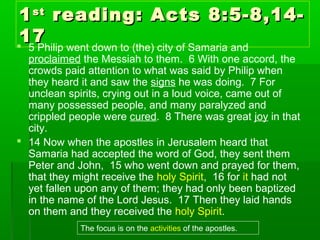
11stst
reading: Acts 8:5-8,14-reading: Acts 8:5-8,14-
1717 5 Philip went down to (the) city of Samaria and
proclaimed the Messiah to them. 6 With one accord, the
crowds paid attention to what was said by Philip when
they heard it and saw the signs he was doing. 7 For
unclean spirits, crying out in a loud voice, came out of
many possessed people, and many paralyzed and
crippled people were cured. 8 There was great joy in that
city.
 14 Now when the apostles in Jerusalem heard that
Samaria had accepted the word of God, they sent them
Peter and John, 15 who went down and prayed for them,
that they might receive the holy Spirit, 16 for it had not
yet fallen upon any of them; they had only been baptized
in the name of the Lord Jesus. 17 Then they laid hands
on them and they received the holy Spirit.
The focus is on the activities of the apostles.
11stst
reading: Acts 8:5-8,14-reading: Acts 8:5-8,14-
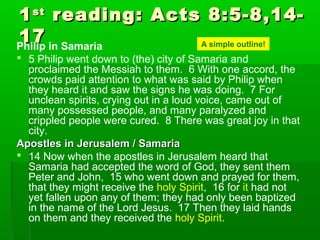
1717Philip in Samaria
 5 Philip went down to (the) city of Samaria and
proclaimed the Messiah to them. 6 With one accord, the
crowds paid attention to what was said by Philip when
they heard it and saw the signs he was doing. 7 For
unclean spirits, crying out in a loud voice, came out of
many possessed people, and many paralyzed and
crippled people were cured. 8 There was great joy in that
city.
Apostles in Jerusalem / SamariaApostles in Jerusalem / Samaria
 14 Now when the apostles in Jerusalem heard that
Samaria had accepted the word of God, they sent them
Peter and John, 15 who went down and prayed for them,
that they might receive the holy Spirit, 16 for it had not
yet fallen upon any of them; they had only been baptized
in the name of the Lord Jesus. 17 Then they laid hands
on them and they received the holy Spirit.
A simple outline!
11stst
reading: Acts 8:5-8,14-reading: Acts 8:5-8,14-
1717
Philip in Samaria
 5 Philip went down to (the)
city of Samaria and
proclaimed the Messiah to
them. 6 With one accord,
the crowds paid attention
to what was said by Philip
when they heard it and
saw the signs he was
doing. 7 For unclean
spirits, crying out in a loud
voice, came out of many
possessed people, and
many paralyzed and
crippled people were
cured. 8 There was great
joy in that city.
Commentary:Commentary:
 Philip is one of the 7 deacons,Philip is one of the 7 deacons,
supposedly to take charge of thesupposedly to take charge of the
Hellenist widows.Hellenist widows.
 But here in v.5, he also preaches inBut here in v.5, he also preaches in
Samaria.Samaria.
 Previously, he was with the EthiopianPreviously, he was with the Ethiopian
eunuch.eunuch.
 V.6 portrays Philip as powerful inV.6 portrays Philip as powerful in
words and deeds.words and deeds.
 V.7 explicitates his deeds:V.7 explicitates his deeds:
 Exorcisms, healingsExorcisms, healings
 V.8 describes the feeling of theV.8 describes the feeling of the
Samaritans over Philip’sSamaritans over Philip’s
accomplishments.accomplishments.
 Great joyGreat joy
Apostles in Jerusalem
 14 Now when the
apostles in Jerusalem
heard that Samaria had
accepted the word of
God, they sent them
Peter and John, 15 who
went down and prayed
for them, that they might
receive the holy Spirit,
16 for it had not yet
fallen upon any of them;
they had only been
baptized in the name of
the Lord Jesus. 17 Then
they laid hands on them
and they received the
holy Spirit.
 In v.14, the apostles welcomeIn v.14, the apostles welcome
the news that the gospel isthe news that the gospel is
accepted in Samaria.accepted in Samaria.
 Jesus was not accepted whenJesus was not accepted when
he passed by there.he passed by there. (Lk 9,51ff)(Lk 9,51ff)
 They send Peter and John toThey send Peter and John to
pray for them that they maypray for them that they may
receive the Holy Spirit. V.15receive the Holy Spirit. V.15
 V.16 indicates the baptism ofV.16 indicates the baptism of
the Samaritans (by Philip), justthe Samaritans (by Philip), just
like what he had done to thelike what he had done to the
Ethiopian eunuch.Ethiopian eunuch.
 In v.17, the 2 apostles lay theirIn v.17, the 2 apostles lay their
hands on the baptizedhands on the baptized
Samaritans and the Holy SpiritSamaritans and the Holy Spirit
descends on them.descends on them.
Reflections on the 1Reflections on the 1stst
readingreading
 To be an apostle, or, a church worker, one mustTo be an apostle, or, a church worker, one must
busy himself/herself with God’s work.busy himself/herself with God’s work.
 God’s work is none other than proclaiming theGod’s work is none other than proclaiming the
good news, exorcism and curing the sick.good news, exorcism and curing the sick.
 We must serve and strengthen our fellowWe must serve and strengthen our fellow
believers.believers.
 We pave the way for the Holy Spirit to work inWe pave the way for the Holy Spirit to work in
them.them.
 What are you doing in your life? Wasting timeWhat are you doing in your life? Wasting time
and energy? No mission?and energy? No mission?
Resp. Ps 66:1-3, 4-5, 6-7, 16, 20
 R. (1) Let all the earth cry out to God with joy.
 1 Shout joyfully to God, all the earth,
2 sing praise to the glory of his name;
proclaim his glorious praise.
3 Say to God, “How tremendous are your deeds!”
 4 “Let all on earth worship and sing praise to you,
sing praise to your name!”
5 Come and see the works of God,
his tremendous deeds among the children of Adam.
 6 He has changed the sea into dry land;
through the river they passed on foot;
7 therefore let us rejoice in him.
He rules by his might forever.
16 Hear now, all you who fear God, while I declare
what he has done for me.
20 Blessed be God who refused me not
my prayer or his kindness!
Resp. Ps 66:1-3, 4-5, 6-7, 16, 20
 R. (1)R. (1) Let all the earth cry out to GodLet all the earth cry out to God
with joy.with joy.
 1 Shout joyfully to God, all the earth,1 Shout joyfully to God, all the earth,
2 Sing praise to the glory of his name;2 Sing praise to the glory of his name;
proclaim his glorious praise.proclaim his glorious praise.
3 Say to God, “How tremendous are your3 Say to God, “How tremendous are your
deeds!”deeds!”
 4 “Let all on earth worship and sing4 “Let all on earth worship and sing
praise to you,praise to you,
sing praise to your name!”sing praise to your name!”
5 Come and see the works of God,5 Come and see the works of God,
his tremendous deeds among thehis tremendous deeds among the
children of Adam.children of Adam.
 6 He has changed the sea into dry land;6 He has changed the sea into dry land;
through the river they passed on foot;through the river they passed on foot;
7 therefore let us rejoice in him.7 therefore let us rejoice in him.
He rules by his might forever.He rules by his might forever.
16 Hear now, all you who fear God, while16 Hear now, all you who fear God, while
I declare what he has done for me.I declare what he has done for me.
20 Blessed be God who refused me not20 Blessed be God who refused me not
my prayer or his kindness!my prayer or his kindness!
CommentaryCommentary
 Vv.1-3 invite us worshippers toVv.1-3 invite us worshippers to
express our joy and appreciation toexpress our joy and appreciation to
the Lord.the Lord.
 In v.4, the psalmist talks to God toIn v.4, the psalmist talks to God to
allow people to worship and praiseallow people to worship and praise
him.him.
 V.5 invites people to witness God’sV.5 invites people to witness God’s
impressive deeds.impressive deeds.
 V.6 remembers the dividing of theV.6 remembers the dividing of the
Red Sea (Sea of Reeds) in theRed Sea (Sea of Reeds) in the
Exodus.Exodus.
 V.7 invites people to rejoice becauseV.7 invites people to rejoice because
of his might.of his might.
 In v.16, the psalmist asks theIn v.16, the psalmist asks the
attention of God-fearing people, toattention of God-fearing people, to
listen to him as he recounts hislisten to him as he recounts his
experience of God’s powerful deeds.experience of God’s powerful deeds.
 V.20 says benediction (blessings) toV.20 says benediction (blessings) to
God for listening always to hisGod for listening always to his
prayers.prayers.
Reflections on theReflections on the
PsalmPsalm
 As God’s people, we must always praiseAs God’s people, we must always praise
God for his wonderful deeds.God for his wonderful deeds.
 We must remember the powerful deedsWe must remember the powerful deeds
he has done for his people and for us.he has done for his people and for us.
 We cannot show our appreciation to GodWe cannot show our appreciation to God
if we do not remember anything aboutif we do not remember anything about
him.him.
 We should sharpen our memories andWe should sharpen our memories and
attribute all good things to him.attribute all good things to him.
22ndnd
reading: 1 Peter 3:15-reading: 1 Peter 3:15-
1818
 15 Sanctify Christ as Lord in your hearts. Always
be ready to give an explanation to anyone who
asks you for a reason for your hope, 16 but do it
with gentleness and reverence, keeping your
conscience clear, so that, when you are
maligned, those who defame your good conduct
in Christ may themselves be put to shame. 17
For it is better to suffer for doing good, if that be
the will of God, than for doing evil. 18 For Christ
also suffered for sins once, the righteous for the
sake of the unrighteous, that he might lead you to
God. Put to death in the flesh, he was brought to
life in the spirit.
22ndnd
reading: 1 Peter 3:15-reading: 1 Peter 3:15-
1818
 15 Sanctify Christ as Lord in your hearts. Always
be ready to give an explanation to anyone who
asks you for a reason for your hope, 16 but do it
with gentleness and reverence, keeping your
conscience clear, so that, when you are
maligned, those who defame your good conduct
in Christ may themselves be put to shame. 17
For it is better to suffer for doing good, if that be
the will of God, than for doing evil. 18 For Christ
also suffered for sins once, the righteous for the
sake of the unrighteous, that he might lead you to
God. Put to death in the flesh, he was brought to
life in the spirit.
The focus is on the good Christian behavior.
22ndnd
reading: 1 Peter 3:15-reading: 1 Peter 3:15-
1818
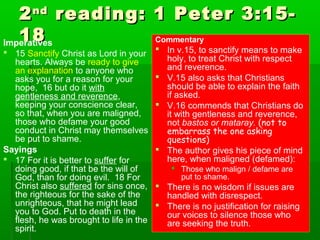
Imperatives
 15 Sanctify Christ as Lord in your hearts. Always be ready
to give an explanation to anyone who asks you for a
reason for your hope, 16 but do it with gentleness and
reverence, keeping your conscience clear, so that, when
you are maligned, those who defame your good conduct
in Christ may themselves be put to shame.
Sayings
 17 For it is better to suffer for doing good, if that be the
will of God, than for doing evil. 18 For Christ also suffered
for sins once, the righteous for the sake of the
unrighteous, that he might lead you to God. Put to death
in the flesh, he was brought to life in the spirit.
A simple outline!
22ndnd
reading: 1 Peter 3:15-reading: 1 Peter 3:15-
1818Imperatives
 15 Sanctify Christ as Lord in your
hearts. Always be ready to give
an explanation to anyone who
asks you for a reason for your
hope, 16 but do it with
gentleness and reverence,
keeping your conscience clear,
so that, when you are maligned,
those who defame your good
conduct in Christ may themselves
be put to shame.
Sayings
 17 For it is better to suffer for
doing good, if that be the will of
God, than for doing evil. 18 For
Christ also suffered for sins once,
the righteous for the sake of the
unrighteous, that he might lead
you to God. Put to death in the
flesh, he was brought to life in the
spirit.
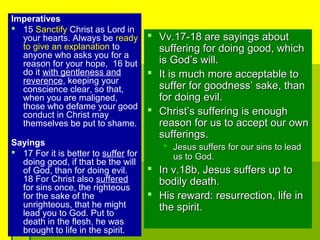
Commentary
 In v.15, to sanctify means to make
holy, to treat Christ with respect
and reverence.
 V.15 also asks that Christians
should be able to explain the faith
if asked.
 V.16 commends that Christians do
it with gentleness and reverence,
not bastos or mataray. (not to
embarrass the one asking
questions)
 The author gives his piece of mind
here, when maligned (defamed):
 Those who malign / defame are
put to shame.
 There is no wisdom if issues are
handled with disrespect.
 There is no justification for raising
our voices to silence those who
are seeking the truth.
Imperatives
 15 Sanctify Christ as Lord in
your hearts. Always be ready
to give an explanation to
anyone who asks you for a
reason for your hope, 16 but
do it with gentleness and
reverence, keeping your
conscience clear, so that,
when you are maligned,
those who defame your good
conduct in Christ may
themselves be put to shame.
Sayings
 17 For it is better to suffer for
doing good, if that be the will
of God, than for doing evil.
18 For Christ also suffered
for sins once, the righteous
for the sake of the
unrighteous, that he might
lead you to God. Put to
death in the flesh, he was
brought to life in the spirit.
 Vv.17-18 are sayings aboutVv.17-18 are sayings about
suffering for doing good, whichsuffering for doing good, which
is God’s will.is God’s will.
 It is much more acceptable toIt is much more acceptable to
suffer for goodness’ sake, thansuffer for goodness’ sake, than
for doing evil.for doing evil.
 Christ’s suffering is enoughChrist’s suffering is enough
reason for us to accept our ownreason for us to accept our own
sufferings.sufferings.
 Jesus suffers for our sins to leadJesus suffers for our sins to lead
us to God.us to God.
 In v.18b, Jesus suffers up toIn v.18b, Jesus suffers up to
bodily death.bodily death.
 His reward: resurrection, life inHis reward: resurrection, life in
the spirit.the spirit.
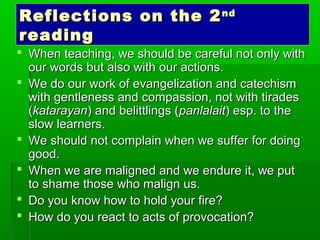
Reflections on the 2Reflections on the 2ndnd
readingreading
 When teaching, we should be careful not only withWhen teaching, we should be careful not only with
our words but also with our actions.our words but also with our actions.
 We do our work of evangelization and catechismWe do our work of evangelization and catechism
with gentleness and compassion, not with tiradeswith gentleness and compassion, not with tirades
((katarayankatarayan) and belittlings () and belittlings (panlalaitpanlalait) esp. to the) esp. to the
slow learners.slow learners.
 We should not complain when we suffer for doingWe should not complain when we suffer for doing
good.good.
 When we are maligned and we endure it, we putWhen we are maligned and we endure it, we put
to shame those who malign us.to shame those who malign us.
 Do you know how to hold your fire?Do you know how to hold your fire?
 How do you react to acts of provocation?How do you react to acts of provocation?
Gospel reading: John 14:15-Gospel reading: John 14:15-
2121
 15 Jesus said to his disciples, "If you love me, you will keep
my commandments. 16 And I will ask the Father, and he
will give you another Advocate to be with you always, 17
the Spirit of truth, which the world cannot accept, because it
neither sees nor knows it. But you know it, because it
remains with you, and will be in you. 18 I will not leave you
orphans; I will come to you. 19 In a little while the world will
no longer see me, but you will see me, because I live and
you will live. 20 On that day you will realize that I am in my
Father and you are in me and I in you. 21 Whoever has my
commandments and observes them is the one who loves
me. And whoever loves me will be loved by my Father, and
I will love him and reveal myself to him."
Gospel reading: John 14:15-Gospel reading: John 14:15-
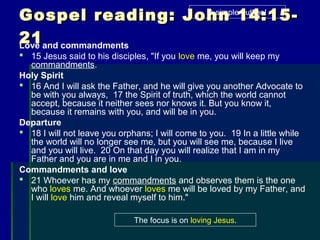
2121Love and commandments
 15 Jesus said to his disciples, "If you love me, you will keep my
commandments.
Holy Spirit
 16 And I will ask the Father, and he will give you another Advocate to
be with you always, 17 the Spirit of truth, which the world cannot
accept, because it neither sees nor knows it. But you know it,
because it remains with you, and will be in you.
Departure
 18 I will not leave you orphans; I will come to you. 19 In a little while
the world will no longer see me, but you will see me, because I live
and you will live. 20 On that day you will realize that I am in my
Father and you are in me and I in you.
Commandments and love
 21 Whoever has my commandments and observes them is the one
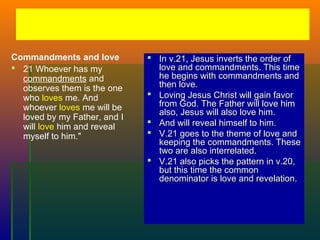
who loves me. And whoever loves me will be loved by my Father, and
I will love him and reveal myself to him."
A simple outline!
The focus is on loving Jesus.
Gospel reading: John 14:15-Gospel reading: John 14:15-
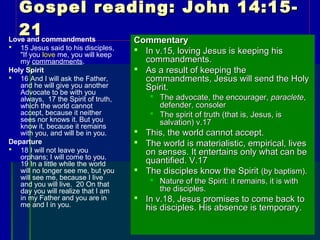
2121Love and commandments
 15 Jesus said to his disciples,
"If you love me, you will keep
my commandments.
Holy Spirit
 16 And I will ask the Father,
and he will give you another
Advocate to be with you
always, 17 the Spirit of truth,
which the world cannot
accept, because it neither
sees nor knows it. But you
know it, because it remains
with you, and will be in you.
Departure
 18 I will not leave you
orphans; I will come to you.
19 In a little while the world
will no longer see me, but you
will see me, because I live
and you will live. 20 On that
day you will realize that I am
in my Father and you are in
me and I in you.
CommentaryCommentary
 In v.15, loving Jesus is keeping hisIn v.15, loving Jesus is keeping his
commandments.commandments.
 As a result of keeping theAs a result of keeping the
commandments, Jesus will send the Holycommandments, Jesus will send the Holy
Spirit.Spirit.
 The advocate, the encourager,The advocate, the encourager, paracleteparaclete,,
defender, consolerdefender, consoler
 The spirit of truth (that is, Jesus, isThe spirit of truth (that is, Jesus, is
salvation) v.17salvation) v.17
 This, the world cannot accept.This, the world cannot accept.
 The world is materialistic, empirical, livesThe world is materialistic, empirical, lives
on senses. It entertains only what can beon senses. It entertains only what can be
quantified. V.17quantified. V.17
 The disciples know the SpiritThe disciples know the Spirit (by baptism).(by baptism).
 Nature of the Spirit: it remains, it is withNature of the Spirit: it remains, it is with
the disciples.the disciples.
 In v.18, Jesus promises to come back toIn v.18, Jesus promises to come back to
his disciples. His absence is temporary.his disciples. His absence is temporary.
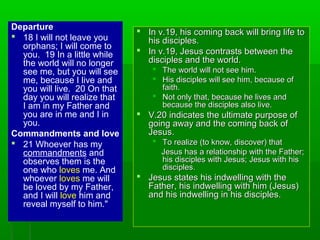
Departure
 18 I will not leave you
orphans; I will come to
you. 19 In a little while
the world will no longer
see me, but you will see
me, because I live and
you will live. 20 On that
day you will realize that
I am in my Father and
you are in me and I in
you.
Commandments and love
 21 Whoever has my
commandments and
observes them is the
one who loves me. And
whoever loves me will
be loved by my Father,
and I will love him and
reveal myself to him."
 In v.19, his coming back will bring life toIn v.19, his coming back will bring life to
his disciples.his disciples.
 In v.19, Jesus contrasts between theIn v.19, Jesus contrasts between the
disciples and the world.disciples and the world.
 The world will not see him.The world will not see him.
 His disciples will see him, because ofHis disciples will see him, because of
faith.faith.
 Not only that, because he lives andNot only that, because he lives and
because the disciples also live.because the disciples also live.
 V.20 indicates the ultimate purpose ofV.20 indicates the ultimate purpose of
going away and the coming back ofgoing away and the coming back of
Jesus.Jesus.
 To realize (to know, discover) thatTo realize (to know, discover) that
Jesus has a relationship with the Father;Jesus has a relationship with the Father;
his disciples with Jesus; Jesus with hishis disciples with Jesus; Jesus with his
disciples.disciples.
 Jesus states his indwelling with theJesus states his indwelling with the
Father, his indwelling with him (Jesus)Father, his indwelling with him (Jesus)
and his indwelling in his disciples.and his indwelling in his disciples.
Commandments and love
 21 Whoever has my
commandments and
observes them is the one
who loves me. And
whoever loves me will be
loved by my Father, and I
will love him and reveal
myself to him."
 In v.21, Jesus inverts the order ofIn v.21, Jesus inverts the order of
love and commandments. This timelove and commandments. This time
he begins with commandments andhe begins with commandments and
then love.then love.
 Loving Jesus Christ will gain favorLoving Jesus Christ will gain favor
from God. The Father will love himfrom God. The Father will love him
also, Jesus will also love him.also, Jesus will also love him.
 And will reveal himself to him.And will reveal himself to him.
 V.21 goes to the theme of love andV.21 goes to the theme of love and
keeping the commandments. Thesekeeping the commandments. These
two are also interrelated.two are also interrelated.
 V.21 also picks the pattern in v.20,V.21 also picks the pattern in v.20,
but this time the commonbut this time the common
denominator is love and revelation.denominator is love and revelation.
Love and commandments
 15 Jesus said to his disciples, "If you
love me, you will keep my
commandments.
Holy Spirit
 16 And I will ask the Father, and he
will give you another Advocate to be
with you always, 17 the Spirit of truth,
which the world cannot accept,
because it neither sees nor knows it.
But you know it, because it remains
with you, and will be in you.
Departure
 18 I will not leave you orphans; I will
come to you. 19 In a little while the
world will no longer see me, but you
will see me, because I live and you
will live. 20 On that day you will
realize that I am in my Father and
you are in me and I in you.
Commandments and love
 21 Whoever has my commandments
and observes them is the one who
loves me. And whoever loves me
will be loved by my Father, and I
will love him and reveal myself to
him."
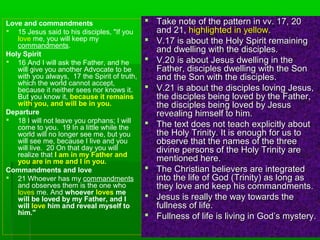
 Take note of the pattern in vv. 17, 20Take note of the pattern in vv. 17, 20
and 21,and 21, highlightedhighlighted in yellow.in yellow.
 V.17 is about the Holy Spirit remainingV.17 is about the Holy Spirit remaining
and dwelling with the disciples.and dwelling with the disciples.
 V.20 is about Jesus dwelling in theV.20 is about Jesus dwelling in the
Father, disciples dwelling with the SonFather, disciples dwelling with the Son
and the Son with the disciples.and the Son with the disciples.
 V.21 is about the disciples loving Jesus,V.21 is about the disciples loving Jesus,
the disciples being loved by the Father,the disciples being loved by the Father,
the disciples being loved by Jesusthe disciples being loved by Jesus
revealing himself to him.revealing himself to him.
 The text does not teach explicitly aboutThe text does not teach explicitly about
the Holy Trinity. It is enough for us tothe Holy Trinity. It is enough for us to
observe that the names of the threeobserve that the names of the three
divine persons of the Holy Trinity aredivine persons of the Holy Trinity are
mentioned here.mentioned here.
 The Christian believers are integratedThe Christian believers are integrated
into the life of God (Trinity) as long asinto the life of God (Trinity) as long as
they love and keep his commandments.they love and keep his commandments.
 Jesus is really the way towards theJesus is really the way towards the
fullness of life.fullness of life.
 Fullness of life is living in God’s mystery.Fullness of life is living in God’s mystery.
Reflections on the gospelReflections on the gospel
readingreading
 Loving God is not emotionalism.
 Loving God is doing concretely his commandments
(teachings).
 You cannot love God if you do not know his
commandments. Hence, the need for catechism
(instructions).
 Loving God is a communal effort and process. We
need others to instruct us and interpret the word of God
for us, according to our times.
 The Holy Spirit is God’s gift to us if we love him, the
spirit of truth.
 We, lovers of God and doers of his commandments,
are on our way to God.
 We are in the process of integration into the life of God.
 God is with us, we are with God. God remains in us, he
remains in us.
Tying the 3 readings and the PsalmTying the 3 readings and the Psalm
 TheThe first readingfirst reading portrays a missionary whoportrays a missionary who
lovesloves his work.his work.
 TheThe psalmpsalm teaches us to express ourteaches us to express our lovelove toto
God by praising and blessing him.God by praising and blessing him.
 TheThe second readingsecond reading enjoins us toenjoins us to lovelove ChristChrist
(to sanctify)(to sanctify) and to becomeand to become lovingloving personspersons (ready(ready
to give explanations and to suffer).to give explanations and to suffer).
 TheThe gospel readinggospel reading talks abouttalks about lovingloving JesusJesus
and doing his commandments.and doing his commandments.
How to develop your homily / sharingHow to develop your homily / sharing
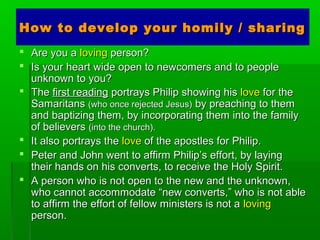
 Are you aAre you a lovingloving person?person?
 Is your heart wide open to newcomers and to peopleIs your heart wide open to newcomers and to people
unknown to you?unknown to you?
 TheThe first readingfirst reading portrays Philip showing hisportrays Philip showing his lovelove for thefor the
SamaritansSamaritans (who once rejected Jesus)(who once rejected Jesus) by preaching to themby preaching to them
and baptizing them, by incorporating them into the familyand baptizing them, by incorporating them into the family
of believersof believers (into the church).(into the church).
 It also portrays theIt also portrays the lovelove of the apostles for Philip.of the apostles for Philip.
 Peter and John went to affirm Philip’s effort, by layingPeter and John went to affirm Philip’s effort, by laying
their hands on his converts, to receive the Holy Spirit.their hands on his converts, to receive the Holy Spirit.
 A person who is not open to the new and the unknown,A person who is not open to the new and the unknown,
who cannot accommodate “new converts,” who is not ablewho cannot accommodate “new converts,” who is not able
to affirm the effort of fellow ministers is not ato affirm the effort of fellow ministers is not a lovingloving
person.person.
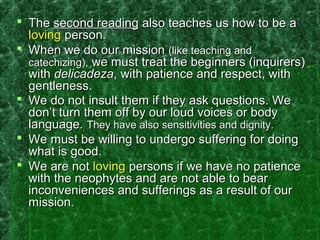
 TheThe second readingsecond reading also teaches us how to be aalso teaches us how to be a
lovingloving person.person.
 When we do our missionWhen we do our mission (like teaching and(like teaching and
catechizing),catechizing), we must treat the beginners (inquirers)we must treat the beginners (inquirers)
withwith delicadezadelicadeza, with patience and respect, with, with patience and respect, with
gentleness.gentleness.
 We do not insult them if they ask questions. WeWe do not insult them if they ask questions. We
don’t turn them off by our loud voices or bodydon’t turn them off by our loud voices or body
language.language. They have also sensitivities and dignity.They have also sensitivities and dignity.
 We must be willing to undergo suffering for doingWe must be willing to undergo suffering for doing
what is good.what is good.
 We are notWe are not lovingloving persons if we have no patiencepersons if we have no patience
with the neophytes and are not able to bearwith the neophytes and are not able to bear
inconveniences and sufferings as a result of ourinconveniences and sufferings as a result of our
mission.mission.
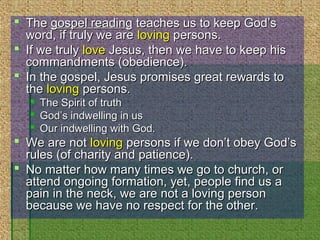
 TheThe gospel readinggospel reading teaches us to keep God’steaches us to keep God’s
word, if truly we areword, if truly we are lovingloving persons.persons.
 If we trulyIf we truly lovelove Jesus, then we have to keep hisJesus, then we have to keep his
commandments (obedience).commandments (obedience).
 In the gospel, Jesus promises great rewards toIn the gospel, Jesus promises great rewards to
thethe lovingloving persons.persons.
 The Spirit of truthThe Spirit of truth
 God’s indwelling in usGod’s indwelling in us
 Our indwelling with God.Our indwelling with God.
 We are notWe are not lovingloving persons if we don’t obey God’spersons if we don’t obey God’s
rules (of charity and patience).rules (of charity and patience).
 No matter how many times we go to church, orNo matter how many times we go to church, or
attend ongoing formation, yet, people find us aattend ongoing formation, yet, people find us a
pain in the neck, we are not a loving personpain in the neck, we are not a loving person
because we have no respect for the other.because we have no respect for the other.
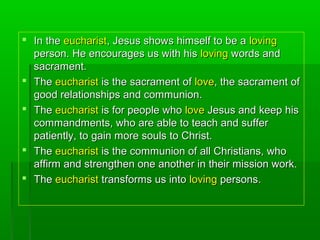
 In theIn the eucharisteucharist, Jesus shows himself to be a, Jesus shows himself to be a lovingloving
person. He encourages us with hisperson. He encourages us with his lovingloving words andwords and
sacrament.sacrament.
 TheThe eucharisteucharist is the sacrament ofis the sacrament of lovelove, the sacrament of, the sacrament of
good relationships and communion.good relationships and communion.
 TheThe eucharisteucharist is for people whois for people who lovelove Jesus and keep hisJesus and keep his
commandments, who are able to teach and suffercommandments, who are able to teach and suffer
patiently, to gain more souls to Christ.patiently, to gain more souls to Christ.
 TheThe eucharisteucharist is the communion of all Christians, whois the communion of all Christians, who
affirm and strengthen one another in their mission work.affirm and strengthen one another in their mission work.
 TheThe eucharisteucharist transforms us intotransforms us into lovingloving persons.persons.
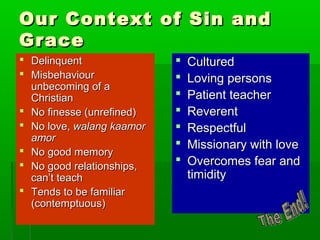
Our Context of Sin andOur Context of Sin and
GraceGrace
 DelinquentDelinquent
 MisbehaviourMisbehaviour
unbecoming of aunbecoming of a
ChristianChristian
 No finesse (unrefined)No finesse (unrefined)
 No love,No love, walang kaamorwalang kaamor
amoramor
 No good memoryNo good memory
 No good relationships,No good relationships,
can’t teachcan’t teach
 Tends to be familiarTends to be familiar
(contemptuous)(contemptuous)
 CulturedCultured
 Loving personsLoving persons
 Patient teacherPatient teacher
 ReverentReverent
 RespectfulRespectful
 Missionary with loveMissionary with love
 Overcomes fear andOvercomes fear and
timiditytimidity
Suggested SongsSuggested Songs
 God is Dwelling in My HeartGod is Dwelling in My Heart
 Come To MeCome To Me
 http://www.youtube.com/watch?v=ID90ryPYU00http://www.youtube.com/watch?v=ID90ryPYU00

6th Easter A

  • 1.
    Welcome to ourBible Study 25 May 201425 May 2014 66thth Sunday of Easter ASunday of Easter A In preparation for this Sunday’s LiturgyIn preparation for this Sunday’s Liturgy In aid of focusing our homilies and sharingIn aid of focusing our homilies and sharing Prepared by Fr. Cielo R. Almazan, OFM
  • 2.
    11stst reading: Acts 8:5-8,14-reading:Acts 8:5-8,14- 1717 5 Philip went down to (the) city of Samaria and proclaimed the Messiah to them. 6 With one accord, the crowds paid attention to what was said by Philip when they heard it and saw the signs he was doing. 7 For unclean spirits, crying out in a loud voice, came out of many possessed people, and many paralyzed and crippled people were cured. 8 There was great joy in that city.  14 Now when the apostles in Jerusalem heard that Samaria had accepted the word of God, they sent them Peter and John, 15 who went down and prayed for them, that they might receive the holy Spirit, 16 for it had not yet fallen upon any of them; they had only been baptized in the name of the Lord Jesus. 17 Then they laid hands on them and they received the holy Spirit. The focus is on the activities of the apostles.
  • 3.
    11stst reading: Acts 8:5-8,14-reading:Acts 8:5-8,14- 1717Philip in Samaria  5 Philip went down to (the) city of Samaria and proclaimed the Messiah to them. 6 With one accord, the crowds paid attention to what was said by Philip when they heard it and saw the signs he was doing. 7 For unclean spirits, crying out in a loud voice, came out of many possessed people, and many paralyzed and crippled people were cured. 8 There was great joy in that city. Apostles in Jerusalem / SamariaApostles in Jerusalem / Samaria  14 Now when the apostles in Jerusalem heard that Samaria had accepted the word of God, they sent them Peter and John, 15 who went down and prayed for them, that they might receive the holy Spirit, 16 for it had not yet fallen upon any of them; they had only been baptized in the name of the Lord Jesus. 17 Then they laid hands on them and they received the holy Spirit. A simple outline!
  • 4.
    11stst reading: Acts 8:5-8,14-reading:Acts 8:5-8,14- 1717 Philip in Samaria  5 Philip went down to (the) city of Samaria and proclaimed the Messiah to them. 6 With one accord, the crowds paid attention to what was said by Philip when they heard it and saw the signs he was doing. 7 For unclean spirits, crying out in a loud voice, came out of many possessed people, and many paralyzed and crippled people were cured. 8 There was great joy in that city. Commentary:Commentary:  Philip is one of the 7 deacons,Philip is one of the 7 deacons, supposedly to take charge of thesupposedly to take charge of the Hellenist widows.Hellenist widows.  But here in v.5, he also preaches inBut here in v.5, he also preaches in Samaria.Samaria.  Previously, he was with the EthiopianPreviously, he was with the Ethiopian eunuch.eunuch.  V.6 portrays Philip as powerful inV.6 portrays Philip as powerful in words and deeds.words and deeds.  V.7 explicitates his deeds:V.7 explicitates his deeds:  Exorcisms, healingsExorcisms, healings  V.8 describes the feeling of theV.8 describes the feeling of the Samaritans over Philip’sSamaritans over Philip’s accomplishments.accomplishments.  Great joyGreat joy
  • 5.
    Apostles in Jerusalem 14 Now when the apostles in Jerusalem heard that Samaria had accepted the word of God, they sent them Peter and John, 15 who went down and prayed for them, that they might receive the holy Spirit, 16 for it had not yet fallen upon any of them; they had only been baptized in the name of the Lord Jesus. 17 Then they laid hands on them and they received the holy Spirit.  In v.14, the apostles welcomeIn v.14, the apostles welcome the news that the gospel isthe news that the gospel is accepted in Samaria.accepted in Samaria.  Jesus was not accepted whenJesus was not accepted when he passed by there.he passed by there. (Lk 9,51ff)(Lk 9,51ff)  They send Peter and John toThey send Peter and John to pray for them that they maypray for them that they may receive the Holy Spirit. V.15receive the Holy Spirit. V.15  V.16 indicates the baptism ofV.16 indicates the baptism of the Samaritans (by Philip), justthe Samaritans (by Philip), just like what he had done to thelike what he had done to the Ethiopian eunuch.Ethiopian eunuch.  In v.17, the 2 apostles lay theirIn v.17, the 2 apostles lay their hands on the baptizedhands on the baptized Samaritans and the Holy SpiritSamaritans and the Holy Spirit descends on them.descends on them.
  • 6.
    Reflections on the1Reflections on the 1stst readingreading  To be an apostle, or, a church worker, one mustTo be an apostle, or, a church worker, one must busy himself/herself with God’s work.busy himself/herself with God’s work.  God’s work is none other than proclaiming theGod’s work is none other than proclaiming the good news, exorcism and curing the sick.good news, exorcism and curing the sick.  We must serve and strengthen our fellowWe must serve and strengthen our fellow believers.believers.  We pave the way for the Holy Spirit to work inWe pave the way for the Holy Spirit to work in them.them.  What are you doing in your life? Wasting timeWhat are you doing in your life? Wasting time and energy? No mission?and energy? No mission?
  • 7.
    Resp. Ps 66:1-3,4-5, 6-7, 16, 20  R. (1) Let all the earth cry out to God with joy.  1 Shout joyfully to God, all the earth, 2 sing praise to the glory of his name; proclaim his glorious praise. 3 Say to God, “How tremendous are your deeds!”  4 “Let all on earth worship and sing praise to you, sing praise to your name!” 5 Come and see the works of God, his tremendous deeds among the children of Adam.  6 He has changed the sea into dry land; through the river they passed on foot; 7 therefore let us rejoice in him. He rules by his might forever. 16 Hear now, all you who fear God, while I declare what he has done for me. 20 Blessed be God who refused me not my prayer or his kindness!
  • 8.
    Resp. Ps 66:1-3,4-5, 6-7, 16, 20  R. (1)R. (1) Let all the earth cry out to GodLet all the earth cry out to God with joy.with joy.  1 Shout joyfully to God, all the earth,1 Shout joyfully to God, all the earth, 2 Sing praise to the glory of his name;2 Sing praise to the glory of his name; proclaim his glorious praise.proclaim his glorious praise. 3 Say to God, “How tremendous are your3 Say to God, “How tremendous are your deeds!”deeds!”  4 “Let all on earth worship and sing4 “Let all on earth worship and sing praise to you,praise to you, sing praise to your name!”sing praise to your name!” 5 Come and see the works of God,5 Come and see the works of God, his tremendous deeds among thehis tremendous deeds among the children of Adam.children of Adam.  6 He has changed the sea into dry land;6 He has changed the sea into dry land; through the river they passed on foot;through the river they passed on foot; 7 therefore let us rejoice in him.7 therefore let us rejoice in him. He rules by his might forever.He rules by his might forever. 16 Hear now, all you who fear God, while16 Hear now, all you who fear God, while I declare what he has done for me.I declare what he has done for me. 20 Blessed be God who refused me not20 Blessed be God who refused me not my prayer or his kindness!my prayer or his kindness! CommentaryCommentary  Vv.1-3 invite us worshippers toVv.1-3 invite us worshippers to express our joy and appreciation toexpress our joy and appreciation to the Lord.the Lord.  In v.4, the psalmist talks to God toIn v.4, the psalmist talks to God to allow people to worship and praiseallow people to worship and praise him.him.  V.5 invites people to witness God’sV.5 invites people to witness God’s impressive deeds.impressive deeds.  V.6 remembers the dividing of theV.6 remembers the dividing of the Red Sea (Sea of Reeds) in theRed Sea (Sea of Reeds) in the Exodus.Exodus.  V.7 invites people to rejoice becauseV.7 invites people to rejoice because of his might.of his might.  In v.16, the psalmist asks theIn v.16, the psalmist asks the attention of God-fearing people, toattention of God-fearing people, to listen to him as he recounts hislisten to him as he recounts his experience of God’s powerful deeds.experience of God’s powerful deeds.  V.20 says benediction (blessings) toV.20 says benediction (blessings) to God for listening always to hisGod for listening always to his prayers.prayers.
  • 9.
    Reflections on theReflectionson the PsalmPsalm  As God’s people, we must always praiseAs God’s people, we must always praise God for his wonderful deeds.God for his wonderful deeds.  We must remember the powerful deedsWe must remember the powerful deeds he has done for his people and for us.he has done for his people and for us.  We cannot show our appreciation to GodWe cannot show our appreciation to God if we do not remember anything aboutif we do not remember anything about him.him.  We should sharpen our memories andWe should sharpen our memories and attribute all good things to him.attribute all good things to him.
  • 10.
    22ndnd reading: 1 Peter3:15-reading: 1 Peter 3:15- 1818  15 Sanctify Christ as Lord in your hearts. Always be ready to give an explanation to anyone who asks you for a reason for your hope, 16 but do it with gentleness and reverence, keeping your conscience clear, so that, when you are maligned, those who defame your good conduct in Christ may themselves be put to shame. 17 For it is better to suffer for doing good, if that be the will of God, than for doing evil. 18 For Christ also suffered for sins once, the righteous for the sake of the unrighteous, that he might lead you to God. Put to death in the flesh, he was brought to life in the spirit.
  • 11.
    22ndnd reading: 1 Peter3:15-reading: 1 Peter 3:15- 1818  15 Sanctify Christ as Lord in your hearts. Always be ready to give an explanation to anyone who asks you for a reason for your hope, 16 but do it with gentleness and reverence, keeping your conscience clear, so that, when you are maligned, those who defame your good conduct in Christ may themselves be put to shame. 17 For it is better to suffer for doing good, if that be the will of God, than for doing evil. 18 For Christ also suffered for sins once, the righteous for the sake of the unrighteous, that he might lead you to God. Put to death in the flesh, he was brought to life in the spirit. The focus is on the good Christian behavior.
  • 12.
    22ndnd reading: 1 Peter3:15-reading: 1 Peter 3:15- 1818 Imperatives  15 Sanctify Christ as Lord in your hearts. Always be ready to give an explanation to anyone who asks you for a reason for your hope, 16 but do it with gentleness and reverence, keeping your conscience clear, so that, when you are maligned, those who defame your good conduct in Christ may themselves be put to shame. Sayings  17 For it is better to suffer for doing good, if that be the will of God, than for doing evil. 18 For Christ also suffered for sins once, the righteous for the sake of the unrighteous, that he might lead you to God. Put to death in the flesh, he was brought to life in the spirit. A simple outline!
  • 13.
    22ndnd reading: 1 Peter3:15-reading: 1 Peter 3:15- 1818Imperatives  15 Sanctify Christ as Lord in your hearts. Always be ready to give an explanation to anyone who asks you for a reason for your hope, 16 but do it with gentleness and reverence, keeping your conscience clear, so that, when you are maligned, those who defame your good conduct in Christ may themselves be put to shame. Sayings  17 For it is better to suffer for doing good, if that be the will of God, than for doing evil. 18 For Christ also suffered for sins once, the righteous for the sake of the unrighteous, that he might lead you to God. Put to death in the flesh, he was brought to life in the spirit. Commentary  In v.15, to sanctify means to make holy, to treat Christ with respect and reverence.  V.15 also asks that Christians should be able to explain the faith if asked.  V.16 commends that Christians do it with gentleness and reverence, not bastos or mataray. (not to embarrass the one asking questions)  The author gives his piece of mind here, when maligned (defamed):  Those who malign / defame are put to shame.  There is no wisdom if issues are handled with disrespect.  There is no justification for raising our voices to silence those who are seeking the truth.
  • 14.
    Imperatives  15 SanctifyChrist as Lord in your hearts. Always be ready to give an explanation to anyone who asks you for a reason for your hope, 16 but do it with gentleness and reverence, keeping your conscience clear, so that, when you are maligned, those who defame your good conduct in Christ may themselves be put to shame. Sayings  17 For it is better to suffer for doing good, if that be the will of God, than for doing evil. 18 For Christ also suffered for sins once, the righteous for the sake of the unrighteous, that he might lead you to God. Put to death in the flesh, he was brought to life in the spirit.  Vv.17-18 are sayings aboutVv.17-18 are sayings about suffering for doing good, whichsuffering for doing good, which is God’s will.is God’s will.  It is much more acceptable toIt is much more acceptable to suffer for goodness’ sake, thansuffer for goodness’ sake, than for doing evil.for doing evil.  Christ’s suffering is enoughChrist’s suffering is enough reason for us to accept our ownreason for us to accept our own sufferings.sufferings.  Jesus suffers for our sins to leadJesus suffers for our sins to lead us to God.us to God.  In v.18b, Jesus suffers up toIn v.18b, Jesus suffers up to bodily death.bodily death.  His reward: resurrection, life inHis reward: resurrection, life in the spirit.the spirit.
  • 15.
    Reflections on the2Reflections on the 2ndnd readingreading  When teaching, we should be careful not only withWhen teaching, we should be careful not only with our words but also with our actions.our words but also with our actions.  We do our work of evangelization and catechismWe do our work of evangelization and catechism with gentleness and compassion, not with tiradeswith gentleness and compassion, not with tirades ((katarayankatarayan) and belittlings () and belittlings (panlalaitpanlalait) esp. to the) esp. to the slow learners.slow learners.  We should not complain when we suffer for doingWe should not complain when we suffer for doing good.good.  When we are maligned and we endure it, we putWhen we are maligned and we endure it, we put to shame those who malign us.to shame those who malign us.  Do you know how to hold your fire?Do you know how to hold your fire?  How do you react to acts of provocation?How do you react to acts of provocation?
  • 16.
    Gospel reading: John14:15-Gospel reading: John 14:15- 2121  15 Jesus said to his disciples, "If you love me, you will keep my commandments. 16 And I will ask the Father, and he will give you another Advocate to be with you always, 17 the Spirit of truth, which the world cannot accept, because it neither sees nor knows it. But you know it, because it remains with you, and will be in you. 18 I will not leave you orphans; I will come to you. 19 In a little while the world will no longer see me, but you will see me, because I live and you will live. 20 On that day you will realize that I am in my Father and you are in me and I in you. 21 Whoever has my commandments and observes them is the one who loves me. And whoever loves me will be loved by my Father, and I will love him and reveal myself to him."
  • 17.
    Gospel reading: John14:15-Gospel reading: John 14:15- 2121Love and commandments  15 Jesus said to his disciples, "If you love me, you will keep my commandments. Holy Spirit  16 And I will ask the Father, and he will give you another Advocate to be with you always, 17 the Spirit of truth, which the world cannot accept, because it neither sees nor knows it. But you know it, because it remains with you, and will be in you. Departure  18 I will not leave you orphans; I will come to you. 19 In a little while the world will no longer see me, but you will see me, because I live and you will live. 20 On that day you will realize that I am in my Father and you are in me and I in you. Commandments and love  21 Whoever has my commandments and observes them is the one who loves me. And whoever loves me will be loved by my Father, and I will love him and reveal myself to him." A simple outline! The focus is on loving Jesus.
  • 18.
    Gospel reading: John14:15-Gospel reading: John 14:15- 2121Love and commandments  15 Jesus said to his disciples, "If you love me, you will keep my commandments. Holy Spirit  16 And I will ask the Father, and he will give you another Advocate to be with you always, 17 the Spirit of truth, which the world cannot accept, because it neither sees nor knows it. But you know it, because it remains with you, and will be in you. Departure  18 I will not leave you orphans; I will come to you. 19 In a little while the world will no longer see me, but you will see me, because I live and you will live. 20 On that day you will realize that I am in my Father and you are in me and I in you. CommentaryCommentary  In v.15, loving Jesus is keeping hisIn v.15, loving Jesus is keeping his commandments.commandments.  As a result of keeping theAs a result of keeping the commandments, Jesus will send the Holycommandments, Jesus will send the Holy Spirit.Spirit.  The advocate, the encourager,The advocate, the encourager, paracleteparaclete,, defender, consolerdefender, consoler  The spirit of truth (that is, Jesus, isThe spirit of truth (that is, Jesus, is salvation) v.17salvation) v.17  This, the world cannot accept.This, the world cannot accept.  The world is materialistic, empirical, livesThe world is materialistic, empirical, lives on senses. It entertains only what can beon senses. It entertains only what can be quantified. V.17quantified. V.17  The disciples know the SpiritThe disciples know the Spirit (by baptism).(by baptism).  Nature of the Spirit: it remains, it is withNature of the Spirit: it remains, it is with the disciples.the disciples.  In v.18, Jesus promises to come back toIn v.18, Jesus promises to come back to his disciples. His absence is temporary.his disciples. His absence is temporary.
  • 19.
    Departure  18 Iwill not leave you orphans; I will come to you. 19 In a little while the world will no longer see me, but you will see me, because I live and you will live. 20 On that day you will realize that I am in my Father and you are in me and I in you. Commandments and love  21 Whoever has my commandments and observes them is the one who loves me. And whoever loves me will be loved by my Father, and I will love him and reveal myself to him."  In v.19, his coming back will bring life toIn v.19, his coming back will bring life to his disciples.his disciples.  In v.19, Jesus contrasts between theIn v.19, Jesus contrasts between the disciples and the world.disciples and the world.  The world will not see him.The world will not see him.  His disciples will see him, because ofHis disciples will see him, because of faith.faith.  Not only that, because he lives andNot only that, because he lives and because the disciples also live.because the disciples also live.  V.20 indicates the ultimate purpose ofV.20 indicates the ultimate purpose of going away and the coming back ofgoing away and the coming back of Jesus.Jesus.  To realize (to know, discover) thatTo realize (to know, discover) that Jesus has a relationship with the Father;Jesus has a relationship with the Father; his disciples with Jesus; Jesus with hishis disciples with Jesus; Jesus with his disciples.disciples.  Jesus states his indwelling with theJesus states his indwelling with the Father, his indwelling with him (Jesus)Father, his indwelling with him (Jesus) and his indwelling in his disciples.and his indwelling in his disciples.
  • 20.
    Commandments and love 21 Whoever has my commandments and observes them is the one who loves me. And whoever loves me will be loved by my Father, and I will love him and reveal myself to him."  In v.21, Jesus inverts the order ofIn v.21, Jesus inverts the order of love and commandments. This timelove and commandments. This time he begins with commandments andhe begins with commandments and then love.then love.  Loving Jesus Christ will gain favorLoving Jesus Christ will gain favor from God. The Father will love himfrom God. The Father will love him also, Jesus will also love him.also, Jesus will also love him.  And will reveal himself to him.And will reveal himself to him.  V.21 goes to the theme of love andV.21 goes to the theme of love and keeping the commandments. Thesekeeping the commandments. These two are also interrelated.two are also interrelated.  V.21 also picks the pattern in v.20,V.21 also picks the pattern in v.20, but this time the commonbut this time the common denominator is love and revelation.denominator is love and revelation.
  • 21.
    Love and commandments 15 Jesus said to his disciples, "If you love me, you will keep my commandments. Holy Spirit  16 And I will ask the Father, and he will give you another Advocate to be with you always, 17 the Spirit of truth, which the world cannot accept, because it neither sees nor knows it. But you know it, because it remains with you, and will be in you. Departure  18 I will not leave you orphans; I will come to you. 19 In a little while the world will no longer see me, but you will see me, because I live and you will live. 20 On that day you will realize that I am in my Father and you are in me and I in you. Commandments and love  21 Whoever has my commandments and observes them is the one who loves me. And whoever loves me will be loved by my Father, and I will love him and reveal myself to him."  Take note of the pattern in vv. 17, 20Take note of the pattern in vv. 17, 20 and 21,and 21, highlightedhighlighted in yellow.in yellow.  V.17 is about the Holy Spirit remainingV.17 is about the Holy Spirit remaining and dwelling with the disciples.and dwelling with the disciples.  V.20 is about Jesus dwelling in theV.20 is about Jesus dwelling in the Father, disciples dwelling with the SonFather, disciples dwelling with the Son and the Son with the disciples.and the Son with the disciples.  V.21 is about the disciples loving Jesus,V.21 is about the disciples loving Jesus, the disciples being loved by the Father,the disciples being loved by the Father, the disciples being loved by Jesusthe disciples being loved by Jesus revealing himself to him.revealing himself to him.  The text does not teach explicitly aboutThe text does not teach explicitly about the Holy Trinity. It is enough for us tothe Holy Trinity. It is enough for us to observe that the names of the threeobserve that the names of the three divine persons of the Holy Trinity aredivine persons of the Holy Trinity are mentioned here.mentioned here.  The Christian believers are integratedThe Christian believers are integrated into the life of God (Trinity) as long asinto the life of God (Trinity) as long as they love and keep his commandments.they love and keep his commandments.  Jesus is really the way towards theJesus is really the way towards the fullness of life.fullness of life.  Fullness of life is living in God’s mystery.Fullness of life is living in God’s mystery.
  • 22.
    Reflections on thegospelReflections on the gospel readingreading  Loving God is not emotionalism.  Loving God is doing concretely his commandments (teachings).  You cannot love God if you do not know his commandments. Hence, the need for catechism (instructions).  Loving God is a communal effort and process. We need others to instruct us and interpret the word of God for us, according to our times.  The Holy Spirit is God’s gift to us if we love him, the spirit of truth.  We, lovers of God and doers of his commandments, are on our way to God.  We are in the process of integration into the life of God.  God is with us, we are with God. God remains in us, he remains in us.
  • 23.
    Tying the 3readings and the PsalmTying the 3 readings and the Psalm  TheThe first readingfirst reading portrays a missionary whoportrays a missionary who lovesloves his work.his work.  TheThe psalmpsalm teaches us to express ourteaches us to express our lovelove toto God by praising and blessing him.God by praising and blessing him.  TheThe second readingsecond reading enjoins us toenjoins us to lovelove ChristChrist (to sanctify)(to sanctify) and to becomeand to become lovingloving personspersons (ready(ready to give explanations and to suffer).to give explanations and to suffer).  TheThe gospel readinggospel reading talks abouttalks about lovingloving JesusJesus and doing his commandments.and doing his commandments.
  • 24.
    How to developyour homily / sharingHow to develop your homily / sharing  Are you aAre you a lovingloving person?person?  Is your heart wide open to newcomers and to peopleIs your heart wide open to newcomers and to people unknown to you?unknown to you?  TheThe first readingfirst reading portrays Philip showing hisportrays Philip showing his lovelove for thefor the SamaritansSamaritans (who once rejected Jesus)(who once rejected Jesus) by preaching to themby preaching to them and baptizing them, by incorporating them into the familyand baptizing them, by incorporating them into the family of believersof believers (into the church).(into the church).  It also portrays theIt also portrays the lovelove of the apostles for Philip.of the apostles for Philip.  Peter and John went to affirm Philip’s effort, by layingPeter and John went to affirm Philip’s effort, by laying their hands on his converts, to receive the Holy Spirit.their hands on his converts, to receive the Holy Spirit.  A person who is not open to the new and the unknown,A person who is not open to the new and the unknown, who cannot accommodate “new converts,” who is not ablewho cannot accommodate “new converts,” who is not able to affirm the effort of fellow ministers is not ato affirm the effort of fellow ministers is not a lovingloving person.person.
  • 25.
     TheThe secondreadingsecond reading also teaches us how to be aalso teaches us how to be a lovingloving person.person.  When we do our missionWhen we do our mission (like teaching and(like teaching and catechizing),catechizing), we must treat the beginners (inquirers)we must treat the beginners (inquirers) withwith delicadezadelicadeza, with patience and respect, with, with patience and respect, with gentleness.gentleness.  We do not insult them if they ask questions. WeWe do not insult them if they ask questions. We don’t turn them off by our loud voices or bodydon’t turn them off by our loud voices or body language.language. They have also sensitivities and dignity.They have also sensitivities and dignity.  We must be willing to undergo suffering for doingWe must be willing to undergo suffering for doing what is good.what is good.  We are notWe are not lovingloving persons if we have no patiencepersons if we have no patience with the neophytes and are not able to bearwith the neophytes and are not able to bear inconveniences and sufferings as a result of ourinconveniences and sufferings as a result of our mission.mission.
  • 26.
     TheThe gospelreadinggospel reading teaches us to keep God’steaches us to keep God’s word, if truly we areword, if truly we are lovingloving persons.persons.  If we trulyIf we truly lovelove Jesus, then we have to keep hisJesus, then we have to keep his commandments (obedience).commandments (obedience).  In the gospel, Jesus promises great rewards toIn the gospel, Jesus promises great rewards to thethe lovingloving persons.persons.  The Spirit of truthThe Spirit of truth  God’s indwelling in usGod’s indwelling in us  Our indwelling with God.Our indwelling with God.  We are notWe are not lovingloving persons if we don’t obey God’spersons if we don’t obey God’s rules (of charity and patience).rules (of charity and patience).  No matter how many times we go to church, orNo matter how many times we go to church, or attend ongoing formation, yet, people find us aattend ongoing formation, yet, people find us a pain in the neck, we are not a loving personpain in the neck, we are not a loving person because we have no respect for the other.because we have no respect for the other.
  • 27.
     In theInthe eucharisteucharist, Jesus shows himself to be a, Jesus shows himself to be a lovingloving person. He encourages us with hisperson. He encourages us with his lovingloving words andwords and sacrament.sacrament.  TheThe eucharisteucharist is the sacrament ofis the sacrament of lovelove, the sacrament of, the sacrament of good relationships and communion.good relationships and communion.  TheThe eucharisteucharist is for people whois for people who lovelove Jesus and keep hisJesus and keep his commandments, who are able to teach and suffercommandments, who are able to teach and suffer patiently, to gain more souls to Christ.patiently, to gain more souls to Christ.  TheThe eucharisteucharist is the communion of all Christians, whois the communion of all Christians, who affirm and strengthen one another in their mission work.affirm and strengthen one another in their mission work.  TheThe eucharisteucharist transforms us intotransforms us into lovingloving persons.persons.
  • 28.
    Our Context ofSin andOur Context of Sin and GraceGrace  DelinquentDelinquent  MisbehaviourMisbehaviour unbecoming of aunbecoming of a ChristianChristian  No finesse (unrefined)No finesse (unrefined)  No love,No love, walang kaamorwalang kaamor amoramor  No good memoryNo good memory  No good relationships,No good relationships, can’t teachcan’t teach  Tends to be familiarTends to be familiar (contemptuous)(contemptuous)  CulturedCultured  Loving personsLoving persons  Patient teacherPatient teacher  ReverentReverent  RespectfulRespectful  Missionary with loveMissionary with love  Overcomes fear andOvercomes fear and timiditytimidity
  • 29.
    Suggested SongsSuggested Songs God is Dwelling in My HeartGod is Dwelling in My Heart  Come To MeCome To Me  http://www.youtube.com/watch?v=ID90ryPYU00http://www.youtube.com/watch?v=ID90ryPYU00