Welcome to our
Bible Study
6th
Sunday of Easter C
1 May 2016
In preparation for this Sunday’s liturgy
As aid in focusing our homilies and sharing
Prepared by Fr. Cielo R. Almazan, OFM
1st
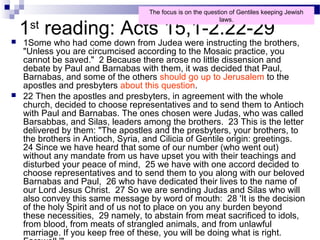
reading: Acts 15,1-2.22-29 1Some who had come down from Judea were instructing the brothers,
"Unless you are circumcised according to the Mosaic practice, you
cannot be saved." 2 Because there arose no little dissension and
debate by Paul and Barnabas with them, it was decided that Paul,
Barnabas, and some of the others should go up to Jerusalem to the
apostles and presbyters about this question.
 22 Then the apostles and presbyters, in agreement with the whole
church, decided to choose representatives and to send them to Antioch
with Paul and Barnabas. The ones chosen were Judas, who was called
Barsabbas, and Silas, leaders among the brothers. 23 This is the letter
delivered by them: "The apostles and the presbyters, your brothers, to
the brothers in Antioch, Syria, and Cilicia of Gentile origin: greetings.
24 Since we have heard that some of our number (who went out)
without any mandate from us have upset you with their teachings and
disturbed your peace of mind, 25 we have with one accord decided to
choose representatives and to send them to you along with our beloved
Barnabas and Paul, 26 who have dedicated their lives to the name of
our Lord Jesus Christ. 27 So we are sending Judas and Silas who will
also convey this same message by word of mouth: 28 'It is the decision
of the holy Spirit and of us not to place on you any burden beyond
these necessities, 29 namely, to abstain from meat sacrificed to idols,
from blood, from meats of strangled animals, and from unlawful
marriage. If you keep free of these, you will be doing what is right.
The focus is on the question of Gentiles keeping Jewish
laws.
1st
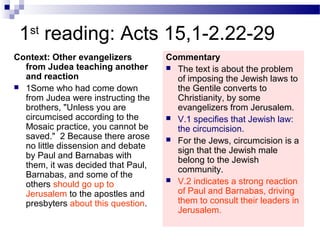
reading: Acts 15,1-2.22-29
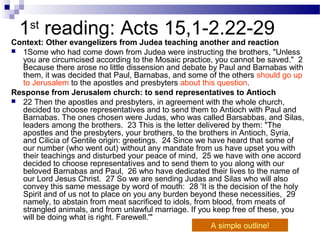
Context: Other evangelizers from Judea teaching another and reaction
 1Some who had come down from Judea were instructing the brothers, "Unless
you are circumcised according to the Mosaic practice, you cannot be saved." 2
Because there arose no little dissension and debate by Paul and Barnabas with
them, it was decided that Paul, Barnabas, and some of the others should go up
to Jerusalem to the apostles and presbyters about this question.
Response from Jerusalem church: to send representatives to Antioch
 22 Then the apostles and presbyters, in agreement with the whole church,
decided to choose representatives and to send them to Antioch with Paul and
Barnabas. The ones chosen were Judas, who was called Barsabbas, and Silas,
leaders among the brothers. 23 This is the letter delivered by them: "The
apostles and the presbyters, your brothers, to the brothers in Antioch, Syria,
and Cilicia of Gentile origin: greetings. 24 Since we have heard that some of
our number (who went out) without any mandate from us have upset you with
their teachings and disturbed your peace of mind, 25 we have with one accord
decided to choose representatives and to send them to you along with our
beloved Barnabas and Paul, 26 who have dedicated their lives to the name of
our Lord Jesus Christ. 27 So we are sending Judas and Silas who will also
convey this same message by word of mouth: 28 'It is the decision of the holy
Spirit and of us not to place on you any burden beyond these necessities, 29
namely, to abstain from meat sacrificed to idols, from blood, from meats of
strangled animals, and from unlawful marriage. If you keep free of these, you
will be doing what is right. Farewell.'"
A simple outline!
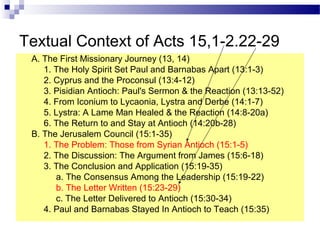
Textual Context of Acts 15,1-2.22-29
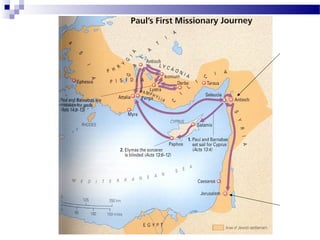
A. The First Missionary Journey (13, 14)
1. The Holy Spirit Set Paul and Barnabas Apart (13:1-3)
2. Cyprus and the Proconsul (13:4-12)
3. Pisidian Antioch: Paul's Sermon & the Reaction (13:13-52)
4. From Iconium to Lycaonia, Lystra and Derbe (14:1-7)
5. Lystra: A Lame Man Healed & the Reaction (14:8-20a)
6. The Return to and Stay at Antioch (14:20b-28)
B. The Jerusalem Council (15:1-35)
1. The Problem: Those from Syrian Antioch (15:1-5)
2. The Discussion: The Argument from James (15:6-18)
3. The Conclusion and Application (15:19-35)
a. The Consensus Among the Leadership (15:19-22)
b. The Letter Written (15:23-29)
c. The Letter Delivered to Antioch (15:30-34)
4. Paul and Barnabas Stayed In Antioch to Teach (15:35)
1st
reading: Acts 15,1-2.22-29
Context: Other evangelizers
from Judea teaching another
and reaction
 1Some who had come down
from Judea were instructing the
brothers, "Unless you are
circumcised according to the
Mosaic practice, you cannot be
saved." 2 Because there arose
no little dissension and debate
by Paul and Barnabas with
them, it was decided that Paul,
Barnabas, and some of the
others should go up to
Jerusalem to the apostles and
presbyters about this question.
Commentary
 The text is about the problem
of imposing the Jewish laws to
the Gentile converts to
Christianity, by some
evangelizers from Jerusalem.
 V.1 specifies that Jewish law:
the circumcision.
 For the Jews, circumcision is a
sign that the Jewish male
belong to the Jewish
community.
 V.2 indicates a strong reaction
of Paul and Barnabas, driving
them to consult their leaders in
Jerusalem.
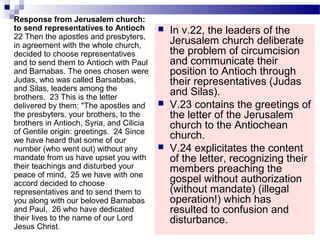
 In v.22, the leaders of the
Jerusalem church deliberate
the problem of circumcision
and communicate their
position to Antioch through
their representatives (Judas
and Silas).
 V.23 contains the greetings of
the letter of the Jerusalem
church to the Antiochean
church.
 V.24 explicitates the content
of the letter, recognizing their
members preaching the
gospel without authorization
(without mandate) (illegal
operation!) which has
resulted to confusion and
disturbance.
Response from Jerusalem church:
to send representatives to Antioch
22 Then the apostles and presbyters,
in agreement with the whole church,
decided to choose representatives
and to send them to Antioch with Paul
and Barnabas. The ones chosen were
Judas, who was called Barsabbas,
and Silas, leaders among the
brothers. 23 This is the letter
delivered by them: "The apostles and
the presbyters, your brothers, to the
brothers in Antioch, Syria, and Cilicia
of Gentile origin: greetings. 24 Since
we have heard that some of our
number (who went out) without any
mandate from us have upset you with
their teachings and disturbed your
peace of mind, 25 we have with one
accord decided to choose
representatives and to send them to
you along with our beloved Barnabas
and Paul, 26 who have dedicated
their lives to the name of our Lord
Jesus Christ.
 In v.25, Paul and Barnabas
will go back to Antioch with
the authorized
representatives. (v.27)
 Vv.28-29 spell out the do’s
and the don’ts expected of a
Gentile convert.
 Definitely, the Gentile
converts should not be
burdened to take upon the
Jewish law (yoke).
27 So we are sending
Judas and Silas who will
also convey this same
message by word of mouth:
28 'It is the decision of the
holy Spirit and of us not to
place on you any burden
beyond these necessities,
29 namely, to abstain from
meat sacrificed to idols,
from blood, from meats of
strangled animals, and from
unlawful marriage. If you
keep free of these, you will
be doing what is right.
Farewell.'"
Reflections on the 1st
reading
 If we want to preach, we should be authorized to do it.
 It is the Church that authorizes us to preach.
 We are authorized only by the Church after having
undergone catechism and instruction.
 In our times, only those who study theology must preach,
otherwise, the contents of their preaching are infirm and
defective.
 These days, the evangelizer must be evangelized first
and have undergone years of biblical and theological
formation.
 Preachers who truly represent the apostles and the
Church are not cheaply made.
Resp. Psalm 67:2-3, 5, 6, 8
R. (4) O God, let all the nations praise you!
2 May God have pity on us and bless us;
may he let his face shine upon us.
3 So may your way be known upon earth;
among all nations, your salvation.
5 May the nations be glad and exult
because you rule the peoples in equity;
the nations on the earth you guide.
6 May the peoples praise you, O God;
may all the peoples praise you!
8 May God bless us,
and may all the ends of the earth fear him!
Resp. Psalm 67:2-3, 5, 6, 8
R. (4) O God, let all the nations praise
you!
2 May God have pity on us and bless us;
may he let his face shine upon us.
3 So may your way be known upon
earth;
among all nations, your salvation.
5 May the nations be glad and exult
because you rule the peoples in equity;
the nations on the earth you guide.
6 May the peoples praise you, O God;
may all the peoples praise you!
8 May God bless us,
and may all the ends of the earth fear
him!
Commentary
 The psalm is classified as a
thanksgiving hymn.
 The psalmist makes the
following wishes:
 mercy and blessing upon
Israel. V.2
 that God’s way and salvation
be known by all. V.3
 that all nations rejoice
because God is just. V.5
 that God be praised by all
men and women. V.6
 that God blesses us all and
all peoples live moral lives
(fear the Lord). V.8
Reflection on the Psalm
 Christian life is a life of good wishes and thanksgiving.
 As Christians, we lead other people see God working
wonders in us.
 We lead people to express their gratitude to God.
 We also invite them to join us in praising God.
 Is your faith facilitative? Does it facilitate others to
recognize God?
 Don’t live a dry and boring faith.
 You can animate others.
2nd
reading: Rev 21,10-14.22-23
 10 The angel took me in spirit to a great, high mountain
and showed me the holy city Jerusalem coming down
out of heaven from God. 11 It gleamed with the splendor
of God. Its radiance was like that of a precious stone,
like jasper, clear as crystal. 12 It had a massive, high
wall, with twelve gates where twelve angels were
stationed and on which names were inscribed, (the
names) of the twelve tribes of the Israelites. 13 There
were three gates facing east, three north, three south,
and three west. 14 The wall of the city had twelve
courses of stones as its foundation, on which were
inscribed the twelve names of the twelve apostles of the
Lamb.
 22 I saw no temple in the city, for its temple is the Lord
God almighty and the Lamb. 23 The city had no need of
sun or moon to shine on it, for the glory of God gave it
light, and its lamp was the Lamb.
The focus is on the vision of the new city of Jerusalem.
2nd
reading: Rev 21,10-14.22-23
The vision of the new city of Jerusalem
 10 The angel took me in spirit to a great, high mountain and
showed me the holy city Jerusalem coming down out of
heaven from God. 11 It gleamed with the splendor of God. Its
radiance was like that of a precious stone, like jasper, clear as
crystal. 12 It had a massive, high wall, with twelve gates
where twelve angels were stationed and on which names
were inscribed, (the names) of the twelve tribes of the
Israelites. 13 There were three gates facing east, three north,
three south, and three west. 14 The wall of the city had
twelve courses of stones as its foundation, on which were
inscribed the twelve names of the twelve apostles of the
Lamb.
No temple
 22 I saw no temple in the city, for its temple is the Lord God
almighty and the Lamb. 23 The city had no need of sun or
moon to shine on it, for the glory of God gave it light, and its
lamp was the Lamb.
A simple outline!
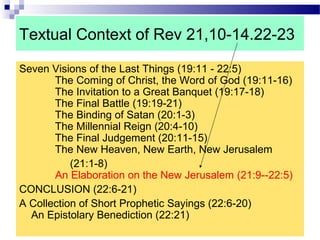
Textual Context of Rev 21,10-14.22-23
Seven Visions of the Last Things (19:11 - 22:5)
The Coming of Christ, the Word of God (19:11-16)
The Invitation to a Great Banquet (19:17-18)
The Final Battle (19:19-21)
The Binding of Satan (20:1-3)
The Millennial Reign (20:4-10)
The Final Judgement (20:11-15)
The New Heaven, New Earth, New Jerusalem
(21:1-8)
An Elaboration on the New Jerusalem (21:9--22:5)
CONCLUSION (22:6-21)
A Collection of Short Prophetic Sayings (22:6-20)
An Epistolary Benediction (22:21)
2nd
reading: Rev 21,10-14.22-23
The vision of the new city of
Jerusalem
 10 The angel took me in spirit to
a great, high mountain and
showed me the holy city
Jerusalem coming down out of
heaven from God. 11 It
gleamed with the splendor of
God. Its radiance was like that
of a precious stone, like jasper,
clear as crystal. 12 It had a
massive, high wall, with twelve
gates where twelve angels were
stationed and on which names
were inscribed, (the names) of
the twelve tribes of the
Israelites. 13 There were three
gates facing east, three north,
three south, and three west. 14
The wall of the city had twelve
courses of stones as its
foundation, on which were
inscribed the twelve names of
the twelve apostles of the Lamb.
.
Commentary
 In v.10, the author starts sharing his
vision of the city of Jerusalem
coming from heaven.
 According to its description, it is
impressive and extraordinary.
 It gleamed (v.11)
 It has radiance. (v.11)
 It has a massive high wall.
 V.12 plays on the number 12.
 12 gates
 12 angels
 12 tribes
 V.13 talks about the quarter of 12,
pointing to the 4 corners of the
compass (East, West, North, South)
 In v.14, again the number 12 is
used, this time 12 groups of stones,
with the 12 names of the apostles.
2nd
reading: Rev 21,10-14.22-23
No temple
 22 I saw no temple in
the city, for its temple is
the Lord God almighty
and the Lamb. 23 The
city had no need of sun
or moon to shine on it,
for the glory of God
gave it light, and its
lamp was the Lamb.
 Surprisingly, in the vision on
v.22, the author does not see
a temple.
 Instead, he claims that the
temple itself is God.
 In v.23, God is shining
brightly. God’s glory gives
light. The lamp is the Lamb
(Jesus).
Reflections on the second reading
 Christians must be ready to accept God’s Word
in an apocalyptic language.
 It is full of symbols.
 It should stir our imagination, not fear.
 Heaven is beyond our imagination.
 But it is there to hope for.
 We cannot complete understanding of our faith,
without imagination.
 Can you imagine heaven? (Fullness of life, complete joy)
Gospel reading: John 14,23-29
 23 Jesus said to his disciples, "Whoever loves me will
keep my word, and my Father will love him, and we will
come to him and make our dwelling with him. 24
Whoever does not love me does not keep my words; yet
the word you hear is not mine but that of the Father who
sent me. 25 "I have told you this while I am with you. 26
The Advocate, the holy Spirit that the Father will send in
my name-- he will teach you everything and remind you
of all that (I) told you. 27 Peace I leave with you; my
peace I give to you. Not as the world gives do I give it to
you. Do not let your hearts be troubled or afraid. 28 You
heard me tell you, 'I am going away and I will come back
to you.' If you loved me, you would rejoice that I am
going to the Father; for the Father is greater than I. 29
And now I have told you this before it happens, so that
when it happens you may believe.
The focus is on loving Jesus.
Gospel reading: John 14,23-29
What happens if we love Jesus?
 23 Jesus said to his disciples, "Whoever loves me will keep my word, and
my Father will love him, and we will come to him and make our dwelling with
him.
What happens if we don’t?
 24 Whoever does not love me does not keep my words; yet the word you
hear is not mine but that of the Father who sent me.
The Role of the Holy Spirit
 25 "I have told you this while I am with you. 26 The Advocate, the holy Spirit
that the Father will send in my name-- he will teach you everything and
remind you of all that (I) told you.
Gift of Peace
 27 Peace I leave with you; my peace I give to you. Not as the world gives do
I give it to you. Do not let your hearts be troubled or afraid.
The correct attitude / disposition if we love Jesus
 28 You heard me tell you, 'I am going away and I will come back to you.' If
you loved me, you would rejoice that I am going to the Father; for the Father
is greater than I. 29 And now I have told you this before it happens, so that
when it happens you may believe.
A simple outline!
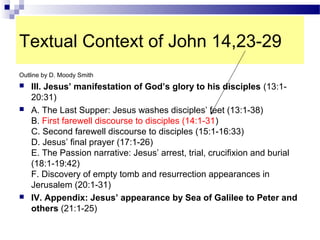
Textual Context of John 14,23-29
Outline by D. Moody Smith
 III. Jesus’ manifestation of God’s glory to his disciples (13:1-
20:31)
 A. The Last Supper: Jesus washes disciples’ feet (13:1-38)
B. First farewell discourse to disciples (14:1-31)
C. Second farewell discourse to disciples (15:1-16:33)
D. Jesus’ final prayer (17:1-26)
E. The Passion narrative: Jesus’ arrest, trial, crucifixion and burial
(18:1-19:42)
F. Discovery of empty tomb and resurrection appearances in
Jerusalem (20:1-31)
 IV. Appendix: Jesus’ appearance by Sea of Galilee to Peter and
others (21:1-25)
Gospel reading: John 14,23-29
What happens if we love Jesus?
 23 Jesus said to his disciples,
"Whoever loves me will keep my
word, and my Father will love
him, and we will come to him
and make our dwelling with him.
What happens if we don’t?
 24 Whoever does not love me
does not keep my words; yet the
word you hear is not mine but
that of the Father who sent me.
The Role of the Holy Spirit
 25 "I have told you this while I
am with you. 26 The Advocate,
the holy Spirit that the Father
will send in my name-- he will
teach you everything and
remind you of all that (I) told
you.
Commentary
• The text continues Jesus’
discourse on his bidding farewell to
his disciples, in the context of the
Last Supper.
• In v.23, Jesus reiterates the
importance of loving him and
keeping his word.
• No one can love Jesus without
taking his word seriously.
• Those who do both become God’s
dwelling place.
• In v.24, Jesus states that it is the
Father we reject if we don’t love
Jesus and keep his word.
• Vv.25-26 introduce the Holy Spirit
and his role (to teach and remind).
Gospel reading: John 14,23-29
Gift of Peace
 27 Peace I leave with you; my
peace I give to you. Not as the
world gives do I give it to you.
Do not let your hearts be
troubled or afraid.
The correct attitude / disposition
if we love Jesus
 28 You heard me tell you, 'I am
going away and I will come back
to you.' If you loved me, you
would rejoice that I am going to
the Father; for the Father is
greater than I. 29 And now I
have told you this before it
happens, so that when it
happens you may believe.
• In v.27, Jesus leaves peace to
the disciples. This peace
comes from God. It is so
different from the peace
offered by the world.
• In v.28 Jesus challenges his
disciples to rejoice at his
departure, because he is
going home to his Father.
Reflections on the gospel reading
 We Christians must see the meaning of Jesus’
departure.
 His departure is not an abandonment.
 His departure paves the way for the coming of
the Holy Spirit.
 It also serves as a reminder to love Jesus and to
keep his words even if he is gone.
 It is an invitation for us to live in God’s mystery.
 With his departure, the Holy Trinity will come to dwell
in those who love Jesus and keep his word.
Tying the 3 readings and the Psalm
 The first reading teaches not to make the lives of the
new Christians burdensome.
 The psalm encourages everyone to praise God’s
goodness.
 The second reading talks about the vision of the new
Jerusalem.
 The gospel reading talks about loving Jesus and keeping
his word as he bids goodbye.
We cannot find a common focus of these three readings. The preacher must
develop the theological meaning of Jesus’ departure (farewell speech). This
prepares well for the next two Sunday’s celebrations: Ascension and Pentecost.
How to develop your homily and sharingHow to develop your homily and sharing
 Bidding good bye is always laden with heavy
emotions. No one is happy except your enemy.
 Certainly we will miss the company of the one
bidding good bye.
 There is an end to all human relationships, no
matter how intimate.
 But if we really want to immortalize his/her
memory, we will do something good – to
represent him/her.
 In the gospel reading, Jesus bids good bye to
his disciples.
 He gives them his final instructions: to love him
and to keep his word.
 They will not be left all alone.
 He assures them of the coming of the Holy Spirit
who will continue his presence.
 The disciples must live in peace and joy when
he is gone.
 This is the best way to represent him in the
world.
 The first reading talks of how the apostles solve a
controversy due to a misrepresentation, due to an
unauthorized evangelizer.
 They fraternally solve it (out of the love for Jesus and his
words.)
 They consult with one another. They take care not to
antagonize their converts at the same time they exhort
them not to go back to their paganistic practices.
 They make good of what Jesus had said when he was
bidding good bye.
 The reading should remind everyone to avoid
unauthorized (unsupervised) activities, otherwise he/she
courts chaos.
 Let us not distort the legacy of Jesus.
 Sometimes, our parishes are chaotic because of
misrepresentations.
 The leaders do not understand the vision and mission of
their own churches.
 They do not know the mind of their pastors (and
bishops).
 They do their own thing.
 The parish goes into different directions.
 In other parishes, the leaders are preoccupied with
representing themselves (advancing their personal agenda).
 To avoid chaos in the church, the mistakes of the overly
enthusiastic, the naïve servant-leaders (including the catechists or
teachers), must be avoided at all times.
 We should not say (teach) anything that we are not sure of, or, that
we have not studied well.
 “Little learning is a dangerous thing.”
 Confusion is not the work of the Holy Spirit.
 It is not a product of a well-prepared teacher, evangelizer or
missionary.
 In this Year of Faith, all of us must be catechized anew.
 Do you have a copy of the Catechism of the Catholic Church?
 In politics (political campaigns), there is a lot of
misinformation, mudslinging and misrepresentations.
 Candidates hire someone or an agency to demolish the
opponent.
 All irregularities and anomalies in political exercise are
works of evil politicians and their cohorts and inefficient
electoral system.
 They distort democracy.
 No to dynastism.
 True Christians must not engage in these immoral
activities. It contradicts our mission to proclaim the
kingdom of God.
For the Philippines, May 13 National Elections
 The second reading describes the destiny of the
true and faithful followers of Jesus, those who
represent him in the missionary work.
 The destiny is the new Jerusalem.
 It is heaven in an apocalyptic language.
 The eucharist is the sacrament that immortalizes the
memory of Jesus.
 The eucharist recalls the love and affection for all of us
disciples.
 The eucharist should teach us how to make a
meaningful good bye to our associates and loved ones,
which means leaving them in good order.
 The eucharist helps us to stand on our own, not for ever
dependent on others.
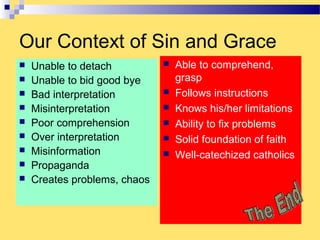
Our Context of Sin and Grace
 Unable to detach
 Unable to bid good bye
 Bad interpretation
 Misinterpretation
 Poor comprehension
 Over interpretation
 Misinformation
 Propaganda
 Creates problems, chaos
 Able to comprehend,
grasp
 Follows instructions
 Knows his/her limitations
 Ability to fix problems
 Solid foundation of faith
 Well-catechized catholics
Suggested Songs
 The Faces of Time
 http://www.youtube.com/watch?v=QHqmelve3sY
 Journeys Ended, Journeys Begun
 Dear sisters and brothers,
 What is your legacy when you bid good
bye to your friends? You must leave
behind something worthwhile.
 Fr. Cielo

6th Easter C

  • 1.
    Welcome to our BibleStudy 6th Sunday of Easter C 1 May 2016 In preparation for this Sunday’s liturgy As aid in focusing our homilies and sharing Prepared by Fr. Cielo R. Almazan, OFM
  • 2.
    1st reading: Acts 15,1-2.22-291Some who had come down from Judea were instructing the brothers, "Unless you are circumcised according to the Mosaic practice, you cannot be saved." 2 Because there arose no little dissension and debate by Paul and Barnabas with them, it was decided that Paul, Barnabas, and some of the others should go up to Jerusalem to the apostles and presbyters about this question.  22 Then the apostles and presbyters, in agreement with the whole church, decided to choose representatives and to send them to Antioch with Paul and Barnabas. The ones chosen were Judas, who was called Barsabbas, and Silas, leaders among the brothers. 23 This is the letter delivered by them: "The apostles and the presbyters, your brothers, to the brothers in Antioch, Syria, and Cilicia of Gentile origin: greetings. 24 Since we have heard that some of our number (who went out) without any mandate from us have upset you with their teachings and disturbed your peace of mind, 25 we have with one accord decided to choose representatives and to send them to you along with our beloved Barnabas and Paul, 26 who have dedicated their lives to the name of our Lord Jesus Christ. 27 So we are sending Judas and Silas who will also convey this same message by word of mouth: 28 'It is the decision of the holy Spirit and of us not to place on you any burden beyond these necessities, 29 namely, to abstain from meat sacrificed to idols, from blood, from meats of strangled animals, and from unlawful marriage. If you keep free of these, you will be doing what is right. The focus is on the question of Gentiles keeping Jewish laws.
  • 3.
    1st reading: Acts 15,1-2.22-29 Context:Other evangelizers from Judea teaching another and reaction  1Some who had come down from Judea were instructing the brothers, "Unless you are circumcised according to the Mosaic practice, you cannot be saved." 2 Because there arose no little dissension and debate by Paul and Barnabas with them, it was decided that Paul, Barnabas, and some of the others should go up to Jerusalem to the apostles and presbyters about this question. Response from Jerusalem church: to send representatives to Antioch  22 Then the apostles and presbyters, in agreement with the whole church, decided to choose representatives and to send them to Antioch with Paul and Barnabas. The ones chosen were Judas, who was called Barsabbas, and Silas, leaders among the brothers. 23 This is the letter delivered by them: "The apostles and the presbyters, your brothers, to the brothers in Antioch, Syria, and Cilicia of Gentile origin: greetings. 24 Since we have heard that some of our number (who went out) without any mandate from us have upset you with their teachings and disturbed your peace of mind, 25 we have with one accord decided to choose representatives and to send them to you along with our beloved Barnabas and Paul, 26 who have dedicated their lives to the name of our Lord Jesus Christ. 27 So we are sending Judas and Silas who will also convey this same message by word of mouth: 28 'It is the decision of the holy Spirit and of us not to place on you any burden beyond these necessities, 29 namely, to abstain from meat sacrificed to idols, from blood, from meats of strangled animals, and from unlawful marriage. If you keep free of these, you will be doing what is right. Farewell.'" A simple outline!
  • 4.
    Textual Context ofActs 15,1-2.22-29 A. The First Missionary Journey (13, 14) 1. The Holy Spirit Set Paul and Barnabas Apart (13:1-3) 2. Cyprus and the Proconsul (13:4-12) 3. Pisidian Antioch: Paul's Sermon & the Reaction (13:13-52) 4. From Iconium to Lycaonia, Lystra and Derbe (14:1-7) 5. Lystra: A Lame Man Healed & the Reaction (14:8-20a) 6. The Return to and Stay at Antioch (14:20b-28) B. The Jerusalem Council (15:1-35) 1. The Problem: Those from Syrian Antioch (15:1-5) 2. The Discussion: The Argument from James (15:6-18) 3. The Conclusion and Application (15:19-35) a. The Consensus Among the Leadership (15:19-22) b. The Letter Written (15:23-29) c. The Letter Delivered to Antioch (15:30-34) 4. Paul and Barnabas Stayed In Antioch to Teach (15:35)
  • 6.
    1st reading: Acts 15,1-2.22-29 Context:Other evangelizers from Judea teaching another and reaction  1Some who had come down from Judea were instructing the brothers, "Unless you are circumcised according to the Mosaic practice, you cannot be saved." 2 Because there arose no little dissension and debate by Paul and Barnabas with them, it was decided that Paul, Barnabas, and some of the others should go up to Jerusalem to the apostles and presbyters about this question. Commentary  The text is about the problem of imposing the Jewish laws to the Gentile converts to Christianity, by some evangelizers from Jerusalem.  V.1 specifies that Jewish law: the circumcision.  For the Jews, circumcision is a sign that the Jewish male belong to the Jewish community.  V.2 indicates a strong reaction of Paul and Barnabas, driving them to consult their leaders in Jerusalem.
  • 7.
     In v.22,the leaders of the Jerusalem church deliberate the problem of circumcision and communicate their position to Antioch through their representatives (Judas and Silas).  V.23 contains the greetings of the letter of the Jerusalem church to the Antiochean church.  V.24 explicitates the content of the letter, recognizing their members preaching the gospel without authorization (without mandate) (illegal operation!) which has resulted to confusion and disturbance. Response from Jerusalem church: to send representatives to Antioch 22 Then the apostles and presbyters, in agreement with the whole church, decided to choose representatives and to send them to Antioch with Paul and Barnabas. The ones chosen were Judas, who was called Barsabbas, and Silas, leaders among the brothers. 23 This is the letter delivered by them: "The apostles and the presbyters, your brothers, to the brothers in Antioch, Syria, and Cilicia of Gentile origin: greetings. 24 Since we have heard that some of our number (who went out) without any mandate from us have upset you with their teachings and disturbed your peace of mind, 25 we have with one accord decided to choose representatives and to send them to you along with our beloved Barnabas and Paul, 26 who have dedicated their lives to the name of our Lord Jesus Christ.
  • 8.
     In v.25,Paul and Barnabas will go back to Antioch with the authorized representatives. (v.27)  Vv.28-29 spell out the do’s and the don’ts expected of a Gentile convert.  Definitely, the Gentile converts should not be burdened to take upon the Jewish law (yoke). 27 So we are sending Judas and Silas who will also convey this same message by word of mouth: 28 'It is the decision of the holy Spirit and of us not to place on you any burden beyond these necessities, 29 namely, to abstain from meat sacrificed to idols, from blood, from meats of strangled animals, and from unlawful marriage. If you keep free of these, you will be doing what is right. Farewell.'"
  • 9.
    Reflections on the1st reading  If we want to preach, we should be authorized to do it.  It is the Church that authorizes us to preach.  We are authorized only by the Church after having undergone catechism and instruction.  In our times, only those who study theology must preach, otherwise, the contents of their preaching are infirm and defective.  These days, the evangelizer must be evangelized first and have undergone years of biblical and theological formation.  Preachers who truly represent the apostles and the Church are not cheaply made.
  • 10.
    Resp. Psalm 67:2-3,5, 6, 8 R. (4) O God, let all the nations praise you! 2 May God have pity on us and bless us; may he let his face shine upon us. 3 So may your way be known upon earth; among all nations, your salvation. 5 May the nations be glad and exult because you rule the peoples in equity; the nations on the earth you guide. 6 May the peoples praise you, O God; may all the peoples praise you! 8 May God bless us, and may all the ends of the earth fear him!
  • 11.
    Resp. Psalm 67:2-3,5, 6, 8 R. (4) O God, let all the nations praise you! 2 May God have pity on us and bless us; may he let his face shine upon us. 3 So may your way be known upon earth; among all nations, your salvation. 5 May the nations be glad and exult because you rule the peoples in equity; the nations on the earth you guide. 6 May the peoples praise you, O God; may all the peoples praise you! 8 May God bless us, and may all the ends of the earth fear him! Commentary  The psalm is classified as a thanksgiving hymn.  The psalmist makes the following wishes:  mercy and blessing upon Israel. V.2  that God’s way and salvation be known by all. V.3  that all nations rejoice because God is just. V.5  that God be praised by all men and women. V.6  that God blesses us all and all peoples live moral lives (fear the Lord). V.8
  • 12.
    Reflection on thePsalm  Christian life is a life of good wishes and thanksgiving.  As Christians, we lead other people see God working wonders in us.  We lead people to express their gratitude to God.  We also invite them to join us in praising God.  Is your faith facilitative? Does it facilitate others to recognize God?  Don’t live a dry and boring faith.  You can animate others.
  • 13.
    2nd reading: Rev 21,10-14.22-23 10 The angel took me in spirit to a great, high mountain and showed me the holy city Jerusalem coming down out of heaven from God. 11 It gleamed with the splendor of God. Its radiance was like that of a precious stone, like jasper, clear as crystal. 12 It had a massive, high wall, with twelve gates where twelve angels were stationed and on which names were inscribed, (the names) of the twelve tribes of the Israelites. 13 There were three gates facing east, three north, three south, and three west. 14 The wall of the city had twelve courses of stones as its foundation, on which were inscribed the twelve names of the twelve apostles of the Lamb.  22 I saw no temple in the city, for its temple is the Lord God almighty and the Lamb. 23 The city had no need of sun or moon to shine on it, for the glory of God gave it light, and its lamp was the Lamb. The focus is on the vision of the new city of Jerusalem.
  • 14.
    2nd reading: Rev 21,10-14.22-23 Thevision of the new city of Jerusalem  10 The angel took me in spirit to a great, high mountain and showed me the holy city Jerusalem coming down out of heaven from God. 11 It gleamed with the splendor of God. Its radiance was like that of a precious stone, like jasper, clear as crystal. 12 It had a massive, high wall, with twelve gates where twelve angels were stationed and on which names were inscribed, (the names) of the twelve tribes of the Israelites. 13 There were three gates facing east, three north, three south, and three west. 14 The wall of the city had twelve courses of stones as its foundation, on which were inscribed the twelve names of the twelve apostles of the Lamb. No temple  22 I saw no temple in the city, for its temple is the Lord God almighty and the Lamb. 23 The city had no need of sun or moon to shine on it, for the glory of God gave it light, and its lamp was the Lamb. A simple outline!
  • 15.
    Textual Context ofRev 21,10-14.22-23 Seven Visions of the Last Things (19:11 - 22:5) The Coming of Christ, the Word of God (19:11-16) The Invitation to a Great Banquet (19:17-18) The Final Battle (19:19-21) The Binding of Satan (20:1-3) The Millennial Reign (20:4-10) The Final Judgement (20:11-15) The New Heaven, New Earth, New Jerusalem (21:1-8) An Elaboration on the New Jerusalem (21:9--22:5) CONCLUSION (22:6-21) A Collection of Short Prophetic Sayings (22:6-20) An Epistolary Benediction (22:21)
  • 16.
    2nd reading: Rev 21,10-14.22-23 Thevision of the new city of Jerusalem  10 The angel took me in spirit to a great, high mountain and showed me the holy city Jerusalem coming down out of heaven from God. 11 It gleamed with the splendor of God. Its radiance was like that of a precious stone, like jasper, clear as crystal. 12 It had a massive, high wall, with twelve gates where twelve angels were stationed and on which names were inscribed, (the names) of the twelve tribes of the Israelites. 13 There were three gates facing east, three north, three south, and three west. 14 The wall of the city had twelve courses of stones as its foundation, on which were inscribed the twelve names of the twelve apostles of the Lamb. . Commentary  In v.10, the author starts sharing his vision of the city of Jerusalem coming from heaven.  According to its description, it is impressive and extraordinary.  It gleamed (v.11)  It has radiance. (v.11)  It has a massive high wall.  V.12 plays on the number 12.  12 gates  12 angels  12 tribes  V.13 talks about the quarter of 12, pointing to the 4 corners of the compass (East, West, North, South)  In v.14, again the number 12 is used, this time 12 groups of stones, with the 12 names of the apostles.
  • 17.
    2nd reading: Rev 21,10-14.22-23 Notemple  22 I saw no temple in the city, for its temple is the Lord God almighty and the Lamb. 23 The city had no need of sun or moon to shine on it, for the glory of God gave it light, and its lamp was the Lamb.  Surprisingly, in the vision on v.22, the author does not see a temple.  Instead, he claims that the temple itself is God.  In v.23, God is shining brightly. God’s glory gives light. The lamp is the Lamb (Jesus).
  • 18.
    Reflections on thesecond reading  Christians must be ready to accept God’s Word in an apocalyptic language.  It is full of symbols.  It should stir our imagination, not fear.  Heaven is beyond our imagination.  But it is there to hope for.  We cannot complete understanding of our faith, without imagination.  Can you imagine heaven? (Fullness of life, complete joy)
  • 19.
    Gospel reading: John14,23-29  23 Jesus said to his disciples, "Whoever loves me will keep my word, and my Father will love him, and we will come to him and make our dwelling with him. 24 Whoever does not love me does not keep my words; yet the word you hear is not mine but that of the Father who sent me. 25 "I have told you this while I am with you. 26 The Advocate, the holy Spirit that the Father will send in my name-- he will teach you everything and remind you of all that (I) told you. 27 Peace I leave with you; my peace I give to you. Not as the world gives do I give it to you. Do not let your hearts be troubled or afraid. 28 You heard me tell you, 'I am going away and I will come back to you.' If you loved me, you would rejoice that I am going to the Father; for the Father is greater than I. 29 And now I have told you this before it happens, so that when it happens you may believe. The focus is on loving Jesus.
  • 20.
    Gospel reading: John14,23-29 What happens if we love Jesus?  23 Jesus said to his disciples, "Whoever loves me will keep my word, and my Father will love him, and we will come to him and make our dwelling with him. What happens if we don’t?  24 Whoever does not love me does not keep my words; yet the word you hear is not mine but that of the Father who sent me. The Role of the Holy Spirit  25 "I have told you this while I am with you. 26 The Advocate, the holy Spirit that the Father will send in my name-- he will teach you everything and remind you of all that (I) told you. Gift of Peace  27 Peace I leave with you; my peace I give to you. Not as the world gives do I give it to you. Do not let your hearts be troubled or afraid. The correct attitude / disposition if we love Jesus  28 You heard me tell you, 'I am going away and I will come back to you.' If you loved me, you would rejoice that I am going to the Father; for the Father is greater than I. 29 And now I have told you this before it happens, so that when it happens you may believe. A simple outline!
  • 21.
    Textual Context ofJohn 14,23-29 Outline by D. Moody Smith  III. Jesus’ manifestation of God’s glory to his disciples (13:1- 20:31)  A. The Last Supper: Jesus washes disciples’ feet (13:1-38) B. First farewell discourse to disciples (14:1-31) C. Second farewell discourse to disciples (15:1-16:33) D. Jesus’ final prayer (17:1-26) E. The Passion narrative: Jesus’ arrest, trial, crucifixion and burial (18:1-19:42) F. Discovery of empty tomb and resurrection appearances in Jerusalem (20:1-31)  IV. Appendix: Jesus’ appearance by Sea of Galilee to Peter and others (21:1-25)
  • 22.
    Gospel reading: John14,23-29 What happens if we love Jesus?  23 Jesus said to his disciples, "Whoever loves me will keep my word, and my Father will love him, and we will come to him and make our dwelling with him. What happens if we don’t?  24 Whoever does not love me does not keep my words; yet the word you hear is not mine but that of the Father who sent me. The Role of the Holy Spirit  25 "I have told you this while I am with you. 26 The Advocate, the holy Spirit that the Father will send in my name-- he will teach you everything and remind you of all that (I) told you. Commentary • The text continues Jesus’ discourse on his bidding farewell to his disciples, in the context of the Last Supper. • In v.23, Jesus reiterates the importance of loving him and keeping his word. • No one can love Jesus without taking his word seriously. • Those who do both become God’s dwelling place. • In v.24, Jesus states that it is the Father we reject if we don’t love Jesus and keep his word. • Vv.25-26 introduce the Holy Spirit and his role (to teach and remind).
  • 23.
    Gospel reading: John14,23-29 Gift of Peace  27 Peace I leave with you; my peace I give to you. Not as the world gives do I give it to you. Do not let your hearts be troubled or afraid. The correct attitude / disposition if we love Jesus  28 You heard me tell you, 'I am going away and I will come back to you.' If you loved me, you would rejoice that I am going to the Father; for the Father is greater than I. 29 And now I have told you this before it happens, so that when it happens you may believe. • In v.27, Jesus leaves peace to the disciples. This peace comes from God. It is so different from the peace offered by the world. • In v.28 Jesus challenges his disciples to rejoice at his departure, because he is going home to his Father.
  • 24.
    Reflections on thegospel reading  We Christians must see the meaning of Jesus’ departure.  His departure is not an abandonment.  His departure paves the way for the coming of the Holy Spirit.  It also serves as a reminder to love Jesus and to keep his words even if he is gone.  It is an invitation for us to live in God’s mystery.  With his departure, the Holy Trinity will come to dwell in those who love Jesus and keep his word.
  • 25.
    Tying the 3readings and the Psalm  The first reading teaches not to make the lives of the new Christians burdensome.  The psalm encourages everyone to praise God’s goodness.  The second reading talks about the vision of the new Jerusalem.  The gospel reading talks about loving Jesus and keeping his word as he bids goodbye. We cannot find a common focus of these three readings. The preacher must develop the theological meaning of Jesus’ departure (farewell speech). This prepares well for the next two Sunday’s celebrations: Ascension and Pentecost.
  • 26.
    How to developyour homily and sharingHow to develop your homily and sharing  Bidding good bye is always laden with heavy emotions. No one is happy except your enemy.  Certainly we will miss the company of the one bidding good bye.  There is an end to all human relationships, no matter how intimate.  But if we really want to immortalize his/her memory, we will do something good – to represent him/her.
  • 27.
     In thegospel reading, Jesus bids good bye to his disciples.  He gives them his final instructions: to love him and to keep his word.  They will not be left all alone.  He assures them of the coming of the Holy Spirit who will continue his presence.  The disciples must live in peace and joy when he is gone.  This is the best way to represent him in the world.
  • 28.
     The firstreading talks of how the apostles solve a controversy due to a misrepresentation, due to an unauthorized evangelizer.  They fraternally solve it (out of the love for Jesus and his words.)  They consult with one another. They take care not to antagonize their converts at the same time they exhort them not to go back to their paganistic practices.  They make good of what Jesus had said when he was bidding good bye.  The reading should remind everyone to avoid unauthorized (unsupervised) activities, otherwise he/she courts chaos.  Let us not distort the legacy of Jesus.
  • 29.
     Sometimes, ourparishes are chaotic because of misrepresentations.  The leaders do not understand the vision and mission of their own churches.  They do not know the mind of their pastors (and bishops).  They do their own thing.  The parish goes into different directions.  In other parishes, the leaders are preoccupied with representing themselves (advancing their personal agenda).
  • 30.
     To avoidchaos in the church, the mistakes of the overly enthusiastic, the naïve servant-leaders (including the catechists or teachers), must be avoided at all times.  We should not say (teach) anything that we are not sure of, or, that we have not studied well.  “Little learning is a dangerous thing.”  Confusion is not the work of the Holy Spirit.  It is not a product of a well-prepared teacher, evangelizer or missionary.  In this Year of Faith, all of us must be catechized anew.  Do you have a copy of the Catechism of the Catholic Church?
  • 31.
     In politics(political campaigns), there is a lot of misinformation, mudslinging and misrepresentations.  Candidates hire someone or an agency to demolish the opponent.  All irregularities and anomalies in political exercise are works of evil politicians and their cohorts and inefficient electoral system.  They distort democracy.  No to dynastism.  True Christians must not engage in these immoral activities. It contradicts our mission to proclaim the kingdom of God. For the Philippines, May 13 National Elections
  • 32.
     The secondreading describes the destiny of the true and faithful followers of Jesus, those who represent him in the missionary work.  The destiny is the new Jerusalem.  It is heaven in an apocalyptic language.
  • 33.
     The eucharistis the sacrament that immortalizes the memory of Jesus.  The eucharist recalls the love and affection for all of us disciples.  The eucharist should teach us how to make a meaningful good bye to our associates and loved ones, which means leaving them in good order.  The eucharist helps us to stand on our own, not for ever dependent on others.
  • 34.
    Our Context ofSin and Grace  Unable to detach  Unable to bid good bye  Bad interpretation  Misinterpretation  Poor comprehension  Over interpretation  Misinformation  Propaganda  Creates problems, chaos  Able to comprehend, grasp  Follows instructions  Knows his/her limitations  Ability to fix problems  Solid foundation of faith  Well-catechized catholics
  • 35.
    Suggested Songs  TheFaces of Time  http://www.youtube.com/watch?v=QHqmelve3sY  Journeys Ended, Journeys Begun
  • 36.
     Dear sistersand brothers,  What is your legacy when you bid good bye to your friends? You must leave behind something worthwhile.  Fr. Cielo