2D transformations (a.k.a. warping)
16-385 Computer Vision
Spring 2020, Lecture 7
http://www.cs.cmu.edu/~16385/
Course announcements
• Homework 1 posted on course website.
- Due on February 5th at 23:59.
- This homework is in Matlab.
- How many of you have looked at/started/finished homework 1?
• Homework 2 will be posted tonight on the course website.
- It will be due on February 19th at 23:59 pm.
- Start early because it is much larger and more difficult than homework 1.
• Second theory quiz on course website and due on February 10th, at 23:59.
• Starting with quiz 3, release/due dates will be on Sunday.
• Reminder: All office hours are at the Smith Hall 200 conference room (not my office!).
• How was the first quiz?
Overview of today’s lecture
• Reminder: image transformations.
• 2D transformations.
• Projective geometry 101.
• Transformations in projective geometry.
• Classification of 2D transformations.
• Determining unknown 2D transformations.
• Determining unknown image warps.
Slide credits
Most of these slides were adapted from:
• Kris Kitani (16-385, Spring 2017).
Reminder: image transformations
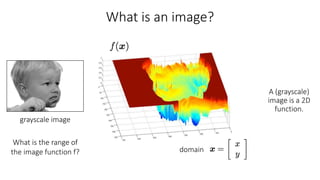
What is an image?
A (grayscale)
image is a 2D
function.
domain
What is the range of
the image function f?
grayscale image
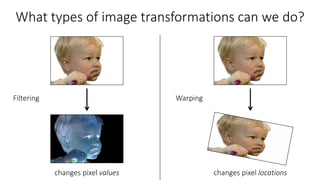
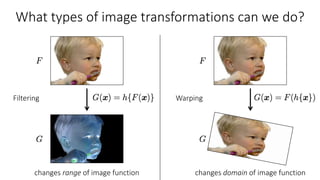
What types of image transformations can we do?
changes pixel values changes pixel locations
Filtering Warping
What types of image transformations can we do?
changes range of image function changes domain of image function
Filtering Warping
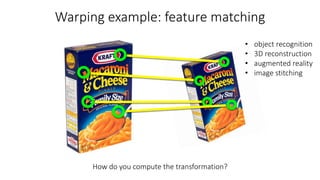
Warping example: feature matching
How do you compute the transformation?
• object recognition
• 3D reconstruction
• augmented reality
• image stitching
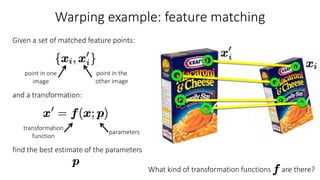
Warping example: feature matching
Given a set of matched feature points:
and a transformation:
find the best estimate of the parameters
parameters
transformation
function
point in one
image
point in the
other image
What kind of transformation functions are there?
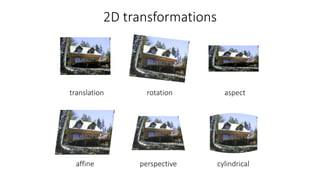
2D transformations
2D transformations
translation rotation aspect
affine perspective cylindrical
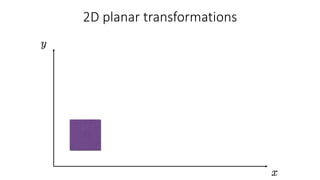
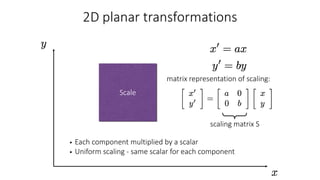
2D planar transformations
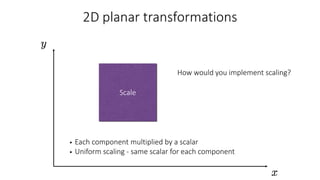
• Each component multiplied by a scalar
• Uniform scaling - same scalar for each component
Scale
How would you implement scaling?
• Each component multiplied by a scalar
• Uniform scaling - same scalar for each component
Scale
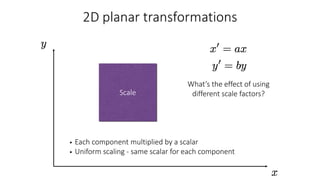
What’s the effect of using
different scale factors?
• Each component multiplied by a scalar
• Uniform scaling - same scalar for each component
Scale
scaling matrix S
matrix representation of scaling:
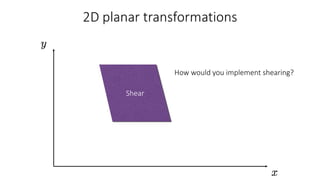
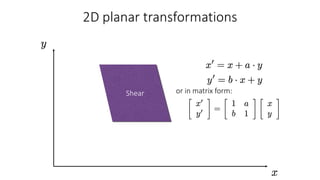
Shear
How would you implement shearing?
Shear or in matrix form:
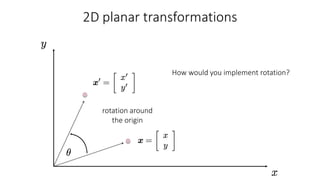
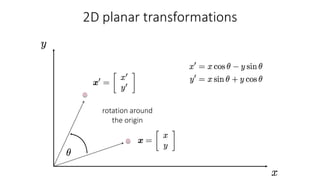
rotation around
the origin
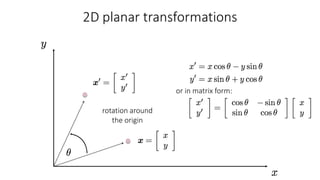
How would you implement rotation?
rotation around
the origin
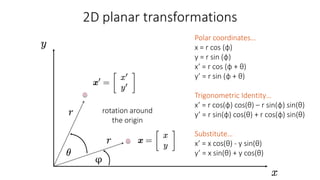
rotation around
the origin
Polar coordinates…
x = r cos (φ)
y = r sin (φ)
x’ = r cos (φ + θ)
y’ = r sin (φ + θ)
Trigonometric Identity…
x’ = r cos(φ) cos(θ) – r sin(φ) sin(θ)
y’ = r sin(φ) cos(θ) + r cos(φ) sin(θ)
Substitute…
x’ = x cos(θ) - y sin(θ)
y’ = x sin(θ) + y cos(θ)
φ
𝑟
𝑟
rotation around
the origin
or in matrix form:
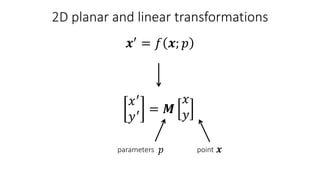
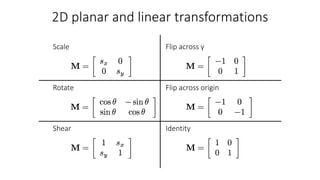
2D planar and linear transformations
point
𝒙′
= 𝑓 𝒙; 𝑝
𝑥′
𝑦′ = 𝑴
𝑥
𝑦
parameters 𝑝 𝒙
2D planar and linear transformations
Scale
Rotate
Shear
Flip across y
Flip across origin
Identity
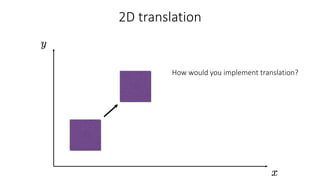
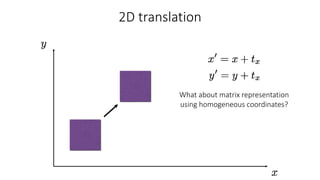
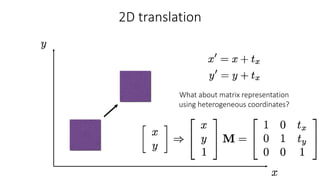
2D translation
How would you implement translation?
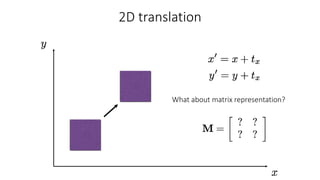
2D translation
What about matrix representation?
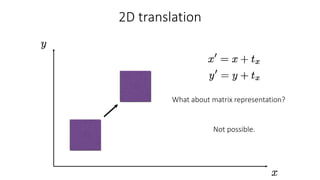
2D translation
What about matrix representation?
Not possible.
Projective geometry 101
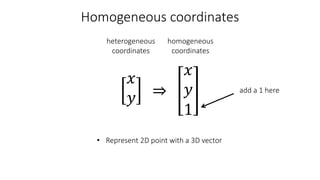
Homogeneous coordinates
• Represent 2D point with a 3D vector
add a 1 here
𝑥
𝑦
𝑥
𝑦
1
heterogeneous
coordinates
homogeneous
coordinates
𝑥
𝑦
𝑥
𝑦
1
≝
𝑎𝑥
𝑎𝑦
𝑎
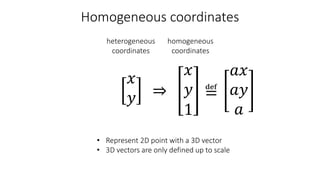
Homogeneous coordinates
• Represent 2D point with a 3D vector
• 3D vectors are only defined up to scale
heterogeneous
coordinates
homogeneous
coordinates
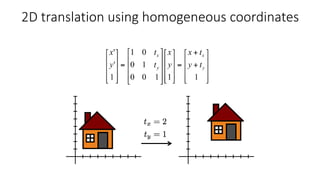
2D translation
What about matrix representation
using homogeneous coordinates?
2D translation
What about matrix representation
using heterogeneous coordinates?
2D translation using homogeneous coordinates
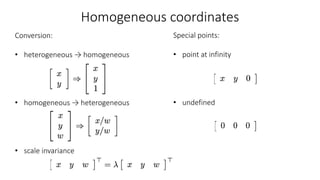
Homogeneous coordinates
Conversion:
• heterogeneous → homogeneous
• homogeneous → heterogeneous
• scale invariance
Special points:
• point at infinity
• undefined
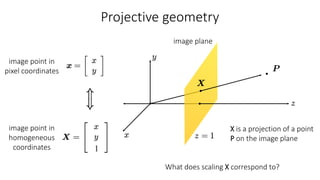
Projective geometry
image plane
X is a projection of a point
P on the image plane
image point in
pixel coordinates
image point in
homogeneous
coordinates
What does scaling X correspond to?
Transformations in projective geometry
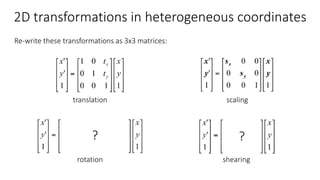
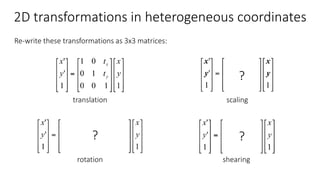
2D transformations in heterogeneous coordinates
Re-write these transformations as 3x3 matrices:
translation
rotation shearing
scaling
?
?
?
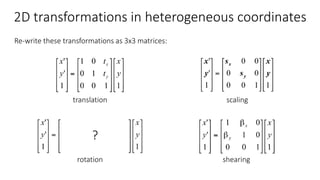
2D transformations in heterogeneous coordinates
Re-write these transformations as 3x3 matrices:
translation
rotation shearing
scaling
?
?
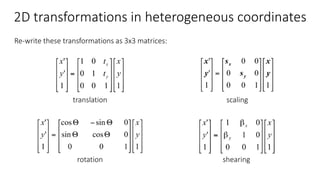
2D transformations in heterogeneous coordinates
Re-write these transformations as 3x3 matrices:
translation
rotation shearing
scaling
?
2D transformations in heterogeneous coordinates
Re-write these transformations as 3x3 matrices:
translation
rotation shearing
scaling
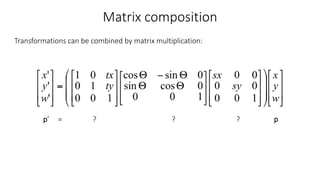
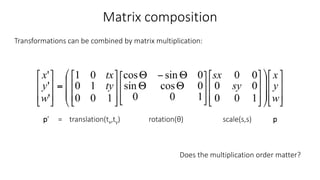
Matrix composition
Transformations can be combined by matrix multiplication:
p’ = ? ? ? p
Matrix composition
Transformations can be combined by matrix multiplication:
p’ = translation(tx,ty) rotation(θ) scale(s,s) p
Does the multiplication order matter?
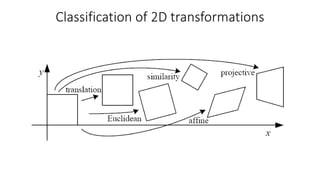
Classification of 2D transformations
?
?
?
?
?
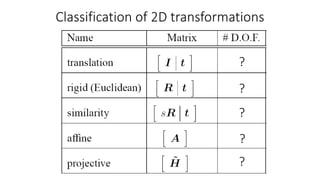
Classification of 2D transformations
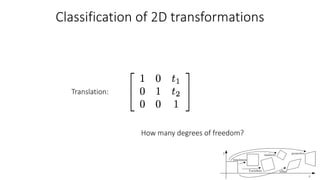
Translation:
How many degrees of freedom?
Classification of 2D transformations
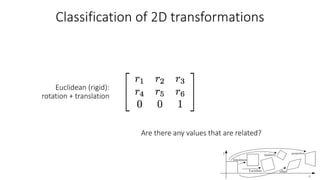
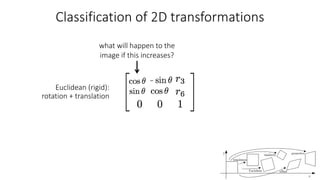
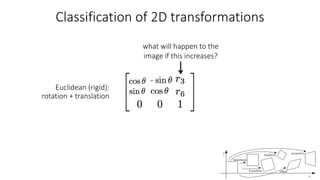
Euclidean (rigid):
rotation + translation
Are there any values that are related?
Classification of 2D transformations
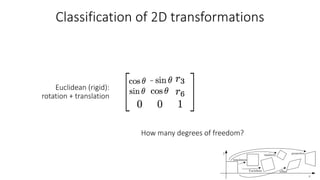
Euclidean (rigid):
rotation + translation
How many degrees of freedom?
Classification of 2D transformations
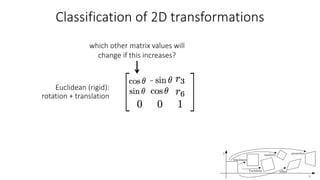
Euclidean (rigid):
rotation + translation
which other matrix values will
change if this increases?
Classification of 2D transformations
Euclidean (rigid):
rotation + translation
what will happen to the
image if this increases?
Classification of 2D transformations
Euclidean (rigid):
rotation + translation
what will happen to the
image if this increases?
Classification of 2D transformations
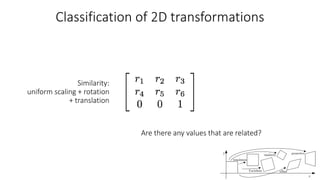
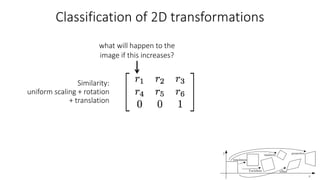
Similarity:
uniform scaling + rotation
+ translation
Are there any values that are related?
Classification of 2D transformations
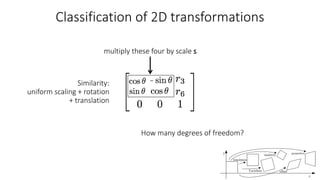
multiply these four by scale s
How many degrees of freedom?
Similarity:
uniform scaling + rotation
+ translation
Classification of 2D transformations
what will happen to the
image if this increases?
Similarity:
uniform scaling + rotation
+ translation
Classification of 2D transformations
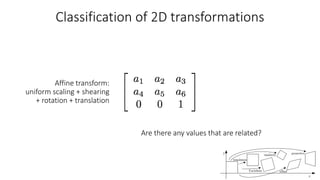
Affine transform:
uniform scaling + shearing
+ rotation + translation
Are there any values that are related?
Classification of 2D transformations
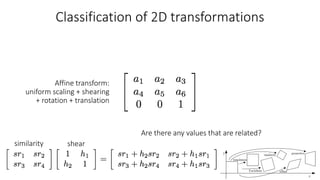
Affine transform:
uniform scaling + shearing
+ rotation + translation
Are there any values that are related?
similarity shear
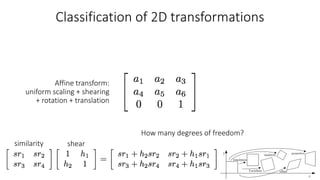
Classification of 2D transformations
Affine transform:
uniform scaling + shearing
+ rotation + translation
How many degrees of freedom?
similarity shear
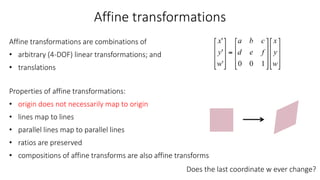
Affine transformations
Affine transformations are combinations of
• arbitrary (4-DOF) linear transformations; and
• translations
Properties of affine transformations:
• origin does not necessarily map to origin
• lines map to lines
• parallel lines map to parallel lines
• ratios are preserved
• compositions of affine transforms are also affine transforms
Does the last coordinate w ever change?
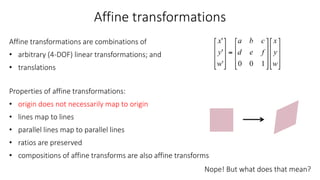
Affine transformations
Affine transformations are combinations of
• arbitrary (4-DOF) linear transformations; and
• translations
Properties of affine transformations:
• origin does not necessarily map to origin
• lines map to lines
• parallel lines map to parallel lines
• ratios are preserved
• compositions of affine transforms are also affine transforms
Nope! But what does that mean?
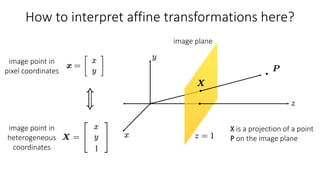
How to interpret affine transformations here?
image plane
X is a projection of a point
P on the image plane
image point in
pixel coordinates
image point in
heterogeneous
coordinates
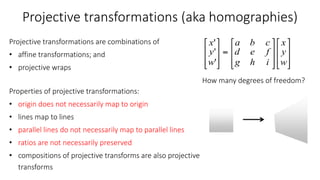
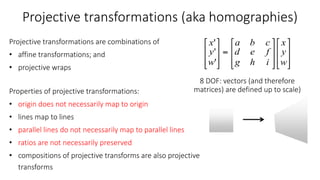
Projective transformations (aka homographies)
Projective transformations are combinations of
• affine transformations; and
• projective wraps
Properties of projective transformations:
• origin does not necessarily map to origin
• lines map to lines
• parallel lines do not necessarily map to parallel lines
• ratios are not necessarily preserved
• compositions of projective transforms are also projective
transforms
How many degrees of freedom?
Projective transformations (aka homographies)
Projective transformations are combinations of
• affine transformations; and
• projective wraps
Properties of projective transformations:
• origin does not necessarily map to origin
• lines map to lines
• parallel lines do not necessarily map to parallel lines
• ratios are not necessarily preserved
• compositions of projective transforms are also projective
transforms
8 DOF: vectors (and therefore
matrices) are defined up to scale)
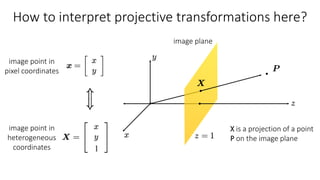
How to interpret projective transformations here?
image plane
X is a projection of a point
P on the image plane
image point in
pixel coordinates
image point in
heterogeneous
coordinates
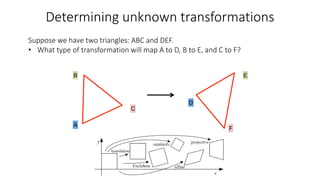
Determining unknown (affine) 2D transformations
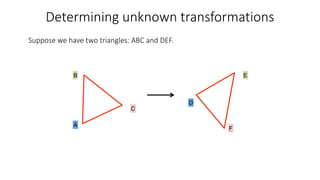
Determining unknown transformations
A
D
B E
F
C
Suppose we have two triangles: ABC and DEF.
Determining unknown transformations
A
D
B E
F
C
Suppose we have two triangles: ABC and DEF.
• What type of transformation will map A to D, B to E, and C to F?
Determining unknown transformations
A
D
B E
F
C
Suppose we have two triangles: ABC and DEF.
• What type of transformation will map A to D, B to E, and C to F?
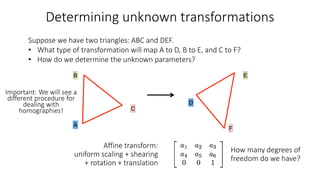
• How do we determine the unknown parameters?
Affine transform:
uniform scaling + shearing
+ rotation + translation
How many degrees of
freedom do we have?
Important: We will see a
different procedure for
dealing with
homographies!
Determining unknown transformations
A
D
B E
F
C
Suppose we have two triangles: ABC and DEF.
• What type of transformation will map A to D, B to E, and C to F?
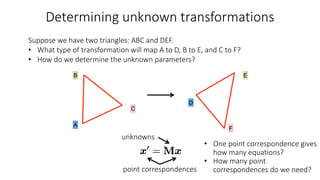
• How do we determine the unknown parameters?
• One point correspondence gives
how many equations?
• How many point
correspondences do we need?
point correspondences
unknowns
Determining unknown transformations
A
D
B E
F
C
Suppose we have two triangles: ABC and DEF.
• What type of transformation will map A to D, B to E, and C to F?
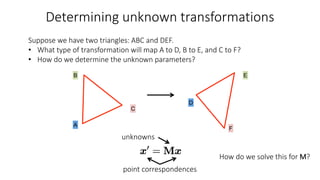
• How do we determine the unknown parameters?
How do we solve this for M?
point correspondences
unknowns
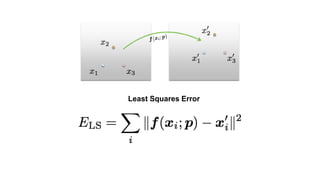
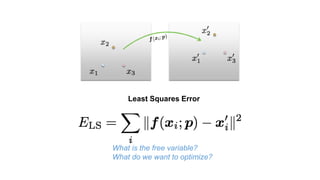
Least Squares Error
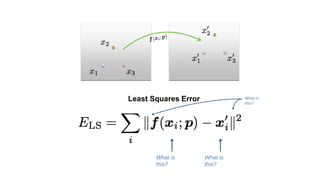
What is
this?
Least Squares Error
What is
this?
What is
this?
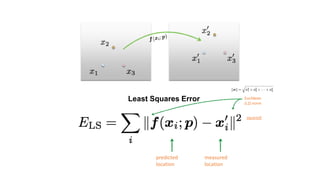
predicted
location
Least Squares Error
measured
location
Euclidean
(L2) norm
Euclidean
(L2) norm
squared!
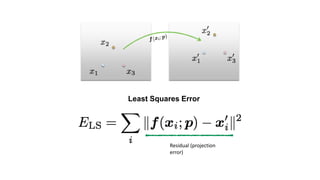
Residual (projection
error)
Least Squares Error
What is the free variable?
What do we want to optimize?
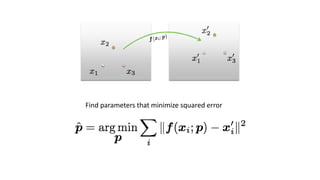
Least Squares Error
Find parameters that minimize squared error
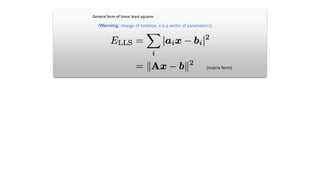
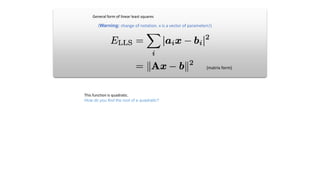
General form of linear least squares
(matrix form)
(Warning: change of notation. x is a vector of parameters!)
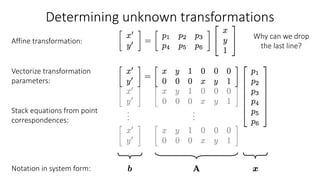
Determining unknown transformations
Affine transformation:
Vectorize transformation
parameters:
Notation in system form:
Stack equations from point
correspondences:
Why can we drop
the last line?
General form of linear least squares
(matrix form)
(Warning: change of notation. x is a vector of parameters!)
This function is quadratic.
How do you find the root of a quadratic?
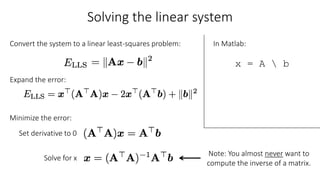
Solving the linear system
Convert the system to a linear least-squares problem:
Expand the error:
Set derivative to 0
Minimize the error:
Solve for x
In Matlab:
x = A  b
Note: You almost never want to
compute the inverse of a matrix.
Linear least squares estimation only works when the transform function is ?
Linear least squares estimation only works when the transform function is linear! (duh)
Also doesn’t deal well with outliers
References
Basic reading:
• Szeliski textbook, Section 3.6.
Additional reading:
• Hartley and Zisserman, “Multiple View Geometry in Computer Vision,” Cambridge University Press 2004.
a comprehensive treatment of all aspects of projective geometry relating to computer vision, and also
a very useful reference for the second part of the class.
• Richter-Gebert, “Perspectives on projective geometry,” Springer 2011.
a beautiful, thorough, and very accessible mathematics textbook on projective geometry (available
online for free from CMU’s library).

2D Transformation.pptx

  • 1.
    2D transformations (a.k.a.warping) 16-385 Computer Vision Spring 2020, Lecture 7 http://www.cs.cmu.edu/~16385/
  • 2.
    Course announcements • Homework1 posted on course website. - Due on February 5th at 23:59. - This homework is in Matlab. - How many of you have looked at/started/finished homework 1? • Homework 2 will be posted tonight on the course website. - It will be due on February 19th at 23:59 pm. - Start early because it is much larger and more difficult than homework 1. • Second theory quiz on course website and due on February 10th, at 23:59. • Starting with quiz 3, release/due dates will be on Sunday. • Reminder: All office hours are at the Smith Hall 200 conference room (not my office!). • How was the first quiz?
  • 3.
    Overview of today’slecture • Reminder: image transformations. • 2D transformations. • Projective geometry 101. • Transformations in projective geometry. • Classification of 2D transformations. • Determining unknown 2D transformations. • Determining unknown image warps.
  • 4.
    Slide credits Most ofthese slides were adapted from: • Kris Kitani (16-385, Spring 2017).
  • 5.
  • 6.
    What is animage? A (grayscale) image is a 2D function. domain What is the range of the image function f? grayscale image
  • 7.
    What types ofimage transformations can we do? changes pixel values changes pixel locations Filtering Warping
  • 8.
    What types ofimage transformations can we do? changes range of image function changes domain of image function Filtering Warping
  • 9.
  • 10.
  • 11.
    Warping example: featurematching How do you compute the transformation? • object recognition • 3D reconstruction • augmented reality • image stitching
  • 12.
    Warping example: featurematching Given a set of matched feature points: and a transformation: find the best estimate of the parameters parameters transformation function point in one image point in the other image What kind of transformation functions are there?
  • 13.
  • 14.
    2D transformations translation rotationaspect affine perspective cylindrical
  • 15.
  • 16.
    • Each componentmultiplied by a scalar • Uniform scaling - same scalar for each component Scale How would you implement scaling?
  • 17.
    • Each componentmultiplied by a scalar • Uniform scaling - same scalar for each component Scale What’s the effect of using different scale factors?
  • 18.
    • Each componentmultiplied by a scalar • Uniform scaling - same scalar for each component Scale scaling matrix S matrix representation of scaling:
  • 19.
    Shear How would youimplement shearing?
  • 20.
    Shear or inmatrix form:
  • 21.
    rotation around the origin Howwould you implement rotation?
  • 22.
  • 23.
    rotation around the origin Polarcoordinates… x = r cos (φ) y = r sin (φ) x’ = r cos (φ + θ) y’ = r sin (φ + θ) Trigonometric Identity… x’ = r cos(φ) cos(θ) – r sin(φ) sin(θ) y’ = r sin(φ) cos(θ) + r cos(φ) sin(θ) Substitute… x’ = x cos(θ) - y sin(θ) y’ = x sin(θ) + y cos(θ) φ 𝑟 𝑟
  • 24.
  • 25.
    2D planar andlinear transformations point 𝒙′ = 𝑓 𝒙; 𝑝 𝑥′ 𝑦′ = 𝑴 𝑥 𝑦 parameters 𝑝 𝒙
  • 26.
    2D planar andlinear transformations Scale Rotate Shear Flip across y Flip across origin Identity
  • 27.
    2D translation How wouldyou implement translation?
  • 28.
    2D translation What aboutmatrix representation?
  • 29.
    2D translation What aboutmatrix representation? Not possible.
  • 30.
  • 31.
    Homogeneous coordinates • Represent2D point with a 3D vector add a 1 here 𝑥 𝑦 𝑥 𝑦 1 heterogeneous coordinates homogeneous coordinates
  • 32.
    𝑥 𝑦 𝑥 𝑦 1 ≝ 𝑎𝑥 𝑎𝑦 𝑎 Homogeneous coordinates • Represent2D point with a 3D vector • 3D vectors are only defined up to scale heterogeneous coordinates homogeneous coordinates
  • 33.
    2D translation What aboutmatrix representation using homogeneous coordinates?
  • 34.
    2D translation What aboutmatrix representation using heterogeneous coordinates?
  • 35.
    2D translation usinghomogeneous coordinates
  • 36.
    Homogeneous coordinates Conversion: • heterogeneous→ homogeneous • homogeneous → heterogeneous • scale invariance Special points: • point at infinity • undefined
  • 37.
    Projective geometry image plane Xis a projection of a point P on the image plane image point in pixel coordinates image point in homogeneous coordinates What does scaling X correspond to?
  • 38.
  • 39.
    2D transformations inheterogeneous coordinates Re-write these transformations as 3x3 matrices: translation rotation shearing scaling ? ? ?
  • 40.
    2D transformations inheterogeneous coordinates Re-write these transformations as 3x3 matrices: translation rotation shearing scaling ? ?
  • 41.
    2D transformations inheterogeneous coordinates Re-write these transformations as 3x3 matrices: translation rotation shearing scaling ?
  • 42.
    2D transformations inheterogeneous coordinates Re-write these transformations as 3x3 matrices: translation rotation shearing scaling
  • 43.
    Matrix composition Transformations canbe combined by matrix multiplication: p’ = ? ? ? p
  • 44.
    Matrix composition Transformations canbe combined by matrix multiplication: p’ = translation(tx,ty) rotation(θ) scale(s,s) p Does the multiplication order matter?
  • 45.
    Classification of 2Dtransformations
  • 46.
    Classification of 2Dtransformations
  • 47.
    Classification of 2Dtransformations ? ? ? ? ?
  • 48.
    Classification of 2Dtransformations Translation: How many degrees of freedom?
  • 49.
    Classification of 2Dtransformations Euclidean (rigid): rotation + translation Are there any values that are related?
  • 50.
    Classification of 2Dtransformations Euclidean (rigid): rotation + translation How many degrees of freedom?
  • 51.
    Classification of 2Dtransformations Euclidean (rigid): rotation + translation which other matrix values will change if this increases?
  • 52.
    Classification of 2Dtransformations Euclidean (rigid): rotation + translation what will happen to the image if this increases?
  • 53.
    Classification of 2Dtransformations Euclidean (rigid): rotation + translation what will happen to the image if this increases?
  • 54.
    Classification of 2Dtransformations Similarity: uniform scaling + rotation + translation Are there any values that are related?
  • 55.
    Classification of 2Dtransformations multiply these four by scale s How many degrees of freedom? Similarity: uniform scaling + rotation + translation
  • 56.
    Classification of 2Dtransformations what will happen to the image if this increases? Similarity: uniform scaling + rotation + translation
  • 57.
    Classification of 2Dtransformations Affine transform: uniform scaling + shearing + rotation + translation Are there any values that are related?
  • 58.
    Classification of 2Dtransformations Affine transform: uniform scaling + shearing + rotation + translation Are there any values that are related? similarity shear
  • 59.
    Classification of 2Dtransformations Affine transform: uniform scaling + shearing + rotation + translation How many degrees of freedom? similarity shear
  • 60.
    Affine transformations Affine transformationsare combinations of • arbitrary (4-DOF) linear transformations; and • translations Properties of affine transformations: • origin does not necessarily map to origin • lines map to lines • parallel lines map to parallel lines • ratios are preserved • compositions of affine transforms are also affine transforms Does the last coordinate w ever change?
  • 61.
    Affine transformations Affine transformationsare combinations of • arbitrary (4-DOF) linear transformations; and • translations Properties of affine transformations: • origin does not necessarily map to origin • lines map to lines • parallel lines map to parallel lines • ratios are preserved • compositions of affine transforms are also affine transforms Nope! But what does that mean?
  • 62.
    How to interpretaffine transformations here? image plane X is a projection of a point P on the image plane image point in pixel coordinates image point in heterogeneous coordinates
  • 63.
    Projective transformations (akahomographies) Projective transformations are combinations of • affine transformations; and • projective wraps Properties of projective transformations: • origin does not necessarily map to origin • lines map to lines • parallel lines do not necessarily map to parallel lines • ratios are not necessarily preserved • compositions of projective transforms are also projective transforms How many degrees of freedom?
  • 64.
    Projective transformations (akahomographies) Projective transformations are combinations of • affine transformations; and • projective wraps Properties of projective transformations: • origin does not necessarily map to origin • lines map to lines • parallel lines do not necessarily map to parallel lines • ratios are not necessarily preserved • compositions of projective transforms are also projective transforms 8 DOF: vectors (and therefore matrices) are defined up to scale)
  • 65.
    How to interpretprojective transformations here? image plane X is a projection of a point P on the image plane image point in pixel coordinates image point in heterogeneous coordinates
  • 66.
    Determining unknown (affine)2D transformations
  • 67.
    Determining unknown transformations A D BE F C Suppose we have two triangles: ABC and DEF.
  • 68.
    Determining unknown transformations A D BE F C Suppose we have two triangles: ABC and DEF. • What type of transformation will map A to D, B to E, and C to F?
  • 69.
    Determining unknown transformations A D BE F C Suppose we have two triangles: ABC and DEF. • What type of transformation will map A to D, B to E, and C to F? • How do we determine the unknown parameters? Affine transform: uniform scaling + shearing + rotation + translation How many degrees of freedom do we have? Important: We will see a different procedure for dealing with homographies!
  • 70.
    Determining unknown transformations A D BE F C Suppose we have two triangles: ABC and DEF. • What type of transformation will map A to D, B to E, and C to F? • How do we determine the unknown parameters? • One point correspondence gives how many equations? • How many point correspondences do we need? point correspondences unknowns
  • 71.
    Determining unknown transformations A D BE F C Suppose we have two triangles: ABC and DEF. • What type of transformation will map A to D, B to E, and C to F? • How do we determine the unknown parameters? How do we solve this for M? point correspondences unknowns
  • 72.
  • 73.
    What is this? Least SquaresError What is this? What is this?
  • 74.
  • 75.
  • 76.
    What is thefree variable? What do we want to optimize? Least Squares Error
  • 77.
    Find parameters thatminimize squared error
  • 78.
    General form oflinear least squares (matrix form) (Warning: change of notation. x is a vector of parameters!)
  • 79.
    Determining unknown transformations Affinetransformation: Vectorize transformation parameters: Notation in system form: Stack equations from point correspondences: Why can we drop the last line?
  • 80.
    General form oflinear least squares (matrix form) (Warning: change of notation. x is a vector of parameters!) This function is quadratic. How do you find the root of a quadratic?
  • 81.
    Solving the linearsystem Convert the system to a linear least-squares problem: Expand the error: Set derivative to 0 Minimize the error: Solve for x In Matlab: x = A b Note: You almost never want to compute the inverse of a matrix.
  • 82.
    Linear least squaresestimation only works when the transform function is ?
  • 83.
    Linear least squaresestimation only works when the transform function is linear! (duh) Also doesn’t deal well with outliers
  • 84.
    References Basic reading: • Szeliskitextbook, Section 3.6. Additional reading: • Hartley and Zisserman, “Multiple View Geometry in Computer Vision,” Cambridge University Press 2004. a comprehensive treatment of all aspects of projective geometry relating to computer vision, and also a very useful reference for the second part of the class. • Richter-Gebert, “Perspectives on projective geometry,” Springer 2011. a beautiful, thorough, and very accessible mathematics textbook on projective geometry (available online for free from CMU’s library).