Stracener_EMIS 7305/5305_Spr08_02.14.08
1
Systems Reliability Growth Modeling
and Analysis
Dr. Jerrell T. Stracener, SAE Fellow
Leadership in Engineering
EMIS 7305/5305
Systems Reliability, Supportability and Availability Analysis
Systems Engineering Program
Department of Engineering Management, Information and Systems
Stracener_EMIS 7305/5305_Spr08_02.14.08
2
Reliability Development Test Definitions
• MIL-STD-785 Definition
A series of tests conducted to disclose deficiencies
and to verify that corrective actions will prevent
recurrence in the operational inventory (also
known as TAAF testing)
• Definition - Narrow View
A reliability development test (RDT) is a dedicated
and specifically designed and conducted test under
usage and maintenance environments that the
equipment is expected to experience during its
service life
Stracener_EMIS 7305/5305_Spr08_02.14.08
3
Reliability Development Test Definitions - continued
• Definition - General View
A reliability development test is any test where
results are designed to improve equipment
reliability
Stracener_EMIS 7305/5305_Spr08_02.14.08
4
Reliability Growth Test Objective and Purpose
• Objective - identify reliability problems early
in the development phase and incorporate
corrective action to preclude recurrence during
service usage
• Purpose - improve the reliability of production
equipment by identifying and correcting
deficiencies in the design, selection of parts,
and manufacturing processes
Stracener_EMIS 7305/5305_Spr08_02.14.08
5
•A technique for reliability development and growth that
requires that a series of tests be conducted, problems
identified and analyzed, and corrective actions be taken.
•TAAF and other reliability growth techniques require a
closed loop feedback and corrective action system and
follow a common problem solving process:
1. Detect failures
2. Feed back problems to designer
3. Analyze and redesign to correct problem
4. Incorporate redesign into system
5. Verify fix by operating system
Test, Analyze and Fix (TAAF)
Stracener_EMIS 7305/5305_Spr08_02.14.08
6
The TAAF Process
• Test analyze and fix (TAAF) is a philosophy
that can be applied to any test
- Data for all failures/problems should
be used for TAAF
- This approach decreases the likelihood
of major problems in service
• Data from each failure/problem from every
test conducted on an item should be analyzed
for corrective action, positive fix and verification
of the fix
Stracener_EMIS 7305/5305_Spr08_02.14.08
7
TAAF Benefits
TAAF provides the means to accelerate design
and reliability maturity through the corrective
actions taken for design performance/reliability
problems identified.
TAAF provides advanced information related
to how the design will work in the field during
the early years of deployment.
Stracener_EMIS 7305/5305_Spr08_02.14.08
8
Selection Criteria for RDT
• Major contributor to system (end-item) failure rate
• New development or application
• High unit cost
• Experience indicates need for improvement
Stracener_EMIS 7305/5305_Spr08_02.14.08
9
Reliability Test Length
Fixed length
- 400 to 10,000 hours (chamber hours)
various tests over past 10 years mostly avionics
and electronics
- Easy to price
- Avoids numbers game of when to stop testing
Truncated
- Stop testing when corrective action rate
reaches a specified level
- Difficult to price
- Analysis of data becomes more important
Stracener_EMIS 7305/5305_Spr08_02.14.08
10
Reliability Growth Management
• Planning the reliability growth necessary to
meet program objectives as a function of
program schedule
• Planning of tasks and program resources
necessary to achieve the planned growth
- Reliability test data
- Failure analysis
- Corrective action
• Assessment and forecast of reliability growth
relative to plan
- Provides early warning of program
reliability problem
Stracener_EMIS 7305/5305_Spr08_02.14.08
11
Reliability Growth
• Reliability growth is the positive improvement
of system reliability through the systematic and
permanent removal of the reasons for failure
• Reliability improvements can be achieved
through testing to identify deficiencies and/or
weaknesses, followed by positive actions to
correct them. Test, analyze, and fix (TAAF) is
one process for achieving reliability growth.
Stracener_EMIS 7305/5305_Spr08_02.14.08
12
Reliability Growth - continued
• Growth curves are management tools; they
show the manager where the system reliability
is now and where is must go
• Air Force Regulation 800-18, Air Force reliability
and maintainability program, requires the use of
reliability growth curves to track improvements
to achieve reliability requirements
Stracener_EMIS 7305/5305_Spr08_02.14.08
13
Reliability Growth Curves
•Decision makers can use reliability growth curves
to assess the need to reallocate resources or
change schedules to achieve R&M requirements
Stracener_EMIS 7305/5305_Spr08_02.14.08
14
DOD Policy on Reliability Growth and Testing
• DOD 5000.40 requires that a period of testing
be scheduled with each intermediate milestone
for purposes of finding design and manufacturing
defects
• AFR 800-18 is intended to implement the
requirements of DOD 5000.40 and implies
reliability growth by such statements as ‘terms
are expressed in mature system values along
with interim thresholds’
Stracener_EMIS 7305/5305_Spr08_02.14.08
15
DOD Policy on Reliability Growth and Testing
• MIL-STD-785 states that a properly balanced
reliability program will emphasize ESS and
RD/GT. It also notes that RD/GT must not
include accept/reject criteria because the
contractors interest in passing a test would be
in conflict with the purpose of doing a RD/GT
MIL-HDBK-781
Stracener_EMIS 7305/5305_Spr08_02.14.08
16
Reliability Growth Models
• AMSAA/Duane
• ARIMA
• ARINC
• Aroef
• Barlow-Scheuer
• Cox-Lewis
• Endless-Burn-In (EBI)
• Exponential single term
• Extended Cox-Lewis
• General Random Point
Process
• Gompertz
• Homogeneous Poisson
process models
• IBM
• Linear
• Lloyd-Lipow
• Logistic
• Modified Duane
• Modified Geometric
• Modified Gompertz
• Simple exponential
Stracener_EMIS 7305/5305_Spr08_02.14.08
17
Reliability Growth Model Types
Engineering Statistical
models models
Deterministic Models Poisson Process Time Series
models
Endless-Burn-In AMSAA/Duane ARIMA
Cox-Lewis
Modified Duane
Stracener_EMIS 7305/5305_Spr08_02.14.08
18
The Duane Model
•In 1964 J.T Duane, with General Electric Company, published a
paper in the IEEE Transactions on Aerospace (Vol. 2, No. 2, April
1964) titled “Learning Curve Approach to Reliability Monitoring.”
•Duane formulated a mathematical relationship for forecasting and
monitoring reliability improvement as a function of cumulative
time.
•The model was based on concluding, from analysis of data, that a
straight line provided a reasonably good fit to cumulative MTBF
vs. cumulative time when plotted on a log-log scale.
Stracener_EMIS 7305/5305_Spr08_02.14.08
19
Reliability Growth Analysis
• To meet reliability goals, a technique must be
used to track reliability and signal when corrective
action should be taken
• J.T. Duane
(1964) noticed
that in many
cases this
relationship
followed a
straight
line on a
log-log plot
Stracener_EMIS 7305/5305_Spr08_02.14.08
20
Jet Engine Control System Reliability - Growth
Stracener_EMIS 7305/5305_Spr08_02.14.08
21
The Duane Model
The Duane Model can be formulated in two different,
but mathematically equivalent, ways: MTBF as a
Function of time and failure rate as a function of time.
In terms of MTBF, the Duane Model is:
where MTBFc(t) is the cumulative MTBF at cumulative
time t, t is cumulative time, and  and  are
parameters of the model.
  α
C κt
t
MTBF 
Stracener_EMIS 7305/5305_Spr08_02.14.08
22
The Duane Model
The parameter  is the reliability improvement, or
growth, rate and  is cumulative MTBF at t=1 hour.
Notice that the graph of the Duane Model on log-log
scale is a straight line since
log MTBF(t) = log k +  log t
which is of the form
y = a + bx
Stracener_EMIS 7305/5305_Spr08_02.14.08
23
The Duane Model
Since
where rc=the cumulative number of failures in time t,
 
c
C
r
t
t
MTBF 
 
α
1
α
C
c
t
κ
1
κt
t
t
MTBF
t
r





Stracener_EMIS 7305/5305_Spr08_02.14.08
24
The Duane Model
Then
dt
drc
(t)
MTBF
1
κt
α
-
1
α)t
-
(1
κ
1
)
t
κ
1
(
dt
d
i
α
α
α
1






(t)
MTBF
κt c
α

α
1
(t)
MTBF
(t)
MTBF c
I


But since
Stracener_EMIS 7305/5305_Spr08_02.14.08
25
The Duane Model
• The instantaneous MTBF as a function of
cumulative test time is obtained mathematically
from MTBFC(t) and is given by
where MTBFi(t) is the instantaneous MTBF at time
t and is interpreted as the equipment MTBF if
reliability development testing was terminated after
a cumulative amount of testing time, t.
  

t
K


1
t
MTBFi
(t)
MTBF
1
1
C



Stracener_EMIS 7305/5305_Spr08_02.14.08
26
10 100 1000 10000
100
1000
10
Cumulative Test Hours
MTBF
Cumulative
Instantaneous
MTBF Growth Curves
Stracener_EMIS 7305/5305_Spr08_02.14.08
27
The Duane Model
• The Duane Model may also be formulated in
terms of equipment failure rate as a function of
cumulative test time as follows:
and
where
C(t) is the cumulative failure rate after test time t
k* is the initial failure rate and k*=1/k,
B is the failure rate growth (decrease rate)
i(t) is the instantaneous failure rate at time t
-α
*
C t
κ
(t)
λ 
(t)
α)λ
(1
t
α)κ
(1
(t)
λ
C
-α
*
i




Stracener_EMIS 7305/5305_Spr08_02.14.08
28
The Duane Model
The initial MTBF or failure rate at the beginning of
RDT depends on a number of other factors including
type of equipment (electronics, structure, etc.)
complexity of the design and equipment operation,
technology, in terms of MTBF of failure rate,
depends on the same factors as does the starting
value, and this in addition depends on management
FRACAS and TAAF implementation.
Stracener_EMIS 7305/5305_Spr08_02.14.08
29
Failure Rate and MTBF
Stracener_EMIS 7305/5305_Spr08_02.14.08
30
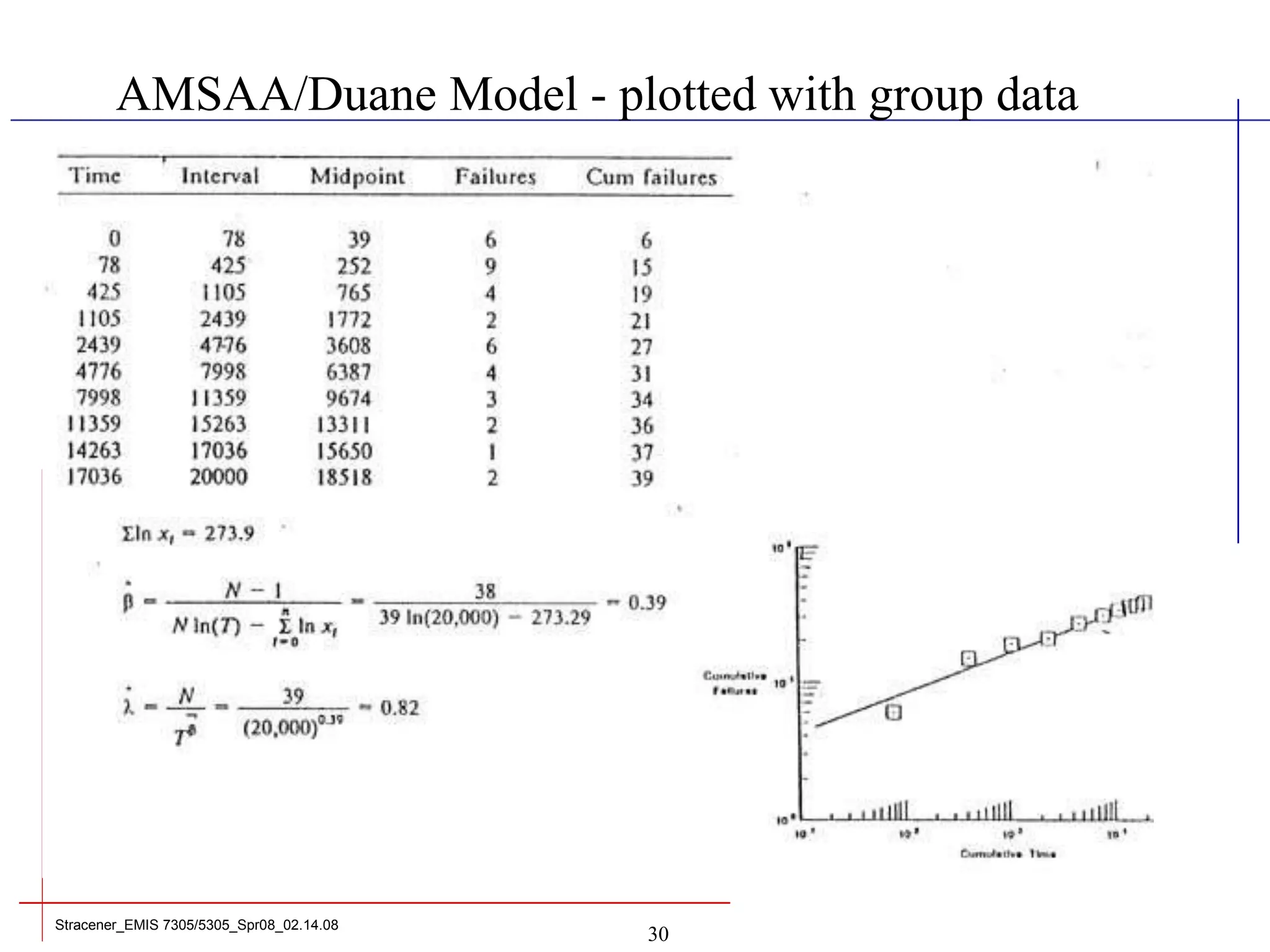
AMSAA/Duane Model - plotted with group data
Stracener_EMIS 7305/5305_Spr08_02.14.08
31
AMSAA/Duane Model - plotting the data and solving for  and 
Stracener_EMIS 7305/5305_Spr08_02.14.08
32
AMSAA/Duane Model - plotting by MTBF

293749024-Reliability-Growth.ppt

  • 1.
    Stracener_EMIS 7305/5305_Spr08_02.14.08 1 Systems ReliabilityGrowth Modeling and Analysis Dr. Jerrell T. Stracener, SAE Fellow Leadership in Engineering EMIS 7305/5305 Systems Reliability, Supportability and Availability Analysis Systems Engineering Program Department of Engineering Management, Information and Systems
  • 2.
    Stracener_EMIS 7305/5305_Spr08_02.14.08 2 Reliability DevelopmentTest Definitions • MIL-STD-785 Definition A series of tests conducted to disclose deficiencies and to verify that corrective actions will prevent recurrence in the operational inventory (also known as TAAF testing) • Definition - Narrow View A reliability development test (RDT) is a dedicated and specifically designed and conducted test under usage and maintenance environments that the equipment is expected to experience during its service life
  • 3.
    Stracener_EMIS 7305/5305_Spr08_02.14.08 3 Reliability DevelopmentTest Definitions - continued • Definition - General View A reliability development test is any test where results are designed to improve equipment reliability
  • 4.
    Stracener_EMIS 7305/5305_Spr08_02.14.08 4 Reliability GrowthTest Objective and Purpose • Objective - identify reliability problems early in the development phase and incorporate corrective action to preclude recurrence during service usage • Purpose - improve the reliability of production equipment by identifying and correcting deficiencies in the design, selection of parts, and manufacturing processes
  • 5.
    Stracener_EMIS 7305/5305_Spr08_02.14.08 5 •A techniquefor reliability development and growth that requires that a series of tests be conducted, problems identified and analyzed, and corrective actions be taken. •TAAF and other reliability growth techniques require a closed loop feedback and corrective action system and follow a common problem solving process: 1. Detect failures 2. Feed back problems to designer 3. Analyze and redesign to correct problem 4. Incorporate redesign into system 5. Verify fix by operating system Test, Analyze and Fix (TAAF)
  • 6.
    Stracener_EMIS 7305/5305_Spr08_02.14.08 6 The TAAFProcess • Test analyze and fix (TAAF) is a philosophy that can be applied to any test - Data for all failures/problems should be used for TAAF - This approach decreases the likelihood of major problems in service • Data from each failure/problem from every test conducted on an item should be analyzed for corrective action, positive fix and verification of the fix
  • 7.
    Stracener_EMIS 7305/5305_Spr08_02.14.08 7 TAAF Benefits TAAFprovides the means to accelerate design and reliability maturity through the corrective actions taken for design performance/reliability problems identified. TAAF provides advanced information related to how the design will work in the field during the early years of deployment.
  • 8.
    Stracener_EMIS 7305/5305_Spr08_02.14.08 8 Selection Criteriafor RDT • Major contributor to system (end-item) failure rate • New development or application • High unit cost • Experience indicates need for improvement
  • 9.
    Stracener_EMIS 7305/5305_Spr08_02.14.08 9 Reliability TestLength Fixed length - 400 to 10,000 hours (chamber hours) various tests over past 10 years mostly avionics and electronics - Easy to price - Avoids numbers game of when to stop testing Truncated - Stop testing when corrective action rate reaches a specified level - Difficult to price - Analysis of data becomes more important
  • 10.
    Stracener_EMIS 7305/5305_Spr08_02.14.08 10 Reliability GrowthManagement • Planning the reliability growth necessary to meet program objectives as a function of program schedule • Planning of tasks and program resources necessary to achieve the planned growth - Reliability test data - Failure analysis - Corrective action • Assessment and forecast of reliability growth relative to plan - Provides early warning of program reliability problem
  • 11.
    Stracener_EMIS 7305/5305_Spr08_02.14.08 11 Reliability Growth •Reliability growth is the positive improvement of system reliability through the systematic and permanent removal of the reasons for failure • Reliability improvements can be achieved through testing to identify deficiencies and/or weaknesses, followed by positive actions to correct them. Test, analyze, and fix (TAAF) is one process for achieving reliability growth.
  • 12.
    Stracener_EMIS 7305/5305_Spr08_02.14.08 12 Reliability Growth- continued • Growth curves are management tools; they show the manager where the system reliability is now and where is must go • Air Force Regulation 800-18, Air Force reliability and maintainability program, requires the use of reliability growth curves to track improvements to achieve reliability requirements
  • 13.
    Stracener_EMIS 7305/5305_Spr08_02.14.08 13 Reliability GrowthCurves •Decision makers can use reliability growth curves to assess the need to reallocate resources or change schedules to achieve R&M requirements
  • 14.
    Stracener_EMIS 7305/5305_Spr08_02.14.08 14 DOD Policyon Reliability Growth and Testing • DOD 5000.40 requires that a period of testing be scheduled with each intermediate milestone for purposes of finding design and manufacturing defects • AFR 800-18 is intended to implement the requirements of DOD 5000.40 and implies reliability growth by such statements as ‘terms are expressed in mature system values along with interim thresholds’
  • 15.
    Stracener_EMIS 7305/5305_Spr08_02.14.08 15 DOD Policyon Reliability Growth and Testing • MIL-STD-785 states that a properly balanced reliability program will emphasize ESS and RD/GT. It also notes that RD/GT must not include accept/reject criteria because the contractors interest in passing a test would be in conflict with the purpose of doing a RD/GT MIL-HDBK-781
  • 16.
    Stracener_EMIS 7305/5305_Spr08_02.14.08 16 Reliability GrowthModels • AMSAA/Duane • ARIMA • ARINC • Aroef • Barlow-Scheuer • Cox-Lewis • Endless-Burn-In (EBI) • Exponential single term • Extended Cox-Lewis • General Random Point Process • Gompertz • Homogeneous Poisson process models • IBM • Linear • Lloyd-Lipow • Logistic • Modified Duane • Modified Geometric • Modified Gompertz • Simple exponential
  • 17.
    Stracener_EMIS 7305/5305_Spr08_02.14.08 17 Reliability GrowthModel Types Engineering Statistical models models Deterministic Models Poisson Process Time Series models Endless-Burn-In AMSAA/Duane ARIMA Cox-Lewis Modified Duane
  • 18.
    Stracener_EMIS 7305/5305_Spr08_02.14.08 18 The DuaneModel •In 1964 J.T Duane, with General Electric Company, published a paper in the IEEE Transactions on Aerospace (Vol. 2, No. 2, April 1964) titled “Learning Curve Approach to Reliability Monitoring.” •Duane formulated a mathematical relationship for forecasting and monitoring reliability improvement as a function of cumulative time. •The model was based on concluding, from analysis of data, that a straight line provided a reasonably good fit to cumulative MTBF vs. cumulative time when plotted on a log-log scale.
  • 19.
    Stracener_EMIS 7305/5305_Spr08_02.14.08 19 Reliability GrowthAnalysis • To meet reliability goals, a technique must be used to track reliability and signal when corrective action should be taken • J.T. Duane (1964) noticed that in many cases this relationship followed a straight line on a log-log plot
  • 20.
    Stracener_EMIS 7305/5305_Spr08_02.14.08 20 Jet EngineControl System Reliability - Growth
  • 21.
    Stracener_EMIS 7305/5305_Spr08_02.14.08 21 The DuaneModel The Duane Model can be formulated in two different, but mathematically equivalent, ways: MTBF as a Function of time and failure rate as a function of time. In terms of MTBF, the Duane Model is: where MTBFc(t) is the cumulative MTBF at cumulative time t, t is cumulative time, and  and  are parameters of the model.   α C κt t MTBF 
  • 22.
    Stracener_EMIS 7305/5305_Spr08_02.14.08 22 The DuaneModel The parameter  is the reliability improvement, or growth, rate and  is cumulative MTBF at t=1 hour. Notice that the graph of the Duane Model on log-log scale is a straight line since log MTBF(t) = log k +  log t which is of the form y = a + bx
  • 23.
    Stracener_EMIS 7305/5305_Spr08_02.14.08 23 The DuaneModel Since where rc=the cumulative number of failures in time t,   c C r t t MTBF    α 1 α C c t κ 1 κt t t MTBF t r     
  • 24.
    Stracener_EMIS 7305/5305_Spr08_02.14.08 24 The DuaneModel Then dt drc (t) MTBF 1 κt α - 1 α)t - (1 κ 1 ) t κ 1 ( dt d i α α α 1       (t) MTBF κt c α  α 1 (t) MTBF (t) MTBF c I   But since
  • 25.
    Stracener_EMIS 7305/5305_Spr08_02.14.08 25 The DuaneModel • The instantaneous MTBF as a function of cumulative test time is obtained mathematically from MTBFC(t) and is given by where MTBFi(t) is the instantaneous MTBF at time t and is interpreted as the equipment MTBF if reliability development testing was terminated after a cumulative amount of testing time, t.     t K   1 t MTBFi (t) MTBF 1 1 C   
  • 26.
    Stracener_EMIS 7305/5305_Spr08_02.14.08 26 10 1001000 10000 100 1000 10 Cumulative Test Hours MTBF Cumulative Instantaneous MTBF Growth Curves
  • 27.
    Stracener_EMIS 7305/5305_Spr08_02.14.08 27 The DuaneModel • The Duane Model may also be formulated in terms of equipment failure rate as a function of cumulative test time as follows: and where C(t) is the cumulative failure rate after test time t k* is the initial failure rate and k*=1/k, B is the failure rate growth (decrease rate) i(t) is the instantaneous failure rate at time t -α * C t κ (t) λ  (t) α)λ (1 t α)κ (1 (t) λ C -α * i    
  • 28.
    Stracener_EMIS 7305/5305_Spr08_02.14.08 28 The DuaneModel The initial MTBF or failure rate at the beginning of RDT depends on a number of other factors including type of equipment (electronics, structure, etc.) complexity of the design and equipment operation, technology, in terms of MTBF of failure rate, depends on the same factors as does the starting value, and this in addition depends on management FRACAS and TAAF implementation.
  • 29.
  • 30.
  • 31.
    Stracener_EMIS 7305/5305_Spr08_02.14.08 31 AMSAA/Duane Model- plotting the data and solving for  and 
  • 32.