Addressing the Substance
Abuse Challenges of Homeless
          Families
                         Deborah Werner
                 Advocates for Human Potential, Inc,


    This presentation is made possible with support from the
  Substance Abuse and Mental Health Services Administration
Substance Use

 Abstinence
 Experimental Use
 Responsible Use
 Episodic or Situational Abuse
 Chronic Abuse
 Dependence

 Responsible use = moderate, legal consumption
              in low-risk settings               2
Not all Use is Addiction
 Use of Illicit Substances
 Heavy consumption
    Binge drinking
    Poor coping strategy
 High-Risk Settings
    Driving under influence
    While caring for child
 Episodical/Situational Abuse
    Common co-occurrence with intimate partner
      violence

  Interventions include: education, brief interventions,   3
   harm reduction, alternative activities, coping skills
Addiction and Dependency

 Brain disorder
 Brain impacted
 Cravings
 Tolerance

 The individual becomes controlled by the
substance at a cellular level. Use continues
   despite catastrophic consequences.
                    – Nora Volkow, MD, paraphrased   4
The Substance Use and Mental
Disorders Landscape is Changing
Reforms

 Ensures consumer                  Allows states the option of
  protections in the insurance       continuing Medicaid
  market.                            coverage to former foster
                                     care children up to the age
 Creates immediate options
                                     of 25 years old.
  for people who can’t get
  insurance today.                  Ensures free preventive
                                     services.
 Expands health insurance
  coverage to 32 million            Small business owners and
  Americans.                         employees will be insured
 Adds 16 mil with incomes          Reduces uncompensated
  below 133% of the federal          care.
  poverty level to Medicaid.
Impact of Reform & Parity

 Creates guaranteed access to mental health and substance use
  disorder services at parity in most major public programs
  including Medicaid and Qualified Health Plans (QHPs) to cover the
  uninsured and small businesses.
 Provides changes to the Medicaid program to continue and
  expand home and community-based services for individuals with
  mental health and substance use disorders.
 Allows state Medicaid programs to establish health homes for
  those with chronic illnesses. States that seek this option must
  consult and coordinate with SAMHSA regarding the prevention
  and treatment of mental illness and substance use disorders
  among those with chronic illnesses.
Impact of Reform & Parity
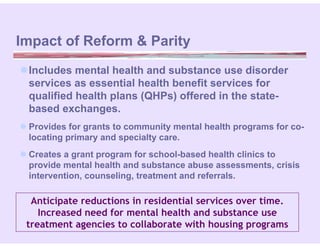
Includes mental health and substance use disorder
 services as essential health benefit services for
 qualified health plans (QHPs) offered in the state-
 based exchanges.
 Provides for grants to community mental health programs for co-
  locating primary and specialty care.
 Creates a grant program for school-based health clinics to
  provide mental health and substance abuse assessments, crisis
  intervention, counseling, treatment and referrals.

  Anticipate reductions in residential services over time.
    Increased need for mental health and substance use
 treatment agencies to collaborate with housing programs
While
substance use/abuse
  in and of itself is
  not child abuse –
      behaviors
   associated with
   substance use/
    abuse can put
     children at
   significant risk
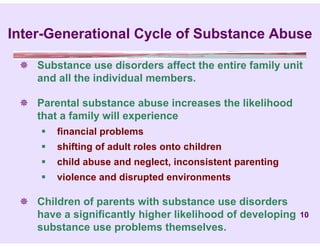
Inter-Generational Cycle of Substance Abuse

  Substance use disorders affect the entire family unit
   and all the individual members.

  Parental substance abuse increases the likelihood
   that a family will experience
        financial problems
        shifting of adult roles onto children
        child abuse and neglect, inconsistent parenting
        violence and disrupted environments

  Children of parents with substance use disorders
   have a significantly higher likelihood of developing    10
   substance use problems themselves.
Families do recover!
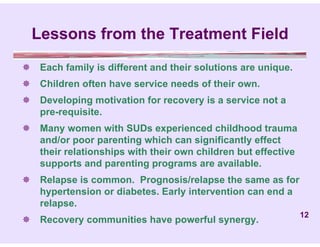
Lessons from the Treatment Field
 Each family is different and their solutions are unique.
 Children often have service needs of their own.
 Developing motivation for recovery is a service not a
  pre-requisite.
 Many women with SUDs experienced childhood trauma
  and/or poor parenting which can significantly effect
  their relationships with their own children but effective
  supports and parenting programs are available.
 Relapse is common. Prognosis/relapse the same as for
  hypertension or diabetes. Early intervention can end a
  relapse.
                                                              12
 Recovery communities have powerful synergy.
Ending the Cycle
   Accessible Gender-Responsive, Trauma-Informed Behavioral
    Health Services
   Children’s Assessments, Developmental Services, Education
   Comprehensive Services for Families and Family Members
   An array of safe, affordable housing options
       Recovery residences
       Supportive housing
       Service-enriched housing
       “mainstream” safe, affordable housing
       Clean/sober communities
   Accessible recovery support
   Opportunities for growth, economic and social well-being
                                                                13
We all want to:

 Help families access supports and resources
 Strengthen/support families and family members
 Preserve individual rights and self-determination
 Support recovery and reduce risks associated with
  use
 See children thrive
 Create wellness focused
  communities
                                                      14
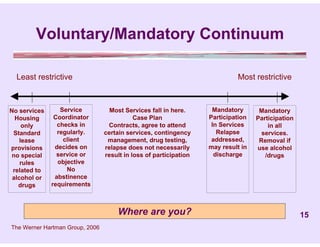
Voluntary/Mandatory Continuum

  Least restrictive                                                         Most restrictive


No services      Service           Most Services fall in here.      Mandatory       Mandatory
  Housing      Coordinator                  Case Plan              Participation   Participation
     only       checks in         Contracts, agree to attend        In Services        in all
 Standard       regularly.       certain services, contingency        Relapse        services.
    lease         client          management, drug testing,         addressed,      Removal if
provisions     decides on        relapse does not necessarily      may result in   use alcohol
 no special     service or       result in loss of participation     discharge        /drugs
    rules       objective
 related to        No
 alcohol or    abstinence
   drugs      requirements


                                     Where are you?                                                15
The Werner Hartman Group, 2006
Approach Varies Depending on

 Agency mission, values philosophical framework
 Availability of collaborative partners and quality
  community services
 Funding agency requirements/constraints
 Individual Family Needs
 Sense of urgency

     What works for one family won’t
    necessarily work for another. Our
  villages benefit from having an array
               of options.
                                                       16
Program Variations – depending on
    population, philosophy and options
 Acknowledging alcohol or drug use may vary
  depending on policies, legality of use, drug testing
  policies, client service plan
 Response to alcohol or drug use may vary by type of
  use, risk to children, mental health status, resources
  available, “rules,” perceived risk to other residents,
 Policies on if or when to evict family when householder
  is using.
 Respect parental authority and roles when you see
  marginal care of children you care about.
 Focusing on strengths when needs are so visible
                                                            17
Resources

   The Treatment Improvement Exchange
      http://www.tie.samhsa.gov/
      http://womenandchildren.treatment.org/
   Homeless Resource Center
      http://www.homeless.samhsa.gov
   National Institute on Drug Abuse
      http://www.drugabuse.gov/
   Join Together
      http://www.jointogether.org/

   Werner, D., Young, N.K., Dennis, K, & Amatetti, S.. Family-Centered Treatment
    for Women with Substance Use Disorders – History, Key Elements and           18
    Challenges. Department of Health and Human Services, Substance Abuse
    and Mental Health Services Administration, 2008.

2.7: Addressing the Substance Abuse Challenges of Homeless Families

  • 1.
    Addressing the Substance AbuseChallenges of Homeless Families Deborah Werner Advocates for Human Potential, Inc, This presentation is made possible with support from the Substance Abuse and Mental Health Services Administration
  • 2.
    Substance Use  Abstinence Experimental Use  Responsible Use  Episodic or Situational Abuse  Chronic Abuse  Dependence Responsible use = moderate, legal consumption in low-risk settings 2
  • 3.
    Not all Useis Addiction  Use of Illicit Substances  Heavy consumption  Binge drinking  Poor coping strategy  High-Risk Settings  Driving under influence  While caring for child  Episodical/Situational Abuse  Common co-occurrence with intimate partner violence Interventions include: education, brief interventions, 3 harm reduction, alternative activities, coping skills
  • 4.
    Addiction and Dependency Brain disorder  Brain impacted  Cravings  Tolerance The individual becomes controlled by the substance at a cellular level. Use continues despite catastrophic consequences. – Nora Volkow, MD, paraphrased 4
  • 5.
    The Substance Useand Mental Disorders Landscape is Changing
  • 6.
    Reforms  Ensures consumer  Allows states the option of protections in the insurance continuing Medicaid market. coverage to former foster care children up to the age  Creates immediate options of 25 years old. for people who can’t get insurance today.  Ensures free preventive services.  Expands health insurance coverage to 32 million  Small business owners and Americans. employees will be insured  Adds 16 mil with incomes  Reduces uncompensated below 133% of the federal care. poverty level to Medicaid.
  • 7.
    Impact of Reform& Parity  Creates guaranteed access to mental health and substance use disorder services at parity in most major public programs including Medicaid and Qualified Health Plans (QHPs) to cover the uninsured and small businesses.  Provides changes to the Medicaid program to continue and expand home and community-based services for individuals with mental health and substance use disorders.  Allows state Medicaid programs to establish health homes for those with chronic illnesses. States that seek this option must consult and coordinate with SAMHSA regarding the prevention and treatment of mental illness and substance use disorders among those with chronic illnesses.
  • 8.
    Impact of Reform& Parity Includes mental health and substance use disorder services as essential health benefit services for qualified health plans (QHPs) offered in the state- based exchanges.  Provides for grants to community mental health programs for co- locating primary and specialty care.  Creates a grant program for school-based health clinics to provide mental health and substance abuse assessments, crisis intervention, counseling, treatment and referrals. Anticipate reductions in residential services over time. Increased need for mental health and substance use treatment agencies to collaborate with housing programs
  • 9.
    While substance use/abuse in and of itself is not child abuse – behaviors associated with substance use/ abuse can put children at significant risk
  • 10.
    Inter-Generational Cycle ofSubstance Abuse  Substance use disorders affect the entire family unit and all the individual members.  Parental substance abuse increases the likelihood that a family will experience  financial problems  shifting of adult roles onto children  child abuse and neglect, inconsistent parenting  violence and disrupted environments  Children of parents with substance use disorders have a significantly higher likelihood of developing 10 substance use problems themselves.
  • 11.
  • 12.
    Lessons from theTreatment Field  Each family is different and their solutions are unique.  Children often have service needs of their own.  Developing motivation for recovery is a service not a pre-requisite.  Many women with SUDs experienced childhood trauma and/or poor parenting which can significantly effect their relationships with their own children but effective supports and parenting programs are available.  Relapse is common. Prognosis/relapse the same as for hypertension or diabetes. Early intervention can end a relapse. 12  Recovery communities have powerful synergy.
  • 13.
    Ending the Cycle  Accessible Gender-Responsive, Trauma-Informed Behavioral Health Services  Children’s Assessments, Developmental Services, Education  Comprehensive Services for Families and Family Members  An array of safe, affordable housing options  Recovery residences  Supportive housing  Service-enriched housing  “mainstream” safe, affordable housing  Clean/sober communities  Accessible recovery support  Opportunities for growth, economic and social well-being 13
  • 14.
    We all wantto:  Help families access supports and resources  Strengthen/support families and family members  Preserve individual rights and self-determination  Support recovery and reduce risks associated with use  See children thrive  Create wellness focused communities 14
  • 15.
    Voluntary/Mandatory Continuum Least restrictive Most restrictive No services Service Most Services fall in here. Mandatory Mandatory Housing Coordinator Case Plan Participation Participation only checks in Contracts, agree to attend In Services in all Standard regularly. certain services, contingency Relapse services. lease client management, drug testing, addressed, Removal if provisions decides on relapse does not necessarily may result in use alcohol no special service or result in loss of participation discharge /drugs rules objective related to No alcohol or abstinence drugs requirements Where are you? 15 The Werner Hartman Group, 2006
  • 16.
    Approach Varies Dependingon  Agency mission, values philosophical framework  Availability of collaborative partners and quality community services  Funding agency requirements/constraints  Individual Family Needs  Sense of urgency What works for one family won’t necessarily work for another. Our villages benefit from having an array of options. 16
  • 17.
    Program Variations –depending on population, philosophy and options  Acknowledging alcohol or drug use may vary depending on policies, legality of use, drug testing policies, client service plan  Response to alcohol or drug use may vary by type of use, risk to children, mental health status, resources available, “rules,” perceived risk to other residents,  Policies on if or when to evict family when householder is using.  Respect parental authority and roles when you see marginal care of children you care about.  Focusing on strengths when needs are so visible 17
  • 18.
    Resources  The Treatment Improvement Exchange  http://www.tie.samhsa.gov/  http://womenandchildren.treatment.org/  Homeless Resource Center  http://www.homeless.samhsa.gov  National Institute on Drug Abuse  http://www.drugabuse.gov/  Join Together  http://www.jointogether.org/  Werner, D., Young, N.K., Dennis, K, & Amatetti, S.. Family-Centered Treatment for Women with Substance Use Disorders – History, Key Elements and 18 Challenges. Department of Health and Human Services, Substance Abuse and Mental Health Services Administration, 2008.