Housing First:
Ending Homelessness for People
with Mental Illness and Addiction

              Brought to you by:


             January 12, 2011
            3:00 CST/2:00 CST
Housing First:
Ending Homelessness for People
with Mental Illness and Addiction

           PRESENTER
           Sam Tsemberis, PhD
           Founder and CEO Pathways to Housing
           Email: stsemberis@pathwaystohousing.org
           Website: www.pathwaystohousing.org
Housing First:
Ending Homelessness for People
with Mental Illness and Addiction

         SPEAKER
         Tim Sheehan, Ph.D.
         Professor and Director of Institutional Effectiveness
         Hazelden Graduate School of Addiction Studies
Presentation Objectives

Participants will be able to describe:
•   the essential ingredients of operating a
                    g             p      g
    Housing First program
•   core values and program components of
                    p g           p
    Housing First: services, treatment and housing
•   steps in starting a Housing First program
       p            g         g       p g
•   available resources, including the Housing First
    manual, training, and consultation
            ,       g,
Poll Question
        ll      i
In what profession do you currently practice?
  A. Mental health, substance abuse, or
                  ,                ,
     co-occurring treatment
  B. Supportive housing
  C. Research
  D. Policy development, government, or
     administration
  E. Other
Poll Question
        ll      i

Does your organization currently p
     y       g                 y provide
any form of supportive housing ?
 1.   Yes
 2.   No
Housing First
Introduction
The Origins of the
Pathways Program
Program Principles
Program Operations
Program Effectiveness
People who are homeless with
             p
           mental health and substance
                 abuse problems
                       p
Chronically homeless
Psychiatric disabilities
  y
Addiction and abuse
Health problems
       p
Poverty
Isolation
Stigma
Trauma
GINI (Social Disparity)
Are they the homeless mentally
 ill or the mentally ill homeless?


  Why are people with psychiatric
disabilities over-represented among
            the homeless?
Traditional Treatment and
           Sobriety then Housing programs

  $$$$        $$$$                   $$$$$$$$                    $$$$
  there     are cost                implications              PERMANENT
                                                                Housing


                TRANSITIONAL H
                             Housing
                                 i
SHELTER                (housing readiness)
Outreach
O t    h               Challenges:
                       Ch ll                               Dx is l t d to
                                                           D i related t
                       1)Housing readiness is not needed   ability to function
Drop-in                2)Clinical assumptions are not      3) Cost
                       substantiated                       implications
Single Site
               g
       (congregate housing)
New or rehab building
Tenants are people with
special needs
Property management and
social services are on site
Psychiatric treatment and
sobriety usually required
(can have harm reduction
models as single-site
programs )
Rules, regulations, and
shared housing
Single Site
             Effectiveness (cont’d)
  About half stayed 3 years or more
  Only one-third of leavers went to stable alternative
       one third
  housing (“positive leavers”)
  “Negative leavers” had more severe levels of mental
      g
  illness, greater incidence of substance abuse, higher
  supportive service needs

(O’Hara, 2007)
When people cannot access
           or keep housing

•   Shelters: 10% of the chronically homeless
    utilize 50% of the system resources
•   Hospitals/Detoxes: 3% of clients use 28% of
    all Medicaid funding for these services
                       g
•   Jail/Prison: High rates of incarceration and
    recidivism rates: poverty and drug related
                      p     y        g
    charges for people who are mentally ill and
    homeless. 25% of prison population have
    mental health problems
                   problems.
Pathways
               Housing First
Scatter site
apartments
Immediate access
Treatment 0r
sobriety are not
required
Admission it i
Ad i i criteria
is inclusive, not
restrictive
What is H
Wh i Housing First?
          i  Fi ?

    An evidence-based, consumer-
    driven program, rooted in the
    principles of:
         Psychiatric rehabilitation
         Harm reduction
         H       d ti
         Consumer movement
         Recovery oriented practice
What is H
Wh i Housing First?
          i  Fi ?

     A clinical and housing
     intervention that provides
     immediate access to
     permanent housing and
     support and treatment services
                 d              i
     for people with mental health
     and addiction problems
Four Essential Ingredients of
    Pathways’ Housing First

1. Consumer Choice Philosophy
2. Separation of Housing and Services
3 Recovery Oriented Services
3.
4. Community Integration
1. Client Choice is the
      Foundation of the Pathways’
        Housing First Program

Choice drives both housing and clinical
services
Clients choose among housing options:
location, size floor neighborhood,
location size, floor, neighborhood
furnishings and other household items
o their apartments
of t e apa t e ts
Clients choose among the services: type,
frequency and intensity
   q     y              y
Top choice: Independent
            apartments i community
                         in         i
          settings (Scatter Site Housing)
Given the choice -- most consumers
prefer own place in normal settings
Creates sense of home
Privacy, safety, security
Integrated housing (rented from
community landlords and rent l
         i l dl d       d     less
than 20% of units in any one building)
Top choice: Independent
            apartments i community
                         in         i
          settings (Scatter Site Housing)
Tenants rights - housing is
permanent, client holds lease
Tenants have the same rights and
responsibilities as any other tenant in
the building
Social services are off site
Visits are required
Treatment is offered not mandated
Landlords as program
                        p g
                 partners
Landlord, program and participants have a common
goal - All want safe, decent, well managed housing
1.Agency ensures rent is paid on time

2.Agency and landlord communication – responsive to
landlord concerns
3.Agency responsible for tenant damages

4.Advantages of using rental market: quick start up,
relocation, expansion as needs change, others.
SERVICES: Clinical and support
            services provided by ACT
                i        id d b
                  or ICM Teams
• M hi the l
  Matching h level of services to the person’s needs
                 l f      i        h        ’     d
• Hi Need: ACT is a multidisciplinary team and
  provides support and services directly
• Moderate Need: ICM case management team provides
  support and brokers services
    pp        b
• Services provided in the participant’s home or
  community (group meetings offered at offices or other
  community settings)
• ACT and ICM – Off site and call services 7-24
• All teams use a recovery orientation
LIMITS to consumer choice:
              clinical, legal, economic &
               li i l l     l        i
                    practical issues
  There are clinical, legal and practical limits to choice:

1 Must agree to weekly apartment visit by team
1.

2. Danger to self or others may lead to involuntary hospitalization

3 Other legal social issues (abuse, violence illegal activity, etc.)
3.                          (abuse violence,         activity etc )

  Limits on housing choice

4. Economic constraints on h
   E     i      t i t      housing choice
                               i    h i

5. Must sign lease, pay 30% of income towards rent and observe
   responsibilities of standard lease
2.
  2 Separation of
Housing and Services


     The home visit
               isit
2. Separation of Housing
              p                 g
          and Treatment Services

Use different criteria for success in housing and success
in treatment services
Relapse i anticipated; relapse i clinical i
R l     is   i i    d l        is li i l issue, not a
housing problem
Relapse does not mean eviction or loss of housing
It means obtaining treatment and returning home
Similarly, eviction from housing does not mean
discharge from the program (it usually means
relocation)
Program commitment i to the person not the h
            i      is    h              h housing
                                              i
Relationship
              l i    hi
True caring and honest concern
“See” the individual and treat as a whole person
 See
“Can do!” messages
Facilitative partnership
Collaborative relationship, Non-judgmental
                         p,     j g
Person as the driver of his or her own life and
recovery
       y
Some Core R
     S    C    Research
                      h

World Health Organization studies
(Whitaker)
The Vermont Study (Harding)
What Helps What Hinders Recovery?
(Onken, Ridgway et al.)
Exploration f Process & St
E l ti of P             Stages of
                                f
Recovery
Key Elements of the
           y
           Paradigm Shift
What helps/what hinders:
 Change in view of those served
 Change in goals of the system
 Change in power relationships
 Change in focus and locus of care
     g
 Change in treatment culture
Recovery Focused
                   y
               Treatment
People need self-directed approaches e.g., supported
employment, wellness self-management, IDDT,
supported education
Other Evidence-Based Practices (EBPs) are
incorporated into treatment services
They also need knowledge and skills to self-manage
their condition
An emphasis on holistic wellness and positive lifestyle
is healing (address emotional, physical, social, cultural,
                    emotional physical social cultural
and spiritual needs)
Recovery Extends Beyond
 the Mental Health Field
M
Meaningful S i l R l
    i f l Social Roles
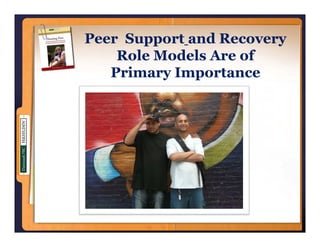
Peer Support and Recovery
       pp               y
    Role Models Are of
   Primary Importance
Opportunities/
         Choices/Options
Choices really matter!
People have often been stuck in programs
with few options and opportunities that
perpetuated dependence and helplessness
Benefits so low as to be life-stealing
Meeting basic needs—housing, income,
transportation, health care
Opening doors to community integration
4.
4 Community Integration

   i l    l i
Social Inclusion
4. Community I t
     4 C      it Integration
                        ti

Housing that is normal housing provides (l
      i    h i          lh   i       id (least
restrictive setting – (Olmstead Decision)
Provide opportunities f social integration
     d                for    l
Building community supports in integrated
neighborhoods (self-help, spiritual, cultural,
personal skills and interests)
Services assist participants with community
integration activities – orientation to building
Mapping of their neighborhood and community
Community Integration
       and Graduation
Services can be reduced over time or stopped
altogether when the person no longer needs
them. This makes for smooth graduation.
In Housing First model, the service providers
                   d l h                 d
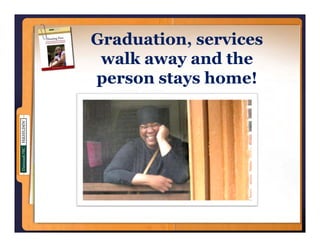
walk away and the person stays home
Graduation, services
          ,
 walk away and the
person stays home!
Program Effectiveness
         ff i


          Studies f
          St di of
           Program
               g
         Effectiveness
Evaluating Housing First

Highly effective program for the ‘hard to house’
85% housing retention rates across many cities and
programs
Access problems eliminated, retention increased
Reduction in acute care services and significant cost
savings (pre=post)
        (pre post)
Improves quality of life          Tsemberis  effectiveness (2004); 
                                  HUD Pearson  6 cities (2007); 
                                  VA Rosenheck 11 cities (2007);
                                  Larimer, cost (2009).
High Choice PSH
                        g
                     Programs, Choice &
                    Psychiatric Symptoms
                                                      reduction
 Program
 P
Assignment

                                           Personal   reduction   Psychiatric
                                  Choice
                                           Mastery                Symptoms

Proportion
                                                        increase
  of time
 homeless

Adapted from Greenwood et al, 2005.
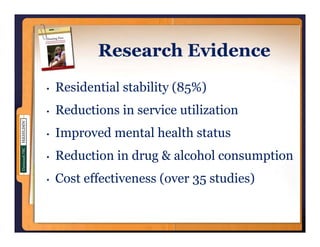
Research E id
           R      h Evidence
•   Residential stability (85%)
•   Reductions service tili ation
    Red ctions in ser ice utilization
•   Improved mental health status
      p
•   Reduction in drug & alcohol consumption
•   Cost effectiveness (over 35 studies)
Research Evidence:
Pathways’ Housing First is
an evidence based practice
Housing First in
 U.S. & Canada
Housing First
 in Europe
        p
Studies in Progress
      St di i P

• Mental Health Commission of Canada

• ($110 M; 5 city longitudinal rct)

• European Union (10 cities hf compared to tau)
      p                           p
• France (4 city implementation)

• Fi l d ( city i
  Finland (4 it implementation)
                   l    t ti )
For more information
 about Pathways to
      H    i
      Housing
        Please visit our website at
        pathwaystohousing.org
        Or send email to
        stsemberis@pathwaystohousing.org
About Housing First
        Ab t H i Fi t
     The manual includes:
information about the program's
philosophy, operations, and
administration
Staffing patterns and day-to-day
operations of the clinical and support
services
property management and housing
services
protocols for assisting clients with the
search for housing building
           housing,
relationships with landlords, and the      Cost: $49.95
overall community integration process      for the manual alone
the research evidence for the              With a 30% discount =
effectiveness of the Pathways model        $34.97
About Housing First
      Ab t H i Fi t

    About the DVD:

The
Th DVD ill t t th
          illustrates the
concepts presented in the
manual, offering client
success stories helpful tips,
        stories,          tips
and model teams in action.

See a preview of the DVD at
www.bhevolution.org              Cost: $265.00 for the
                                 manual and the DVD
                                 With a 30% discount =
                                 $185.50
www.BHEVOLUTION.org
                  g
Sign up for Funding Alerts and
             N    l tt
       our e-Newsletter
This presentation
                p
           covered:

•   the essential ingredients of operating a
    Housing First program
•   core values and program components of
    Housing First: services, treatment and housing
                   services
•   steps in starting a Housing First program
•   available resources, including the Housing First
    manual, training, and consultation
The Series Continues!
Join
J i us th second Wednesday of every month for more
       the       dW d       d    f           th f
  information about treating co-occurring disorders…

                   February 9:
                   Applying the Individual Placement and
                   Support Model with Supported
                   Employment
Time for Discussion
           Ti   f Di       i
For more information about
Housing First materials or to order
call 1-800-328-9000

You will receive a follow-up e-mail
with information about receiving
credit for Continuing Education
                     g
through NAADAC or APA

Participants in this web
conference will receive
    f         ill    i
a 30% discount on Housing First

Use this d to d
U thi code t order:
SMIREWARD
Six Steps to Obtain Continuing
           Education credit through
           NAADAC and APA

1) Go to www.hazelden.org/professionaled
2) Click on “Course Catalogue
             Course Catalogue”
3) Search for the course: Housing First Learner
   Assessment
4) Pay the administrative fee ($10.00) for the
   assessment
5) T k the assessment
 ) Take th              t
6) Print your certificate!
Housing First Webinar

Housing First Webinar

  • 1.
    Housing First: Ending Homelessnessfor People with Mental Illness and Addiction Brought to you by: January 12, 2011 3:00 CST/2:00 CST
  • 2.
    Housing First: Ending Homelessnessfor People with Mental Illness and Addiction PRESENTER Sam Tsemberis, PhD Founder and CEO Pathways to Housing Email: stsemberis@pathwaystohousing.org Website: www.pathwaystohousing.org
  • 3.
    Housing First: Ending Homelessnessfor People with Mental Illness and Addiction SPEAKER Tim Sheehan, Ph.D. Professor and Director of Institutional Effectiveness Hazelden Graduate School of Addiction Studies
  • 4.
    Presentation Objectives Participants willbe able to describe: • the essential ingredients of operating a g p g Housing First program • core values and program components of p g p Housing First: services, treatment and housing • steps in starting a Housing First program p g g p g • available resources, including the Housing First manual, training, and consultation , g,
  • 5.
    Poll Question ll i In what profession do you currently practice? A. Mental health, substance abuse, or , , co-occurring treatment B. Supportive housing C. Research D. Policy development, government, or administration E. Other
  • 6.
    Poll Question ll i Does your organization currently p y g y provide any form of supportive housing ? 1. Yes 2. No
  • 7.
    Housing First Introduction The Originsof the Pathways Program Program Principles Program Operations Program Effectiveness
  • 8.
    People who arehomeless with p mental health and substance abuse problems p Chronically homeless Psychiatric disabilities y Addiction and abuse Health problems p Poverty Isolation Stigma Trauma GINI (Social Disparity)
  • 9.
    Are they thehomeless mentally ill or the mentally ill homeless? Why are people with psychiatric disabilities over-represented among the homeless?
  • 10.
    Traditional Treatment and Sobriety then Housing programs $$$$ $$$$ $$$$$$$$ $$$$ there are cost implications PERMANENT Housing TRANSITIONAL H Housing i SHELTER (housing readiness) Outreach O t h Challenges: Ch ll Dx is l t d to D i related t 1)Housing readiness is not needed ability to function Drop-in 2)Clinical assumptions are not 3) Cost substantiated implications
  • 11.
    Single Site g (congregate housing) New or rehab building Tenants are people with special needs Property management and social services are on site Psychiatric treatment and sobriety usually required (can have harm reduction models as single-site programs ) Rules, regulations, and shared housing
  • 12.
    Single Site Effectiveness (cont’d) About half stayed 3 years or more Only one-third of leavers went to stable alternative one third housing (“positive leavers”) “Negative leavers” had more severe levels of mental g illness, greater incidence of substance abuse, higher supportive service needs (O’Hara, 2007)
  • 13.
    When people cannotaccess or keep housing • Shelters: 10% of the chronically homeless utilize 50% of the system resources • Hospitals/Detoxes: 3% of clients use 28% of all Medicaid funding for these services g • Jail/Prison: High rates of incarceration and recidivism rates: poverty and drug related p y g charges for people who are mentally ill and homeless. 25% of prison population have mental health problems problems.
  • 14.
    Pathways Housing First Scatter site apartments Immediate access Treatment 0r sobriety are not required Admission it i Ad i i criteria is inclusive, not restrictive
  • 15.
    What is H Whi Housing First? i Fi ? An evidence-based, consumer- driven program, rooted in the principles of: Psychiatric rehabilitation Harm reduction H d ti Consumer movement Recovery oriented practice
  • 16.
    What is H Whi Housing First? i Fi ? A clinical and housing intervention that provides immediate access to permanent housing and support and treatment services d i for people with mental health and addiction problems
  • 17.
    Four Essential Ingredientsof Pathways’ Housing First 1. Consumer Choice Philosophy 2. Separation of Housing and Services 3 Recovery Oriented Services 3. 4. Community Integration
  • 18.
    1. Client Choiceis the Foundation of the Pathways’ Housing First Program Choice drives both housing and clinical services Clients choose among housing options: location, size floor neighborhood, location size, floor, neighborhood furnishings and other household items o their apartments of t e apa t e ts Clients choose among the services: type, frequency and intensity q y y
  • 19.
    Top choice: Independent apartments i community in i settings (Scatter Site Housing) Given the choice -- most consumers prefer own place in normal settings Creates sense of home Privacy, safety, security Integrated housing (rented from community landlords and rent l i l dl d d less than 20% of units in any one building)
  • 20.
    Top choice: Independent apartments i community in i settings (Scatter Site Housing) Tenants rights - housing is permanent, client holds lease Tenants have the same rights and responsibilities as any other tenant in the building Social services are off site Visits are required Treatment is offered not mandated
  • 21.
    Landlords as program p g partners Landlord, program and participants have a common goal - All want safe, decent, well managed housing 1.Agency ensures rent is paid on time 2.Agency and landlord communication – responsive to landlord concerns 3.Agency responsible for tenant damages 4.Advantages of using rental market: quick start up, relocation, expansion as needs change, others.
  • 22.
    SERVICES: Clinical andsupport services provided by ACT i id d b or ICM Teams • M hi the l Matching h level of services to the person’s needs l f i h ’ d • Hi Need: ACT is a multidisciplinary team and provides support and services directly • Moderate Need: ICM case management team provides support and brokers services pp b • Services provided in the participant’s home or community (group meetings offered at offices or other community settings) • ACT and ICM – Off site and call services 7-24 • All teams use a recovery orientation
  • 23.
    LIMITS to consumerchoice: clinical, legal, economic & li i l l l i practical issues There are clinical, legal and practical limits to choice: 1 Must agree to weekly apartment visit by team 1. 2. Danger to self or others may lead to involuntary hospitalization 3 Other legal social issues (abuse, violence illegal activity, etc.) 3. (abuse violence, activity etc ) Limits on housing choice 4. Economic constraints on h E i t i t housing choice i h i 5. Must sign lease, pay 30% of income towards rent and observe responsibilities of standard lease
  • 24.
    2. 2Separation of Housing and Services The home visit isit
  • 25.
    2. Separation ofHousing p g and Treatment Services Use different criteria for success in housing and success in treatment services Relapse i anticipated; relapse i clinical i R l is i i d l is li i l issue, not a housing problem Relapse does not mean eviction or loss of housing It means obtaining treatment and returning home Similarly, eviction from housing does not mean discharge from the program (it usually means relocation) Program commitment i to the person not the h i is h h housing i
  • 26.
    Relationship l i hi True caring and honest concern “See” the individual and treat as a whole person See “Can do!” messages Facilitative partnership Collaborative relationship, Non-judgmental p, j g Person as the driver of his or her own life and recovery y
  • 28.
    Some Core R S C Research h World Health Organization studies (Whitaker) The Vermont Study (Harding) What Helps What Hinders Recovery? (Onken, Ridgway et al.) Exploration f Process & St E l ti of P Stages of f Recovery
  • 29.
    Key Elements ofthe y Paradigm Shift What helps/what hinders: Change in view of those served Change in goals of the system Change in power relationships Change in focus and locus of care g Change in treatment culture
  • 30.
    Recovery Focused y Treatment People need self-directed approaches e.g., supported employment, wellness self-management, IDDT, supported education Other Evidence-Based Practices (EBPs) are incorporated into treatment services They also need knowledge and skills to self-manage their condition An emphasis on holistic wellness and positive lifestyle is healing (address emotional, physical, social, cultural, emotional physical social cultural and spiritual needs)
  • 31.
    Recovery Extends Beyond the Mental Health Field
  • 32.
    M Meaningful S il R l i f l Social Roles
  • 33.
    Peer Support andRecovery pp y Role Models Are of Primary Importance
  • 34.
    Opportunities/ Choices/Options Choices really matter! People have often been stuck in programs with few options and opportunities that perpetuated dependence and helplessness Benefits so low as to be life-stealing Meeting basic needs—housing, income, transportation, health care Opening doors to community integration
  • 35.
    4. 4 Community Integration i l l i Social Inclusion
  • 36.
    4. Community It 4 C it Integration ti Housing that is normal housing provides (l i h i lh i id (least restrictive setting – (Olmstead Decision) Provide opportunities f social integration d for l Building community supports in integrated neighborhoods (self-help, spiritual, cultural, personal skills and interests) Services assist participants with community integration activities – orientation to building Mapping of their neighborhood and community
  • 37.
    Community Integration and Graduation Services can be reduced over time or stopped altogether when the person no longer needs them. This makes for smooth graduation. In Housing First model, the service providers d l h d walk away and the person stays home
  • 38.
    Graduation, services , walk away and the person stays home!
  • 39.
    Program Effectiveness ff i Studies f St di of Program g Effectiveness
  • 40.
    Evaluating Housing First Highlyeffective program for the ‘hard to house’ 85% housing retention rates across many cities and programs Access problems eliminated, retention increased Reduction in acute care services and significant cost savings (pre=post) (pre post) Improves quality of life Tsemberis  effectiveness (2004);  HUD Pearson  6 cities (2007);  VA Rosenheck 11 cities (2007); Larimer, cost (2009).
  • 41.
    High Choice PSH g Programs, Choice & Psychiatric Symptoms reduction Program P Assignment Personal reduction Psychiatric Choice Mastery Symptoms Proportion increase of time homeless Adapted from Greenwood et al, 2005.
  • 42.
    Research E id R h Evidence • Residential stability (85%) • Reductions service tili ation Red ctions in ser ice utilization • Improved mental health status p • Reduction in drug & alcohol consumption • Cost effectiveness (over 35 studies)
  • 43.
    Research Evidence: Pathways’ HousingFirst is an evidence based practice
  • 44.
    Housing First in U.S. & Canada
  • 45.
  • 46.
    Studies in Progress St di i P • Mental Health Commission of Canada • ($110 M; 5 city longitudinal rct) • European Union (10 cities hf compared to tau) p p • France (4 city implementation) • Fi l d ( city i Finland (4 it implementation) l t ti )
  • 47.
    For more information about Pathways to H i Housing Please visit our website at pathwaystohousing.org Or send email to stsemberis@pathwaystohousing.org
  • 48.
    About Housing First Ab t H i Fi t The manual includes: information about the program's philosophy, operations, and administration Staffing patterns and day-to-day operations of the clinical and support services property management and housing services protocols for assisting clients with the search for housing building housing, relationships with landlords, and the Cost: $49.95 overall community integration process for the manual alone the research evidence for the With a 30% discount = effectiveness of the Pathways model $34.97
  • 49.
    About Housing First Ab t H i Fi t About the DVD: The Th DVD ill t t th illustrates the concepts presented in the manual, offering client success stories helpful tips, stories, tips and model teams in action. See a preview of the DVD at www.bhevolution.org Cost: $265.00 for the manual and the DVD With a 30% discount = $185.50
  • 50.
    www.BHEVOLUTION.org g Sign up for Funding Alerts and N l tt our e-Newsletter
  • 51.
    This presentation p covered: • the essential ingredients of operating a Housing First program • core values and program components of Housing First: services, treatment and housing services • steps in starting a Housing First program • available resources, including the Housing First manual, training, and consultation
  • 52.
    The Series Continues! Join Ji us th second Wednesday of every month for more the dW d d f th f information about treating co-occurring disorders… February 9: Applying the Individual Placement and Support Model with Supported Employment
  • 53.
    Time for Discussion Ti f Di i For more information about Housing First materials or to order call 1-800-328-9000 You will receive a follow-up e-mail with information about receiving credit for Continuing Education g through NAADAC or APA Participants in this web conference will receive f ill i a 30% discount on Housing First Use this d to d U thi code t order: SMIREWARD
  • 54.
    Six Steps toObtain Continuing Education credit through NAADAC and APA 1) Go to www.hazelden.org/professionaled 2) Click on “Course Catalogue Course Catalogue” 3) Search for the course: Housing First Learner Assessment 4) Pay the administrative fee ($10.00) for the assessment 5) T k the assessment ) Take th t 6) Print your certificate!