Intensive Service Interventions for People with Disabilities: Helping Families Stabilize & Thrive   2011   National Conference on Ending Family Homelessness Devra Edelman Director of Programs Hamilton Family Center   February 11, 2011 [email_address]
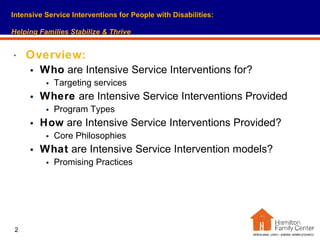
Overview: Who  are Intensive Service Interventions for?  Targeting services Where  are Intensive Service Interventions Provided  Program Types How  are Intensive Service Interventions Provided? Core Philosophies What  are Intensive Service Intervention models?  Promising Practices Intensive Service Interventions for People with Disabilities:   Helping Families Stabilize & Thrive
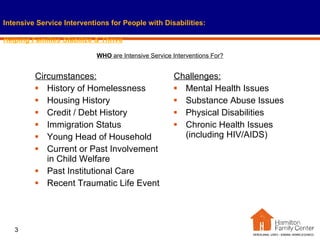
Circumstances: History of Homelessness Housing History Credit / Debt History Immigration Status Young Head of Household Current or Past Involvement in Child Welfare Past Institutional Care Recent Traumatic Life Event Challenges: Mental Health Issues Substance Abuse Issues Physical Disabilities Chronic Health Issues (including HIV/AIDS) Intensive Service Interventions for People with Disabilities:   Helping Families Stabilize & Thrive WHO  are Intensive Service Interventions For?
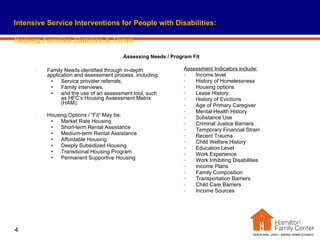
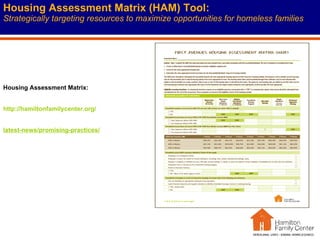
Family Needs identified through in-depth application and assessment process, including: Service provider referrals,  Family interviews, and the use of an assessment tool, such as HFC’s Housing Assessment Matrix (HAM). Housing Options / “Fit” May be: Market Rate Housing Short-term Rental Assistance Medium-term Rental Assistance Affordable Housing Deeply Subsidized Housing Transitional Housing Program Permanent Supportive Housing Assessment Indicators include: Income level History of Homelessness Housing options Lease History History of Evictions Age of Primary Caregiver Mental Health History Substance Use Criminal Justice Barriers Temporary Financial Strain Recent Trauma Child Welfare History Education Level Work Experience Work Inhibiting Disabilities Income Plans Family Composition Transportation Barriers Child Care Barriers Income Sources Intensive Service Interventions for People with Disabilities:   Helping Families Stabilize & Thrive Assessing Needs / Program Fit
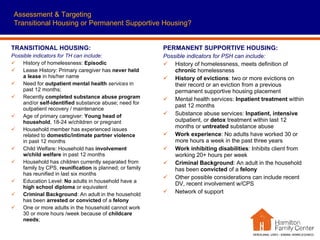
Assessment & Targeting Transitional Housing or Permanent Supportive Housing? TRANSITIONAL HOUSING: Possible indicators for TH can include:   History of homelessness:  Episodic Lease History: Primary caregiver has  never held a lease  in his/her name Need for  outpatient mental health  services  in past 12 months; Recently  completed substance abuse program  and/or  self-identified  substance abuse; need for outpatient recovery / maintenance Age of primary caregiver:  Young head of household , 18-24 w/children or pregnant Household member has experienced issues related to  domestic/intimate partner violence  in past 12 months Child Welfare: Household has  involvement w/child welfare  in past 12 months Household has children currently separated from family by CPS,  reunification  is planned; or family has reunified in last six months  Education Level:  No  adults in household have a  high school diploma  or equivalent Criminal Background : An adult in the household has been  arrested or convicted  of a  felony One or more adults in the household cannot work 30 or more hours /week because of  childcare needs ;  PERMANENT SUPPORTIVE HOUSING: Possible indicators for PSH can include:   History of homelessness, meets definition of  chronic  homelessness History of evictions : two or more evictions on their record or an eviction from a previous permanent supportive housing placement Mental health services:  Inpatient treatment  within past 12 months Substance abuse services:  Inpatient, intensive  outpatient, or  detox  treatment within last 12 months or  untreated  substance abuse Work experience : No adults have worked 30 or more hours a week in the past three years Work inhibiting disabilities : Inhibits client from working 20+ hours per week Criminal Background : An adult in the household has been  convicted  of a  felony Other possible considerations can include recent DV, recent involvement w/CPS Network of support
Housing Assessment Matrix (HAM) Tool: Strategically targeting resources to maximize opportunities for homeless families Housing Assessment Matrix: http://hamiltonfamilycenter.org/ latest-news/promising-practices/
Intensive Service Intervention Components “Therapeutic” Housing: Direct therapy services Therapeutic Consultation for Staff Wrap-Around / Collaborative Services Linkages among Housing, Services and Supports Parent-Child Interaction / Family Focus Children’s Programming / Enrichment Intensive Case Management Safe Environment (Physical & Emotional) Individualized Family Action Plan Choice within Structure
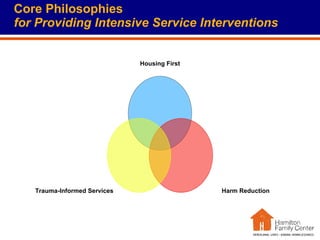
Core Philosophies  for Providing Intensive Service Interventions Housing First Harm Reduction Trauma-Informed Services
Housing is a basic human need and right Families are more responsive to intervention and social service support once in permanent and stable housing  Everyone is valuable and capable of being a valuable resident and community member Outreach should be targeted to reach the most vulnerable Residents, property managers, and service providers should work together to integrate services into housing Client focused services Move homeless families into permanent, affordable housing Rapidly Time-limited, home-based support services Housing First
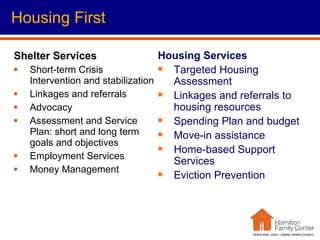
Shelter Services Short-term Crisis Intervention and stabilization Linkages and referrals Advocacy Assessment and Service Plan: short and long term goals and objectives Employment Services Money Management Housing First Housing Services Targeted Housing Assessment Linkages and referrals to housing resources Spending Plan and budget Move-in assistance Home-based Support Services Eviction Prevention
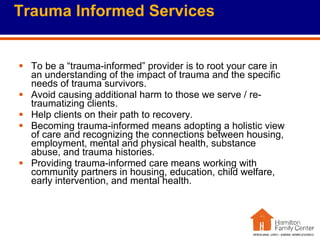
Trauma Informed Services To be a “trauma-informed” provider is to root your care in an understanding of the impact of trauma and the specific needs of trauma survivors.  Avoid causing additional harm to those we serve / re-traumatizing clients. Help clients on their path to recovery. Becoming trauma-informed means adopting a holistic view of care and recognizing the connections between housing, employment, mental and physical health, substance abuse, and trauma histories.  Providing trauma-informed care means working with community partners in housing, education, child welfare, early intervention, and mental health.
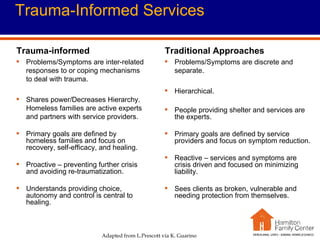
Trauma-Informed Services Trauma-informed Problems/Symptoms are inter-related responses to or coping mechanisms to deal with trauma. Shares power/Decreases Hierarchy. Homeless families are active experts and partners with service providers. Primary goals are defined by homeless families and focus on recovery, self-efficacy, and healing. Proactive – preventing further crisis and avoiding re-traumatization. Understands providing choice, autonomy and control is central to healing. Traditional Approaches Problems/Symptoms are discrete and separate. Hierarchical. People providing shelter and services are the experts. Primary goals are defined by service providers and focus on symptom reduction. Reactive – services and symptoms are crisis driven and focused on minimizing liability. Sees clients as broken, vulnerable and needing protection from themselves. Adapted from L.Prescott via K. Guarino
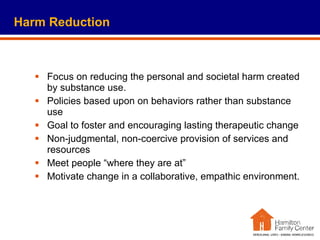
Harm Reduction Focus on reducing the personal and societal harm created by substance use. Policies based upon on behaviors rather than substance use Goal to foster and encouraging lasting therapeutic change Non-judgmental, non-coercive provision of services and resources Meet people “where they are at”  Motivate change in a collaborative, empathic environment.
Promising Practices: Early Childhood Mental Health Initiative / Therapeutic Alliance for Children Objective:  To provide onsite, accessible, culturally competent mental health consultation to homeless and formerly homeless families and their young children, as well as to the staff providing services. Includes a mix of direct treatment and consultation services that meet the needs of children, parents, and program staff. Services include: Mental health support and education for parents Onsite individual and group mental health treatment for children and their parents Child Developmental Screening (ASQ and ASQ-SE) Training, case consultation, and emotional support for program staff Program consultation Outreach and referral
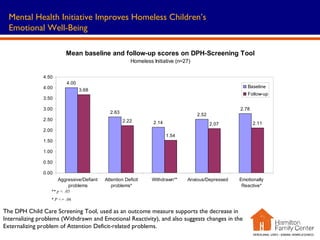
Mental Health Initiative Improves Homeless Children’s  Emotional Well-Being ** p < .05 * P <= .06  The DPH Child Care Screening Tool, used as an outcome measure supports the decrease in Internalizing problems (Withdrawn and Emotional Reactivity), and also suggests changes in the Externalizing problem of Attention Deficit-related problems.
Program staff feel more confident working with clients How would you rate your skills dealing with [children/ parents] with mental health problems? Highly skilled Not skilled at all Before  consultant After  consultant Before  consultant After  consultant Both changes represent statistically significant gains
Partnership with the Court System Collaboration with Dependency Drug Court and Behavioral Health Court prioritizes child welfare / substance abuse and behavioral health / criminal justice referrals  Up to 10 DDC and 5 BHC referred families accepted in the program at any given time.  Other referrals continue to be accepted  Emergency Shelters Domestic Violence Programs Treatment Programs, etc. From 2008 through 2010, 80% of the families who entered the program had histories of child welfare involvement, substance use, mental health or other specialized needs (39 out of 49).   28 of these families had CPS involvement, 17 of whom were referrals from DDC (16) or BHC (1). Promising Practices: Family Transitional Housing - Collaborative Justice Partnership
Promising Practices: Family Transitional Housing - Collaborative Justice Partnership DDC / BHC Key Service Components Increased Judicial Supervision Integrated team provides support and wraparound services Intensive Case Management Supportive, but Structured Environment Accessible, appropriate treatment services Relapse Support Coordinated Responses to Family Needs Substance Abuse Treatment Behavioral Health Services Parenting Support Housing
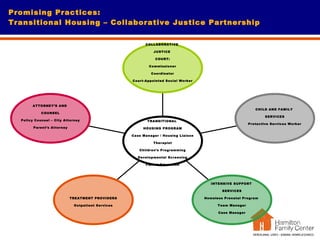
Promising Practices:  Transitional Housing – Collaborative Justice Partnership ATTORNEY’S AND  COUNSEL Policy Counsel – City Attorney Parent’s Attorney TREATMENT PROVIDERS Outpatient Services INTENSIVE SUPPORT  SERVICES Homeless Prenatal Program  Team Manager Case Manager CHILD AND FAMILY  SERVICES Protective Services Worker COLLABORATIVE  JUSTICE  COURT: Commissioner Coordinator Court-Appointed Social Worker TRANSITIONAL  HOUSING PROGRAM Case Manager / Housing Liaison Therapist Children’s Programming Developmental Screening Parent Education
Contact: Devra M. Edelman Director of Programs Hamilton Family Center 415-409-2100 x122 [email_address] www.hamiltonfamilycenter.org

6.7 Intensive Service Interventions for People with Disabilities

  • 1.
    Intensive Service Interventionsfor People with Disabilities: Helping Families Stabilize & Thrive 2011 National Conference on Ending Family Homelessness Devra Edelman Director of Programs Hamilton Family Center February 11, 2011 [email_address]
  • 2.
    Overview: Who are Intensive Service Interventions for? Targeting services Where are Intensive Service Interventions Provided Program Types How are Intensive Service Interventions Provided? Core Philosophies What are Intensive Service Intervention models? Promising Practices Intensive Service Interventions for People with Disabilities: Helping Families Stabilize & Thrive
  • 3.
    Circumstances: History ofHomelessness Housing History Credit / Debt History Immigration Status Young Head of Household Current or Past Involvement in Child Welfare Past Institutional Care Recent Traumatic Life Event Challenges: Mental Health Issues Substance Abuse Issues Physical Disabilities Chronic Health Issues (including HIV/AIDS) Intensive Service Interventions for People with Disabilities: Helping Families Stabilize & Thrive WHO are Intensive Service Interventions For?
  • 4.
    Family Needs identifiedthrough in-depth application and assessment process, including: Service provider referrals, Family interviews, and the use of an assessment tool, such as HFC’s Housing Assessment Matrix (HAM). Housing Options / “Fit” May be: Market Rate Housing Short-term Rental Assistance Medium-term Rental Assistance Affordable Housing Deeply Subsidized Housing Transitional Housing Program Permanent Supportive Housing Assessment Indicators include: Income level History of Homelessness Housing options Lease History History of Evictions Age of Primary Caregiver Mental Health History Substance Use Criminal Justice Barriers Temporary Financial Strain Recent Trauma Child Welfare History Education Level Work Experience Work Inhibiting Disabilities Income Plans Family Composition Transportation Barriers Child Care Barriers Income Sources Intensive Service Interventions for People with Disabilities: Helping Families Stabilize & Thrive Assessing Needs / Program Fit
  • 5.
    Assessment & TargetingTransitional Housing or Permanent Supportive Housing? TRANSITIONAL HOUSING: Possible indicators for TH can include: History of homelessness: Episodic Lease History: Primary caregiver has never held a lease in his/her name Need for outpatient mental health services in past 12 months; Recently completed substance abuse program and/or self-identified substance abuse; need for outpatient recovery / maintenance Age of primary caregiver: Young head of household , 18-24 w/children or pregnant Household member has experienced issues related to domestic/intimate partner violence in past 12 months Child Welfare: Household has involvement w/child welfare in past 12 months Household has children currently separated from family by CPS, reunification is planned; or family has reunified in last six months Education Level: No adults in household have a high school diploma or equivalent Criminal Background : An adult in the household has been arrested or convicted of a felony One or more adults in the household cannot work 30 or more hours /week because of childcare needs ; PERMANENT SUPPORTIVE HOUSING: Possible indicators for PSH can include: History of homelessness, meets definition of chronic homelessness History of evictions : two or more evictions on their record or an eviction from a previous permanent supportive housing placement Mental health services: Inpatient treatment within past 12 months Substance abuse services: Inpatient, intensive outpatient, or detox treatment within last 12 months or untreated substance abuse Work experience : No adults have worked 30 or more hours a week in the past three years Work inhibiting disabilities : Inhibits client from working 20+ hours per week Criminal Background : An adult in the household has been convicted of a felony Other possible considerations can include recent DV, recent involvement w/CPS Network of support
  • 6.
    Housing Assessment Matrix(HAM) Tool: Strategically targeting resources to maximize opportunities for homeless families Housing Assessment Matrix: http://hamiltonfamilycenter.org/ latest-news/promising-practices/
  • 7.
    Intensive Service InterventionComponents “Therapeutic” Housing: Direct therapy services Therapeutic Consultation for Staff Wrap-Around / Collaborative Services Linkages among Housing, Services and Supports Parent-Child Interaction / Family Focus Children’s Programming / Enrichment Intensive Case Management Safe Environment (Physical & Emotional) Individualized Family Action Plan Choice within Structure
  • 8.
    Core Philosophies for Providing Intensive Service Interventions Housing First Harm Reduction Trauma-Informed Services
  • 9.
    Housing is abasic human need and right Families are more responsive to intervention and social service support once in permanent and stable housing Everyone is valuable and capable of being a valuable resident and community member Outreach should be targeted to reach the most vulnerable Residents, property managers, and service providers should work together to integrate services into housing Client focused services Move homeless families into permanent, affordable housing Rapidly Time-limited, home-based support services Housing First
  • 10.
    Shelter Services Short-termCrisis Intervention and stabilization Linkages and referrals Advocacy Assessment and Service Plan: short and long term goals and objectives Employment Services Money Management Housing First Housing Services Targeted Housing Assessment Linkages and referrals to housing resources Spending Plan and budget Move-in assistance Home-based Support Services Eviction Prevention
  • 11.
    Trauma Informed ServicesTo be a “trauma-informed” provider is to root your care in an understanding of the impact of trauma and the specific needs of trauma survivors. Avoid causing additional harm to those we serve / re-traumatizing clients. Help clients on their path to recovery. Becoming trauma-informed means adopting a holistic view of care and recognizing the connections between housing, employment, mental and physical health, substance abuse, and trauma histories. Providing trauma-informed care means working with community partners in housing, education, child welfare, early intervention, and mental health.
  • 12.
    Trauma-Informed Services Trauma-informedProblems/Symptoms are inter-related responses to or coping mechanisms to deal with trauma. Shares power/Decreases Hierarchy. Homeless families are active experts and partners with service providers. Primary goals are defined by homeless families and focus on recovery, self-efficacy, and healing. Proactive – preventing further crisis and avoiding re-traumatization. Understands providing choice, autonomy and control is central to healing. Traditional Approaches Problems/Symptoms are discrete and separate. Hierarchical. People providing shelter and services are the experts. Primary goals are defined by service providers and focus on symptom reduction. Reactive – services and symptoms are crisis driven and focused on minimizing liability. Sees clients as broken, vulnerable and needing protection from themselves. Adapted from L.Prescott via K. Guarino
  • 13.
    Harm Reduction Focuson reducing the personal and societal harm created by substance use. Policies based upon on behaviors rather than substance use Goal to foster and encouraging lasting therapeutic change Non-judgmental, non-coercive provision of services and resources Meet people “where they are at” Motivate change in a collaborative, empathic environment.
  • 14.
    Promising Practices: EarlyChildhood Mental Health Initiative / Therapeutic Alliance for Children Objective: To provide onsite, accessible, culturally competent mental health consultation to homeless and formerly homeless families and their young children, as well as to the staff providing services. Includes a mix of direct treatment and consultation services that meet the needs of children, parents, and program staff. Services include: Mental health support and education for parents Onsite individual and group mental health treatment for children and their parents Child Developmental Screening (ASQ and ASQ-SE) Training, case consultation, and emotional support for program staff Program consultation Outreach and referral
  • 15.
    Mental Health InitiativeImproves Homeless Children’s Emotional Well-Being ** p < .05 * P <= .06 The DPH Child Care Screening Tool, used as an outcome measure supports the decrease in Internalizing problems (Withdrawn and Emotional Reactivity), and also suggests changes in the Externalizing problem of Attention Deficit-related problems.
  • 16.
    Program staff feelmore confident working with clients How would you rate your skills dealing with [children/ parents] with mental health problems? Highly skilled Not skilled at all Before consultant After consultant Before consultant After consultant Both changes represent statistically significant gains
  • 17.
    Partnership with theCourt System Collaboration with Dependency Drug Court and Behavioral Health Court prioritizes child welfare / substance abuse and behavioral health / criminal justice referrals Up to 10 DDC and 5 BHC referred families accepted in the program at any given time. Other referrals continue to be accepted Emergency Shelters Domestic Violence Programs Treatment Programs, etc. From 2008 through 2010, 80% of the families who entered the program had histories of child welfare involvement, substance use, mental health or other specialized needs (39 out of 49). 28 of these families had CPS involvement, 17 of whom were referrals from DDC (16) or BHC (1). Promising Practices: Family Transitional Housing - Collaborative Justice Partnership
  • 18.
    Promising Practices: FamilyTransitional Housing - Collaborative Justice Partnership DDC / BHC Key Service Components Increased Judicial Supervision Integrated team provides support and wraparound services Intensive Case Management Supportive, but Structured Environment Accessible, appropriate treatment services Relapse Support Coordinated Responses to Family Needs Substance Abuse Treatment Behavioral Health Services Parenting Support Housing
  • 19.
    Promising Practices: Transitional Housing – Collaborative Justice Partnership ATTORNEY’S AND COUNSEL Policy Counsel – City Attorney Parent’s Attorney TREATMENT PROVIDERS Outpatient Services INTENSIVE SUPPORT SERVICES Homeless Prenatal Program Team Manager Case Manager CHILD AND FAMILY SERVICES Protective Services Worker COLLABORATIVE JUSTICE COURT: Commissioner Coordinator Court-Appointed Social Worker TRANSITIONAL HOUSING PROGRAM Case Manager / Housing Liaison Therapist Children’s Programming Developmental Screening Parent Education
  • 20.
    Contact: Devra M.Edelman Director of Programs Hamilton Family Center 415-409-2100 x122 [email_address] www.hamiltonfamilycenter.org

Editor's Notes

  • #2 Local offices in CA, RI, CT, NY, NJ, IN, IL, OH, MI, MN, TX CSH’s national teams assist supportive housing practitioners across the U.S.
  • #3 Any chance to add some background color or design, the pages look very white.