Performance of PV modules
under different irradiances
and temperatures
Robert Kenny
• Why the need for Energy Rating
• Peak power (Wp) at Standard Test Conditions (STC) is
currently the standard performance guide for modules
• End users need kWh NOT Wp!
• Energy Rating Procedure
• The performance is measured over a range of irradiances
and temperatures to simulate the conditions that will be
experienced outdoors
• Outdoor verification: The module is placed outdoors on the
Energy Rating (ENRA) fixed rack and continuously monitored
for up to one year
𝑼 =
𝒈,𝒌
𝑷 𝒈, 𝒌 ∆𝒕 𝒈, 𝒌
Energy Rating requires Power
Rating at different conditions
• STC measurement:
• 25°C
• 1000W/m2
• AM1.5G
𝐔 = 𝑷 𝒕 𝒅𝒕
= 𝑷 𝑮 𝒕 , 𝑻 𝒕 , . . . 𝒅𝒕
Where:
g=[100,200,400,600,800,1000,1100]W/m2
k=[15,25,50,75]°C
POWER RATING
IEC 61853-1
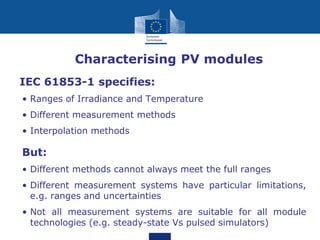
• Characterising PV modules
IEC 61853-1 specifies:
• Ranges of Irradiance and Temperature
• Different measurement methods
• Interpolation methods
But:
• Different methods cannot always meet the full ranges
• Different measurement systems have particular limitations,
e.g. ranges and uncertainties
• Not all measurement systems are suitable for all module
technologies (e.g. steady-state Vs pulsed simulators)
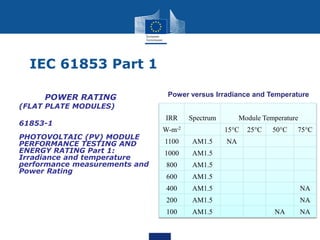
IEC 61853 Part 1
POWER RATING
(FLAT PLATE MODULES)
• 61853-1
PHOTOVOLTAIC (PV) MODULE
PERFORMANCE TESTING AND
ENERGY RATING Part 1:
Irradiance and temperature
performance measurements and
Power Rating
Power versus Irradiance and Temperature
IRR Spectrum Module Temperature
W-m-2 15C 25C 50C 75C
1100 AM1.5 NA
1000 AM1.5
800 AM1.5
600 AM1.5
400 AM1.5 NA
200 AM1.5 NA
100 AM1.5 NA NA
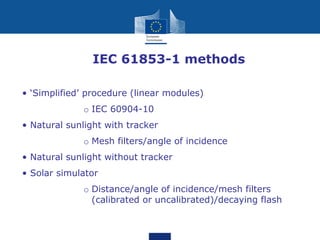
• IEC 61853-1 methods
• ‘Simplified’ procedure (linear modules)
o IEC 60904-10
• Natural sunlight with tracker
o Mesh filters/angle of incidence
• Natural sunlight without tracker
• Solar simulator
o Distance/angle of incidence/mesh filters
(calibrated or uncalibrated)/decaying flash
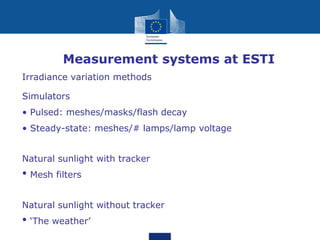
• Measurement systems at ESTI
Irradiance variation methods
Simulators
• Pulsed: meshes/masks/flash decay
• Steady-state: meshes/# lamps/lamp voltage
Natural sunlight with tracker
• Mesh filters
Natural sunlight without tracker
• ‘The weather’
IEC 61853-1 Indoor method
g=[100,200,400,600,800,1000]W/m2
k=[25,35,45,55,65]°C
<<Procedure with solar simulator>>
decay masks
P3B
heated box
P2B
varying G
varying T none
Time (ms)
Irradiance
P2B LAPSS pulse
characteristic
200
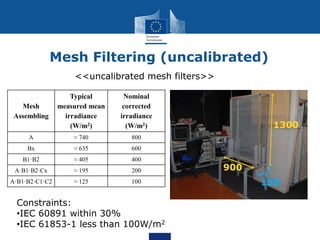
Mesh Filtering (uncalibrated)
<<uncalibrated mesh filters>>
Mesh
Assembling
Typical
measured mean
irradiance
(W/m2)
Nominal
corrected
irradiance
(W/m2)
A ≈ 740 800
Bx ≈ 635 600
B1·B2 ≈ 405 400
A·B1·B2·Cx ≈ 195 200
A·B1·B2·C1·C2 ≈ 125 100
Constraints:
•IEC 60891 within 30%
•IEC 61853-1 less than 100W/m2
900
1300
150
Outdoor with tracker
g=[100,200,400,600,800,1000]W/m2
k=[25,35,45,55]°C
<<under natural sunlight with tracker>>
Temperature:
•Heated up by sun
•Cooled down with water
•Fine control using an
opaque lid
Irradiance:
•Mesh Filters
Mesh filters
D.U.T.
Aluminum
structure
RefCell
Wooden
box
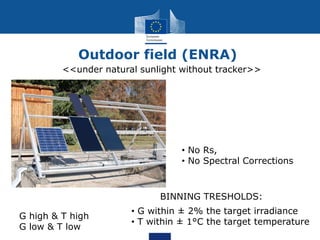
Outdoor field (ENRA)
G high & T high
G low & T low
<<under natural sunlight without tracker>>
BINNING TRESHOLDS:
• G within ± 2% the target irradiance
• T within ± 1°C the target temperature
• No Rs,
• No Spectral Corrections
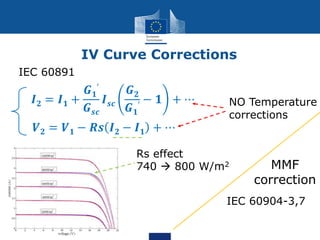
IV Curve Corrections
IEC 60891
Rs effect
740  800 W/m2 MMF
correction
IEC 60904-3,7
𝑰 𝟐 = 𝑰 𝟏 +
𝑮 𝟏
′
𝑮 𝒔𝒄
𝑰 𝒔𝒄
𝑮 𝟐
𝑮 𝟏
′
− 𝟏 + ⋯
𝑽 𝟐 = 𝑽 𝟏 − 𝑹𝒔 𝑰 𝟐 − 𝑰 𝟏 + ⋯
NO Temperature
corrections
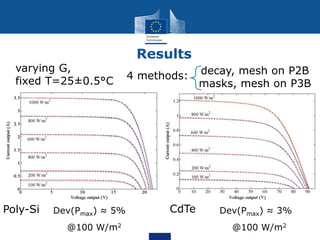
Results
decay, mesh on P2B
masks, mesh on P3B
varying G,
fixed T=25±0.5°C 4 methods:
Poly-Si CdTeDev(Pmax) ≈ 5% Dev(Pmax) ≈ 3%
@100 W/m2 @100 W/m2
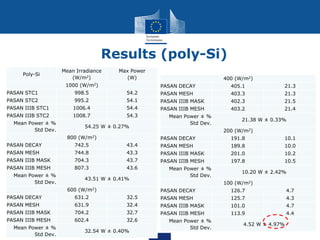
Results (poly-Si)
Poly-Si
Mean Irradiance
(W/m2)
Max Power
(W)
1000 (W/m2)
PASAN STC1 998.5 54.2
PASAN STC2 995.2 54.1
PASAN IIIB STC1 1006.4 54.4
PASAN IIIB STC2 1008.7 54.3
Mean Power ± %
Std Dev.
54.25 W ± 0.27%
800 (W/m2)
PASAN DECAY 742.5 43.4
PASAN MESH 744.8 43.3
PASAN IIIB MASK 704.3 43.7
PASAN IIIB MESH 807.3 43.6
Mean Power ± %
Std Dev.
43.51 W ± 0.41%
600 (W/m2)
PASAN DECAY 631.2 32.5
PASAN MESH 631.9 32.4
PASAN IIIB MASK 704.2 32.7
PASAN IIIB MESH 602.4 32.6
Mean Power ± %
Std Dev.
32.54 W ± 0.40%
400 (W/m2)
PASAN DECAY 405.1 21.3
PASAN MESH 403.3 21.3
PASAN IIIB MASK 402.3 21.5
PASAN IIIB MESH 403.2 21.4
Mean Power ± %
Std Dev.
21.38 W ± 0.33%
200 (W/m2)
PASAN DECAY 191.8 10.1
PASAN MESH 189.8 10.0
PASAN IIIB MASK 201.0 10.2
PASAN IIIB MESH 197.8 10.5
Mean Power ± %
Std Dev.
10.20 W ± 2.42%
100 (W/m2)
PASAN DECAY 126.7 4.7
PASAN MESH 125.7 4.3
PASAN IIIB MASK 101.0 4.7
PASAN IIIB MESH 113.9 4.4
Mean Power ± %
Std Dev.
4.52 W ± 4.97%
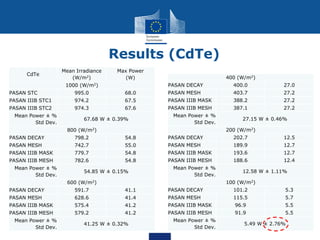
Results (CdTe)
CdTe
Mean Irradiance
(W/m2)
Max Power
(W)
1000 (W/m2)
PASAN STC 995.0 68.0
PASAN IIIB STC1 974.2 67.5
PASAN IIIB STC2 974.3 67.6
Mean Power ± %
Std Dev.
67.68 W ± 0.39%
800 (W/m2)
PASAN DECAY 798.2 54.8
PASAN MESH 742.7 55.0
PASAN IIIB MASK 779.7 54.8
PASAN IIIB MESH 782.6 54.8
Mean Power ± %
Std Dev.
54.85 W ± 0.15%
600 (W/m2)
PASAN DECAY 591.7 41.1
PASAN MESH 628.6 41.4
PASAN IIIB MASK 575.4 41.2
PASAN IIIB MESH 579.2 41.2
Mean Power ± %
Std Dev.
41.25 W ± 0.32%
400 (W/m2)
PASAN DECAY 400.0 27.0
PASAN MESH 403.7 27.2
PASAN IIIB MASK 388.2 27.2
PASAN IIIB MESH 387.1 27.2
Mean Power ± %
Std Dev.
27.15 W ± 0.46%
200 (W/m2)
PASAN DECAY 202.7 12.5
PASAN MESH 189.9 12.7
PASAN IIIB MASK 193.6 12.7
PASAN IIIB MESH 188.6 12.4
Mean Power ± %
Std Dev.
12.58 W ± 1.11%
100 (W/m2)
PASAN DECAY 101.2 5.3
PASAN MESH 115.5 5.7
PASAN IIIB MASK 96.9 5.5
PASAN IIIB MESH 91.9 5.5
Mean Power ± %
Std Dev.
5.49 W ± 2.76%
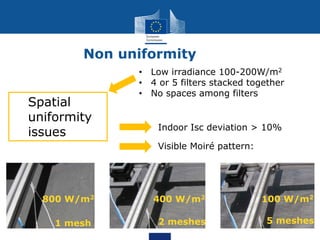
Non uniformity
• Low irradiance 100-200W/m2
• 4 or 5 filters stacked together
• No spaces among filters
Spatial
uniformity
issues Indoor Isc deviation > 10%
Visible Moiré pattern:
800 W/m2 400 W/m2 100 W/m2
1 mesh 2 meshes 5 meshes
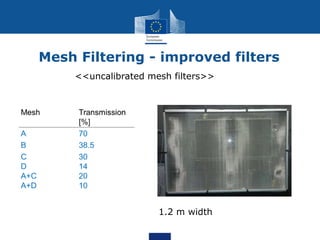
Mesh Filtering - improved filters
<<uncalibrated mesh filters>>
1.2 m width
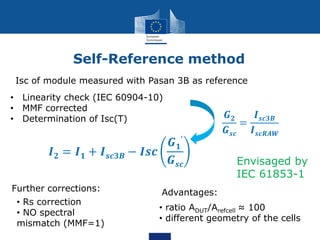
Self-Reference method
𝑮 𝟐
𝑮 𝒔𝒄
=
𝑰 𝒔𝒄𝟑𝑩
𝑰 𝒔𝒄𝑹𝑨𝑾
𝑰 𝟐 = 𝑰 𝟏 + 𝑰 𝒔𝒄𝟑𝑩 − 𝑰𝒔𝒄
𝑮 𝟏
′
𝑮 𝒔𝒄
Isc of module measured with Pasan 3B as reference
• Linearity check (IEC 60904-10)
• MMF corrected
• Determination of Isc(T)
• Rs correction
• NO spectral
mismatch (MMF=1)
Further corrections:
Envisaged by
IEC 61853-1
Advantages:
• ratio ADUT/Arefcell ≈ 100
• different geometry of the cells
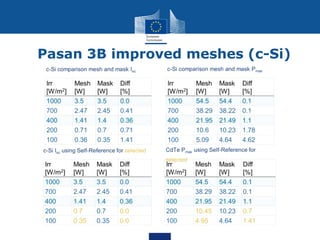
Pasan 3B improved meshes (c-Si)
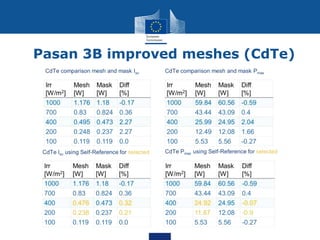
Pasan 3B improved meshes (CdTe)
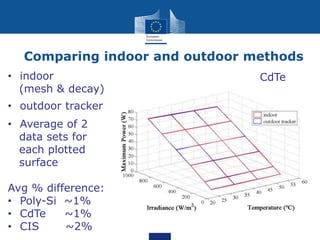
Comparing indoor and outdoor methods
CdTe• indoor
(mesh & decay)
• outdoor tracker
• Average of 2
data sets for
each plotted
surface
Avg % difference:
• Poly-Si ~1%
• CdTe ~1%
• CIS ~2%
Comparing outdoor methods
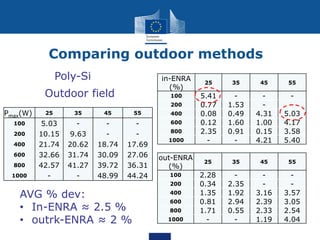
Poly-Si
Pmax(W) 25 35 45 55
100 5.03 - - -
200 10.15 9.63 - -
400 21.74 20.62 18.74 17.69
600 32.66 31.74 30.09 27.06
800 42.57 41.27 39.72 36.31
1000 - - 48.99 44.24
out-ENRA
(%)
25 35 45 55
100 2.28 - - -
200 0.34 2.35 - -
400 1.35 1.92 3.16 3.57
600 0.81 2.94 2.39 3.05
800 1.71 0.55 2.33 2.54
1000 - - 1.19 4.04
in-ENRA
(%)
25 35 45 55
100 5.41 - - -
200 0.77 1.53 - -
400 0.08 0.49 4.31 5.03
600 0.12 1.60 1.00 4.17
800 2.35 0.91 0.15 3.58
1000 - - 4.21 5.40
Outdoor field
AVG % dev:
• In-ENRA ≈ 2.5 %
• outrk-ENRA ≈ 2 %
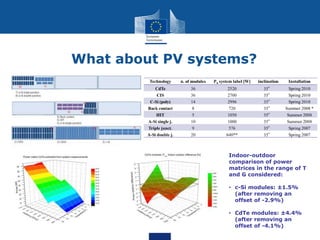
What about PV systems?
Indoor-outdoor
comparison of power
matrices in the range of T
and G considered:
• c-Si modules: ±1.5%
(after removing an
offset of -2.9%)
• CdTe modules: ±4.4%
(after removing an
offset of -4.1%)
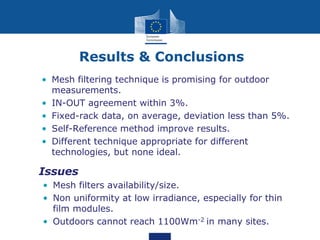
Results & Conclusions
• Mesh filtering technique is promising for outdoor
measurements.
• IN-OUT agreement within 3%.
• Fixed-rack data, on average, deviation less than 5%.
• Self-Reference method improve results.
• Different technique appropriate for different
technologies, but none ideal.
• Issues
• Mesh filters availability/size.
• Non uniformity at low irradiance, especially for thin
film modules.
• Outdoors cannot reach 1100Wm-2 in many sites.
• References
• [1] Robert P. Kenny, Davide Viganó, Elena Salis, Matthew Norton,
Harald Müllejans, Willem Zaaiman, ‘Power rating of photovoltaic
modules including validation of procedures to implement IEC 61853-1
on solar simulators and under natural sunlight’, Prog. Photovolt: Res.
Appl. 2013; 21:1384–1399
• [2] Adrián A. Santamaría Lancia, Giorgio Bardizza, Harald Müllejans,
‘Assessment of uncalibrated light attenuation filters constructed from
industrial woven wire meshes for use in photovoltaic research’,
presented at EUPVSEC conference

23 presentation kenny supsi mar17

  • 1.
    Performance of PVmodules under different irradiances and temperatures Robert Kenny
  • 2.
    • Why theneed for Energy Rating • Peak power (Wp) at Standard Test Conditions (STC) is currently the standard performance guide for modules • End users need kWh NOT Wp! • Energy Rating Procedure • The performance is measured over a range of irradiances and temperatures to simulate the conditions that will be experienced outdoors • Outdoor verification: The module is placed outdoors on the Energy Rating (ENRA) fixed rack and continuously monitored for up to one year
  • 3.
    𝑼 = 𝒈,𝒌 𝑷 𝒈,𝒌 ∆𝒕 𝒈, 𝒌 Energy Rating requires Power Rating at different conditions • STC measurement: • 25°C • 1000W/m2 • AM1.5G 𝐔 = 𝑷 𝒕 𝒅𝒕 = 𝑷 𝑮 𝒕 , 𝑻 𝒕 , . . . 𝒅𝒕 Where: g=[100,200,400,600,800,1000,1100]W/m2 k=[15,25,50,75]°C POWER RATING IEC 61853-1
  • 4.
    • Characterising PVmodules IEC 61853-1 specifies: • Ranges of Irradiance and Temperature • Different measurement methods • Interpolation methods But: • Different methods cannot always meet the full ranges • Different measurement systems have particular limitations, e.g. ranges and uncertainties • Not all measurement systems are suitable for all module technologies (e.g. steady-state Vs pulsed simulators)
  • 5.
    IEC 61853 Part1 POWER RATING (FLAT PLATE MODULES) • 61853-1 PHOTOVOLTAIC (PV) MODULE PERFORMANCE TESTING AND ENERGY RATING Part 1: Irradiance and temperature performance measurements and Power Rating Power versus Irradiance and Temperature IRR Spectrum Module Temperature W-m-2 15C 25C 50C 75C 1100 AM1.5 NA 1000 AM1.5 800 AM1.5 600 AM1.5 400 AM1.5 NA 200 AM1.5 NA 100 AM1.5 NA NA
  • 6.
    • IEC 61853-1methods • ‘Simplified’ procedure (linear modules) o IEC 60904-10 • Natural sunlight with tracker o Mesh filters/angle of incidence • Natural sunlight without tracker • Solar simulator o Distance/angle of incidence/mesh filters (calibrated or uncalibrated)/decaying flash
  • 7.
    • Measurement systemsat ESTI Irradiance variation methods Simulators • Pulsed: meshes/masks/flash decay • Steady-state: meshes/# lamps/lamp voltage Natural sunlight with tracker • Mesh filters Natural sunlight without tracker • ‘The weather’
  • 8.
    IEC 61853-1 Indoormethod g=[100,200,400,600,800,1000]W/m2 k=[25,35,45,55,65]°C <<Procedure with solar simulator>> decay masks P3B heated box P2B varying G varying T none Time (ms) Irradiance P2B LAPSS pulse characteristic 200
  • 9.
    Mesh Filtering (uncalibrated) <<uncalibratedmesh filters>> Mesh Assembling Typical measured mean irradiance (W/m2) Nominal corrected irradiance (W/m2) A ≈ 740 800 Bx ≈ 635 600 B1·B2 ≈ 405 400 A·B1·B2·Cx ≈ 195 200 A·B1·B2·C1·C2 ≈ 125 100 Constraints: •IEC 60891 within 30% •IEC 61853-1 less than 100W/m2 900 1300 150
  • 10.
    Outdoor with tracker g=[100,200,400,600,800,1000]W/m2 k=[25,35,45,55]°C <<undernatural sunlight with tracker>> Temperature: •Heated up by sun •Cooled down with water •Fine control using an opaque lid Irradiance: •Mesh Filters Mesh filters D.U.T. Aluminum structure RefCell Wooden box
  • 11.
    Outdoor field (ENRA) Ghigh & T high G low & T low <<under natural sunlight without tracker>> BINNING TRESHOLDS: • G within ± 2% the target irradiance • T within ± 1°C the target temperature • No Rs, • No Spectral Corrections
  • 12.
    IV Curve Corrections IEC60891 Rs effect 740  800 W/m2 MMF correction IEC 60904-3,7 𝑰 𝟐 = 𝑰 𝟏 + 𝑮 𝟏 ′ 𝑮 𝒔𝒄 𝑰 𝒔𝒄 𝑮 𝟐 𝑮 𝟏 ′ − 𝟏 + ⋯ 𝑽 𝟐 = 𝑽 𝟏 − 𝑹𝒔 𝑰 𝟐 − 𝑰 𝟏 + ⋯ NO Temperature corrections
  • 13.
    Results decay, mesh onP2B masks, mesh on P3B varying G, fixed T=25±0.5°C 4 methods: Poly-Si CdTeDev(Pmax) ≈ 5% Dev(Pmax) ≈ 3% @100 W/m2 @100 W/m2
  • 14.
    Results (poly-Si) Poly-Si Mean Irradiance (W/m2) MaxPower (W) 1000 (W/m2) PASAN STC1 998.5 54.2 PASAN STC2 995.2 54.1 PASAN IIIB STC1 1006.4 54.4 PASAN IIIB STC2 1008.7 54.3 Mean Power ± % Std Dev. 54.25 W ± 0.27% 800 (W/m2) PASAN DECAY 742.5 43.4 PASAN MESH 744.8 43.3 PASAN IIIB MASK 704.3 43.7 PASAN IIIB MESH 807.3 43.6 Mean Power ± % Std Dev. 43.51 W ± 0.41% 600 (W/m2) PASAN DECAY 631.2 32.5 PASAN MESH 631.9 32.4 PASAN IIIB MASK 704.2 32.7 PASAN IIIB MESH 602.4 32.6 Mean Power ± % Std Dev. 32.54 W ± 0.40% 400 (W/m2) PASAN DECAY 405.1 21.3 PASAN MESH 403.3 21.3 PASAN IIIB MASK 402.3 21.5 PASAN IIIB MESH 403.2 21.4 Mean Power ± % Std Dev. 21.38 W ± 0.33% 200 (W/m2) PASAN DECAY 191.8 10.1 PASAN MESH 189.8 10.0 PASAN IIIB MASK 201.0 10.2 PASAN IIIB MESH 197.8 10.5 Mean Power ± % Std Dev. 10.20 W ± 2.42% 100 (W/m2) PASAN DECAY 126.7 4.7 PASAN MESH 125.7 4.3 PASAN IIIB MASK 101.0 4.7 PASAN IIIB MESH 113.9 4.4 Mean Power ± % Std Dev. 4.52 W ± 4.97%
  • 15.
    Results (CdTe) CdTe Mean Irradiance (W/m2) MaxPower (W) 1000 (W/m2) PASAN STC 995.0 68.0 PASAN IIIB STC1 974.2 67.5 PASAN IIIB STC2 974.3 67.6 Mean Power ± % Std Dev. 67.68 W ± 0.39% 800 (W/m2) PASAN DECAY 798.2 54.8 PASAN MESH 742.7 55.0 PASAN IIIB MASK 779.7 54.8 PASAN IIIB MESH 782.6 54.8 Mean Power ± % Std Dev. 54.85 W ± 0.15% 600 (W/m2) PASAN DECAY 591.7 41.1 PASAN MESH 628.6 41.4 PASAN IIIB MASK 575.4 41.2 PASAN IIIB MESH 579.2 41.2 Mean Power ± % Std Dev. 41.25 W ± 0.32% 400 (W/m2) PASAN DECAY 400.0 27.0 PASAN MESH 403.7 27.2 PASAN IIIB MASK 388.2 27.2 PASAN IIIB MESH 387.1 27.2 Mean Power ± % Std Dev. 27.15 W ± 0.46% 200 (W/m2) PASAN DECAY 202.7 12.5 PASAN MESH 189.9 12.7 PASAN IIIB MASK 193.6 12.7 PASAN IIIB MESH 188.6 12.4 Mean Power ± % Std Dev. 12.58 W ± 1.11% 100 (W/m2) PASAN DECAY 101.2 5.3 PASAN MESH 115.5 5.7 PASAN IIIB MASK 96.9 5.5 PASAN IIIB MESH 91.9 5.5 Mean Power ± % Std Dev. 5.49 W ± 2.76%
  • 16.
    Non uniformity • Lowirradiance 100-200W/m2 • 4 or 5 filters stacked together • No spaces among filters Spatial uniformity issues Indoor Isc deviation > 10% Visible Moiré pattern: 800 W/m2 400 W/m2 100 W/m2 1 mesh 2 meshes 5 meshes
  • 17.
    Mesh Filtering -improved filters <<uncalibrated mesh filters>> 1.2 m width
  • 18.
    Self-Reference method 𝑮 𝟐 𝑮𝒔𝒄 = 𝑰 𝒔𝒄𝟑𝑩 𝑰 𝒔𝒄𝑹𝑨𝑾 𝑰 𝟐 = 𝑰 𝟏 + 𝑰 𝒔𝒄𝟑𝑩 − 𝑰𝒔𝒄 𝑮 𝟏 ′ 𝑮 𝒔𝒄 Isc of module measured with Pasan 3B as reference • Linearity check (IEC 60904-10) • MMF corrected • Determination of Isc(T) • Rs correction • NO spectral mismatch (MMF=1) Further corrections: Envisaged by IEC 61853-1 Advantages: • ratio ADUT/Arefcell ≈ 100 • different geometry of the cells
  • 19.
    Pasan 3B improvedmeshes (c-Si)
  • 20.
    Pasan 3B improvedmeshes (CdTe)
  • 21.
    Comparing indoor andoutdoor methods CdTe• indoor (mesh & decay) • outdoor tracker • Average of 2 data sets for each plotted surface Avg % difference: • Poly-Si ~1% • CdTe ~1% • CIS ~2%
  • 22.
    Comparing outdoor methods Poly-Si Pmax(W)25 35 45 55 100 5.03 - - - 200 10.15 9.63 - - 400 21.74 20.62 18.74 17.69 600 32.66 31.74 30.09 27.06 800 42.57 41.27 39.72 36.31 1000 - - 48.99 44.24 out-ENRA (%) 25 35 45 55 100 2.28 - - - 200 0.34 2.35 - - 400 1.35 1.92 3.16 3.57 600 0.81 2.94 2.39 3.05 800 1.71 0.55 2.33 2.54 1000 - - 1.19 4.04 in-ENRA (%) 25 35 45 55 100 5.41 - - - 200 0.77 1.53 - - 400 0.08 0.49 4.31 5.03 600 0.12 1.60 1.00 4.17 800 2.35 0.91 0.15 3.58 1000 - - 4.21 5.40 Outdoor field AVG % dev: • In-ENRA ≈ 2.5 % • outrk-ENRA ≈ 2 %
  • 23.
    What about PVsystems? Indoor-outdoor comparison of power matrices in the range of T and G considered: • c-Si modules: ±1.5% (after removing an offset of -2.9%) • CdTe modules: ±4.4% (after removing an offset of -4.1%)
  • 24.
    Results & Conclusions •Mesh filtering technique is promising for outdoor measurements. • IN-OUT agreement within 3%. • Fixed-rack data, on average, deviation less than 5%. • Self-Reference method improve results. • Different technique appropriate for different technologies, but none ideal. • Issues • Mesh filters availability/size. • Non uniformity at low irradiance, especially for thin film modules. • Outdoors cannot reach 1100Wm-2 in many sites.
  • 25.
    • References • [1]Robert P. Kenny, Davide Viganó, Elena Salis, Matthew Norton, Harald Müllejans, Willem Zaaiman, ‘Power rating of photovoltaic modules including validation of procedures to implement IEC 61853-1 on solar simulators and under natural sunlight’, Prog. Photovolt: Res. Appl. 2013; 21:1384–1399 • [2] Adrián A. Santamaría Lancia, Giorgio Bardizza, Harald Müllejans, ‘Assessment of uncalibrated light attenuation filters constructed from industrial woven wire meshes for use in photovoltaic research’, presented at EUPVSEC conference