EN 50380 ed. 2.0:
Bengt Jaeckel
UL International GmbH
Admiral-Rosendahl-Strasse 9, 63263 Neu-Isenburg (Zeppelinheim), Germany
Session 1: Energy rating (9:30-10:30)
7th Energy Rating and Module Performance Modeling Workshop
30-31 March 2017 Lugano / Switzerland
 What is new?
 What’s coming next?
page 2
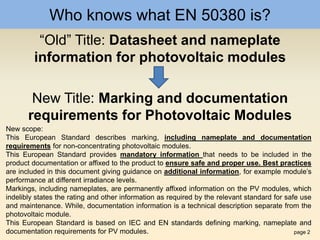
Who knows what EN 50380 is?
“Old” Title: Datasheet and nameplate
information for photovoltaic modules
New Title: Marking and documentation
requirements for Photovoltaic Modules
New scope:
This European Standard describes marking, including nameplate and documentation
requirements for non-concentrating photovoltaic modules.
This European Standard provides mandatory information that needs to be included in the
product documentation or affixed to the product to ensure safe and proper use. Best practices
are included in this document giving guidance on additional information, for example module’s
performance at different irradiance levels.
Markings, including nameplates, are permanently affixed information on the PV modules, which
indelibly states the rating and other information as required by the relevant standard for safe use
and maintenance. While, documentation information is a technical description separate from the
photovoltaic module.
This European Standard is based on IEC and EN standards defining marking, nameplate and
documentation requirements for PV modules.
page 3
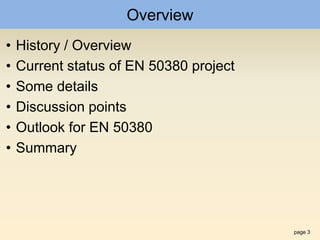
Overview
• History / Overview
• Current status of EN 50380 project
• Some details
• Discussion points
• Outlook for EN 50380
• Summary
page 4
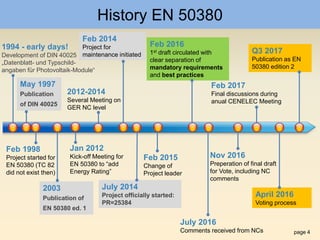
July 2014
Project officially started:
PR=25384
History EN 50380
2003
Publication of
EN 50380 ed. 1
1994 - early days!
Development of DIN 40025
„Datenblatt- und Typschild-
angaben für Photovoltaik-Module“
Feb 2014
Project for
maintenance initiated
Jan 2012
Kick-off Meeting for
EN 50380 to “add
Energy Rating”
Feb 2016
1st draft circulated with
clear separation of
mandatory requirements
and best practices
Feb 2015
Change of
Project leader
April 2016
Voting process
Nov 2016
Preperation of final draft
for Vote, including NC
comments
Q3 2017
Publication as EN
50380 edition 2
2012-2014
Several Meeting on
GER NC level
Feb 2017
Final discussions during
anual CENELEC Meeting
July 2016
Comments received from NCs
May 1997
Publication
of DIN 40025
Feb 1998
Project started for
EN 50380 (TC 82
did not exist then)
page 5
Photovoltaic cell
Current status of EN 50380
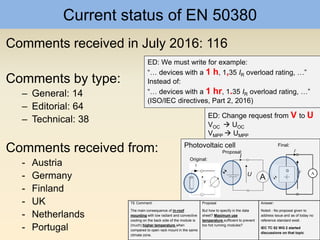
Comments received in July 2016: 116
Comments by type:
– General: 14
– Editorial: 64
– Technical: 38
Comments received from:
- Austria
- Germany
- Finland
- UK
- Netherlands
- Portugal
ED: We must write for example:
“… devices with a 1 h, 1,35 IR overload rating, …”
Instead of:
“… devices with a 1 hr, 1.35 IR overload rating, …”
(ISO/IEC directives, Part 2, 2016)
ED: Change request from V to U
VOC  UOC
VMPP  UMPP
AU
I
TE Comment:
The main consequence of in-roof
mounting with low radiant and convective
cooling on the back side of the module is
(much) higher temperature when
compared to open rack mount in the same
climate zone.
Proposal
But how to specify in the data
sheet? Maximum use
temperature sufficient to prevent
too hot running modules?
Answer:
Noted - No proposal given to
address issue and as of today no
reference standard exist.
IEC TC 82 WG 2 started
discussions on that topic
Original:
Proposal:
Final:
page 6
Next project steps of EN 50380
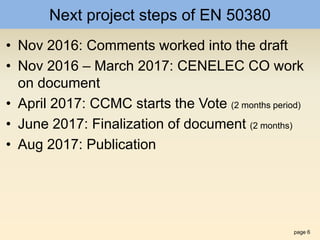
• Nov 2016: Comments worked into the draft
• Nov 2016 – March 2017: CENELEC CO work
on document
• April 2017: CCMC starts the Vote (2 months period)
• June 2017: Finalization of document (2 months)
• Aug 2017: Publication
page 7
New document structure
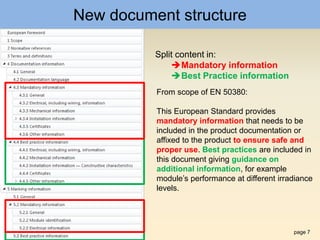
Split content in:
Mandatory information
Best Practice information
From scope of EN 50380:
This European Standard provides
mandatory information that needs to be
included in the product documentation or
affixed to the product to ensure safe and
proper use. Best practices are included in
this document giving guidance on
additional information, for example
module’s performance at different irradiance
levels.
page 8
Mandatory & Best practice
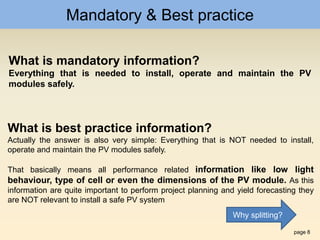
What is mandatory information?
Everything that is needed to install, operate and maintain the PV
modules safely.
What is best practice information?
Actually the answer is also very simple: Everything that is NOT needed to install,
operate and maintain the PV modules safely.
That basically means all performance related information like low light
behaviour, type of cell or even the dimensions of the PV module. As this
information are quite important to perform project planning and yield forecasting they
are NOT relevant to install a safe PV system
Why splitting?
page 9
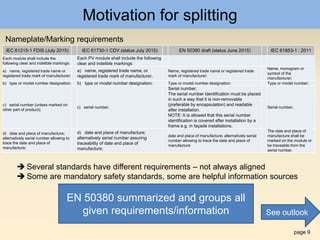
Motivation for splitting
IEC 61215-1 FDIS (July 2015) IEC 61730-1 CDV (status July 2015) EN 50380 draft (status June 2015) IEC 61853-1 : 2011
Each module shall include the
following clear and indelible markings:
Each PV module shall include the following
clear and indelible markings:
a) name, registered trade name or
registered trade mark of manufacturer;
a) name, registered trade name, or
registered trade mark of manufacturer;
Name, registered trade name or registered trade
mark of manufacturer;
Name, monogram or
symbol of the
manufacturer;
b) type or model number designation; b) type or model number designation; Type or model number designation; Type or model number;
c) serial number (unless marked on
other part of product);
c) serial number;
Serial number;
The serial number identification must be placed
in such a way that it is non-removable
(preferable by encapsulation) and readable
after installation.
NOTE: It is allowed that this serial number
identification is covered after installation by a
frame e.g. in façade installations.
Serial number;
d) date and place of manufacture;
alternatively serial number allowing to
trace the date and place of
manufacture;
d) date and place of manufacture;
alternatively serial number assuring
traceability of date and place of
manufacture;
date and place of manufacture; alternatively serial
number allowing to trace the date and place of
manufacture
The date and place of
manufacture shall be
marked on the module or
be traceable from the
serial number.
Nameplate/Marking requirements
 Several standards have different requirements – not always aligned
 Some are mandatory safety standards, some are helpful information sources
EN 50380 summarized and groups all
given requirements/information See outlook
page 10
Example: Mandatory
The documentation shall contain the following electrical information:
a) polarity of terminals or leads;
b) “Maximum system voltage” or Vsys;
c) Maximum overcurrent protection (OCP) rating
d) Class of protection against electrical shock
e) “Voltage at open-circuit” or “Voc” including rated production tolerance
f) “Voltages at maximum power point” or “Vmax”
g) “Current at maximum power point”; or “Imax”
h) “PV module maximum power” or “Pmax ”
i) “Current at short-circuit”; or “Isc”
j) Relative temperature coefficients in [%/K] for Isc, Pmax and Voc at STC
Example: Best practice
a) Nominal module operating temperature – NMOT (MQT 05)
b) Performance at NMOT (MQT 06.2).
c) Performance at low irradiance (MQT 07).
Highlighting some requirements
page 11
Discussion points
• What are Mandatory and Best practice
requirements?
– At some points some best practice information will be
mandatory – dependent on country
• Some terms and their verification
– What is “permanently affixed”, “permanent marking”,
“indelibly” and “durable construction” ?
– How to verify that?
Proposal:
“The durability of markings (the permanently affixed information on the
PV modules with all indelibly states ratings) is verified with Visual
inspection MST 01 and Durability of markings Test MST 05 after
passing all tests from Sequence A to F.“
page 12
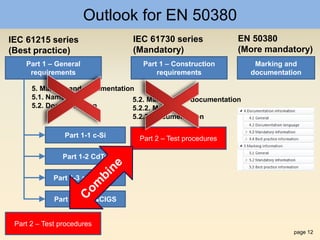
Outlook for EN 50380
Part 1 – General
requirements
Part 2 – Test procedures
Part 1-1 c-Si
Part 1-2 CdTe
Part 1-3 a-Si & µ-Si
Part 1-4 CIS&CIGS
IEC 61215 series
(Best practice)
Part 1 – Construction
requirements
Part 2 – Test procedures
IEC 61730 series
(Mandatory)
EN 50380
(More mandatory)
Marking and
documentation
5. Marking and documentation
5.1. Name plate
5.2. Documentation
5.2. Marking and documentation
5.2.2. Marking
5.2.3. Documentation
page 13
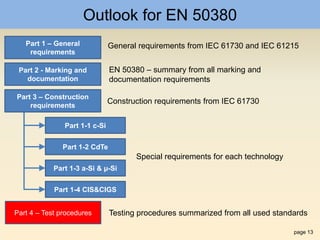
Outlook for EN 50380
Part 1 – General
requirements
Part 4 – Test procedures
Part 1-1 c-Si
Part 1-2 CdTe
Part 1-3 a-Si & µ-Si
Part 1-4 CIS&CIGS
Part 3 – Construction
requirements
Part 2 - Marking and
documentation
General requirements from IEC 61730 and IEC 61215
EN 50380 – summary from all marking and
documentation requirements
Construction requirements from IEC 61730
Special requirements for each technology
Testing procedures summarized from all used standards
page 14
Summary
• Short history EN 50380
• EN 50380 project status
• Comments and new structure with
–Mandatory &
–Best practice information
• Some discussion points
• Outlook what could happen with EN
50380
06 en50380 2017-03-29

06 en50380 2017-03-29

  • 1.
    EN 50380 ed.2.0: Bengt Jaeckel UL International GmbH Admiral-Rosendahl-Strasse 9, 63263 Neu-Isenburg (Zeppelinheim), Germany Session 1: Energy rating (9:30-10:30) 7th Energy Rating and Module Performance Modeling Workshop 30-31 March 2017 Lugano / Switzerland  What is new?  What’s coming next?
  • 2.
    page 2 Who knowswhat EN 50380 is? “Old” Title: Datasheet and nameplate information for photovoltaic modules New Title: Marking and documentation requirements for Photovoltaic Modules New scope: This European Standard describes marking, including nameplate and documentation requirements for non-concentrating photovoltaic modules. This European Standard provides mandatory information that needs to be included in the product documentation or affixed to the product to ensure safe and proper use. Best practices are included in this document giving guidance on additional information, for example module’s performance at different irradiance levels. Markings, including nameplates, are permanently affixed information on the PV modules, which indelibly states the rating and other information as required by the relevant standard for safe use and maintenance. While, documentation information is a technical description separate from the photovoltaic module. This European Standard is based on IEC and EN standards defining marking, nameplate and documentation requirements for PV modules.
  • 3.
    page 3 Overview • History/ Overview • Current status of EN 50380 project • Some details • Discussion points • Outlook for EN 50380 • Summary
  • 4.
    page 4 July 2014 Projectofficially started: PR=25384 History EN 50380 2003 Publication of EN 50380 ed. 1 1994 - early days! Development of DIN 40025 „Datenblatt- und Typschild- angaben für Photovoltaik-Module“ Feb 2014 Project for maintenance initiated Jan 2012 Kick-off Meeting for EN 50380 to “add Energy Rating” Feb 2016 1st draft circulated with clear separation of mandatory requirements and best practices Feb 2015 Change of Project leader April 2016 Voting process Nov 2016 Preperation of final draft for Vote, including NC comments Q3 2017 Publication as EN 50380 edition 2 2012-2014 Several Meeting on GER NC level Feb 2017 Final discussions during anual CENELEC Meeting July 2016 Comments received from NCs May 1997 Publication of DIN 40025 Feb 1998 Project started for EN 50380 (TC 82 did not exist then)
  • 5.
    page 5 Photovoltaic cell Currentstatus of EN 50380 Comments received in July 2016: 116 Comments by type: – General: 14 – Editorial: 64 – Technical: 38 Comments received from: - Austria - Germany - Finland - UK - Netherlands - Portugal ED: We must write for example: “… devices with a 1 h, 1,35 IR overload rating, …” Instead of: “… devices with a 1 hr, 1.35 IR overload rating, …” (ISO/IEC directives, Part 2, 2016) ED: Change request from V to U VOC  UOC VMPP  UMPP AU I TE Comment: The main consequence of in-roof mounting with low radiant and convective cooling on the back side of the module is (much) higher temperature when compared to open rack mount in the same climate zone. Proposal But how to specify in the data sheet? Maximum use temperature sufficient to prevent too hot running modules? Answer: Noted - No proposal given to address issue and as of today no reference standard exist. IEC TC 82 WG 2 started discussions on that topic Original: Proposal: Final:
  • 6.
    page 6 Next projectsteps of EN 50380 • Nov 2016: Comments worked into the draft • Nov 2016 – March 2017: CENELEC CO work on document • April 2017: CCMC starts the Vote (2 months period) • June 2017: Finalization of document (2 months) • Aug 2017: Publication
  • 7.
    page 7 New documentstructure Split content in: Mandatory information Best Practice information From scope of EN 50380: This European Standard provides mandatory information that needs to be included in the product documentation or affixed to the product to ensure safe and proper use. Best practices are included in this document giving guidance on additional information, for example module’s performance at different irradiance levels.
  • 8.
    page 8 Mandatory &Best practice What is mandatory information? Everything that is needed to install, operate and maintain the PV modules safely. What is best practice information? Actually the answer is also very simple: Everything that is NOT needed to install, operate and maintain the PV modules safely. That basically means all performance related information like low light behaviour, type of cell or even the dimensions of the PV module. As this information are quite important to perform project planning and yield forecasting they are NOT relevant to install a safe PV system Why splitting?
  • 9.
    page 9 Motivation forsplitting IEC 61215-1 FDIS (July 2015) IEC 61730-1 CDV (status July 2015) EN 50380 draft (status June 2015) IEC 61853-1 : 2011 Each module shall include the following clear and indelible markings: Each PV module shall include the following clear and indelible markings: a) name, registered trade name or registered trade mark of manufacturer; a) name, registered trade name, or registered trade mark of manufacturer; Name, registered trade name or registered trade mark of manufacturer; Name, monogram or symbol of the manufacturer; b) type or model number designation; b) type or model number designation; Type or model number designation; Type or model number; c) serial number (unless marked on other part of product); c) serial number; Serial number; The serial number identification must be placed in such a way that it is non-removable (preferable by encapsulation) and readable after installation. NOTE: It is allowed that this serial number identification is covered after installation by a frame e.g. in façade installations. Serial number; d) date and place of manufacture; alternatively serial number allowing to trace the date and place of manufacture; d) date and place of manufacture; alternatively serial number assuring traceability of date and place of manufacture; date and place of manufacture; alternatively serial number allowing to trace the date and place of manufacture The date and place of manufacture shall be marked on the module or be traceable from the serial number. Nameplate/Marking requirements  Several standards have different requirements – not always aligned  Some are mandatory safety standards, some are helpful information sources EN 50380 summarized and groups all given requirements/information See outlook
  • 10.
    page 10 Example: Mandatory Thedocumentation shall contain the following electrical information: a) polarity of terminals or leads; b) “Maximum system voltage” or Vsys; c) Maximum overcurrent protection (OCP) rating d) Class of protection against electrical shock e) “Voltage at open-circuit” or “Voc” including rated production tolerance f) “Voltages at maximum power point” or “Vmax” g) “Current at maximum power point”; or “Imax” h) “PV module maximum power” or “Pmax ” i) “Current at short-circuit”; or “Isc” j) Relative temperature coefficients in [%/K] for Isc, Pmax and Voc at STC Example: Best practice a) Nominal module operating temperature – NMOT (MQT 05) b) Performance at NMOT (MQT 06.2). c) Performance at low irradiance (MQT 07). Highlighting some requirements
  • 11.
    page 11 Discussion points •What are Mandatory and Best practice requirements? – At some points some best practice information will be mandatory – dependent on country • Some terms and their verification – What is “permanently affixed”, “permanent marking”, “indelibly” and “durable construction” ? – How to verify that? Proposal: “The durability of markings (the permanently affixed information on the PV modules with all indelibly states ratings) is verified with Visual inspection MST 01 and Durability of markings Test MST 05 after passing all tests from Sequence A to F.“
  • 12.
    page 12 Outlook forEN 50380 Part 1 – General requirements Part 2 – Test procedures Part 1-1 c-Si Part 1-2 CdTe Part 1-3 a-Si & µ-Si Part 1-4 CIS&CIGS IEC 61215 series (Best practice) Part 1 – Construction requirements Part 2 – Test procedures IEC 61730 series (Mandatory) EN 50380 (More mandatory) Marking and documentation 5. Marking and documentation 5.1. Name plate 5.2. Documentation 5.2. Marking and documentation 5.2.2. Marking 5.2.3. Documentation
  • 13.
    page 13 Outlook forEN 50380 Part 1 – General requirements Part 4 – Test procedures Part 1-1 c-Si Part 1-2 CdTe Part 1-3 a-Si & µ-Si Part 1-4 CIS&CIGS Part 3 – Construction requirements Part 2 - Marking and documentation General requirements from IEC 61730 and IEC 61215 EN 50380 – summary from all marking and documentation requirements Construction requirements from IEC 61730 Special requirements for each technology Testing procedures summarized from all used standards
  • 14.
    page 14 Summary • Shorthistory EN 50380 • EN 50380 project status • Comments and new structure with –Mandatory & –Best practice information • Some discussion points • Outlook what could happen with EN 50380

Editor's Notes

  • #5 Die erste überarbeitete englische Fassung für die damalige Task Force CLC/ BTTF 86-2 (CLC/TC82 war noch nicht gegründet) habe ich im Februar 1998 versandt. Im Februar 2002 gründete sich CLC/TC82 und die EN 50380 war im März 2003 die erste veröffentlichte "homegrown" Norm von CLC/TC82