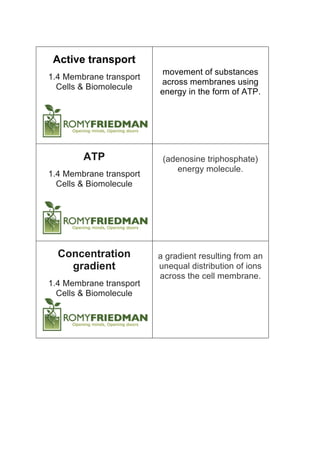
Active transport
1.4 Membrane transport
Cells & Biomolecule
movement of substances
across membranes using
energy in the form of ATP.
ATP
1.4 Membrane transport
Cells & Biomolecule
(adenosine triphosphate)
energy molecule.
Concentration
gradient
1.4 Membrane transport
Cells & Biomolecule
a gradient resulting from an
unequal distribution of ions
across the cell membrane.
Diffusion
1.4 Membrane transport
Cells & Biomolecule
passive movement of
particles from a region of
higher concentration to a
region of lower
concentration.
Endocytosis
1.4 Membrane transport
Cells & Biomolecule
the process in which the cell
takes in materials from the
outside by infolding of the
membrane to form a vesicle.
Exocytosis
1.4 Membrane transport
Cells & Biomolecule
the process in which the cell
releases materials to the
outside by discharging them
as membrane-bounded
vesicles that pass through
the cell membrane.
Facilitated diffusion
1.4 Membrane transport
Cells & Biomolecule
diffusion through a
membrane that requires
proteins.
Hypertonic
1.4 Membrane transport
Cells & Biomolecule
a more concentrated
solution relative to another
fluid.
Hypotonic
1.4 Membrane transport
Cells & Biomolecule
a less concentrated solution
relative to another fluid.
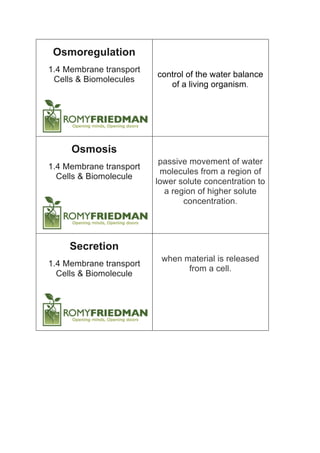
Osmoregulation
1.4 Membrane transport
Cells & Biomolecules
control of the water balance
of a living organism.
Osmosis
1.4 Membrane transport
Cells & Biomolecule
passive movement of water
molecules from a region of
lower solute concentration to
a region of higher solute
concentration.
Secretion
1.4 Membrane transport
Cells & Biomolecule
when material is released
from a cell.
Semi-permeable
membrane
1.4 Membrane transport
Cells & Biomolecule
membrane that allows some
substances to diffuse through
but not others. Transport pumps
proteins in the plasma
membrane that use ATP to
move substances across the
membrane. Vesicles a bubble-
like membranous structure that
stores and transports cellular
products.

1.4 flashcards

  • 1.
    Active transport 1.4 Membranetransport Cells & Biomolecule movement of substances across membranes using energy in the form of ATP. ATP 1.4 Membrane transport Cells & Biomolecule (adenosine triphosphate) energy molecule. Concentration gradient 1.4 Membrane transport Cells & Biomolecule a gradient resulting from an unequal distribution of ions across the cell membrane.
  • 2.
    Diffusion 1.4 Membrane transport Cells& Biomolecule passive movement of particles from a region of higher concentration to a region of lower concentration. Endocytosis 1.4 Membrane transport Cells & Biomolecule the process in which the cell takes in materials from the outside by infolding of the membrane to form a vesicle. Exocytosis 1.4 Membrane transport Cells & Biomolecule the process in which the cell releases materials to the outside by discharging them as membrane-bounded vesicles that pass through the cell membrane.
  • 3.
    Facilitated diffusion 1.4 Membranetransport Cells & Biomolecule diffusion through a membrane that requires proteins. Hypertonic 1.4 Membrane transport Cells & Biomolecule a more concentrated solution relative to another fluid. Hypotonic 1.4 Membrane transport Cells & Biomolecule a less concentrated solution relative to another fluid.
  • 4.
    Osmoregulation 1.4 Membrane transport Cells& Biomolecules control of the water balance of a living organism. Osmosis 1.4 Membrane transport Cells & Biomolecule passive movement of water molecules from a region of lower solute concentration to a region of higher solute concentration. Secretion 1.4 Membrane transport Cells & Biomolecule when material is released from a cell.
  • 5.
    Semi-permeable membrane 1.4 Membrane transport Cells& Biomolecule membrane that allows some substances to diffuse through but not others. Transport pumps proteins in the plasma membrane that use ATP to move substances across the membrane. Vesicles a bubble- like membranous structure that stores and transports cellular products.