Enabling Key Applications for Transport SDN
OptiNetChina 2020
August 26, 2020
Hu Qian
Editor
OIF Integrated Packet/Optical SDN Implementation Agreement
Copyright © 2020 OIF 1
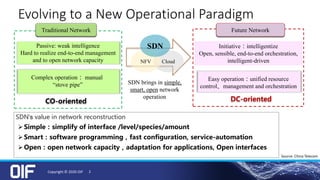
DC-oriented
Traditional Network Future Network
Complex operation: manual
“stove pipe”
Easy operation:unified resource
control、management and orchestration
CO-oriented
Passive: weak intelligence
Hard to realize end-to-end management
and to open network capacity
Initiative:intelligentize
Open, sensible, end-to-end orchestration,
intelligent-driven
SDN brings in simple,
smart, open network
operation
CloudNFV
SDN
➢ Simple:simplify of interface /level/species/amount
➢ Smart:software programming,fast configuration, service-automation
➢ Open:open network capacity,adaptation for applications, Open interfaces
SDN’s value in network reconstruction
Evolving to a New Operational Paradigm
Source: China Telecom
Copyright © 2020 OIF 2
What is OIF
• Since 1998, OIF has brought together industry groups from the data and
optical worlds
• Mission: To foster the development and deployment of interoperable
products and services for data switching and routing using optical
networking technologies
• OIF’s 100+ member companies represent the entire industry ecosystem:
• Network operators and network users
• Component and systems vendors
• Testing and software companies
• Academia
• Products: IAs, White Papers, Certification Test Specs
• Current Work in Networking WG (Transport SDN related):
• Requirements for Integrated Packet/Optical SDN
• Transport SDN API Interoperability Testing
Copyright © 2020 OIF 3
OIF’s SDN Activities
• Identify architecture and requirements based on operator input
• Prototype and test SDN architecture and interfaces
• Work jointly with SDOs on addressing gaps (e.g. ONF T-API)
• Interop testing and demonstration of standards
• Allows hands-on experience for participating operators
• Helps drive vendor implementation
• Push findings back to SDOs (ONF Specs and Developer’s Guide)
• Potential certification function based on operator needs
Copyright © 2020 OIF 4
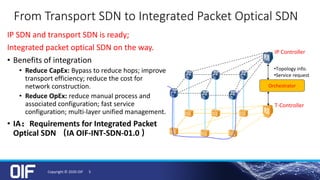
From Transport SDN to Integrated Packet Optical SDN
IP SDN and transport SDN is ready;
Integrated packet optical SDN on the way.
• Benefits of integration
• Reduce CapEx: Bypass to reduce hops; improve
transport efficiency; reduce the cost for
network construction.
• Reduce OpEx: reduce manual process and
associated configuration; fast service
configuration; multi-layer unified management.
• IA:Requirements for Integrated Packet
Optical SDN (IA OIF-INT-SDN-01.0 )
IP Controller
T-Controller
•Topology info.
•Service request
Copyright © 2020 OIF 5
Orchestrator
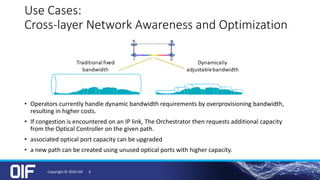
Use Cases:
Cross-layer Network Awareness and Optimization
• Operators currently handle dynamic bandwidth requirements by overprovisioning bandwidth,
resulting in higher costs.
• If congestion is encountered on an IP link, The Orchestrator then requests additional capacity
from the Optical Controller on the given path.
• associated optical port capacity can be upgraded
• a new path can be created using unused optical ports with higher capacity.
Copyright © 2020 OIF 6
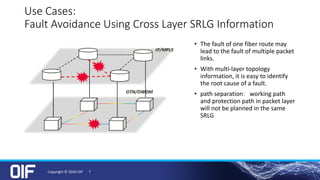
Use Cases:
Fault Avoidance Using Cross Layer SRLG Information
• The fault of one fiber route may
lead to the fault of multiple packet
links.
• With multi-layer topology
information, it is easy to identify
the root cause of a fault.
• path separation:working path
and protection path in packet layer
will not be planned in the same
SRLG
Copyright © 2020 OIF 7
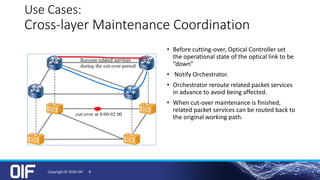
Use Cases:
Cross-layer Maintenance Coordination
• Before cutting-over, Optical Controller set
the operational state of the optical link to be
“down”
• Notify Orchestrator.
• Orchestrator reroute related packet services
in advance to avoid being affected.
• When cut-over maintenance is finished,
related packet services can be routed back to
the original working path.
Copyright © 2020 OIF 8
Use Cases:
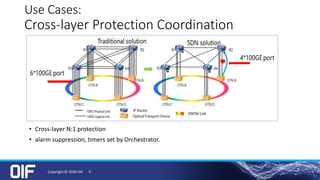
Cross-layer Protection Coordination
• Cross-layer N:1 protection
• alarm suppression, timers set by Orchestrator.
Copyright © 2020 OIF 9
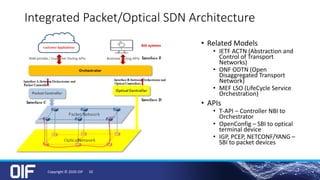
Integrated Packet/Optical SDN Architecture
• Related Models
• IETF ACTN (Abstraction and
Control of Transport
Networks)
• ONF ODTN (Open
Disaggregated Transport
Network)
• MEF LSO (LifeCycle Service
Orchestration)
• APIs
• T-API – Controller NBI to
Orchestrator
• OpenConfig – SBI to optical
terminal device
• IGP, PCEP, NETCONF/YANG –
SBI to packet devices
Copyright © 2020 OIF 10
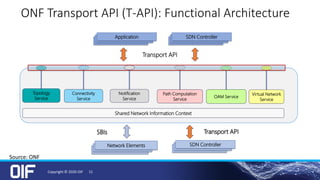
ONF Transport API (T-API): Functional Architecture
Topology
Service
Connectivity
Service
Path Computation
Service
Shared Network Information Context
OAM Service
Virtual Network
Service
NENetwork Elements
NENESDN Controller
NENESDN Controller
NENEApplication
SBIs
Transport API
Notification
Service
Transport API
Source: ONF
Copyright © 2020 OIF 11
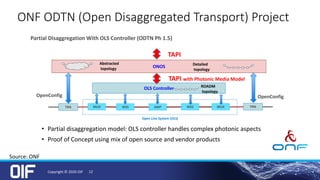
ONF ODTN (Open Disaggregated Transport) Project
OLS Controller
WSS TRN
Open Line System (OLS)
OpenConfig OpenConfig
MUX WSSAMP MUXTRN
ONOS
Partial Disaggregation With OLS Controller (ODTN Ph 1.5)
TAPI with Photonic Media Model
ROADM
topology
TAPI
Abstracted
topology
Detailed
topology
Source: ONF
• Partial disaggregation model: OLS controller handles complex photonic aspects
• Proof of Concept using mix of open source and vendor products
Copyright © 2020 OIF 12
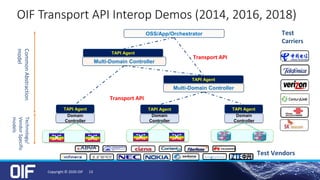
OIF Transport API Interop Demos (2014, 2016, 2018)
Domain
Controller
Domain
Controller
Domain
Controller
Multi-Domain Controller
Technology/
VendorSpecific
models
TAPI Agent
OSS/App/Orchestrator
CommonAbstraction
model
Transport API
Test Vendors
Test
Carriers
Transport API
TAPI Agent
Multi-Domain Controller
TAPI AgentTAPI Agent
TAPI Agent
Copyright © 2020 OIF 13
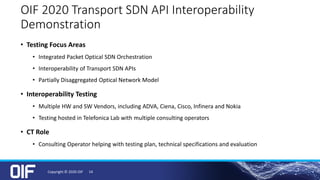
OIF 2020 Transport SDN API Interoperability
Demonstration
• Testing Focus Areas
• Integrated Packet Optical SDN Orchestration
• Interoperability of Transport SDN APIs
• Partially Disaggregated Optical Network Model
• Interoperability Testing
• Multiple HW and SW Vendors, including ADVA, Ciena, Cisco, Infinera and Nokia
• Testing hosted in Telefonica Lab with multiple consulting operators
• CT Role
• Consulting Operator helping with testing plan, technical specifications and evaluation
Copyright © 2020 OIF 14
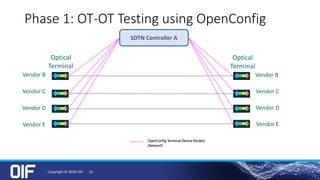
Phase 1: OT-OT Testing using OpenConfig
SDTN Controller A
Vendor B
Vendor C
Vendor D
Vendor E
Vendor C
Vendor D
Vendor E
Vendor B
Optical
Terminal
Optical
Terminal
OpenConfig Terminal Device Models
(Netconf)
Copyright © 2020 OIF 15
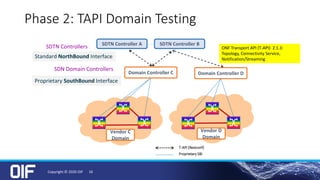
Phase 2: TAPI Domain Testing
SDTN Controllers
Proprietary SouthBound Interface
Standard NorthBound Interface
SDN Domain Controllers
ONF Transport API (T-API) 2.1.3:
Topology, Connectivity Service,
Notification/Streaming
T-API (Restconf)
SDTN Controller A SDTN Controller B
Domain Controller C Domain Controller D
Proprietary SBI
Vendor C
Domain
Vendor D
Domain
Copyright © 2020 OIF 16
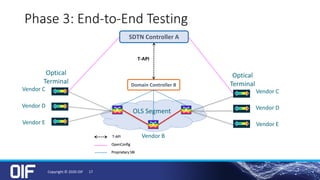
Phase 3: End-to-End Testing
SDTN Controller A
T-API
OpenConfig
T-API
OLS Segment
Vendor C
Vendor D
Vendor E
Vendor C
Vendor D
Vendor E
Domain Controller B
Vendor B
Proprietary SBI
Optical
Terminal
Optical
Terminal
Copyright © 2020 OIF 17
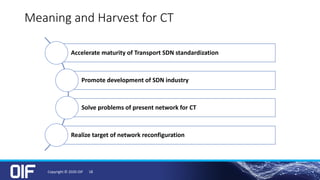
Meaning and Harvest for CT
Accelerate maturity of Transport SDN standardization
Promote development of SDN industry
Solve problems of present network for CT
Realize target of network reconfiguration
Copyright © 2020 OIF 18
Summary: OIF Transport SDN
• Interoperability Testing: from 2014 to 2020, Provides early feedback to SDOs to accelerate
standardization.
• T-API/OpenConfig: OIF has substantiated T-API as the Northbound Interface (NBI) of choice.
OpenConfig realizes standardization of the management interface of the terminal devices and OLS.
• IP+Optical: IP SDN and transport SDN is ready; Integrated packet optical SDN on the way.
• OIF Transport SDN: The OIF, in collaboration with industry leaders, has helped establish a
foundation for open, programmable networks that allow operators to efficiently deliver dynamic
multi-domain connectivity services to the market
Copyright © 2020 OIF 19
Thanks!
www.oiforum.com
Copyright © 2020 OIF 20

Enabling Key Applications for Transport SDN - Optinet China 2020

  • 1.
    Enabling Key Applicationsfor Transport SDN OptiNetChina 2020 August 26, 2020 Hu Qian Editor OIF Integrated Packet/Optical SDN Implementation Agreement Copyright © 2020 OIF 1
  • 2.
    DC-oriented Traditional Network FutureNetwork Complex operation: manual “stove pipe” Easy operation:unified resource control、management and orchestration CO-oriented Passive: weak intelligence Hard to realize end-to-end management and to open network capacity Initiative:intelligentize Open, sensible, end-to-end orchestration, intelligent-driven SDN brings in simple, smart, open network operation CloudNFV SDN ➢ Simple:simplify of interface /level/species/amount ➢ Smart:software programming,fast configuration, service-automation ➢ Open:open network capacity,adaptation for applications, Open interfaces SDN’s value in network reconstruction Evolving to a New Operational Paradigm Source: China Telecom Copyright © 2020 OIF 2
  • 3.
    What is OIF •Since 1998, OIF has brought together industry groups from the data and optical worlds • Mission: To foster the development and deployment of interoperable products and services for data switching and routing using optical networking technologies • OIF’s 100+ member companies represent the entire industry ecosystem: • Network operators and network users • Component and systems vendors • Testing and software companies • Academia • Products: IAs, White Papers, Certification Test Specs • Current Work in Networking WG (Transport SDN related): • Requirements for Integrated Packet/Optical SDN • Transport SDN API Interoperability Testing Copyright © 2020 OIF 3
  • 4.
    OIF’s SDN Activities •Identify architecture and requirements based on operator input • Prototype and test SDN architecture and interfaces • Work jointly with SDOs on addressing gaps (e.g. ONF T-API) • Interop testing and demonstration of standards • Allows hands-on experience for participating operators • Helps drive vendor implementation • Push findings back to SDOs (ONF Specs and Developer’s Guide) • Potential certification function based on operator needs Copyright © 2020 OIF 4
  • 5.
    From Transport SDNto Integrated Packet Optical SDN IP SDN and transport SDN is ready; Integrated packet optical SDN on the way. • Benefits of integration • Reduce CapEx: Bypass to reduce hops; improve transport efficiency; reduce the cost for network construction. • Reduce OpEx: reduce manual process and associated configuration; fast service configuration; multi-layer unified management. • IA:Requirements for Integrated Packet Optical SDN (IA OIF-INT-SDN-01.0 ) IP Controller T-Controller •Topology info. •Service request Copyright © 2020 OIF 5 Orchestrator
  • 6.
    Use Cases: Cross-layer NetworkAwareness and Optimization • Operators currently handle dynamic bandwidth requirements by overprovisioning bandwidth, resulting in higher costs. • If congestion is encountered on an IP link, The Orchestrator then requests additional capacity from the Optical Controller on the given path. • associated optical port capacity can be upgraded • a new path can be created using unused optical ports with higher capacity. Copyright © 2020 OIF 6
  • 7.
    Use Cases: Fault AvoidanceUsing Cross Layer SRLG Information • The fault of one fiber route may lead to the fault of multiple packet links. • With multi-layer topology information, it is easy to identify the root cause of a fault. • path separation:working path and protection path in packet layer will not be planned in the same SRLG Copyright © 2020 OIF 7
  • 8.
    Use Cases: Cross-layer MaintenanceCoordination • Before cutting-over, Optical Controller set the operational state of the optical link to be “down” • Notify Orchestrator. • Orchestrator reroute related packet services in advance to avoid being affected. • When cut-over maintenance is finished, related packet services can be routed back to the original working path. Copyright © 2020 OIF 8
  • 9.
    Use Cases: Cross-layer ProtectionCoordination • Cross-layer N:1 protection • alarm suppression, timers set by Orchestrator. Copyright © 2020 OIF 9
  • 10.
    Integrated Packet/Optical SDNArchitecture • Related Models • IETF ACTN (Abstraction and Control of Transport Networks) • ONF ODTN (Open Disaggregated Transport Network) • MEF LSO (LifeCycle Service Orchestration) • APIs • T-API – Controller NBI to Orchestrator • OpenConfig – SBI to optical terminal device • IGP, PCEP, NETCONF/YANG – SBI to packet devices Copyright © 2020 OIF 10
  • 11.
    ONF Transport API(T-API): Functional Architecture Topology Service Connectivity Service Path Computation Service Shared Network Information Context OAM Service Virtual Network Service NENetwork Elements NENESDN Controller NENESDN Controller NENEApplication SBIs Transport API Notification Service Transport API Source: ONF Copyright © 2020 OIF 11
  • 12.
    ONF ODTN (OpenDisaggregated Transport) Project OLS Controller WSS TRN Open Line System (OLS) OpenConfig OpenConfig MUX WSSAMP MUXTRN ONOS Partial Disaggregation With OLS Controller (ODTN Ph 1.5) TAPI with Photonic Media Model ROADM topology TAPI Abstracted topology Detailed topology Source: ONF • Partial disaggregation model: OLS controller handles complex photonic aspects • Proof of Concept using mix of open source and vendor products Copyright © 2020 OIF 12
  • 13.
    OIF Transport APIInterop Demos (2014, 2016, 2018) Domain Controller Domain Controller Domain Controller Multi-Domain Controller Technology/ VendorSpecific models TAPI Agent OSS/App/Orchestrator CommonAbstraction model Transport API Test Vendors Test Carriers Transport API TAPI Agent Multi-Domain Controller TAPI AgentTAPI Agent TAPI Agent Copyright © 2020 OIF 13
  • 14.
    OIF 2020 TransportSDN API Interoperability Demonstration • Testing Focus Areas • Integrated Packet Optical SDN Orchestration • Interoperability of Transport SDN APIs • Partially Disaggregated Optical Network Model • Interoperability Testing • Multiple HW and SW Vendors, including ADVA, Ciena, Cisco, Infinera and Nokia • Testing hosted in Telefonica Lab with multiple consulting operators • CT Role • Consulting Operator helping with testing plan, technical specifications and evaluation Copyright © 2020 OIF 14
  • 15.
    Phase 1: OT-OTTesting using OpenConfig SDTN Controller A Vendor B Vendor C Vendor D Vendor E Vendor C Vendor D Vendor E Vendor B Optical Terminal Optical Terminal OpenConfig Terminal Device Models (Netconf) Copyright © 2020 OIF 15
  • 16.
    Phase 2: TAPIDomain Testing SDTN Controllers Proprietary SouthBound Interface Standard NorthBound Interface SDN Domain Controllers ONF Transport API (T-API) 2.1.3: Topology, Connectivity Service, Notification/Streaming T-API (Restconf) SDTN Controller A SDTN Controller B Domain Controller C Domain Controller D Proprietary SBI Vendor C Domain Vendor D Domain Copyright © 2020 OIF 16
  • 17.
    Phase 3: End-to-EndTesting SDTN Controller A T-API OpenConfig T-API OLS Segment Vendor C Vendor D Vendor E Vendor C Vendor D Vendor E Domain Controller B Vendor B Proprietary SBI Optical Terminal Optical Terminal Copyright © 2020 OIF 17
  • 18.
    Meaning and Harvestfor CT Accelerate maturity of Transport SDN standardization Promote development of SDN industry Solve problems of present network for CT Realize target of network reconfiguration Copyright © 2020 OIF 18
  • 19.
    Summary: OIF TransportSDN • Interoperability Testing: from 2014 to 2020, Provides early feedback to SDOs to accelerate standardization. • T-API/OpenConfig: OIF has substantiated T-API as the Northbound Interface (NBI) of choice. OpenConfig realizes standardization of the management interface of the terminal devices and OLS. • IP+Optical: IP SDN and transport SDN is ready; Integrated packet optical SDN on the way. • OIF Transport SDN: The OIF, in collaboration with industry leaders, has helped establish a foundation for open, programmable networks that allow operators to efficiently deliver dynamic multi-domain connectivity services to the market Copyright © 2020 OIF 19
  • 20.