Open Transport API for Interoperable
Optical Networking
Oscar Gonzalez de Dios
12th October 2018
SDN/NFV World Congress
Open
Networking
Foundation
www.opennetworking.org www.mef.netwww.oiforum.com
Agenda
• Motivation
• Objectives
• Overview of Tests
• Findings and Summary
2
Motivation
• Operators need flexibility and tools to fully utilize the
potential of the optical transport networks
• SDN – the key to improve Transport Control
– Adapt Network Element Behaviour to Operator requirements
– Enables full automation
– Enables multi-domain scenarios
– Allows Vendor-agnostic network control
Programmability enables carrier requirements to be met
3
How can programmability be provided?
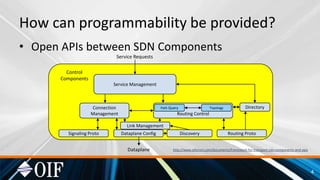
• Open APIs between SDN Components
Control
Components
Service Management
Connection
Management Routing Control
Path Query Topology
Signaling Proto Dataplane Config
Link Management
Discovery Routing Proto
Directory
Service Requests
Dataplane http://www.oiforum.com/documents/framework-for-transport-sdn-components-and-apis
4
ONF SDN Architecture
5
Application
Layer
Control Layer
Infrastructure Layer
Domain 1
NE NE NE
Domain 2
NE NE NE
Domain 3
NE NE NE
Multi-Domain
Controller
Domain
Controller
Domain
Controller
Domain
Controller
SBI
NBI
SBI
Cloud
Orchestrator
Compute Storage
NBI
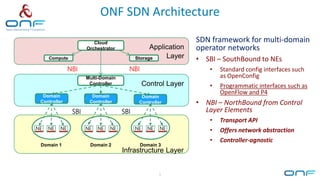
SDN framework for multi-domain
operator networks
• SBI – SouthBound to NEs
• Standard config interfaces such
as OpenConfig
• Programmatic interfaces such as
OpenFlow and P4
• NBI – NorthBound from Control
Layer Elements
• Transport API
• Offers network abstraction
• Controller-agnostic
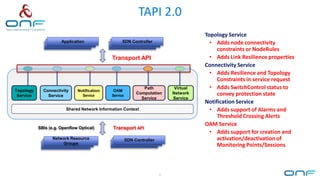
TAPI 2.0
6
NENESDN Controller
NENEApplication
Transport API
NE
Network Resource
Groups NENESDN Controller
Transport APISBIs (e.g. Openflow Optical)
Topology
Service
Connectivity
Service
Path
Computation
Service
Shared Network Information Context
Virtual
Network
Service
Notification
Service
OAM
Service
• Topology Service
• Connectivity Service
• Notification Service
•
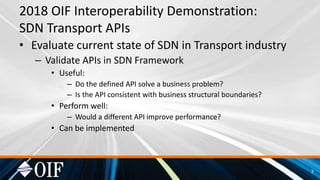
• Evaluate current state of SDN in Transport industry
– Validate APIs in SDN Framework
• Useful:
– Do the defined API solve a business problem?
– Is the API consistent with business structural boundaries?
• Perform well:
– Would a different API improve performance?
• Can be implemented
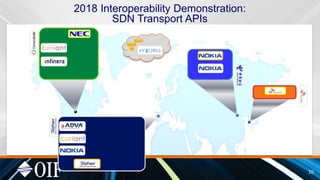
2018 OIF Interoperability Demonstration:
SDN Transport APIs
7
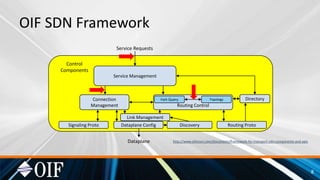
OIF SDN Framework
8
Control
Components
Service Management
Connection
Management Routing Control
Path Query Topology
Signaling Proto Dataplane Config
Link Management
Discovery Routing Proto
Directory
Service Requests
Dataplane http://www.oiforum.com/documents/framework-for-transport-sdn-components-and-apis
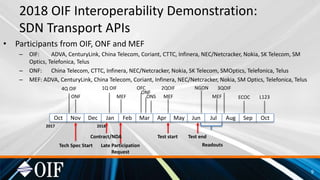
• Participants from OIF, ONF and MEF
– OIF: ADVA, CenturyLink, China Telecom, Coriant, CTTC, Infinera, NEC/Netcracker, Nokia, SK Telecom, SM
Optics, Telefonica, Telus
– ONF: China Telecom, CTTC, Infinera, NEC/Netcracker, Nokia, SK Telecom, SMOptics, Telefonica, Telus
– MEF: ADVA, CenturyLink, China Telecom, Coriant, Infinera, NEC/Netcracker, Nokia, SM Optics, Telefonica, Telus
2018 OIF Interoperability Demonstration:
SDN Transport APIs
9
Oct Nov Dec Jan Feb Mar Apr May Jun Jul Aug Sep Oct
2017 2018
Tech Spec Start
Contract/NDA Test start Test end
Readouts
4Q OIF
ONF
1Q OIF OFC
ONS
2QOIF NGON 3QOIF
ECOC L123
Late Participation
Request
MEF
ONF
MEF MEF
2018 Interoperability Demonstration:
SDN Transport APIs
10
• Telefonica Lab testbed.
• Three vendors participating:
Nokia, ADVA and Coriant.
• ONF TAPI 2.0.2 tested
individually in each domain.
• Topology, Connectivity and
Notification services tested.
OIF Copyright © 2016
2018 OIF Interoperability Event
Telefonica Lab Setup
S0001-1:
10.95.86.154
S0001-3:
10.95.86.156
S0001-2:
10.95.86.155
NOKIA_NODE_4:
172.30.15.123 /32
NOKIA_NODE_5:
172.30.15.122 /32
NOKIA_NODE_2:
172.30.15.121/32
ADVA_FSP300
0_196:
10.95.86.196
ADVA_FSP300
0_198:
10.95.86.198
ADVA_FSP300
0_197:
10.95.86.197
CORIANT | 10.95.86.157
NOKIA | 172.30.18.75
ADVA | 10.95.86.200
ADV.C.2
ADV.C.1
ADV.B.2
ADV.B.1
COR.B.1
COR.C.1COR.A.2
MX240-2|10.95.86.133 MX240-3|10.95.86.134
NOKIA_NODE_3:
172.16.15..91/32
NODO4/A2325A-1-15-
LINENODO5/A2325A-4-
2-LINEOMS
Link_5_1015002_3
_1015001
Link_3_1015002_5
_1015001
FSP3000_198[OL-2] ---
FSP3000_197
[OL-1]
FSP3000_196 [OL-1] ---
FSP3000_198
[OL-2]
FSP3000_196 [OL-1] ---
FSP3000_197
[OL-2]
Nokia NRC-T
IP: 172.30.18.75
Nokia NFM-T ADVA FSP
Network HyperVisor
IP: 10.95.86.200
CORIANT TRASCEND
Network HyperVisor
IP: 10.95.86.200
Telefonica SDTN
Controller
IP: 10.95.86.30
NODO2/AHPLG-2-14-
LINENODO-3/AHPLG-1-
6-LINEOMS
NODO2/AM2125A-2-3-
LINEOUT NODO5/
AM2125A-2-6-LINEIN OMS
NODO5/A2325A-2-14-LINE
NODO-3/A2325A-1-14-LINE
OMS
NODO4/AHPLG-1-6-LINE
NODO2/AHPLG-2-6-LINE
OMS
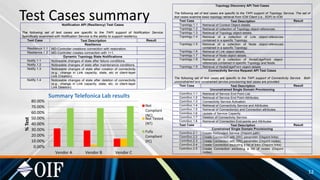
Test Cases summary
12
Topology Discovery API Test Cases
The following set of test cases are specific to the TAPI support of Topology Service. The set of
test cases examine basic topology retrieval from ICM Client (i.e., SOF) to ICM.
Test Case Test Description Result
Topology.1.1 Retrieval of Context Object-details
Topology.1.2 Retrieval of collection of Topology object-references.
Topology.1.3 Retrieval of Topology object-details.
Topology.1.4 Retrieval of a collection of Link object-references
contained in a specific Topology.
Topology.1.5 Retrieval of a collection of Node object-references
contained in a specific Topology.
Topology.1.6 Retrieval of Link object-details.
Topology.1.7 Retrieval of Node object-details.
Topology.1.8 Retrieval of a collection of NodeEdgePoint object-
references contained in specific Topology and Node.
Topology.1.9 Retrieval of NodeEdgePoint object-details.
Connectivity Service Request API Test Cases
The following set of test cases are specific to the TAPI support of Connectivity Service. Both
unconstrained and constrained service provisioning test cases are provided.
Test Case Test Description Result
Unconstrained Single Domain Provisioning
ConnSvc.1.1 Retrieval of Service End Point List.
ConnSvc.1.2 Retrieval of Service End Point Attributes.
ConnSvc.1.3 Connectivity Service Activation.
ConnSvc.1.4 Retrieval of Connectivity Service and Attributes.
ConnSvc.1.5 Retrieval of Connection(s) and Connection attributes.
ConnSvc.1.6 Update of Service Capacity.
ConnSvc.1.7 Deletion of Connectivity Service.
ConnSvc.1.8 Retrieval of Connection End-points and Attributes
Test Case Test Description Result
Constrained Single Domain Provisioning
ConnSvc.2.1 Create Redundant Service (Disjoint path).
ConnSvc.2.2 Create Connection with SRG parameter (Disjoint links)
ConnSvc.2.3 Create Connection with SRG parameter (Disjoint nodes)
ConnSvc.2.4 Create Connection excluding a list of links (Disjoint links)
ConnSvc.2.5 Create Connection excluding a list of nodes (Disjoint
nodes)
0.00%
10.00%
20.00%
30.00%
40.00%
50.00%
60.00%
70.00%
80.00%
Vendor A Vendor B Vendor C
%Test
Summary Telefonica Lab results
Not
Compliant
(NC)
Not Tested
(NT)
Fully
Compliant
(FC)
Notification API (Resiliency) Test Cases
The following set of test cases are specific to the TAPI support of Notification Service.
Specifically examined with Notification Service is the ability to support resiliency.
Test Case Test Description Result
Resilience
Resilience.1.1 MD-Controller creations connection with restoration.
Resilience.1.2 MD-Controller creates connection with 1+1.
Dynamic Topology State Notifications
Notify.1.1 Noticeable changes of state after failure conditions.
Notify.1.2 Noticeable changes of state after maintenance conditions.
Notify.1.3 Noticeable changes of state after creation of connectivity
(e.g., change in Link capacity, state, etc or client-layer
Link Creation).
Notify.1.4 Noticeable changes of state after deletion of connectivity
(e.g., change in Link capacity, state, etc. or client-layer
Link Deletion)
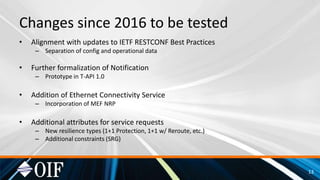
Changes since 2016 to be tested
• Alignment with updates to IETF RESTCONF Best Practices
– Separation of config and operational data
• Further formalization of Notification
– Prototype in T-API 1.0
• Addition of Ethernet Connectivity Service
– Incorporation of MEF NRP
• Additional attributes for service requests
– New resilience types (1+1 Protection, 1+1 w/ Reroute, etc.)
– Additional constraints (SRG)
13
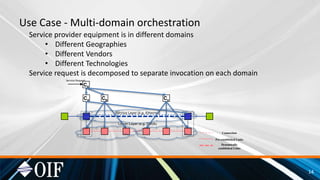
Use Case - Multi-domain orchestration
Service provider equipment is in different domains
• Different Geographies
• Different Vendors
• Different Technologies
Service request is decomposed to separate invocation on each domain
Service Request
Pre-established Links
Dynamically
established Links
Service Layer (e.g. Ethernet)
Lower Layer (e.g. ODUk)
Connection
Ca Cb
Cs
Cc
14
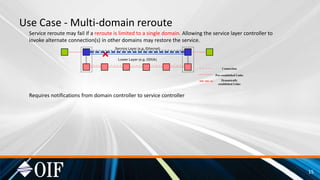
Use Case - Multi-domain reroute
Service reroute may fail if a reroute is limited to a single domain. Allowing the service layer controller to
invoke alternate connection(s) in other domains may restore the service.
Pre-established Links
Dynamically
established Links
Service Layer (e.g. Ethernet)
Lower Layer (e.g. ODUk)
Connection
Requires notifications from domain controller to service controller
15
FINDINGS
16
Findings
• ONF’s alignment of T-API with IETF RESTCONF is a good start
– Provides developers access to RESTCONF tool environment
– Some additional alignment changes still required (addressed in T-API 2.1)
• MEF’s extensions to T-API for LSO Presto and Ethernet are necessary
extensions to meet operator requirements for T-API
• Additional use cases are supported by the formalized notifications interface
– Multi-domain/Multi-layer Reroute
– Network reoptimization
• Swagger definitions can aid automated testing
– Specifies behavior of request and response
17
Findings
• Controllers abstract the network in different ways
– E.g. Unidirectional vs Bidirectional links
• Controllers provide/report different capabilities
– E.g. Connectivity restrictions
• Division of responsibility between controllers unclear
– E.g. Multi-domain Path Computation
• Additional use cases exist and need to validated
– Use of topology interface for Path Computation
– Service Management interface
18
Findings
• Restoration control evolution required
– Need extensions for operations control for rerouted services
(Forced reroute, Freeze, Make Permanent, Restoration scheduling)
• T-API evolution is required to increase performance
– Reduce number of API operations required when following relations between
tables
– Remove need for bulk retrieval to follow some relations
– Architecture description for notification hub
• Better error reporting required across interface
– HTTP result codes (e.g. 20x, 40x) do not provide enough clarity
19
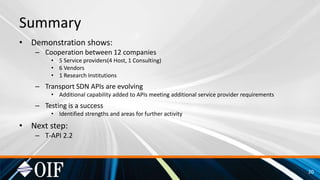
Summary
• Demonstration shows:
– Cooperation between 12 companies
• 5 Service providers(4 Host, 1 Consulting)
• 6 Vendors
• 1 Research Institutions
– Transport SDN APIs are evolving
• Additional capability added to APIs meeting additional service provider requirements
– Testing is a success
• Identified strengths and areas for further activity
• Next step:
– T-API 2.2
20
Acknolwledgment
• Part of the work carried out in Telefonica lab was
funded by EU-H2020 Metrohaul project (grant no.
761727).
21

OIF Open Transport API for Interoperable Optical Networking

  • 1.
    Open Transport APIfor Interoperable Optical Networking Oscar Gonzalez de Dios 12th October 2018 SDN/NFV World Congress Open Networking Foundation www.opennetworking.org www.mef.netwww.oiforum.com
  • 2.
    Agenda • Motivation • Objectives •Overview of Tests • Findings and Summary 2
  • 3.
    Motivation • Operators needflexibility and tools to fully utilize the potential of the optical transport networks • SDN – the key to improve Transport Control – Adapt Network Element Behaviour to Operator requirements – Enables full automation – Enables multi-domain scenarios – Allows Vendor-agnostic network control Programmability enables carrier requirements to be met 3
  • 4.
    How can programmabilitybe provided? • Open APIs between SDN Components Control Components Service Management Connection Management Routing Control Path Query Topology Signaling Proto Dataplane Config Link Management Discovery Routing Proto Directory Service Requests Dataplane http://www.oiforum.com/documents/framework-for-transport-sdn-components-and-apis 4
  • 5.
    ONF SDN Architecture 5 Application Layer ControlLayer Infrastructure Layer Domain 1 NE NE NE Domain 2 NE NE NE Domain 3 NE NE NE Multi-Domain Controller Domain Controller Domain Controller Domain Controller SBI NBI SBI Cloud Orchestrator Compute Storage NBI SDN framework for multi-domain operator networks • SBI – SouthBound to NEs • Standard config interfaces such as OpenConfig • Programmatic interfaces such as OpenFlow and P4 • NBI – NorthBound from Control Layer Elements • Transport API • Offers network abstraction • Controller-agnostic
  • 6.
    TAPI 2.0 6 NENESDN Controller NENEApplication TransportAPI NE Network Resource Groups NENESDN Controller Transport APISBIs (e.g. Openflow Optical) Topology Service Connectivity Service Path Computation Service Shared Network Information Context Virtual Network Service Notification Service OAM Service • Topology Service • Connectivity Service • Notification Service •
  • 7.
    • Evaluate currentstate of SDN in Transport industry – Validate APIs in SDN Framework • Useful: – Do the defined API solve a business problem? – Is the API consistent with business structural boundaries? • Perform well: – Would a different API improve performance? • Can be implemented 2018 OIF Interoperability Demonstration: SDN Transport APIs 7
  • 8.
    OIF SDN Framework 8 Control Components ServiceManagement Connection Management Routing Control Path Query Topology Signaling Proto Dataplane Config Link Management Discovery Routing Proto Directory Service Requests Dataplane http://www.oiforum.com/documents/framework-for-transport-sdn-components-and-apis
  • 9.
    • Participants fromOIF, ONF and MEF – OIF: ADVA, CenturyLink, China Telecom, Coriant, CTTC, Infinera, NEC/Netcracker, Nokia, SK Telecom, SM Optics, Telefonica, Telus – ONF: China Telecom, CTTC, Infinera, NEC/Netcracker, Nokia, SK Telecom, SMOptics, Telefonica, Telus – MEF: ADVA, CenturyLink, China Telecom, Coriant, Infinera, NEC/Netcracker, Nokia, SM Optics, Telefonica, Telus 2018 OIF Interoperability Demonstration: SDN Transport APIs 9 Oct Nov Dec Jan Feb Mar Apr May Jun Jul Aug Sep Oct 2017 2018 Tech Spec Start Contract/NDA Test start Test end Readouts 4Q OIF ONF 1Q OIF OFC ONS 2QOIF NGON 3QOIF ECOC L123 Late Participation Request MEF ONF MEF MEF
  • 10.
  • 11.
    • Telefonica Labtestbed. • Three vendors participating: Nokia, ADVA and Coriant. • ONF TAPI 2.0.2 tested individually in each domain. • Topology, Connectivity and Notification services tested. OIF Copyright © 2016 2018 OIF Interoperability Event Telefonica Lab Setup S0001-1: 10.95.86.154 S0001-3: 10.95.86.156 S0001-2: 10.95.86.155 NOKIA_NODE_4: 172.30.15.123 /32 NOKIA_NODE_5: 172.30.15.122 /32 NOKIA_NODE_2: 172.30.15.121/32 ADVA_FSP300 0_196: 10.95.86.196 ADVA_FSP300 0_198: 10.95.86.198 ADVA_FSP300 0_197: 10.95.86.197 CORIANT | 10.95.86.157 NOKIA | 172.30.18.75 ADVA | 10.95.86.200 ADV.C.2 ADV.C.1 ADV.B.2 ADV.B.1 COR.B.1 COR.C.1COR.A.2 MX240-2|10.95.86.133 MX240-3|10.95.86.134 NOKIA_NODE_3: 172.16.15..91/32 NODO4/A2325A-1-15- LINENODO5/A2325A-4- 2-LINEOMS Link_5_1015002_3 _1015001 Link_3_1015002_5 _1015001 FSP3000_198[OL-2] --- FSP3000_197 [OL-1] FSP3000_196 [OL-1] --- FSP3000_198 [OL-2] FSP3000_196 [OL-1] --- FSP3000_197 [OL-2] Nokia NRC-T IP: 172.30.18.75 Nokia NFM-T ADVA FSP Network HyperVisor IP: 10.95.86.200 CORIANT TRASCEND Network HyperVisor IP: 10.95.86.200 Telefonica SDTN Controller IP: 10.95.86.30 NODO2/AHPLG-2-14- LINENODO-3/AHPLG-1- 6-LINEOMS NODO2/AM2125A-2-3- LINEOUT NODO5/ AM2125A-2-6-LINEIN OMS NODO5/A2325A-2-14-LINE NODO-3/A2325A-1-14-LINE OMS NODO4/AHPLG-1-6-LINE NODO2/AHPLG-2-6-LINE OMS
  • 12.
    Test Cases summary 12 TopologyDiscovery API Test Cases The following set of test cases are specific to the TAPI support of Topology Service. The set of test cases examine basic topology retrieval from ICM Client (i.e., SOF) to ICM. Test Case Test Description Result Topology.1.1 Retrieval of Context Object-details Topology.1.2 Retrieval of collection of Topology object-references. Topology.1.3 Retrieval of Topology object-details. Topology.1.4 Retrieval of a collection of Link object-references contained in a specific Topology. Topology.1.5 Retrieval of a collection of Node object-references contained in a specific Topology. Topology.1.6 Retrieval of Link object-details. Topology.1.7 Retrieval of Node object-details. Topology.1.8 Retrieval of a collection of NodeEdgePoint object- references contained in specific Topology and Node. Topology.1.9 Retrieval of NodeEdgePoint object-details. Connectivity Service Request API Test Cases The following set of test cases are specific to the TAPI support of Connectivity Service. Both unconstrained and constrained service provisioning test cases are provided. Test Case Test Description Result Unconstrained Single Domain Provisioning ConnSvc.1.1 Retrieval of Service End Point List. ConnSvc.1.2 Retrieval of Service End Point Attributes. ConnSvc.1.3 Connectivity Service Activation. ConnSvc.1.4 Retrieval of Connectivity Service and Attributes. ConnSvc.1.5 Retrieval of Connection(s) and Connection attributes. ConnSvc.1.6 Update of Service Capacity. ConnSvc.1.7 Deletion of Connectivity Service. ConnSvc.1.8 Retrieval of Connection End-points and Attributes Test Case Test Description Result Constrained Single Domain Provisioning ConnSvc.2.1 Create Redundant Service (Disjoint path). ConnSvc.2.2 Create Connection with SRG parameter (Disjoint links) ConnSvc.2.3 Create Connection with SRG parameter (Disjoint nodes) ConnSvc.2.4 Create Connection excluding a list of links (Disjoint links) ConnSvc.2.5 Create Connection excluding a list of nodes (Disjoint nodes) 0.00% 10.00% 20.00% 30.00% 40.00% 50.00% 60.00% 70.00% 80.00% Vendor A Vendor B Vendor C %Test Summary Telefonica Lab results Not Compliant (NC) Not Tested (NT) Fully Compliant (FC) Notification API (Resiliency) Test Cases The following set of test cases are specific to the TAPI support of Notification Service. Specifically examined with Notification Service is the ability to support resiliency. Test Case Test Description Result Resilience Resilience.1.1 MD-Controller creations connection with restoration. Resilience.1.2 MD-Controller creates connection with 1+1. Dynamic Topology State Notifications Notify.1.1 Noticeable changes of state after failure conditions. Notify.1.2 Noticeable changes of state after maintenance conditions. Notify.1.3 Noticeable changes of state after creation of connectivity (e.g., change in Link capacity, state, etc or client-layer Link Creation). Notify.1.4 Noticeable changes of state after deletion of connectivity (e.g., change in Link capacity, state, etc. or client-layer Link Deletion)
  • 13.
    Changes since 2016to be tested • Alignment with updates to IETF RESTCONF Best Practices – Separation of config and operational data • Further formalization of Notification – Prototype in T-API 1.0 • Addition of Ethernet Connectivity Service – Incorporation of MEF NRP • Additional attributes for service requests – New resilience types (1+1 Protection, 1+1 w/ Reroute, etc.) – Additional constraints (SRG) 13
  • 14.
    Use Case -Multi-domain orchestration Service provider equipment is in different domains • Different Geographies • Different Vendors • Different Technologies Service request is decomposed to separate invocation on each domain Service Request Pre-established Links Dynamically established Links Service Layer (e.g. Ethernet) Lower Layer (e.g. ODUk) Connection Ca Cb Cs Cc 14
  • 15.
    Use Case -Multi-domain reroute Service reroute may fail if a reroute is limited to a single domain. Allowing the service layer controller to invoke alternate connection(s) in other domains may restore the service. Pre-established Links Dynamically established Links Service Layer (e.g. Ethernet) Lower Layer (e.g. ODUk) Connection Requires notifications from domain controller to service controller 15
  • 16.
  • 17.
    Findings • ONF’s alignmentof T-API with IETF RESTCONF is a good start – Provides developers access to RESTCONF tool environment – Some additional alignment changes still required (addressed in T-API 2.1) • MEF’s extensions to T-API for LSO Presto and Ethernet are necessary extensions to meet operator requirements for T-API • Additional use cases are supported by the formalized notifications interface – Multi-domain/Multi-layer Reroute – Network reoptimization • Swagger definitions can aid automated testing – Specifies behavior of request and response 17
  • 18.
    Findings • Controllers abstractthe network in different ways – E.g. Unidirectional vs Bidirectional links • Controllers provide/report different capabilities – E.g. Connectivity restrictions • Division of responsibility between controllers unclear – E.g. Multi-domain Path Computation • Additional use cases exist and need to validated – Use of topology interface for Path Computation – Service Management interface 18
  • 19.
    Findings • Restoration controlevolution required – Need extensions for operations control for rerouted services (Forced reroute, Freeze, Make Permanent, Restoration scheduling) • T-API evolution is required to increase performance – Reduce number of API operations required when following relations between tables – Remove need for bulk retrieval to follow some relations – Architecture description for notification hub • Better error reporting required across interface – HTTP result codes (e.g. 20x, 40x) do not provide enough clarity 19
  • 20.
    Summary • Demonstration shows: –Cooperation between 12 companies • 5 Service providers(4 Host, 1 Consulting) • 6 Vendors • 1 Research Institutions – Transport SDN APIs are evolving • Additional capability added to APIs meeting additional service provider requirements – Testing is a success • Identified strengths and areas for further activity • Next step: – T-API 2.2 20
  • 21.
    Acknolwledgment • Part ofthe work carried out in Telefonica lab was funded by EU-H2020 Metrohaul project (grant no. 761727). 21

Editor's Notes

  • #2 Introduce yourself. State that you’ll cover an short overview of the OIF, then the networking demo, then PLL demo.
  • #4 Probability of single cut – often Probability of double faults – low