Big Question: How can we work
together to achieve a goal?

Author:
Joan Sandin
Genre:
Historical Fiction
Small Group
Timer
Story Sort
Vocabulary Words:
Arcade Games
Study Stack
Spelling City: Vocabulary
Spelling City: Spelling Words
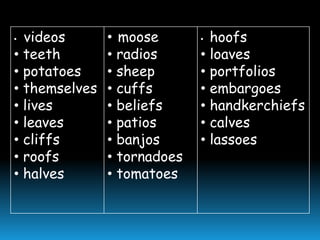
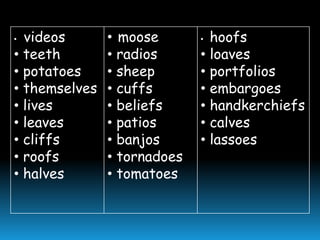
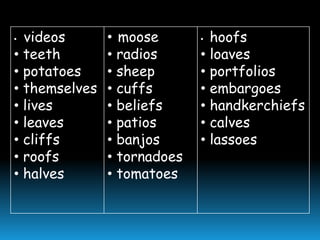
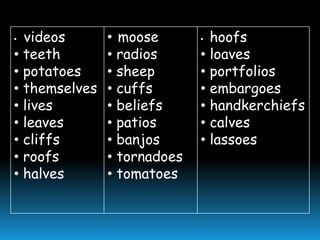
videos
• teeth
• potatoes
• themselves
• lives
• leaves
• cliffs
• roofs
• halves
•

• moose
• radios
• sheep
• cuffs
• beliefs
• patios
• banjos
• tornadoes
• tomatoes

hoofs
• loaves
• portfolios
• embargoes
• handkerchiefs
• calves
• lassoes
•
 Monday
 Tuesday

 Wednesday
 Thursday
 Friday
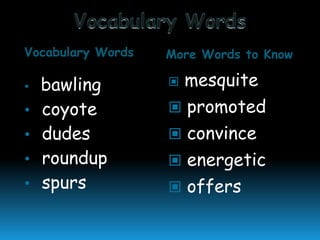
Vocabulary Words
•

•
•
•
•

bawling
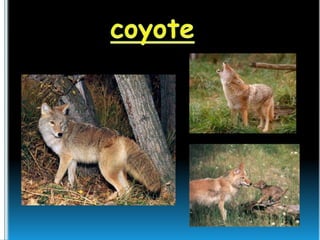
coyote
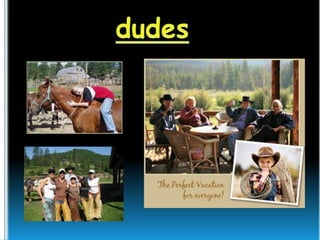
dudes
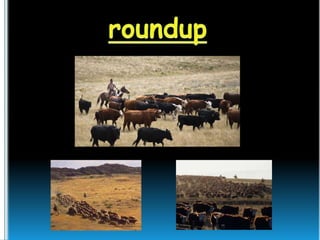
roundup
spurs

More Words to Know

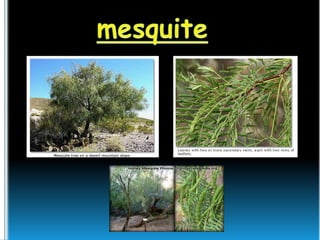
mesquite
 promoted
 convince
 energetic
 offers

Question of the Day

How can we work
together to achieve a
goal?
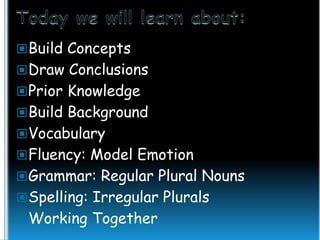
 Build Concepts
 Draw Conclusions

 Prior Knowledge
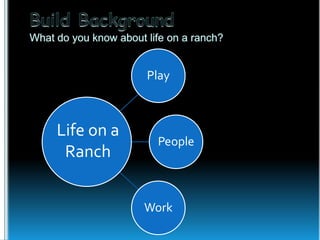
 Build Background
 Vocabulary
 Fluency: Model Emotion
 Grammar: Regular Plural Nouns

 Spelling: Irregular Plurals
 Working Together
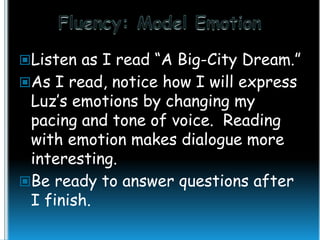
Listen as I read “A Big-City Dream.”
As I read, notice how I will express

Luz’s emotions by changing my
pacing and tone of voice. Reading
with emotion makes dialogue more
interesting.
Be ready to answer questions after
I finish.
At the beginning of the

story, how does Luz feel about
her plan for creating a garden?
What kind of person is Luz?
How do you know?
 convince – to make someone
feel sure; to persuade by
argument or proof
 energetic – full of energy;
vigorous
 offers – holds out to be taken;
is willing if another approves
(To add information to the graphic organizer, click on end
show, type in your new information, and save your changes.)
Working
Together

Gathering
a Team
Performing
Tasks
Play

Life on a
Ranch

People

Work


bawling – crying out in a noisy way

 coyote – small, wolflike mammal

living in many parts of North
America

 dudes – people raised in the city,

especially easterners who vacation
on a ranch
roundup – the act of driving or
bringing cattle together from long
distances



 spurs – metal points or pointed

wheels, worn on a rider’s boot heels
for urging a horse on
 mesquite – any of several trees

or bushes common in
southwestern United States and
Mexico, which often grow in
dense clumps or thickets
 promoted – raised in
rank, condition, or importance
 (Next Slide)
Regular Plural Nouns
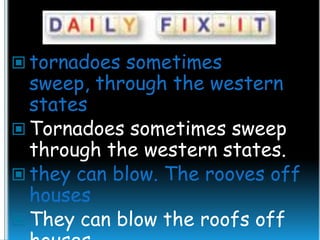
 tornadoes sometimes

sweep, through the western
states
 Tornadoes sometimes sweep
through the western states.
 they can blow. The rooves off

houses
 They can blow the roofs off
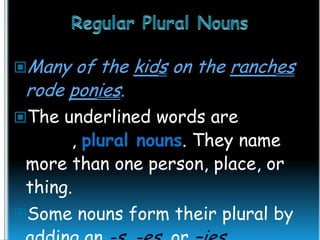
Many

of the kids on the ranches
rode ponies.

The underlined words are

nouns, plural nouns. They name
more than one person, place, or
thing.
Some nouns form their plural by
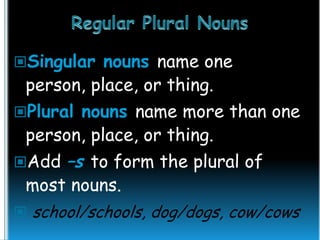
Singular nouns name one

person, place, or thing.
Plural nouns name more than one
person, place, or thing.
Add –s to form the plural of
most nouns.
 school/schools, dog/dogs, cow/cows
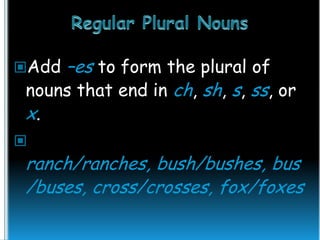
–es to form the plural of
nouns that end in ch, sh, s, ss, or
x.

Add



ranch/ranches, bush/bushes, bus
/buses, cross/crosses, fox/foxes
To form the plural of nouns that

end in a consonant followed by a
y, change the y to i and add –es.

family/families, party/parties,
pony/ponies


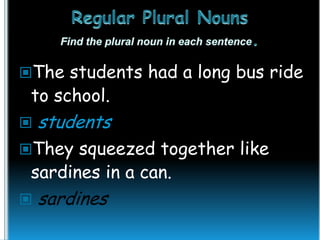
The students had a long bus ride

to school.



students

They squeezed together like

sardines in a can.



sardines
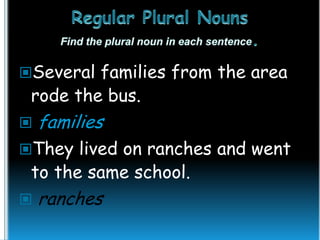
Several families from the area

rode the bus.



families

They lived on ranches and went

to the same school.



ranches
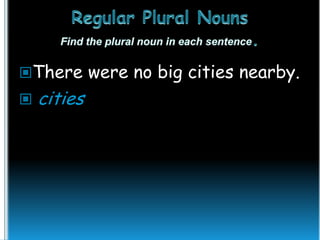
There were no big cities nearby.


cities
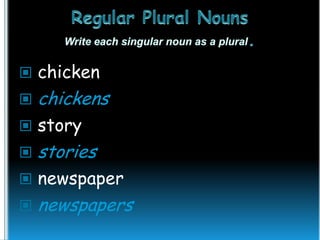
 chicken


chickens

 story


stories

 newspaper


newspapers
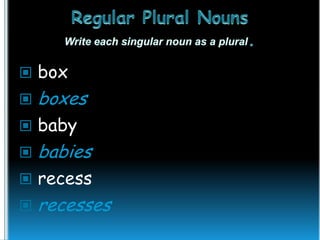
 box


boxes

 baby


babies

 recess


recesses
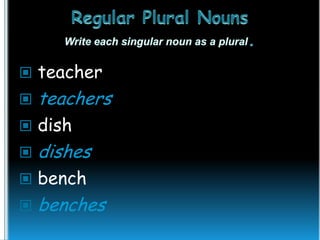
 teacher


teachers

 dish


dishes

 bench


benches
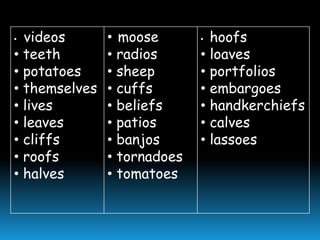
videos
• teeth
• potatoes
• themselves
• lives
• leaves
• cliffs
• roofs
• halves
•

• moose
• radios
• sheep
• cuffs
• beliefs
• patios
• banjos
• tornadoes
• tomatoes

hoofs
• loaves
• portfolios
• embargoes
• handkerchiefs
• calves
• lassoes
•
Question of the Day

What work must be done
on a ranch?
 Dictionary/Glossary
 Draw Conclusions

 Prior Knowledge
 Setting
 Vocabulary

 Fluency: Choral Reading
 Grammar: Regular Plural Nouns
 Spelling: Irregular Plurals

 Social Studies: U.S. Expansion
 Spanish Explorers
 Working Together
Turn to pages 164 - 165.
Turn to pages 166 - 175.
Turn to page 172, paragraphs 2-3.

As I read, notice how my pitch and

tone change to express Monchi’s
feelings about Victor and Miss
Byers.
Now we will practice together as a
class by doing three choral readings
of these paragraphs.
Regular Plural Nouns
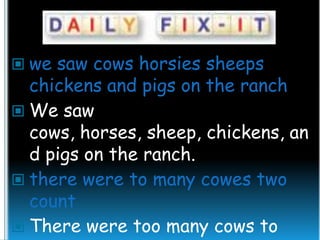
 we saw cows horsies sheeps

chickens and pigs on the ranch
 We saw
cows, horses, sheep, chickens, an
d pigs on the ranch.
 there were to many cowes two
count
 There were too many cows to
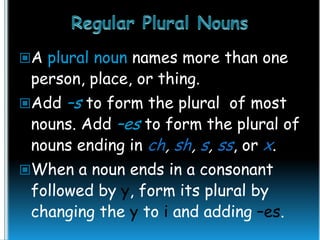
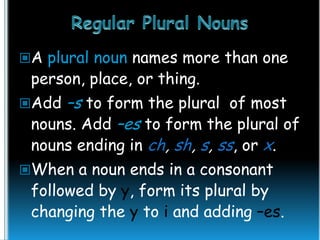
A plural noun names more than one

person, place, or thing.

–s to form the plural of most
nouns. Add –es to form the plural of
nouns ending in ch, sh, s, ss, or x.

Add

When a noun ends in a consonant

followed by y, form its plural by
changing the y to i and adding –es.
videos
• teeth
• potatoes
• themselves
• lives
• leaves
• cliffs
• roofs
• halves
•

• moose
• radios
• sheep
• cuffs
• beliefs
• patios
• banjos
• tornadoes
• tomatoes

hoofs
• loaves
• portfolios
• embargoes
• handkerchiefs
• calves
• lassoes
•
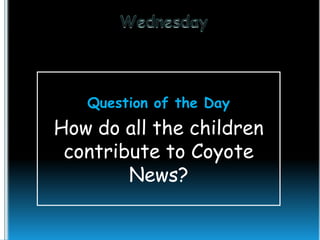
Question of the Day

How do all the children
contribute to Coyote
News?
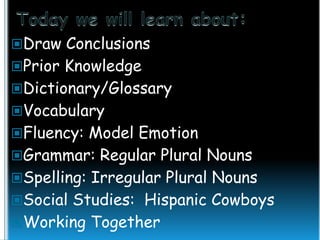
Draw Conclusions
Prior Knowledge

Dictionary/Glossary
Vocabulary

Fluency: Model Emotion

Grammar: Regular Plural Nouns
Spelling: Irregular Plural Nouns

Social Studies: Hispanic Cowboys
Working Together
Turn to pages 176 - 184.
Turn to page 183, paragraphs 3-9

(begin with “The winner of…”)
As I read, notice how my voice
changes to express Monchi’s
surprise and then sense of pride.
Now we will practice together as a
class by doing three choral readings
of these paragraphs.
Regular Plural Nouns
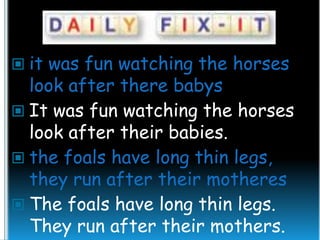
 it was fun watching the horses

look after there babys
 It was fun watching the horses
look after their babies.
 the foals have long thin legs,
they run after their motheres
 The foals have long thin legs.
They run after their mothers.
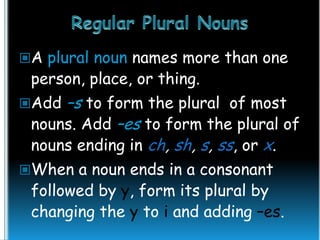
A plural noun names more than one

person, place, or thing.

–s to form the plural of most
nouns. Add –es to form the plural of
nouns ending in ch, sh, s, ss, or x.

Add

When a noun ends in a consonant

followed by y, form its plural by
changing the y to i and adding –es.
Good writers are careful to spell

words correctly.

Review something you have written

to see if you can improve it by
correcting the spelling of plural
nouns.
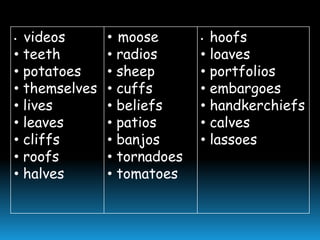
videos
• teeth
• potatoes
• themselves
• lives
• leaves
• cliffs
• roofs
• halves
•

• moose
• radios
• sheep
• cuffs
• beliefs
• patios
• banjos
• tornadoes
• tomatoes

hoofs
• loaves
• portfolios
• embargoes
• handkerchiefs
• calves
• lassoes
•
Question of the Day

How is teamwork
necessary in Monchi’s
life, both in and out of
the Coyote School?
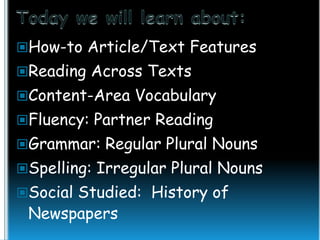
How-to Article/Text Features
Reading Across Texts
Content-Area Vocabulary
Fluency: Partner Reading

Grammar: Regular Plural Nouns
Spelling: Irregular Plural Nouns

Social Studied: History of

Newspapers
Turn to pages 186 - 187.
Turn to page 183, paragraphs 3-

9.
Read these paragraphs three
times with a partner. Read with
emotion, and offer each another
feedback.
Regular Plural Nouns
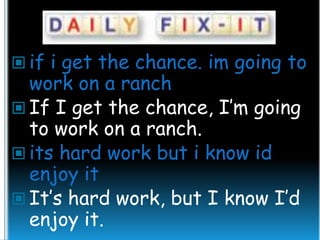
 if i get the chance. im going to

work on a ranch
 If I get the chance, I’m going
to work on a ranch.
 its hard work but i know id
enjoy it
 It’s hard work, but I know I’d
enjoy it.
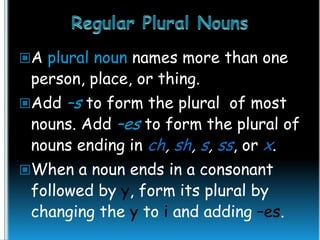
A plural noun names more than one

person, place, or thing.

–s to form the plural of most
nouns. Add –es to form the plural of
nouns ending in ch, sh, s, ss, or x.

Add

When a noun ends in a consonant

followed by y, form its plural by
changing the y to i and adding –es.
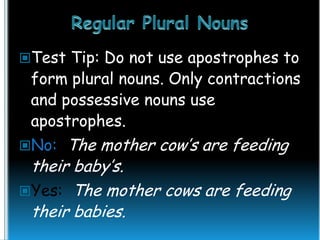
Test Tip: Do not use apostrophes to

form plural nouns. Only contractions
and possessive nouns use
apostrophes.

The mother cow’s are feeding
their baby’s.
Yes: The mother cows are feeding
their babies.
No:
videos
• teeth
• potatoes
• themselves
• lives
• leaves
• cliffs
• roofs
• halves
•

• moose
• radios
• sheep
• cuffs
• beliefs
• patios
• banjos
• tornadoes
• tomatoes

hoofs
• loaves
• portfolios
• embargoes
• handkerchiefs
• calves
• lassoes
•
Question of the Day

How can we work
together to achieve a
goal?
Build Concept Vocabulary
Draw Conclusions
Narrative Writing
Dictionary/Glossary
Grammar: Regular Plural Nouns
Spelling: Irregular Plural Nouns

Newspaper/Newsletter
Working Together
Drawing a conclusion while you read

or after you read is forming an
opinion based on what you already
know or on the facts and details in a
text.
Check on author’s conclusions or your
own conclusion by asking: Is this the

only logical choice? Are the facts
accurate?
Narrative writing recalls an event or

series of events through the
storyteller, or narrator.
Narrative writing describes events in
detail as seen through the eyes of
the storyteller.
Think about the storyteller’s point of
view when reading narrative writing.
The dark, or bold, words defined

in a dictionary or glossary are
called entry words. When
looking up the meaning of an
unfamiliar word, its entry word
may not match exactly the word
in the selection.
Entry words are often base

words without endings, prefixes,
or suffixes.
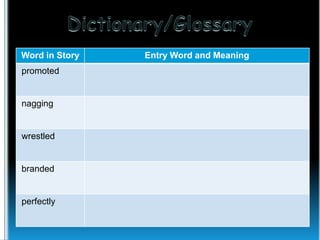
Use a dictionary to define the
following words from “Coyote
School News.” List the entry
word and meaning for each word.
Word in Story
promoted

nagging

wrestled

branded

perfectly

Entry Word and Meaning
Name a newspaper and share what

you know about how it is organized.

A newspaper is a daily or weekly

publication containing world and local
news and other features.

Newspapers are divided into sections.

Each section focuses on a subject,
such as local news, arts, or sports.
A newspaper has an index on or near

the front page.

Newspapers include editorial pages

that express opinions on current
events.

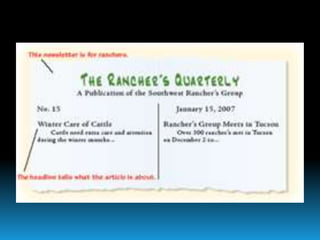
A newsletter is a brief publication

from a group that contains news of
interest to the group’s members.
Newspapers and newsletter articles

are identified with headlines and may
also include illustrations or
photographs with captions.
Regular Plural Nouns
 what great rider those vaqueros

are
 What great riders those
vaqueros are!
 they can rode all day and never
get tired, id like to do that
 They can ride all day and never
get tired. I’d like to do that.
A plural noun names more than one

person, place, or thing.

–s to form the plural of most
nouns. Add –es to form the plural of
nouns ending in ch, sh, s, ss, or x.

Add

When a noun ends in a consonant

followed by y, form its plural by
changing the y to i and adding –es.
videos
• teeth
• potatoes
• themselves
• lives
• leaves
• cliffs
• roofs
• halves
•

• moose
• radios
• sheep
• cuffs
• beliefs
• patios
• banjos
• tornadoes
• tomatoes

hoofs
• loaves
• portfolios
• embargoes
• handkerchiefs
• calves
• lassoes
•
 Story test



Classroom webpage,
Reading Test

 AR



Other Reading Quizzes
Quiz #

2.2 coyote school news

  • 1.
    Big Question: Howcan we work together to achieve a goal? Author: Joan Sandin Genre: Historical Fiction
  • 2.
  • 3.
    Story Sort Vocabulary Words: ArcadeGames Study Stack Spelling City: Vocabulary Spelling City: Spelling Words
  • 5.
    videos • teeth • potatoes •themselves • lives • leaves • cliffs • roofs • halves • • moose • radios • sheep • cuffs • beliefs • patios • banjos • tornadoes • tomatoes hoofs • loaves • portfolios • embargoes • handkerchiefs • calves • lassoes •
  • 6.
     Monday  Tuesday Wednesday  Thursday  Friday
  • 7.
    Vocabulary Words • • • • • bawling coyote dudes roundup spurs More Wordsto Know mesquite  promoted  convince  energetic  offers 
  • 8.
    Question of theDay How can we work together to achieve a goal?
  • 9.
     Build Concepts Draw Conclusions  Prior Knowledge  Build Background  Vocabulary  Fluency: Model Emotion  Grammar: Regular Plural Nouns  Spelling: Irregular Plurals  Working Together
  • 11.
    Listen as Iread “A Big-City Dream.” As I read, notice how I will express Luz’s emotions by changing my pacing and tone of voice. Reading with emotion makes dialogue more interesting. Be ready to answer questions after I finish.
  • 12.
    At the beginningof the story, how does Luz feel about her plan for creating a garden? What kind of person is Luz? How do you know?
  • 13.
     convince –to make someone feel sure; to persuade by argument or proof  energetic – full of energy; vigorous  offers – holds out to be taken; is willing if another approves
  • 14.
    (To add informationto the graphic organizer, click on end show, type in your new information, and save your changes.)
  • 15.
  • 17.
  • 19.
     bawling – cryingout in a noisy way  coyote – small, wolflike mammal living in many parts of North America  dudes – people raised in the city, especially easterners who vacation on a ranch
  • 20.
    roundup – theact of driving or bringing cattle together from long distances   spurs – metal points or pointed wheels, worn on a rider’s boot heels for urging a horse on
  • 21.
     mesquite –any of several trees or bushes common in southwestern United States and Mexico, which often grow in dense clumps or thickets  promoted – raised in rank, condition, or importance  (Next Slide)
  • 27.
  • 28.
     tornadoes sometimes sweep,through the western states  Tornadoes sometimes sweep through the western states.  they can blow. The rooves off houses  They can blow the roofs off
  • 29.
    Many of the kidson the ranches rode ponies. The underlined words are nouns, plural nouns. They name more than one person, place, or thing. Some nouns form their plural by
  • 30.
    Singular nouns nameone person, place, or thing. Plural nouns name more than one person, place, or thing. Add –s to form the plural of most nouns.  school/schools, dog/dogs, cow/cows
  • 31.
    –es to formthe plural of nouns that end in ch, sh, s, ss, or x. Add  ranch/ranches, bush/bushes, bus /buses, cross/crosses, fox/foxes
  • 32.
    To form theplural of nouns that end in a consonant followed by a y, change the y to i and add –es. family/families, party/parties, pony/ponies 
  • 33.
    The students hada long bus ride to school.  students They squeezed together like sardines in a can.  sardines
  • 34.
    Several families fromthe area rode the bus.  families They lived on ranches and went to the same school.  ranches
  • 35.
    There were nobig cities nearby.  cities
  • 36.
  • 37.
  • 38.
  • 40.
    videos • teeth • potatoes •themselves • lives • leaves • cliffs • roofs • halves • • moose • radios • sheep • cuffs • beliefs • patios • banjos • tornadoes • tomatoes hoofs • loaves • portfolios • embargoes • handkerchiefs • calves • lassoes •
  • 41.
    Question of theDay What work must be done on a ranch?
  • 42.
     Dictionary/Glossary  DrawConclusions  Prior Knowledge  Setting  Vocabulary  Fluency: Choral Reading  Grammar: Regular Plural Nouns  Spelling: Irregular Plurals  Social Studies: U.S. Expansion  Spanish Explorers  Working Together
  • 43.
    Turn to pages164 - 165.
  • 44.
    Turn to pages166 - 175.
  • 46.
    Turn to page172, paragraphs 2-3. As I read, notice how my pitch and tone change to express Monchi’s feelings about Victor and Miss Byers. Now we will practice together as a class by doing three choral readings of these paragraphs.
  • 47.
  • 48.
     we sawcows horsies sheeps chickens and pigs on the ranch  We saw cows, horses, sheep, chickens, an d pigs on the ranch.  there were to many cowes two count  There were too many cows to
  • 49.
    A plural nounnames more than one person, place, or thing. –s to form the plural of most nouns. Add –es to form the plural of nouns ending in ch, sh, s, ss, or x. Add When a noun ends in a consonant followed by y, form its plural by changing the y to i and adding –es.
  • 51.
    videos • teeth • potatoes •themselves • lives • leaves • cliffs • roofs • halves • • moose • radios • sheep • cuffs • beliefs • patios • banjos • tornadoes • tomatoes hoofs • loaves • portfolios • embargoes • handkerchiefs • calves • lassoes •
  • 52.
    Question of theDay How do all the children contribute to Coyote News?
  • 53.
    Draw Conclusions Prior Knowledge Dictionary/Glossary Vocabulary Fluency:Model Emotion Grammar: Regular Plural Nouns Spelling: Irregular Plural Nouns Social Studies: Hispanic Cowboys Working Together
  • 54.
    Turn to pages176 - 184.
  • 56.
    Turn to page183, paragraphs 3-9 (begin with “The winner of…”) As I read, notice how my voice changes to express Monchi’s surprise and then sense of pride. Now we will practice together as a class by doing three choral readings of these paragraphs.
  • 57.
  • 58.
     it wasfun watching the horses look after there babys  It was fun watching the horses look after their babies.  the foals have long thin legs, they run after their motheres  The foals have long thin legs. They run after their mothers.
  • 59.
    A plural nounnames more than one person, place, or thing. –s to form the plural of most nouns. Add –es to form the plural of nouns ending in ch, sh, s, ss, or x. Add When a noun ends in a consonant followed by y, form its plural by changing the y to i and adding –es.
  • 60.
    Good writers arecareful to spell words correctly. Review something you have written to see if you can improve it by correcting the spelling of plural nouns.
  • 62.
    videos • teeth • potatoes •themselves • lives • leaves • cliffs • roofs • halves • • moose • radios • sheep • cuffs • beliefs • patios • banjos • tornadoes • tomatoes hoofs • loaves • portfolios • embargoes • handkerchiefs • calves • lassoes •
  • 63.
    Question of theDay How is teamwork necessary in Monchi’s life, both in and out of the Coyote School?
  • 64.
    How-to Article/Text Features ReadingAcross Texts Content-Area Vocabulary Fluency: Partner Reading Grammar: Regular Plural Nouns Spelling: Irregular Plural Nouns Social Studied: History of Newspapers
  • 65.
    Turn to pages186 - 187.
  • 67.
    Turn to page183, paragraphs 3- 9. Read these paragraphs three times with a partner. Read with emotion, and offer each another feedback.
  • 68.
  • 69.
     if iget the chance. im going to work on a ranch  If I get the chance, I’m going to work on a ranch.  its hard work but i know id enjoy it  It’s hard work, but I know I’d enjoy it.
  • 70.
    A plural nounnames more than one person, place, or thing. –s to form the plural of most nouns. Add –es to form the plural of nouns ending in ch, sh, s, ss, or x. Add When a noun ends in a consonant followed by y, form its plural by changing the y to i and adding –es.
  • 71.
    Test Tip: Donot use apostrophes to form plural nouns. Only contractions and possessive nouns use apostrophes. The mother cow’s are feeding their baby’s. Yes: The mother cows are feeding their babies. No:
  • 73.
    videos • teeth • potatoes •themselves • lives • leaves • cliffs • roofs • halves • • moose • radios • sheep • cuffs • beliefs • patios • banjos • tornadoes • tomatoes hoofs • loaves • portfolios • embargoes • handkerchiefs • calves • lassoes •
  • 74.
    Question of theDay How can we work together to achieve a goal?
  • 75.
    Build Concept Vocabulary DrawConclusions Narrative Writing Dictionary/Glossary Grammar: Regular Plural Nouns Spelling: Irregular Plural Nouns Newspaper/Newsletter Working Together
  • 76.
    Drawing a conclusionwhile you read or after you read is forming an opinion based on what you already know or on the facts and details in a text. Check on author’s conclusions or your own conclusion by asking: Is this the only logical choice? Are the facts accurate?
  • 77.
    Narrative writing recallsan event or series of events through the storyteller, or narrator. Narrative writing describes events in detail as seen through the eyes of the storyteller. Think about the storyteller’s point of view when reading narrative writing.
  • 78.
    The dark, orbold, words defined in a dictionary or glossary are called entry words. When looking up the meaning of an unfamiliar word, its entry word may not match exactly the word in the selection.
  • 79.
    Entry words areoften base words without endings, prefixes, or suffixes. Use a dictionary to define the following words from “Coyote School News.” List the entry word and meaning for each word.
  • 80.
  • 81.
    Name a newspaperand share what you know about how it is organized. A newspaper is a daily or weekly publication containing world and local news and other features. Newspapers are divided into sections. Each section focuses on a subject, such as local news, arts, or sports.
  • 82.
    A newspaper hasan index on or near the front page. Newspapers include editorial pages that express opinions on current events. A newsletter is a brief publication from a group that contains news of interest to the group’s members.
  • 83.
    Newspapers and newsletterarticles are identified with headlines and may also include illustrations or photographs with captions.
  • 85.
  • 86.
     what greatrider those vaqueros are  What great riders those vaqueros are!  they can rode all day and never get tired, id like to do that  They can ride all day and never get tired. I’d like to do that.
  • 87.
    A plural nounnames more than one person, place, or thing. –s to form the plural of most nouns. Add –es to form the plural of nouns ending in ch, sh, s, ss, or x. Add When a noun ends in a consonant followed by y, form its plural by changing the y to i and adding –es.
  • 89.
    videos • teeth • potatoes •themselves • lives • leaves • cliffs • roofs • halves • • moose • radios • sheep • cuffs • beliefs • patios • banjos • tornadoes • tomatoes hoofs • loaves • portfolios • embargoes • handkerchiefs • calves • lassoes •
  • 90.
     Story test   Classroomwebpage, Reading Test  AR   Other Reading Quizzes Quiz #