Plural of Nouns
The plural of a noun is usually made by adding  s  to the singular: dog – dogs house – houses  s is pronounced /s/ after  p, k  or  f  sound. Otherwise it is pronounced /z/.
Nouns ending in  y  following a  consonant  form their plural by dropping the y and adding  ies : baby – babies Nouns ending in  y  following a  vowel  form their plural by adding  s : day – days  guy - guys
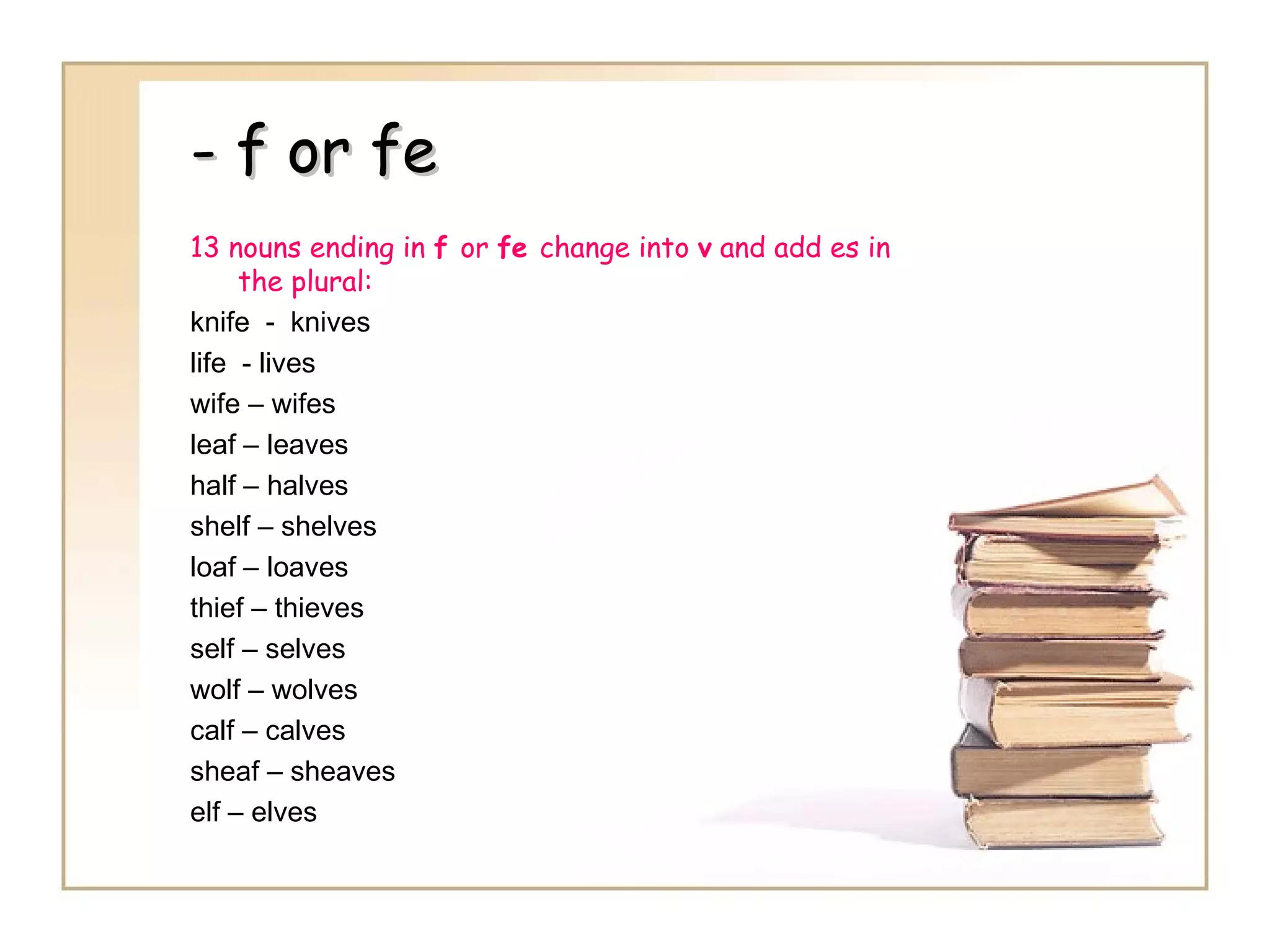
- f or fe   13 nouns ending in  f  or  fe  change into  v  and add es in the plural: knife  -  knives life  - lives wife – wifes leaf – leaves half – halves shelf – shelves loaf – loaves thief – thieves self – selves wolf – wolves calf – calves sheaf – sheaves elf – elves
Other nouns take only –s in the plural: roof  - roofs proof – proofs chief - chiefs
Nouns ending in  -o Nouns ending in  –o  preceded by a consonant add  –es  in the plural: tomato – tomatoes hero – heroes All nouns ending in  –o  preceded by a vowel take only  –s  in the plural: studio – studios scenario – scenarios Certain foreign nouns ending in  –o  preceded by a consonant, take only  –s  in the plural: piano – pianos kilo – kilos photo – photos Double forms: Fresco – frescos and frescoes Flamingo – flamingos and flamingoes
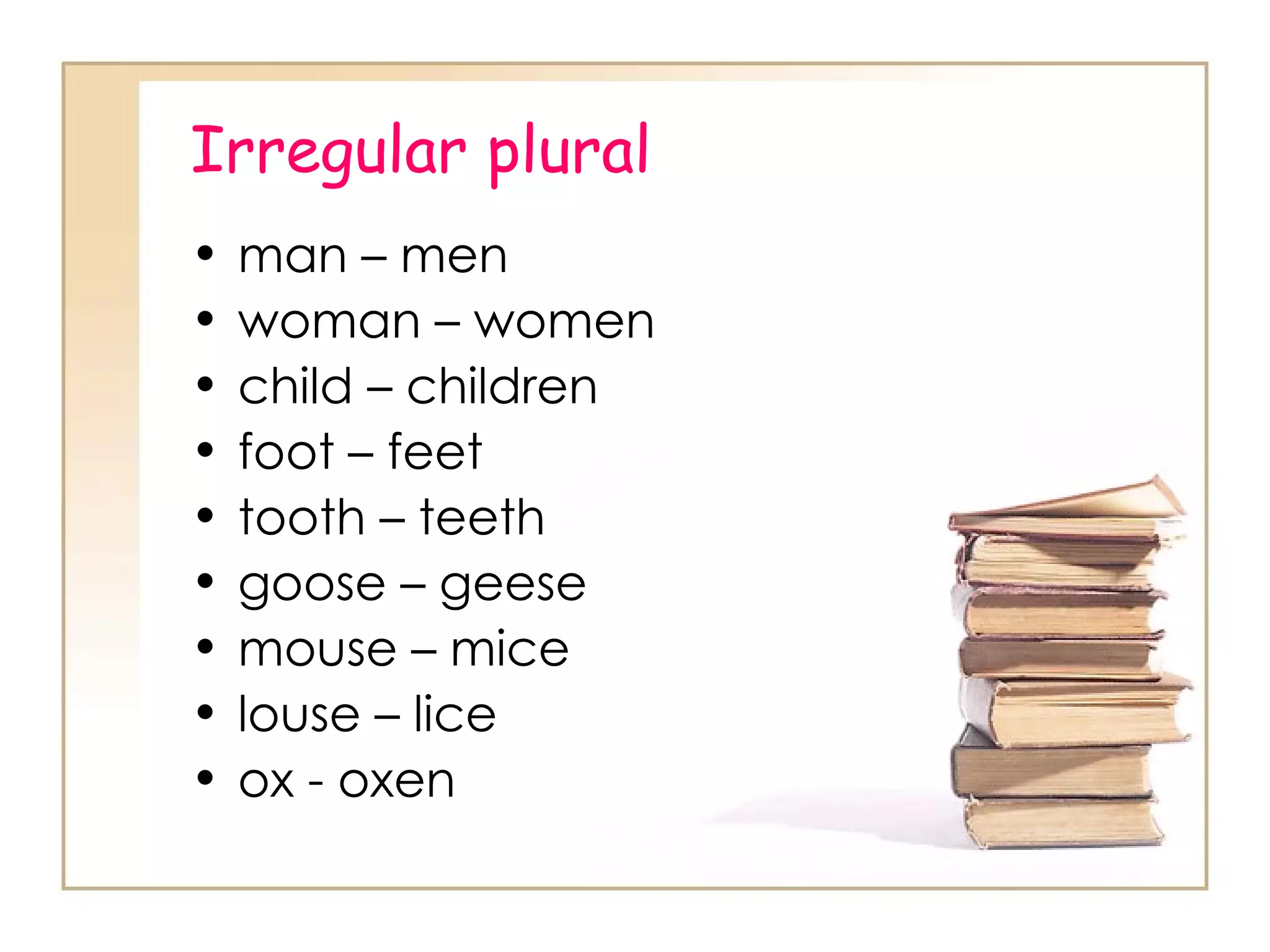
Irregular plural man – men woman – women child – children foot – feet tooth – teeth goose – geese mouse – mice louse – lice ox - oxen
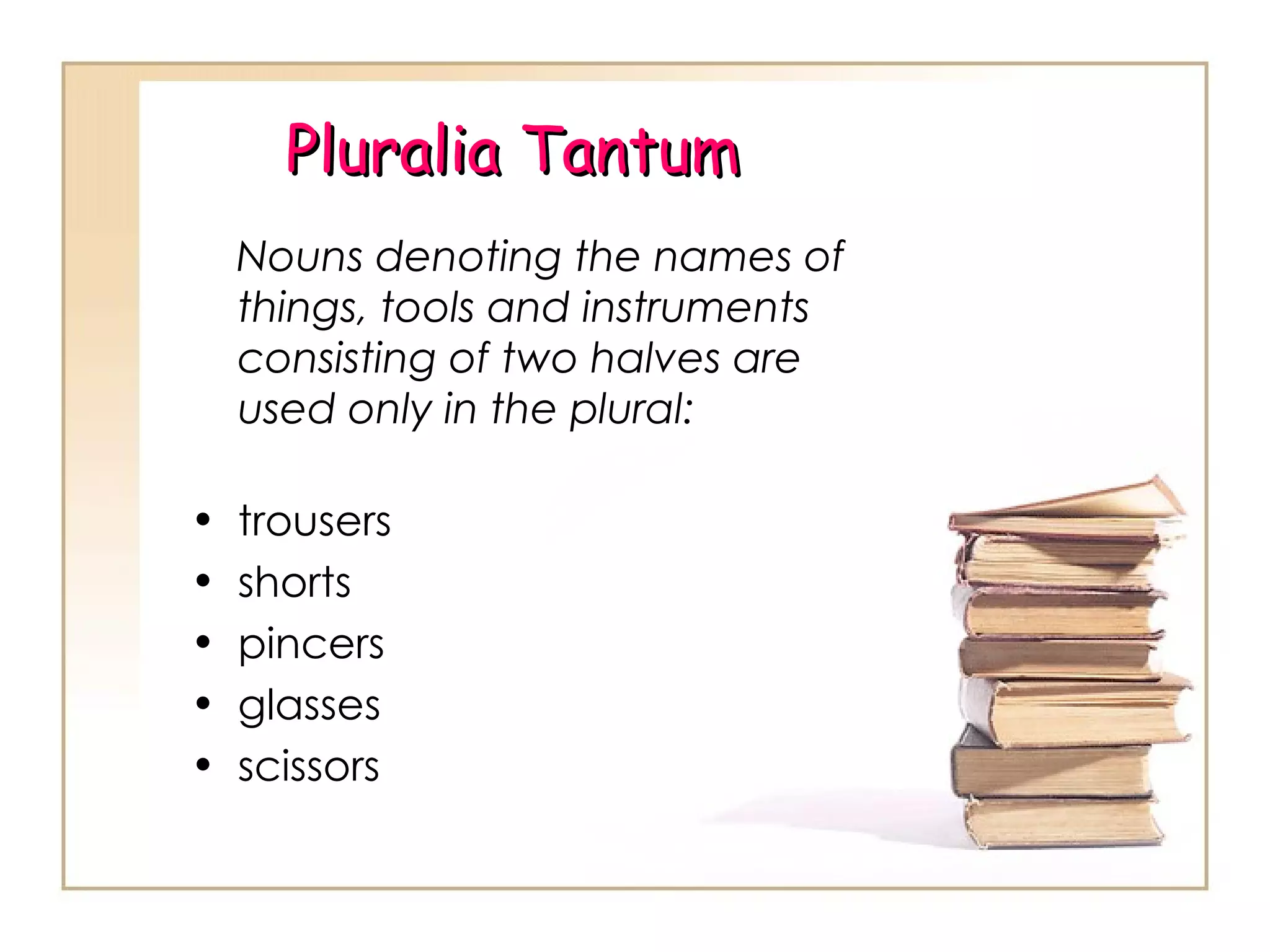
Pluralia Tantum Nouns denoting the names of things, tools and instruments consisting of two halves are used only in the plural: trousers shorts pincers glasses  scissors
The following nouns have only a plural form: arms – oružje goods – roba headquarters – štab, sedište premises – prostorije riches - bogatstvo
A number of words ending in  – ics  (acoustics, athletics, mathematics, politics, physics etc) normally take a plural verb: His mathematics are weak. But names of sciences can sometimes be considered singular: -Mathematics is an exact science.
The following nouns have the same form in the singular and plural: deer sheep means series species cross-roads
Nouns indicating nationality and ending in – ss  and  –se  have the same singular and plural form: A Japanese – two Japanese A Swiss – three Swiss
Some nouns taken from foreign languages keep their original plural forms: bas is  – bas es thes is  – thes es cris is  – cris es dat um  – dat a formul a  – formul ae phenomen on  - phenomen a
Some nouns have different meanings in the plural and singular: arm – arms good – goods hair – hairs cloth – clothes custom - customs
Singularia Tantum The following nouns have no plural form, they are always followed by a singular verb: information news advice courage knowledge furniture

Plural Of Nouns

  • 1.
    Plural of Nouns
  • 2.
    The plural ofa noun is usually made by adding s to the singular: dog – dogs house – houses s is pronounced /s/ after p, k or f sound. Otherwise it is pronounced /z/.
  • 3.
    Nouns ending in y following a consonant form their plural by dropping the y and adding ies : baby – babies Nouns ending in y following a vowel form their plural by adding s : day – days guy - guys
  • 4.
    - f orfe 13 nouns ending in f or fe change into v and add es in the plural: knife - knives life - lives wife – wifes leaf – leaves half – halves shelf – shelves loaf – loaves thief – thieves self – selves wolf – wolves calf – calves sheaf – sheaves elf – elves
  • 5.
    Other nouns takeonly –s in the plural: roof - roofs proof – proofs chief - chiefs
  • 6.
    Nouns ending in -o Nouns ending in –o preceded by a consonant add –es in the plural: tomato – tomatoes hero – heroes All nouns ending in –o preceded by a vowel take only –s in the plural: studio – studios scenario – scenarios Certain foreign nouns ending in –o preceded by a consonant, take only –s in the plural: piano – pianos kilo – kilos photo – photos Double forms: Fresco – frescos and frescoes Flamingo – flamingos and flamingoes
  • 7.
    Irregular plural man– men woman – women child – children foot – feet tooth – teeth goose – geese mouse – mice louse – lice ox - oxen
  • 8.
    Pluralia Tantum Nounsdenoting the names of things, tools and instruments consisting of two halves are used only in the plural: trousers shorts pincers glasses scissors
  • 9.
    The following nounshave only a plural form: arms – oružje goods – roba headquarters – štab, sedište premises – prostorije riches - bogatstvo
  • 10.
    A number ofwords ending in – ics (acoustics, athletics, mathematics, politics, physics etc) normally take a plural verb: His mathematics are weak. But names of sciences can sometimes be considered singular: -Mathematics is an exact science.
  • 11.
    The following nounshave the same form in the singular and plural: deer sheep means series species cross-roads
  • 12.
    Nouns indicating nationalityand ending in – ss and –se have the same singular and plural form: A Japanese – two Japanese A Swiss – three Swiss
  • 13.
    Some nouns takenfrom foreign languages keep their original plural forms: bas is – bas es thes is – thes es cris is – cris es dat um – dat a formul a – formul ae phenomen on - phenomen a
  • 14.
    Some nouns havedifferent meanings in the plural and singular: arm – arms good – goods hair – hairs cloth – clothes custom - customs
  • 15.
    Singularia Tantum Thefollowing nouns have no plural form, they are always followed by a singular verb: information news advice courage knowledge furniture