Workshop: TPACK-related competences of teachers in the 21st century, a challenging development! Petra Fisser University of Twente Curriculum Design & Educational Innovation 13 December 2010
21st century skills for students/children Cooperation  Communication ICT literacy Social and/or cultural skills Creativity Critical thinking skills Problem solving skills Productivity Learning to learn Self steering  Planning Flexibility Math, Science, Languages Taking risks Metacognition Controlling / solving conflicts Initiative and entrepreneurism Interdisciplinary themes
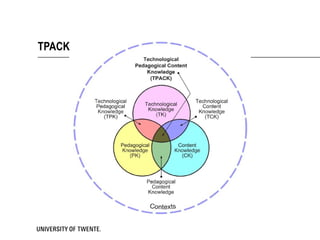
21 st  century competences of the teacher Effective teaching depends on flexible access to rich,  well-organized and integrated knowledge from different domains, including  knowledge of student thinking and learning,  knowledge of subject matter, and increasingly,  knowledge of technology “ At the heart of good teaching with technology are three core components: content, pedagogy, and technology, plus the relationships among and between them.” (Koehler & Mishra, 2006)
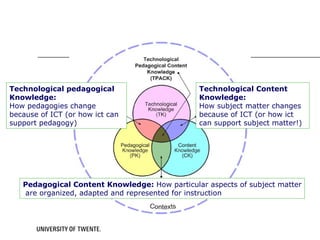
TPACK
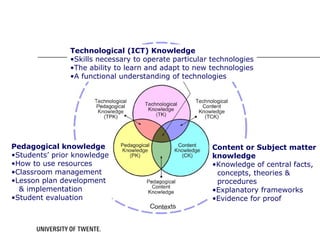
Content or Subject matter knowledge Knowledge of central facts,   concepts, theories &   procedures Explanatory frameworks Evidence for proof Pedagogical knowledge Students’ prior knowledge How to use resources Classroom management Lesson plan development    & implementation Student evaluation Technological (ICT) Knowledge Skills necessary to operate particular technologies The ability to learn and adapt to new technologies A functional understanding of technologies
Pedagogical Content Knowledge:  How particular aspects of subject matter are organized, adapted and represented for instruction Technological Content Knowledge: How subject matter changes because of ICT (or how ict can support subject matter!) Technological pedagogical Knowledge:   How pedagogies change because of ICT (or how ict can support pedagogy)
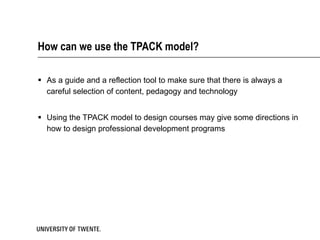
How can we use the TPACK model? As a guide and a reflection tool to make sure that there is always a careful selection of content, pedagogy and technology Using the TPACK model to design courses may give some directions in how to design professional development programs
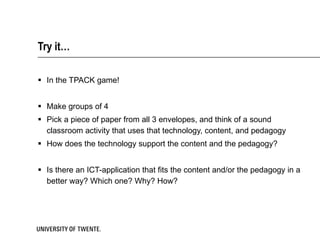
Try it… In the TPACK game! Make groups of 4 Pick a piece of paper from all 3 envelopes, and think of a sound classroom activity that uses that technology, content, and pedagogy How does the technology support the content and the pedagogy? Is there an ICT-application that fits the content and/or the pedagogy in a better way? Which one? Why? How?
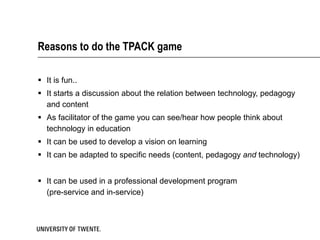
Reasons to do the TPACK game It is fun.. It starts a discussion about the relation between technology, pedagogy and content As facilitator of the game you can see/hear how people think about technology in education It can be used to develop a vision on learning It can be adapted to specific needs (content, pedagogy  and  technology) It can be used in a professional development program (pre-service and in-service)
Professional development.. Important: Introducing new educational technologies into the learning process changes more than the tools used It has deep implications for the nature of content-area learning, as well as the pedagogical approaches among which teachers can select This is often an overlooked aspect of many technology integration approaches used to date How to proceed?  Opportunity: Activity types  (Harris, Mishra & Koehler, 2009)
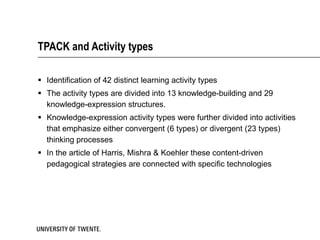
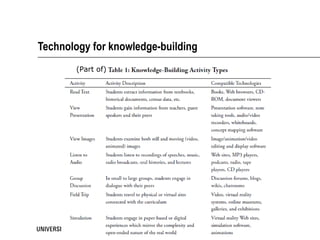
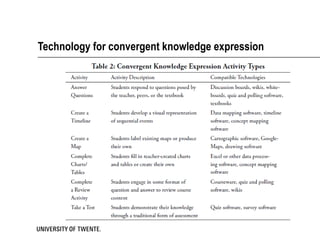
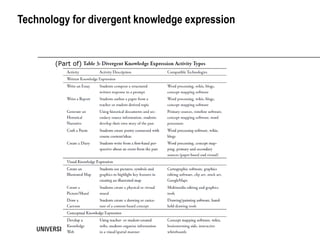
TPACK and Activity types Identification of 42 distinct learning activity types The activity types are divided into 13 knowledge-building and 29 knowledge-expression structures.  Knowledge-expression activity types were further divided into activities that emphasize either convergent (6 types) or divergent (23 types) thinking processes In the article of Harris, Mishra & Koehler these content-driven pedagogical strategies are connected with specific technologies
Technology for knowledge-building (Part of)
Technology for convergent knowledge expression
Technology for divergent knowledge expression (Part of)
Why all these lists? The goal in identifying activity types and specific technologies is  to help teachers become aware of the full range of possible curriculum-based learning activity options and  the different ways that digital and non-digital tools support this This can help teachers efficiently select among, customize, and combine activity types that are well matched to  students’ differentiated learning needs and  students’ differentiated preferences and  classroom contextual realities  (such as computer access, class time, etc.)
Try it... Think about your discussions during the TPACK Game Does the list of activity types help you in making more or other choices?  Why? How? And.. Just curious… is this approach something that can work in Poland?
Want to know more? Literature study (in translation at the moment) Development of TPACK interventions & instruments Studies in the Netherlands, Belgium, Kuwait, Tanzania, Ghana,  ….. and Poland???? Please contact me! Petra Fisser University of Twente http://users.gw.utwente.nl/fisser [email_address]

21st Century Skills & TPACK (Workshop)

  • 1.
    Workshop: TPACK-related competencesof teachers in the 21st century, a challenging development! Petra Fisser University of Twente Curriculum Design & Educational Innovation 13 December 2010
  • 2.
    21st century skillsfor students/children Cooperation Communication ICT literacy Social and/or cultural skills Creativity Critical thinking skills Problem solving skills Productivity Learning to learn Self steering Planning Flexibility Math, Science, Languages Taking risks Metacognition Controlling / solving conflicts Initiative and entrepreneurism Interdisciplinary themes
  • 3.
    21 st century competences of the teacher Effective teaching depends on flexible access to rich, well-organized and integrated knowledge from different domains, including knowledge of student thinking and learning, knowledge of subject matter, and increasingly, knowledge of technology “ At the heart of good teaching with technology are three core components: content, pedagogy, and technology, plus the relationships among and between them.” (Koehler & Mishra, 2006)
  • 4.
  • 5.
    Content or Subjectmatter knowledge Knowledge of central facts, concepts, theories & procedures Explanatory frameworks Evidence for proof Pedagogical knowledge Students’ prior knowledge How to use resources Classroom management Lesson plan development & implementation Student evaluation Technological (ICT) Knowledge Skills necessary to operate particular technologies The ability to learn and adapt to new technologies A functional understanding of technologies
  • 6.
    Pedagogical Content Knowledge: How particular aspects of subject matter are organized, adapted and represented for instruction Technological Content Knowledge: How subject matter changes because of ICT (or how ict can support subject matter!) Technological pedagogical Knowledge: How pedagogies change because of ICT (or how ict can support pedagogy)
  • 7.
    How can weuse the TPACK model? As a guide and a reflection tool to make sure that there is always a careful selection of content, pedagogy and technology Using the TPACK model to design courses may give some directions in how to design professional development programs
  • 8.
    Try it… Inthe TPACK game! Make groups of 4 Pick a piece of paper from all 3 envelopes, and think of a sound classroom activity that uses that technology, content, and pedagogy How does the technology support the content and the pedagogy? Is there an ICT-application that fits the content and/or the pedagogy in a better way? Which one? Why? How?
  • 9.
    Reasons to dothe TPACK game It is fun.. It starts a discussion about the relation between technology, pedagogy and content As facilitator of the game you can see/hear how people think about technology in education It can be used to develop a vision on learning It can be adapted to specific needs (content, pedagogy and technology) It can be used in a professional development program (pre-service and in-service)
  • 10.
    Professional development.. Important:Introducing new educational technologies into the learning process changes more than the tools used It has deep implications for the nature of content-area learning, as well as the pedagogical approaches among which teachers can select This is often an overlooked aspect of many technology integration approaches used to date How to proceed? Opportunity: Activity types (Harris, Mishra & Koehler, 2009)
  • 11.
    TPACK and Activitytypes Identification of 42 distinct learning activity types The activity types are divided into 13 knowledge-building and 29 knowledge-expression structures. Knowledge-expression activity types were further divided into activities that emphasize either convergent (6 types) or divergent (23 types) thinking processes In the article of Harris, Mishra & Koehler these content-driven pedagogical strategies are connected with specific technologies
  • 12.
  • 13.
    Technology for convergentknowledge expression
  • 14.
    Technology for divergentknowledge expression (Part of)
  • 15.
    Why all theselists? The goal in identifying activity types and specific technologies is to help teachers become aware of the full range of possible curriculum-based learning activity options and the different ways that digital and non-digital tools support this This can help teachers efficiently select among, customize, and combine activity types that are well matched to students’ differentiated learning needs and students’ differentiated preferences and classroom contextual realities (such as computer access, class time, etc.)
  • 16.
    Try it... Thinkabout your discussions during the TPACK Game Does the list of activity types help you in making more or other choices? Why? How? And.. Just curious… is this approach something that can work in Poland?
  • 17.
    Want to knowmore? Literature study (in translation at the moment) Development of TPACK interventions & instruments Studies in the Netherlands, Belgium, Kuwait, Tanzania, Ghana, ….. and Poland???? Please contact me! Petra Fisser University of Twente http://users.gw.utwente.nl/fisser [email_address]