STRATEGICALLY 
INTEGRATING 
TECHNOLOGY INTO 
YOUR INSTRUCTION 
Benjamin Oberdick 
September 18, 2014
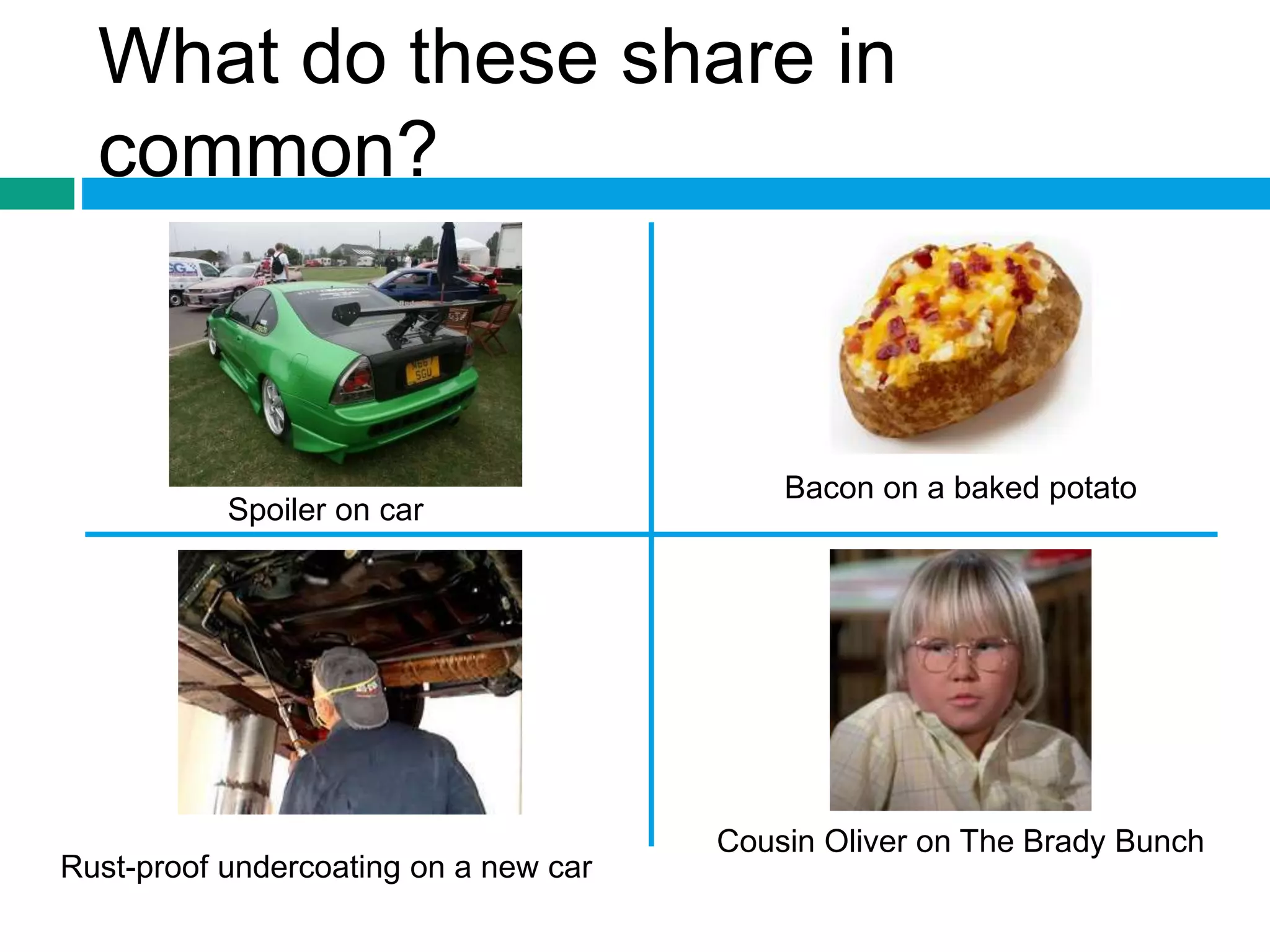
What do these share in 
common? 
Bacon on a baked potato 
Cousin Oliver on The Brady Bunch 
Spoiler on car 
Rust-proof undercoating on a new car
Strategic Integration of Technology 
 Critical to effective teaching with technology 
 Solves problem of technology as add-on 
 Purposeful decision making
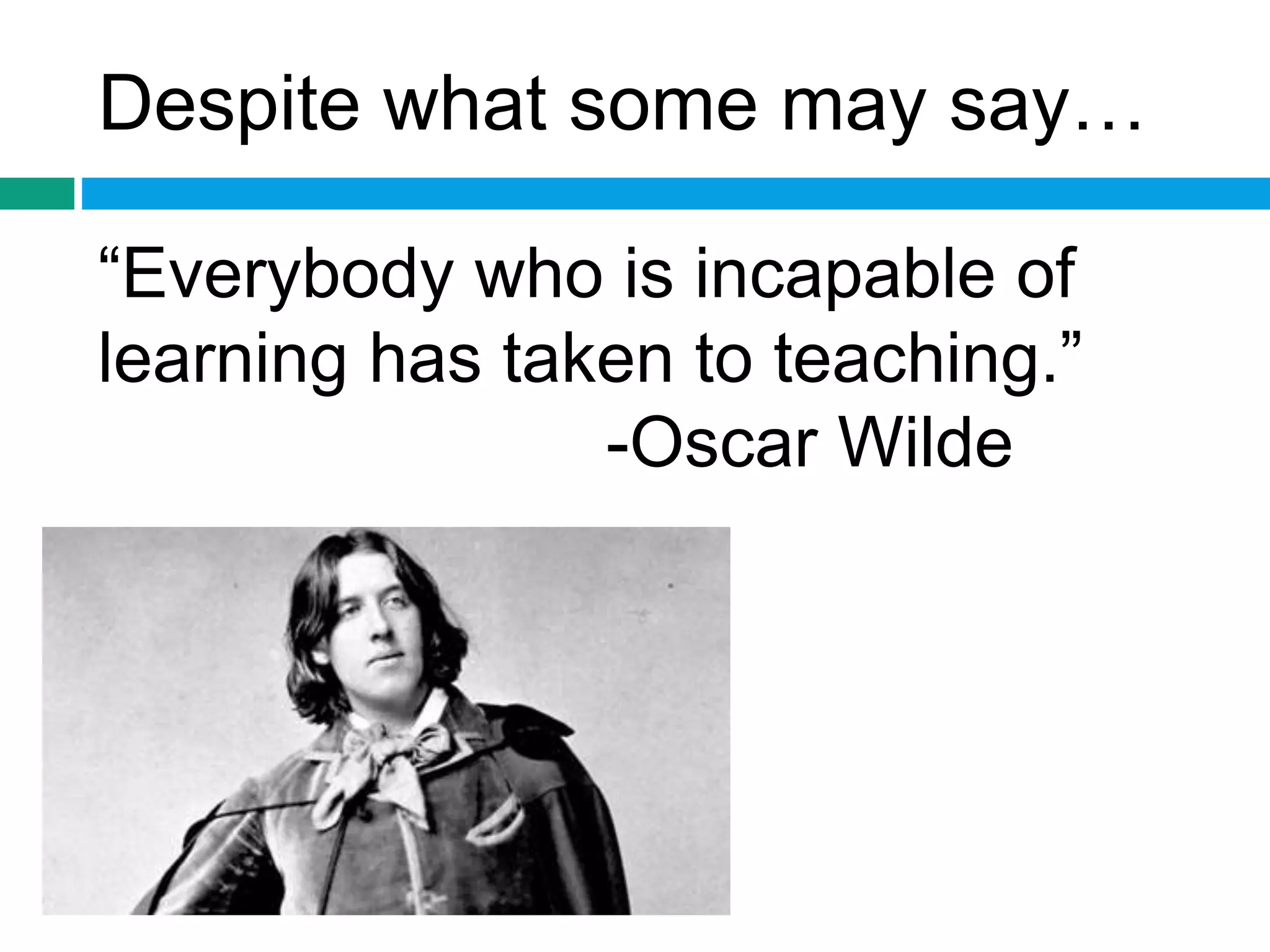
Despite what some may say… 
“Everybody who is incapable of 
learning has taken to teaching.” 
-Oscar Wilde
Teaching is Ill-Structured & 
Complex 
 Expertise in teaching is dependent on flexible 
access to and application of highly organized 
systems of knowledge 
 Highly complex and dynamic environment 
 Often no known or “correct” solution 
 High level of variability 
 Adding technology brings even more 
complexity
Getting Started with TPACK 
 TPACK framework helps the effective 
integration of technology into teaching and 
learning 
 Focuses on interplay of three primary forms of 
knowledge: 
 Content (CK) 
 Pedagogy (PK) 
 Technology (TK)
Where does TPACK come from? 
 Extension of Lee Shulman’s idea of 
Pedagogical Content Knowledge 
 2 MSU Education faculty: 
 Dr. Matthew Koehler 
 Dr. Punya Mishra 
 My introduction - MSU MAED program
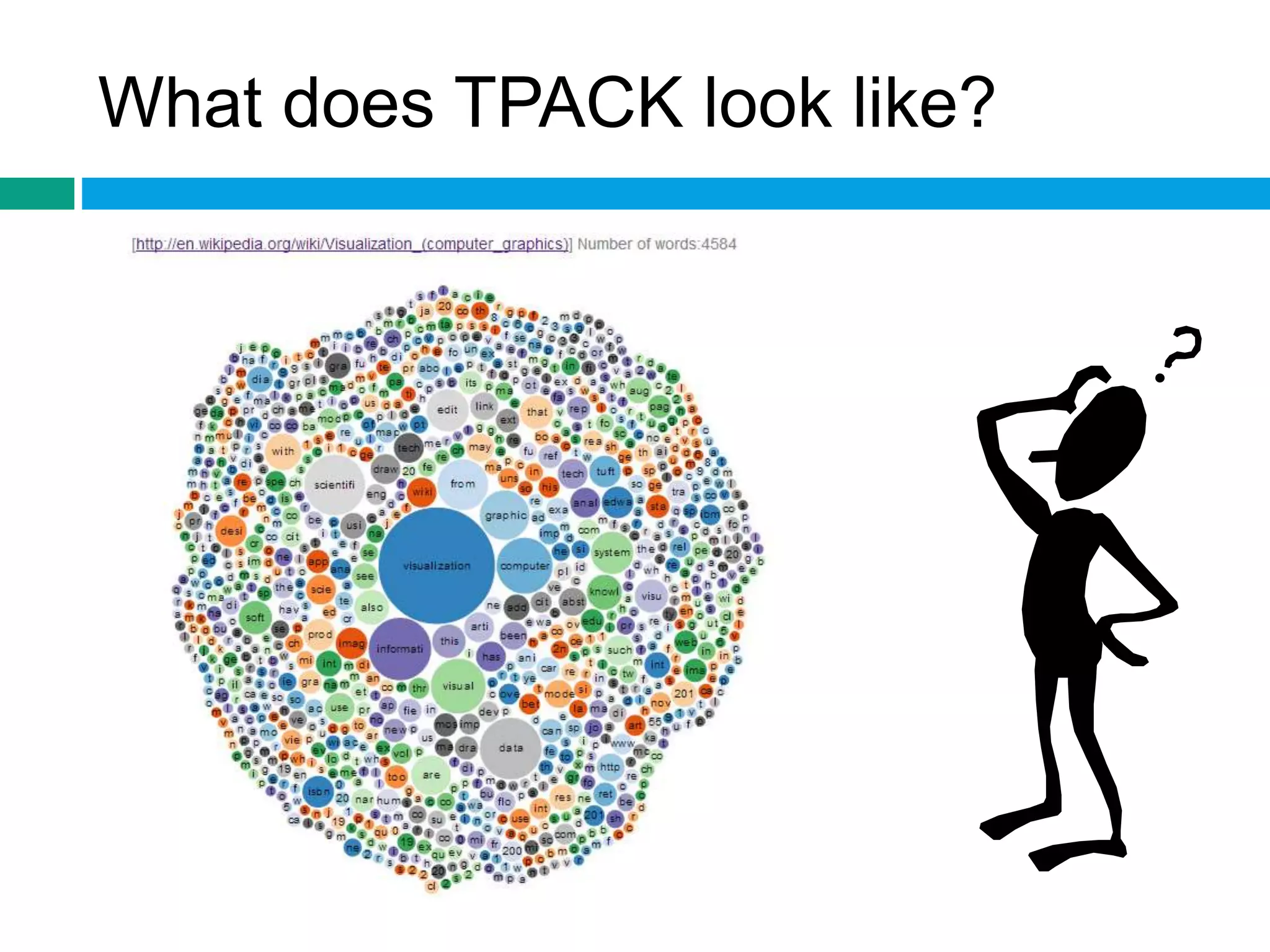
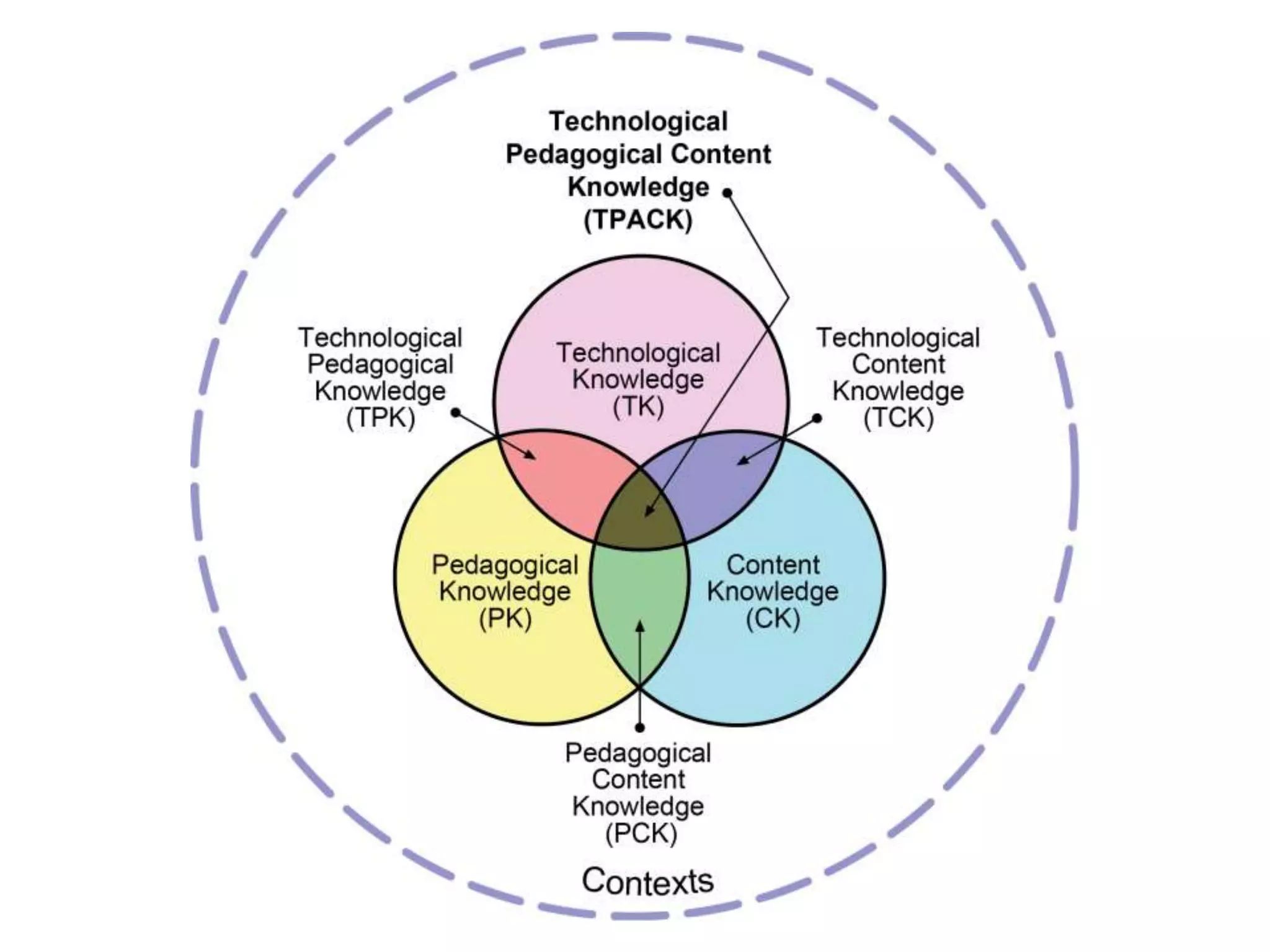
What does TPACK look like?
7 Components of TPACK (#1-3) 
Step 1: Examine each component in isolation: 
 Content Knowledge (CK) 
 Pedagogical Knowledge (PK) 
 Technology Knowledge (TK)
#1 Content Knowledge (CK) 
 Teachers’ knowledge about the subject matter 
to be learned or taught 
 includes knowledge of the concepts, theories, 
ideas, organizational frameworks in field 
 Foundation of TPACK 
 Content varies from course to course
#2 Pedagogical Knowledge (PK) 
 Teachers’ deep knowledge about the 
processes and practices or methods of 
teaching and learning 
 Educational purposes, values, and aims 
 Understanding how students learn, general 
classroom management skills, lesson 
planning, assessment, etc.
#3 Technology Knowledge (TK) 
 Knowledge about and working with technology, 
tools and resources 
 Applying technology productively 
 Recognizing when information technology can 
assist or impede the achievement of a goal 
 Adapting to changes in information technology 
 What technologies have you used in the 
classroom?
Individual Reflection 
 Identify one technology you’ve used in a class. 
 Why do you use that technology? 
 What are some pros and cons of 
using that technology?
7 Components of TPACK (#4-6) 
Step 2: Examine interplay of components: 
 Pedagogical Content Knowledge (PCK) 
 Technological Content Knowledge (TCK) 
 Technological Pedagogical Knowledge (TPK)
#4 Pedagogical Content 
Knowledge 
 Interpreting subject matter, finding multiple 
ways to represent it, and adapting/tailoring 
instructional materials 
 Covers the core business of teaching, 
learning, curriculum, assessment and 
reporting 
 conditions that promote learning 
 links -- curriculum, assessment, and pedagogy
#5 Technological Content 
Knowledge 
 How technology and content influence and 
constrain one another 
 How subject matter can be changed by 
particular technologies 
 Matching subject matter and technology 
 how the content dictates or changes the 
technology
#6 Technological Pedagogical 
Knowledge 
 How teaching and learning can change when 
technologies are used in particular ways 
 Pedagogical affordances & constraints of 
technological tools as they relate to 
disciplinarily and developmentally appropriate 
pedagogical designs and strategies
Individual Reflection 
 How could I use this whiteboard when 
teaching? 
 What could I do differently if I had multiple 
white boards?
#7 Putting it all Together 
Technological Pedagogical 
Content Knowledge (TPACK)
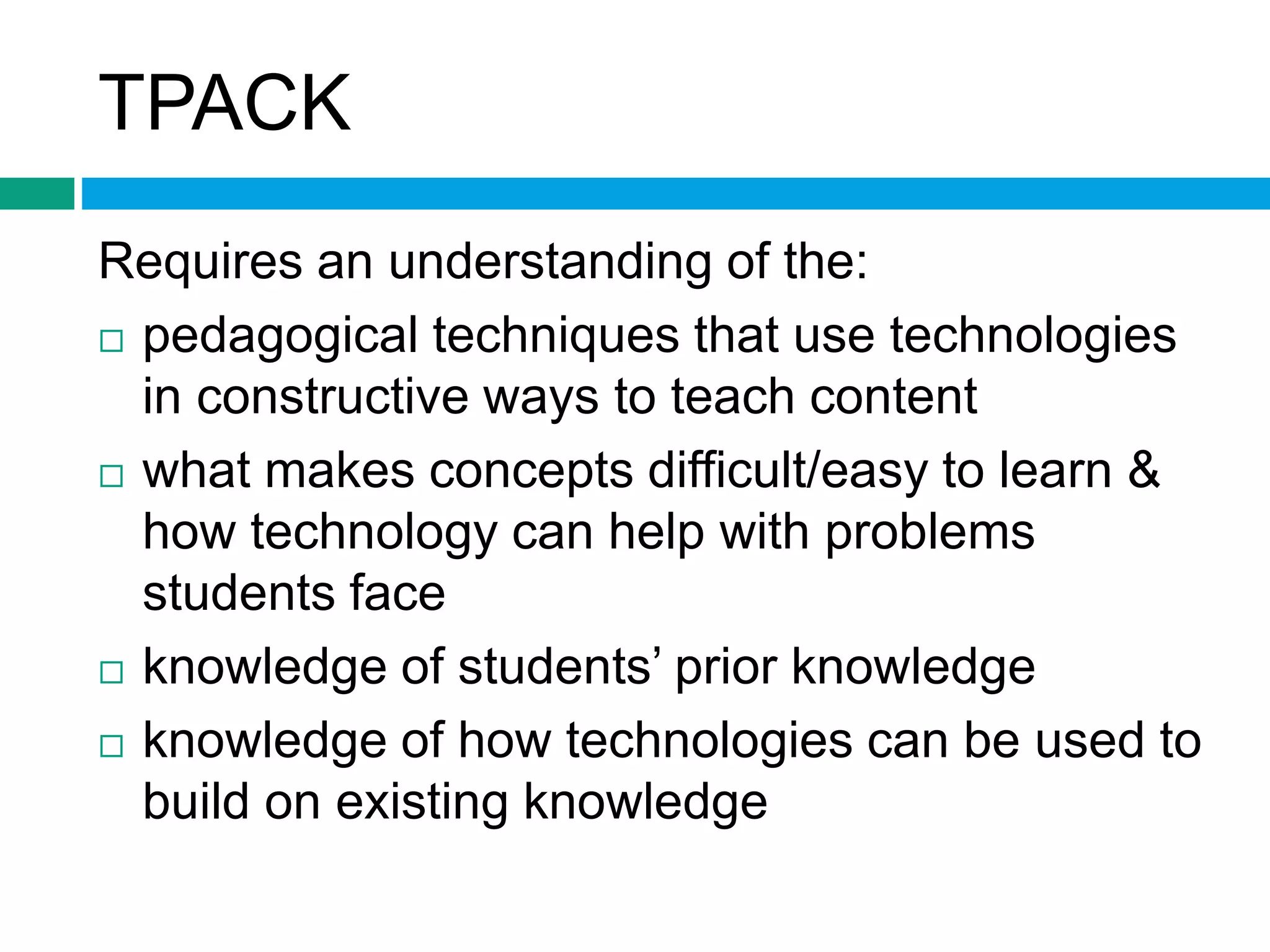
TPACK 
Requires an understanding of the: 
 pedagogical techniques that use technologies 
in constructive ways to teach content 
 what makes concepts difficult/easy to learn & 
how technology can help with problems 
students face 
 knowledge of students’ prior knowledge 
 knowledge of how technologies can be used to 
build on existing knowledge
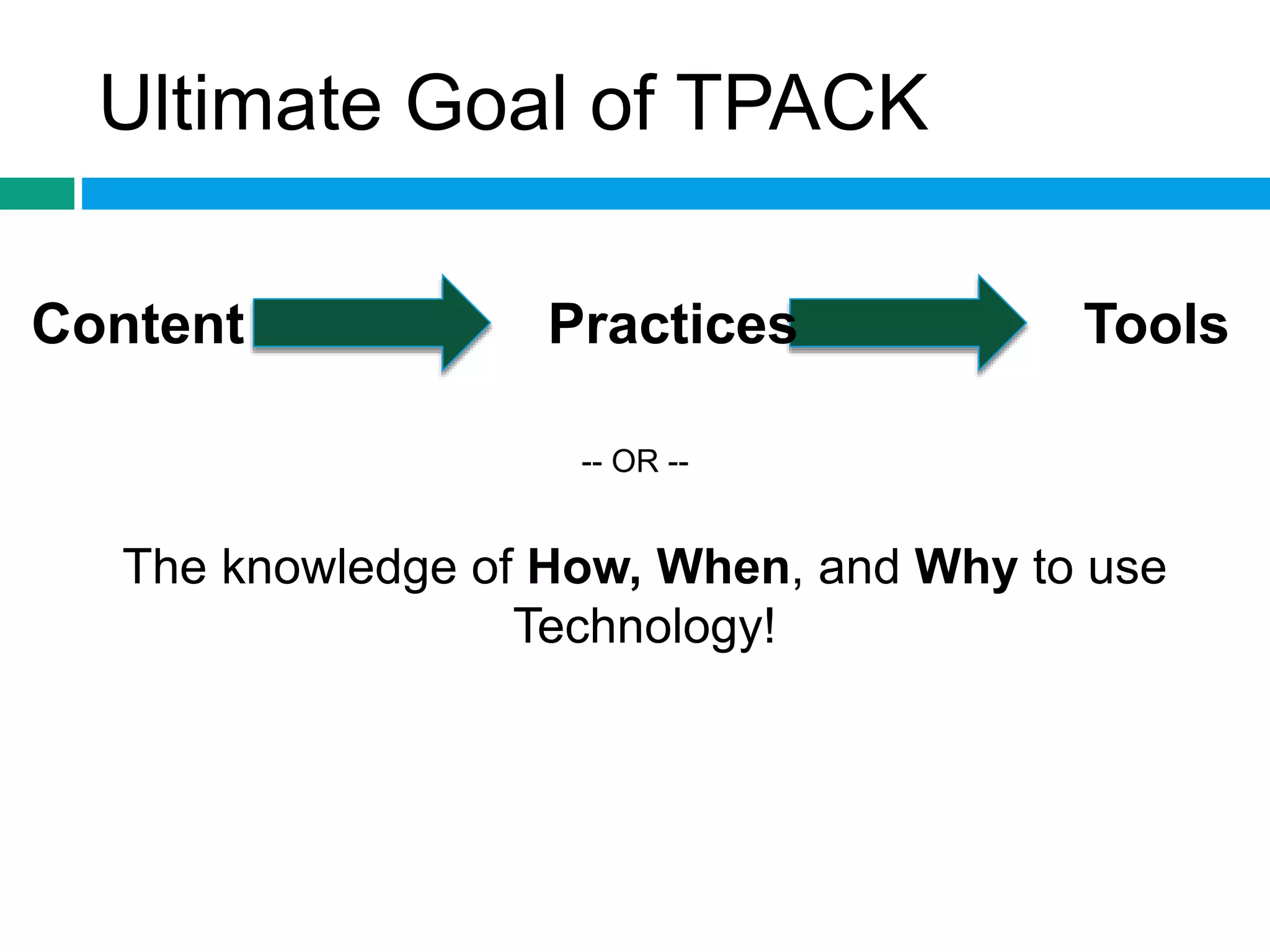
Ultimate Goal of TPACK 
Content Practices Tools 
-- OR -- 
The knowledge of How, When, and Why to use 
Technology!
So how can you 
use TPACK in 
your teaching?
Group Activity 
 Get in groups of 3 
 Complete worksheet
Pick a 
card content, 
any card 
content 
Part I: Choose an IL 
topic you might 
cover in class.
Pick a 
pedagogy, 
any pedagogy 
Part II: Choose a type 
of pedagogy you 
might use in class.
Pick a 
technology, 
any 
technology 
Part III: Choose a type 
of technology that 
you might use in 
class.
Think about… 
 How does the technology support the content 
and the pedagogy? 
 Is there another technology/application that fits 
the content and/or the pedagogy in a better 
way? 
 If so, Which one? Why? How?
Report Out
Bibliography 
 Agyei, D., & Keengwe, J. (2014). Using technology 
pedagogical 
content knowledge development to enhance learning 
outcomes. Education & Information Technologies, 19(1), 
155-171. 
 Linton, J. (2012). TPACK as a framework for collaborative 
inquiry in the learning commons. Teacher Librarian, 39(6), 
25-29. 
 Koehler, M. J., & Mishra, P. (2008). Introducing TPACK. In 
AACTE Committee on Innovation and Technology 
(Eds.), Handbook of Technological Pedagogical 
Content Knowledge (TPACK) for Educators (3-29). New 
York: Routledge. 
 Koehler, M. J. (2014, April 9). TPACK. Retrieved from 
http://www.tpack.org/.
For more information about 
TPACK 
 Check out their website - tpack.org/ 
 Resources 
 Bibliography 
 Newsletter 
 Also have a Mendeley group - 
http://www.mendeley.com/groups/522011/tpac 
k/
Questions

Strategically Integrating Technology into your Instruction (2014)

  • 1.
    STRATEGICALLY INTEGRATING TECHNOLOGYINTO YOUR INSTRUCTION Benjamin Oberdick September 18, 2014
  • 2.
    What do theseshare in common? Bacon on a baked potato Cousin Oliver on The Brady Bunch Spoiler on car Rust-proof undercoating on a new car
  • 3.
    Strategic Integration ofTechnology  Critical to effective teaching with technology  Solves problem of technology as add-on  Purposeful decision making
  • 4.
    Despite what somemay say… “Everybody who is incapable of learning has taken to teaching.” -Oscar Wilde
  • 5.
    Teaching is Ill-Structured& Complex  Expertise in teaching is dependent on flexible access to and application of highly organized systems of knowledge  Highly complex and dynamic environment  Often no known or “correct” solution  High level of variability  Adding technology brings even more complexity
  • 6.
    Getting Started withTPACK  TPACK framework helps the effective integration of technology into teaching and learning  Focuses on interplay of three primary forms of knowledge:  Content (CK)  Pedagogy (PK)  Technology (TK)
  • 7.
    Where does TPACKcome from?  Extension of Lee Shulman’s idea of Pedagogical Content Knowledge  2 MSU Education faculty:  Dr. Matthew Koehler  Dr. Punya Mishra  My introduction - MSU MAED program
  • 8.
    What does TPACKlook like?
  • 10.
    7 Components ofTPACK (#1-3) Step 1: Examine each component in isolation:  Content Knowledge (CK)  Pedagogical Knowledge (PK)  Technology Knowledge (TK)
  • 11.
    #1 Content Knowledge(CK)  Teachers’ knowledge about the subject matter to be learned or taught  includes knowledge of the concepts, theories, ideas, organizational frameworks in field  Foundation of TPACK  Content varies from course to course
  • 12.
    #2 Pedagogical Knowledge(PK)  Teachers’ deep knowledge about the processes and practices or methods of teaching and learning  Educational purposes, values, and aims  Understanding how students learn, general classroom management skills, lesson planning, assessment, etc.
  • 13.
    #3 Technology Knowledge(TK)  Knowledge about and working with technology, tools and resources  Applying technology productively  Recognizing when information technology can assist or impede the achievement of a goal  Adapting to changes in information technology  What technologies have you used in the classroom?
  • 14.
    Individual Reflection Identify one technology you’ve used in a class.  Why do you use that technology?  What are some pros and cons of using that technology?
  • 15.
    7 Components ofTPACK (#4-6) Step 2: Examine interplay of components:  Pedagogical Content Knowledge (PCK)  Technological Content Knowledge (TCK)  Technological Pedagogical Knowledge (TPK)
  • 16.
    #4 Pedagogical Content Knowledge  Interpreting subject matter, finding multiple ways to represent it, and adapting/tailoring instructional materials  Covers the core business of teaching, learning, curriculum, assessment and reporting  conditions that promote learning  links -- curriculum, assessment, and pedagogy
  • 17.
    #5 Technological Content Knowledge  How technology and content influence and constrain one another  How subject matter can be changed by particular technologies  Matching subject matter and technology  how the content dictates or changes the technology
  • 18.
    #6 Technological Pedagogical Knowledge  How teaching and learning can change when technologies are used in particular ways  Pedagogical affordances & constraints of technological tools as they relate to disciplinarily and developmentally appropriate pedagogical designs and strategies
  • 19.
    Individual Reflection How could I use this whiteboard when teaching?  What could I do differently if I had multiple white boards?
  • 20.
    #7 Putting itall Together Technological Pedagogical Content Knowledge (TPACK)
  • 21.
    TPACK Requires anunderstanding of the:  pedagogical techniques that use technologies in constructive ways to teach content  what makes concepts difficult/easy to learn & how technology can help with problems students face  knowledge of students’ prior knowledge  knowledge of how technologies can be used to build on existing knowledge
  • 22.
    Ultimate Goal ofTPACK Content Practices Tools -- OR -- The knowledge of How, When, and Why to use Technology!
  • 23.
    So how canyou use TPACK in your teaching?
  • 24.
    Group Activity Get in groups of 3  Complete worksheet
  • 25.
    Pick a cardcontent, any card content Part I: Choose an IL topic you might cover in class.
  • 26.
    Pick a pedagogy, any pedagogy Part II: Choose a type of pedagogy you might use in class.
  • 27.
    Pick a technology, any technology Part III: Choose a type of technology that you might use in class.
  • 28.
    Think about… How does the technology support the content and the pedagogy?  Is there another technology/application that fits the content and/or the pedagogy in a better way?  If so, Which one? Why? How?
  • 29.
  • 30.
    Bibliography  Agyei,D., & Keengwe, J. (2014). Using technology pedagogical content knowledge development to enhance learning outcomes. Education & Information Technologies, 19(1), 155-171.  Linton, J. (2012). TPACK as a framework for collaborative inquiry in the learning commons. Teacher Librarian, 39(6), 25-29.  Koehler, M. J., & Mishra, P. (2008). Introducing TPACK. In AACTE Committee on Innovation and Technology (Eds.), Handbook of Technological Pedagogical Content Knowledge (TPACK) for Educators (3-29). New York: Routledge.  Koehler, M. J. (2014, April 9). TPACK. Retrieved from http://www.tpack.org/.
  • 31.
    For more informationabout TPACK  Check out their website - tpack.org/  Resources  Bibliography  Newsletter  Also have a Mendeley group - http://www.mendeley.com/groups/522011/tpac k/
  • 32.

Editor's Notes

  • #3 They’re all ADD-Ons
  • #4 Holistic approach to teaching and learning where you don’t just focus on what you’re teaching, and what pedagogy you’re using to get there, but instead look at your classroom and teaching as a whole and work to build a lesson, activity, class, or course by deciding what technology you want to use to teach a particular topic in a certain way or method of teaching.
  • #6 Most librarians, just like most teaching faculty, were not trained as teachers. And for those librarians who are new to teaching, and even for many experienced teachers, teaching is an ill-structured and complex activity. And while having a background in education and teaching can make this “easier” in some ways (I went in knowing a lot about pedagogy and how to write a learning outcome), teaching will always be a highly complex and dynamic activity, with a high level of variability, with no one right answer or solution, and adding technology into the mix just adds another degree to the complication and makes a framework like TPACK even more necessary.
  • #7 Quality teaching requires developing a nuanced understanding of the complex relationships between technology, content, and pedagogy, and using this understanding to develop appropriate, context-specific strategies and representations. Understanding the three forms of knowledge in isolation, and also the interactions between them, produces knowledge to successfully integrate technology in the classroom. TPACK focuses on teacher knowledge because teachers are often autonomous agents, especially in higher education, with the power to significantly influence the appropriate (or inappropriate) integration of technology in teaching.
  • #8 Lee Shulman’s idea of Pedagogical Content Knowledge – he argued that effective teachers must not only possess knowledge of their content areas and knowledge of effective instructional practices, but also an understanding of how content knowledge and pedagogical knowledge interact within the classroom. Lee S. Shulman is an educational psychologist is a professor emeritus at Stanford Graduate School of Education. From 1963 to 1982, Shulman was a faculty member at Michigan State University, where he founded and co-directed the Institute for Research on Teaching (IRT). Mishra and Koehler extended the framework to include technological knowledge because of the ways that educational technology has changed the nature of teaching and learning.
  • #9 Thankfully it’s not nearly as complicated as this graph. We’ll talk about all the different parts of TPACK and thinking about a visual for it can be helpful, at least to me, for understanding it better.
  • #12 Implementation of TPACK begins here – it is the foundation. Without content knowledge, the other two are useless. Encompasses an understanding of effective instructional and assessment practices. Teachers have to understand the subjects and content they are teaching. I may have taken calculus in HS 20 years ago, but I would not be good teaching it now because I have not had a math class since that one in 1994.
  • #13 Encompasses an understanding of effective instructional and assessment practices. Pedagogical knowledge enables teachers to support learners in acquiring the content knowledge teachers possess.
  • #14 In addition, teaching in today's classrooms requires a certain amount of technological expertise. Educators must develop the ability to flexibly utilize technology for teaching and learning. This one is always in a state of flux – technologies change and evolve continuously, sometimes at amazing speeds. In addition to understanding technology and how to use it, it’s about applying technology in productive ways, recognizing when technology can assist or impede the achievement of a goal, and being able to adapt to the continual changes in technology.
  • #17 What is the best way to teach about this topic? Do I want to lecture about the differences between scholarly journals and magazines, or should I incorporate some active learning into this part of class and have the student’s examine some examples of scholarly journals and magazines and try to come up with the characteristics of each.
  • #18 Understanding the impact of technology on the practices and knowledge of a given discipline is critical if we are able to develop appropriate technological tools for educational purposes. Teachers need to master more than the subject matter they teach, they must also have a deep understanding of the manner in which the subject matter can be changed by the application of technology. Teachers need to understand which specific technologies are best suited for addressing subject-matter learning in their domains and how the content dictates or perhaps even changes the technology – or vice versa.
  • #19 Requires deeper understanding of the constraints and affordances of technologies and the disciplinary contexts within which they function. Think about the many different ways you may use a whiteboard in the classroom. Is it in the front of the room where only the teacher uses it – if so, that says something about the pedagogy of that classroom – it’s a more teacher-centered focus. Or is the white board being used in a group activity where all participants have access to it. This establishes a different kind of classroom and teacher-student interaction. This is an important part of TRK – developing creative flexibility with available tools in order to repurpose them for specific pedagogical purposes
  • #20 List as many ways it could be used as you can think of.
  • #21 The interaction of these three types of knowledge guide teachers’ decision-making in selecting appropriate instructional strategies, assessment practices, differentiation techniques, and technological tools.
  • #22 It is the knowledge of HOW, WHEN, and WHY to use technology
  • #23 Plus… the effective integration of technology into your teaching!
  • #24 Ok, so how can you use this when you are designing and planning activities and lessons for your classes and students? Grab a handout on the tables and you’re going to be working with the people at your tables to think about using TPACK in the IL classroom.
  • #33 Sharon and Ben