Readings in
Philippine
History
Chapter 1
Meaning and
Relevance of
History
It is being written based on
the actual evidence,
manuscripts, and written
documents which provide
sources of historical
information.
History
Two Categories of
Historical Data
•Primary Sources
•Secondary Souces
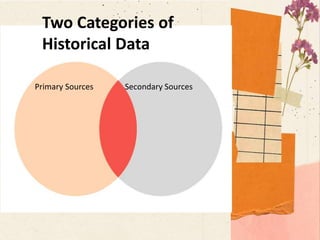
Primary Sources Secondary Sources
Two Categories of
Historical Data
•Primary Sources
- It provides direct or
firsthand evidence about an
event, object, person, or work
of art.
- It contains "firsthand"
knowledge about historical
events, figures, and people.
•Primary Sources
-It provides compelling and direct
evidence of human activity.
- These are the things that were
created or in use during the period
which is being studied.
-These sources are actual records that
have survived from the past.
•Primary Sources
Examples:
✓Autobiography
✓Memoirs
✓Eyewitness Accounts
✓ Diary
✓Fossils
✓Relics
✓Letters
•Primary Sources
Examples:
✓Photographs
✓Speeches
✓Videos
✓Legal Documents
✓Ornaments
✓Clothing
✓Tools
•Secondary Sources
- It is something that was not
made by someone or by a group
of people who participated in the
historical era which is being
studied.
- These are usually created by
historians ajd scholastic writers
based on their interpretation of
the primary sources.
•Secondary Sources
-These are sources of historical data
which are created later or after the
historical event which is being studied
and provided by the people who were
not present in that event.
- It describes, discuss, interpret,
comment upon, analyze, evaluate,
summarize, and process primary
sources.
•Secondary Sources
Examples:
✓Biography
✓Encyclopedia
✓Textbooks
✓Thesis
✓Dissertations
✓Interviews
✓News reports
•Secondary Sources
Examples:
✓Movies
✓News articles
✓Scholarly journals
✓Transcriptions
✓Almanacs
✓Dictionaries
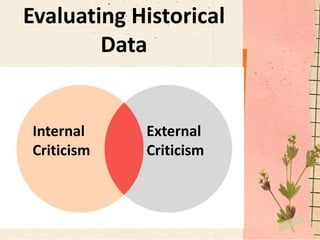
Evaluating Historical
Data
Internal
Criticism
External
Criticism
Internal Criticism
- It looks within the data itself to try to
determine the truth-facts and the
reasonable interpretation.
-It includes looking at the personal data
provider's apparent or possible motives.
-It indicates the accuracy, trustworthiness,
and integrity of the materials to which
historical data will be based.
External Criticism
- It applies experimental science to
certify the authenticity of the material
that holds the data in which historical
information will be based.
- It entails such physical and technical
tests as the dating of paper when a
document is written.
External Criticism
- It involves knowledge of when
certain things existed, or it
supports the claik whether it is
possible or impossible to exist.
-It evaluates the authenticity and
genuineness of data.
"Whoever wishes to foresee the
future must consult the past; for
human events ever resemble those
of preceding times. This arises from
the fact that they are produced by
men who ever have been, and ever
shall be, animated by the same
passions, and thus necessarily have
the same results"
-Niccolo Machiavelli
Quiz #1
Identification: Identify the
following italicized source of
historical information whether it is
a PRIMARY SOURCE or
SECONDARY SOURCE. Write your
answer on your paper (1/4 sheet
of paper).
1. The documentary films about
the "Oplan Tokhang" aired in
many international news
agencies are a source of
information about Pres. Rodrigo
R. Duterte's drug on war.
2. The biography of Jose P.
Rizal authored by Gregorio F.
Zaide is a source of
information about the life
and works of our national
hero.
3. The replica of "Lolong"
in the National Museum is
a source of information
about saltwater crocodiles
in the Philippines.
4. The "Motto Stella"
which is the monument
of Dr. Jose P. Rizal is a
source of relevant
information about his
life and heroism.
5. Coins from the
Central Bank of the
Philippines are sources
of information about
Philippine heroes.
6. The "Spolarium" is
evidence about the
artistry of Juan Luna.
7. "I-Witness" which is
one of the premier news
and current affair shows in
GMA 7 provides
information about social
issues in the Philippines.
8. The speech of Juan Ponce
Enrile during the
impeachment is a source of
information about the case
field against former Chief
Justice Renato Corona.
9. The old canyons in
Corregidor Island are
evidence of Filipino bravery
during the world war.
10. Campaign jingles give
the voters information
about the political
platforms of the
candidates in both local
and national government.
Chapter 2
CONTENT AND CONTEXTUAL
ANALYSIS OF SELECTED
PRIMARY SOURCES
Analyzing Primary
Sources
✓ The document itself
✓ Era from which it comes
The following questions may be helpful
to you as you begin to analyze the
sources:
1. Look at the physical nature of your source.

This is especially important and powerful
when dealing with a source such as an actual
old letter instead of a transcribed and
published version of the same letter. What
are you able to learn from the source form?
Was it written in elegant handwriting on
fancy paper or scrap-paper in pencil?
2. What's that saying to you? Think
of the source's purpose. What was
the message or arguments from the
author? What did he/she tries to do?
Is the message explicit, or are the
messages implicit?
3. How is the author
trying to convey the
message? Which
methods is he/she
using?
4. What are you familiar
with the author? Religion,
age, region, political beliefs,
race, sex, class, occupation?
5. Who was the
intended audience?
6. What can you be told
by a careful reading of
the text or even by an
object?
6 C's Guide to Effectively
Analyze Primary Sources:
1. Content
- You must identify
the maind idea.
2. Citation
- You must identify the
creator of the document
amd the time it is
created.
6 C's Guide to Effectively
Analyze Primary Sources:
6 C's Guide to Effectively
Analyze Primary Sources:
3. Communication
- You must identify biases
of the author.
6 C's Guide to Effectively
Analyze Primary Sources:
4. Context
- You must understand what is
going on in the world, country,
region, or locality when the
document is created.
6 C's Guide to Effectively
Analyze Primary Sources:
5. Connections.
-You must recognize the
connections of the
primary source to what
you already know.
6 C's Guide to Effectively
Analyze Primary Sources:
6. Conclusions.
-You must determine the
contributions of the
primary source to our
understanding of history.

Readings-in-Phil.-History-CHAPTER-1-2.pptx

  • 1.
  • 2.
  • 3.
    It is beingwritten based on the actual evidence, manuscripts, and written documents which provide sources of historical information. History
  • 4.
    Two Categories of HistoricalData •Primary Sources •Secondary Souces
  • 5.
    Primary Sources SecondarySources Two Categories of Historical Data
  • 6.
    •Primary Sources - Itprovides direct or firsthand evidence about an event, object, person, or work of art. - It contains "firsthand" knowledge about historical events, figures, and people.
  • 7.
    •Primary Sources -It providescompelling and direct evidence of human activity. - These are the things that were created or in use during the period which is being studied. -These sources are actual records that have survived from the past.
  • 8.
  • 9.
  • 10.
    •Secondary Sources - Itis something that was not made by someone or by a group of people who participated in the historical era which is being studied. - These are usually created by historians ajd scholastic writers based on their interpretation of the primary sources.
  • 11.
    •Secondary Sources -These aresources of historical data which are created later or after the historical event which is being studied and provided by the people who were not present in that event. - It describes, discuss, interpret, comment upon, analyze, evaluate, summarize, and process primary sources.
  • 12.
  • 13.
    •Secondary Sources Examples: ✓Movies ✓News articles ✓Scholarlyjournals ✓Transcriptions ✓Almanacs ✓Dictionaries
  • 14.
  • 15.
    Internal Criticism - Itlooks within the data itself to try to determine the truth-facts and the reasonable interpretation. -It includes looking at the personal data provider's apparent or possible motives. -It indicates the accuracy, trustworthiness, and integrity of the materials to which historical data will be based.
  • 16.
    External Criticism - Itapplies experimental science to certify the authenticity of the material that holds the data in which historical information will be based. - It entails such physical and technical tests as the dating of paper when a document is written.
  • 17.
    External Criticism - Itinvolves knowledge of when certain things existed, or it supports the claik whether it is possible or impossible to exist. -It evaluates the authenticity and genuineness of data.
  • 18.
    "Whoever wishes toforesee the future must consult the past; for human events ever resemble those of preceding times. This arises from the fact that they are produced by men who ever have been, and ever shall be, animated by the same passions, and thus necessarily have the same results" -Niccolo Machiavelli
  • 19.
    Quiz #1 Identification: Identifythe following italicized source of historical information whether it is a PRIMARY SOURCE or SECONDARY SOURCE. Write your answer on your paper (1/4 sheet of paper).
  • 20.
    1. The documentaryfilms about the "Oplan Tokhang" aired in many international news agencies are a source of information about Pres. Rodrigo R. Duterte's drug on war.
  • 21.
    2. The biographyof Jose P. Rizal authored by Gregorio F. Zaide is a source of information about the life and works of our national hero.
  • 22.
    3. The replicaof "Lolong" in the National Museum is a source of information about saltwater crocodiles in the Philippines.
  • 23.
    4. The "MottoStella" which is the monument of Dr. Jose P. Rizal is a source of relevant information about his life and heroism.
  • 24.
    5. Coins fromthe Central Bank of the Philippines are sources of information about Philippine heroes.
  • 25.
    6. The "Spolarium"is evidence about the artistry of Juan Luna.
  • 26.
    7. "I-Witness" whichis one of the premier news and current affair shows in GMA 7 provides information about social issues in the Philippines.
  • 27.
    8. The speechof Juan Ponce Enrile during the impeachment is a source of information about the case field against former Chief Justice Renato Corona.
  • 28.
    9. The oldcanyons in Corregidor Island are evidence of Filipino bravery during the world war.
  • 29.
    10. Campaign jinglesgive the voters information about the political platforms of the candidates in both local and national government.
  • 30.
    Chapter 2 CONTENT ANDCONTEXTUAL ANALYSIS OF SELECTED PRIMARY SOURCES
  • 31.
    Analyzing Primary Sources ✓ Thedocument itself ✓ Era from which it comes
  • 32.
    The following questionsmay be helpful to you as you begin to analyze the sources: 1. Look at the physical nature of your source. This is especially important and powerful when dealing with a source such as an actual old letter instead of a transcribed and published version of the same letter. What are you able to learn from the source form? Was it written in elegant handwriting on fancy paper or scrap-paper in pencil?
  • 33.
    2. What's thatsaying to you? Think of the source's purpose. What was the message or arguments from the author? What did he/she tries to do? Is the message explicit, or are the messages implicit?
  • 34.
    3. How isthe author trying to convey the message? Which methods is he/she using?
  • 35.
    4. What areyou familiar with the author? Religion, age, region, political beliefs, race, sex, class, occupation?
  • 36.
    5. Who wasthe intended audience?
  • 37.
    6. What canyou be told by a careful reading of the text or even by an object?
  • 38.
    6 C's Guideto Effectively Analyze Primary Sources: 1. Content - You must identify the maind idea.
  • 39.
    2. Citation - Youmust identify the creator of the document amd the time it is created. 6 C's Guide to Effectively Analyze Primary Sources:
  • 40.
    6 C's Guideto Effectively Analyze Primary Sources: 3. Communication - You must identify biases of the author.
  • 41.
    6 C's Guideto Effectively Analyze Primary Sources: 4. Context - You must understand what is going on in the world, country, region, or locality when the document is created.
  • 42.
    6 C's Guideto Effectively Analyze Primary Sources: 5. Connections. -You must recognize the connections of the primary source to what you already know.
  • 43.
    6 C's Guideto Effectively Analyze Primary Sources: 6. Conclusions. -You must determine the contributions of the primary source to our understanding of history.