The 21st Century Digital
Learner
By: Karen Shen Tauto-an 
Introduction
 The 21st century dawned as the beginning of the
Digital Age – a time of unprecedented growth in
technology and its subsequent information explosion.
Never before have the tools for information access and
management made such an impact on the way we live,
work, shop, and play. Numerous studies and reports
have emerged over the past decade that seek to identify
the life, career, and learning skills that define the skills
needed for success in the 21st century world.
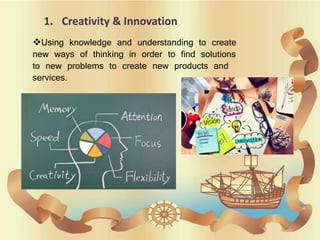
1. Creativity & Innovation
Using knowledge and understanding to create
new ways of thinking in order to find solutions
to new problems to create new products and
services.
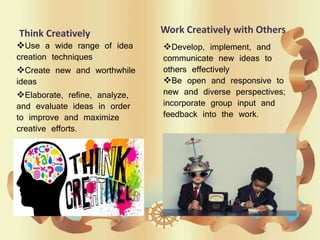
Think Creatively
Use a wide range of idea
creation techniques
Create new and worthwhile
ideas
Elaborate, refine, analyze,
and evaluate ideas in order
to improve and maximize
creative efforts.
Work Creatively with Others
Develop, implement, and
communicate new ideas to
others effectively
Be open and responsive to
new and diverse perspectives;
incorporate group input and
feedback into the work.
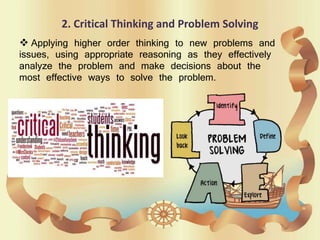
2. Critical Thinking and Problem Solving
 Applying higher order thinking to new problems and
issues, using appropriate reasoning as they effectively
analyze the problem and make decisions about the
most effective ways to solve the problem.
Reason Effectively
 Use various types of
reasoning (e.g., inductive,
deductive, etc.) as
appropriate to the situation.
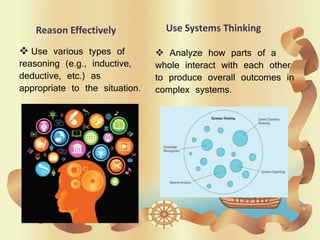
Use Systems Thinking
 Analyze how parts of a
whole interact with each other
to produce overall outcomes in
complex systems.
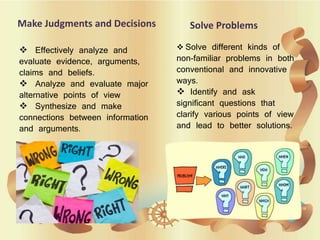
Make Judgments and Decisions
 Effectively analyze and
evaluate evidence, arguments,
claims and beliefs.
 Analyze and evaluate major
alternative points of view
 Synthesize and make
connections between information
and arguments.
Solve Problems
 Solve different kinds of
non-familiar problems in both
conventional and innovative
ways.
 Identify and ask
significant questions that
clarify various points of view
and lead to better solutions.
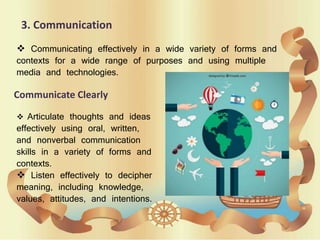
3. Communication
 Communicating effectively in a wide variety of forms and
contexts for a wide range of purposes and using multiple
media and technologies.
Communicate Clearly
 Articulate thoughts and ideas
effectively using oral, written,
and nonverbal communication
skills in a variety of forms and
contexts.
 Listen effectively to decipher
meaning, including knowledge,
values, attitudes, and intentions.
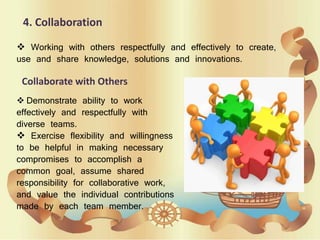
4. Collaboration
 Working with others respectfully and effectively to create,
use and share knowledge, solutions and innovations.
Collaborate with Others
 Demonstrate ability to work
effectively and respectfully with
diverse teams.
 Exercise flexibility and willingness
to be helpful in making necessary
compromises to accomplish a
common goal, assume shared
responsibility for collaborative work,
and value the individual contributions
made by each team member.
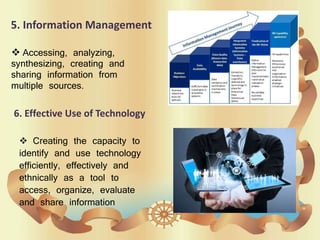
5. Information Management
 Accessing, analyzing,
synthesizing, creating and
sharing information from
multiple sources.
6. Effective Use of Technology
 Creating the capacity to
identify and use technology
efficiently, effectively and
ethnically as a tool to
access, organize, evaluate
and share information
7. Career and Life Skills
 Developing skills for becoming self-
directed, independent learners and
workers who can adapt to change,
manage projects, take responsibility for
their work, lead others and produce
results.
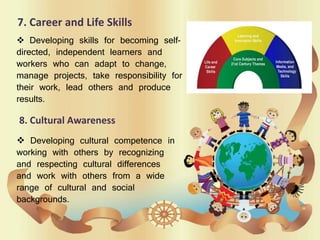
8. Cultural Awareness
 Developing cultural competence in
working with others by recognizing
and respecting cultural differences
and work with others from a wide
range of cultural and social
backgrounds.
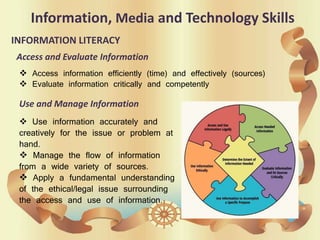
Information, Media and Technology Skills
INFORMATION LITERACY
Access and Evaluate Information
 Access information efficiently (time) and effectively (sources)
 Evaluate information critically and competently
Use and Manage Information
 Use information accurately and
creatively for the issue or problem at
hand.
 Manage the flow of information
from a wide variety of sources.
 Apply a fundamental understanding
of the ethical/legal issue surrounding
the access and use of information.
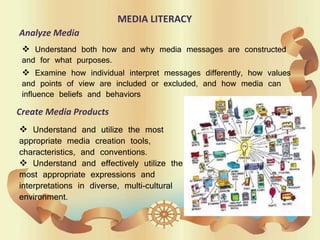
MEDIA LITERACY
Analyze Media
 Understand both how and why media messages are constructed
and for what purposes.
 Examine how individual interpret messages differently, how values
and points of view are included or excluded, and how media can
influence beliefs and behaviors
Create Media Products
 Understand and utilize the most
appropriate media creation tools,
characteristics, and conventions.
 Understand and effectively utilize the
most appropriate expressions and
interpretations in diverse, multi-cultural
environment.
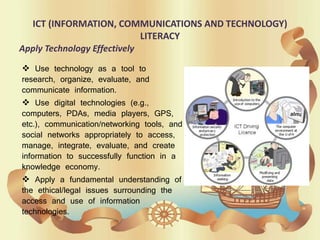
ICT (INFORMATION, COMMUNICATIONS AND TECHNOLOGY)
LITERACY
Apply Technology Effectively
 Use technology as a tool to
research, organize, evaluate, and
communicate information.
 Use digital technologies (e.g.,
computers, PDAs, media players, GPS,
etc.), communication/networking tools, and
social networks appropriately to access,
manage, integrate, evaluate, and create
information to successfully function in a
knowledge economy.
 Apply a fundamental understanding of
the ethical/legal issues surrounding the
access and use of information
technologies.
Integrating 21st Century Skills with Content
 Connecting the content knowledge to real-world applications and problem
situations.
 Emphasizing deep understanding of the learning by focusing on projects
and problems.
Helping students understand and monitor the thinking processes they are
using by including metacognitive activities.
 Using technology to help students access, analyze, organize and share
what they are learning.
 Providing opportunities for students to become ‘’creators as well as
consumers of published information”
 Engaging students in solving complex problems.
 Providing opportunities for students to work collaborative as they gather
information, solve problems, share ideas, and generate new ideas.
 Developing life and career skills for students to become self-directed
learners.
 Helping students make connections between subjects, concepts and
ideas and with others, including those outside of the classroom.
How Should Instruction Change to Prepare Students
for Success in the 21st Century?
Instruction that meets the needs of today’s students will
incorporate:
 A Variety of learning opportunities and activities,
 The use of appropriate technology tools to accomplish learning
goals,
 Project- and problem-based learning,
 Cross-curricular connections,
 A focus on inquiry and the students-led investigations,
 Collaborative learning environments, both within and beyond the
classroom
• High levels of visualization and the use of visuals to increase
understanding
• Frequent, formative assessments including the use of self-
assessment.
The 21st Century Teacher
Are acquired the following characteristics:
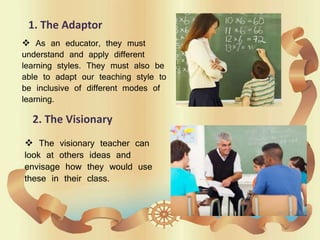
1. The Adaptor
 As an educator, they must
understand and apply different
learning styles. They must also be
able to adapt our teaching style to
be inclusive of different modes of
learning.
2. The Visionary
 The visionary teacher can
look at others ideas and
envisage how they would use
these in their class.
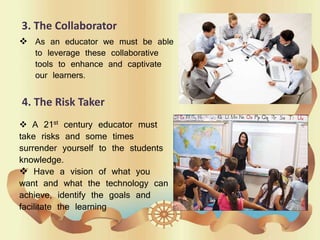
3. The Collaborator
 As an educator we must be able
to leverage these collaborative
tools to enhance and captivate
our learners.
4. The Risk Taker
 A 21st century educator must
take risks and some times
surrender yourself to the students
knowledge.
 Have a vision of what you
want and what the technology can
achieve, identify the goals and
facilitate the learning
5. The Learner
 We too must continue to absorb
new possibilities and experiences.
We must endeavor to stay current.
The 21st century educator must
learn and adapt.
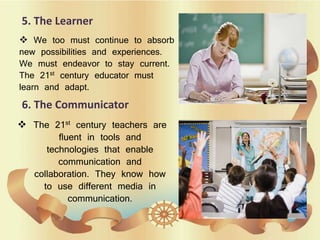
6. The Communicator
 The 21st century teachers are
fluent in tools and
technologies that enable
communication and
collaboration. They know how
to use different media in
communication.
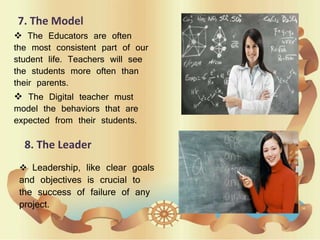
7. The Model
 The Educators are often
the most consistent part of our
student life. Teachers will see
the students more often than
their parents.
 The Digital teacher must
model the behaviors that are
expected from their students.
8. The Leader
 Leadership, like clear goals
and objectives is crucial to
the success of failure of any
project.
THANK YOU FOR
WATCHING!!
- Karen Shen G. Tauto-an 

The 21st-century-digital-learner

  • 1.
    The 21st CenturyDigital Learner By: Karen Shen Tauto-an 
  • 2.
    Introduction  The 21stcentury dawned as the beginning of the Digital Age – a time of unprecedented growth in technology and its subsequent information explosion. Never before have the tools for information access and management made such an impact on the way we live, work, shop, and play. Numerous studies and reports have emerged over the past decade that seek to identify the life, career, and learning skills that define the skills needed for success in the 21st century world.
  • 3.
    1. Creativity &Innovation Using knowledge and understanding to create new ways of thinking in order to find solutions to new problems to create new products and services.
  • 4.
    Think Creatively Use awide range of idea creation techniques Create new and worthwhile ideas Elaborate, refine, analyze, and evaluate ideas in order to improve and maximize creative efforts. Work Creatively with Others Develop, implement, and communicate new ideas to others effectively Be open and responsive to new and diverse perspectives; incorporate group input and feedback into the work.
  • 5.
    2. Critical Thinkingand Problem Solving  Applying higher order thinking to new problems and issues, using appropriate reasoning as they effectively analyze the problem and make decisions about the most effective ways to solve the problem.
  • 6.
    Reason Effectively  Usevarious types of reasoning (e.g., inductive, deductive, etc.) as appropriate to the situation. Use Systems Thinking  Analyze how parts of a whole interact with each other to produce overall outcomes in complex systems.
  • 7.
    Make Judgments andDecisions  Effectively analyze and evaluate evidence, arguments, claims and beliefs.  Analyze and evaluate major alternative points of view  Synthesize and make connections between information and arguments. Solve Problems  Solve different kinds of non-familiar problems in both conventional and innovative ways.  Identify and ask significant questions that clarify various points of view and lead to better solutions.
  • 8.
    3. Communication  Communicatingeffectively in a wide variety of forms and contexts for a wide range of purposes and using multiple media and technologies. Communicate Clearly  Articulate thoughts and ideas effectively using oral, written, and nonverbal communication skills in a variety of forms and contexts.  Listen effectively to decipher meaning, including knowledge, values, attitudes, and intentions.
  • 9.
    4. Collaboration  Workingwith others respectfully and effectively to create, use and share knowledge, solutions and innovations. Collaborate with Others  Demonstrate ability to work effectively and respectfully with diverse teams.  Exercise flexibility and willingness to be helpful in making necessary compromises to accomplish a common goal, assume shared responsibility for collaborative work, and value the individual contributions made by each team member.
  • 10.
    5. Information Management Accessing, analyzing, synthesizing, creating and sharing information from multiple sources. 6. Effective Use of Technology  Creating the capacity to identify and use technology efficiently, effectively and ethnically as a tool to access, organize, evaluate and share information
  • 11.
    7. Career andLife Skills  Developing skills for becoming self- directed, independent learners and workers who can adapt to change, manage projects, take responsibility for their work, lead others and produce results. 8. Cultural Awareness  Developing cultural competence in working with others by recognizing and respecting cultural differences and work with others from a wide range of cultural and social backgrounds.
  • 12.
    Information, Media andTechnology Skills INFORMATION LITERACY Access and Evaluate Information  Access information efficiently (time) and effectively (sources)  Evaluate information critically and competently Use and Manage Information  Use information accurately and creatively for the issue or problem at hand.  Manage the flow of information from a wide variety of sources.  Apply a fundamental understanding of the ethical/legal issue surrounding the access and use of information.
  • 13.
    MEDIA LITERACY Analyze Media Understand both how and why media messages are constructed and for what purposes.  Examine how individual interpret messages differently, how values and points of view are included or excluded, and how media can influence beliefs and behaviors Create Media Products  Understand and utilize the most appropriate media creation tools, characteristics, and conventions.  Understand and effectively utilize the most appropriate expressions and interpretations in diverse, multi-cultural environment.
  • 14.
    ICT (INFORMATION, COMMUNICATIONSAND TECHNOLOGY) LITERACY Apply Technology Effectively  Use technology as a tool to research, organize, evaluate, and communicate information.  Use digital technologies (e.g., computers, PDAs, media players, GPS, etc.), communication/networking tools, and social networks appropriately to access, manage, integrate, evaluate, and create information to successfully function in a knowledge economy.  Apply a fundamental understanding of the ethical/legal issues surrounding the access and use of information technologies.
  • 15.
    Integrating 21st CenturySkills with Content  Connecting the content knowledge to real-world applications and problem situations.  Emphasizing deep understanding of the learning by focusing on projects and problems. Helping students understand and monitor the thinking processes they are using by including metacognitive activities.  Using technology to help students access, analyze, organize and share what they are learning.  Providing opportunities for students to become ‘’creators as well as consumers of published information”  Engaging students in solving complex problems.  Providing opportunities for students to work collaborative as they gather information, solve problems, share ideas, and generate new ideas.  Developing life and career skills for students to become self-directed learners.  Helping students make connections between subjects, concepts and ideas and with others, including those outside of the classroom.
  • 16.
    How Should InstructionChange to Prepare Students for Success in the 21st Century? Instruction that meets the needs of today’s students will incorporate:  A Variety of learning opportunities and activities,  The use of appropriate technology tools to accomplish learning goals,  Project- and problem-based learning,  Cross-curricular connections,  A focus on inquiry and the students-led investigations,  Collaborative learning environments, both within and beyond the classroom • High levels of visualization and the use of visuals to increase understanding • Frequent, formative assessments including the use of self- assessment.
  • 17.
    The 21st CenturyTeacher Are acquired the following characteristics:
  • 18.
    1. The Adaptor As an educator, they must understand and apply different learning styles. They must also be able to adapt our teaching style to be inclusive of different modes of learning. 2. The Visionary  The visionary teacher can look at others ideas and envisage how they would use these in their class.
  • 19.
    3. The Collaborator As an educator we must be able to leverage these collaborative tools to enhance and captivate our learners. 4. The Risk Taker  A 21st century educator must take risks and some times surrender yourself to the students knowledge.  Have a vision of what you want and what the technology can achieve, identify the goals and facilitate the learning
  • 20.
    5. The Learner We too must continue to absorb new possibilities and experiences. We must endeavor to stay current. The 21st century educator must learn and adapt. 6. The Communicator  The 21st century teachers are fluent in tools and technologies that enable communication and collaboration. They know how to use different media in communication.
  • 21.
    7. The Model The Educators are often the most consistent part of our student life. Teachers will see the students more often than their parents.  The Digital teacher must model the behaviors that are expected from their students. 8. The Leader  Leadership, like clear goals and objectives is crucial to the success of failure of any project.
  • 22.
    THANK YOU FOR WATCHING!! -Karen Shen G. Tauto-an 