21ST CENTURY BUSINESS
   COMMUNICATION
21ST CENTURY BUSINESS COMMUNICATION


      Indiana Wesleyan University


                                      2
Introduction
21st Century Business Communication
 Communicating is vital to the progression of
 business and our ability to take progress to
 the next level. The channels we use to
 communicate are even more important. In
 the 21st Century, employers rely on people
 with exceptional and savvy communication
 skills. They want people with the ability to
 communicate worldwide utilizing innovative
 communication channels.
                                                3
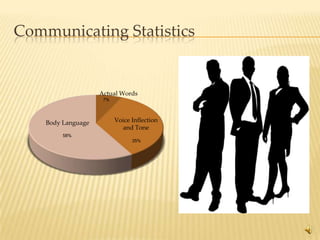
Communicating Statistics


                    Actual Words
                     7%


    Body Language         Voice Inflection
                            and Tone
         58%
                                35%


                                             4
Communication Skills
Why you need strong
 communication skills?
     vital to exchange information
     important for clear and accurate
      delivered messages
     important for securing and
      maintaining employment
     important for career advancement
     critical for team building


                                         5
Team Environment Communication

Strong team communication skills can
facilitate an environment that:
• harvest team resources
• capitalize on global opportunities
• collaboratively and freely share information
• take advantage of virtual teams both locally or globally
• utilize innovative communication channels


                                                             6
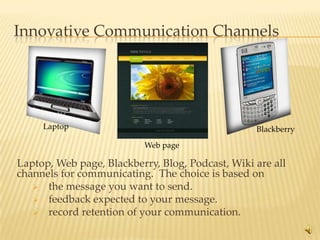
Innovative Communication Channels


     Laptop                                       Blackberry

                           Web page

Laptop, Web page, Blackberry, Blog, Podcast, Wiki are all
channels for communicating. The choice is based on
    the message you want to send.
    feedback expected to your message.
    record retention of your communication.

                                                               7
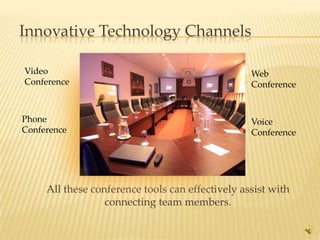
Innovative Technology Channels

Video                                             Web
Conference                                        Conference


Phone                                             Voice
Conference                                        Conference


     All these conference tools can effectively assist with
                  connecting team members.

                                                               8
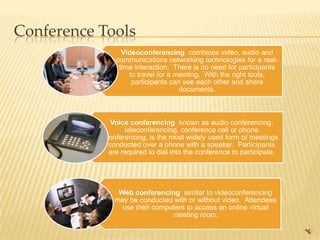
Conference Tools
                Videoconferencing combines video, audio and
              communications networking technologies for a real-
               time interaction. There is no need for participants
                  to travel for a meeting. With the right tools,
                   participants can see each other and share
                                   documents.


             Voice conferencing known as audio conferencing,
                 teleconferencing, conference call or phone
           conferencing, is the most widely used form of meetings
            conducted over a phone with a speaker. Participants
            are required to dial into the conference to participate.


               Web conferencing similar to videoconferencing
              may be conducted with or without video. Attendees
                use their computers to access an online virtual
                               meeting room.

                                                                       9
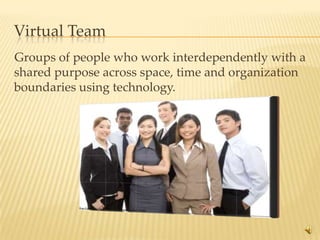
Virtual Team
Groups of people who work interdependently with a
shared purpose across space, time and organization
boundaries using technology.


                                                 10
Develop Listening Skills
   communication channels deliver unclear messages
   team members unable to understand your language well.
   team member not able to express or interpret word
    meanings


                                                            11
Developing Listen Skills
   stop and listen
   work hard at listening
   block out competing thoughts
   control the listening environment
   maintain an open mind
   paraphrase the speaker’s ideas
   listen between the lines
   distinguish between facts and opinions
   capitalize on lag time
   use memory devices
   take selective notes
                                             12
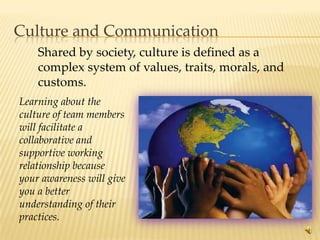
Culture and Communication
    Shared by society, culture is defined as a
    complex system of values, traits, morals, and
    customs.
Learning about the
culture of team members
will facilitate a
collaborative and
supportive working
relationship because
your awareness will give
you a better
understanding of their
practices.
                                                    13
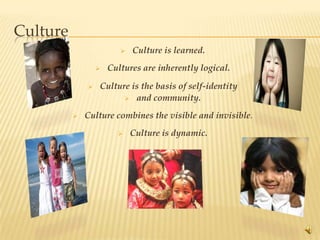
Culture
                            Culture is learned.
                     Cultures are inherently logical.

                 Culture is the basis of self-identity
                         and community.

             Culture combines the visible and invisible.
                            Culture is dynamic.


                                                            14
Diversity


               seek training

               understand the value
                of differences

               don’t expect
                conformity


                                       15
Diversity, continued

   learn about your
    cultural self

   make fewer
    assumptions

   build on
    similarities


                       16
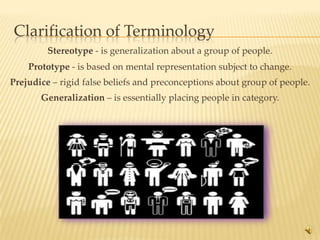
Clarification of Terminology
         Stereotype - is generalization about a group of people.
    Prototype - is based on mental representation subject to change.
Prejudice – rigid false beliefs and preconceptions about group of people.
       Generalization – is essentially placing people in category.


                                                                       17
Written Communications
 Deliver quality messages that are legal and
 ethical.
   Special attention:
     investment

     safety

     marketing

     human  resources
     copyright laws


                                               18
Writing a Sophisticated Process
    Prewriting:
                   Analyze
                   Anticipate
                   Adapt
    Writing:
                   Research
                   Organize
                   Compose
    Revising:
                   Revise
                   Proofread
                   Evaluate

                                  19
Constructing Written Communications

  Letter or Memo
     I. Opening
    II. Body
   III. Closing


  Analytical Report
     I.   Introduction/Problem
    II.   Facts/findings
   III.   Conclusion
   IV.    Recommendations (if required)


                                          20
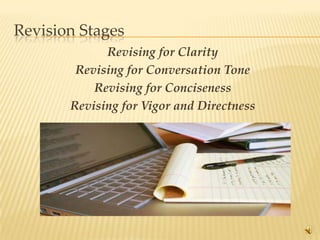
Revision Stages
             Revising for Clarity
        Revising for Conversation Tone
           Revising for Conciseness
       Revising for Vigor and Directness


                                           21
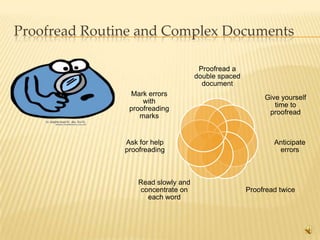
Proofread Routine and Complex Documents

                                      Proofread a
                                     double spaced
                                       document
                Mark errors
                                                          Give yourself
                    with
                                                             time to
                proofreading
                                                           proofread
                   marks


               Ask for help                                  Anticipate
               proofreading                                   errors


                   Read slowly and
                   concentrate on                    Proofread twice
                     each word


                                                                       22
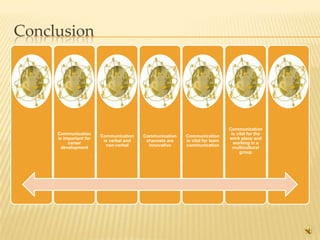
Conclusion


                                                                             Communication
     Communication                                                            is vital for the
                        Communication    Communication   Communication
     is important for                                                        work place and
                         is verbal and    channels are   is vital for team
          career                                                               working in a
                          non-verbal       innovative    communication
       development                                                             multicultural
                                                                                   group


                                                                                                 23
21ST CENTURY BUSINESS COMMUNICATION


               Q&A


                                  24
END


      25
References
Guffey, M. (2008). Business communication: Process and product (6

   th   ed.). Mason, OH. South-Western Cengage Leaning

 Schaefer, R. (2010). Effective Communication in the work place,

   Retrieved on September 4, 2010, from

   http://ezinearticles.com/?Effective-Communication-in-the-

   Workplace&id=4017537


                                                                    26

21st century business communication presentation

  • 1.
  • 2.
    21ST CENTURY BUSINESSCOMMUNICATION Indiana Wesleyan University 2
  • 3.
    Introduction 21st Century BusinessCommunication Communicating is vital to the progression of business and our ability to take progress to the next level. The channels we use to communicate are even more important. In the 21st Century, employers rely on people with exceptional and savvy communication skills. They want people with the ability to communicate worldwide utilizing innovative communication channels. 3
  • 4.
    Communicating Statistics Actual Words 7% Body Language Voice Inflection and Tone 58% 35% 4
  • 5.
    Communication Skills Why youneed strong communication skills?  vital to exchange information  important for clear and accurate delivered messages  important for securing and maintaining employment  important for career advancement  critical for team building 5
  • 6.
    Team Environment Communication Strongteam communication skills can facilitate an environment that: • harvest team resources • capitalize on global opportunities • collaboratively and freely share information • take advantage of virtual teams both locally or globally • utilize innovative communication channels 6
  • 7.
    Innovative Communication Channels Laptop Blackberry Web page Laptop, Web page, Blackberry, Blog, Podcast, Wiki are all channels for communicating. The choice is based on  the message you want to send.  feedback expected to your message.  record retention of your communication. 7
  • 8.
    Innovative Technology Channels Video Web Conference Conference Phone Voice Conference Conference All these conference tools can effectively assist with connecting team members. 8
  • 9.
    Conference Tools Videoconferencing combines video, audio and communications networking technologies for a real- time interaction. There is no need for participants to travel for a meeting. With the right tools, participants can see each other and share documents. Voice conferencing known as audio conferencing, teleconferencing, conference call or phone conferencing, is the most widely used form of meetings conducted over a phone with a speaker. Participants are required to dial into the conference to participate. Web conferencing similar to videoconferencing may be conducted with or without video. Attendees use their computers to access an online virtual meeting room. 9
  • 10.
    Virtual Team Groups ofpeople who work interdependently with a shared purpose across space, time and organization boundaries using technology. 10
  • 11.
    Develop Listening Skills  communication channels deliver unclear messages  team members unable to understand your language well.  team member not able to express or interpret word meanings 11
  • 12.
    Developing Listen Skills  stop and listen  work hard at listening  block out competing thoughts  control the listening environment  maintain an open mind  paraphrase the speaker’s ideas  listen between the lines  distinguish between facts and opinions  capitalize on lag time  use memory devices  take selective notes 12
  • 13.
    Culture and Communication Shared by society, culture is defined as a complex system of values, traits, morals, and customs. Learning about the culture of team members will facilitate a collaborative and supportive working relationship because your awareness will give you a better understanding of their practices. 13
  • 14.
    Culture  Culture is learned.  Cultures are inherently logical.  Culture is the basis of self-identity  and community.  Culture combines the visible and invisible.  Culture is dynamic. 14
  • 15.
    Diversity  seek training  understand the value of differences  don’t expect conformity 15
  • 16.
    Diversity, continued  learn about your cultural self  make fewer assumptions  build on similarities 16
  • 17.
    Clarification of Terminology Stereotype - is generalization about a group of people. Prototype - is based on mental representation subject to change. Prejudice – rigid false beliefs and preconceptions about group of people. Generalization – is essentially placing people in category. 17
  • 18.
    Written Communications Deliverquality messages that are legal and ethical. Special attention:  investment  safety  marketing  human resources  copyright laws 18
  • 19.
    Writing a SophisticatedProcess Prewriting:  Analyze  Anticipate  Adapt Writing:  Research  Organize  Compose Revising:  Revise  Proofread  Evaluate 19
  • 20.
    Constructing Written Communications Letter or Memo I. Opening II. Body III. Closing Analytical Report I. Introduction/Problem II. Facts/findings III. Conclusion IV. Recommendations (if required) 20
  • 21.
    Revision Stages Revising for Clarity Revising for Conversation Tone Revising for Conciseness Revising for Vigor and Directness 21
  • 22.
    Proofread Routine andComplex Documents Proofread a double spaced document Mark errors Give yourself with time to proofreading proofread marks Ask for help Anticipate proofreading errors Read slowly and concentrate on Proofread twice each word 22
  • 23.
    Conclusion Communication Communication is vital for the Communication Communication Communication is important for work place and is verbal and channels are is vital for team career working in a non-verbal innovative communication development multicultural group 23
  • 24.
    21ST CENTURY BUSINESSCOMMUNICATION Q&A 24
  • 25.
    END 25
  • 26.
    References Guffey, M. (2008).Business communication: Process and product (6 th ed.). Mason, OH. South-Western Cengage Leaning Schaefer, R. (2010). Effective Communication in the work place, Retrieved on September 4, 2010, from http://ezinearticles.com/?Effective-Communication-in-the- Workplace&id=4017537 26

Editor's Notes

  • #2 Greet audience ~Greeting everyone and welcome to our presentation today entitled 21st Century Business Communication.
  • #3 Introduce team members ~Our team consists of Leslie Hagan-Morgan, Shani Hotchkiss, and Shirley Watts.
  • #4 Give title of presentation and an overview of the introduction: Communicating verbally, in writing and through non-verbal body language is central to how we interact with others. Channels tocommunicate our messages are important for the delivery of a clear and accurate message to the receiver. In the 21st Century, employers are searching for people with strong communication skills. They need people that can communicate on all levels, with diverse groups of people and with various communication channels and tools. Virtual teams will not only need communication skills; they must have excellent listening skills and well developed writing skills.
  • #5 What is considered communicating? Communicating is transmitting information verbally, written, through non-verbal body language and sign-language. How do we communicate?Statistics presented by Dr. Rick Schaefer in an article entitled Effective Communication in the Work Place shows that:58% of our communication is in our body language35% is in our voice inflection and tone, and7% is our actual words _____________________________________________________________________________________________________________ Schaefer, R. (2010). Effective Communication in the work place, Retrieved on September 4, 2010, from http://ezinearticles.com/?Effective-Communication-in-the-Workplace&id=4017537
  • #6 Ask question: Why do we need strong communication skills to trigger audience to think ~Strong communication skills are vital and very important for exchanging information.Examples of who we communicate with in the work environment ~Not only are strong communication skills important for securing employment it is important for mainlining productive employment.Internally in the work place communication is between:you and you direct manager or subordinatesyou and colleagues Externally communication is usually betweenyou and vendors, clients, and customersand these skills are very important in a team environment especially amongst virtual team members For communication to be understood and perceived correctly between the two, sender and receiver, the communication must be delivered clearly and accurately.
  • #7 Strong communication skills are even more important for developing a team both internally and externally.Today, managers are seeking team members with communications skills that they can assign to projects, committees and steering groups. In other words, managers are seeking employees with strong communication savvy; with the ability to utilize innovative channels, and employees they can pool together maximizingminimum resources to accomplish their goals.Virtual teams as an example are pooled resources. People within a virtual team can be from any place in the world grouped together to work on one task.
  • #8 To maximize resources in team environment, communication channels are needed to connect people with each other both internally and externally, lets review technical resources for delivering effective communication. Some of the innovative communication channels we have access to in the 21st century include:laptopweb pageBlackberryBlog Your choice will depend on the expected message, feedback and retention of the communication.
  • #9 Communication channels in the 21st include are even more state-of-the-art and include innovative tools such as:Videoconferencing, Phone Conference, Web Conference and Voice Conference are all innovative technology communication tools used today to collaborate with team members, business partners, vendors and customers.  
  • #10 Elaborate more on each technical communication channels for clarification because everyone is not as familiarly with these channels: Videoconferencing combines video, audio and communications networking technologies for a real-time interaction.Voice conference known as audio conferencing, teleconferencing, conference call or phone conferencing is conducted over a phone with speakers.Web conferencing is similar to videoconferencing and may be conducted with or without video (Guffey, p. 48)All the these innovative communication channels will prove to be very beneficial to a virtual team where there is no face-to-face communication between team members.______________________________________________________________________________________Guffey, M. J. (2008). Business communication: Process and product (6 th ed.). Mason, OH:   South-Western Cengage Leaning
  • #11 For virtual teams to be effective, efficient, and a benefit for management, they must work well as a unit. Also they must utilizeinnovative communication channels to work collaboratively together.Virtual teams as a fact will go through non-productive stages, but the utilization of effective communication channels can assist with improving communication in each stage.Stage 1 – team members are at a disadvantage because they cannot see each other, they are not face-to-face. Video Conference can help support the process of developing trust between team members.Stage 2 – team members feel as though they are going through a storm trying to iron out the roles each members play. For this stage, the simplest form or communication is the best; email, chat, and instant messaging.Stage 3 – team members start to see everything fall in place. Communication is provided openly; everyone is ready and willing to share information. Voice conference is the communication channel to keep project progressing and eliminate misunderstandings.Although communication can transpire with the proper use of innovative technical channels, a virtual team will not truly develop into a team that collaborates effectively if listening skills are not developed.
  • #12 In conjunction with utilizing communication channels, it is also important to develop excellent listening habits and skills to understand what is required of us in the workplace. What develop listen skills~Communicating via conference tools, email, chat, and other communication channels could result in unclear messages.Team members may not speak your language well.Team member unsure of how to explain their topic  Guffey, author of Business Communication, suggests we should improve our listening skills. She further maintains that following these next eleven steps can help to improve our workplace listening skills.Move on to next slide for steps~_____________________________________________________________________________________________________________Guffey, M. J. (2008). Business communication: Process and product (6 th ed.). Mason, OH:   South-Western Cengage Leaning 
  • #13 How are listening skills developed? And how to get excellent listening skills ~ 1. Stop. Accept the role of listener by concentrating on the speaker’s words, not on what your response will be.2. Work hard at listening. Become actively involved; expect to learn something.3. Block out competing thoughts. Concentrate on the message. Don’t allow yourself to daydream during lag time.4. Control the listening environment. Move to a quiet area where you won’t be interrupted by telephone calls or visitors. Checkto be certain that listeners can her speakers.5. Maintain an open mind. Know your biases and try to correct for them. Be tolerant of less-abled and different-lookingspeakers. Provide verbal and nonverbal feedback. Encourage the speaker with comments such as, “Yes,” “ I see,” “OK,” and “Uhhuh,” and ask polite questions. Look alert by learning forward.6. Paraphrase the speaker’s ideas. Silently repeat the message in your own words, sort out the main points, and identify supporting details. In conversation sum up the main points to confirm what was said.7. Listen between the lines. Observe nonverbal clues and interpret the feelings of the speaker: What is really being said?8. Distinguish between facts and opinions. Know the difference between factual statements and opinions stated as assertions.9. Capitalize on lag time. Use spare moments to organize, review, anticipate, challenge, and weigh the evidence.10. Use memory devices. If the information is important, develop acronyms, links, or rhymes to help you remember.11. Take selective notes. If you are hearing instructions or important data, record the major points; then, revise your notes immediately or verify them with the speaker(p. 52).Well developed listening skills will heighten your awareness of your virtual team member’s environment and promote your ability tocommunicate with team members from different parts of the world and of different cultural backgrounds.______________________________________________________________________________________Guffey, M. J. (2008). Business communication: Process and product (6 th ed.). Mason, OH:   South-Western Cengage Leaning
  • #14 Share the definition of culture from the above slide with the audience~Developed listening skills enhance our communication skills, and enable us to communicate and work with people from different cultures. An example of why we must learn to skillfully listen to others:Companies that were once located only in the United States now have branches located in different parts of the world. For example McDonald’s and Starbucks are now located in almost every corner of the world. This further emphasizes why we must review our culture awareness, and our method of communication with people we perceive as different.Share the definition of culture from the above slide with the audience as you move to the next slide~ 
  • #15  Guffey, author of Business Communication: Process and Product, further provides this list of inherent characteristics of a culture to enhance our knowledge: Culture is learned. You are not borne with knowledge of a certain culture. It is learned through rules, values and attitudes passed down from generation to generation.Cultures are inherently logical. They are formed from deep seated beliefs and serve to normalize those beliefs.Culture is the basis of self-identity and community. We make choices through our lives based on our culture even down to eating certain types of food during holidays. All of this serves to express our self-identity.Culture combines the visible and invisible. In most cases it is easily identifiable the culture of some people by the way they interact with others, what they are wearing, or how they perform a certain function. Although visible, they carry with them an invisible meaning that is important in that particular cultureCulture is dynamic. Culture is ever changing and could be brought on by new technology, migration, natural disasters, and wars (p. 73). Culture awareness will assist with helping team members understand their biases about other team members and serve to promote peak performance amongst team members.______________________________________________________________________________________Guffey, M. (2008). Business communication: Process and product (6 th ed.). Mason, OH:   South-Western Cengage Leaning 
  • #16 As underdeveloped culture awareness can affect our ability to perform well as a team so can misunderstanding of diversity.Diversity has many dimensions – race, ethnicity, age, religion, gender, national origin, physical ability and countless other qualities (Guffey p. 89).The goal is to communicate effectively which means increasing our culture and diversity awareness. Organizations seeking to improve diversity in their workplace should follow these steps:Seek training – if there are issues around diversity.Understand the value of differences – all ideas and opinions will not be the same and it is not meant to be.Don’t expect conformity - learn to listen to new stories don’t expect to hear the same old plan over and over again, welcome change (p. 92).______________________________________________________________________________________Guffey, M. (2008). Business communication: Process and product (6 th ed.). Mason, OH:   South-Western Cengage Leaning 
  • #17 Learn about your cultural self - don’t forget you are a product of your culture; reflex on yourself, is your way of thinking always the best.Make fewer assumptions – avoid making assumption about other’s beliefs; don’t assume everyone in your office celebrates Christmas or everyone in your office is married.Build on similarities - be open and look for shared opinions, but also accept that you will not agree on everything (p. 92)______________________________________________________________________________________Guffey, M. (2008). Business communication: Process and product (6 th ed.). Mason, OH:   South-Western Cengage Leaning
  • #18 While diversity is steadily improving in the work environment, there is still dissention and potential for stereotyping, prototyping, and generalizations all of which usually lead to prejudices in one form or another.It is important to speak on the topics of culture, diversity, stereotypes, prototypes, prejudices, and generalizations because we need to understand the differences and become aware of our feelings and style of communicating with people we perceived as different.
  • #19 In our best efforts to communicate with others minus the stereotypes, prototypes, prejudices and generalizations, we must also keep in mind our obligation to deliver quality messages that are legally sound and ethically represented in the workplace. Special attention should be placed around communications involving:investmentssafetymarketinghuman resourcesand copyright lawsCaution should be placed on the way our communications about these items are structured and presented to our audience.We want to ensure that we – never give out misleading informationexaggeratetell half-truthsomit important information, such as safety warningsbe honestavoid oral promises that can result in lawsuits (p. 23-24).We also want to utilize a business writing process to construct these communications to convey our message clearly and accurately._____________________________________________________________________________________________________________Guffey, M. (2008). Business communication: Process and product (6 th ed.). Mason, OH:   South-Western Cengage Leaning
  • #20 Once you understand your legal and ethical responsibility;and have an idea of the message you want to communicate to your intended audience it is time to start the writing process.The writing process is divided into three distinct phases called The 3-x-3 Writing Process described as prewriting, writing and revision. The 3-x-3 described process (prewriting, writing and revision) are further divided into three more major activities. Prewriting:Analyze – determine what the message is about. What are you trying to get the receiver to understand.Anticipate – who is your targeted audience, what do they already know, and how will they receive your message. Adapt – what style of writing will appeal to your audience.Writing:Research – do your background check. What is needed to write your communication.Organize – group information together and decide to organize directly or indirectly.Compose – draft your first communication.Revising:Revise – make necessary changes to your initial draft.Proofread- carefully read through you for error and make corrections.Evaluate – is this the message you want to convey. Utilize this writing process to compose communications that are clear, precise and easily understood.The phases are designed to simplify the writing process by providing us with a systematic plan for developing business communications (p. 102). _____________________________________________________________________________________________________________Guffey, M. (2008). Business communication: Process and product (6 th ed.). Mason, OH:   South-Western Cengage Leaning 
  • #21 To further develop well constructed communications we should follow the components in the business writing process as demonstrated on the slide for letters, memos, and analytical reports.The channel for communicating with our targeted audience to avoid misunderstanding and potential lawsuits is through a well constructed written message or document; not only will it later serve as reference but it could potentially protect you if needed in a legal situation.Refer audience to the slide above~As you can see, how ideas are grouped into components depends on the topic, and the channel for communicating your topic will depend on the component used to structure your communication.It is safe to say a letter or memo could utilize an email channel, whereas an analytical report could post on a channel such as a web page. 
  • #22 The final stage of the 3-x-3 writing process is probably the most important; revision. To produce quality written communications, drafters should review the stages of revising a document and follow these guidelines:Revising for Clarity – is the message clear and immediately understandableRevising for Conversation Tone – sound professional by friendlyRevising for Conciseness – are you making your point in the first few wordsRevising for Vigor and Directness - don’t bore your audience; keep the wordiness to a minimum (p. 149-153)._____________________________________________________________________________________________Guffey, M. (2008). Business communication: Process and product (6 th ed.). Mason, OH:   South-Western Cengage Leaning 
  • #23 After following through on the stages of drafting and revising our message, document or communication, we will need to proofread. Proofreading is important and it is especially important for documents that are detailed and lengthy.Proofreading a revised document that may be complex, long and detailed can be daunting requiring special attention to ensure no slip-up in communication. Briefly review the each steps from slide with audience.Proofread a double spaced documentGive yourself time to proofreadAnticipate errorsProofread twiceRead slowly and concentrate on each wordAsk for help proofreadingMark errors with proofreading marks (p. 159).______________________________________________________________________________________Guffey, M. (2008). Business communication: Process and product (6 th ed.). Mason, OH:   South-Western Cengage Leaning
  • #24 Conclusion:We live in a globally, multicultural environment that is constantly changing. Knowing how to communicate in this environment is essential and empowering for your career development. Understand the channels for communicating, learn to listen well, and learn to communicate your thoughts both verbally and written will prove to benefit you, your place of employment, and the world.
  • #25 Give audience a chance to ask questions.Have these questions available if needed:Why You Need strong Communication Skills?What are considered innovative communication channels?What are example of ways to develop listening skills?What is the 3x3 Writing process?
  • #26 Thank audience for attending.
  • #27 Reference Page