Security and Trust Software Architecture Lecture 21
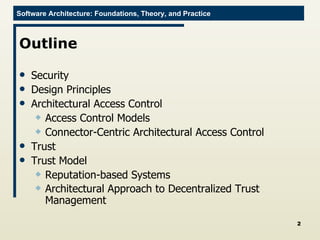
Outline Security Design Principles Architectural Access Control Access Control Models Connector-Centric Architectural Access Control Trust Trust Model Reputation-based Systems Architectural Approach to Decentralized Trust Management
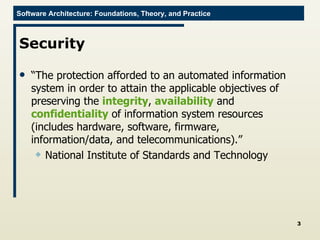
Security “ The protection afforded to an automated information system in order to attain the applicable objectives of preserving the  integrity ,  availability  and  confidentiality  of information system resources (includes hardware, software, firmware, information/data, and telecommunications).”  National Institute of Standards and Technology
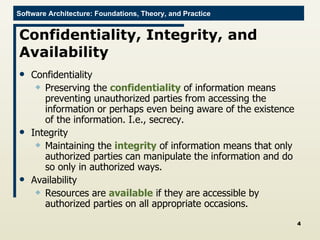
Confidentiality, Integrity, and Availability  Confidentiality Preserving the  confidentiality  of information means preventing unauthorized parties from accessing the information or perhaps even being aware of the existence of the information. I.e., secrecy. Integrity Maintaining the  integrity  of information means that only authorized parties can manipulate the information and do so only in authorized ways. Availability Resources are  available  if they are accessible by authorized parties on all appropriate occasions.
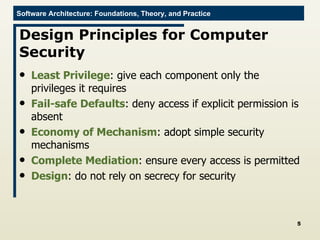
Design Principles for Computer Security Least Privilege : give each component only the privileges it requires Fail-safe Defaults : deny access if explicit permission is absent Economy of Mechanism : adopt simple security mechanisms Complete Mediation : ensure every access is permitted Design : do not rely on secrecy for security
Design Principles for Computer Security (cont’d) Separation of Privilege : introduce multiple parties to avoid exploitation of privileges Least Common Mechanism : limit critical resource sharing to only a few mechanisms Psychological Acceptability : make security mechanisms usable Defense in Depth : have multiple layers of countermeasures
Security for Microsoft IIS --from [Wing, 2003]
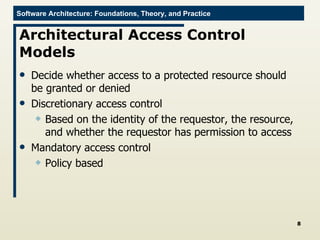
Architectural Access Control Models Decide whether access to a protected resource should be granted or denied Discretionary access control Based on the identity of the requestor, the resource, and whether the requestor has permission to access Mandatory access control Policy based
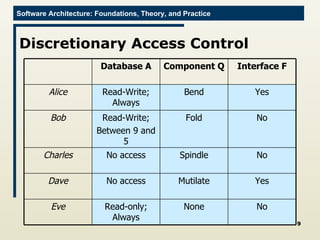
Discretionary Access Control Database A Component Q Interface F Alice Read-Write; Always Bend Yes Bob Read-Write; Between 9 and 5 Fold No Charles No access Spindle No Dave No access Mutilate Yes Eve Read-only; Always None No
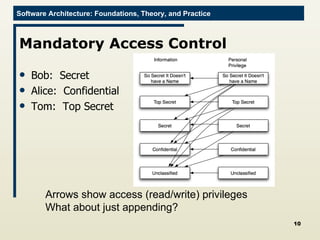
Mandatory Access Control Bob:  Secret Alice:  Confidential Tom:  Top Secret Arrows show access (read/write) privileges What about just appending?
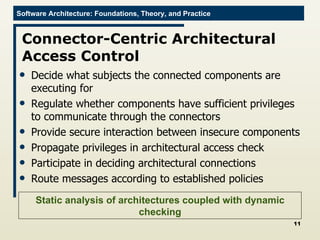
Connector-Centric Architectural Access Control Decide what subjects the connected components are executing for Regulate whether components have sufficient privileges to communicate through the connectors Provide secure interaction between insecure components Propagate privileges in architectural access check Participate in deciding architectural connections Route messages according to established policies Static analysis of architectures coupled with dynamic checking
Decentralization No centralized authority to coordinate and control entities Independent peers, with possibly conflicting goals, interact with each other and make local autonomous decisions Presence of malicious peers in open decentralized applications Need for measures to protect peers against malicious attacks
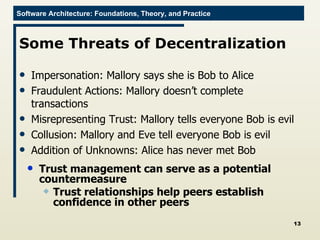
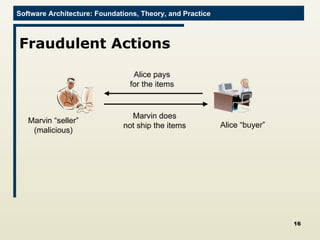
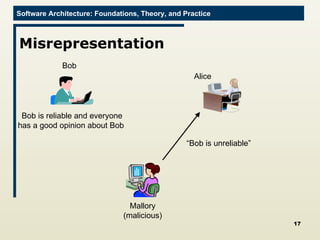
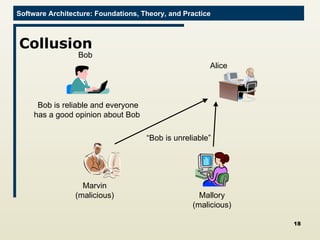
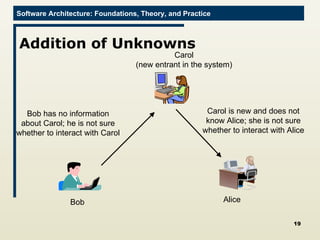
Some Threats of Decentralization Impersonation: Mallory says she is Bob to Alice Fraudulent Actions: Mallory doesn’t complete transactions Misrepresenting Trust: Mallory tells everyone Bob is evil Collusion: Mallory and Eve tell everyone Bob is evil Addition of Unknowns: Alice has never met Bob Trust management can serve as a potential countermeasure Trust relationships help peers establish confidence in other peers
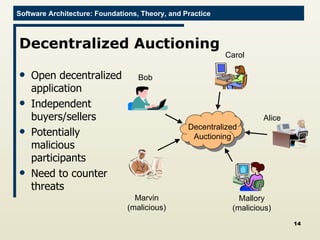
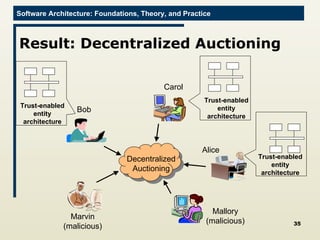
Decentralized Auctioning Open decentralized application Independent buyers/sellers Potentially malicious participants Need to counter threats Marvin (malicious) Carol Bob Alice Mallory (malicious) Decentralized Auctioning
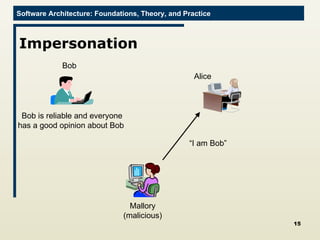
Impersonation Bob Alice Mallory (malicious) “ I am Bob” Bob is reliable and everyone has a good opinion about Bob
Fraudulent Actions Alice “buyer” Alice pays for the items Marvin “seller” (malicious) Marvin does not ship the items
Misrepresentation Bob Alice Mallory (malicious) “ Bob is unreliable” Bob is reliable and everyone has a good opinion about Bob
Collusion Bob Alice Mallory (malicious) “ Bob is unreliable” Bob is reliable and everyone has a good opinion about Bob  Marvin (malicious)
Addition of Unknowns Carol (new entrant in the system) Bob Alice Bob has no information about Carol; he is not sure whether to interact with Carol Carol is new and does not know Alice; she is not sure whether to interact with Alice
Background: Trust Management Trust Trust is a particular level of the subjective probability with which an agent assesses that another agent will perform a particular action in a context that affects his actions [Gambetta, 1990] Reputation Expectation about an entity’s behavior based on past behavior [Abdul-Rahman, 2000] May be used to determine trust Two types of trust management systems Credential and Policy-based Reputation-based
Role of Trust Management Each entity (peer) must protect itself against these threats Trust Management can serve as a potential countermeasure Trust relationships between peers help establish confidence Two types of decentralized trust management systems Credential and policy-based Reputation-based
Architecture and Trust Management Decentralized trust management has received a lot of attention from researchers [Grandison and Sloman, 2000] Primary focus has been on developing new models But how does one build a trust-enabled decentralized application? How do I pick a trust model for a given application? And, how do I incorporate the trust model within each entity?
Approach Select a suitable reputation-based trust model for a given application Describe this trust model precisely Incorporate the model within the structure (architecture) of an entity Software architectural style for trust management (PACE) Result – entity architecture consisting of  components that encapsulate the trust model additional trust technologies to counter threats
Key Insights Trust Cannot be isolated to one component Is a dominant concern in decentralized applications and should be considered early on during application development Having an explicit architecture is one way to consistently address the cross-cutting concern of trust  Architectural styles  Provide a foundation to reason about specific goals Facilitate reuse of design knowledge Allow known benefits to be leveraged and induce desirable properties
Design Guidelines: Approach Identify threats of decentralization Use the threats to identify guiding principles that help defend against the threats Incorporate these principles within an architectural style focused on decentralized trust management
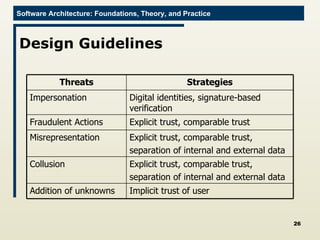
Design Guidelines Threats Strategies Impersonation Digital identities, signature-based verification Fraudulent Actions Explicit trust, comparable trust Misrepresentation Explicit trust, comparable trust, separation of internal and external data Collusion Explicit trust, comparable trust, separation of internal and external data Addition of unknowns Implicit trust of user
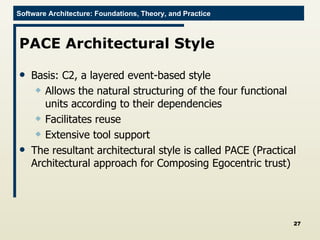
PACE Architectural Style Basis: C2, a layered event-based style Allows the natural structuring of the four functional units according to their dependencies Facilitates reuse  Extensive tool support The resultant architectural style is called PACE (Practical Architectural approach for Composing Egocentric trust)
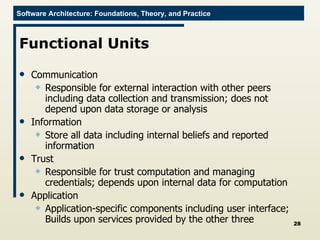
Functional Units Communication Responsible for external interaction with other peers including data collection and transmission; does not depend upon data storage or analysis Information Store all data including internal beliefs and reported information Trust Responsible for trust computation and managing credentials; depends upon internal data for computation Application Application-specific components including user interface; Builds upon services provided by the other three
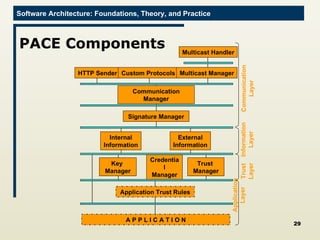
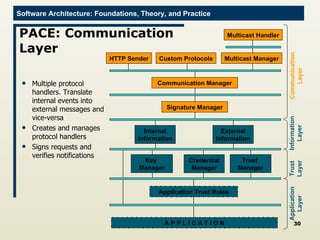
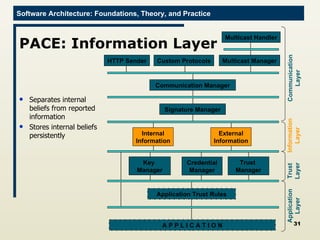
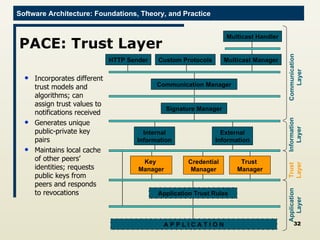
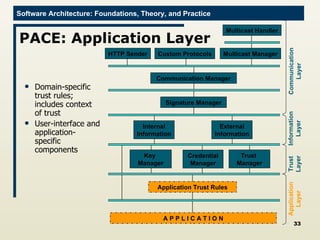
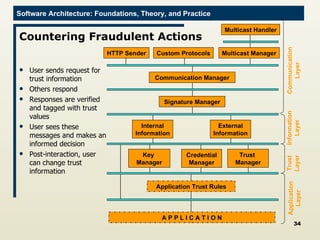
PACE Components Application Layer Communication Layer Information Layer Trust Layer Communication Manager External Information Internal Information Key  Manager Signature Manager  Trust  Manager Application Trust Rules HTTP Sender Custom Protocols Multicast Manager Multicast Handler Credential Manager A P P L I C A T I O N
PACE: Communication  Layer Multiple protocol handlers. Translate internal events into external messages and vice-versa Creates and manages protocol handlers Signs requests and verifies notifications Communication Layer Information Layer Trust Layer Application Layer Communication Manager External Information Internal Information Key  Manager Signature Manager  Trust  Manager Application Trust Rules HTTP Sender Custom Protocols Multicast Manager Multicast Handler Credential Manager A P P L I C A T I O N
PACE: Information Layer Separates internal beliefs from reported information Stores internal beliefs persistently Communication Layer Information Layer Trust Layer Application Layer Communication Manager External Information Internal Information Key  Manager Signature Manager  Trust  Manager Application Trust Rules HTTP Sender Custom Protocols Multicast Manager Multicast Handler Credential Manager A P P L I C A T I O N
PACE: Trust Layer Incorporates different trust models and algorithms; can assign trust values to notifications received Generates unique public-private key pairs Maintains local cache of other peers’ identities; requests public keys from peers and responds to revocations Communication Layer Information Layer Trust Layer Application Layer Communication Manager External Information Internal Information Key  Manager Signature Manager  Trust  Manager Application Trust Rules HTTP Sender Custom Protocols Multicast Manager Multicast Handler Credential Manager A P P L I C A T I O N
PACE: Application Layer Domain-specific trust rules; includes context of trust User-interface and application-specific components Communication Layer Information Layer Trust Layer Application Layer Communication Manager External Information Internal Information Key  Manager Signature Manager  Trust  Manager Application Trust Rules HTTP Sender Custom Protocols Multicast Manager Multicast Handler Credential Manager A P P L I C A T I O N
Countering Fraudulent Actions User sends request for trust information Others respond  Responses are verified and tagged with trust values  User sees these messages and makes an informed decision Post-interaction, user can change trust information Communication Layer Information Layer Trust Layer Application Layer Communication Manager External Information Internal Information Key  Manager Signature Manager  Trust  Manager Application Trust Rules HTTP Sender Custom Protocols Multicast Manager Multicast Handler Credential Manager A P P L I C A T I O N
Result: Decentralized Auctioning Carol Bob Alice Marvin (malicious) Mallory (malicious) Decentralized Auctioning Trust-enabled entity architecture Trust-enabled entity architecture Trust-enabled entity architecture

21 security and_trust

  • 1.
    Security and TrustSoftware Architecture Lecture 21
  • 2.
    Outline Security DesignPrinciples Architectural Access Control Access Control Models Connector-Centric Architectural Access Control Trust Trust Model Reputation-based Systems Architectural Approach to Decentralized Trust Management
  • 3.
    Security “ Theprotection afforded to an automated information system in order to attain the applicable objectives of preserving the integrity , availability and confidentiality of information system resources (includes hardware, software, firmware, information/data, and telecommunications).” National Institute of Standards and Technology
  • 4.
    Confidentiality, Integrity, andAvailability Confidentiality Preserving the confidentiality of information means preventing unauthorized parties from accessing the information or perhaps even being aware of the existence of the information. I.e., secrecy. Integrity Maintaining the integrity of information means that only authorized parties can manipulate the information and do so only in authorized ways. Availability Resources are available if they are accessible by authorized parties on all appropriate occasions.
  • 5.
    Design Principles forComputer Security Least Privilege : give each component only the privileges it requires Fail-safe Defaults : deny access if explicit permission is absent Economy of Mechanism : adopt simple security mechanisms Complete Mediation : ensure every access is permitted Design : do not rely on secrecy for security
  • 6.
    Design Principles forComputer Security (cont’d) Separation of Privilege : introduce multiple parties to avoid exploitation of privileges Least Common Mechanism : limit critical resource sharing to only a few mechanisms Psychological Acceptability : make security mechanisms usable Defense in Depth : have multiple layers of countermeasures
  • 7.
    Security for MicrosoftIIS --from [Wing, 2003]
  • 8.
    Architectural Access ControlModels Decide whether access to a protected resource should be granted or denied Discretionary access control Based on the identity of the requestor, the resource, and whether the requestor has permission to access Mandatory access control Policy based
  • 9.
    Discretionary Access ControlDatabase A Component Q Interface F Alice Read-Write; Always Bend Yes Bob Read-Write; Between 9 and 5 Fold No Charles No access Spindle No Dave No access Mutilate Yes Eve Read-only; Always None No
  • 10.
    Mandatory Access ControlBob: Secret Alice: Confidential Tom: Top Secret Arrows show access (read/write) privileges What about just appending?
  • 11.
    Connector-Centric Architectural AccessControl Decide what subjects the connected components are executing for Regulate whether components have sufficient privileges to communicate through the connectors Provide secure interaction between insecure components Propagate privileges in architectural access check Participate in deciding architectural connections Route messages according to established policies Static analysis of architectures coupled with dynamic checking
  • 12.
    Decentralization No centralizedauthority to coordinate and control entities Independent peers, with possibly conflicting goals, interact with each other and make local autonomous decisions Presence of malicious peers in open decentralized applications Need for measures to protect peers against malicious attacks
  • 13.
    Some Threats ofDecentralization Impersonation: Mallory says she is Bob to Alice Fraudulent Actions: Mallory doesn’t complete transactions Misrepresenting Trust: Mallory tells everyone Bob is evil Collusion: Mallory and Eve tell everyone Bob is evil Addition of Unknowns: Alice has never met Bob Trust management can serve as a potential countermeasure Trust relationships help peers establish confidence in other peers
  • 14.
    Decentralized Auctioning Opendecentralized application Independent buyers/sellers Potentially malicious participants Need to counter threats Marvin (malicious) Carol Bob Alice Mallory (malicious) Decentralized Auctioning
  • 15.
    Impersonation Bob AliceMallory (malicious) “ I am Bob” Bob is reliable and everyone has a good opinion about Bob
  • 16.
    Fraudulent Actions Alice“buyer” Alice pays for the items Marvin “seller” (malicious) Marvin does not ship the items
  • 17.
    Misrepresentation Bob AliceMallory (malicious) “ Bob is unreliable” Bob is reliable and everyone has a good opinion about Bob
  • 18.
    Collusion Bob AliceMallory (malicious) “ Bob is unreliable” Bob is reliable and everyone has a good opinion about Bob Marvin (malicious)
  • 19.
    Addition of UnknownsCarol (new entrant in the system) Bob Alice Bob has no information about Carol; he is not sure whether to interact with Carol Carol is new and does not know Alice; she is not sure whether to interact with Alice
  • 20.
    Background: Trust ManagementTrust Trust is a particular level of the subjective probability with which an agent assesses that another agent will perform a particular action in a context that affects his actions [Gambetta, 1990] Reputation Expectation about an entity’s behavior based on past behavior [Abdul-Rahman, 2000] May be used to determine trust Two types of trust management systems Credential and Policy-based Reputation-based
  • 21.
    Role of TrustManagement Each entity (peer) must protect itself against these threats Trust Management can serve as a potential countermeasure Trust relationships between peers help establish confidence Two types of decentralized trust management systems Credential and policy-based Reputation-based
  • 22.
    Architecture and TrustManagement Decentralized trust management has received a lot of attention from researchers [Grandison and Sloman, 2000] Primary focus has been on developing new models But how does one build a trust-enabled decentralized application? How do I pick a trust model for a given application? And, how do I incorporate the trust model within each entity?
  • 23.
    Approach Select asuitable reputation-based trust model for a given application Describe this trust model precisely Incorporate the model within the structure (architecture) of an entity Software architectural style for trust management (PACE) Result – entity architecture consisting of components that encapsulate the trust model additional trust technologies to counter threats
  • 24.
    Key Insights TrustCannot be isolated to one component Is a dominant concern in decentralized applications and should be considered early on during application development Having an explicit architecture is one way to consistently address the cross-cutting concern of trust Architectural styles Provide a foundation to reason about specific goals Facilitate reuse of design knowledge Allow known benefits to be leveraged and induce desirable properties
  • 25.
    Design Guidelines: ApproachIdentify threats of decentralization Use the threats to identify guiding principles that help defend against the threats Incorporate these principles within an architectural style focused on decentralized trust management
  • 26.
    Design Guidelines ThreatsStrategies Impersonation Digital identities, signature-based verification Fraudulent Actions Explicit trust, comparable trust Misrepresentation Explicit trust, comparable trust, separation of internal and external data Collusion Explicit trust, comparable trust, separation of internal and external data Addition of unknowns Implicit trust of user
  • 27.
    PACE Architectural StyleBasis: C2, a layered event-based style Allows the natural structuring of the four functional units according to their dependencies Facilitates reuse Extensive tool support The resultant architectural style is called PACE (Practical Architectural approach for Composing Egocentric trust)
  • 28.
    Functional Units CommunicationResponsible for external interaction with other peers including data collection and transmission; does not depend upon data storage or analysis Information Store all data including internal beliefs and reported information Trust Responsible for trust computation and managing credentials; depends upon internal data for computation Application Application-specific components including user interface; Builds upon services provided by the other three
  • 29.
    PACE Components ApplicationLayer Communication Layer Information Layer Trust Layer Communication Manager External Information Internal Information Key Manager Signature Manager Trust Manager Application Trust Rules HTTP Sender Custom Protocols Multicast Manager Multicast Handler Credential Manager A P P L I C A T I O N
  • 30.
    PACE: Communication Layer Multiple protocol handlers. Translate internal events into external messages and vice-versa Creates and manages protocol handlers Signs requests and verifies notifications Communication Layer Information Layer Trust Layer Application Layer Communication Manager External Information Internal Information Key Manager Signature Manager Trust Manager Application Trust Rules HTTP Sender Custom Protocols Multicast Manager Multicast Handler Credential Manager A P P L I C A T I O N
  • 31.
    PACE: Information LayerSeparates internal beliefs from reported information Stores internal beliefs persistently Communication Layer Information Layer Trust Layer Application Layer Communication Manager External Information Internal Information Key Manager Signature Manager Trust Manager Application Trust Rules HTTP Sender Custom Protocols Multicast Manager Multicast Handler Credential Manager A P P L I C A T I O N
  • 32.
    PACE: Trust LayerIncorporates different trust models and algorithms; can assign trust values to notifications received Generates unique public-private key pairs Maintains local cache of other peers’ identities; requests public keys from peers and responds to revocations Communication Layer Information Layer Trust Layer Application Layer Communication Manager External Information Internal Information Key Manager Signature Manager Trust Manager Application Trust Rules HTTP Sender Custom Protocols Multicast Manager Multicast Handler Credential Manager A P P L I C A T I O N
  • 33.
    PACE: Application LayerDomain-specific trust rules; includes context of trust User-interface and application-specific components Communication Layer Information Layer Trust Layer Application Layer Communication Manager External Information Internal Information Key Manager Signature Manager Trust Manager Application Trust Rules HTTP Sender Custom Protocols Multicast Manager Multicast Handler Credential Manager A P P L I C A T I O N
  • 34.
    Countering Fraudulent ActionsUser sends request for trust information Others respond Responses are verified and tagged with trust values User sees these messages and makes an informed decision Post-interaction, user can change trust information Communication Layer Information Layer Trust Layer Application Layer Communication Manager External Information Internal Information Key Manager Signature Manager Trust Manager Application Trust Rules HTTP Sender Custom Protocols Multicast Manager Multicast Handler Credential Manager A P P L I C A T I O N
  • 35.
    Result: Decentralized AuctioningCarol Bob Alice Marvin (malicious) Mallory (malicious) Decentralized Auctioning Trust-enabled entity architecture Trust-enabled entity architecture Trust-enabled entity architecture

Editor's Notes

  • #21 Transition to threat-centric framework – In order to better understand these trust models, I first compared their abilities against the critical threats of decentralization