ELECTRONICWASTE
(OR “E-WASTE”)
By Mridul Jain
What is “ElectronicWaste”?
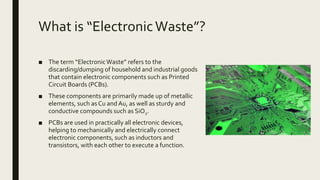
■ The term “ElectronicWaste” refers to the
discarding/dumping of household and industrial goods
that contain electronic components such as Printed
Circuit Boards (PCBs).
■ These components are primarily made up of metallic
elements, such as Cu and Au, as well as sturdy and
conductive compounds such as SiO2.
■ PCBs are used in practically all electronic devices,
helping to mechanically and electrically connect
electronic components, such as inductors and
transistors, with each other to execute a function.
Composition of PCBs
■ PCBs are generally consisted of 31.8% organic material and epoxy resin, 30.1% metallic elements,
and 37.6% non-metals, their oxides, and glass fibers.
■ C, O, Br, H, Sb and N come under the organic material and epoxy resin used in PCBs, arranged in
descending order with regards to content mass (%).
■ Si/SiO2,Al/Al2O3,Ca/CaO, Na/NaO, Mg/MgO, Sr/SrO, and Ba/BaO come under the non-metallic
material and glass fibers used in PCBs, arranged in descending order with regards to content mass
(%).
■ Metals are used in 3 different ways in PCBs, all of which are arranged in descending order with
regards to content mass (%):
– Cu, Sn, and Pb are used for wiring and soldering.
– Fe, Ni,Cr, and Mo are used for construction.
– Ag, Au, and Pd are used in connectors.
■ And this is just the content of one aspect of such components. In reality, one computer alone is
estimated to contain ≈1.728kg of Pb, ≈0.003kg of Cd, ≈0.001kg of Hg, 3 of the most toxic metals
found in computers.These numbers skyrocket quickly when we consider the 315 million
computers that were discarded in the USA alone in 2004.
Why is electronic waste such an issue?
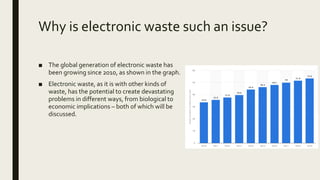
■ The global generation of electronic waste has
been growing since 2010, as shown in the graph.
■ Electronic waste, as it is with other kinds of
waste, has the potential to create devastating
problems in different ways, from biological to
economic implications – both of which will be
discussed.
Medical Implications
■ Electronic waste contain considerable amounts of heavy metals.
– Heavy metals are metals that have relatively high densities and are
toxic at minute concentrations.
■ Heavy metals present in electronic waste – Antimony, Lead,Tin, Mercury,
Cadmium, and Chromium – cause significant damage to organisms,
leading to consequences such as heavy metal poisoning in humans.
■ An example of heavy metal poisoning, cadmium poisoning causes
osteomalacia, a bone-softening disease that deforms bone tissues in
humans.
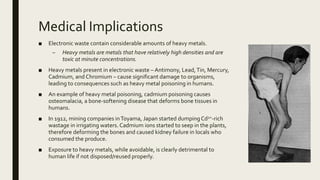
■ In 1912, mining companies inToyama, Japan started dumpingCd2+-rich
wastage in irrigating waters. Cadmium ions started to seep in the plants,
therefore deforming the bones and caused kidney failure in locals who
consumed the produce.
■ Exposure to heavy metals, while avoidable, is clearly detrimental to
human life if not disposed/reused properly.
Environmental Implications
■ Aside from toxicological consequences, pro-longed exposure of such metals to the
environment may cause severe damage to ecosystems.
■ Exposure to heavy metals is toxic to most, if not all, organisms.
■ Once heavy metals enter an ecosystem, such as aquatic ecosystems, the toxicity that
is absorbed by aquatic plants and fishes continues along the food web of the
ecosystem.
■ Accumulation of the like leads to heavy metal poisoning, creating a catastrophic
domino effect. For example, if fishes are exposed more frequently to lead, more fishes
will perish.With a low population of fishes, predators such as humans, bears, and
sharks will lose a source of sustenance. If they are unable to procure a new source,
they too will perish.
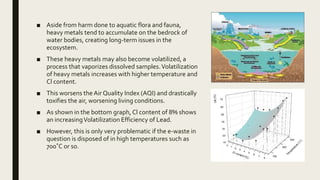
■ Aside from harm done to aquatic flora and fauna,
heavy metals tend to accumulate on the bedrock of
water bodies, creating long-term issues in the
ecosystem.
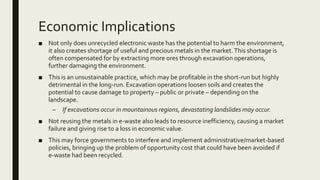
■ These heavy metals may also become volatilized, a
process that vaporizes dissolved samples.Volatilization
of heavy metals increases with higher temperature and
Cl content.
■ This worsens the Air Quality Index (AQI) and drastically
toxifies the air, worsening living conditions.
■ As shown in the bottom graph,Cl content of 8% shows
an increasingVolatilization Efficiency of Lead.
■ However, this is only very problematic if the e-waste in
question is disposed of in high temperatures such as
700˚C or so.
Economic Implications
■ Not only does unrecycled electronic waste has the potential to harm the environment,
it also creates shortage of useful and precious metals in the market.This shortage is
often compensated for by extracting more ores through excavation operations,
further damaging the environment.
■ This is an unsustainable practice, which may be profitable in the short-run but highly
detrimental in the long-run. Excavation operations loosen soils and creates the
potential to cause damage to property – public or private – depending on the
landscape.
– If excavations occur in mountainous regions, devastating landslides may occur.
■ Not reusing the metals in e-waste also leads to resource inefficiency, causing a market
failure and giving rise to a loss in economic value.
■ This may force governments to interfere and implement administrative/market-based
policies, bringing up the problem of opportunity cost that could have been avoided if
e-waste had been recycled.
Political Implications
■ With e-waste accumulating year-by-year, developed countries, such as the US, dump
50-70% of their accumulated e-waste into less developed countries.
■ This commonly ending up inAsia (China, India) andWest Africa (Nigeria, Ghana).
■ These create dystopian-like residential areas that are fully committed to the recycling
of e-waste, such as the infamous Guiyu village in China.Guiyu is a leading e-waste
processing site out of the many “digital dumps” in developing nations.
– Sampling of the village showed dangerously high levels of heavy metals present,
with children having an average of 15.3 μg dL-1, three times more than the safety
limit of blood lead levels (BLL).
■ Such incidences are liable to cause an outrage by the public and political reaction by
central governments.This may worsen international affairs within countries as
embargos and the like may be implemented to retaliate against dumping nations.
■ To monitor dumping of e-waste from developed to developing nations, the Basel
convention was established.
Current treaties/policies to combat the
issue?
■ Fortunately, efforts towards fixing the issue are being made. Several nations are
working together, and other parties, to carry out certain actions against e-waste.
■ International MaritimeOrganization (IMO) is an agency that focuses on ships and ship
regulations.As of 2008, the agency started focusing on “ship scrapping”, from reusing
the ship’s hull to computers and other electronic equipment used in ships.
– Entities may draw inspiration to create agencies that focus solely on e-waste.
■ The Basel Convention is an international treaty that prevents the dumping of waste
from developed nations to developing ones.This helps to protect human and
environmental damages in other nations and forces dumping nations to rectify their
market failures by themselves.
■ Restriction of Hazardous Substances (RoHS) is a compliance applied to all products in
the European Union.Often times, products that are compliant contain lead-free
soldering, preventing exposure to high BLL in people.
Current methods to dispose of e-waste
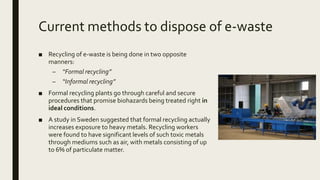
■ Recycling of e-waste is being done in two opposite
manners:
– “Formal recycling”
– “Informal recycling”
■ Formal recycling plants go through careful and secure
procedures that promise biohazards being treated right in
ideal conditions.
■ A study in Sweden suggested that formal recycling actually
increases exposure to heavy metals. Recycling workers
were found to have significant levels of such toxic metals
through mediums such as air, with metals consisting of up
to 6% of particulate matter.
Steps taken in formal e-recycling
1. Collection andTransportation
– Waste components are gathered at the plant through various mediums.
2. Shredding and Sorting
– Typically labor-intensive, e-waste is cut down and sorted by hand.
– Certain e-waste is not shredded such as batteries and fluorescent lights.
3. Dust Extraction
– Tiny particulate matter, such as dust, is removed through a shaking process in an environmentally
compliant setting.
4. Magnetic Separation
– A strong overhead magnet is used to separate the steel and iron from the waste.
5. Water Separation
– Water is used to separate glass fibers from the plastic.
6. Purification of Waste Stream
– Leftover metals are identified and removed from plastics to purify the stream further.
Informal e-recycling
■ However, this does not mean informal e-recycling is better. Practices of informal e-
recycling produce tremendously damaging effects as people willingly expose
themselves to dangerous toxins and chemicals, risking themselves to provide a living.
■ Back to our infamous example of Guiyu, workers in the village prioritize precious
metals over all else, stripping away any gold or silver away from the components they
find.
■ Because precious metals are more commercially feasible, leftover wastes containing
lead-based soldering are either dumped or burnt, exposing residents of the area to
highly unsafe living conditions.
A possible method to hasten recycling of metals while
maintaining safety limits.
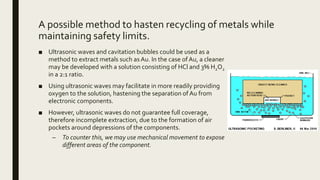
■ Ultrasonic waves and cavitation bubbles could be used as a
method to extract metals such as Au. In the case ofAu, a cleaner
may be developed with a solution consisting of HCl and 3% H2O2
in a 2:1 ratio.
■ Using ultrasonic waves may facilitate in more readily providing
oxygen to the solution, hastening the separation of Au from
electronic components.
■ However, ultrasonic waves do not guarantee full coverage,
therefore incomplete extraction, due to the formation of air
pockets around depressions of the components.
– To counter this, we may use mechanical movement to expose
different areas of the component.
Evaluation
■ The data used in Slide 3 was based on the core composition of PCBs found in Poland,
taking 5 differing sets of PCBs of varying sample sizes. However, only one set was
referred to as other sets contained both insufficient data and inconsistency with
regards to other sets to further use in the presentation.
■ Some references were removed from their original publishing websites.This may be
due to old and irrelevant data, which hampers the viewpoints discussed in the
presentation.
Bibliography
■ Szałatkiewicz, J. (2014). Metals Content in Printed Circuit Board Waste. Polish Journal of Environmental Studies, 23(6), 2365–2369. http://www.pjoes.com/Metals-Content-in-
Printed-Circuit-Board-Waste,89421,0,2.html
■ https://www.independent.co.uk/climate-change/news/toxic-metals-danger-in-your-computer-5371933.html
■ https://www.statista.com/statistics/499891/projection-ewaste-generation-worldwide/
■ https://web.archive.org/web/20080415154342/http://www.icett.or.jp/lpca_jp.nsf/a21a0d8b94740fbd492567ca000d5879/b30e2e489f4b4ff1492567ca0011ff90?OpenDocumen
t
■ Chen, L., Liao, Y., & Ma, X. (2019). Heavy metals volatilization characteristics and risk evaluation of co-combusted municipal solid wastes and sewage sludge without and
with calcium-based sorbents. Ecotoxicology and Environmental Safety, 182, 109370–109380. https://doi.org/10.1016/j.ecoenv.2019.109370
■ https://www.basel.int/
■ Needhidasan, S., Samuel, M. & Chidambaram, R. Electronic waste – an emerging threat to the environment of urban India. J Environ Health Sci Engineer 12, 36 (2014).
https://doi.org/10.1186/2052-336X-12-36
■ https://www.usnews.com/news/articles/2014/08/01/e-waste-in-developing-countries-endangers-environment-locals
■ https://web.archive.org/web/20121221124954/http://seattletimes.com/html/nationworld/2002920133_ewaste09.html
■ Walters, A., & Santillo, D. (2008). Evidence of environmental and health impacts of electronics recycling in China: An update. Greenpeace International.
https://www.greenpeace.to/publications/impacts-of-e-recycling-China-update.pdf
■ https://www.mayoclinic.org/diseases-conditions/lead-poisoning/diagnosis-treatment/drc-20354723
■ https://www.imo.org/en/OurWork/Environment/Pages/JointILOIMOBCWorkingGroupOnShipScrapping.aspx
■ Julander,A., Lundgren, L., Skare, L., Grandér, M., Palm, B.,Vahter, M., & Lidén,C. (2014). Formal recycling of e-waste leads to increased exposure to toxic
metals: An occupational exposure study from Sweden. Environment International, 73, 243–251. https://doi.org/10.1016/j.envint.2014.07.006
■ https://www.niehs.nih.gov/research/programs/geh/geh_newsletter/2013/7/articles/ewaste_recycling_in_china_a_health_disaster_in_the_making.cfm
■ https://www.conserve-energy-future.com/e-waste-recycling-process.php

Electronic waste

  • 1.
  • 2.
    What is “ElectronicWaste”? ■The term “ElectronicWaste” refers to the discarding/dumping of household and industrial goods that contain electronic components such as Printed Circuit Boards (PCBs). ■ These components are primarily made up of metallic elements, such as Cu and Au, as well as sturdy and conductive compounds such as SiO2. ■ PCBs are used in practically all electronic devices, helping to mechanically and electrically connect electronic components, such as inductors and transistors, with each other to execute a function.
  • 3.
    Composition of PCBs ■PCBs are generally consisted of 31.8% organic material and epoxy resin, 30.1% metallic elements, and 37.6% non-metals, their oxides, and glass fibers. ■ C, O, Br, H, Sb and N come under the organic material and epoxy resin used in PCBs, arranged in descending order with regards to content mass (%). ■ Si/SiO2,Al/Al2O3,Ca/CaO, Na/NaO, Mg/MgO, Sr/SrO, and Ba/BaO come under the non-metallic material and glass fibers used in PCBs, arranged in descending order with regards to content mass (%). ■ Metals are used in 3 different ways in PCBs, all of which are arranged in descending order with regards to content mass (%): – Cu, Sn, and Pb are used for wiring and soldering. – Fe, Ni,Cr, and Mo are used for construction. – Ag, Au, and Pd are used in connectors. ■ And this is just the content of one aspect of such components. In reality, one computer alone is estimated to contain ≈1.728kg of Pb, ≈0.003kg of Cd, ≈0.001kg of Hg, 3 of the most toxic metals found in computers.These numbers skyrocket quickly when we consider the 315 million computers that were discarded in the USA alone in 2004.
  • 4.
    Why is electronicwaste such an issue? ■ The global generation of electronic waste has been growing since 2010, as shown in the graph. ■ Electronic waste, as it is with other kinds of waste, has the potential to create devastating problems in different ways, from biological to economic implications – both of which will be discussed.
  • 5.
    Medical Implications ■ Electronicwaste contain considerable amounts of heavy metals. – Heavy metals are metals that have relatively high densities and are toxic at minute concentrations. ■ Heavy metals present in electronic waste – Antimony, Lead,Tin, Mercury, Cadmium, and Chromium – cause significant damage to organisms, leading to consequences such as heavy metal poisoning in humans. ■ An example of heavy metal poisoning, cadmium poisoning causes osteomalacia, a bone-softening disease that deforms bone tissues in humans. ■ In 1912, mining companies inToyama, Japan started dumpingCd2+-rich wastage in irrigating waters. Cadmium ions started to seep in the plants, therefore deforming the bones and caused kidney failure in locals who consumed the produce. ■ Exposure to heavy metals, while avoidable, is clearly detrimental to human life if not disposed/reused properly.
  • 6.
    Environmental Implications ■ Asidefrom toxicological consequences, pro-longed exposure of such metals to the environment may cause severe damage to ecosystems. ■ Exposure to heavy metals is toxic to most, if not all, organisms. ■ Once heavy metals enter an ecosystem, such as aquatic ecosystems, the toxicity that is absorbed by aquatic plants and fishes continues along the food web of the ecosystem. ■ Accumulation of the like leads to heavy metal poisoning, creating a catastrophic domino effect. For example, if fishes are exposed more frequently to lead, more fishes will perish.With a low population of fishes, predators such as humans, bears, and sharks will lose a source of sustenance. If they are unable to procure a new source, they too will perish.
  • 7.
    ■ Aside fromharm done to aquatic flora and fauna, heavy metals tend to accumulate on the bedrock of water bodies, creating long-term issues in the ecosystem. ■ These heavy metals may also become volatilized, a process that vaporizes dissolved samples.Volatilization of heavy metals increases with higher temperature and Cl content. ■ This worsens the Air Quality Index (AQI) and drastically toxifies the air, worsening living conditions. ■ As shown in the bottom graph,Cl content of 8% shows an increasingVolatilization Efficiency of Lead. ■ However, this is only very problematic if the e-waste in question is disposed of in high temperatures such as 700˚C or so.
  • 8.
    Economic Implications ■ Notonly does unrecycled electronic waste has the potential to harm the environment, it also creates shortage of useful and precious metals in the market.This shortage is often compensated for by extracting more ores through excavation operations, further damaging the environment. ■ This is an unsustainable practice, which may be profitable in the short-run but highly detrimental in the long-run. Excavation operations loosen soils and creates the potential to cause damage to property – public or private – depending on the landscape. – If excavations occur in mountainous regions, devastating landslides may occur. ■ Not reusing the metals in e-waste also leads to resource inefficiency, causing a market failure and giving rise to a loss in economic value. ■ This may force governments to interfere and implement administrative/market-based policies, bringing up the problem of opportunity cost that could have been avoided if e-waste had been recycled.
  • 9.
    Political Implications ■ Withe-waste accumulating year-by-year, developed countries, such as the US, dump 50-70% of their accumulated e-waste into less developed countries. ■ This commonly ending up inAsia (China, India) andWest Africa (Nigeria, Ghana). ■ These create dystopian-like residential areas that are fully committed to the recycling of e-waste, such as the infamous Guiyu village in China.Guiyu is a leading e-waste processing site out of the many “digital dumps” in developing nations. – Sampling of the village showed dangerously high levels of heavy metals present, with children having an average of 15.3 μg dL-1, three times more than the safety limit of blood lead levels (BLL). ■ Such incidences are liable to cause an outrage by the public and political reaction by central governments.This may worsen international affairs within countries as embargos and the like may be implemented to retaliate against dumping nations. ■ To monitor dumping of e-waste from developed to developing nations, the Basel convention was established.
  • 10.
    Current treaties/policies tocombat the issue? ■ Fortunately, efforts towards fixing the issue are being made. Several nations are working together, and other parties, to carry out certain actions against e-waste. ■ International MaritimeOrganization (IMO) is an agency that focuses on ships and ship regulations.As of 2008, the agency started focusing on “ship scrapping”, from reusing the ship’s hull to computers and other electronic equipment used in ships. – Entities may draw inspiration to create agencies that focus solely on e-waste. ■ The Basel Convention is an international treaty that prevents the dumping of waste from developed nations to developing ones.This helps to protect human and environmental damages in other nations and forces dumping nations to rectify their market failures by themselves. ■ Restriction of Hazardous Substances (RoHS) is a compliance applied to all products in the European Union.Often times, products that are compliant contain lead-free soldering, preventing exposure to high BLL in people.
  • 11.
    Current methods todispose of e-waste ■ Recycling of e-waste is being done in two opposite manners: – “Formal recycling” – “Informal recycling” ■ Formal recycling plants go through careful and secure procedures that promise biohazards being treated right in ideal conditions. ■ A study in Sweden suggested that formal recycling actually increases exposure to heavy metals. Recycling workers were found to have significant levels of such toxic metals through mediums such as air, with metals consisting of up to 6% of particulate matter.
  • 12.
    Steps taken informal e-recycling 1. Collection andTransportation – Waste components are gathered at the plant through various mediums. 2. Shredding and Sorting – Typically labor-intensive, e-waste is cut down and sorted by hand. – Certain e-waste is not shredded such as batteries and fluorescent lights. 3. Dust Extraction – Tiny particulate matter, such as dust, is removed through a shaking process in an environmentally compliant setting. 4. Magnetic Separation – A strong overhead magnet is used to separate the steel and iron from the waste. 5. Water Separation – Water is used to separate glass fibers from the plastic. 6. Purification of Waste Stream – Leftover metals are identified and removed from plastics to purify the stream further.
  • 13.
    Informal e-recycling ■ However,this does not mean informal e-recycling is better. Practices of informal e- recycling produce tremendously damaging effects as people willingly expose themselves to dangerous toxins and chemicals, risking themselves to provide a living. ■ Back to our infamous example of Guiyu, workers in the village prioritize precious metals over all else, stripping away any gold or silver away from the components they find. ■ Because precious metals are more commercially feasible, leftover wastes containing lead-based soldering are either dumped or burnt, exposing residents of the area to highly unsafe living conditions.
  • 14.
    A possible methodto hasten recycling of metals while maintaining safety limits. ■ Ultrasonic waves and cavitation bubbles could be used as a method to extract metals such as Au. In the case ofAu, a cleaner may be developed with a solution consisting of HCl and 3% H2O2 in a 2:1 ratio. ■ Using ultrasonic waves may facilitate in more readily providing oxygen to the solution, hastening the separation of Au from electronic components. ■ However, ultrasonic waves do not guarantee full coverage, therefore incomplete extraction, due to the formation of air pockets around depressions of the components. – To counter this, we may use mechanical movement to expose different areas of the component.
  • 15.
    Evaluation ■ The dataused in Slide 3 was based on the core composition of PCBs found in Poland, taking 5 differing sets of PCBs of varying sample sizes. However, only one set was referred to as other sets contained both insufficient data and inconsistency with regards to other sets to further use in the presentation. ■ Some references were removed from their original publishing websites.This may be due to old and irrelevant data, which hampers the viewpoints discussed in the presentation.
  • 16.
    Bibliography ■ Szałatkiewicz, J.(2014). Metals Content in Printed Circuit Board Waste. Polish Journal of Environmental Studies, 23(6), 2365–2369. http://www.pjoes.com/Metals-Content-in- Printed-Circuit-Board-Waste,89421,0,2.html ■ https://www.independent.co.uk/climate-change/news/toxic-metals-danger-in-your-computer-5371933.html ■ https://www.statista.com/statistics/499891/projection-ewaste-generation-worldwide/ ■ https://web.archive.org/web/20080415154342/http://www.icett.or.jp/lpca_jp.nsf/a21a0d8b94740fbd492567ca000d5879/b30e2e489f4b4ff1492567ca0011ff90?OpenDocumen t ■ Chen, L., Liao, Y., & Ma, X. (2019). Heavy metals volatilization characteristics and risk evaluation of co-combusted municipal solid wastes and sewage sludge without and with calcium-based sorbents. Ecotoxicology and Environmental Safety, 182, 109370–109380. https://doi.org/10.1016/j.ecoenv.2019.109370 ■ https://www.basel.int/ ■ Needhidasan, S., Samuel, M. & Chidambaram, R. Electronic waste – an emerging threat to the environment of urban India. J Environ Health Sci Engineer 12, 36 (2014). https://doi.org/10.1186/2052-336X-12-36 ■ https://www.usnews.com/news/articles/2014/08/01/e-waste-in-developing-countries-endangers-environment-locals ■ https://web.archive.org/web/20121221124954/http://seattletimes.com/html/nationworld/2002920133_ewaste09.html ■ Walters, A., & Santillo, D. (2008). Evidence of environmental and health impacts of electronics recycling in China: An update. Greenpeace International. https://www.greenpeace.to/publications/impacts-of-e-recycling-China-update.pdf ■ https://www.mayoclinic.org/diseases-conditions/lead-poisoning/diagnosis-treatment/drc-20354723 ■ https://www.imo.org/en/OurWork/Environment/Pages/JointILOIMOBCWorkingGroupOnShipScrapping.aspx ■ Julander,A., Lundgren, L., Skare, L., Grandér, M., Palm, B.,Vahter, M., & Lidén,C. (2014). Formal recycling of e-waste leads to increased exposure to toxic metals: An occupational exposure study from Sweden. Environment International, 73, 243–251. https://doi.org/10.1016/j.envint.2014.07.006 ■ https://www.niehs.nih.gov/research/programs/geh/geh_newsletter/2013/7/articles/ewaste_recycling_in_china_a_health_disaster_in_the_making.cfm ■ https://www.conserve-energy-future.com/e-waste-recycling-process.php