An Overview of OSHA Standards
and Confined Space Hazards
Developed by Western Iowa Tech Community College
This material was produced under a grant (SH-16634-07-60-F-19) from the
Occupational Safety and Health Administration, U.S. Department of Labor. It
does not necessarily reflect the views or policies of the U.S. Department of
Labor, nor does the mention or trade names, commercial products, or
organization imply endorsement by the U.S. government.
• Construction Industry Standard 1926.21(b)(6)
• General Industry Standard 1910.146
• Best Practices for all Industries
All employees required to enter into
confined or enclosed spaces shall be
instructed as to the nature of the hazards
involved, the necessary precautions to be
taken, and in the use of protective and
emergency equipment required. The
employer shall comply with any specific
regulations that apply to work in
dangerous or potentially dangerous areas.
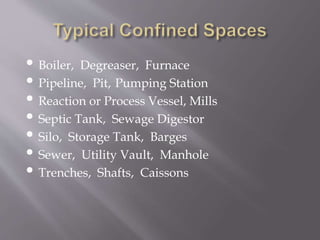
• Boiler, Degreaser, Furnace
• Pipeline, Pit, Pumping Station
• Reaction or Process Vessel, Mills
• Septic Tank, Sewage Digestor
• Silo, Storage Tank, Barges
• Sewer, Utility Vault, Manhole
• Trenches, Shafts, Caissons
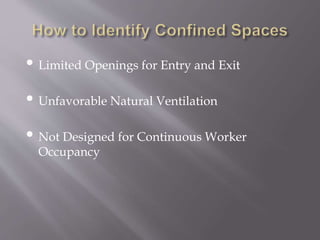
• Limited Openings for Entry and Exit
• Unfavorable Natural Ventilation
• Not Designed for Continuous Worker
Occupancy
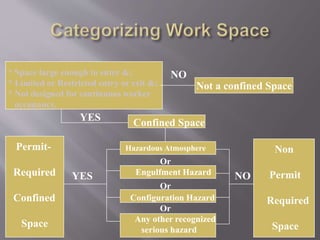
* Space large enough to enter &;
* Limited or Restricted entry or exit &;
* Not designed for continuous worker
occupancy.
NO
Not a confined Space
YES
Confined Space
Hazardous Atmosphere
Engulfment Hazard
Configuration Hazard
Any other recognized
serious hazard
Permit-
Required
Confined
Space
Non
Permit
Required
Space
YES NO
Or
Or
Or
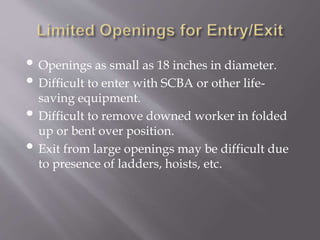
• Openings as small as 18 inches in diameter.
• Difficult to enter with SCBA or other life-
saving equipment.
• Difficult to remove downed worker in folded
up or bent over position.
• Exit from large openings may be difficult due
to presence of ladders, hoists, etc.
• Lack of air movement in and out of the space
can create an atmosphere much different than
the outside atmosphere.
• Deadly gases can be trapped inside.
• Organic materials can decompose.
• May not be enough oxygen due to presence of
other gases or chemical reactions such as
rusting.
• Most confined spaces are not designed to enter
and work in on a regular basis.
• Designed to store a product.
• Enclose materials or processes.
• Transport products or substances.
• Occasional worker entry for inspection, repair,
cleanup, maintenance, etc.
• Presence of all three confined space
characteristics can complicate the situation.
• Working in and around the space.
• Rescue operations during emergencies.
• Worsened conditions due to work activities:
 Welding and cutting, use of bonding agents
 Cleaning with solvents, use of other chemicals
 Use of gas-powered equipment
• Oxygen Deficient Atmospheres
• Oxygen Enriched Atmospheres
• Flammable Atmospheres
• Toxic Atmospheres
• Temperature Extremes
• Engulfment Hazards
• Noise, Slick/Wet Surfaces, Falling Objects
• Mechanical Hazards
“Hazardous atmosphere” means an atmosphere
that may expose employees to the risk of
death, incapacitation, impairment of ability to
self-rescue (that is, escape unaided from a
permit space)injury, or acute illness from one
or more of the following causes:
(1) Flammable gas, vapor, or mist in excess of 10
percent of its lower flammable limit (LFL);
“Hazardous atmosphere” (cont’d)
(2) Airborne combustible dust at a concentration that
meets or exceeds its LFL;
NOTE: This concentration may be approximated as
a condition in which the dust obscures vision at a
distance of 5 feet or less.
(3) Atmospheric oxygen concentration below 19.5
percent or above 23.5 percent;
“Hazardous atmosphere” (cont’d)
(4) Atmospheric concentration of any substance for
which a dose or a permissible exposure limit is
published in Subpart G, Occupational Health and
Environmental Control, or in Subpart Z, Toxic and
Hazardous Substance , of this Part which could result
in employee exposure in excess of its dose or
permissible exposure limit.
(5) Any other atmospheric condition that is immediately
dangerous to life and health.
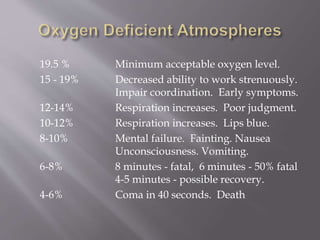
19.5 % Minimum acceptable oxygen level.
15 - 19% Decreased ability to work strenuously.
Impair coordination. Early symptoms.
12-14% Respiration increases. Poor judgment.
10-12% Respiration increases. Lips blue.
8-10% Mental failure. Fainting. Nausea
Unconsciousness. Vomiting.
6-8% 8 minutes - fatal, 6 minutes - 50% fatal
4-5 minutes - possible recovery.
4-6% Coma in 40 seconds. Death
• Oxygen level above 21%.
• Causes flammable and combustible materials
to burn violently when ignited.
• Hair, clothing, materials, etc.
• Oil soaked clothing and materials.
• Never use pure oxygen to ventilate.
• Never store or place compressed tanks in a
confined space.
• Critical Factors:
 Oxygen content in the air.
 Presence of a flammable gas, or vapor
 Presence of dust (visibility of 5’ or less)
• Proper air/gas mixture can lead to explosion
• Typical Ignition Sources:
 Sparking or electric tool.
 Welding / cutting operations.
 Smoking
o Product stored in a confined space:
o Gases released when cleaning.
o Materials absorbed into walls of confined space.
o Decomposition of materials in the confined space.
o Work performed in a confined space:
o Welding, cutting, brazing, soldering.
o Painting, scraping, sanding, degreasing.
o Sealing, bonding, melting.
o Areas adjacent to a confined space.
o Exhaust , pumps, generators
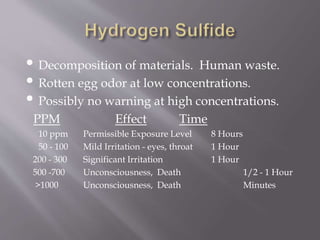
• Decomposition of materials. Human waste.
• Rotten egg odor at low concentrations.
• Possibly no warning at high concentrations.
PPM Effect Time
10 ppm Permissible Exposure Level 8 Hours
50 - 100 Mild Irritation - eyes, throat 1 Hour
200 - 300 Significant Irritation 1 Hour
500 -700 Unconsciousness, Death 1/2 - 1 Hour
>1000 Unconsciousness, Death Minutes
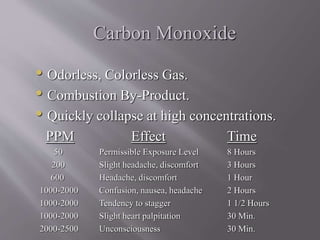
Carbon Monoxide
• Odorless, Colorless Gas.
• Combustion By-Product.
• Quickly collapse at high concentrations.
PPM Effect Time
50 Permissible Exposure Level 8 Hours
200 Slight headache, discomfort 3 Hours
600 Headache, discomfort 1 Hour
1000-2000 Confusion, nausea, headache 2 Hours
1000-2000 Tendency to stagger 1 1/2 Hours
1000-2000 Slight heart palpitation 30 Min.
2000-2500 Unconsciousness 30 Min.
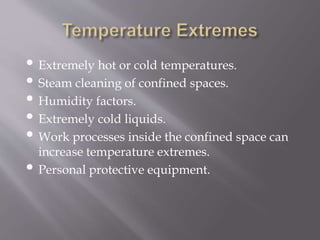
• Extremely hot or cold temperatures.
• Steam cleaning of confined spaces.
• Humidity factors.
• Extremely cold liquids.
• Work processes inside the confined space can
increase temperature extremes.
• Personal protective equipment.
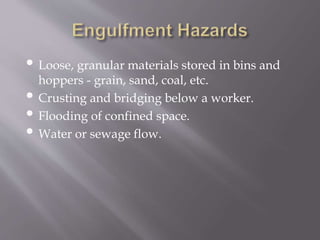
• Loose, granular materials stored in bins and
hoppers - grain, sand, coal, etc.
• Crusting and bridging below a worker.
• Flooding of confined space.
• Water or sewage flow.
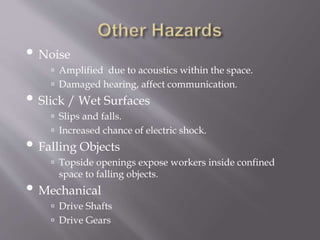
• Noise
 Amplified due to acoustics within the space.
 Damaged hearing, affect communication.
• Slick / Wet Surfaces
 Slips and falls.
 Increased chance of electric shock.
• Falling Objects
 Topside openings expose workers inside confined
space to falling objects.
• Mechanical
 Drive Shafts
 Drive Gears
• Verify presence of safe work atmosphere.
• Test all areas of a confined space.
 Top, Middle, Bottom, and each end
• Methane is lighter than air.
• Carbon Monoxide is the same as air.
• Hydrogen Sulfide is heavier than air.
• Oxygen Deficiency.
• First option to correct problems.
• Must be aware of hazards you are trying to
correct in the confined space.
• Air intake in a safe location to draw fresh air
only.
• Continuous ventilation whenever possible.
• Retest the confined space before entry.
• Locking and tagging out electrical sources.
• Blanking and bleeding pneumatic and
hydraulic lines.
• Disconnecting mechanical drives and shafts.
• Securing mechanical parts.
• Blanking sewer and water flow.
• Locking and tagging out shutoff valves.
• Air-Purifying Respirators
 Filter dangerous substances from the air.
 Must know the type and amount of hazardous
substance present in the confined space.
 NEVER use with oxygen deficiency!
• Air-Supplying Respirators
 Deliver a safe supply of breathing air from a tank or
an uncontaminated area nearby.
 Must be adequately monitored.
• Worker assigned to remain outside the
confined space and be in constant contact with
the workers inside.
• Know emergency rescue procedures.
• 50% of workers who die in confined spaces are
would-be rescuers.
• Trained in use of emergency rescue equipment
and PPE.
• Written permit signed by entry supervisor.
• Verifies pre-entry precautions have been taken
and the space is safe to enter.
• Posted at entry to confined space.
• Specifies apparent hazards and corrective
actions taken prior to entry.
• Requires termination of permit when task is
completed or when new conditions exist.
• Date, location, and name of confined space.
• Purpose of entry and known hazards.
• Duration of entry permit time.
• Authorized entrants, attendants, supervisors.
• Air testing results - signature of tester.
• Protective measures to be taken.
 Ventilation, Isolation, Flushing
 Lockout / Tagout, Purging
• Name and phone numbers of rescue and
emergency services.
• Communication procedures.
• Special equipment and procedures.
 Personal protective equipment.
 Alarm procedures.
 Rescue equipment.
 Respirators.
• All workers who must enter confined spaces
• All attendants and rescue team members.
• Prior to initial work assignment.
• Retraining:
 Job duties change.
 Change in permit-space program.
 New hazards are present.
 Job performance indicates deficiencies.
 Definition of a confined space
 Hazards of a confined space
 Neutralizing hazards in a confined space
 Steps for proper confined space entry
 Proper permits for confined space entry
 Other related issues of confined spaces
Questions or Comments?

mod_6_confined_space2.pptx

  • 1.
    An Overview ofOSHA Standards and Confined Space Hazards Developed by Western Iowa Tech Community College This material was produced under a grant (SH-16634-07-60-F-19) from the Occupational Safety and Health Administration, U.S. Department of Labor. It does not necessarily reflect the views or policies of the U.S. Department of Labor, nor does the mention or trade names, commercial products, or organization imply endorsement by the U.S. government.
  • 2.
    • Construction IndustryStandard 1926.21(b)(6) • General Industry Standard 1910.146 • Best Practices for all Industries
  • 3.
    All employees requiredto enter into confined or enclosed spaces shall be instructed as to the nature of the hazards involved, the necessary precautions to be taken, and in the use of protective and emergency equipment required. The employer shall comply with any specific regulations that apply to work in dangerous or potentially dangerous areas.
  • 4.
    • Boiler, Degreaser,Furnace • Pipeline, Pit, Pumping Station • Reaction or Process Vessel, Mills • Septic Tank, Sewage Digestor • Silo, Storage Tank, Barges • Sewer, Utility Vault, Manhole • Trenches, Shafts, Caissons
  • 5.
    • Limited Openingsfor Entry and Exit • Unfavorable Natural Ventilation • Not Designed for Continuous Worker Occupancy
  • 6.
    * Space largeenough to enter &; * Limited or Restricted entry or exit &; * Not designed for continuous worker occupancy. NO Not a confined Space YES Confined Space Hazardous Atmosphere Engulfment Hazard Configuration Hazard Any other recognized serious hazard Permit- Required Confined Space Non Permit Required Space YES NO Or Or Or
  • 8.
    • Openings assmall as 18 inches in diameter. • Difficult to enter with SCBA or other life- saving equipment. • Difficult to remove downed worker in folded up or bent over position. • Exit from large openings may be difficult due to presence of ladders, hoists, etc.
  • 9.
    • Lack ofair movement in and out of the space can create an atmosphere much different than the outside atmosphere. • Deadly gases can be trapped inside. • Organic materials can decompose. • May not be enough oxygen due to presence of other gases or chemical reactions such as rusting.
  • 10.
    • Most confinedspaces are not designed to enter and work in on a regular basis. • Designed to store a product. • Enclose materials or processes. • Transport products or substances. • Occasional worker entry for inspection, repair, cleanup, maintenance, etc.
  • 11.
    • Presence ofall three confined space characteristics can complicate the situation. • Working in and around the space. • Rescue operations during emergencies. • Worsened conditions due to work activities:  Welding and cutting, use of bonding agents  Cleaning with solvents, use of other chemicals  Use of gas-powered equipment
  • 12.
    • Oxygen DeficientAtmospheres • Oxygen Enriched Atmospheres • Flammable Atmospheres • Toxic Atmospheres • Temperature Extremes • Engulfment Hazards • Noise, Slick/Wet Surfaces, Falling Objects • Mechanical Hazards
  • 13.
    “Hazardous atmosphere” meansan atmosphere that may expose employees to the risk of death, incapacitation, impairment of ability to self-rescue (that is, escape unaided from a permit space)injury, or acute illness from one or more of the following causes: (1) Flammable gas, vapor, or mist in excess of 10 percent of its lower flammable limit (LFL);
  • 14.
    “Hazardous atmosphere” (cont’d) (2)Airborne combustible dust at a concentration that meets or exceeds its LFL; NOTE: This concentration may be approximated as a condition in which the dust obscures vision at a distance of 5 feet or less. (3) Atmospheric oxygen concentration below 19.5 percent or above 23.5 percent;
  • 15.
    “Hazardous atmosphere” (cont’d) (4)Atmospheric concentration of any substance for which a dose or a permissible exposure limit is published in Subpart G, Occupational Health and Environmental Control, or in Subpart Z, Toxic and Hazardous Substance , of this Part which could result in employee exposure in excess of its dose or permissible exposure limit. (5) Any other atmospheric condition that is immediately dangerous to life and health.
  • 16.
    19.5 % Minimumacceptable oxygen level. 15 - 19% Decreased ability to work strenuously. Impair coordination. Early symptoms. 12-14% Respiration increases. Poor judgment. 10-12% Respiration increases. Lips blue. 8-10% Mental failure. Fainting. Nausea Unconsciousness. Vomiting. 6-8% 8 minutes - fatal, 6 minutes - 50% fatal 4-5 minutes - possible recovery. 4-6% Coma in 40 seconds. Death
  • 17.
    • Oxygen levelabove 21%. • Causes flammable and combustible materials to burn violently when ignited. • Hair, clothing, materials, etc. • Oil soaked clothing and materials. • Never use pure oxygen to ventilate. • Never store or place compressed tanks in a confined space.
  • 18.
    • Critical Factors: Oxygen content in the air.  Presence of a flammable gas, or vapor  Presence of dust (visibility of 5’ or less) • Proper air/gas mixture can lead to explosion • Typical Ignition Sources:  Sparking or electric tool.  Welding / cutting operations.  Smoking
  • 19.
    o Product storedin a confined space: o Gases released when cleaning. o Materials absorbed into walls of confined space. o Decomposition of materials in the confined space. o Work performed in a confined space: o Welding, cutting, brazing, soldering. o Painting, scraping, sanding, degreasing. o Sealing, bonding, melting. o Areas adjacent to a confined space. o Exhaust , pumps, generators
  • 20.
    • Decomposition ofmaterials. Human waste. • Rotten egg odor at low concentrations. • Possibly no warning at high concentrations. PPM Effect Time 10 ppm Permissible Exposure Level 8 Hours 50 - 100 Mild Irritation - eyes, throat 1 Hour 200 - 300 Significant Irritation 1 Hour 500 -700 Unconsciousness, Death 1/2 - 1 Hour >1000 Unconsciousness, Death Minutes
  • 21.
    Carbon Monoxide • Odorless,Colorless Gas. • Combustion By-Product. • Quickly collapse at high concentrations. PPM Effect Time 50 Permissible Exposure Level 8 Hours 200 Slight headache, discomfort 3 Hours 600 Headache, discomfort 1 Hour 1000-2000 Confusion, nausea, headache 2 Hours 1000-2000 Tendency to stagger 1 1/2 Hours 1000-2000 Slight heart palpitation 30 Min. 2000-2500 Unconsciousness 30 Min.
  • 22.
    • Extremely hotor cold temperatures. • Steam cleaning of confined spaces. • Humidity factors. • Extremely cold liquids. • Work processes inside the confined space can increase temperature extremes. • Personal protective equipment.
  • 23.
    • Loose, granularmaterials stored in bins and hoppers - grain, sand, coal, etc. • Crusting and bridging below a worker. • Flooding of confined space. • Water or sewage flow.
  • 24.
    • Noise  Amplifieddue to acoustics within the space.  Damaged hearing, affect communication. • Slick / Wet Surfaces  Slips and falls.  Increased chance of electric shock. • Falling Objects  Topside openings expose workers inside confined space to falling objects. • Mechanical  Drive Shafts  Drive Gears
  • 25.
    • Verify presenceof safe work atmosphere. • Test all areas of a confined space.  Top, Middle, Bottom, and each end • Methane is lighter than air. • Carbon Monoxide is the same as air. • Hydrogen Sulfide is heavier than air. • Oxygen Deficiency.
  • 26.
    • First optionto correct problems. • Must be aware of hazards you are trying to correct in the confined space. • Air intake in a safe location to draw fresh air only. • Continuous ventilation whenever possible. • Retest the confined space before entry.
  • 27.
    • Locking andtagging out electrical sources. • Blanking and bleeding pneumatic and hydraulic lines. • Disconnecting mechanical drives and shafts. • Securing mechanical parts. • Blanking sewer and water flow. • Locking and tagging out shutoff valves.
  • 28.
    • Air-Purifying Respirators Filter dangerous substances from the air.  Must know the type and amount of hazardous substance present in the confined space.  NEVER use with oxygen deficiency! • Air-Supplying Respirators  Deliver a safe supply of breathing air from a tank or an uncontaminated area nearby.  Must be adequately monitored.
  • 29.
    • Worker assignedto remain outside the confined space and be in constant contact with the workers inside. • Know emergency rescue procedures. • 50% of workers who die in confined spaces are would-be rescuers. • Trained in use of emergency rescue equipment and PPE.
  • 30.
    • Written permitsigned by entry supervisor. • Verifies pre-entry precautions have been taken and the space is safe to enter. • Posted at entry to confined space. • Specifies apparent hazards and corrective actions taken prior to entry. • Requires termination of permit when task is completed or when new conditions exist.
  • 31.
    • Date, location,and name of confined space. • Purpose of entry and known hazards. • Duration of entry permit time. • Authorized entrants, attendants, supervisors. • Air testing results - signature of tester. • Protective measures to be taken.  Ventilation, Isolation, Flushing  Lockout / Tagout, Purging
  • 32.
    • Name andphone numbers of rescue and emergency services. • Communication procedures. • Special equipment and procedures.  Personal protective equipment.  Alarm procedures.  Rescue equipment.  Respirators.
  • 33.
    • All workerswho must enter confined spaces • All attendants and rescue team members. • Prior to initial work assignment. • Retraining:  Job duties change.  Change in permit-space program.  New hazards are present.  Job performance indicates deficiencies.
  • 34.
     Definition ofa confined space  Hazards of a confined space  Neutralizing hazards in a confined space  Steps for proper confined space entry  Proper permits for confined space entry  Other related issues of confined spaces
  • 35.

Editor's Notes

  • #2 Title Page This presentation represented general guidelines and policies needed for compliance of confined spaces under OSHA regulations. Industry specific rules and regulations may apply in addition to those stated within this presentation. Please consult your employer for additional instructions and equipment if necessary.
  • #3 Different Categories of OSHA Confined Spaces. General Industry Standard is for permit required confined space. 1. Construction Industry covered by 1926.21(b)(6) 2. General Industry Standard covered under 1910.146 Best Confined Space practices for all industries.
  • #4 General guideline or policy for employees and employers concerning confined spaces.
  • #5 Examples of confined spaces.
  • #6 Ways to identify confined spaces.
  • #7 Flow chart to determine not a confined space versus a confined space versus permit required confined space.
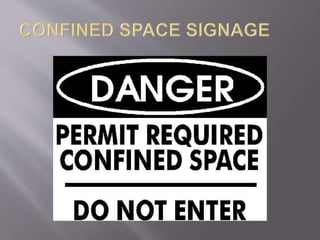
  • #8 An example of a confined space warning sign.
  • #9 Discussion of opening limits of a confined space. Talk about difficult to enter and exit. Talk about the rescue of a injured worker. Related to slide #5 three main types this would be the 1st.
  • #10 Discussion of confined space ventilation. This expands on the information found on slide #5 the 2nd type of confined space.
  • #11 Points of what constitutes continuous occupancy. Give example of an attic with a doorway with no hazards does not meet the standard as a confined space.
  • #12 Combination of confined space hazards. These would be examples of confined space characteristics that would complicate working in a confined space. 1.Limited Openings for Entry/Exit, 2.Not Designed for Continuous Worker Occupancy, 3.Unfavorable Natural Ventilation
  • #13 Discussion of confined space hazards. Talking in respect to potential dangers present in confined spaces. Oxygen: Needs to be at a level that is just right. Not too much and not too little. Flammable: Too much concentration and there can be an explosion or fire hazard. Toxic: Gases or vapors that can poison personnel. Temperatures: Work in an ambient temperature environment if possible. Too hot or too cold environments can cause stress and hazards. Engulfment: Materials can move and cover personnel causing suffocation. Noise, Surfaces and Objects: All can create hazards that put personnel health and safety at risk.
  • #14 Discussion of confined space hazardous atmospheres. Per the OSHA standard.
  • #15 Discussion of confined space hazardous atmospheres.
  • #16 Discussion of confined space hazardous atmospheres.
  • #17 Effects of low oxygen concentration on humans.
  • #18 Hazards of too much oxygen in the atmosphere. Example of oxygen enriched atmosphere would be the use of pure oxygen to fill confined space as a replacement for breathable air. Accidents have happed in the past caused by the use of opening oxygen lines from cutting torches in the confined space.
  • #19 How to identify flammable atmospheres and conditions that lead to safety and health hazards.
  • #20 Situations where toxic atmospheres might be present.
  • #21 Effects and conditions of hydrogen sulfide in the atmosphere.
  • #22 Effects and conditions of carbon monoxide in the atmosphere.
  • #23 Hazards associated with temperature extremes in confined spaces.
  • #24 Examples of engulfment hazards in confined spaces.
  • #25 Other possible hazards in confined spaces. Noise: Can be introduced into the confined space and can last longer through vessel vibrations than in normal conditions. Amplification of the sound can also be a hazard. Slick/Wet Surfaces: This can cause a falling or slipping hazard in addition to other hazards. Falling objects: They can create a hazard for equipment and personnel on impact.
  • #26 Testing of an atmosphere is usually done with electronic detection devices. Test all level of the confined space to ensure proper atmospheric conditions. Contaminants may displace the air within confined spaces.
  • #27 Ventilation, if necessary, should introduce good air, if possible, into the confined space rather than taking the bad atmosphere directly out of the confined space.
  • #28 Follow proper lockout/tagout procedures for your company. Procedures for lockout/tagout should be covered under a separate training module.
  • #29 A separate training module should be supplied for personal protective equipment and respirators. Please follow proper procedures for using the necessary equipment. Equipment may, and usually does, vary by manufacturer. Please consult any user manuals before use.
  • #30 If possible use at least two attendants of the confined space. Only one is required but use proper judgment. Working knowledge and certification of first aid and CPR is also recommended.
  • #31 Procedure for permit entry confined spaces.
  • #32 All of this information must be on a permit entry confined space permit when issued.
  • #33 Additional information that needs to be available when working in permit entry confined spaces.
  • #34 Extent of training and education for employees.
  • #35 Summary page for the complete confined space presentation.
  • #36 Time for questions and comments about confined spaces.