How CTF help on my career
as a vulnerability researcher
bruce30262
About me
Bruce Chen ( @bruce30262 )
● Vulnerability researcher at STAR Labs, mainly focus on Browser & IoT
vulnerability research
● Former vulnerability researcher at NCSIST & TeamT5
● MSRC 2023 Most Valuable Security Researcher
● Retired CTF player ( 2014 ~ 2022 )
● Mainly focus on binary challenges ( Pwn / Reverse )
What I learned from CTFs
● Static & Dynamic program analyzing
○ Static: Reverse engineering
○ Dynamic: Software debugging
● Vulnerability discovering and exploitation techniques
● Scripting / Tooling
● Hacking mindset
Case 1:
Getting root shell on an IoT device
Skills for IoT vulnerability research
● Forensic / Crypto
○ Firmware extraction and decryption
● Static & Dynamic program analysis
○ Finding vulnerabilities via reverse engineering
○ Debugging target service
● Exploitation
○ Buffer overflow, Shellcode, ROP, command injection…etc
● Misc ( e.g. Hardware )
Getting root shell on an IoT device
● It’s important to have a root shell on the research target
○ Can use it for service enumeration, install gdb …etc
● But sometimes the device doesn’t provide shell by default
○ No ssh, telnet…etc
● We’ll need to get the root shell with some tricks
Getting root shell on an IoT device
● Target: an IP camera
● No ssh or telnet, but have UART pins
○ With UART we were able to login to U-boot and run some commands
● We were able to modify the boot command
○ Default is /init, can modify to other program, but no arguments allowed
○ Modify to /bin/sh will ended up freezing the serial console
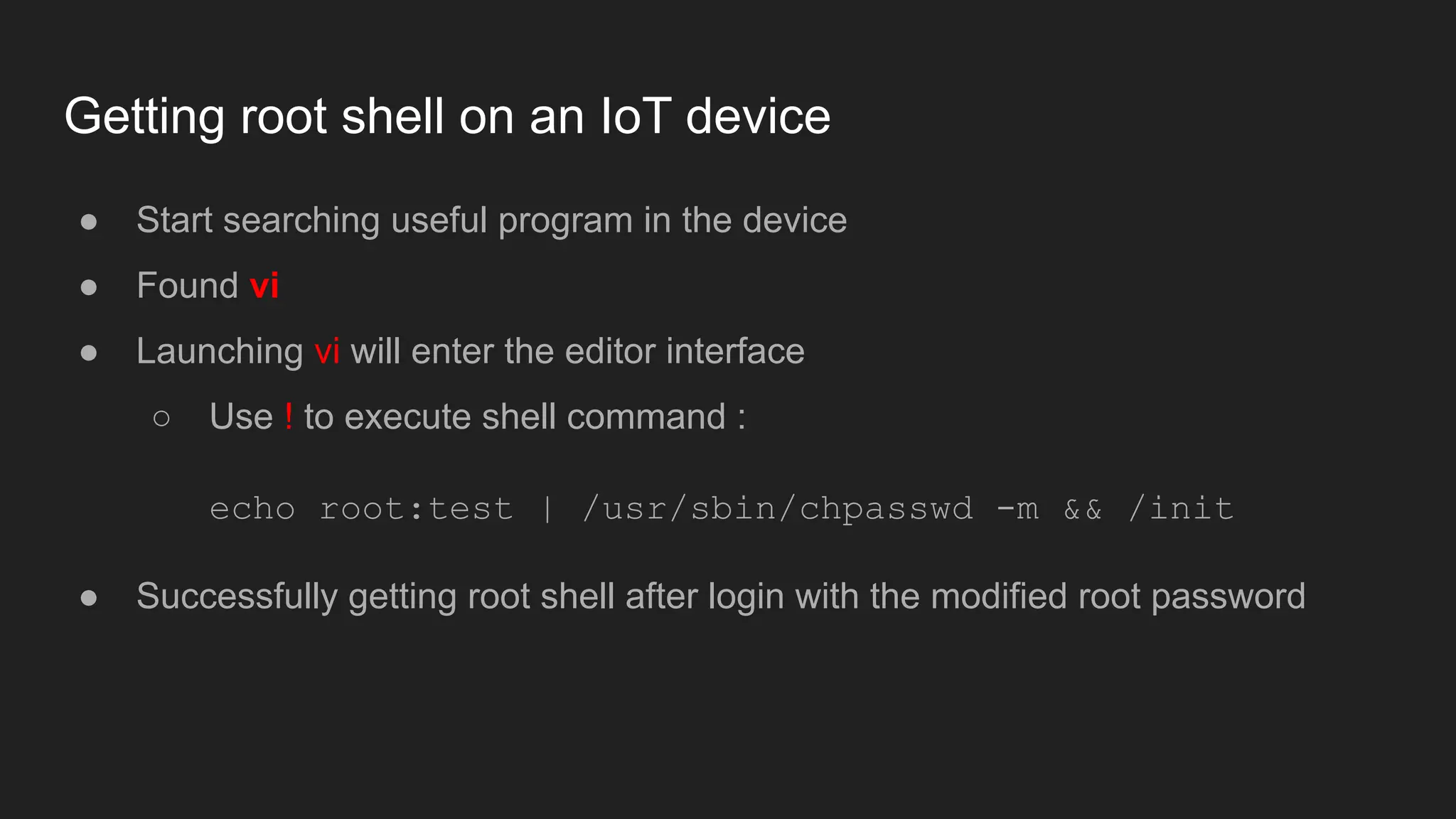
Getting root shell on an IoT device
● Start searching useful program in the device
● Found vi
● Launching vi will enter the editor interface
○ Use ! to execute shell command :
echo root:test | /usr/sbin/chpasswd -m && /init
● Successfully getting root shell after login with the modified root password
Case 2:
Bypassing CFG in
Windows Chrome browser
Real world CTF challenges are useful
● Pwnable
○ Browser
○ Linux kernel
○ VM escape
● Reverse
○ Challenges from Flare-on challenge
Getting RCE in Windows Chrome browser
● We reach to a point where we can control a C++ object in the browser
○ Can read/write the object memory
○ Fully control its member and vtable
● Normally we can achieve RCE by controlling the vtable
○ e.g. stack pivot -> ROP
● However, CFG is enabled in Windows Chrome
○ Can’t jump to arbitrary code address when calling virtual function
Bypassing CFG
● We can still jump to a valid virtual function, can we do something about it ?
● There are CTF challenges with similar solution
○ PlaidCTF 2020 - mojo
○ SCTF-XCTF 2020 - EasyMojo
● Looking at those write-ups, we found that we can search for useful virtual
functions in Chrome and do some evil stuff.
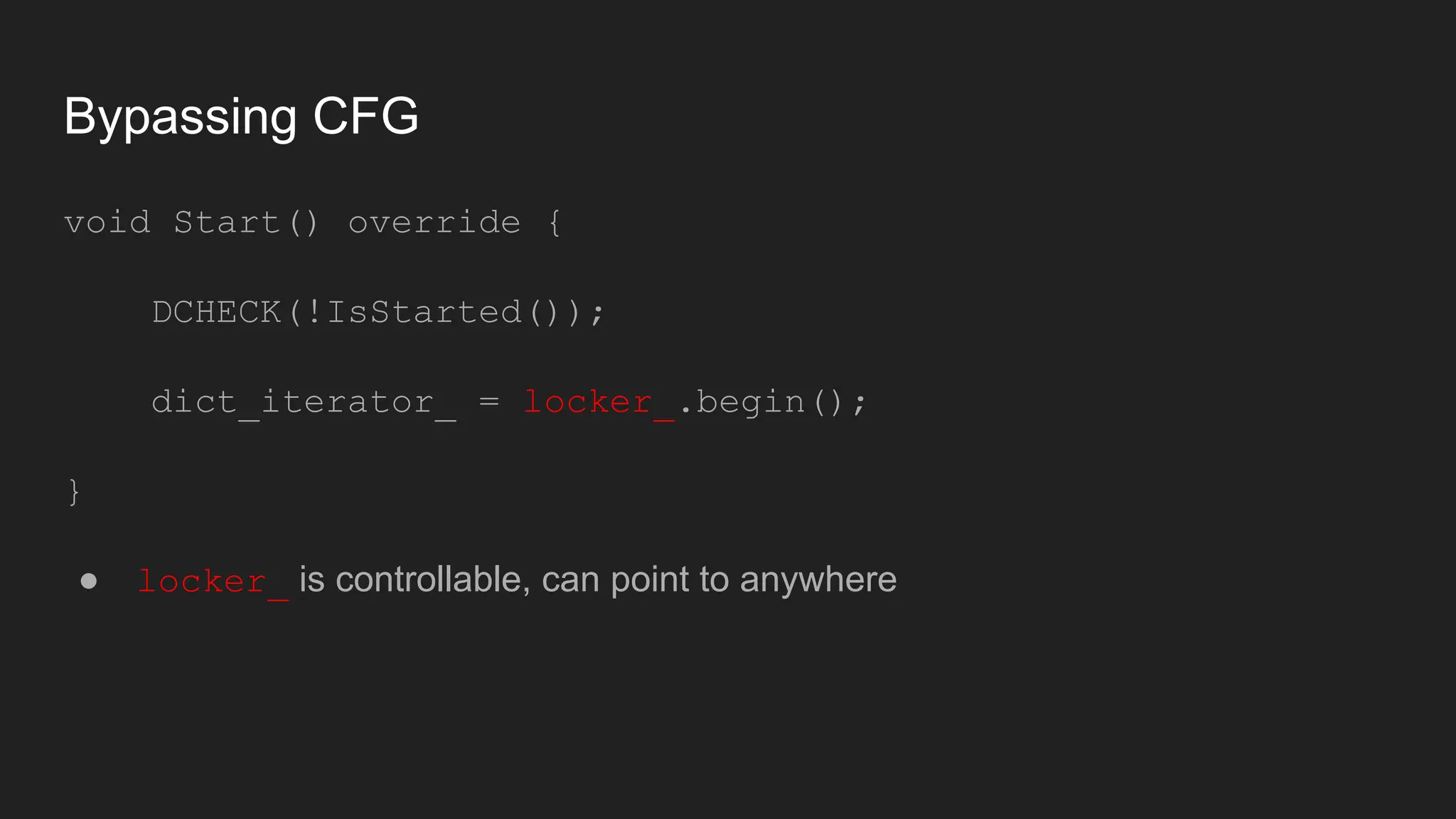
Bypassing CFG
void Start() override {
DCHECK(!IsStarted());
dict_iterator_ = locker_.begin();
}
● locker_ is controllable, can point to anywhere
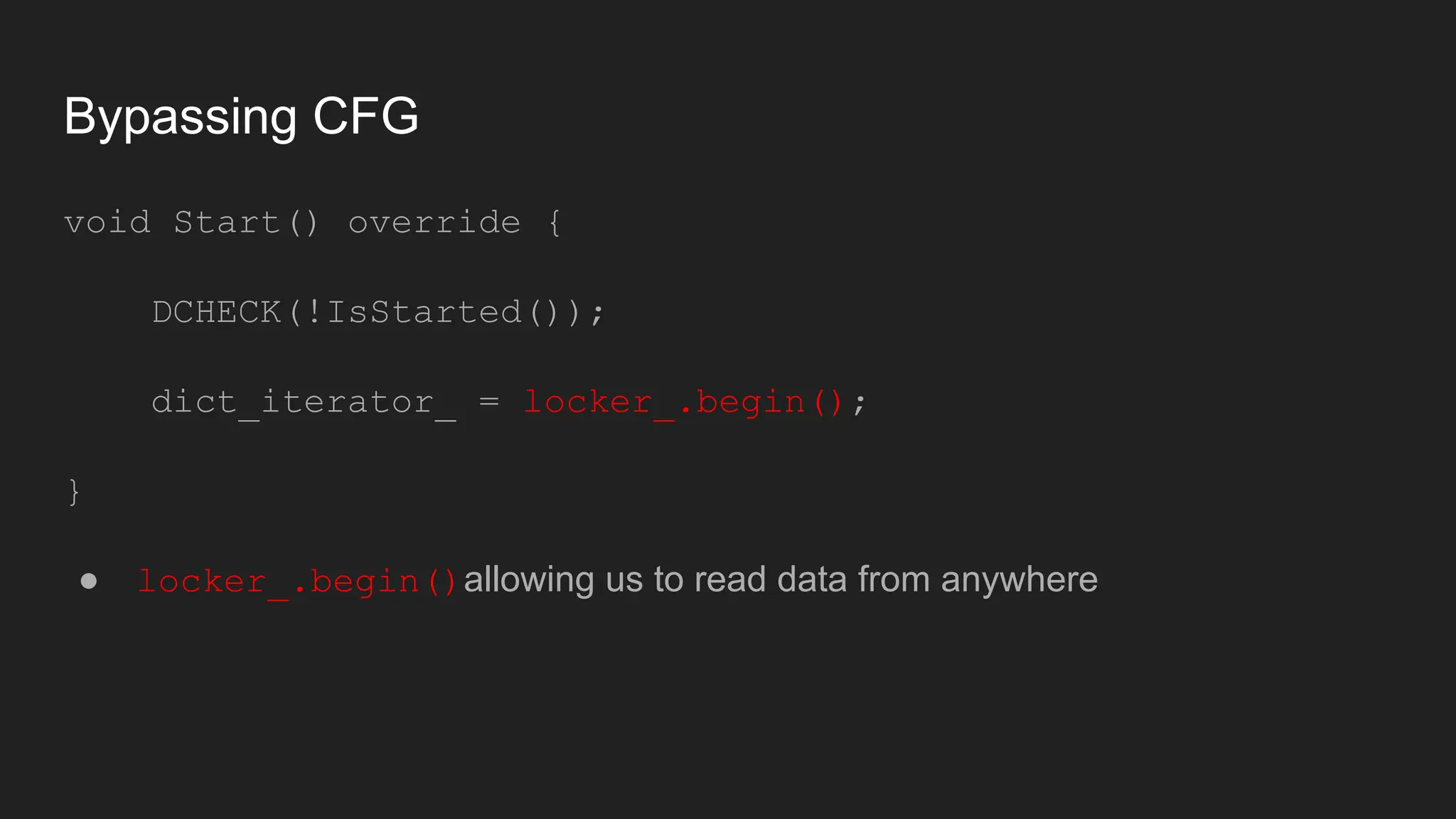
Bypassing CFG
void Start() override {
DCHECK(!IsStarted());
dict_iterator_ = locker_.begin();
}
● locker_.begin()allowing us to read data from anywhere
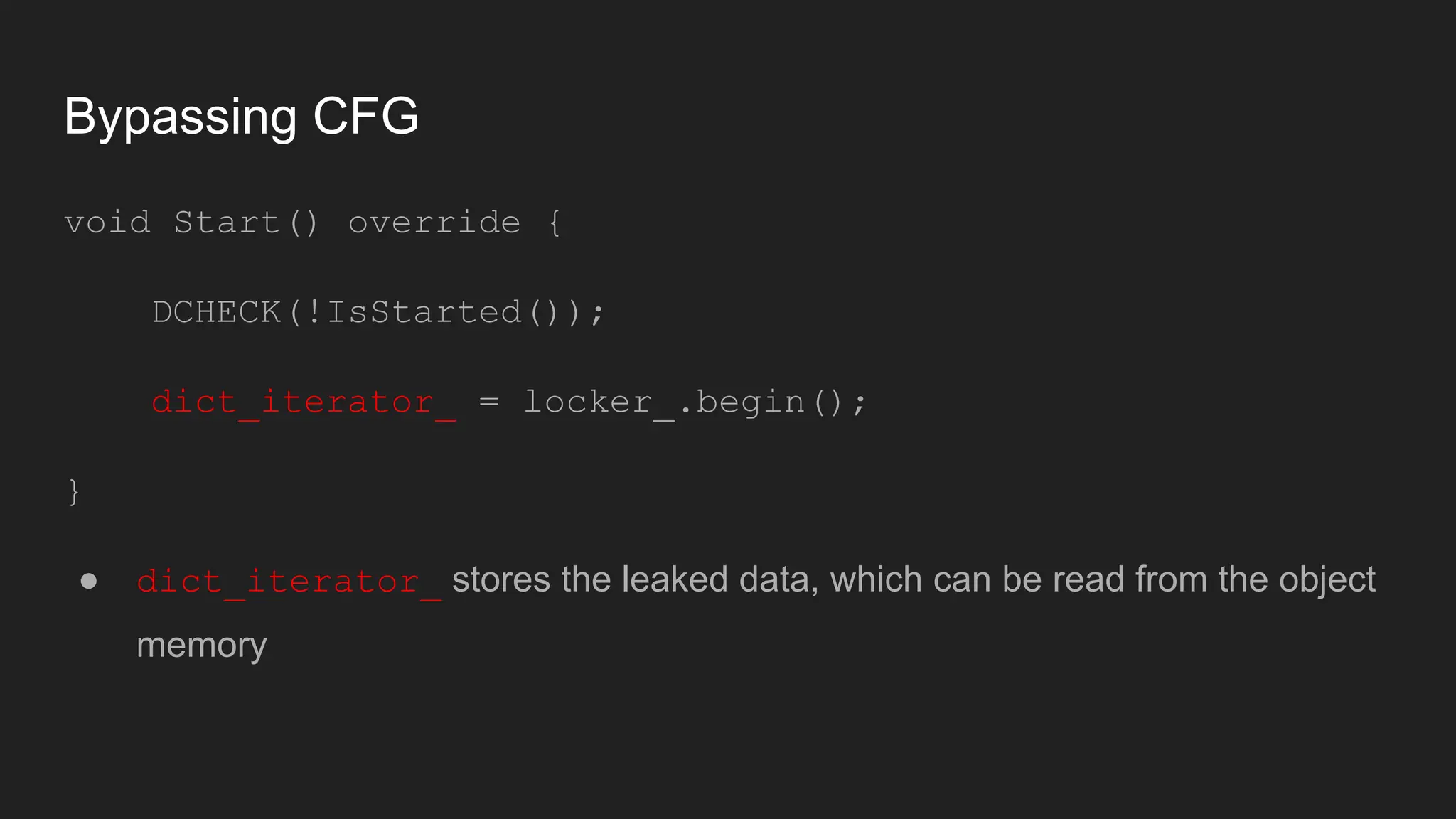
Bypassing CFG
void Start() override {
DCHECK(!IsStarted());
dict_iterator_ = locker_.begin();
}
● dict_iterator_ stores the leaked data, which can be read from the object
memory
Bypassing CFG
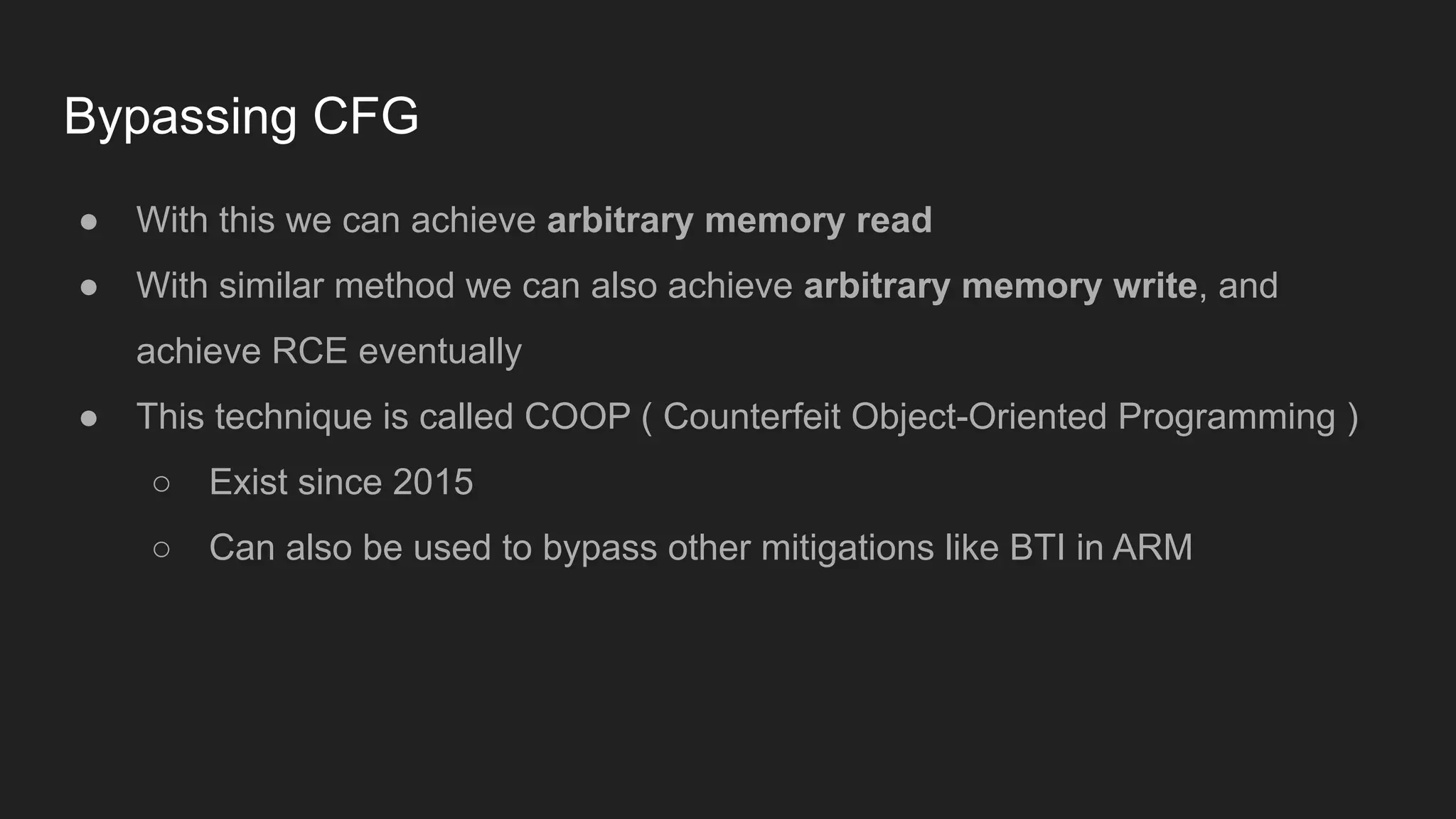
● With this we can achieve arbitrary memory read
● With similar method we can also achieve arbitrary memory write, and
achieve RCE eventually
● This technique is called COOP ( Counterfeit Object-Oriented Programming )
○ Exist since 2015
○ Can also be used to bypass other mitigations like BTI in ARM
Conclusion
● CTF is definitely useful
○ Improving various skills
○ Cultivate hacking mindset
○ Accumulating experiences
● Advice for CTFers ( that want to get into infosec career )
○ Focus on improving skills and mindset
○ Try more real world CTF challenges
○ Learn things that’s rarely seen in CTF ( e.g. Fuzzing, MIPS/ARM…etc )
○ Write write-up and always take note
THANK YOU
(backup slide)
Case 0:
NotPetya ransomeware analysis
Analyzing NotPetya ransomeware
● Static analysis
○ Reverse engineer the ransomware and the malicious bootloader
● Dynamic analysis
○ Debugging the malicious bootloader
● Forensic / Crypto
○ Perform disk forensics to understand how it was
corrupted/encrypted

20240921 - HITCON 社群活動《CTF 轉生-到了業界就拿出真本事》- bruce30262 講師分享

  • 1.
    How CTF helpon my career as a vulnerability researcher bruce30262
  • 2.
    About me Bruce Chen( @bruce30262 ) ● Vulnerability researcher at STAR Labs, mainly focus on Browser & IoT vulnerability research ● Former vulnerability researcher at NCSIST & TeamT5 ● MSRC 2023 Most Valuable Security Researcher ● Retired CTF player ( 2014 ~ 2022 ) ● Mainly focus on binary challenges ( Pwn / Reverse )
  • 3.
    What I learnedfrom CTFs ● Static & Dynamic program analyzing ○ Static: Reverse engineering ○ Dynamic: Software debugging ● Vulnerability discovering and exploitation techniques ● Scripting / Tooling ● Hacking mindset
  • 4.
    Case 1: Getting rootshell on an IoT device
  • 5.
    Skills for IoTvulnerability research ● Forensic / Crypto ○ Firmware extraction and decryption ● Static & Dynamic program analysis ○ Finding vulnerabilities via reverse engineering ○ Debugging target service ● Exploitation ○ Buffer overflow, Shellcode, ROP, command injection…etc ● Misc ( e.g. Hardware )
  • 6.
    Getting root shellon an IoT device ● It’s important to have a root shell on the research target ○ Can use it for service enumeration, install gdb …etc ● But sometimes the device doesn’t provide shell by default ○ No ssh, telnet…etc ● We’ll need to get the root shell with some tricks
  • 7.
    Getting root shellon an IoT device ● Target: an IP camera ● No ssh or telnet, but have UART pins ○ With UART we were able to login to U-boot and run some commands ● We were able to modify the boot command ○ Default is /init, can modify to other program, but no arguments allowed ○ Modify to /bin/sh will ended up freezing the serial console
  • 8.
    Getting root shellon an IoT device ● Start searching useful program in the device ● Found vi ● Launching vi will enter the editor interface ○ Use ! to execute shell command : echo root:test | /usr/sbin/chpasswd -m && /init ● Successfully getting root shell after login with the modified root password
  • 9.
    Case 2: Bypassing CFGin Windows Chrome browser
  • 10.
    Real world CTFchallenges are useful ● Pwnable ○ Browser ○ Linux kernel ○ VM escape ● Reverse ○ Challenges from Flare-on challenge
  • 11.
    Getting RCE inWindows Chrome browser ● We reach to a point where we can control a C++ object in the browser ○ Can read/write the object memory ○ Fully control its member and vtable ● Normally we can achieve RCE by controlling the vtable ○ e.g. stack pivot -> ROP ● However, CFG is enabled in Windows Chrome ○ Can’t jump to arbitrary code address when calling virtual function
  • 12.
    Bypassing CFG ● Wecan still jump to a valid virtual function, can we do something about it ? ● There are CTF challenges with similar solution ○ PlaidCTF 2020 - mojo ○ SCTF-XCTF 2020 - EasyMojo ● Looking at those write-ups, we found that we can search for useful virtual functions in Chrome and do some evil stuff.
  • 13.
    Bypassing CFG void Start()override { DCHECK(!IsStarted()); dict_iterator_ = locker_.begin(); } ● locker_ is controllable, can point to anywhere
  • 14.
    Bypassing CFG void Start()override { DCHECK(!IsStarted()); dict_iterator_ = locker_.begin(); } ● locker_.begin()allowing us to read data from anywhere
  • 15.
    Bypassing CFG void Start()override { DCHECK(!IsStarted()); dict_iterator_ = locker_.begin(); } ● dict_iterator_ stores the leaked data, which can be read from the object memory
  • 16.
    Bypassing CFG ● Withthis we can achieve arbitrary memory read ● With similar method we can also achieve arbitrary memory write, and achieve RCE eventually ● This technique is called COOP ( Counterfeit Object-Oriented Programming ) ○ Exist since 2015 ○ Can also be used to bypass other mitigations like BTI in ARM
  • 17.
    Conclusion ● CTF isdefinitely useful ○ Improving various skills ○ Cultivate hacking mindset ○ Accumulating experiences ● Advice for CTFers ( that want to get into infosec career ) ○ Focus on improving skills and mindset ○ Try more real world CTF challenges ○ Learn things that’s rarely seen in CTF ( e.g. Fuzzing, MIPS/ARM…etc ) ○ Write write-up and always take note
  • 18.
  • 19.
  • 20.
  • 21.
    Analyzing NotPetya ransomeware ●Static analysis ○ Reverse engineer the ransomware and the malicious bootloader ● Dynamic analysis ○ Debugging the malicious bootloader ● Forensic / Crypto ○ Perform disk forensics to understand how it was corrupted/encrypted