Capture the Flag (CTF) is a type of
information security competition that
challenges competitors to solve a
variety of tasks. CTFs are an educational
exercise to give participants experience
in attacking or defending software and
sometimes even hardware. The goal is to
find hidden "flags", which are typically
text or files that must be submitted to
earn points.
CTF challenges are based on already
existing exploits and give you an
environment to try them out. But the fun
part is...you don‘t know what exploit has
to be used. You have to review whatever
challenge files have been given to you
and craft an exploit yourself. This leads
to a much better understanding of the
exploit than just reading one.
Apart from a better understanding of
exploits you learn secure coding
practices and improve your scripting
skills. You learn essential skills you need
for any tech career - SQL, web stacks,
CP, linux, docker and much more....
The CTF community is very active and
you are able to connect to people around
the globe. And solving puzzles and
learning new skills all while having
fun...isn’t that just awesome?
Most of public CTFs are listed on
CTFtime. This is a site which saves the
data after each CTF, and mantains a
scoreboard for each team. There is a
country wise scoreboard and an
international scoreboard. The difficulty
of a CTF depends on the rating points
given. Generally, more the rating, the
tougher the CTF will be.
• Web Exploitation
• Forensics/IR/Stego
• pwn
• Reversing
• Crypto
• OSINT
https://bit.ly/48CmYoe
Web exploitation in CTF
challenges refers to finding and
exploiting vulnerabilities in web
applications. Usually, the source
code for the web app is provided
as a docker environment. You are
supposed to review the source
code and find some vulnerability.
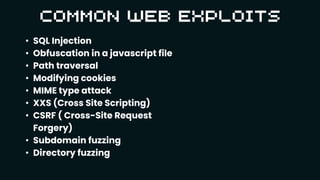
• SQL Injection
• Obfuscation in a javascript file
• Path traversal
• Modifying cookies
• MIME type attack
• XXS (Cross Site Scripting)
• CSRF ( Cross-Site Request
Forgery)
• Subdomain fuzzing
• Directory fuzzing
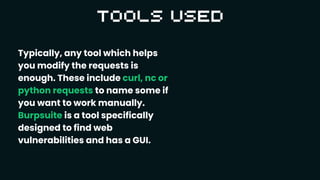
Typically, any tool which helps
you modify the requests is
enough. These include curl, nc or
python requests to name some if
you want to work manually.
Burpsuite is a tool specifically
designed to find web
vulnerabilities and has a GUI.
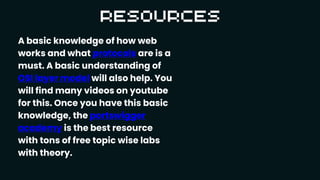
A basic knowledge of how web
works and what protocols are is a
must. A basic understanding of
OSI layer model will also help. You
will find many videos on youtube
for this. Once you have this basic
knowledge, the portswigger
academy is the best resource
with tons of free topic wise labs
with theory.
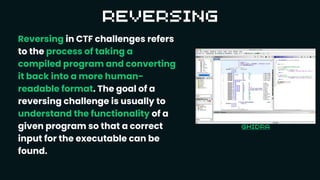
Reversing in CTF challenges refers
to the process of taking a
compiled program and converting
it back into a more human-
readable format. The goal of a
reversing challenge is usually to
understand the functionality of a
given program so that a correct
input for the executable can be
found.
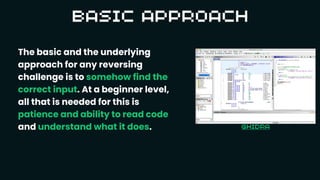
The basic and the underlying
approach for any reversing
challenge is to somehow find the
correct input. At a beginner level,
all that is needed for this is
patience and ability to read code
and understand what it does.
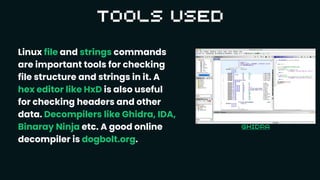
Linux file and strings commands
are important tools for checking
file structure and strings in it. A
hex editor like HxD is also useful
for checking headers and other
data. Decompilers like Ghidra, IDA,
Binaray Ninja etc. A good online
decompiler is dogbolt.org.
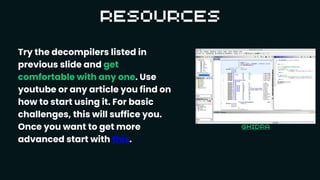
Try the decompilers listed in
previous slide and get
comfortable with any one. Use
youtube or any article you find on
how to start using it. For basic
challenges, this will suffice you.
Once you want to get more
advanced start with this.
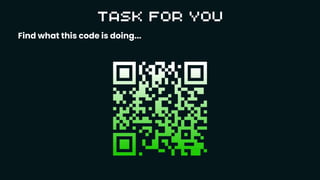
Find what this code is doing...
Forensics in CTF challenges
involve analyzing digital artifacts
or images to extract hidden
information. Participants may
need to examine file headers,
recover deleted data, or use
steganography techniques to
uncover hidden messages. This
is a category where you mostly
learn as you see challenges.
In stego challs, usually very less
information is given and many
times you need to do everything
you know one by one to check
what is hidden.
In IR, you are given a copy of a disk
of an attacked machine and you
are supposed to trace events and
find flags. This is mostly a series of
7-8 challs and requires knowledge
of all other categories as well.
The list of tools here is unending,
but some tools used as de facto
are:
• Wireshark/tshark for pcap
analysis
• Stego tools (loads of them)
• Password cracking tools (yes
they exist!)
As mentioned earlier, you learn
forensics by doing only. You can
follow our CSOC’22 course for
learning the skills here. Apart
from this seeing and reading
writeups will help a lot. Look at
this playlist. For IR, a basic
knowledge of all skills is required.
You can check this writeup here
for seeing how its done.
In CTF challenges, "pwn" refers to a
category of challenges that
involves exploiting vulnerable
programs running on a remote
server. The objective is to redirect
the program flow to do something
different and obtain a flag. This is
also called Binary Exploitation.
One of the most interesting
problems is that of pwning, where
you have to somehow get what is
unintended by the program. The
approach is to basically
understand the control flow and
craft inputs that would break the
program and allow it to behave the
way we want.
pwning requires knowledge of
assembly and computer
architecture. Some tools that will
help you analyse them and craft
exploits are:
• Reversing tools
• Debugger like gdb
• pwntools library for python
Knowledge of assembly, memory,
executables is required. For
assembly follow this. Then you can
start with pwn.college or nightmare
(helps in reversing as well). Both
are excellent resources. This
playlist is also really awesome!
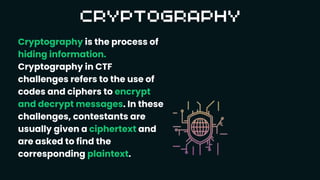
Cryptography is the process of
hiding information.
Cryptography in CTF
challenges refers to the use of
codes and ciphers to encrypt
and decrypt messages. In these
challenges, contestants are
usually given a ciphertext and
are asked to find the
corresponding plaintext.
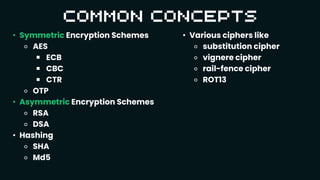
• Symmetric Encryption Schemes
⚬ AES
■ ECB
■ CBC
■ CTR
⚬ OTP
• Asymmetric Encryption Schemes
⚬ RSA
⚬ DSA
• Hashing
⚬ SHA
⚬ Md5
• Various ciphers like
⚬ substitution cipher
⚬ vignere cipher
⚬ rail-fence cipher
⚬ ROT13
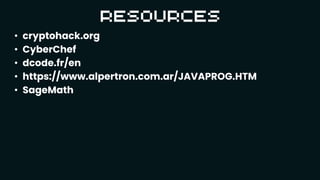
• cryptohack.org
• CyberChef
• dcode.fr/en
• https://www.alpertron.com.ar/JAVAPROG.HTM
• SageMath
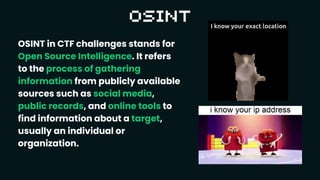
OSINT in CTF challenges stands for
Open Source Intelligence. It refers
to the process of gathering
information from publicly available
sources such as social media,
public records, and online tools to
find information about a target,
usually an individual or
organization.
What OSINT really requires is
observing skills and tons of patience.
You learn most by gaining
experience. Specific tools maybe
found at an awesome online tool
osintframework.com. Reading and
seeing writeups will help you gain
good skills. This is a really nice 5 hrs
video covering all aspects.
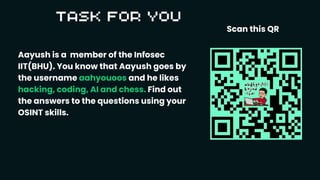
Aayush is a member of the Infosec
IIT(BHU). You know that Aayush goes by
the username aahyouoos and he likes
hacking, coding, AI and chess. Find out
the answers to the questions using your
OSINT skills.
Scan this QR
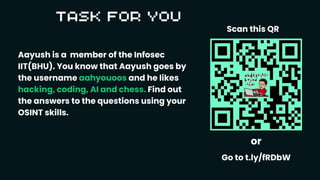
Aayush is a member of the Infosec
IIT(BHU). You know that Aayush goes by
the username aahyouoos and he likes
hacking, coding, AI and chess. Find out
the answers to the questions using your
OSINT skills.
or
Go to t.ly/fRDbW
Scan this QR
Apart from the before mentioned domain related resources, there
are a few skills you would need to have.
The first is Linux. Linux is an open source and lightweight operating
system that is used for development and other tech tasks. We
recommend you install linux as a VM and start learning from here.
Once you get comfortable, do this.
The second thing is learning a scripting language. Most of you will
learn C programming language in first year. But for scripting,
especially in CTFs, python is the language of choice due its
flexibility and tons of extra libraries. You can start learning python
by following the tutorial in official docs.
The CTF will be your first step in the process of
entry in COPS. So get ready for some action!

Cyber Security Workshop Presentation.pptx

  • 2.
    Capture the Flag(CTF) is a type of information security competition that challenges competitors to solve a variety of tasks. CTFs are an educational exercise to give participants experience in attacking or defending software and sometimes even hardware. The goal is to find hidden "flags", which are typically text or files that must be submitted to earn points.
  • 3.
    CTF challenges arebased on already existing exploits and give you an environment to try them out. But the fun part is...you don‘t know what exploit has to be used. You have to review whatever challenge files have been given to you and craft an exploit yourself. This leads to a much better understanding of the exploit than just reading one.
  • 4.
    Apart from abetter understanding of exploits you learn secure coding practices and improve your scripting skills. You learn essential skills you need for any tech career - SQL, web stacks, CP, linux, docker and much more.... The CTF community is very active and you are able to connect to people around the globe. And solving puzzles and learning new skills all while having fun...isn’t that just awesome?
  • 5.
    Most of publicCTFs are listed on CTFtime. This is a site which saves the data after each CTF, and mantains a scoreboard for each team. There is a country wise scoreboard and an international scoreboard. The difficulty of a CTF depends on the rating points given. Generally, more the rating, the tougher the CTF will be.
  • 6.
    • Web Exploitation •Forensics/IR/Stego • pwn • Reversing • Crypto • OSINT
  • 7.
  • 8.
    Web exploitation inCTF challenges refers to finding and exploiting vulnerabilities in web applications. Usually, the source code for the web app is provided as a docker environment. You are supposed to review the source code and find some vulnerability.
  • 9.
    • SQL Injection •Obfuscation in a javascript file • Path traversal • Modifying cookies • MIME type attack • XXS (Cross Site Scripting) • CSRF ( Cross-Site Request Forgery) • Subdomain fuzzing • Directory fuzzing
  • 10.
    Typically, any toolwhich helps you modify the requests is enough. These include curl, nc or python requests to name some if you want to work manually. Burpsuite is a tool specifically designed to find web vulnerabilities and has a GUI.
  • 11.
    A basic knowledgeof how web works and what protocols are is a must. A basic understanding of OSI layer model will also help. You will find many videos on youtube for this. Once you have this basic knowledge, the portswigger academy is the best resource with tons of free topic wise labs with theory.
  • 12.
    Reversing in CTFchallenges refers to the process of taking a compiled program and converting it back into a more human- readable format. The goal of a reversing challenge is usually to understand the functionality of a given program so that a correct input for the executable can be found.
  • 13.
    The basic andthe underlying approach for any reversing challenge is to somehow find the correct input. At a beginner level, all that is needed for this is patience and ability to read code and understand what it does.
  • 14.
    Linux file andstrings commands are important tools for checking file structure and strings in it. A hex editor like HxD is also useful for checking headers and other data. Decompilers like Ghidra, IDA, Binaray Ninja etc. A good online decompiler is dogbolt.org.
  • 15.
    Try the decompilerslisted in previous slide and get comfortable with any one. Use youtube or any article you find on how to start using it. For basic challenges, this will suffice you. Once you want to get more advanced start with this.
  • 16.
    Find what thiscode is doing...
  • 17.
    Forensics in CTFchallenges involve analyzing digital artifacts or images to extract hidden information. Participants may need to examine file headers, recover deleted data, or use steganography techniques to uncover hidden messages. This is a category where you mostly learn as you see challenges.
  • 18.
    In stego challs,usually very less information is given and many times you need to do everything you know one by one to check what is hidden. In IR, you are given a copy of a disk of an attacked machine and you are supposed to trace events and find flags. This is mostly a series of 7-8 challs and requires knowledge of all other categories as well.
  • 19.
    The list oftools here is unending, but some tools used as de facto are: • Wireshark/tshark for pcap analysis • Stego tools (loads of them) • Password cracking tools (yes they exist!)
  • 20.
    As mentioned earlier,you learn forensics by doing only. You can follow our CSOC’22 course for learning the skills here. Apart from this seeing and reading writeups will help a lot. Look at this playlist. For IR, a basic knowledge of all skills is required. You can check this writeup here for seeing how its done.
  • 21.
    In CTF challenges,"pwn" refers to a category of challenges that involves exploiting vulnerable programs running on a remote server. The objective is to redirect the program flow to do something different and obtain a flag. This is also called Binary Exploitation.
  • 22.
    One of themost interesting problems is that of pwning, where you have to somehow get what is unintended by the program. The approach is to basically understand the control flow and craft inputs that would break the program and allow it to behave the way we want.
  • 23.
    pwning requires knowledgeof assembly and computer architecture. Some tools that will help you analyse them and craft exploits are: • Reversing tools • Debugger like gdb • pwntools library for python
  • 24.
    Knowledge of assembly,memory, executables is required. For assembly follow this. Then you can start with pwn.college or nightmare (helps in reversing as well). Both are excellent resources. This playlist is also really awesome!
  • 25.
    Cryptography is theprocess of hiding information. Cryptography in CTF challenges refers to the use of codes and ciphers to encrypt and decrypt messages. In these challenges, contestants are usually given a ciphertext and are asked to find the corresponding plaintext.
  • 26.
    • Symmetric EncryptionSchemes ⚬ AES ■ ECB ■ CBC ■ CTR ⚬ OTP • Asymmetric Encryption Schemes ⚬ RSA ⚬ DSA • Hashing ⚬ SHA ⚬ Md5 • Various ciphers like ⚬ substitution cipher ⚬ vignere cipher ⚬ rail-fence cipher ⚬ ROT13
  • 27.
    • cryptohack.org • CyberChef •dcode.fr/en • https://www.alpertron.com.ar/JAVAPROG.HTM • SageMath
  • 28.
    OSINT in CTFchallenges stands for Open Source Intelligence. It refers to the process of gathering information from publicly available sources such as social media, public records, and online tools to find information about a target, usually an individual or organization.
  • 29.
    What OSINT reallyrequires is observing skills and tons of patience. You learn most by gaining experience. Specific tools maybe found at an awesome online tool osintframework.com. Reading and seeing writeups will help you gain good skills. This is a really nice 5 hrs video covering all aspects.
  • 30.
    Aayush is amember of the Infosec IIT(BHU). You know that Aayush goes by the username aahyouoos and he likes hacking, coding, AI and chess. Find out the answers to the questions using your OSINT skills. Scan this QR
  • 31.
    Aayush is amember of the Infosec IIT(BHU). You know that Aayush goes by the username aahyouoos and he likes hacking, coding, AI and chess. Find out the answers to the questions using your OSINT skills. or Go to t.ly/fRDbW Scan this QR
  • 32.
    Apart from thebefore mentioned domain related resources, there are a few skills you would need to have. The first is Linux. Linux is an open source and lightweight operating system that is used for development and other tech tasks. We recommend you install linux as a VM and start learning from here. Once you get comfortable, do this. The second thing is learning a scripting language. Most of you will learn C programming language in first year. But for scripting, especially in CTFs, python is the language of choice due its flexibility and tons of extra libraries. You can start learning python by following the tutorial in official docs.
  • 33.
    The CTF willbe your first step in the process of entry in COPS. So get ready for some action!