PMPâ
Prep Exam Test
Page 1
200 Exam Test Questions
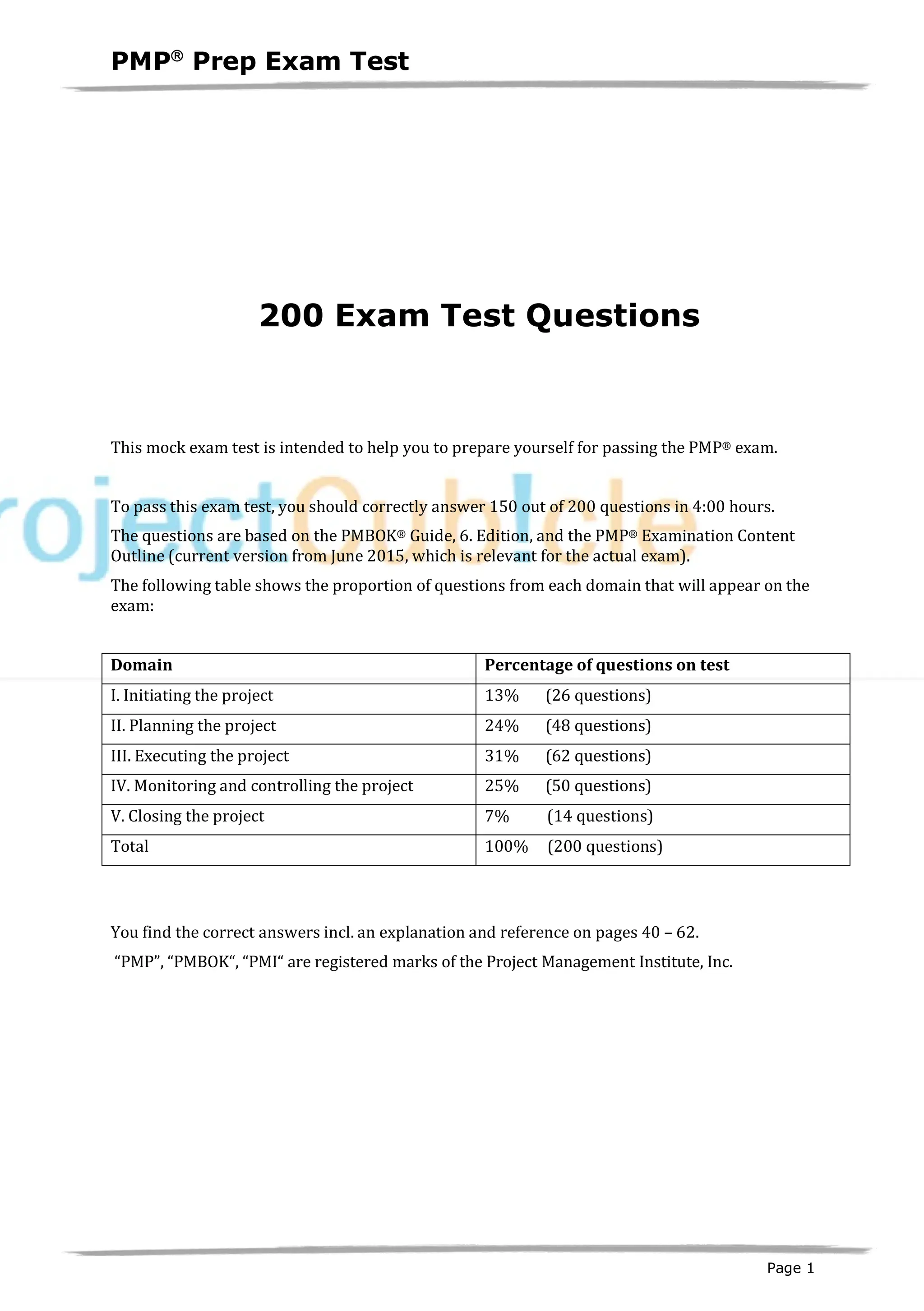
This mock exam test is intended to help you to prepare yourself for passing the PMP® exam.
To pass this exam test, you should correctly answer 150 out of 200 questions in 4:00 hours.
The questions are based on the PMBOK® Guide, 6. Edition, and the PMP® Examination Content
Outline (current version from June 2015, which is relevant for the actual exam).
The following table shows the proportion of questions from each domain that will appear on the
exam:
Domain Percentage of questions on test
I. Initiating the project 13% (26 questions)
II. Planning the project 24% (48 questions)
III. Executing the project 31% (62 questions)
IV. Monitoring and controlling the project 25% (50 questions)
V. Closing the project 7% (14 questions)
Total 100% (200 questions)
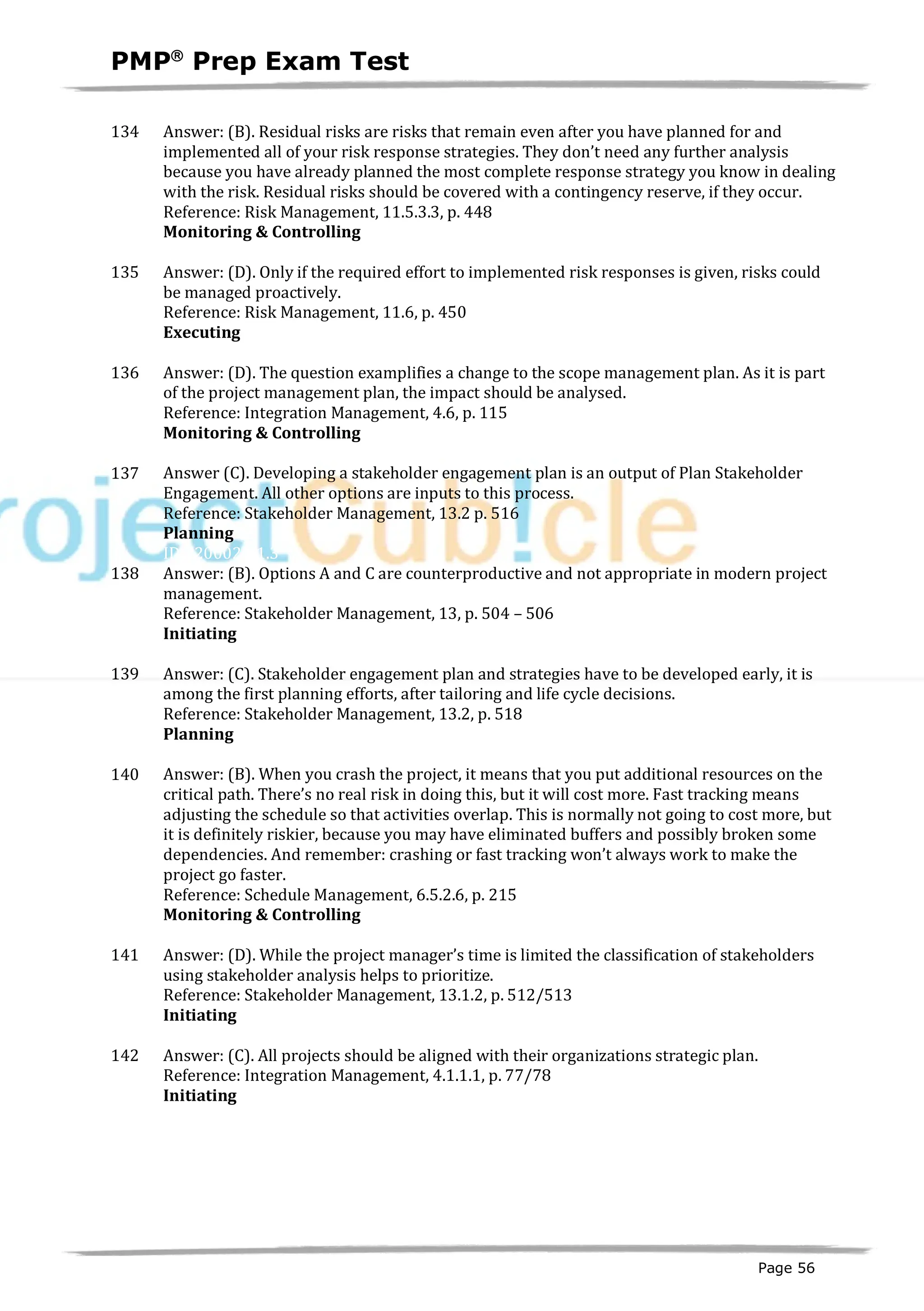
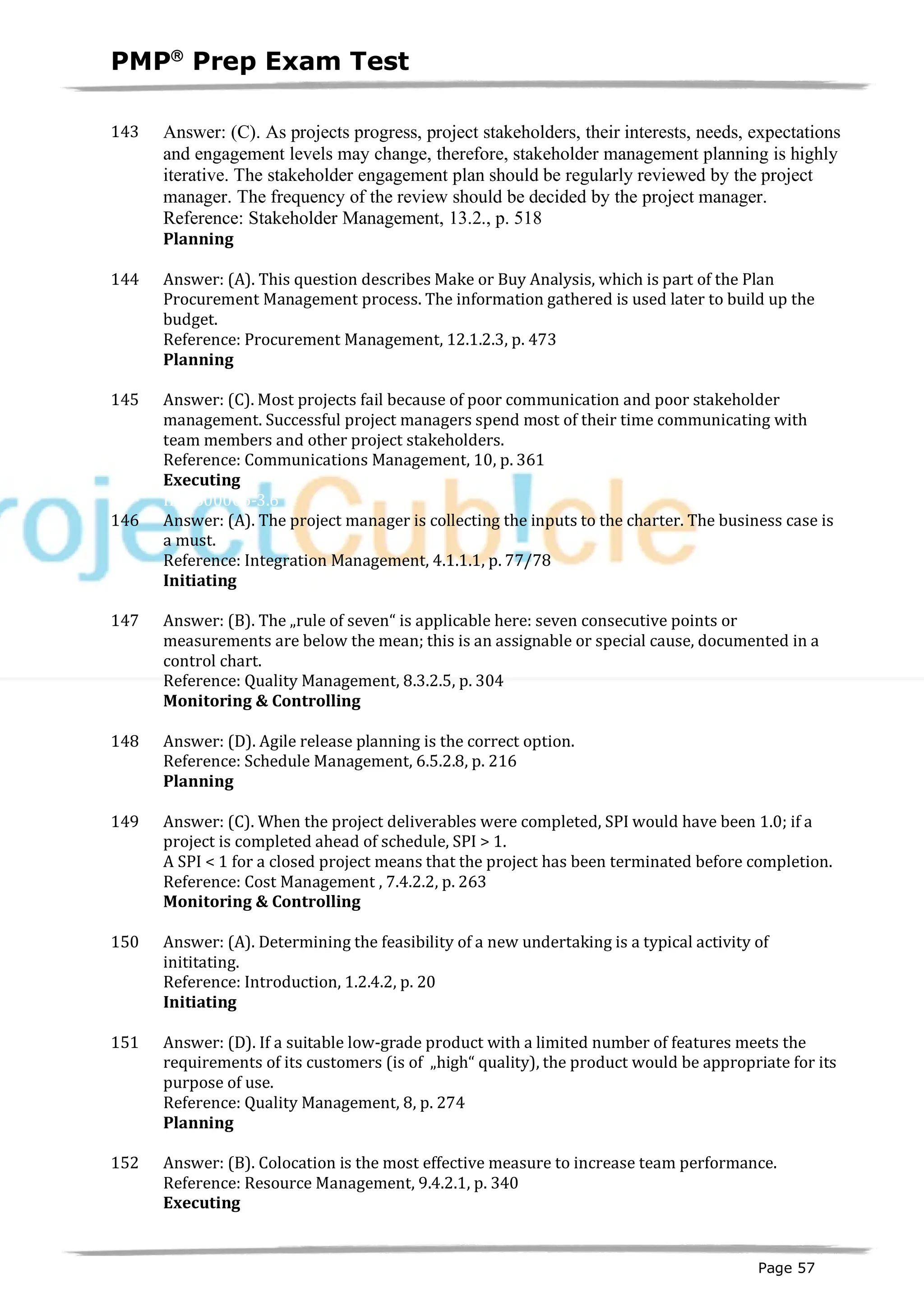
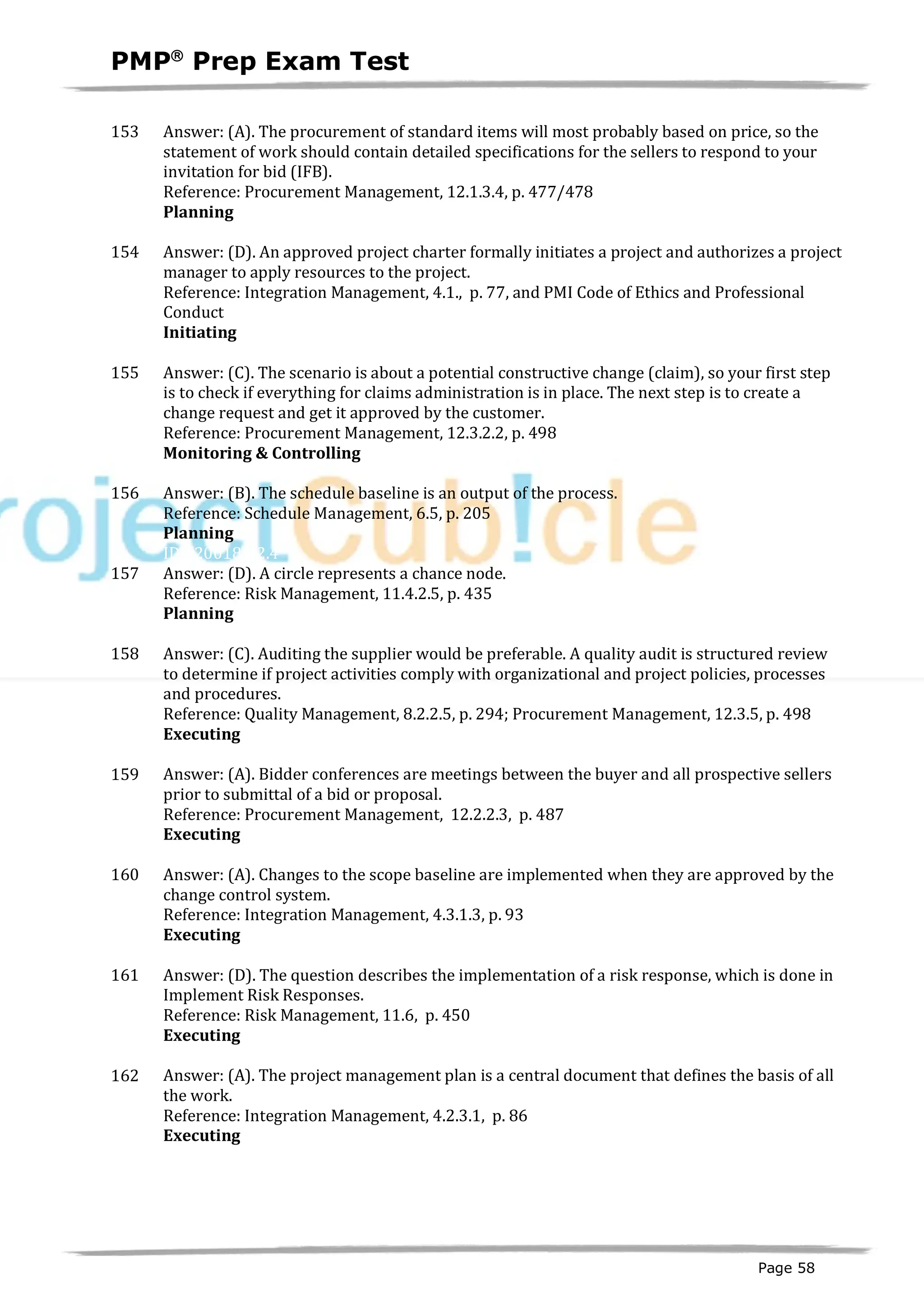
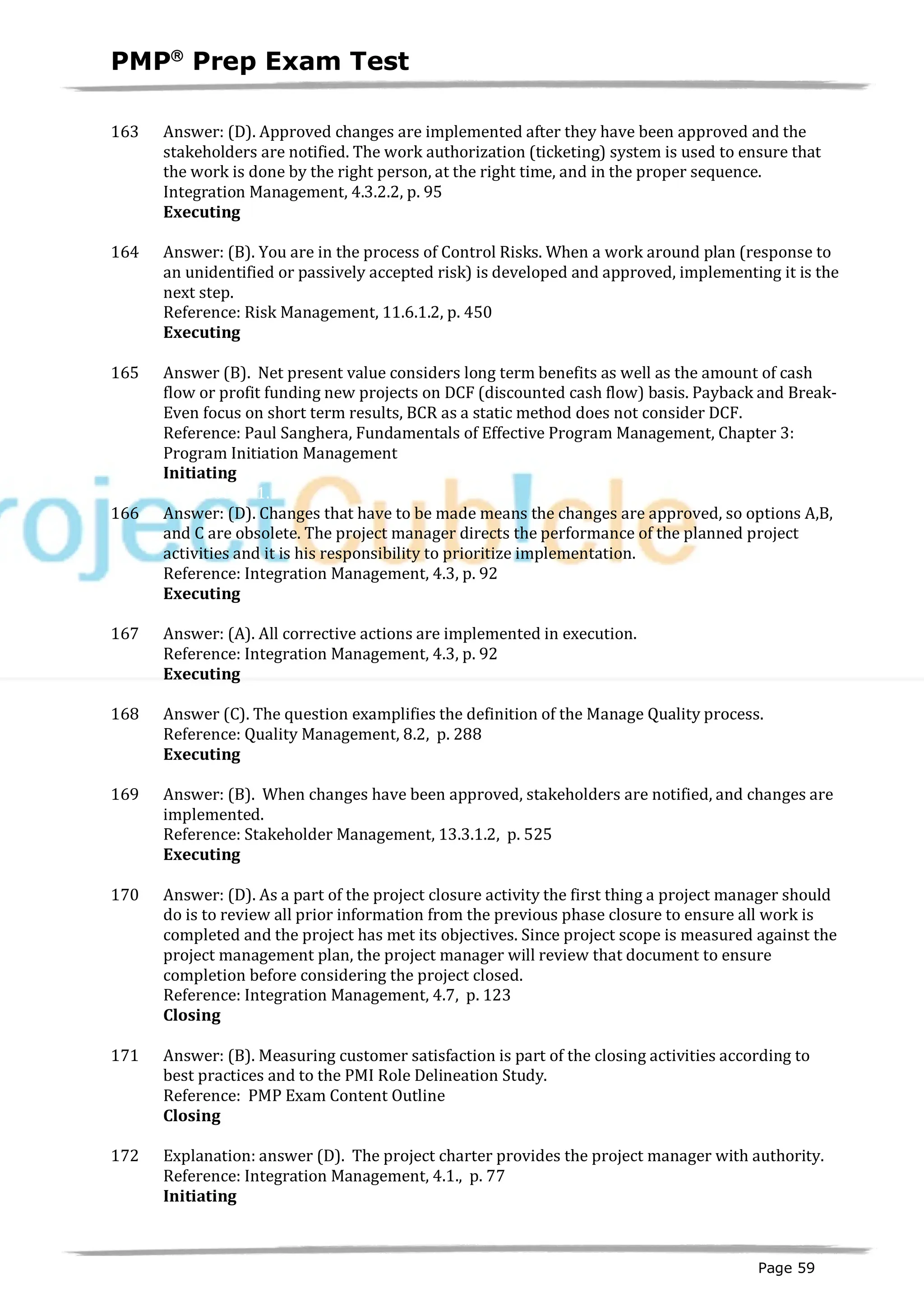
You find the correct answers incl. an explanation and reference on pages 40 – 62.
“PMP”, “PMBOK“, “PMI“ are registered marks of the Project Management Institute, Inc.
PMPâ
Prep Exam Test
Page 2
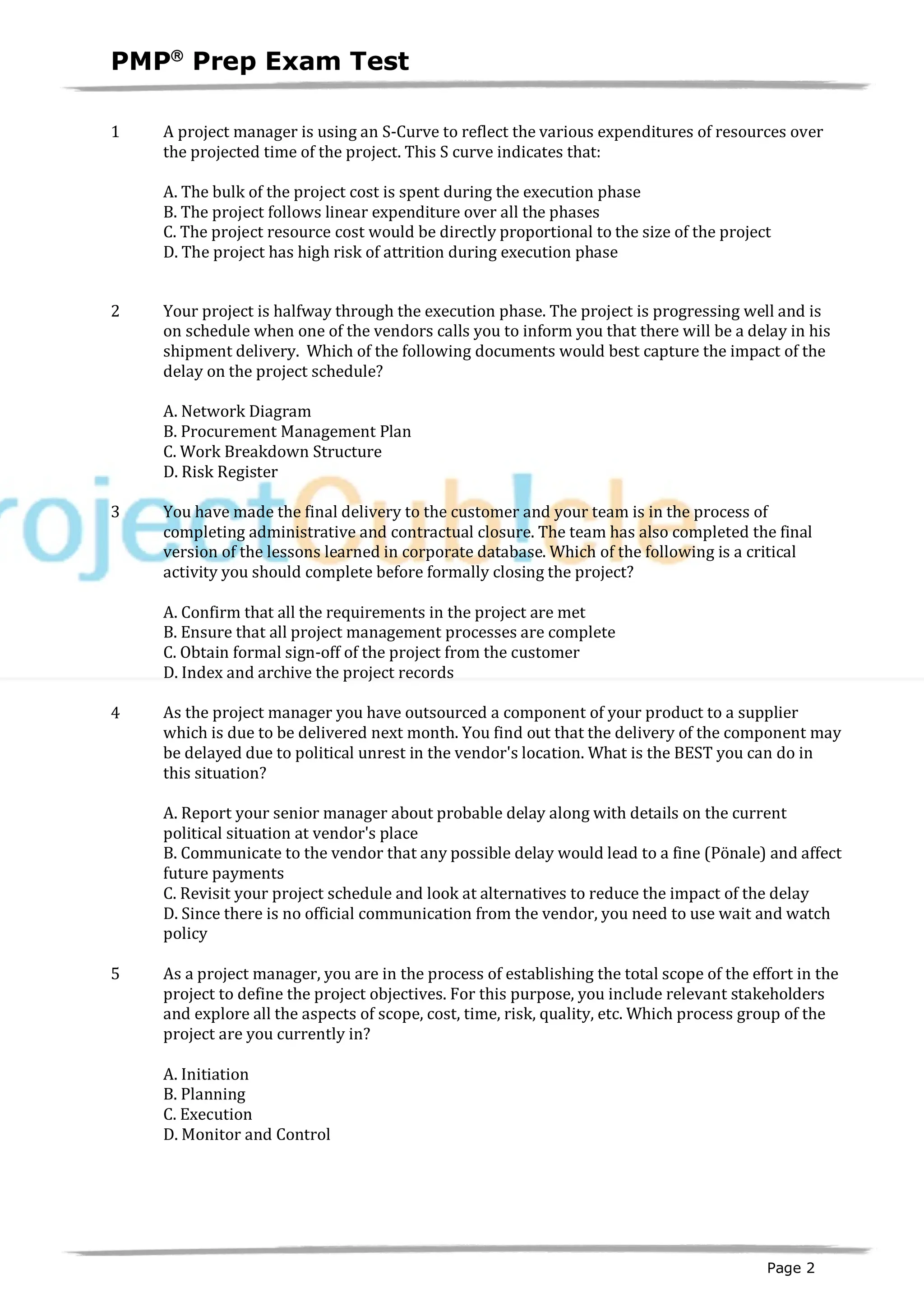
1 A project manager is using an S-Curve to reflect the various expenditures of resources over
the projected time of the project. This S curve indicates that:
A. The bulk of the project cost is spent during the execution phase
B. The project follows linear expenditure over all the phases
C. The project resource cost would be directly proportional to the size of the project
D. The project has high risk of attrition during execution phase
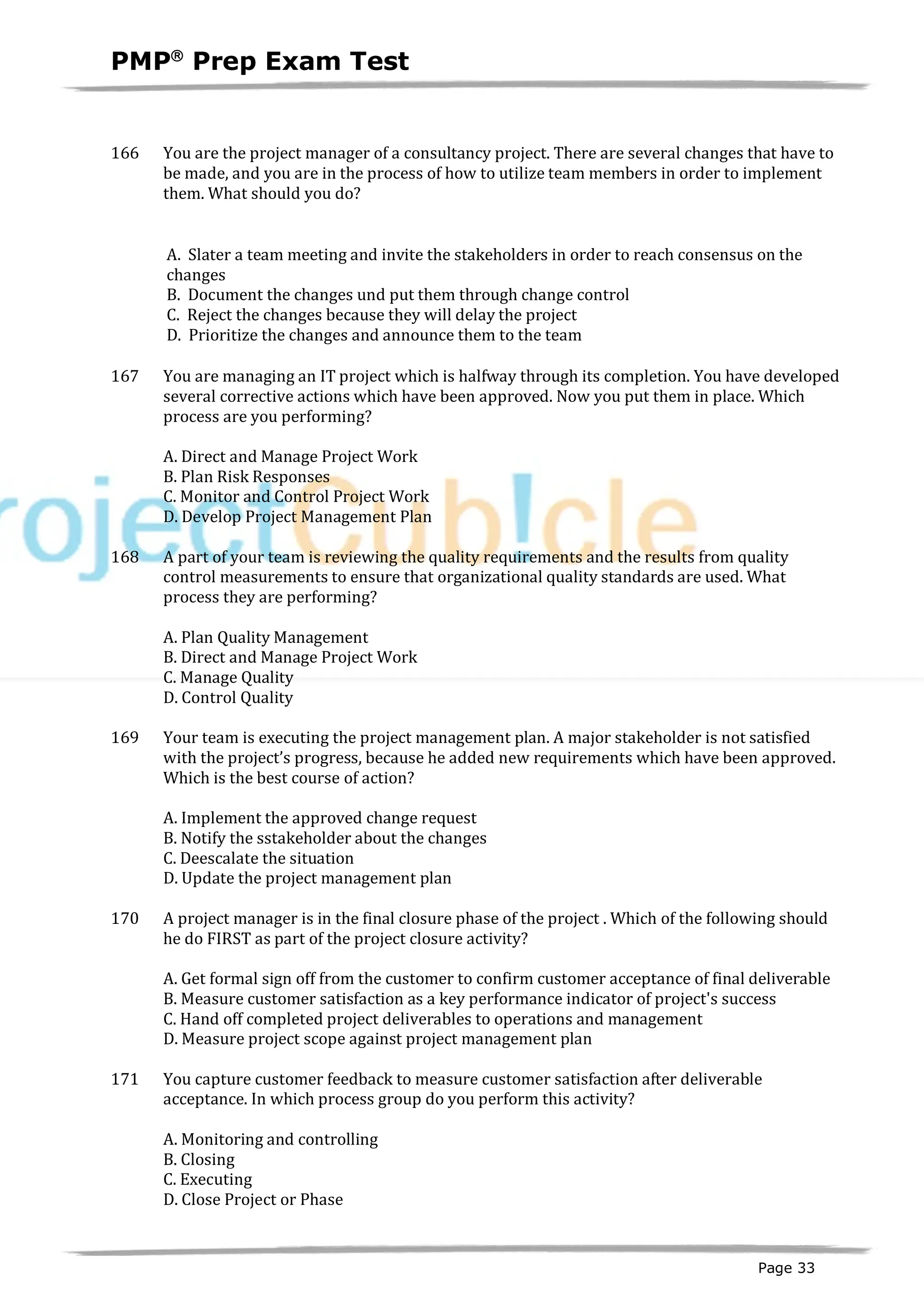
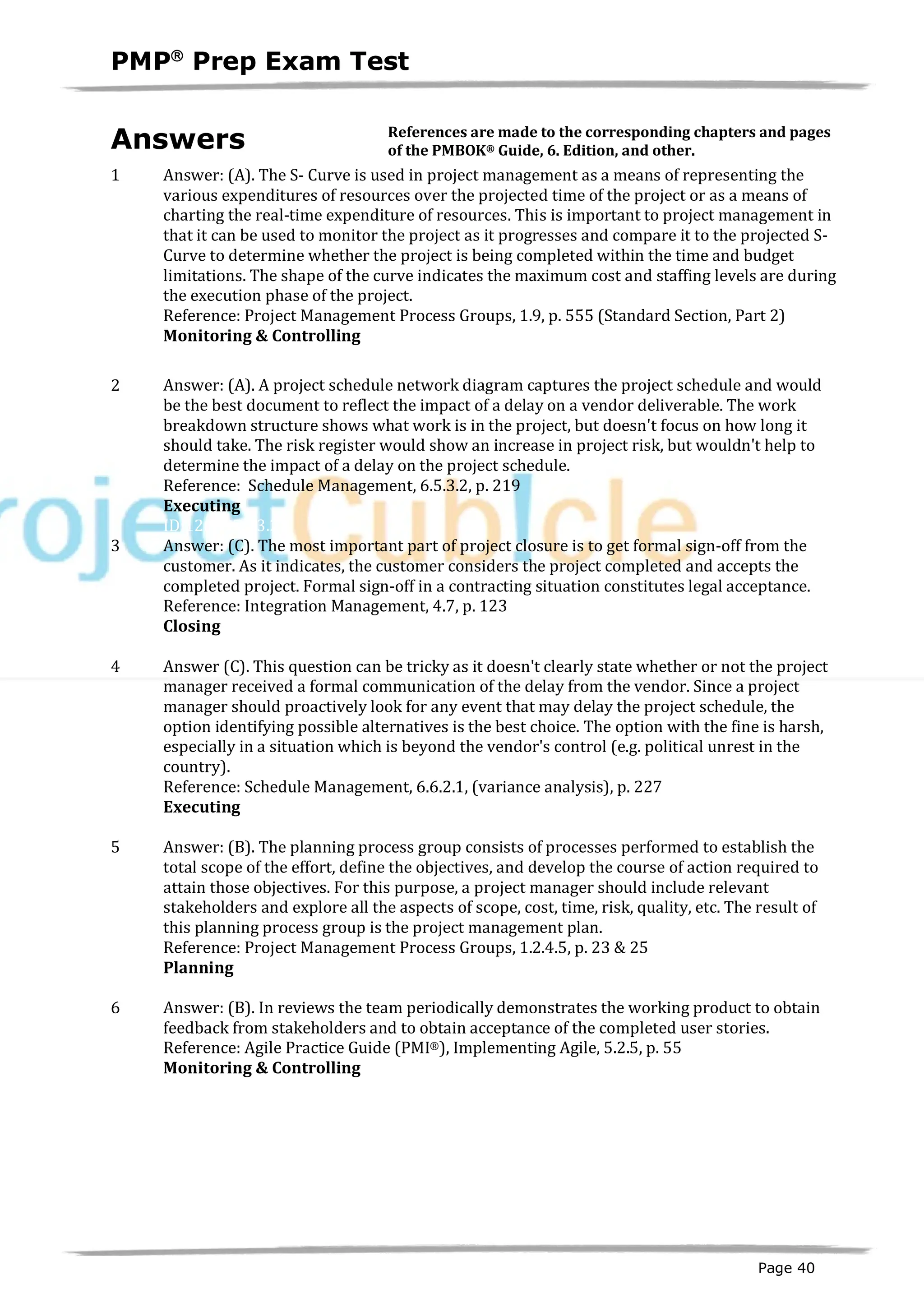
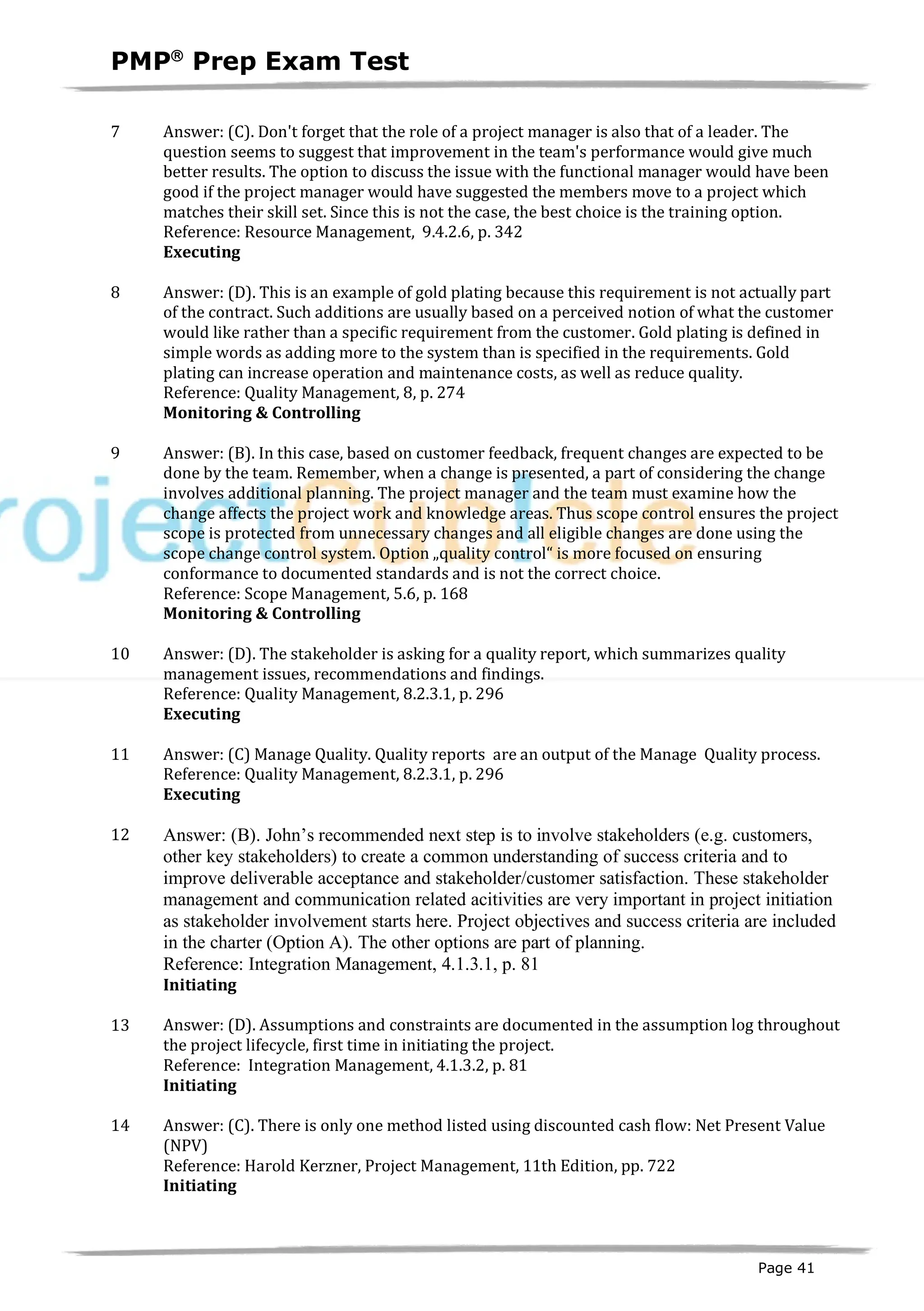
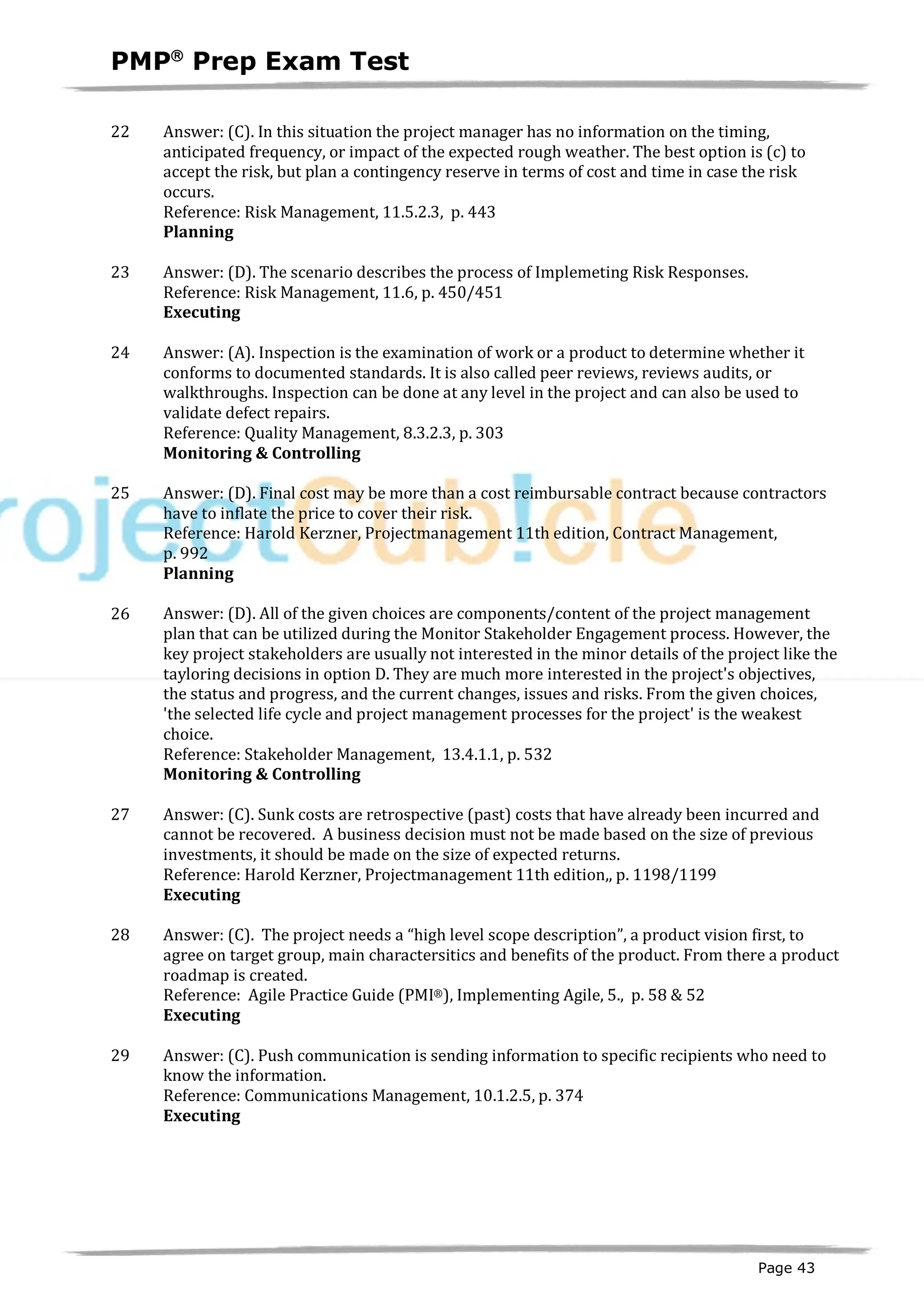
2 Your project is halfway through the execution phase. The project is progressing well and is
on schedule when one of the vendors calls you to inform you that there will be a delay in his
shipment delivery. Which of the following documents would best capture the impact of the
delay on the project schedule?
A. Network Diagram
B. Procurement Management Plan
C. Work Breakdown Structure
D. Risk Register
3 You have made the final delivery to the customer and your team is in the process of
completing administrative and contractual closure. The team has also completed the final
version of the lessons learned in corporate database. Which of the following is a critical
activity you should complete before formally closing the project?
A. Confirm that all the requirements in the project are met
B. Ensure that all project management processes are complete
C. Obtain formal sign-off of the project from the customer
D. Index and archive the project records
4 As the project manager you have outsourced a component of your product to a supplier
which is due to be delivered next month. You find out that the delivery of the component may
be delayed due to political unrest in the vendor's location. What is the BEST you can do in
this situation?
A. Report your senior manager about probable delay along with details on the current
political situation at vendor's place
B. Communicate to the vendor that any possible delay would lead to a fine (Pönale) and affect
future payments
C. Revisit your project schedule and look at alternatives to reduce the impact of the delay
D. Since there is no official communication from the vendor, you need to use wait and watch
policy
5 As a project manager, you are in the process of establishing the total scope of the effort in the
project to define the project objectives. For this purpose, you include relevant stakeholders
and explore all the aspects of scope, cost, time, risk, quality, etc. Which process group of the
project are you currently in?
A. Initiation
B. Planning
C. Execution
D. Monitor and Control
PMPâ
Prep Exam Test
Page 3
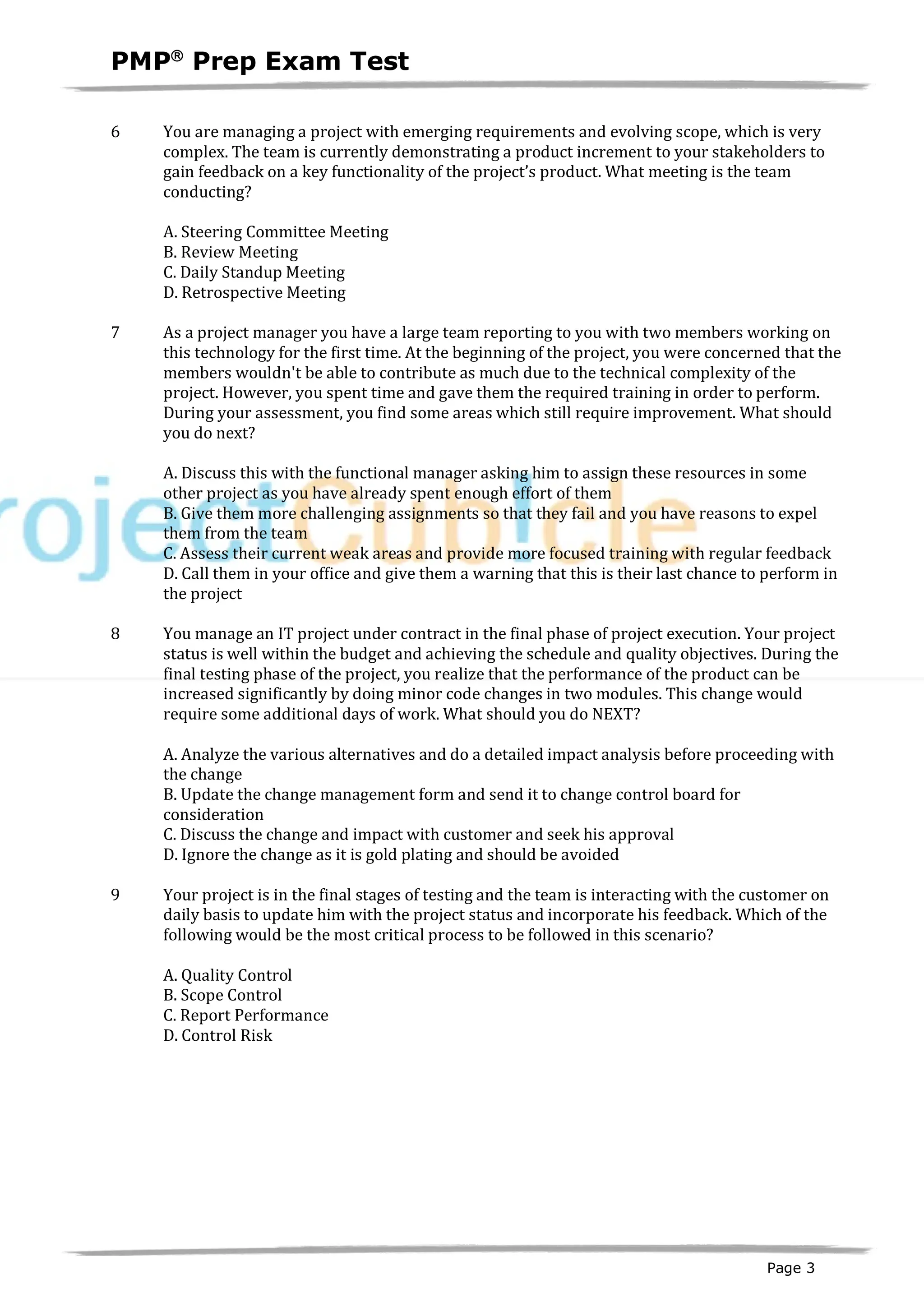
6 You are managing a project with emerging requirements and evolving scope, which is very
complex. The team is currently demonstrating a product increment to your stakeholders to
gain feedback on a key functionality of the project’s product. What meeting is the team
conducting?
A. Steering Committee Meeting
B. Review Meeting
C. Daily Standup Meeting
D. Retrospective Meeting
7 As a project manager you have a large team reporting to you with two members working on
this technology for the first time. At the beginning of the project, you were concerned that the
members wouldn't be able to contribute as much due to the technical complexity of the
project. However, you spent time and gave them the required training in order to perform.
During your assessment, you find some areas which still require improvement. What should
you do next?
A. Discuss this with the functional manager asking him to assign these resources in some
other project as you have already spent enough effort of them
B. Give them more challenging assignments so that they fail and you have reasons to expel
them from the team
C. Assess their current weak areas and provide more focused training with regular feedback
D. Call them in your office and give them a warning that this is their last chance to perform in
the project
8 You manage an IT project under contract in the final phase of project execution. Your project
status is well within the budget and achieving the schedule and quality objectives. During the
final testing phase of the project, you realize that the performance of the product can be
increased significantly by doing minor code changes in two modules. This change would
require some additional days of work. What should you do NEXT?
A. Analyze the various alternatives and do a detailed impact analysis before proceeding with
the change
B. Update the change management form and send it to change control board for
consideration
C. Discuss the change and impact with customer and seek his approval
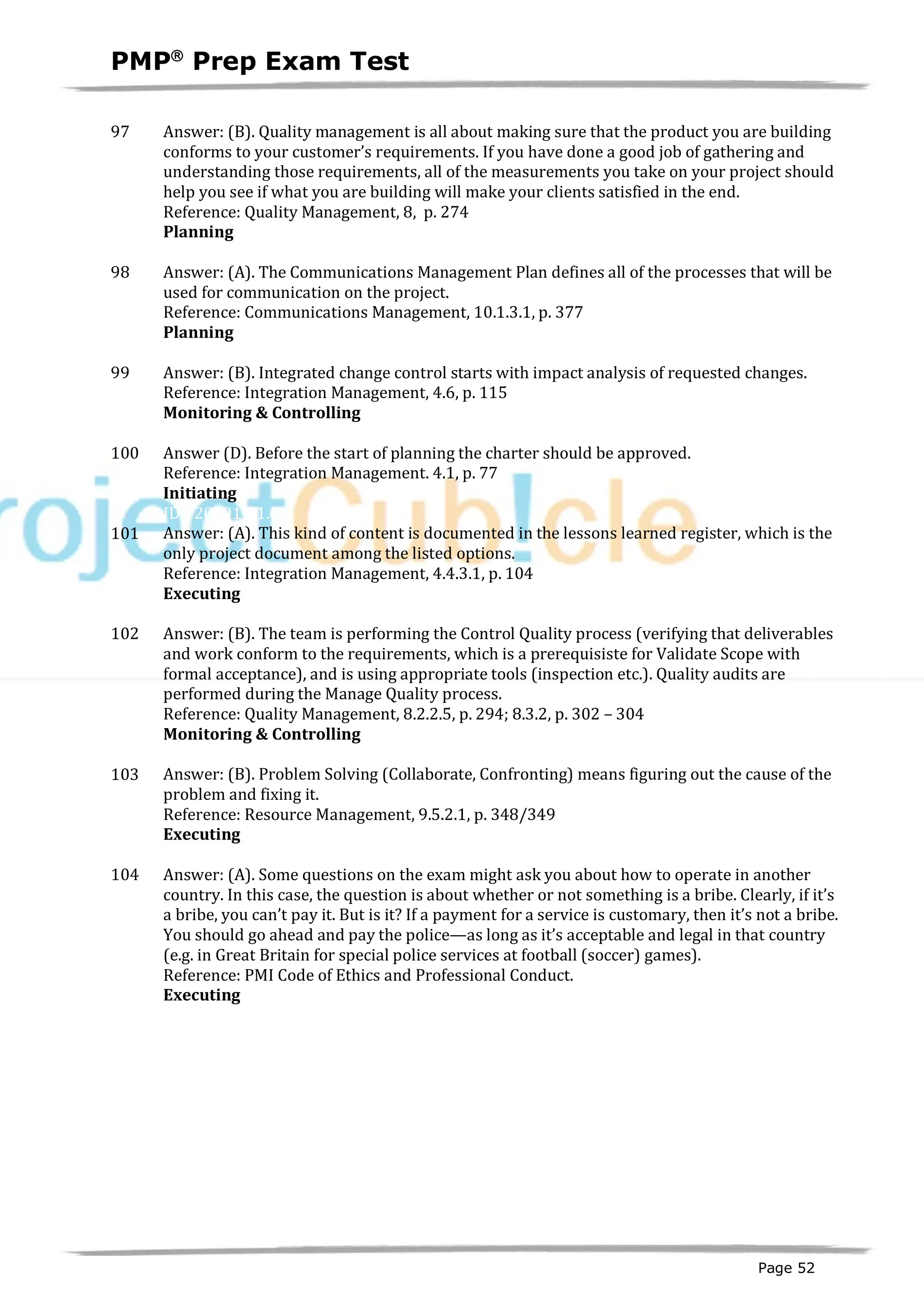
D. Ignore the change as it is gold plating and should be avoided
9 Your project is in the final stages of testing and the team is interacting with the customer on
daily basis to update him with the project status and incorporate his feedback. Which of the
following would be the most critical process to be followed in this scenario?
A. Quality Control
B. Scope Control
C. Report Performance
D. Control Risk
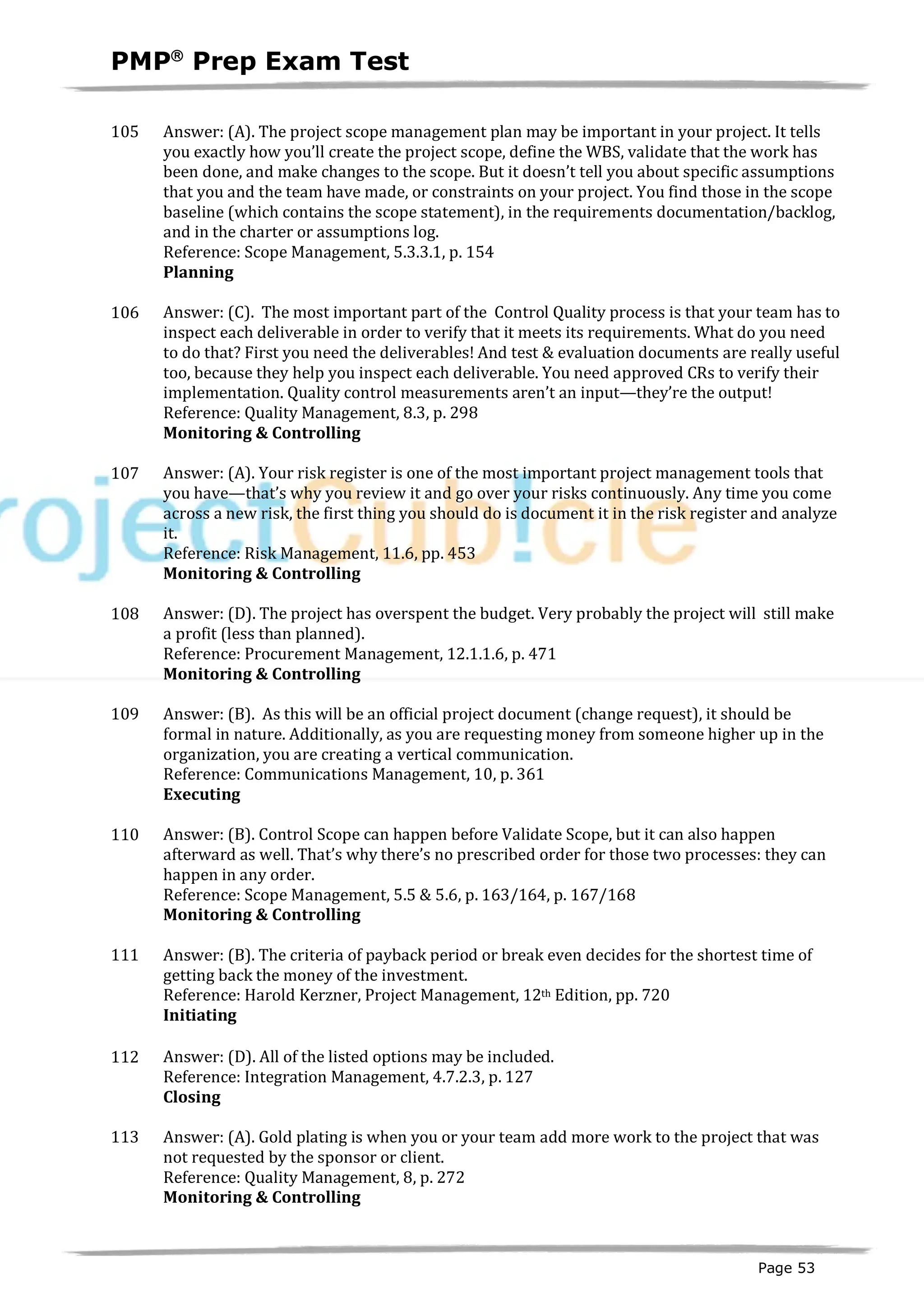
PMPâ
Prep Exam Test
Page 4
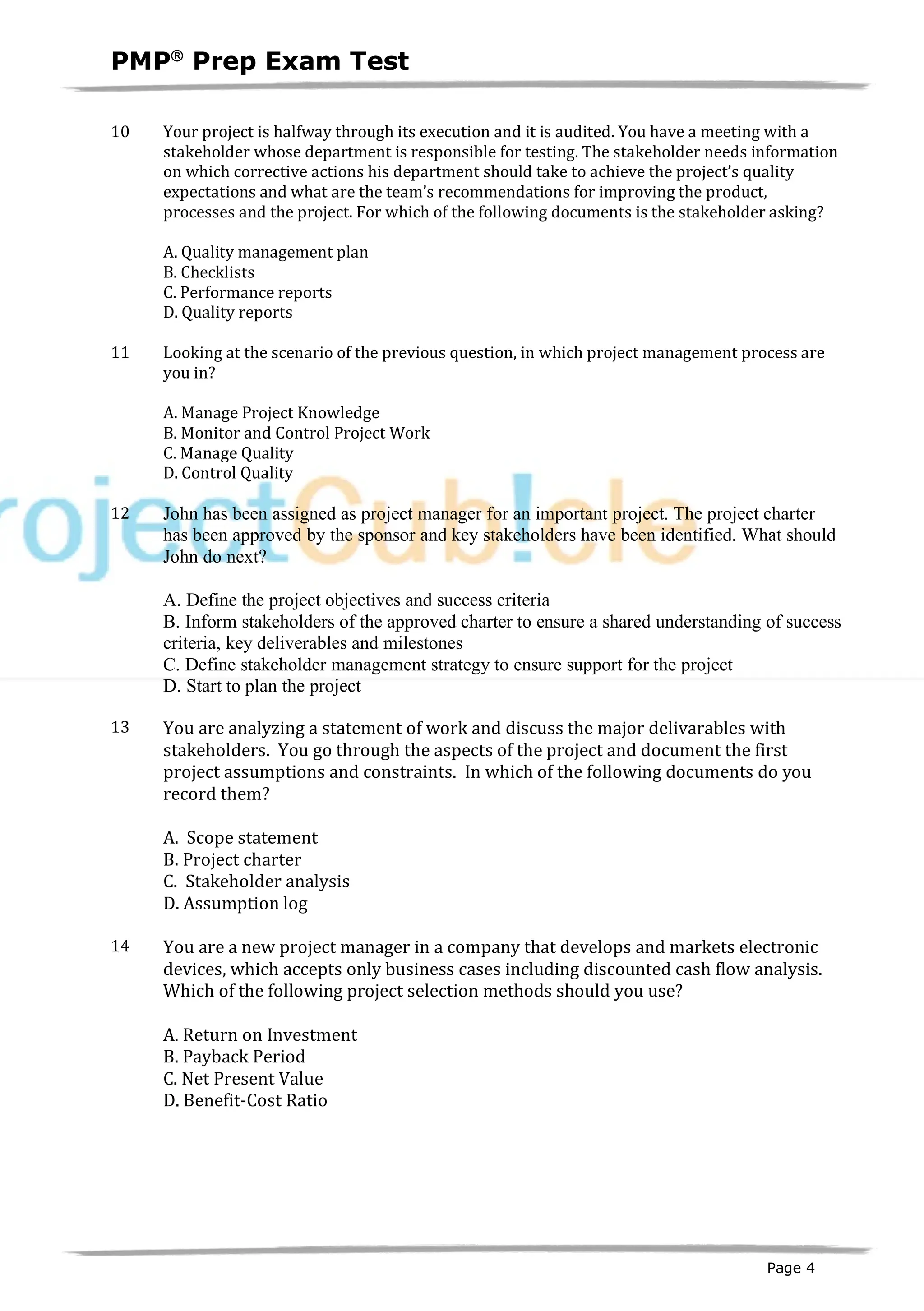
10 Your project is halfway through its execution and it is audited. You have a meeting with a
stakeholder whose department is responsible for testing. The stakeholder needs information
on which corrective actions his department should take to achieve the project’s quality
expectations and what are the team’s recommendations for improving the product,
processes and the project. For which of the following documents is the stakeholder asking?
A. Quality management plan
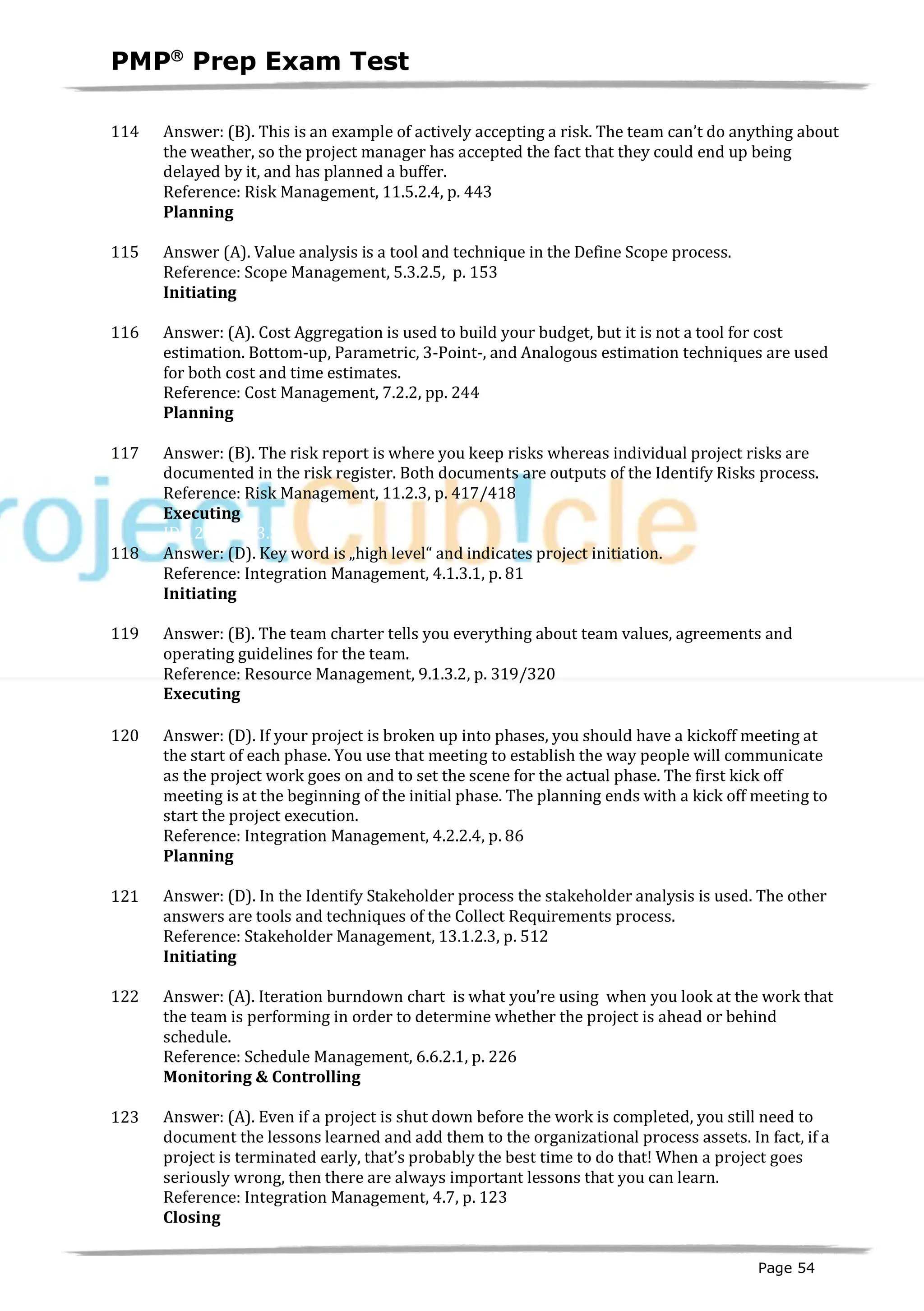
B. Checklists
C. Performance reports
D. Quality reports
11 Looking at the scenario of the previous question, in which project management process are
you in?
A. Manage Project Knowledge
B. Monitor and Control Project Work
C. Manage Quality
D. Control Quality
12 John has been assigned as project manager for an important project. The project charter
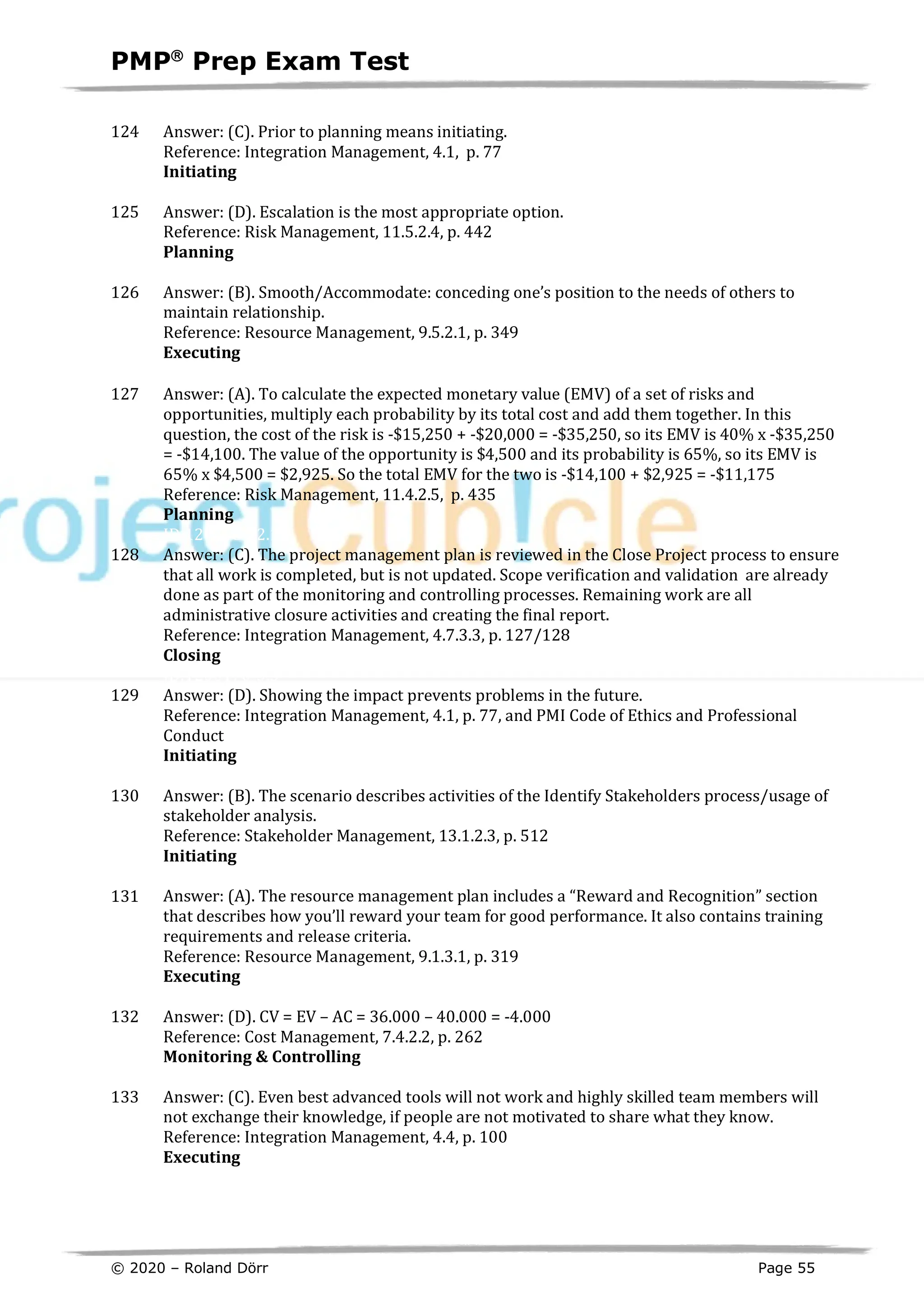
has been approved by the sponsor and key stakeholders have been identified. What should
John do next?
A. Define the project objectives and success criteria
B. Inform stakeholders of the approved charter to ensure a shared understanding of success
criteria, key deliverables and milestones
C. Define stakeholder management strategy to ensure support for the project
D. Start to plan the project
13 You are analyzing a statement of work and discuss the major delivarables with
stakeholders. You go through the aspects of the project and document the first
project assumptions and constraints. In which of the following documents do you
record them?
A. Scope statement
B. Project charter
C. Stakeholder analysis
D. Assumption log
14 You are a new project manager in a company that develops and markets electronic
devices, which accepts only business cases including discounted cash flow analysis.
Which of the following project selection methods should you use?
A. Return on Investment
B. Payback Period
C. Net Present Value
D. Benefit-Cost Ratio
PMPâ
Prep Exam Test
Page 5
15 As a project manager you are estimating the duration of your project activities using beta
distribution. For a particular project activity, your optimistic estimate is 41 days, pessimistic
estimate is 77 days and most Likely estimate is 53 days. What would be the expected
duration and standard deviation of the estimate for this activity?
A. 55/6.00
B. 110/6.00
C. 55/4.00
D. 55/2.00
16 A project manager is in the process of documenting and defining stakeholder's needs to meet
project objectives. What is the output of this process?
A. Stakeholder Register
B. Stakeholder Engagement Plan
C. Requirements Documentation
D. Issue Log
17 As a project manager, you are a firm believer in process and you want to follow the best
practices on the project right from the beginning. In this regard, you understand the
importance of having a formal kick-off meeting to launch the project with all your key
stakeholders including the customer. However, you are worried about the behavior of some
of your team members. In the last internal meeting, there was utter chaos with the speaker
shouting to be heard while others kept talking amongst themselves and ignoring the speaker.
What is the BEST strategy to use to avoid such a situation in the kick-off meeting?
A. Set objectives of the kick off meeting clearly, so that all the attendees are aware of the
meeting agenda
B. Ensure that all the key stakeholders are invited to avoid inviting disinterested people who
wouldn't listen to speaker
C. Develop a team charter with common values, guidelines and ground rules and ensure they
are followed in all the meetings going forward
D. Meet the troublemakers in the team and communicate them the importance of meetings in
a project success. Warn them of disciplinary action if they don't oblige
18 A key stakeholder from the quality department wants to know more on how the tailoring of
the project management processes was done by the project team. Additionally, he would like
to know the rationale for selecting processes, their implementation level details, and how
they will be used to manage the interdependencies. Which document should the project
manager refer him to?
A. Work Breakdown Structure
B. Project Scope Statement
C. Project Management Plan
D. Quality Management Plan
19 Once the risks have been identified on the project, the next step is to manage the risks. Of the
following, which is NOT a suitable way of managing the risks?
A. By using existing assets
B. By contingency planning
C. By investing in new resources
D. By Brainstorming
PMPâ
Prep Exam Test
Page 6
20 You are a project manager and your team is preparing for the internal quality audit cycle.
However, you feel that the team is a little apprehensive about the audit process. You decide
to give them an overview of the process. Which of the following would be not correct about
quality audits?
A. Quality Audits are used to identify all the best practices implemented in the project
B. Quality audits help to share best practices in one project with other projects in the
organization
C. Quality Audits aim to asses project team effectiveness and suggest improvements
D. Quality Audits help to improve process implementation and team productivity
21 A major stakeholder in the project wants to know his role and responsibility in the
scheduling process of the project. He also wants to understand how the schedule baseline is
established for the project and which scheduling methodologies are used in the project.
Which document should the project manager ask him to refer to?
A. Project Management Plan
B. Project Schedule Baseline
C. Stakeholder Register
D. Schedule Management Plan
22 A project manager working on a construction project identifies a risk of a heavy storm in the
coming months which might affect the construction activity. However, he doesn't have any
reliable information on the weather forecast or the severity of the storm. In this case, what is
the BEST project manager can do?
A. Capture the Risk in the Risk Register
B. Ignore the Risk as nothing can be done to avoid it
C. Actively accept the risk and allocate time and cost reserve in contingency plans
D. Proceed with Risk Response Strategy to attack the Risk
23 A project manager is working with several stakeholders nominated as risk owners in the risk
register. He encourages the risk owners to take necessary actions to execute agreed-upon
risk responses. In a meeting with senior management he ensures that an escalated risk is
understood and appropriate action will be taken. Which of the following processes the
project manager is performing?
A. Monitor Risks
B. Plan Risk Responses
C. Manage Project Knowledge
D. Implement Risk Responses
24 The method of examining work or a product to determine whether it conforms to
documented standards is called?
A. Inspection
B. Statistical Sampling
C. Audit
D. Verification
PMPâ
Prep Exam Test
Page 7
25 Which of the following is NOT an advantage of a fixed price contract?
A. Less work for buyer to manage
B. Seller has a strong incentive to control costs
C. Buyer knows the total price at project starts
D. Final cost may be more than a cost reimbursable contract because contractors have to
increase the price to cover their risk
26 A project manager is currently focused on maintaining the stakeholders’ engagement with
the help of the Control Stakeholder Engagement process. The project mangement plan is
major input to this process. Which of the following content of the project management plan
is least likely to be utilized in this process?
A. Communication management plan
B. Resources management plan
C. Change management plan
D. Selected life cycle for the project and selected project management processes
27 A company just launched a new product in the market. Customers seem to be reluctant to
accept it. The company has incurred huge costs in the development of the product including
market analysis, research and development, patents, etc . All of these costs are referred to as
____________.
A. Opportunity Costs
B. Depreciation
C. Sunk Costs
D. Variable Costs
28 You just took over an agile project in its very early phase. After some discussions with the
sponsor and major stakeholders you realize that the target group and main features and
benefits of the product are unclear. The stakeholders are in disagreement. What should you
do?
A. Perform a proper stakeholder analysis to identify all stakeholders
B. Schedule workshops with focus groups to collect user needs and requirements
C. Help the sponsor and stakeholders to craft a product vision and build a product roadmap
D. Invite stakeholders to a workshop and use story mapping to create a product backlog
together with the team
29 A project manager shares project performance through status reports via email to selected
stakeholders of the project. He is using which of the following techniques?
A. Kick off meeting
B. Pull Communication
C. Push Communication
D. Communication model
30 A project manager is in the process of analyzing activity sequences, durations, resources
requirements, and schedule constraints and has created an approved project schedule. What
should he do NEXT?
A. Determine resource requirements for each activity in the project
B. Use techniques like Critical Path method, What-if Analysis to calculate optimum duration
of the project
C. Use this approved schedule duration as a baseline and start tracking the project
D. Create a network diagram of the project using one of the diagramming methods
PMPâ
Prep Exam Test
Page 8
31 You are assigned as a new project manager to a project in the execution stage. Current
schedule and performance indices for the project, SPI and CPI are 1.12 and 1.15 and project
performance are well within the baseline. The defects found during internal testing for the
last deliverable were well below the organization’s limits. However, the customer doesn't
seem to be happy with the project progress. What should be the FIRST thing the project
manager should do?
A. Start managing the project as you gain more insight into day to day responsibilities
B. Meet with the project team to understand open issues in the project
C. Conduct a meeting with the customer to understand his concern over project progress
D. Improve project project performance to reach SPI and CPI above 1.5
32 A project manager in an information technology project is discussing a complex algorithm
with a new team member. After a long and thorough verbal discussion, the project manager
asks the person if he understood the algorithm and is capable to put it in the document. The
team member implies that he has understood. However, when the project manager goes
through the document, he realizes that the member didn't understand what was actually said
thus resulting in an inefficient use of time and effort. Who is responsible for this loss of time
and how could it have been avoided?
A. Project manager, he shouldn't have given the complex assignment to a new team member
B. Team Member, since he implied he understood the discussion and didn't ask immediately
C. Project Manager, as he should have also helped the team member in preparing and
reviewing the document
D. Project manager, since it is his responsibility to ensure his message is clear and concise
and confirm that team member truly understands the message
33 As a project manager you monitor the project’s issue log which captures issue description,
priority, owner, the target date for resolution, and status . All of the following are common
examples of issues in the project EXCEPT?
A. Differences in opinion
B. Probable delay in the next delivery
C. Pending root cause analysis
D. Delay in receiving feedback from the customer
34 You are developing the project charter for the new project assigned to you. Which of the
following is NOT part of the enterprise environmental factors?
A. Lessons learned from previous projects
B. Work authorization system
C. Government and industry standards that affect your project
D. Knowledge of which departments in your company typically work on projects
35 Which of the following models or grids describes classes of stakeholders based on their
power, need for immediate attention and appropriate involvement?
A. Power/influence (active involvement) grid
B. Power/interest (level of concern) grid
C. Salience model
D. Influence/impact grid
PMPâ
Prep Exam Test
Page 9
36 As a project manager, you understand the importance of effective communication with
stakeholders. You want to present a project progress report to the stakeholders in the next
project meeting. What should be your approach?
A. Make the report concise, restricted to specific technical details of the project
B. Prepare a complete report but filter the information to remove details
C. Focus on specific stakeholders with whom there is good personal relation
D. Research and understand the experience level and expectations of stakeholders
37 A project activity has values for the earliest and latest date it can start and earliest and latest
date it can be completed. An activity’s Late Start (LS) is day 5 and Late Finish is (LF) day 10.
Similarly Early Start (ES) is day 3 and Early finish (EF) is day 8. What is the float of this
activity?
A. 5 days
B. 4 days
C. 2 days
D. 3 days
38 You recently took over a project in the execution phase with large procurements. In a
meeting with stakeholders you notice diverging opinions on almost all procurement aspects:
Should the seller deliver turnkey? Based on which contract type should sellers be payed?
What are the milestones of the bidding process and following activities etc? Which of the
following would help BEST in this situation?
A. Create a procurement management plan
B. Determine a procurement strategy
C. Agree on contract types and vendors
D. Coordinate procurement work with other project work
39 Of the following, which conflict resolution technique is believed to generate the LEAST
enduring positive results?
A. Problem Solving
B. Avoidance
C. Compromising
D. Forcing
40 As a project manager, you have been asked by the customer to give an overview of the
project status using milestone charts. Which of the following statement is not true about
milestone charts?
A. Milestones have zero duration
B. Milestone charts are similar to bar charts but only show major events
C. Milestone charts can be used to capture the status of project schedule
D. Milestones are only used to define the phases of a project
41 Which of the following is a tool used in the perform qualitative risk analysis process?
A. SWOT (Strength, Weakness, Opportunities and Threat)
B. Probability and Impact Matrix
C. Root cause identification
D. Monte Carlo Simulation
PMPâ
Prep Exam Test
Page 10
42 You are managing a multinational project with team members sitting across different
countries with varying time zones. In this scenario, you wish to choose a communication
medium which is most efficient for the project requirements. What is the most appropriate
way to address this?
A. Discuss these communication requirements and available options with stakeholders to
seek their input exclusively for your project instead of using existing tools in the organization
B. Use the most cost effective technique and involve everyone to explain it s usage
C. Use a combination of communication technology as being done in your peers project D.
Explore communication tools available in the market and ask for quotation
43 Which of the following are the MOST important to deriving the total funding requirements
and periodic funding requirements of the project?
A. Management Reserve and Contingency Reserve
B. Cost Baseline and Management Reserve
C. Funding Limit Reconciliation
D. Project Budget and Contingency Reserve
44 Your agile project is in its execution. You facilitate a meeting where the team takes time to
learn from previous work and collects qualitative and quantitative data, performs root cause
analysis, and develops action plans to remove impediments. Which meeting is conducted?
A. Problem solving workshop
B. Review
C. Retrospective
D. Lessons learned
45 Which of the following is the correct order of actions that you take during the closing
processes?
A. Get formal acceptance, release the team, write lessons learned, close the contract
B. Write lessons learned, release the team, get formal acceptance, close the contract
C. Close the contract, get formal acceptance, write lessons learned, release the team
D. Get formal acceptance, close the contract, write lessons learned, release the team
46 You are managing a project, which is innovative and is expected to create new knowledge
in a large scale. The project involves some explicit knowledge and much more implicit or
tacit knowledge, which are insights, experience and know-how of the individuals in the
project team. To ensure effectiveness of learning for the team, stakeholders, and the
organization, what should you do?
A. Conduct well prepared lessons learned workshops at the end of your project
B. Hire an external consultancy with proven expertise in providing knowledge transfer
C. Use knowledge management tools and techniques
D. Document learnings and knowledge accurately so that they can be shared
PMPâ
Prep Exam Test
Page 11
47 As a project manager, you understand the importance of handling contested and potential
constructive changes contract documents and correspondence for future references. Which
of the following can be used to document, process, and monitor these changes throughout
the contract life cycle?
A. Procurement
B. Procurement documents
C. Lessons Learned
D. Claims Administration
48 Your project has faced some unforeseen issues that have delayed it. The project is very
critical for the company and it has to meet the scheduled deadline. In order to meet the
deadline your team would have to work over the weekends for the next two weeks. However,
you know that many of the team members will have some personal commitments and it will
be very difficult for them to work for seven consecutive days. What is the BEST option for
you?
A. Hire additional resources and brief them about the project
B. Inform the customer that this deadline can't be met
C. Discuss the situation with the team and give them the choice to willingly work overtime
D. Send an official mail making it mandatory for the team to come and work over the
weekends
49 As part of a joint venture, a project manager working with another company needs to share
some confidential information related to intellectual property rights. He wants to know the
person responsible for authorizing the release of this confidential information. Which project
document should he refer?
A. Organizational Breakdown Structure
B. Project Charter
C. Project Communication Management Plan
D. Stakeholder Management Plan
50 A project manager is going through the defect report reviewing the bugs reported during the
testing cycle of a software project. The report has information on the severity of the bug,
origin of the bug, possible resolutions, along with the owner and reporter of the bug. The
project manager wants to prioritize the bug fixing activities by evaluating the top three most
frequent reasons for the defects. Which of the following tools should he use?
A. Control chart
B. Fishbone diagram
C. Scatter diagram
D. Pareto chart
51 You are managing an agile project. In ammeting with senior management a discussion
emerges about “T-shaped” people, being a requirement for working in an agile environment.
Which of the following definitions of “T-shaped” people is correct?
A. Generalizing specialists: team members have a focus specialty plus a breadth of experience
across multiple skills
B. Team structured: working in a crossfunctional and self organizing team
C. Tight matrix: team members work in crossfunctional and collocated teams
D. Turn-over: team members with a low turn-over rate are preferred to work in agile
environments
PMPâ
Prep Exam Test
Page 12
52 As a project manager, you are conducting a structured review of the seller's progress to
deliver the project within the contract specifications. Your objective is to determine progress
with respect to the procurement statement of work. When would you be doing this review in
your project?
A. During contract closure
B. Before awarding the contract
C. During a project performance review
D. In case of non conformance by seller
53 Which one of the following is the last step of project closing?
A. Archive Project Documents
B. Measure customer satisfaction at the end of the project
C. Reallocate facilities and equipment, and release project resources
D. Document lessons learned
54 Project performance reviews using earned value management would typically incorporate
information from all the following EXCEPT?
A. Variance Analysis
B. Cost Benefit Analysis
C. Trend Analysis
D. Earned Value Analysis
55 A key stakeholder of the project is contacted for a requirements document approval, but
shows no interest. The project manager decides to have a friendly, informal discussion with
him to understand the reason for his lack of interest. During the conversation, the
stakeholder expresses his displeasure that two of his key suggestions were not addressed on
the project. He feels as though his approval or feedback doesn't really matter since his main
requirements are not being captured. What is the best option for the project manager in this
case?
A. Agree with stakeholder and don't take his approval on requirements. Remove his name
from the list of stakeholders and avoid communicating with him further on project status
B. Incorporate the requirements of the stakeholder and then take his approval
C. Talk to your project sponsor about the issue and take his approval before taking any
further action
D. Explain to the stakeholder that although his suggestions were appreciated, it is not
possible to address all of them in this release due to project constraints. You will revisit them
for the next phase.
56 Your development team is waiting for the design team to finish their work. As a project
manager, you have decided to use this approach to reduce uncertainty in the project. Which
of the following relationships does this describe?
A. Iterative relationship
B. Sequential relationship
C. Overlapping relationship
D. Common relationship
PMPâ
Prep Exam Test
Page 13
57 You are a project manager taking over a project midway. It is in the execution phase. You
would like to know more about project deliverables, work required to complete those
deliverables, acceptance criteria etc. Which of the following documents would be MOST
useful?
A. Work Breakdown Structure (WBS) and WBS dictionary
B. Requirements Documentation
C. Activity List
D. Project Scope Statement
58 You are project manager and your project under contract is in its closing phase. You’ve been
asked by your sponsor to inform all the stakeholders about how the project met its
competing demands and objectives, and about how the project achieved its business
objectives. What is the best thing to do?
A. Consult your communications management plan
B. Conduct a customer wrap-up meeting
C. Invite the stakeholders to the project’s final steering committee meeting
D. Complete the project’s final report and communicate appropriately
59 A project manager wants to apply a set of technical guidelines to be used during the
development of the project’s product to optimize a specific aspect of the design: the
manufacturing costs. Which of the following methods would be most appropriate to use?
A. Problem solving
B. Design for X (DfX)
C. Root cause analysis
D. Six Sigma
60 A project manager wants to determine the standard deviation for an activity cost estimate
using a beta distribution estimate with the following data: Pessimistic=8,000,
Optimistic=2,000, Most Likely=5,000.
What is the standard deviation?
A. 6,000
B. 2,000
C. 1,000
D. Not enough information
61 Your team completed first product components and you are collecting deliverable status,
schedule progress and costs incurred to prepare for the next meeting of the project steering
commitee. Which process are you performing?
A. Monitor and control project work
B. Manage communications
C. Direct and manage project work
D. Manage project team
PMPâ
Prep Exam Test
Page 14
62 You are managing a construction project which is nearing completion when a major
stakeholder points out a flaw in the design which could make the entire structure weak. He
suggests a change which would provide the necessary support. You are worried that this
change could impact the schedule and cost of the project significantly. What is your BEST
response to the stakeholder?
A. Refuse him as the project is already nearing completion and it's not possible to make any
changes at this stage
B. Do a root cause analysis with the team to determine how this design flaw could have been
missed and if there could be more potential problems with the design
C. Proceed with the change and communicate the impact on project schedule and cost to the
customer
D. Use a schedule compression technique as part of integrated change control to investigate
and minimize the adverse impact of the change
63 During project execution, the customer interprets a clause in the contract differently and
demands an elaborate design document as part of the next deliverable. According to your
planning the document is not included in the deliverable list. What is the best you can do to
resolve the situation?
A. Change the contract and continue with your project work
B. Accept customer's demand as he is the one responsible for project's success
C. Raise a complaint to project sponsor along with the implications of accepting such request
on schedule and cost of the project
D. Document the dispute and refer to the claims administration
64 A project manager wants to measure project performance against the project baseline. Which
of the following techniques would be MOST helpful?
A. Variance Analysis
B. Earned Value Analysis
C. Work Performance Information
D. Reserve Analysis
65 A project manager is conducting procurement activities to select the most suitable sellers.
Which of the following tools will NOT be helpful?
A. Proposal Evaluation
B. Advertising
C. Procurement Negotiations
D. Agreements
66 A project team is in the process of implementing agreed upon risk responses. The response
action defined by the mitigation and contingency plans is being executed in accordance with
the details of those plans. Who is responsible for implementing the responses?
A. Project Manager
B. Project Team
C. Risk Owner
D. Risk Manager
PMPâ
Prep Exam Test
Page 15
67 You are a project manager; your new project leads to significant change in your organization
and all its internal and external stakeholders. From similar projects in other industries you
are aware of the fact that a large part of the individuals, groups and organizations perceive
that they will be affected by the outcomes of the project. How should you react?
A. Identify all stakeholders, ensure that all team members are involved in stakeholder
engagement activities, and review the stakeholder community regularly
B. Aks your sponsor for support, because he is obliged to do so
C. Delegate stakeholder activities to line managers to gain leverage to drive the internal
change
D. Hire a consultancy with proven expertise to help you in this matter
68 After awarding a contract to one of the sellers, you realize you have missed a clause for delay
in the contract and want to modify it. How should you proceed further?
A. Contract is legally binding and cannot be changed once signed
B. Project manager should inform the seller about the change in next meeting
C. Project manager should inform the seller about the change through a formal written
communication
D. Project manager should proceed according to the contract change control system at his
end
69 A pharmaceutical company recently terminated a research project because it no longer
seems commercially viable for the company. What is the FIRST thing the project manager
should do?
A. Release the team members
B. Document the lessons learned
C. Conduct scope validation
D. Discuss with senior manager the reason for project termination
70 A project manager has derived quality metrics, such as cost performance, failure rates,
customer satisfaction scores, and percentage of requirements covered by test plans along
with tolerance limits for his project. He is performing which project management process?
A. Plan Quality Management
B. Manage Quality
C. Control Quality
D. Define Scope
71 As a project manager you are working with your team to explore alternatives to decrease
project cost without compromising on performance or scope of the project. You are most
probably using which of the following techniques?
A. Benchmarking
B. Simultaneous Engineering
C. Process Analysis
D. Product analysis
PMPâ
Prep Exam Test
Page 16
72 The project manager is reviewing the issue log as part of project execution. Which of the
following should the project manager perform as part of his monitoring and controlling
process group activity?
A. Assess the corrective actions on the issue log
B. Determine the next steps for unresolved issues
C. Use appropriate tools and techniques in order to minimize the impact on project schedule,
cost and resources
D. All of the above
73 Your project is the development and launch of a new product in the market. For this purpose,
you are analyzing the existing products in the market to compare their features. You also
compare industry standards for performance metrics including cost, life cycle time,
productivity, and quality to come up with your own product metrics. You are doing which of
the following activities?
A. Cost Benefit Analysis
B. Value Engineering
C. Benchmarking
D. Process Analysis
74 You and your team have finished creating the WBS and WBS dictionary. Afterwards, you
prepare a detailed documentation of all of the project’s schedule as appropriate. What should
you do NEXT?
A. Create network diagram for the project
B. Estimate time and costs for each activity
C. Create the schedule
D. Conduct project progress meeting
75 You are managing a large project. One of your teams has developed a new component that
has a negative impact on system performance. You have slatered a meeting to assess the
impact of the problem and find out ways to resolve it. Which of the following should you
use to facilitate communication and ensure effectively recording and tracking of the issue?
A. Risk register
B. Communication methods
C. Issue log
D. Communications management plan
76 Which of the following are inputs to the Direct and Manage Project Work process?
A. Performance reports and approved change requests
B. Corrective action
C. Verified deliverables
D. Work performance information
77 You and your project team are facing several time constraints and are not having the time to
develop a WBS from the scratch. What would be the best option?
A. You make use of the organizational process assets
B. You save time by cutting down requirements collection and analysis
C. You decompose the WBS not in too much detail
D. You can ignore the time constraints because you have to develop a realistic plan
PMPâ
Prep Exam Test
Page 17
78 You as the project manager have signed a lump-sum contract with a software vendor for the
development of a new application. The contract price seems rather low to you. Which of the
following statements is NOT true for this situation?
A. In a fixed-price contract, change requests can cause issues regarding additional time and
extra costs for the changes to be applied
B. It is the contractor's risk in this type of contract that their profit may vanish if costs have
been underestimated
C. Your organization very probably may have to assume unexpected additional costs for the
software development in this type of contract
D. This form of contract should only be chosen when all the requirements for the building of
the product are well-known by all parties involved
79 Which of the following is NOT true of obtaining project management plan approval?
A. Until you obtain approval of the project management plan or its major elements, you
don’t need to put changes to it through change control
B. Change control makes sure that only approved changes go into the approved plan
C. All updates of the planning before approval have to go through integrated change control
D. It’s important for the entire team to buy into the PM Plan for it to be successful
80 A project manager is studying the business documents and going through the narrative
description of products and services to be completed by the project. He is also meeting key
stakeholders and subject matter experts to evaluate whether or not the project is worth the
required investment. Which of the following documents would be created as an output in the
process?
A. Project Scope Statement
B. Project Charter
C. Project Management plan
D. Stakeholder Register
81 You are a project manager managing a project with a high level of complexity and
uncertainty, using an adaptive approach. Which of the following techniques would be most
useful to create a schedule that defines for the customer when which feature will be
available?
A. Critical Path Method
B. Fast Tracking
C. Agile Release Planning
D. On-Demand Scheduling
82 A project manager is collecting, organizing, and distributing information on how project
resources are being used to complete project objectives. In addition, he is adapting the
information to be provided at an appropriate level and format. The project manager is in
which process?
A. Direct and Manage Project Work
B. Manage Communications
C. Earned Value Technique
D. Control Risks
PMPâ
Prep Exam Test
© 2020 – Roland Dörr Page 18
83 A project manager is in the process of predicting future performance based on the
performance to date. Which activity is he performing?
A. Variance Analysis
B. Trend Analysis
C. Design of Experiments
D. Benchmarking
84 Which of the following is not included in 'cost of conformance'?
A. Prevention cost
B. Appraisal cost
C. Internal failure cost
D. Cost of training
85 Which of the following can be found in the project charter?
A. Instructions and organizational standards, how projects are initiated
B. Functional and non-functional requirements
C. Product acceptance criteria
D. Measurable project objectives and related success criteria
86 Which of the following can be found in the stakeholder management strategy?
A. Roles and responsibilities of stakeholders
B. Level of participation in the project desired for relevant stakeholders
C. Communication requirements of stakeholders
D. Information to be communicated
87 When you are conducting a trend analysis, in which of the following processes you are in?
A. Control Costs
B. Monitor and Control Project Work
C. Control Resources
D. All of the above
88 Which of the following is NOT a tool for the Manage Quality process?
A. Quality Audits
B. Design for X
C. Checklists
D. Quality Metrics
89 You are working on a project to build a hybrid car which would run on diesel fuel, as well as
electricity. This car would have a 750 ccm engine and a regenerative braking system. It
should be able to seat four passengers including a driver and comply with advanced Euro 6
emission norms. This information should be captured in which of the following documents?
A. Product Scope
B. Project Scope
C. Scope baseline
D. Requirements Management Plan
PMPâ
Prep Exam Test
Page 19
90 A project manager expects many changes during the course of the project. He wants to
establish a robust configuration management system and also make his team aware of the
process. Which of the following statements is NOT true about configuration management?
A. The purpose of configuration management is to maintain integrity of work product
B. Configuration management includes configuration audits, configuration control,
configuration status accounting and configuration identification
C. Configuration management focuses on establishing and maintaining consistency of a
product's requirements
D. Configuration management involves measuring project performance with baselines and
taking corrective action when necessary
91 Which of the following is the estimating technique that uses a statistical relationship
between the historical data and other variables to calculate an estimate for an activity?
A. Analogous Estimating
B. Parametric Estimating
C. Three Point Estimating
D. Monte Carlo technique
92 A project manager is facing many serious issues in his project. The project's final deliverable
is scheduled for four weeks from now. It needs to fulfill compliance to mandatory standards.
In addition to that there are some changes required to improve performance which the
project manager feels will make the customer happy. Above all, a senior test engineer asks
the project manager for a long leave. Which is the most critical issue the project manager
needs to address FIRST?
A. Ensure product complies to standards
B. Find a replacement for the senior tester and ensure he completes knowledge transfer
before leaving
C. Complete change control process to incorporate changes to enhance performance
D. Notify the customer about probable delay in the final deliverable to avoid surprise later
93 You are project manager on an industrial engineering project. You have found a pattern of
defects occurring in all of your projects over the past few years and you think there might be
a problem in the process your company is using that is causing it. You use Ishikawa diagrams
to come up with the root cause for this trend over projects so that you can make
recommendations for process changes to avoid this problem in the future. What process are
you performing?
A. Plan Quality Management
B. Manage Quality
C. Perform Qualitative Risk Analysis
D. Control Quality
94 Which of the following shows roles and responsibilities on your project?
A. Project organization chart
B. Bar chart
C. RACI matrix
D. Resource histogram
PMPâ
Prep Exam Test
Page 20
95 You are the project manager for a construction project. Your sponsor has asked you for a
forecast for the cost of project completion. The project has a total budget of $800,000 and CPI
of .95. The project has spent $250,000 of its budget so far. How much more money will you
probably expend for the project?
A. $ 842,105
B. $ 800,000
C. $ 1,092,105
D. $ 592,105
96 You are project manager on an event project. About halfway through the project, you found
that you had not estimated enough time for some of the technical work your team needed to
do. You requested that the new work be added to the scope statement and that the time to do
the work be added to the schedule. The change control board approved your change. What’s
your next step?
A. Manage Quality
B. Start doing the work
C. Gather performance metrics on the team’s work so far
D. Update the scope and schedule baselines to reflect the approved change
97 Which is the BEST definition of quality?
A. A product that passes all of ist tests
B. A product that satisfies the requirements of the people who pay for it
C. A product made of very expensive materials
D. A product made with a lot of care by the team who built it
98 In which plan do you define the processes that will be used to keep people informed
throughout the project?
A. Communications Management Plan
B. Stakeholder Engagement Plan
C. Quality Management Plan
D. Resource Management Plan
99 A team member approaches you with a change that could cut your schedule down by one
month. What is the first thing you should do?
A. Make the change; it’s going to save time and nobody will want the project to take longer
than it should
B. Figure out the impact on the scope of the work, the cost and other knowledge areas
before you submit the change request
C. Write up a change request and see if you can get it approved
D. Tell the team member that you’ve already communicated the deadline for the project, so
you can’t make any changes now
PMPâ
Prep Exam Test
Page 21
100 A project manager has completed the project charter and is looking forward to start working
on the project management plan. What should he do next?
A. To determine on the management plans for the project
B. To review the project charter with key stakeholders
C. To start the next project phase
D. To get the sponsor’s signature to authorize the project
101 Your project has created new knowledge. Together with the team you have recorded
challenges and problems, and recommended action plans associated with these situations. In
which of the following project documents should you include this kind of content?
A. Project Management Information System (PMIS)
B. Lessons learned repository
C. Organizational process assets
D. Lessons learned register
102 Your project team is involved in verifying that the project deliverables and work meet the
requirements specified by key stakeholders necessary for final acceptance. Which of the
following tools are they not using?
A. Inspection
B. Quality audits
C. Statistical sampling
D. Testing and product evaluations
103 Which conflict resolution technique is most effective and can result in a win-win situation?
A. Compromise
B. Collaborate
C. Accomodate
D. Withdraw
104 You are working as a project manager in a country where it is customary and legal to pay the
police for private special services. Your supervisor tells you that in another country, that
practice may be considered a bribe. What is the BEST way to proceed?
A. Pay the police for private protection services, because it is customary in the country they
are operating in
B. Do not pay the police for private protection services, because that would be a bribe
C. Consult the Cost Management Plan about payment
D. Ask your legal department for guidance
105 Which of the following is NOT a source of information about specific project constraints and
assumptions?
A. The project scope management plan
B. The project scope statement
C. The requirements documentation/backlog
D. The scope baseline
PMPâ
Prep Exam Test
Page 22
106 Which of the following is NOT an input to Control Quality?
A. Deliverables
B. Test and evaluation documents
C. Quality control measurements
D. Approved change requests
107 You are managing a software project. You are partway through the project, and your team
has just delivered a prototype of software increments. During the review an important
stakeholder points out that he prefers to advance the release date of the software product.
You think there is a high probability that the change control board would approve the
change. What should you do?
A. Add the risk to the risk register and gather information about its impact
B. Add the risk to the issue log and revisit it when there is more information
C. Mitigate the risk by asking a team member to get familiar with the feature of the software
that might be changed
D. Schedule a meeting with the stakeholder to discuss the issue
108 You are managing a project using a firm fixed price (FFP) contract. The contract is structured
so that your company will be paid a price of $85,000 to complete the work. There were
$15,000 contribution and overhead cost that your company had to cover. It’s now two
months into the project, which is 90% complete and your costs have just exceeded $70,000.
What’s the BEST way to describe this situation?
A. The project doesn’t make any profit. The company will face a loss.
B. The project has reached the point of total assumption
C. The project manager has missed to submit a change request
D. The project manager has overspent the budget
109 If you are writing a request for additional funding, which form of communication should you
choose?
A. Informal and horizontal
B. Formal and vertical
C. Informal and vertical
D. Formal and horizontal
110 Which of the following is the correct order of the Monitoring & Controlling processes for
Scope Management?
A. First Validate Scope, then Control Scope
B. They can happen in any order
C. Both happen simultaneously
D. First Control Scope, then Validate Scope
111 You are discussing economic models for project selection. What is the disadvantage of
payback period or break even?
A. There is no disadvantage; many companies use these models for project selection
B. They do not consider high profits in later periods
C. They are simple to calculate
D. They do not consider sunk costs
PMPâ
Prep Exam Test
Page 23
112 Your project is in the closure phase, while the team is reviewing the project management
plan to ensure that the project’s objectives are met. Which type(s) of meeting(s) is (are) used
in in the process?
A. Customer wrap-up meetings
B. Lessons learned meetings
C. Celebration meetings
D. All of the above
113 You are managing a software project. During a walkthrough of newly implemented
functionality, your team shows you a new feature that they have added to help make the
workflow in the product easier for your client. The client didn’t ask for the feature, but it
does look like it will make the product easier to use. The team developed it on their own time
because they wanted to make the client happy. You know this change would have made it
very probably not through change control. What is this an example of?
A. Gold plating
B. Scope creep
C. Schedule Variance
D. Scope variance
114 While identifying risks for a new construction project, you discover that a chemical you are
using on your building cannot be applied in rainy conditions. You also learn that your project
will be ready for the chemical application around the time when most of the rainfall happens
in this part of the country. Since the project can’t be delayed until after the rainy season and
you need to make sure the building gets the chemical coating, you decide that your team will
just have to allow enough time in the schedule for nonworked rain days.
This is an example of which strategy?
A. Mitigate
B. Accept
C. Exploit
D. Transfer
115 Which of the following is not an economic model for project selection?
A. Value analysis
B. Internal Rate of Return
C. Net Present Value
D. Benefit cost ratio
116 Which of the following is NOT a tool or technique of Estimate Costs?
A. Cost aggregation
B. Bottom-up
C. Analogous
D. Parametric
PMPâ
Prep Exam Test
Page 24
117 You are managing a project. During your risk identification interviews you learn that there
are sources of overall project risks and non-event risks like technical complexity, unclear
requirements, and ambigious developments in regulatory frameworks.
Where do you record the risks so that you don’t lose track of it?
A. In the probability and impact matrix
B. In the risk report
C. In the risk register
D. In a list of triggers
118 A project manager documents high level risks, assumptions and constraints based on current
environment and expert judgment to propose a development and implementation approach.
On which of the following documents is he working?
A. Risk report
B. Requirements documentation
C. Business case
D. Project charter
119 You are planning a project and want to establish clear expectations and guidelines for
communication, decision making, conflict management and code of conduct among project
team members. Which of the following is a result of this effort?
A. Team management plan
B. Team charter
C. Conflict resolution process
D. Communications management plan
120 You are managing a large project. When is the BEST time to have project kick-off meetings?
A. When each deliverable is created
B. At the beginning of the project
C. at the beginning of project execution
D. At the start of each phase
121 As new assigned project manager you are responsible for aligning stakeholders’ expectations
and gaining sustainable support for the project. Which of the following do you use?
A. Observation
B. Facilitated workshops
C. Product analysis
D. Stakeholder analysis
122 You just have been hired by a contractor, who wants you to manage an agile project for one
of their clients. The project team has been working for six weeks. You need to determine
whether the team is ahead of or behind schedule. Which of the following tools and
techniques is the BEST one for you to consult?
A. Iteration burndown chart
B. Sprint planning
C. Critical path method
D. Schedule Baseline
PMPâ
Prep Exam Test
Page 25
123 Your client has terminated your project before it is complete. Which of the following is true?
A. You must work with the team to investigate and document the reasons for termination
B. You must update the project management plan to reflect this change
C. You must keep the team working on the project to give your senior management time to
talk to the client
D. You must stop all work and release the team immediately
124 A project manager conducts a workshop prior to planning with key stakeholders and experts
to identify constraints, risks and assumptions in order to determine project limitations. In
which process group/project management process is the team?
A. Planning/Plan Risk Management
B. Planning/Define Scope
C. Initiating/Develop Project Charter
D. Planning/Identify Risks
125 A project manager has slatered a meeting to develop response strategies to deal with project
threats. In the course of the exercise the team agrees that a threat is outside the scope of the
project. What should the project manager do?
A. Close the risk
B. Accept the risk
C. Document it in the issue log
D. Escalate the risk
126 A project manager is faced with two team members who have conflicting opinions. One team
member explains her side of the conflict. The other team member responds by saying, “I
know you’ll never really listen to my side, so let’s just go with her opinion and get back to
work.” This is an example of:
A. Forcing
B. Smoothing
C. Withdrawal
D. Compromise
127 Your team has identified an important project risk: you have a subcontractor that may not
deliver on time. The team estimates that there is a 40% chance that the subcontractor will
fail to deliver. If that happens, it will cost an additional $15,250 to pay your engineers to
rewrite the work, and the delay will cost the company $20,000 in lost business. Another team
member points out an opportunity to save money on another area to offset the risk: if an
existing component can be adapted, it will save the project $4,500 in engineering costs.
There is a 65% probability that the team can take advantage of that opportunity. What is the
expected monetary value (EMV) of these two risks?
A. - $11,175
B. - $14,100
C. $ 6,100
D. $ 39, 750
PMPâ
Prep Exam Test
Page 26
128 All the technical work of the project is completed. Which of the following remains to be done?
A. Update project management plan
B. Validate scope
C. Evaluate and report that the business case is fulfilled
D. Verify if customer requirements are met
129 Your company won a large contract with a demanding time frame, because the contract was
awarded three months later than it was previously announced. You are in the process of
creating the project charter and your manager requires to start the project immediately to
complete the contract in time. What is the best you should do?
A. Review the contract and the statement of work
B. Start working on the critical deliverables
C. Set up an integrated change control process
D. Show your manager the impact of proceeding without charter approval
130 You are using brainstorming and interviewing to gather systematically information to
determine whose interests should be taken into account throughout the project. This
describes which of the following process?
A. Collect Requirements
B. Identify Stakeholders
C. Define Scope
D. Identify Risks
131 You are reviewing performance goals to figure out how much bonus to pay to your team
members. What document would you consult to find your team’s bonus plan?
A. The resource management plan
B. The team charter
C. The project’s budget
D. The cost management plan
132 You’re managing a project to install several hundred air conditioner panels in a new office
building. You have completed 360 panels out of a total of 900 planned panels, but according
to your schedule you should have completed 400 of them. You budgeted costs of $100 per
panel. You’ve spent $40,000 so far on the project. Which of the following BEST describes
your situation?
A. The CPI is .90, which means your project is currently below budget
B. The SPI is .40, which means your project is behind schedule
C. The TCPI is .99, which is the minumum CPI you need to stay within budget
D. The CV is -$4,000, which means your project is currently over your budget
133 You are managing a complex project and you have implemented information management
tools to support communities of practice/subject matter experts. What is the most important
part in knowledge management?
A. Clear roles and responsibilities
B. Implementing effective knowledge management tools and techniques
C. Creating an atmosphere of trust so that people are motivated to share their knowledge
D. Assignment of self-organizing teams with generalized specialists, who continuously
adapt to changing environment and embrace constructive feedback
PMPâ
Prep Exam Test
Page 27
134 You are conducting a status meeting and monitoring your risk register when you discover a
risk that remains even after you implement all of your response strategies. What kind of risk
is this and what should you do about it?
A. It’s a contingency reserve. You should only use it if the first risk occurs
B. It’s a residual risk; if it is covered by your contingency reserve, you are fine
C. It’s a residual risk; you need to plan a response strategy for it
D. It’s a secondary risk; you don’t need to worry about it
135 You have completed your risk response planning and integrated the agrred upon activities
into the project management plan You start the execution of your project. In order to manage
individual project risks and overall risk exposure of the project proactively, what should you
do?
A. Manage your stakeholders carefully
B. Continue to identify and analyze risks during the project
C. Adapt your risk responses, update risk register and risk report
D. Implement risk responses to ensure their execution
136 Your team has recommended a change to the Validate Scope process. What’s the first
thing you should do?
A. Tell your team that the process has already been decided and they should follow it
B. Submit a change request
C. Implement the change
D. Analyze the change versus the Project Management plan to see what the impact will be
137 Which of the following is NOT needed to develop a strategy for approaching stakeholders to
enhance positive influences and mitigate potential negative impacts?
A. Stakeholder register
B. Assumption log
C. Stakeholder engagement plan
D. Communications management plan
138 You manage a complex project with an adaptive approach. Which of the following should you
do regarding your stakeholder management?
A. Identify a limited set of stakeholders to simplify your approach
B. Invite stakeholders to project meetings and reviews, and post project results in public to
promote transperency
C. Assign clear responsibilities to engage with stakeholders through layers of management
D. All of the above
139 The success of your new project is paramount to the interests of your company. The project
has a large stakeholder community. As you see it, when should you develop your stakeholder
engagement plan?
A. After scope definition
B. Stakeholder engagement is a means to reduce risks, so the stakeholder engagement plan
is developed towards the end of the planning together with risk management
C. Stakeholder engagement plan is developed early after the initial stakeholder community
has been identified
D. After requirements collection
PMPâ
Prep Exam Test
Page 28
140 You’re managing a project, when your client tells you that an external problem happened,
and now you have to meet an earlier deadline. One of your core team members heard that in
a situation like this, you can use schedule compression by either crashing or fast-tracking the
schedule, but he’s not sure which is which. What do you tell him?
A. When you fast-track a project, it always shortens the total duration of the project
B. Crashing the project adds cost, while fast-tracking adds risk
C. Crashing the project adds risk, while fast-tracking adds cost
D. When you crash a project, it always shortens the total duration of the project
141 At a company event you have a conversation with a project manager. He tells you about his
concerns to fail focusing on all the relationships to a large number of stakeholders in his
project. What do you recommend to him?
A. To communicate with all stakeholders frequently
B. To use sophisticated communication technology to use his limited time efficiently
C. To enhance his communication skills
D. To prioritize the stakeholders according to their influence, interest and involvement
142 You are discussing together with other project managers in your company the question on
which basis projects should be selected and prioritized. Which statement is correct?
A. Focus should be on projects with the highest benefit-cost ratio
B. Projects should be selected based on the importance and potential of customers
C. Selection of projects should consider their support to the company’s strategic goals
D. Projects should be selected based on their potential risks
143 John is managing a project. He has developed a comprehensive stakeholder engagement plan
for his project. John needs to define the frequency of the plan review during execution. How
often should the stakeholder engagement plan be reviewed?
A. There is no need to review the stakeholder management plan during the execution of the
project
B. On a monthly basis
C. On a regular basis, to reflect changes to the stakeholder community
D. On a weekly basis
144 You’re managing a project that might have to contract out work, and you’re comparing the
relative advantages and disadvantages of finding a seller versus having your company do the
work itself. Which process are you in?
A. Plan Procurement Management
B. Control Procurements
C. Determine Budget
D. Conduct Procurements
145 Project managers spend the largest portion of their time doing what?
A. Managing risks
B. Working scheduled tasks
C. Communicating
D. Updating the project management plan
PMPâ
Prep Exam Test
Page 29
146 A project manager has begun to work on the project charter. He reviewed the business need
and product scope description given by the sponsor, made a market analysis and
summarized the available lessons learned from previous projects. What should he consider
to move forward?
A. The business case to justify the project
B. To develop a summary budget estimate
C. To document the approval requirements for the project
D.The stakeholder management strategy
147 A production process has been defined as part of a manufacturing project. The
process should produce metal items with a length of 10 cm. The control limits are 9.955cm
and 10.045cm.
The measurements made at the end of the process provided the following results:
10.033cm, 9.982cm, 9,995cm, 10.006cm, 9.970cm, 9.968cm,
9.963cm, 9.958cm, 9.962cm, 9.979cm, 9.959cm.
What should be done?
A. The process is under control. It should not be adjusted
B. A special cause should be investigated, the process should be adjusted
C. The control limits should be adjusted
D. The precision of the process is low. It should be adjusted
148 A project manager discusses the product’s roadmap to determine a release plan and establish
the number of iterations to create a minimum viable product with the sponsor and other
stakeholders. They also decide on the available resources for the project. Which of the
following describes best this activity?
A. Create the project schedule
B. Perform Monte Carlo simulation
C. Resource optimization
D. Agile release planning
149 You found the following Earned Value Analysis information for a recently closed out project:
SPI = 0.71, CPI = 1.0. Which of the following is correct?
A. The project's deliverables have been completed. The project came in on schedule but
over budget
B. The project's deliverables have been completed. The project was ahead of schedule but
on budget
C. The project has been cancelled while it was executed. At that time the project was behind
schedule and on budget
D. The project's deliverables have been completed. The project was behind schedule but on
budget
150 A project manager performs a feasibility study to define the scope and develop a first
estimate to commit financial resources. Which process group is he in?
A. Initiating
B. Planning
C. Executing
D. Closing
PMPâ
Prep Exam Test
Page 30
151 Which of the following statements provides the best description of the relationship between
quality and grade?
A. Grade is a category or a class given to products having different functional requirements
but the same need for quality
B. Low grade is always a problem; low quality may be overcome by a good rework and
repair process
C. Both quality and grade can often be improved through intelligent measuring, testing and
examining
D. Low quality is always a problem as it bears on the ability of a product to meet
requirements; low grade may be acceptable
152 Your globally spread virtual team is executing the project. The project is progressing too
slowly. Which measure is most likely to immediately speed up the project?
A. Formal written communication
B. Temporary colocation of key team members at a suitable place
C. Daily phone conferences and detailed reporting
D. A team meeting at a location convenient to all team members
153 You decide to procure some standardized products which are available in identical grade and
quality from many suppliers. What should be included in the procurement documents to
ensure that their responses will be comparable?
A. A statement of work specifying the requested deliverables in detail to allow vendors
submission of bids
B. The approved project scope statement, the WBS which should be broken down to Work
Package level and the WBS dictionary
C. A statement of work describing the needs of the project in sufficient detail to enable
suppliers to make appropriate proposals
D. The Scope baseline and detailed resource requirements
154 You are managing a product development project when the Vice-President of the company
calls you to discuss an opportunity to manage a critical company project which can boost
your career and professional experience. Your development project is due to complete in 4
weeks. What is your best response to the Vice-President?
A. You would surely like to manage both the projects together as latter is a critical project for
the company
B. You would use a compression technique to finish your current project faster and then take
up this new project
C. Since the new project is more critical to the organization, you could take this project
immediately and your earlier project can be managed by someone else. It is coming to a close
anyway.
D. The project should first develop an approved project charter which would formally initiate
the project
PMPâ
Prep Exam Test
Page 31
155 Your project is executed for a customer under a Fixed Price contract. Your customer just
informed you that the project scope has to be refined.
You agree that the requested actions are beneficial to the project, but believe that they lead
to a major change increasing the project scope. What should you do next?
A. Accept the request of the customer. Document the additional costs of the change and
invoice these to the customer at appropriate rates
B. Reject the change. It is not necessary to implement the change
C. Check the contract, the scope statement and other documents related to the project and
the contract. Implement ADR (Alternative Dispute Resolution) procedures if the conflict
cannot be resolved otherwise
D. Perform Variance Analysis to get all the numbers you need to communicate the problem
to the Change Control Board which then will have to make the best decision regarding the
customer request
156 Which of the following is NOT an input to Develop Schedule?
A. Project schedule network diagrams
B. Schedule baseline
C. Activity list
D. Resource calendars
157 In a traditionally drawn decision tree, a circle represents ___________.
A. A decision to which an Expected Monetary Value may be assigned to calculate the most
likely pay-off
B. An end of a branch to which an Expected Monetary Value can be assigned
C. A decision to which no Expected Monetary Value can be assigned so that a likely pay-off
cannot be shown
D. A chance to which an Expected Monetary Value may be assigned to calculate a likely pay-
off
158 You as the project manager have subcontracted work to a service company. Which of the
following tools is the best choice to assure that this company will be able to meet the quality
requirements of the project?
A. Quality assurance
B. Product inspection
C. Audit
D. Service level agreement
159 When are bidder conferences performed?
A. Prior to the submission of a bid or proposal by the bidder
B. After the submission of bids or proposals, but before technical sales meetings with
bidders
C. Together with the contract award
D. After the submission of bids or proposals, but before contract award
PMPâ
Prep Exam Test
Page 32
160 Your construction project is in the execution phase, when the customer requires that the
pillars in his building have to be built with a diameter of 30cm. The statement of work says
that the pillars are 25cm. What is the best option?
A. Implement the change after it has been accepted
B. Tell the customer that the work is already underway and you can’t accept his
requirement
C. Advise the team to implement the request
D. Look for a cheaper contractor to minimize the cost increase
161 You are executing a planned activity to reduce the probability of negative consequences
associated with a project risk. Which process are you conducting?
A. Plan Risk Responses
B. Monitor and Control Project Work
C. Perform Qualitative Risk Analysis
D. Implement Risk Responses
162 You are holding a formal, approved document that defines how the project is executed,
monitored, and controlled. This document is:
A. The project management plan
B. The work breakdown structure
C. The scope statement
D. The performance measurement baseline
163 You manage a manufacturing project. You recently were approached by stakeholders with
various change requests. The changes were analyzed on their impact and approved. You
updated the project management plan and informed the stakeholders. What do you next?
A. Incorporate the changes into the scope statement
B. Incorporate the changes into the baseline to track the implementation
C. Make sure to track the changes against the baseline to know if the required additional
budget and time are appropriate
D. Use the work authorization system to ensure the work is performed
164 You and your team are in the process of reassessing risks. A new risk had occured and a work
around plan was developed and agreed with the stakeholders. What do you next?
A. Get approval for the corrective action
B. Implement the corrective action
C. Analyze the risk
D. Update the risk register
165 You’ve been assigned as Senior Project Manager in a company developing electronical
devices. The business objective financial sustainability focuses on long term profits and
surpluses to pay for new innovative product developments. Which of the following project
selection methods would be best in alignment with the companies strategy?
A. Payback period
B. Net Present Value
C. Break-Even
D. Benefit-Cost-Ratio
PMPâ
Prep Exam Test
Page 33
166 You are the project manager of a consultancy project. There are several changes that have to
be made, and you are in the process of how to utilize team members in order to implement
them. What should you do?
A. Slater a team meeting and invite the stakeholders in order to reach consensus on the
changes
B. Document the changes und put them through change control
C. Reject the changes because they will delay the project
D. Prioritize the changes and announce them to the team
167 You are managing an IT project which is halfway through its completion. You have developed
several corrective actions which have been approved. Now you put them in place. Which
process are you performing?
A. Direct and Manage Project Work
B. Plan Risk Responses
C. Monitor and Control Project Work
D. Develop Project Management Plan
168 A part of your team is reviewing the quality requirements and the results from quality
control measurements to ensure that organizational quality standards are used. What
process they are performing?
A. Plan Quality Management
B. Direct and Manage Project Work
C. Manage Quality
D. Control Quality
169 Your team is executing the project management plan. A major stakeholder is not satisfied
with the project’s progress, because he added new requirements which have been approved.
Which is the best course of action?
A. Implement the approved change request
B. Notify the sstakeholder about the changes
C. Deescalate the situation
D. Update the project management plan
170 A project manager is in the final closure phase of the project . Which of the following should
he do FIRST as part of the project closure activity?
A. Get formal sign off from the customer to confirm customer acceptance of final deliverable
B. Measure customer satisfaction as a key performance indicator of project's success
C. Hand off completed project deliverables to operations and management
D. Measure project scope against project management plan
171 You capture customer feedback to measure customer satisfaction after deliverable
acceptance. In which process group do you perform this activity?
A. Monitoring and controlling
B. Closing
C. Executing
D. Close Project or Phase
PMPâ
Prep Exam Test
Page 34
172 The project is in the starting blocks and you have just been assigned as the project manager.
What would help best to align your global spread core team and functional managers?
A. Memo from your sponsor to the team and their managers informing them that they work
for you now
B. Kick-off meeting
C. State-of-the-art communication technologies
D. Project charter
173 You have a conversation with a project manager colleague. He took over a project in its final
phase. He tells you that his customer seems reluctant to issue final acceptance. What do you
advise him?
A. To consult the project management plan for closure
B. To look at the project closure guidelines in organizational process assets
C. To review the formal documentation of accepted deliverables
D. To meet with the customer to learn about his issues
174 A project manager presents a performance report to the steering committee which captures
project results over the last 3 months to see if the performance is improving or deteriorating.
Which of the following reports does he use?
A. Earned value
B. Status report
C. Forecast reporting
D. Trend Report
175 According to the project plan, a contractor is scheduled to deliver some software components
today afternoon. A regular payment is due to be made to this contractor tomorrow.
You and your project team received a note this morning informing you that the software
delivery will be delayed by 3 weeks. What should you do?
A. You should make the payment and reschedule the project plan
B. You should delay the payment also for 3 weeks
C. You should conduct a meeting with the contractor to resolve the delivery issues before
making the payment
D. You must immediately find another contractor
176 You update the risk register and risk response plan by identifying new risks, assessing
existing risks and evaluating the effectiveness of the riks processes, in order to manage the
impact of risks on your project. Which process are you performing?
A. Direct and Manage Work
B. Plan Risk Responses
C. Develop Project Management Plan
D. Control Risks
PMPâ
Prep Exam Test
Page 35
177 You analyze defects and order them by their frequency of occurence to focus corrective
action. Which tool and technique do you use?
A. Affinity diagram
B. Pareto chart
C. control chart
D. Cause and effect diagram
178 What is a constructive change?
A. A change request that helps improving the project and its product, service or result and
is discussed generally in a friendly style
B. A direction by the buyer or an action taken by the seller that the other party considers an
undocumented change to the contract
C. A change request which will lead to the re-construction of an older version of the project
performance baseline by the contractor
D. An ad-hoc change mandated by the project customer in a public construction project
179 You consult the procurement management plan to find out about prequalified sellers to
request seller proposals. Which process are you in?
A. Plan Procurement Management
B. Define Scope
C. Conduct Procurements
D. Control Procurement
180 You are the manager of your company's PMO. The company is running many concurrent
projects; most of them share a resource pool of technical staff. This morning you received a
message that the resource pool members will be unable to perform as planned for the next
months because the overall work load has grown too high and while delays are adding up,
the morale of the staff is going down. What should you do next?
A. Do nothing related to the described problem unless you are explicitly requested by the
organizations upper management. Supporting decision making on the level on which project
portfolio management is done, is not the PMO’s business
B. Implement an enterprise project management software solution which is able to level the
human resources across the various projects and to model resource assignment on a
percentage level to optimize resource utilization
C. Evaluate project management software which supports planning and scheduling across
enterprise-wide project portfolios. Avoid managing the availability of shared resources for
all the projects because this is not the business of a PMO
D. Ensure that quantitative information for all projects is being made available in a uniform
and reliable manner and verify that the project management methodology is accepted and
followed to. Then consolidate the information to get an understanding of the problems
related with the use of shared resources
PMPâ
Prep Exam Test
Page 36
181 You are managing a software project, which is half completed and on track. The lead
programmer informs you about a work package which is causing trouble. It is not clear who
is responsible for it, and there are discussions what work should be performed. Which of the
following would be best to help in this situation?
A. Scope management plan
B. WBS dictionary
C. Product analysis
D. Activity list
182 Which of the following items is not an input to the Direct and Manage Project Work Process?
A. Risk report
B. Work Performance Data
C. Approved Changes
D. Standardized guidelines and work instructions
183 A part of your team is reviewing the organization’s quality templates to create a document
which is needed to evaluate the achievement of quality objectives. On which document are
they working?
A. Quality Management Plan
B. Quality Report
C. Test and Evaluation Documents
D. Test Plan
184 Which statement describes best configuration control?
A. It is focused on selection and identification of configuration item
B. Configuration Control is focused on the specification of the deliverables and the
processes of a project
C. It communicates all approved and rejected changes to the stakeholders
D. Configuration Control is focused on identifying, documenting and controlling changes to
the project and product baselines
185 Your team has resolved two major issues last month. You have informed the relevant
stakeholders. A team member is not sure about the procedure for issue management.
Where would the team member find the information?
A. Organizational process assets
B. Performance reports
C. Work performance information
D. Project management plan
PMPâ
Prep Exam Test
Page 37
186 A project manager has created a project charter in collaboration with the sponsor. They have
documented the project’s justification, objectives, high-level requirements and risks,
milestone schedule and summary budget. In order to get the project approved, what should
they concentrate on?
A. Business case and description of the economic benefit of the project
B. Description of stakeholders and their potential influence
C. Project approval requirements
D. Project and product requirements
187 Which of the following is not an input to Manage Quality?
A. Quality management plan
B. Quality control measurements
C. Quality metrics
D. Deliverables
188 You perform root cause analysis and use quality improvement methods to implement
specific design guidelines for your project’s product. These activities belong to which of the
following processes?
A. Direct and Manage Project Work
B. Control Quality
C. Manage Quality
D. Manage Knowledge
189 Which of the following is not an activity performed in the closing process group?
A. Formal acceptance
B. Collect project records
C. Audit project success or failure
D. Transfer product to operations
190 Cost benefit analysis, weighted scoring models, payback period and internal rate of return
are examples of .
A. Benefits measurement methods when selecting a project
B. Integral parts of project control
C. Ways to ensure stakeholder acceptance
D. Mathematical models (constrained optimization)
191 You are mentoring a young project manager closing his project. He tells you that he feels a
strong pinch in his closing activities, because he is already assigned to a new project with a
very demanding schedule. He has gained final acceptance and transfered the final deliverable
to the customer. He intents to obtain admininstrative closure, collate the lessons learned and
then take over his new project. What do you tell him?
A. You support him in his view
B. He should delegate the administrative closure to save time
C. To archive the project documents
D. To start his new project as soon as possible because he transfered the product after final
acceptance
PMPâ
Prep Exam Test
Page 38
192 You are performing Earned Value technique on your project. After budget approval,
additional costs have been identified, which made the project more expensive one month
ago. The additional costs meanwhile have been paid, and it is expected that for the remaining
duration of the project, costs will be as budgeted.
In this case, which is the best formula to calculate EAC (Estimate at Completion)?
A. EAC = AC + ETC / CV
B. EAC = BAC – CV
C. EAC = BAC / CPI
D. You can not compute the EAC
193 A change request in a project has been rejected some weeks ago. Yesterday, the project
manager found out that a stakeholder knew of the change request, but not of the rejection. In
order to avoid such a situation, rejected change requests should be consistently
communicated to stakeholders through which process?
A. Validate Scope
B. Manage Communications
C. Manage Quality
D. Perform Integrated Change Control
194 On a meeting you had the opportunity to talk to a peer project manager. He told you that for
his project in his today’s status report the cumulated actual costs are 15% below the
budgeted cumulated costs. What do you think?
A. The project will probably be completed with total costs remaining under budget until the
end
B. He has planned his project with an appropriate buffer
C. The information given to you by the colleague is not sufficient to assess project
performance
D. Original cost forecasting and budgeting for the project must have been poor to allow this
variance
195 Which of the following is NOT an output of the Manage Quality process?
A. Updates of the quality management plan
B. Recommendationsfor quality process and product improvements
C. Test and evaluation documents
D. Quality control measurements
196 Which of the following statements is a correct example of using project information in
monitoring and controlling processes?
A. Work performance information is an output of Monitor and Control Project Work
B. Work performance information is an input to Control Costs
C. Work performance data is an input to Validate Scope
D. Work performance data is an input to Monitor and Control Project Work
PMPâ
Prep Exam Test
Page 39
197 A project manager is reviewing historical information to develop a mathematical model to
predict total project costs using specific parameters which are characteristic for the project.
This activity is part of which of the following processes?
A. Estimate Costs
B. Parametric estimating
C. Determine Budget
D. Forecasting
198 A project manager is reviewing and updating the stakeholder engagement plan to ensure
that engagement strategies and plans reflect stakeholder relationships and community.
Which of the following processes is he performing?
A. Manage Stakeholder Engagement
B. Monitor Stakeholder Engagement
C. Manage Team
D. Plan Stakeholder Engagement
199 A project manager is closing his project in time. The customer has confirmed the acceptance
of the completed project scope, the final product has been transferred to the relevant
stakeholders, and the final report has been created and distributed. However, the lessons
learned required by the PMO have not been completed and transferred to the lessons learned
repository. What is the status of the project?
A. The project is complete because the final report has been communicated
B. The project is complete because the customer has accepted all the deliverables
C. The project is not complete until all project and product deliverables are complete and
accepted
D. The project is complete because it has reached its finish date
200 A project manager is collecting work performance information to create performance
reports, which he is presenting as a dashboard. These activities are part of which process?
A. Manage Communications
B. Direct and Manage Project Work
C. Monitor Communications
D. Monitor and Control Project Work
PMPâ
Prep Exam Test
Page 40
Answers
1 Answer: (A). The S- Curve is used in project management as a means of representing the
various expenditures of resources over the projected time of the project or as a means of
charting the real-time expenditure of resources. This is important to project management in
that it can be used to monitor the project as it progresses and compare it to the projected S-
Curve to determine whether the project is being completed within the time and budget
limitations. The shape of the curve indicates the maximum cost and staffing levels are during
the execution phase of the project.
Reference: Project Management Process Groups, 1.9, p. 555 (Standard Section, Part 2)
Monitoring & Controlling
ID:1200055-4.1
2 Answer: (A). A project schedule network diagram captures the project schedule and would
be the best document to reflect the impact of a delay on a vendor deliverable. The work
breakdown structure shows what work is in the project, but doesn't focus on how long it
should take. The risk register would show an increase in project risk, but wouldn't help to
determine the impact of a delay on the project schedule.
Reference: Schedule Management, 6.5.3.2, p. 219
Executing
ID:1200056-3.2
3 Answer: (C). The most important part of project closure is to get formal sign-off from the
customer. As it indicates, the customer considers the project completed and accepts the
completed project. Formal sign-off in a contracting situation constitutes legal acceptance.
Reference: Integration Management, 4.7, p. 123
Closing
ID:1200057-5.3
4 Answer (C). This question can be tricky as it doesn't clearly state whether or not the project
manager received a formal communication of the delay from the vendor. Since a project
manager should proactively look for any event that may delay the project schedule, the
option identifying possible alternatives is the best choice. The option with the fine is harsh,
especially in a situation which is beyond the vendor's control (e.g. political unrest in the
country).
Reference: Schedule Management, 6.6.2.1, (variance analysis), p. 227
Executing
ID:1200058-3.2
5 Answer: (B). The planning process group consists of processes performed to establish the
total scope of the effort, define the objectives, and develop the course of action required to
attain those objectives. For this purpose, a project manager should include relevant
stakeholders and explore all the aspects of scope, cost, time, risk, quality, etc. The result of
this planning process group is the project management plan.
Reference: Project Management Process Groups, 1.2.4.5, p. 23 & 25
Planning
ID:1200059-2.1
6 Answer: (B). In reviews the team periodically demonstrates the working product to obtain
feedback from stakeholders and to obtain acceptance of the completed user stories.
Reference: Agile Practice Guide (PMI®), Implementing Agile, 5.2.5, p. 55
Monitoring & Controlling
ID:1800001-4.35.3
References are made to the corresponding chapters and pages
of the PMBOK® Guide, 6. Edition, and other.
PMPâ
Prep Exam Test
Page 41
7 Answer: (C). Don't forget that the role of a project manager is also that of a leader. The
question seems to suggest that improvement in the team's performance would give much
better results. The option to discuss the issue with the functional manager would have been
good if the project manager would have suggested the members move to a project which
matches their skill set. Since this is not the case, the best choice is the training option.
Reference: Resource Management, 9.4.2.6, p. 342
Executing
ID:1200061-3.1
8 Answer: (D). This is an example of gold plating because this requirement is not actually part
of the contract. Such additions are usually based on a perceived notion of what the customer
would like rather than a specific requirement from the customer. Gold plating is defined in
simple words as adding more to the system than is specified in the requirements. Gold
plating can increase operation and maintenance costs, as well as reduce quality.
Reference: Quality Management, 8, p. 274
Monitoring & Controlling
ID:1200062-4.2
9 Answer: (B). In this case, based on customer feedback, frequent changes are expected to be
done by the team. Remember, when a change is presented, a part of considering the change
involves additional planning. The project manager and the team must examine how the
change affects the project work and knowledge areas. Thus scope control ensures the project
scope is protected from unnecessary changes and all eligible changes are done using the
scope change control system. Option „quality control“ is more focused on ensuring
conformance to documented standards and is not the correct choice.
Reference: Scope Management, 5.6, p. 168
Monitoring & Controlling
ID:1200063-4.6
10 Answer: (D). The stakeholder is asking for a quality report, which summarizes quality
management issues, recommendations and findings.
Reference: Quality Management, 8.2.3.1, p. 296
Executing
ID:1800002-3.3
11 Answer: (C) Manage Quality. Quality reports are an output of the Manage Quality process.
Reference: Quality Management, 8.2.3.1, p. 296
Executing
ID:1200436-3.3
12 Answer: (B). John’s recommended next step is to involve stakeholders (e.g. customers,
other key stakeholders) to create a common understanding of success criteria and to
improve deliverable acceptance and stakeholder/customer satisfaction. These stakeholder
management and communication related acitivities are very important in project initiation
as stakeholder involvement starts here. Project objectives and success criteria are included
in the charter (Option A). The other options are part of planning.
Reference: Integration Management, 4.1.3.1, p. 81
Initiating
ID:1600001-1.8
13 Answer: (D). Assumptions and constraints are documented in the assumption log throughout
the project lifecycle, first time in initiating the project.
Reference: Integration Management, 4.1.3.2, p. 81
Initiating
ID:1200006-1.4
14 Answer: (C). There is only one method listed using discounted cash flow: Net Present Value
(NPV)
Reference: Harold Kerzner, Project Management, 11th Edition, pp. 722
Initiating
ID:1200007-1.1
PMPâ
Prep Exam Test
Page 42
15 Answer: (A) 55/6.00
The beta distribution (PERT estimate) allows the estimator to include three estimates:
optimistic, pessimistic, and most likely, given by the equation: Expected Duration = [P +
4(ML) + O]/6 and standard deviation = (P-O)/6 where P is the pessimistic estimate, ML is
the most likely estimate, and O is the optimistic estimate.
Reference: Cost Management, 7.2.2.5, p. 245
Planning
ID:1200069-2.4
16 Answer: (C). The project manager is in the process of 'collect requirements' which has the
output: requirements documentation. This document describes how individual requirements
meet the business need for the project.
Reference: Scope Management, 5.2.3.1, p. 147/148
Planning
ID:1200110-2.1
17 Answer: (C). Ground rules are a set of rules on how the team will interact, make decisions,
and handle issues that must be addressed. They are the best option for a project manager as
it enables him to remove himself from the issue and address the conflict or situation without
unnecessary or harmful emotion. Ground rules should be established at the very start of the
project, preferably at the kick-off meeting.
Reference: Resource Management, 9.3.2.4, p. 277
Planning
ID:1200081-2.12
18 Answer: (C). The results of all process tailoring by the project team are captured in the
project management plan, along with all the other information required by the stakeholder.
Reference: Integration Management, 4.2.3.1, p. 85, 86-89
Planning
ID:1200084-2.11
19 Answer: (D). Brainstorming is a tool and technique for risk identification. All of the other
options are ways of managing (incl. risk analysis, response planning, risk monitoring and
controlling) the risks.
Reference: Risk Management, 11.2.2.2 , p. 414
Monitoring & Controlling
ID:1200086-4.4
20 Answer: (C). While all the other statements are true about a quality audit, option (c) is not
true. Improving the project team’s effectiveness is an objective of the Develop Project Team
process.
Reference: Quality Management, 8.2.2.5, p. 294
Executing
ID:1200085-3.3
21 Answer: (D). The schedule management plan establishes how the schedule management will
be carried out in the project. It serves as guidance for the scheduling process and defines the
roles and responsibilities for stakeholders, along with scheduling methodologies, schedule
change control procedures, etc.
Reference: Schedule Management, 6.1.3.1, p. 181/182
Planning
ID:1200097-2.11
PMPâ
Prep Exam Test
Page 43
22 Answer: (C). In this situation the project manager has no information on the timing,
anticipated frequency, or impact of the expected rough weather. The best option is (c) to
accept the risk, but plan a contingency reserve in terms of cost and time in case the risk
occurs.
Reference: Risk Management, 11.5.2.3, p. 443
Planning
ID:1200082-2.10
23 Answer: (D). The scenario describes the process of Implemeting Risk Responses.
Reference: Risk Management, 11.6, p. 450/451
Executing
ID:1800003-3.51
24 Answer: (A). Inspection is the examination of work or a product to determine whether it
conforms to documented standards. It is also called peer reviews, reviews audits, or
walkthroughs. Inspection can be done at any level in the project and can also be used to
validate defect repairs.
Reference: Quality Management, 8.3.2.3, p. 303
Monitoring & Controlling
ID:1200066-4.3
25 Answer: (D). Final cost may be more than a cost reimbursable contract because contractors
have to inflate the price to cover their risk.
Reference: Harold Kerzner, Projectmanagement 11th edition, Contract Management,
p. 992
Planning
ID:1200067-2.7
26 Answer: (D). All of the given choices are components/content of the project management
plan that can be utilized during the Monitor Stakeholder Engagement process. However, the
key project stakeholders are usually not interested in the minor details of the project like the
tayloring decisions in option D. They are much more interested in the project's objectives,
the status and progress, and the current changes, issues and risks. From the given choices,
'the selected life cycle and project management processes for the project' is the weakest
choice.
Reference: Stakeholder Management, 13.4.1.1, p. 532
Monitoring & Controlling
ID:1600004-5.
27 Answer: (C). Sunk costs are retrospective (past) costs that have already been incurred and
cannot be recovered. A business decision must not be made based on the size of previous
investments, it should be made on the size of expected returns.
Reference: Harold Kerzner, Projectmanagement 11th edition,, p. 1198/1199
Executing
ID:1200070-3.2
28 Answer: (C). The project needs a “high level scope description”, a product vision first, to
agree on target group, main charactersitics and benefits of the product. From there a product
roadmap is created.
Reference: Agile Practice Guide (PMI®), Implementing Agile, 5., p. 58 & 52
Executing
ID:1800004-3.
29 Answer: (C). Push communication is sending information to specific recipients who need to
know the information.
Reference: Communications Management, 10.1.2.5, p. 374
Executing
ID:1200072-3.6
PMPâ
Prep Exam Test
Page 44
30 Answer: (C). The project manager is in the process 'Develop Schedule'. Since he has already
derived an approved project schedule, it implies all other options are already completed as
part of the processes estimate activity resources, sequence activities, and develop schedule.
Reference: Schedule Management, 6.5.3.1, p. 217
Planning
ID:1200073-2.4
31 Answer: (C). The most important thing for the project manager who is taking over in the
middle of the project is to understand why the customer is unhappy in spite of the project
performance being well within the baseline. All other options have no valid justification. The
process Manage Stakeholder Engagement involves addressing concerns and clarifying issues.
Reference: Stakeholder Management, 13.3, p. 523/524
Executing
ID:1200074-3.7
32 Answer: (D). In the communication model, it is the sender's responsibility to make the
message clear, complete, and concise so that the recipient can receive it. The sender must
also confirm that the recipient truly understands the message. In this scenario, the project
manager is at fault.
Reference: Communications Management, 10.1.2.4, p. 372
Executing
ID:1200075-3.6
33 Answer: (B). Probable delay in the next delivery represents a project risk and is not an issue
as the event is uncertain. This may or may not happen in future.
Reference: Integration Management, 4.3.3.3, p. 96
Monitoring & Controlling
ID:1200076-4.5
34 Answer: (A). Lessons learned are part of the organizational process assets.
Reference: Integration Management, 4.1.1.3/4.1.1.4, p. 78/79
Initiating
ID:1200001-1.3
35 Answer (C). The criteria described are used by the salience model.
Reference: Stakeholder Management, 13.1.2., p. 513
Initiating
ID:1200012-1.3
36 Answer: (D). Since a project's success is heavily dependent on stakeholders favorable
acceptance of the project, it is important to have effective communication with stakeholders,
especially during project meetings. For this purpose, the project manager should research
and understand his stakeholders expectations, to ensure effective communication.
Reference: Communications Management, 10.2, p. 379-381
Executing
ID:1200077-3.6
37 Answer: (C). Float for an activity can be calculated using any of the two formula (i.e. Float =
LS-ES or LF-EF). In this case, float = 5-3 or 10- 8 = 2 days. Remember, float or slack is the
amount of time a task in a project network can be delayed without causing a delay to
subsequent tasks (free float) or project completion date (total float).
Reference: Schedule Management, 6.5.2.2, p. 210/211
Planning
ID:1200078-2.4
PMPâ
Prep Exam Test
Page 45
38 Answer: (B). A procurement strategy defines the delivery method, the contract types and
procurement phases as an “overall approach”, which is obviously missing in the scenario.
The procurement management plan is emphasizing the coordination of the procurement
work with other project work (e.g. schedule), roles & responsibilities, and metrics.
Reference: Procurement Management, 12.1.3.2, p. 476
Executing
ID:1200079-3.2
39 Answer: (D). Forcing will very probably generate the least positive enduring results, because
it offers only win-lose solutions.
Reference: Resource Management, 9.5.2.1, p. 349
Executing
ID:1200080-3.6
40 Answer: (D). Milestone charts capture the major milestone in the project which represents
the beginning or completion of a deliverable, work package, phase, or project. A milestone is
a zero duration activity and these charts are commonly used to present project status to
senior management or a customer.
Reference: Schedule Management, 6.2.3.3, p. 186; 6.5.3.2, p. 218/219
Monitoring & Controlling
ID:1200083-4.6
41 Answer: (B). Qualitative risk analysis prioritizes risks with the probility and impact matrix.
SWOT analysis and root cause identification are used in risk identification, simulation in
quantitative risk analysis.
Reference: Risk Management, 11.3.2.6, p. 425
Planning
ID:1200089-2.10
42 Answer: (A). It is important to have an effective communication medium in this project,
especially since the team is in different geographical locations and communication
requirements are complex. It is best to take input from the stakeholders of the project and
understand their communication requirements before finalizing a technique
Reference: Communications Management; 10.1.2.2, p. 369/370
Planning
ID:1200090-2.6
43 Answer: (B). The total funds required in the project are those included in cost baseline, plus
management reserve if any. The cost baseline includes contingency reserves because the cost
baseline will include projected expenditures plus anticipated liabilities.
Reference: Cost Management, 7.3.3.1, p. 255
Planning
ID:1200091-2.3
44 Answer (C). Retrospectives help the team to learn about, improve and adapt its process. “At
regular intervals, the team reflects on how to become more effective, then tunes and adjusts
its behavior accordingly” (Agile Manifesto). There are similarities with lessons learned, but
retrospectives are more periodically and focused on the process and the teams’s behavior.
Reference: Agile Practice Guide (PMI®), Common Agile Practices, 5.2, p. 50/51
Monitoring & Controlling
ID:1800005-4.3
45 Answer: (C). One important fact is that you need your team’s help when you’re writing the
lessons learned. That’s why you can’t release the team until the lessons learned are
documented and added to the organizational process assets. Closing out contracts should be
completed before closing the project (Agreements are an input to the Close Project process).
Reference: Integration Management, 4.7, pp. 121-125
Closing
ID:1200093-5.3
PMPâ
Prep Exam Test
Page 46
46 Answer: (C). You should use knowledge management tools and techniques to connect
people to foster collaboration and knowledge creation, share tacit knowledge and integrate
knowledge of diverse team members. It is a common misconception, that only
documenting the knowledge or conducting lessons learned at the end of the project would
be sufficient. Information management is adequate only for explicit knowledge.
Reference: Integration Management, 4.4, p. 100, 102/103
Executing
ID:1200441-3.1
47 Answer: (D). Claims administration is to be used to handle changes where the buyer and
seller cannot reach an agreement on compensation or cannot agree that a change has
occurred.
Reference: Procurement Management, 12.3.2.2, p. 498
Executing
ID:1200098-3.2
48 Answer: (C). The project manager should explore all the options to avoid delay in the project.
In this case, there might be some team members willing to work over the weekends and the
manager can re-plan the schedule once their availability is confirmed.
Reference: Resource Management, 9.5.2.1, pp. 348-350
Executing
ID:1200099-3.1
49 Answer: (C). A project communication management plan would capture the details of the
person responsible for authorizing release of this confidential information on the project.
Reference: Communications Management, 10.1.3.1, p. 377
Planning
ID:1200101-2.6
50 Answer: (D). Pareto charts works on the Pareto principal which states 80% of the problems
usually stem from 20% of the causes. A Pareto chart is a special type of histogram.
Reference: Quality Management, 8.3.2.5, p. 304
Monitoring & Controlling
ID:1200102-4.3
51 Answer: (A). T-shaped people supplement their expertise/focus specialty with supporting,
but less developed skills in associated areas and good collaborations skills.
Reference: Agile Practice Guide, 4.3.3, p. 42
Planning
ID:1200103-2.5
52 Answer: (C). The project manager is doing procurement performance reviews as part of the
process 'Control Procurements'. It is a structured review of the seller's progress to deliver
project scope and quality, within cost and on schedule, as compared to the contract.
Reference: Procurement Management, 12.3.2.3, p. 498
Monitoring & Controlling
ID:1200104-4.1
53 Answer (C). All of the stated options are activities conducted during project closing. Measure
customer satisfaction at the end of the project belongs also to the closing process group.
Since you need resources to complete all these tasks, final performance assessment and
release of resources is the last step.
Reference: Integration Management, 4.7, p. 121-123
Closing
ID:1200105-5.7
PMPâ
Prep Exam Test
Page 47
54 Answer: (B). Cost benefit analysis is a technique that compares positive factors or benefits
with negative ones to determine the net result of doing the action. It is a popular technique
for project selection, and helps to keep the project focused on the business goals by repeating
it at the start of each phase, but will not be useful during the project performance review.
Reference: Project Success Measures, 1.2.6.4, p. 34, Cost Management , 7.4.2.2, p 261 - 265
Monitoring & Controlling
ID:1200106-4.1
55 Answer: (D). This should be addressed as part of 'manage stakeholder engagement'. A
project manager should proactively work with stakeholders to manage their expectations,
address concerns and resolve issues.
Reference: Stakeholder Management, 13.3, p. 523/524
Executing
ID:1200107-4.5
56 Answer: (B). A sequential relationship is where a phase can only start once the previous
phase is complete. The step-by-step nature of the approach reduces uncertainty but may
eliminate options for reducing the schedule.
Reference: Project and Development Lifecycles, 1.2.4..1, p. 19
Initiating
ID:1200114-1.4
57 Answer (D). The project manager should refer to the project scope statement as it captures
all of the details related to the project scope including product acceptance criteria, scope
description, project deliverables, constraints, assumptions, etc.
Reference: Scope Management, 5.3.3.1, p. 154/155
Planning
ID:1200117-2.1
58 Answe: (D). The final report is a summary of the project performance.
Reference: Integration Management, 4.7.3.3,, p. 127/128
Closing
ID:1200118-5.5
59 Answer: (D). Design for X is a systematic approach to design a product towards improved
characteristics, e.g. costs, usability, reliability, service etc. The “X” stands for these different
aspects.
Reference: Quality Management, 8.2.2.6, p. 295
Executing
ID:1200119-2.8
60 Answer: (C).
Reference: Cost Management, 7.2.2.5, p. 245
Planning
ID:1200121-2.3
61 Answer: (C). Deliverables and work performance data are outputs of the Direct and Manage
Project Work process.
Reference: Integration Management, 4.3.3, p. 90
Executing
ID:1200087-3.2
62 Answer: (D). Schedule compression technique is useful not only during project planning to
see if the desired completion date can be met but also during integrated change control to
look at the schedule impacts of changes to time ,cost ,scope, or risk . The root cause analysis
though seems to be in good faith, but doesn't address the immediate problem.
Communicating the impact should be done once all the alternatives are explored to minimize
the adverse effect of the change on the project schedule and other constraints.
Reference: Schedule Management, 6.5.2.6, p. 215
Monitoring & Controlling
ID:1200108-4.2
PMPâ
Prep Exam Test
Page 48
63 Answer: (D). In case of conflicting claims, it is best to refer them to claims administration.
Claims administration resolves claims according to the contract's dispute resolution
procedures when the buyer and seller cannot resolve a claim on their own. Claims
administration documents, processes, monitors, and manages claims during the life of the
contract, usually according to the contract terms.
Reference: Procurement Management, 12.3.2.2, p. 498
Monitoring & Controlling
ID:1200109-4.2
64 Answer: (B). The earned value technique helps to measure project performance against
project baseline. It is a better method than simply comparing the plan with respect to actual
as it integrates cost, time, and work completed.
Reference: Cost Management, 7.4.2.2, pp. 261
Monitoring & Controlling
ID:1200111-4.1
65 Answer: (D). The project manager is in the process of conduct procurements and all of the
above are tools and techniques that can be used in the process. When agreements are in
place, the seller selection has already been made.
Reference: Procurement Management, 12.2 p. 482
Executing
ID:1200112-3.1
66 Answer: (C). Risk owner for that particular risk is responsible for implementing the actions
defined by mitigation and contingency plan in risk management
Reference: Risk Management, 11.6.1.1, p. 450
Executing
ID:1200113-3.5
67 Answer: (A). Tis option addresses all stakeholder management activities, whereas the others
only cover single aspects or activities.
Reference: Stakeholder Management, 13 p. 505
Executing
ID:1200115-3.2
68 Answer: (D). A contract change control system defines the process by which agreements can
be modified. It is part of the EEFs and may be described in the contract.
Reference: Procurement Management, 12.3.1.7, p. 497
Monitoring & Controlling
ID:1200116-4.2
69 Answer: (C). If the project is terminated, the project manager should do scope validation to
determine the extent of completion of the project.
Reference: Integration Management, 4.7, p. 123
Closing
ID:1200120-5.3
70 Answer: (A). Quality metrics are determined as an output to the process plan quality
management, along with tolerance limits for each of them. A metric would give the actual
value or the measurement of a project or product attribute, whereas a tolerance defines the
allowable variations on the metrics. The selection of these metrics in a project would heavily
depend on the type of the project and the objective of collecting the metrics.
Reference: Quality Management, 8.1.3.2, p. 287
Planning
ID:1200122-2.8
71 Answer: (D). Product analysis uses depending on the application area different techniques to
translate high level product descriptions into tangible deliverables (e.g. value analysis,
systems analysis etc).
Reference: Scope Management, 5.3.2.5, p. 153
Planning
ID:1200123-2.1
PMPâ
Prep Exam Test
Page 49
72 Answer: (D). All the listed options are typical monitoring and controlling related activities.
Reference: IntegrationManagement, 4.5, p. 107
Monitoring & Controlling
ID:1200124-4.5
73 Answer: (C). Benchmarking is a management tool through which a plan for evaluation,
measurement, and improvement is implemented. It is the process of comparing the business
processes and performance metrics including cost, cycle time, productivity, and/or quality to
another that is widely considered to be an industry standard benchmark or best practice.
The objective of Benchmarking is: (1) to determine what and where improvements are called
for; (2) how other firms achieve their high performance levels; (3) use this information to
improve the firm's performance.
Reference: Quality Management, 8.1.2.2, p. 281
Planning
ID:1200126-2.8
74 Answer: (A). You have created a WBS, a WBS dictionary, and an activity list in the planning
stage. The next step would be to create a network diagram for the project.
Reference: Schedule Management, 6.3, pp. 187
Planning
ID:1200127-2.4
75 Answer: (C). Issue logs are used to document and monitor the resolution of issues and to
facilitate communication about issues amongst stakeholders. They are an output of the
Direct and Manage Proejct Work process.
Reference: Integration Management, 4.3.3.3, p. 96
Executing
ID:1200442-3.1
76 Answer: (A). Approved change requests are implemented and performance reports as
project communications are inputs to this process.
Reference: Integration Management, 4.3.1, p. 92/93
Executing
ID:1200088-3.4
77 Answer: (A). The organizational process assets library contains WBS forms and templates
from previous projects. This will speed up the activity.
Reference: Scope Management, 5.4.1.4, p. 157
Planning
ID:1200216-2.2
78 Answer: (C). A fixed price contract normally provides firm assurance of ultimate cost to the
buyer.
Reference: Procurement Management, 12.1.1.6, p. 471
Planning
ID:1200204-2.7
79 Answer: (C). Changes always relate to a baseline. A baseline is an approved plan for a project.
Before the baselines are established, changes are not required to be formally controlled by
the Perform Integrated Change Control process.
Reference: Integration Management, 4.6, p. 115
Planning
ID:1200139-2.9
80 Answer: (B). The project manager is in the Develop Project Charter process in project
integration management and using the business case to understand the product
requirements and descriptions. The output of this process is a project charter which once
approved formally authorizes the project.
Reference: Integration Management, 4.1.1.1, p. 77/78
Initiating
ID:1200003-1.5
PMPâ
Prep Exam Test
Page 50
81 Answer: (C). The Agile Release Planning technique provides oversight to the customer which
features will be available at the end of each iteration.
Reference: Schedule Management, 6.5.2.8, p. 216
Planning
ID:1200128-2.4
82 Answer (B). The project manager is in the Manage Communications process and doing
project reporting as part of communication management.
Reference: Communications Management, 10.2.2.5, p. 385
Monitoring & Controlling
ID:1200129-4.6
83 Answer (B). Trend analysis refers to a mathematical technique that uses historical results to
predict future outcome.
Reference: Glossary p. 725, Cost Management, 7.4.2.4, p. 263
Monitoring & Controlling
ID:1200130-4.1
84 Explanation : Answer (C). Internal failure costs are costs of non conformance.
Reference: Quality Management, 8.1.2.3, p. 283
Planning
ID:1200133-2.8
85 Answer: (D). Project objectives and related success criteria are contained in project charter.
Instructions and organizational standards (OPAs) are an input, (detailed) requirements are
included in the requirements documentation, and product acceptance criteria are contained
in the scope statement.
Reference: Integration Management, 4.1.3.1, p. 81
Initiating
ID:1200005-1.2
86 Answer: (B). The stakeholder management strategy is documented in the stakeholder
engagement plan and contains among other things the desired level of participation or
engagement of stakeholders.
Reference: Stakeholder Management, 13.2.3.1, p. 522
Planning
ID:1200013-2.13
87 Explanation: answer (D). Trend analysis is used in all of the mentioned processes.
Monitoring & Controlling
ID:1200131-4.1
88 Answer: (D). Quality metrics is an input to Manage Quality.
Reference: Quality Management, 8.2, p. 288
Executing
ID:1200134-3.3
89 Answer (A). The question describes the features, functions, and requirements which are part
of defining product scope. Note: completion of project scope is measured against the project
management plan , project scope statement and its associated Work Breakdown Structure
(WBS ) , WBS dictionary, and scope baseline. Completion of product scope is measured
against product features or requirements (requirements documentation).
Reference: Scope Management, 5., p. 131
Planning
ID:1200135-2.1
PMPâ
Prep Exam Test
Page 51
90 Answer: (D). This is done as a part of the process 'monitor and control project work'. All the
other statements describe the configuration management process.
Reference: Integration Management, 4.6.2.2, p. 118/119
Monitoring & Controlling
ID:1200136-4.2
91 Answer: (B). Parametric estimating is an estimation technique which utilizes the statistical
relationship that exists between a series of historical data and a particular delineated list of
other variables. E.g. square footage in a construction project, the number of lines or code
that exist in a software application.
Reference: Schedule Management, 6.42.3, p. 200
Planning
ID:1200137-2.4
92 Answer: (A) This question describes a typical scenario when a project manager needs to
decide what is most important. Option (c) is part of gold plating and is not actually required
in the project. Option (b) can cause some trouble to the project manager. The question
doesn't clearly establish whether the resource is leaving before or after the final delivery.
There is no indication that his absence would adversely affect the project delivery. In this
situation, the most important thing to focus on should be the compliance testing because it is
a mandatory requirement on the project.
Reference: Integration Management, 4.5, p. 107
Monitoring & Controlling
ID:1200138-4.5
93 Answer: (B). You do root-cause analysis on process problems: that’s Manage Quality. You are
using root cause analysis as a tool & technique here. Control Quality is when you are trying to
find problems in your work products through inspection. Manage Quality is when you are
looking at the way your process affects the quality of the work you are doing.
Reference: Quality Management, 8.2.2.2, p. 292
Executing
ID:1200140-3.3
94 Answer: (C). The RACI matrix shows roles and responsibilities on your project. RACI stands
for Responsible, Accountable, Consulted, Informed. Project organization charts display
reporting relationships among team members.
Reference: Resource Management, 9.1.2.2, p. 317
Planning
ID:1200141-2.5
95 Answer: (D). This question is asking you to create a forecast using an estimate to complete
(ETC), which uses CPI to project how much money is likely to be spent for the rest of the
project.
EAC = BAC / CPI, which yields EAC = $800,000 / .95 = $842,105.
Now you can calculate ETC = EAC -AC = $842,105 - $250,000 = $592,105.
Reference: Cost Management, 7.4.2.2, p. 264/265
Monitoring & Controlling
ID:1200144-4.1
96 Answer: (D). When a change has been approved you always need to update the baseline and
then notify your stakeholders and implement the change. The process model of the PMBOK®
Guide emphasizes this with different outputs: approved change requests, change log
(communicating to stakeholders), project management plan updates.
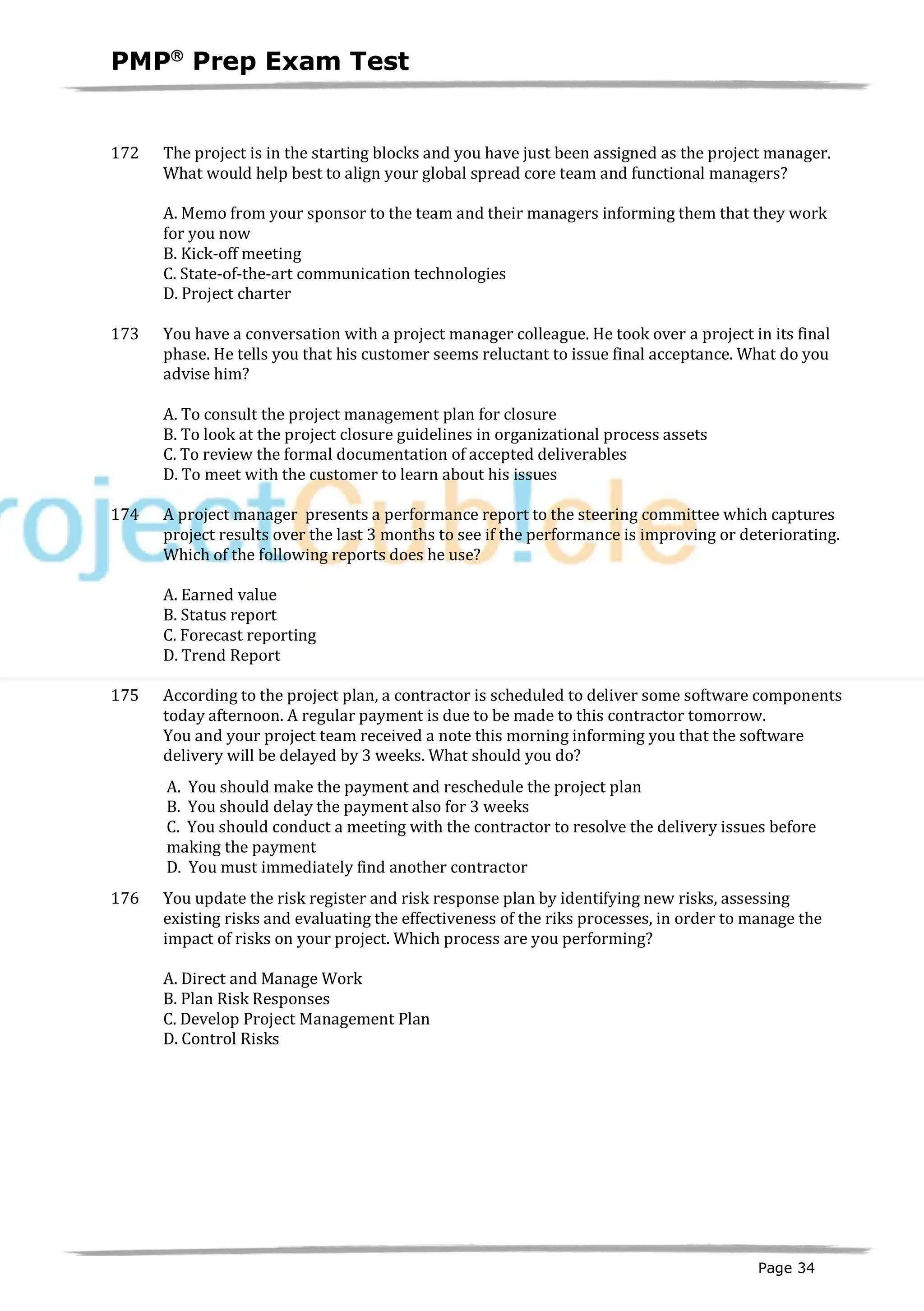
Reference: Integration Management , 4.6.3, p. 120
Monitoring & Controlling
ID:1200142-4.2
PMPâ
Prep Exam Test
Page 52
97 Answer: (B). Quality management is all about making sure that the product you are building
conforms to your customer’s requirements. If you have done a good job of gathering and
understanding those requirements, all of the measurements you take on your project should
help you see if what you are building will make your clients satisfied in the end.
Reference: Quality Management, 8, p. 274
Planning
ID:1200145-2.8
98 Answer: (A). The Communications Management Plan defines all of the processes that will be
used for communication on the project.
Reference: Communications Management, 10.1.3.1, p. 377
Planning
ID:1200146-2.6
99 Answer: (B). Integrated change control starts with impact analysis of requested changes.
Reference: Integration Management, 4.6, p. 115
Monitoring & Controlling
ID:1200143-4.2
100 Answer (D). Before the start of planning the charter should be approved.
Reference: Integration Management. 4.1, p. 77
Initiating
ID:1200014-1.6
101 Answer: (A). This kind of content is documented in the lessons learned register, which is the
only project document among the listed options.
Reference: Integration Management, 4.4.3.1, p. 104
Executing
ID:1200147-3.2
102 Answer: (B). The team is performing the Control Quality process (verifying that deliverables
and work conform to the requirements, which is a prerequisiste for Validate Scope with
formal acceptance), and is using appropriate tools (inspection etc.). Quality audits are
performed during the Manage Quality process.
Reference: Quality Management, 8.2.2.5, p. 294; 8.3.2, p. 302 – 304
Monitoring & Controlling
ID:1200148-4.3
103 Answer: (B). Problem Solving (Collaborate, Confronting) means figuring out the cause of the
problem and fixing it.
Reference: Resource Management, 9.5.2.1, p. 348/349
Executing
ID:1200149-3.6
104 Answer: (A). Some questions on the exam might ask you about how to operate in another
country. In this case, the question is about whether or not something is a bribe. Clearly, if it’s
a bribe, you can’t pay it. But is it? If a payment for a service is customary, then it’s not a bribe.
You should go ahead and pay the police—as long as it’s acceptable and legal in that country
(e.g. in Great Britain for special police services at football (soccer) games).
Reference: PMI Code of Ethics and Professional Conduct.
Executing
ID: 1200150-3.2
PMPâ
Prep Exam Test
Page 53
105 Answer: (A). The project scope management plan may be important in your project. It tells
you exactly how you’ll create the project scope, define the WBS, validate that the work has
been done, and make changes to the scope. But it doesn’t tell you about specific assumptions
that you and the team have made, or constraints on your project. You find those in the scope
baseline (which contains the scope statement), in the requirements documentation/backlog,
and in the charter or assumptions log.
Reference: Scope Management, 5.3.3.1, p. 154
Planning
ID:1200151-2.1
106 Answer: (C). The most important part of the Control Quality process is that your team has to
inspect each deliverable in order to verify that it meets its requirements. What do you need
to do that? First you need the deliverables! And test & evaluation documents are really useful
too, because they help you inspect each deliverable. You need approved CRs to verify their
implementation. Quality control measurements aren’t an input—they’re the output!
Reference: Quality Management, 8.3, p. 298
Monitoring & Controlling
ID:1200152-4.3
107 Answer: (A). Your risk register is one of the most important project management tools that
you have—that’s why you review it and go over your risks continuously. Any time you come
across a new risk, the first thing you should do is document it in the risk register and analyze
it.
Reference: Risk Management, 11.6, pp. 453
Monitoring & Controlling
ID:1200153-4.4
108 Answer: (D). The project has overspent the budget. Very probably the project will still make
a profit (less than planned).
Reference: Procurement Management, 12.1.1.6, p. 471
Monitoring & Controlling
ID:1200154-4.1
109 Answer: (B). As this will be an official project document (change request), it should be
formal in nature. Additionally, as you are requesting money from someone higher up in the
organization, you are creating a vertical communication.
Reference: Communications Management, 10, p. 361
Executing
ID:1600005-3.6
110 Answer: (B). Control Scope can happen before Validate Scope, but it can also happen
afterward as well. That’s why there’s no prescribed order for those two processes: they can
happen in any order.
Reference: Scope Management, 5.5 & 5.6, p. 163/164, p. 167/168
Monitoring & Controlling
ID:1200156-4.1
111 Answer: (B). The criteria of payback period or break even decides for the shortest time of
getting back the money of the investment.
Reference: Harold Kerzner, Project Management, 12th Edition, pp. 720
Initiating:1200016-1.7
112 Answer: (D). All of the listed options may be included.
Reference: Integration Management, 4.7.2.3, p. 127
Closing
ID:1200157-5.3
113 Answer: (A). Gold plating is when you or your team add more work to the project that was
not requested by the sponsor or client.
Reference: Quality Management, 8, p. 272
Monitoring & Controlling
I
D:1200158-4.2
PMPâ
Prep Exam Test
Page 54
114 Answer: (B). This is an example of actively accepting a risk. The team can’t do anything about
the weather, so the project manager has accepted the fact that they could end up being
delayed by it, and has planned a buffer.
Reference: Risk Management, 11.5.2.4, p. 443
Planning
ID:1200159-2.10
115 Answer (A). Value analysis is a tool and technique in the Define Scope process.
Reference: Scope Management, 5.3.2.5, p. 153
Initiating
ID:1200017-1.1
116 Answer: (A). Cost Aggregation is used to build your budget, but it is not a tool for cost
estimation. Bottom-up, Parametric, 3-Point-, and Analogous estimation techniques are used
for both cost and time estimates.
Reference: Cost Management, 7.2.2, pp. 244
Planning
ID:1200161-2.3
117 Answer: (B). The risk report is where you keep risks whereas individual project risks are
documented in the risk register. Both documents are outputs of the Identify Risks process.
Reference: Risk Management, 11.2.3, p. 417/418
Executing
ID:1200160-3.5
118 Answer: (D). Key word is „high level“ and indicates project initiation.
Reference: Integration Management, 4.1.3.1, p. 81
Initiating
ID:1200018-1.4
119 Answer: (B). The team charter tells you everything about team values, agreements and
operating guidelines for the team.
Reference: Resource Management, 9.1.3.2, p. 319/320
Executing62-3.1
120 Answer: (D). If your project is broken up into phases, you should have a kickoff meeting at
the start of each phase. You use that meeting to establish the way people will communicate
as the project work goes on and to set the scene for the actual phase. The first kick off
meeting is at the beginning of the initial phase. The planning ends with a kick off meeting to
start the project execution.
Reference: Integration Management, 4.2.2.4, p. 86
Planning
ID:1200163-2.12
121 Answer: (D). In the Identify Stakeholder process the stakeholder analysis is used. The other
answers are tools and techniques of the Collect Requirements process.
Reference: Stakeholder Management, 13.1.2.3, p. 512
Initiating
ID:1200020-1.3
122 Answer: (A). Iteration burndown chart is what you’re using when you look at the work that
the team is performing in order to determine whether the project is ahead or behind
schedule.
Reference: Schedule Management, 6.6.2.1, p. 226
Monitoring & Controlling
ID:1200164-4.1
123 Answer: (A). Even if a project is shut down before the work is completed, you still need to
document the lessons learned and add them to the organizational process assets. In fact, if a
project is terminated early, that’s probably the best time to do that! When a project goes
seriously wrong, then there are always important lessons that you can learn.
Reference: Integration Management, 4.7, p. 123
Closing
ID:1200165-5.5
PMPâ
Prep Exam Test
© 2020 – Roland Dörr Page 55
124 Answer: (C). Prior to planning means initiating.
Reference: Integration Management, 4.1, p. 77
Initiating
ID:1200019-1.4
125 Answer: (D). Escalation is the most appropriate option.
Reference: Risk Management, 11.5.2.4, p. 442
Planning
ID:1200166-2.10
126 Answer: (B). Smooth/Accommodate: conceding one’s position to the needs of others to
maintain relationship.
Reference: Resource Management, 9.5.2.1, p. 349
Executing
ID:12001676
127 Answer: (A). To calculate the expected monetary value (EMV) of a set of risks and
opportunities, multiply each probability by its total cost and add them together. In this
question, the cost of the risk is -$15,250 + -$20,000 = -$35,250, so its EMV is 40% x -$35,250
= -$14,100. The value of the opportunity is $4,500 and its probability is 65%, so its EMV is
65% x $4,500 = $2,925. So the total EMV for the two is -$14,100 + $2,925 = -$11,175
Reference: Risk Management, 11.4.2.5, p. 435
Planning
ID:1200169-2.10
128 Answer: (C). The project management plan is reviewed in the Close Project process to ensure
that all work is completed, but is not updated. Scope verification and validation are already
done as part of the monitoring and controlling processes. Remaining work are all
administrative closure activities and creating the final report.
Reference: Integration Management, 4.7.3.3, p. 127/128
Closing
ID:1200170-5.5
129 Answer: (D). Showing the impact prevents problems in the future.
Reference: Integration Management, 4.1, p. 77, and PMI Code of Ethics and Professional
Conduct
Initiating
ID:1200021-1.6
130 Answer: (B). The scenario describes activities of the Identify Stakeholders process/usage of
stakeholder analysis.
Reference: Stakeholder Management, 13.1.2.3, p. 512
Initiating
ID:1200023-1.3
131 Answer: (A). The resource management plan includes a “Reward and Recognition” section
that describes how you’ll reward your team for good performance. It also contains training
requirements and release criteria.
Reference: Resource Management, 9.1.3.1, p. 319
Executing
ID:1200172-3.6
132 Answer: (D). CV = EV – AC = 36.000 – 40.000 = -4.000
Reference: Cost Management, 7.4.2.2, p. 262
Monitoring & Controlling
ID:1200173-3.6
133 Answer: (C). Even best advanced tools will not work and highly skilled team members will
not exchange their knowledge, if people are not motivated to share what they know.
Reference: Integration Management, 4.4, p. 100
Executing
ID:1200174-3.1
PMPâ
Prep Exam Test
Page 56
134 Answer: (B). Residual risks are risks that remain even after you have planned for and
implemented all of your risk response strategies. They don’t need any further analysis
because you have already planned the most complete response strategy you know in dealing
with the risk. Residual risks should be covered with a contingency reserve, if they occur.
Reference: Risk Management, 11.5.3.3, p. 448
Monitoring & Controlling
135 Answer: (D). Only if the required effort to implemented risk responses is given, risks could
be managed proactively.
Reference: Risk Management, 11.6, p. 450
Executing
ID:1200176-3.1
136 Answer: (D). The question examplifies a change to the scope management plan. As it is part
of the project management plan, the impact should be analysed.
Reference: Integration Management, 4.6, p. 115
Monitoring & Controlling
ID:1200177-4.2
137 Answer (C). Developing a stakeholder engagement plan is an output of Plan Stakeholder
Engagement. All other options are inputs to this process.
Reference: Stakeholder Management, 13.2 p. 516
Planning
ID:1200024-1.3
138 Answer: (B). Options A and C are counterproductive and not appropriate in modern project
management.
Reference: Stakeholder Management, 13, p. 504 – 506
Initiating
ID:1200178-2.11
139 Answer: (C). Stakeholder engagement plan and strategies have to be developed early, it is
among the first planning efforts, after tailoring and life cycle decisions.
Reference: Stakeholder Management, 13.2, p. 518
Planning
ID:1200179-2.6
140 Answer: (B). When you crash the project, it means that you put additional resources on the
critical path. There’s no real risk in doing this, but it will cost more. Fast tracking means
adjusting the schedule so that activities overlap. This is normally not going to cost more, but
it is definitely riskier, because you may have eliminated buffers and possibly broken some
dependencies. And remember: crashing or fast tracking won’t always work to make the
project go faster.
Reference: Schedule Management, 6.5.2.6, p. 215
Monitoring & Controlling
ID:1200182-4.5
141 Answer: (D). While the project manager’s time is limited the classification of stakeholders
using stakeholder analysis helps to prioritize.
Reference: Stakeholder Management, 13.1.2, p. 512/513
Initiating
ID:1200025-1.3
142 Answer: (C). All projects should be aligned with their organizations strategic plan.
Reference: Integration Management, 4.1.1.1, p. 77/78
Initiating
ID:1200028-1.7
PMPâ
Prep Exam Test
Page 57
143 Answer: (C). As projects progress, project stakeholders, their interests, needs, expectations
and engagement levels may change, therefore, stakeholder management planning is highly
iterative. The stakeholder engagement plan should be regularly reviewed by the project
manager. The frequency of the review should be decided by the project manager.
Reference: Stakeholder Management, 13.2., p. 518
Planning
ID:1600003-2.13
144 Answer: (A). This question describes Make or Buy Analysis, which is part of the Plan
Procurement Management process. The information gathered is used later to build up the
budget.
Reference: Procurement Management, 12.1.2.3, p. 473
Planning
ID:1200187-2.7
145 Answer: (C). Most projects fail because of poor communication and poor stakeholder
management. Successful project managers spend most of their time communicating with
team members and other project stakeholders.
Reference: Communications Management, 10, p. 361
Executing
ID:1600006-3.6
146 Answer: (A). The project manager is collecting the inputs to the charter. The business case is
a must.
Reference: Integration Management, 4.1.1.1, p. 77/78
Initiating
ID:1200029-1.5
147 Answer: (B). The „rule of seven“ is applicable here: seven consecutive points or
measurements are below the mean; this is an assignable or special cause, documented in a
control chart.
Reference: Quality Management, 8.3.2.5, p. 304
Monitoring & Controlling
ID:1200190-4.3
148 Answer: (D). Agile release planning is the correct option.
Reference: Schedule Management, 6.5.2.8, p. 216
Planning
ID:1200191-2.6
149 Answer: (C). When the project deliverables were completed, SPI would have been 1.0; if a
project is completed ahead of schedule, SPI > 1.
A SPI < 1 for a closed project means that the project has been terminated before completion.
Reference: Cost Management , 7.4.2.2, p. 263
Monitoring & Controlling
ID:1200192-4.1
150 Answer: (A). Determining the feasibility of a new undertaking is a typical activity of
inititating.
Reference: Introduction, 1.2.4.2, p. 20
Initiating
ID:1200030-1.2
151 Answer: (D). If a suitable low-grade product with a limited number of features meets the
requirements of its customers (is of „high“ quality), the product would be appropriate for its
purpose of use.
Reference: Quality Management, 8, p. 274
Planning
ID:1200195-2.8
152 Answer: (B). Colocation is the most effective measure to increase team performance.
Reference: Resource Management, 9.4.2.1, p. 340
Executing
ID:1200196-3.6
PMPâ
Prep Exam Test
Page 58
153 Answer: (A). The procurement of standard items will most probably based on price, so the
statement of work should contain detailed specifications for the sellers to respond to your
invitation for bid (IFB).
Reference: Procurement Management, 12.1.3.4, p. 477/478
Planning
ID:1200197-2.7
154 Answer: (D). An approved project charter formally initiates a project and authorizes a project
manager to apply resources to the project.
Reference: Integration Management, 4.1., p. 77, and PMI Code of Ethics and Professional
Conduct
Initiating
ID:1200031-1.6
155 Answer: (C). The scenario is about a potential constructive change (claim), so your first step
is to check if everything for claims administration is in place. The next step is to create a
change request and get it approved by the customer.
Reference: Procurement Management, 12.3.2.2, p. 498
Monitoring & Controlling
ID:1200198-4.2
156 Answer: (B). The schedule baseline is an output of the process.
Reference: Schedule Management, 6.5, p. 205
Planning
ID:1200184-2.4
157 Answer: (D). A circle represents a chance node.
Reference: Risk Management, 11.4.2.5, p. 435
Planning
ID:1200193-2.10
158 Answer: (C). Auditing the supplier would be preferable. A quality audit is structured review
to determine if project activities comply with organizational and project policies, processes
and procedures.
Reference: Quality Management, 8.2.2.5, p. 294; Procurement Management, 12.3.5, p. 498
Executing
ID:1200194-3.3
159 Answer: (A). Bidder conferences are meetings between the buyer and all prospective sellers
prior to submittal of a bid or proposal.
Reference: Procurement Management, 12.2.2.3, p. 487
Executing
ID:1200199-3.2
160 Answer: (A). Changes to the scope baseline are implemented when they are approved by the
change control system.
Reference: Integration Management, 4.3.1.3, p. 93
Executing
ID:1200219-3.4
161 Answer: (D). The question describes the implementation of a risk response, which is done in
Implement Risk Responses.
Reference: Risk Management, 11.6, p. 450
Executing
ID:1200220-3.5
162 Answer: (A). The project management plan is a central document that defines the basis of all
the work.
Reference: Integration Management, 4.2.3.1, p. 86
Executing
ID:1200222-3.2
PMPâ
Prep Exam Test
Page 59
163 Answer: (D). Approved changes are implemented after they have been approved and the
stakeholders are notified. The work authorization (ticketing) system is used to ensure that
the work is done by the right person, at the right time, and in the proper sequence.
Integration Management, 4.3.2.2, p. 95
Executing
ID:1200221-3.4
164 Answer: (B). You are in the process of Control Risks. When a work around plan (response to
an unidentified or passively accepted risk) is developed and approved, implementing it is the
next step.
Reference: Risk Management, 11.6.1.2, p. 450
Executing
ID:1200226-3.5
165 Answer (B). Net present value considers long term benefits as well as the amount of cash
flow or profit funding new projects on DCF (discounted cash flow) basis. Payback and Break-
Even focus on short term results, BCR as a static method does not consider DCF.
Reference: Paul Sanghera, Fundamentals of Effective Program Management, Chapter 3:
Program Initiation Management
Initiating
ID:1200036-1.1
166 Answer: (D). Changes that have to be made means the changes are approved, so options A,B,
and C are obsolete. The project manager directs the performance of the planned project
activities and it is his responsibility to prioritize implementation.
Reference: Integration Management, 4.3, p. 92
Executing
ID:1200223-3.4
167 Answer: (A). All corrective actions are implemented in execution.
Reference: Integration Management, 4.3, p. 92
Executing
ID:1200227-3.5
168 Answer (C). The question examplifies the definition of the Manage Quality process.
Reference: Quality Management, 8.2, p. 288
Executing
ID:1200233-3.3
169 Answer: (B). When changes have been approved, stakeholders are notified, and changes are
implemented.
Reference: Stakeholder Management, 13.3.1.2, p. 525
Executing
ID:1200232-3.4
170 Answer: (D). As a part of the project closure activity the first thing a project manager should
do is to review all prior information from the previous phase closure to ensure all work is
completed and the project has met its objectives. Since project scope is measured against the
project management plan, the project manager will review that document to ensure
completion before considering the project closed.
Reference: Integration Management, 4.7, p. 123
Closing
ID:1200094-5.1
171 Answer: (B). Measuring customer satisfaction is part of the closing activities according to
best practices and to the PMI Role Delineation Study.
Reference: PMP Exam Content Outline
Closing
ID:1200240-5.7
172 Explanation: answer (D). The project charter provides the project manager with authority.
Reference: Integration Management, 4.1., p. 77
Initiating
I
D:1200037-1.6
PMPâ
Prep Exam Test
Page 60
173 Answer: (C). There are answers that seem to make sense at the first place. B and D are not
wrong, but the project manager must do his homework first. As the deliverable acceptance
done in Validate Scope strongly supports the closure, C is the best choice.
Reference: Integration Management, 4.7.1.4, p. 125
Closing
ID:1200242-5.1
174 Answer: (D). A trend report would capture this information.
Reference: Intgration Management, 4.5.2.2, p. 111
Monitoring & Controlling
ID:1200125-4.6
175 Answer: (C). According to the stakeholder engagement management you should try to
resolve the issue directly with the supplier.
Reference: Stakeholder Management, 13.3.2.5, p. 528
Monitoring & Controlling
ID:1200211-4.5
176 Answer: (D). The activities performed belong to the Control Risks process.
Reference: Risk Management, 11.7, p. 453
Monitoring & Controlling
ID:1200229-4.4
177 Answer: (B). Rank ordering and focus on the most critical issues is the benefit of a pareto
chart, a histogram type.
Reference: Quality Management, 8.2.2.4, p. 293
Monitoring & Controlling
ID:1200237-4.3
178 Answer: (B). Constructive change = buyer and seller cannot reach an agreement on
compensation for the change or cannot agree that a change has occured (claim).
Reference: Procurement Management, 12.3.2.2, p. 498
Monitoring & Controlling
ID:1200208-4.2
179 Answer: (C). The procurement management plan may contain qualified sellers and is used
(input) in Conduct Procurements.
Reference: Procurement Management, 12.2.1.1, p. 484
Executing
ID:1200188-3.1
180 Answer: (D). As the PMO manager it is very probably your responsibility to give guidance for
the allocation/usage of shared resources. What you need first are the facts.
Reference: Environment, 2.4.4.3, p. 48
Executing
ID:1200206-3.1
181 Answer: (B). The WBS dictionary provides more detailed descriptions of the WBS
components.
Reference: Scope Management, 5.4.3.1, p. 162
Executing
ID:1200218-3.2
182 Answer: (B). Work Performance Data is an output of Direct and Manage Project Work.
Reference: Integration Management, 4.3.3.2, p. 95
Executing
ID:1200231-3.2
183 Answer (C). The question examplifies the definition of test and evaluation documents
Reference: Quality Management, 8.2.3.2, p. 296
Executing
ID:1200233-3.3
PMPâ
Prep Exam Test
Page 61
184 Answer: (B). Configuration control as part of configuration management coordinates the
proper and consistent specification of all elements of a project, whereas change control is
focused on managing the changes to these elements.
Reference: Integration Management, 4.6.2.2, p. 118
Monitoring & Controlling
ID:1200201-4.2
185 Answer: (A). Corporate policies and proedures for issue, risk and change management are
part of OPAs.
Reference: Stakeholder Management, 13.3.1.4, p. 526
Executing
ID:1200440-3.2
186 Answer: (C). Project approval requirements (what constitutes project succes, who decides
the project is successful, and who signs off the project) should be documented in the charter.
Reference: Integration Management, 4.1.3.1, p. 81
Initiating
ID:1200041-1.6
187 Answer: (D). Deliverables are an input to the Control Quality process, where they are
verified.
Reference: Quality Management, 8.2., p. 288
Executing
ID:1200234-3.3
188 Answer: (C). Root cause analysis and quality improvement methods are used in Manage
Quality.
Reference: Quality Management, 8.2.2, p. 292 – 296
Executing
ID:1200235-3.3
189 Answer (A). Formal acceptance is done in Validate Scope. Accepted deliverables are an input
to Close Project. The Validate Scope process supports the closure, where formal acceptance
of the customer or sponsor is confirmed.
Reference: Integration Management, 4.7, p. 123
Closing
ID:1200241-5.3
190 Answer: (A). There are two main categories of project selection methods: constrained
optimization (calculating or predicting the success of a project) and benefits measurement
methods. The methods listed in the question part of benefits measurement.
Reference: Paul Sanghera, Fundmentals of Effective Program Management, Chapter 3:
Program Initiation Management
Initiating
ID:1200042-1.1
191 Answer: (C). Archiving the project documents is a must and has to be done in addition to his
intented activities.
Reference: Integration Management, 4.7, p. 123
Closing
ID:1200244-5.6
192 Answer: (B). As the variance one month ago was not typical for the future EAC is calculated
by subtracting the cost variance (CV) from BAC. The CV contains the AC: CV = EV – AC.
Cost Management, 7.4.2.2, p. 265
Monitoring & Controlling
ID:1200203-4.1
PMPâ
Prep Exam Test
Page 62
193 Answer: (D). Managing stakeholder engagement means working and communicating with
stakeholder to meet their expectations. The change log (output from Perform Integrated
Change Control) is an input here.
Reference: Communications Management, 10.2.1.2, p. 382
Executing
ID:1200209-4.2
194 Answer: (C). Without an indication of what the project has achieved (eaned value) you can’t
make a statement about performance.
Reference: Cost Management, 7.4.2.2, p. 261
Monitoring & Controlling
ID:1200202-4.1
195 Answer (D). Quality control measurements are an input to quality assurance.
Reference: Quality Management, 8.2, p. 288
Executing
ID:1200239-3.3
196 Answer: (C). Work performance data (output from Executing: Direct and Manage Project
Work) is an input to all monitoring and controlling processes (except overall project control.
Monitor and Control Project Work), where work performance information as an output is
created. All work performance information is collected by Monitor and Control Project Work,
where work performance reports are created.
Reference: Introduction, 1.2.4.7, p. 27
Monitoring & Controlling
ID:1200095-4.1
197 Answer: (C). Options B and D are not processes. The key word here is “predict total project
costs”. Therefore C is the best answer.
Reference: Cost Management, 7.3.2.4, p. 253
Planning
ID:1200437-3.2
198 Answer: (B). Monitoring Stakeholder Engagement is the process of monitoring relationships
and adjusting plans and strategies.
Reference: Stakeholder Management, 13.4, p. 530
Monitoring & Controlling
ID:1200438-3.1
199 Answer (C). A project is complete and can be closed when ALL the work (incl. the project
management work with all its deliverables and artifacts) is completed and accepted. The
lessons learned are project management deliverables, and therefore must be completed to
claim the project as completed.
Reference: Integration Management, 8.7.3.4, p. 128
Closing
ID:1200238-3.3
200 Answer: (D). Work performance reports are created in Monitor and Control Project Work
based on collected work performance information.
Reference: Integration Management, 4.5.3.1, p. 112
Monitoring & Controlling
ID:1200439-3.1

PMP-Prep-Exam-Test-200_Questions.pdf

  • 1.
    PMPâ Prep Exam Test Page1 200 Exam Test Questions This mock exam test is intended to help you to prepare yourself for passing the PMP® exam. To pass this exam test, you should correctly answer 150 out of 200 questions in 4:00 hours. The questions are based on the PMBOK® Guide, 6. Edition, and the PMP® Examination Content Outline (current version from June 2015, which is relevant for the actual exam). The following table shows the proportion of questions from each domain that will appear on the exam: Domain Percentage of questions on test I. Initiating the project 13% (26 questions) II. Planning the project 24% (48 questions) III. Executing the project 31% (62 questions) IV. Monitoring and controlling the project 25% (50 questions) V. Closing the project 7% (14 questions) Total 100% (200 questions) You find the correct answers incl. an explanation and reference on pages 40 – 62. “PMP”, “PMBOK“, “PMI“ are registered marks of the Project Management Institute, Inc.
  • 2.
    PMPâ Prep Exam Test Page2 1 A project manager is using an S-Curve to reflect the various expenditures of resources over the projected time of the project. This S curve indicates that: A. The bulk of the project cost is spent during the execution phase B. The project follows linear expenditure over all the phases C. The project resource cost would be directly proportional to the size of the project D. The project has high risk of attrition during execution phase 2 Your project is halfway through the execution phase. The project is progressing well and is on schedule when one of the vendors calls you to inform you that there will be a delay in his shipment delivery. Which of the following documents would best capture the impact of the delay on the project schedule? A. Network Diagram B. Procurement Management Plan C. Work Breakdown Structure D. Risk Register 3 You have made the final delivery to the customer and your team is in the process of completing administrative and contractual closure. The team has also completed the final version of the lessons learned in corporate database. Which of the following is a critical activity you should complete before formally closing the project? A. Confirm that all the requirements in the project are met B. Ensure that all project management processes are complete C. Obtain formal sign-off of the project from the customer D. Index and archive the project records 4 As the project manager you have outsourced a component of your product to a supplier which is due to be delivered next month. You find out that the delivery of the component may be delayed due to political unrest in the vendor's location. What is the BEST you can do in this situation? A. Report your senior manager about probable delay along with details on the current political situation at vendor's place B. Communicate to the vendor that any possible delay would lead to a fine (Pönale) and affect future payments C. Revisit your project schedule and look at alternatives to reduce the impact of the delay D. Since there is no official communication from the vendor, you need to use wait and watch policy 5 As a project manager, you are in the process of establishing the total scope of the effort in the project to define the project objectives. For this purpose, you include relevant stakeholders and explore all the aspects of scope, cost, time, risk, quality, etc. Which process group of the project are you currently in? A. Initiation B. Planning C. Execution D. Monitor and Control
  • 3.
    PMPâ Prep Exam Test Page3 6 You are managing a project with emerging requirements and evolving scope, which is very complex. The team is currently demonstrating a product increment to your stakeholders to gain feedback on a key functionality of the project’s product. What meeting is the team conducting? A. Steering Committee Meeting B. Review Meeting C. Daily Standup Meeting D. Retrospective Meeting 7 As a project manager you have a large team reporting to you with two members working on this technology for the first time. At the beginning of the project, you were concerned that the members wouldn't be able to contribute as much due to the technical complexity of the project. However, you spent time and gave them the required training in order to perform. During your assessment, you find some areas which still require improvement. What should you do next? A. Discuss this with the functional manager asking him to assign these resources in some other project as you have already spent enough effort of them B. Give them more challenging assignments so that they fail and you have reasons to expel them from the team C. Assess their current weak areas and provide more focused training with regular feedback D. Call them in your office and give them a warning that this is their last chance to perform in the project 8 You manage an IT project under contract in the final phase of project execution. Your project status is well within the budget and achieving the schedule and quality objectives. During the final testing phase of the project, you realize that the performance of the product can be increased significantly by doing minor code changes in two modules. This change would require some additional days of work. What should you do NEXT? A. Analyze the various alternatives and do a detailed impact analysis before proceeding with the change B. Update the change management form and send it to change control board for consideration C. Discuss the change and impact with customer and seek his approval D. Ignore the change as it is gold plating and should be avoided 9 Your project is in the final stages of testing and the team is interacting with the customer on daily basis to update him with the project status and incorporate his feedback. Which of the following would be the most critical process to be followed in this scenario? A. Quality Control B. Scope Control C. Report Performance D. Control Risk
  • 4.
    PMPâ Prep Exam Test Page4 10 Your project is halfway through its execution and it is audited. You have a meeting with a stakeholder whose department is responsible for testing. The stakeholder needs information on which corrective actions his department should take to achieve the project’s quality expectations and what are the team’s recommendations for improving the product, processes and the project. For which of the following documents is the stakeholder asking? A. Quality management plan B. Checklists C. Performance reports D. Quality reports 11 Looking at the scenario of the previous question, in which project management process are you in? A. Manage Project Knowledge B. Monitor and Control Project Work C. Manage Quality D. Control Quality 12 John has been assigned as project manager for an important project. The project charter has been approved by the sponsor and key stakeholders have been identified. What should John do next? A. Define the project objectives and success criteria B. Inform stakeholders of the approved charter to ensure a shared understanding of success criteria, key deliverables and milestones C. Define stakeholder management strategy to ensure support for the project D. Start to plan the project 13 You are analyzing a statement of work and discuss the major delivarables with stakeholders. You go through the aspects of the project and document the first project assumptions and constraints. In which of the following documents do you record them? A. Scope statement B. Project charter C. Stakeholder analysis D. Assumption log 14 You are a new project manager in a company that develops and markets electronic devices, which accepts only business cases including discounted cash flow analysis. Which of the following project selection methods should you use? A. Return on Investment B. Payback Period C. Net Present Value D. Benefit-Cost Ratio
  • 5.
    PMPâ Prep Exam Test Page5 15 As a project manager you are estimating the duration of your project activities using beta distribution. For a particular project activity, your optimistic estimate is 41 days, pessimistic estimate is 77 days and most Likely estimate is 53 days. What would be the expected duration and standard deviation of the estimate for this activity? A. 55/6.00 B. 110/6.00 C. 55/4.00 D. 55/2.00 16 A project manager is in the process of documenting and defining stakeholder's needs to meet project objectives. What is the output of this process? A. Stakeholder Register B. Stakeholder Engagement Plan C. Requirements Documentation D. Issue Log 17 As a project manager, you are a firm believer in process and you want to follow the best practices on the project right from the beginning. In this regard, you understand the importance of having a formal kick-off meeting to launch the project with all your key stakeholders including the customer. However, you are worried about the behavior of some of your team members. In the last internal meeting, there was utter chaos with the speaker shouting to be heard while others kept talking amongst themselves and ignoring the speaker. What is the BEST strategy to use to avoid such a situation in the kick-off meeting? A. Set objectives of the kick off meeting clearly, so that all the attendees are aware of the meeting agenda B. Ensure that all the key stakeholders are invited to avoid inviting disinterested people who wouldn't listen to speaker C. Develop a team charter with common values, guidelines and ground rules and ensure they are followed in all the meetings going forward D. Meet the troublemakers in the team and communicate them the importance of meetings in a project success. Warn them of disciplinary action if they don't oblige 18 A key stakeholder from the quality department wants to know more on how the tailoring of the project management processes was done by the project team. Additionally, he would like to know the rationale for selecting processes, their implementation level details, and how they will be used to manage the interdependencies. Which document should the project manager refer him to? A. Work Breakdown Structure B. Project Scope Statement C. Project Management Plan D. Quality Management Plan 19 Once the risks have been identified on the project, the next step is to manage the risks. Of the following, which is NOT a suitable way of managing the risks? A. By using existing assets B. By contingency planning C. By investing in new resources D. By Brainstorming
  • 6.
    PMPâ Prep Exam Test Page6 20 You are a project manager and your team is preparing for the internal quality audit cycle. However, you feel that the team is a little apprehensive about the audit process. You decide to give them an overview of the process. Which of the following would be not correct about quality audits? A. Quality Audits are used to identify all the best practices implemented in the project B. Quality audits help to share best practices in one project with other projects in the organization C. Quality Audits aim to asses project team effectiveness and suggest improvements D. Quality Audits help to improve process implementation and team productivity 21 A major stakeholder in the project wants to know his role and responsibility in the scheduling process of the project. He also wants to understand how the schedule baseline is established for the project and which scheduling methodologies are used in the project. Which document should the project manager ask him to refer to? A. Project Management Plan B. Project Schedule Baseline C. Stakeholder Register D. Schedule Management Plan 22 A project manager working on a construction project identifies a risk of a heavy storm in the coming months which might affect the construction activity. However, he doesn't have any reliable information on the weather forecast or the severity of the storm. In this case, what is the BEST project manager can do? A. Capture the Risk in the Risk Register B. Ignore the Risk as nothing can be done to avoid it C. Actively accept the risk and allocate time and cost reserve in contingency plans D. Proceed with Risk Response Strategy to attack the Risk 23 A project manager is working with several stakeholders nominated as risk owners in the risk register. He encourages the risk owners to take necessary actions to execute agreed-upon risk responses. In a meeting with senior management he ensures that an escalated risk is understood and appropriate action will be taken. Which of the following processes the project manager is performing? A. Monitor Risks B. Plan Risk Responses C. Manage Project Knowledge D. Implement Risk Responses 24 The method of examining work or a product to determine whether it conforms to documented standards is called? A. Inspection B. Statistical Sampling C. Audit D. Verification
  • 7.
    PMPâ Prep Exam Test Page7 25 Which of the following is NOT an advantage of a fixed price contract? A. Less work for buyer to manage B. Seller has a strong incentive to control costs C. Buyer knows the total price at project starts D. Final cost may be more than a cost reimbursable contract because contractors have to increase the price to cover their risk 26 A project manager is currently focused on maintaining the stakeholders’ engagement with the help of the Control Stakeholder Engagement process. The project mangement plan is major input to this process. Which of the following content of the project management plan is least likely to be utilized in this process? A. Communication management plan B. Resources management plan C. Change management plan D. Selected life cycle for the project and selected project management processes 27 A company just launched a new product in the market. Customers seem to be reluctant to accept it. The company has incurred huge costs in the development of the product including market analysis, research and development, patents, etc . All of these costs are referred to as ____________. A. Opportunity Costs B. Depreciation C. Sunk Costs D. Variable Costs 28 You just took over an agile project in its very early phase. After some discussions with the sponsor and major stakeholders you realize that the target group and main features and benefits of the product are unclear. The stakeholders are in disagreement. What should you do? A. Perform a proper stakeholder analysis to identify all stakeholders B. Schedule workshops with focus groups to collect user needs and requirements C. Help the sponsor and stakeholders to craft a product vision and build a product roadmap D. Invite stakeholders to a workshop and use story mapping to create a product backlog together with the team 29 A project manager shares project performance through status reports via email to selected stakeholders of the project. He is using which of the following techniques? A. Kick off meeting B. Pull Communication C. Push Communication D. Communication model 30 A project manager is in the process of analyzing activity sequences, durations, resources requirements, and schedule constraints and has created an approved project schedule. What should he do NEXT? A. Determine resource requirements for each activity in the project B. Use techniques like Critical Path method, What-if Analysis to calculate optimum duration of the project C. Use this approved schedule duration as a baseline and start tracking the project D. Create a network diagram of the project using one of the diagramming methods
  • 8.
    PMPâ Prep Exam Test Page8 31 You are assigned as a new project manager to a project in the execution stage. Current schedule and performance indices for the project, SPI and CPI are 1.12 and 1.15 and project performance are well within the baseline. The defects found during internal testing for the last deliverable were well below the organization’s limits. However, the customer doesn't seem to be happy with the project progress. What should be the FIRST thing the project manager should do? A. Start managing the project as you gain more insight into day to day responsibilities B. Meet with the project team to understand open issues in the project C. Conduct a meeting with the customer to understand his concern over project progress D. Improve project project performance to reach SPI and CPI above 1.5 32 A project manager in an information technology project is discussing a complex algorithm with a new team member. After a long and thorough verbal discussion, the project manager asks the person if he understood the algorithm and is capable to put it in the document. The team member implies that he has understood. However, when the project manager goes through the document, he realizes that the member didn't understand what was actually said thus resulting in an inefficient use of time and effort. Who is responsible for this loss of time and how could it have been avoided? A. Project manager, he shouldn't have given the complex assignment to a new team member B. Team Member, since he implied he understood the discussion and didn't ask immediately C. Project Manager, as he should have also helped the team member in preparing and reviewing the document D. Project manager, since it is his responsibility to ensure his message is clear and concise and confirm that team member truly understands the message 33 As a project manager you monitor the project’s issue log which captures issue description, priority, owner, the target date for resolution, and status . All of the following are common examples of issues in the project EXCEPT? A. Differences in opinion B. Probable delay in the next delivery C. Pending root cause analysis D. Delay in receiving feedback from the customer 34 You are developing the project charter for the new project assigned to you. Which of the following is NOT part of the enterprise environmental factors? A. Lessons learned from previous projects B. Work authorization system C. Government and industry standards that affect your project D. Knowledge of which departments in your company typically work on projects 35 Which of the following models or grids describes classes of stakeholders based on their power, need for immediate attention and appropriate involvement? A. Power/influence (active involvement) grid B. Power/interest (level of concern) grid C. Salience model D. Influence/impact grid
  • 9.
    PMPâ Prep Exam Test Page9 36 As a project manager, you understand the importance of effective communication with stakeholders. You want to present a project progress report to the stakeholders in the next project meeting. What should be your approach? A. Make the report concise, restricted to specific technical details of the project B. Prepare a complete report but filter the information to remove details C. Focus on specific stakeholders with whom there is good personal relation D. Research and understand the experience level and expectations of stakeholders 37 A project activity has values for the earliest and latest date it can start and earliest and latest date it can be completed. An activity’s Late Start (LS) is day 5 and Late Finish is (LF) day 10. Similarly Early Start (ES) is day 3 and Early finish (EF) is day 8. What is the float of this activity? A. 5 days B. 4 days C. 2 days D. 3 days 38 You recently took over a project in the execution phase with large procurements. In a meeting with stakeholders you notice diverging opinions on almost all procurement aspects: Should the seller deliver turnkey? Based on which contract type should sellers be payed? What are the milestones of the bidding process and following activities etc? Which of the following would help BEST in this situation? A. Create a procurement management plan B. Determine a procurement strategy C. Agree on contract types and vendors D. Coordinate procurement work with other project work 39 Of the following, which conflict resolution technique is believed to generate the LEAST enduring positive results? A. Problem Solving B. Avoidance C. Compromising D. Forcing 40 As a project manager, you have been asked by the customer to give an overview of the project status using milestone charts. Which of the following statement is not true about milestone charts? A. Milestones have zero duration B. Milestone charts are similar to bar charts but only show major events C. Milestone charts can be used to capture the status of project schedule D. Milestones are only used to define the phases of a project 41 Which of the following is a tool used in the perform qualitative risk analysis process? A. SWOT (Strength, Weakness, Opportunities and Threat) B. Probability and Impact Matrix C. Root cause identification D. Monte Carlo Simulation
  • 10.
    PMPâ Prep Exam Test Page10 42 You are managing a multinational project with team members sitting across different countries with varying time zones. In this scenario, you wish to choose a communication medium which is most efficient for the project requirements. What is the most appropriate way to address this? A. Discuss these communication requirements and available options with stakeholders to seek their input exclusively for your project instead of using existing tools in the organization B. Use the most cost effective technique and involve everyone to explain it s usage C. Use a combination of communication technology as being done in your peers project D. Explore communication tools available in the market and ask for quotation 43 Which of the following are the MOST important to deriving the total funding requirements and periodic funding requirements of the project? A. Management Reserve and Contingency Reserve B. Cost Baseline and Management Reserve C. Funding Limit Reconciliation D. Project Budget and Contingency Reserve 44 Your agile project is in its execution. You facilitate a meeting where the team takes time to learn from previous work and collects qualitative and quantitative data, performs root cause analysis, and develops action plans to remove impediments. Which meeting is conducted? A. Problem solving workshop B. Review C. Retrospective D. Lessons learned 45 Which of the following is the correct order of actions that you take during the closing processes? A. Get formal acceptance, release the team, write lessons learned, close the contract B. Write lessons learned, release the team, get formal acceptance, close the contract C. Close the contract, get formal acceptance, write lessons learned, release the team D. Get formal acceptance, close the contract, write lessons learned, release the team 46 You are managing a project, which is innovative and is expected to create new knowledge in a large scale. The project involves some explicit knowledge and much more implicit or tacit knowledge, which are insights, experience and know-how of the individuals in the project team. To ensure effectiveness of learning for the team, stakeholders, and the organization, what should you do? A. Conduct well prepared lessons learned workshops at the end of your project B. Hire an external consultancy with proven expertise in providing knowledge transfer C. Use knowledge management tools and techniques D. Document learnings and knowledge accurately so that they can be shared
  • 11.
    PMPâ Prep Exam Test Page11 47 As a project manager, you understand the importance of handling contested and potential constructive changes contract documents and correspondence for future references. Which of the following can be used to document, process, and monitor these changes throughout the contract life cycle? A. Procurement B. Procurement documents C. Lessons Learned D. Claims Administration 48 Your project has faced some unforeseen issues that have delayed it. The project is very critical for the company and it has to meet the scheduled deadline. In order to meet the deadline your team would have to work over the weekends for the next two weeks. However, you know that many of the team members will have some personal commitments and it will be very difficult for them to work for seven consecutive days. What is the BEST option for you? A. Hire additional resources and brief them about the project B. Inform the customer that this deadline can't be met C. Discuss the situation with the team and give them the choice to willingly work overtime D. Send an official mail making it mandatory for the team to come and work over the weekends 49 As part of a joint venture, a project manager working with another company needs to share some confidential information related to intellectual property rights. He wants to know the person responsible for authorizing the release of this confidential information. Which project document should he refer? A. Organizational Breakdown Structure B. Project Charter C. Project Communication Management Plan D. Stakeholder Management Plan 50 A project manager is going through the defect report reviewing the bugs reported during the testing cycle of a software project. The report has information on the severity of the bug, origin of the bug, possible resolutions, along with the owner and reporter of the bug. The project manager wants to prioritize the bug fixing activities by evaluating the top three most frequent reasons for the defects. Which of the following tools should he use? A. Control chart B. Fishbone diagram C. Scatter diagram D. Pareto chart 51 You are managing an agile project. In ammeting with senior management a discussion emerges about “T-shaped” people, being a requirement for working in an agile environment. Which of the following definitions of “T-shaped” people is correct? A. Generalizing specialists: team members have a focus specialty plus a breadth of experience across multiple skills B. Team structured: working in a crossfunctional and self organizing team C. Tight matrix: team members work in crossfunctional and collocated teams D. Turn-over: team members with a low turn-over rate are preferred to work in agile environments
  • 12.
    PMPâ Prep Exam Test Page12 52 As a project manager, you are conducting a structured review of the seller's progress to deliver the project within the contract specifications. Your objective is to determine progress with respect to the procurement statement of work. When would you be doing this review in your project? A. During contract closure B. Before awarding the contract C. During a project performance review D. In case of non conformance by seller 53 Which one of the following is the last step of project closing? A. Archive Project Documents B. Measure customer satisfaction at the end of the project C. Reallocate facilities and equipment, and release project resources D. Document lessons learned 54 Project performance reviews using earned value management would typically incorporate information from all the following EXCEPT? A. Variance Analysis B. Cost Benefit Analysis C. Trend Analysis D. Earned Value Analysis 55 A key stakeholder of the project is contacted for a requirements document approval, but shows no interest. The project manager decides to have a friendly, informal discussion with him to understand the reason for his lack of interest. During the conversation, the stakeholder expresses his displeasure that two of his key suggestions were not addressed on the project. He feels as though his approval or feedback doesn't really matter since his main requirements are not being captured. What is the best option for the project manager in this case? A. Agree with stakeholder and don't take his approval on requirements. Remove his name from the list of stakeholders and avoid communicating with him further on project status B. Incorporate the requirements of the stakeholder and then take his approval C. Talk to your project sponsor about the issue and take his approval before taking any further action D. Explain to the stakeholder that although his suggestions were appreciated, it is not possible to address all of them in this release due to project constraints. You will revisit them for the next phase. 56 Your development team is waiting for the design team to finish their work. As a project manager, you have decided to use this approach to reduce uncertainty in the project. Which of the following relationships does this describe? A. Iterative relationship B. Sequential relationship C. Overlapping relationship D. Common relationship
  • 13.
    PMPâ Prep Exam Test Page13 57 You are a project manager taking over a project midway. It is in the execution phase. You would like to know more about project deliverables, work required to complete those deliverables, acceptance criteria etc. Which of the following documents would be MOST useful? A. Work Breakdown Structure (WBS) and WBS dictionary B. Requirements Documentation C. Activity List D. Project Scope Statement 58 You are project manager and your project under contract is in its closing phase. You’ve been asked by your sponsor to inform all the stakeholders about how the project met its competing demands and objectives, and about how the project achieved its business objectives. What is the best thing to do? A. Consult your communications management plan B. Conduct a customer wrap-up meeting C. Invite the stakeholders to the project’s final steering committee meeting D. Complete the project’s final report and communicate appropriately 59 A project manager wants to apply a set of technical guidelines to be used during the development of the project’s product to optimize a specific aspect of the design: the manufacturing costs. Which of the following methods would be most appropriate to use? A. Problem solving B. Design for X (DfX) C. Root cause analysis D. Six Sigma 60 A project manager wants to determine the standard deviation for an activity cost estimate using a beta distribution estimate with the following data: Pessimistic=8,000, Optimistic=2,000, Most Likely=5,000. What is the standard deviation? A. 6,000 B. 2,000 C. 1,000 D. Not enough information 61 Your team completed first product components and you are collecting deliverable status, schedule progress and costs incurred to prepare for the next meeting of the project steering commitee. Which process are you performing? A. Monitor and control project work B. Manage communications C. Direct and manage project work D. Manage project team
  • 14.
    PMPâ Prep Exam Test Page14 62 You are managing a construction project which is nearing completion when a major stakeholder points out a flaw in the design which could make the entire structure weak. He suggests a change which would provide the necessary support. You are worried that this change could impact the schedule and cost of the project significantly. What is your BEST response to the stakeholder? A. Refuse him as the project is already nearing completion and it's not possible to make any changes at this stage B. Do a root cause analysis with the team to determine how this design flaw could have been missed and if there could be more potential problems with the design C. Proceed with the change and communicate the impact on project schedule and cost to the customer D. Use a schedule compression technique as part of integrated change control to investigate and minimize the adverse impact of the change 63 During project execution, the customer interprets a clause in the contract differently and demands an elaborate design document as part of the next deliverable. According to your planning the document is not included in the deliverable list. What is the best you can do to resolve the situation? A. Change the contract and continue with your project work B. Accept customer's demand as he is the one responsible for project's success C. Raise a complaint to project sponsor along with the implications of accepting such request on schedule and cost of the project D. Document the dispute and refer to the claims administration 64 A project manager wants to measure project performance against the project baseline. Which of the following techniques would be MOST helpful? A. Variance Analysis B. Earned Value Analysis C. Work Performance Information D. Reserve Analysis 65 A project manager is conducting procurement activities to select the most suitable sellers. Which of the following tools will NOT be helpful? A. Proposal Evaluation B. Advertising C. Procurement Negotiations D. Agreements 66 A project team is in the process of implementing agreed upon risk responses. The response action defined by the mitigation and contingency plans is being executed in accordance with the details of those plans. Who is responsible for implementing the responses? A. Project Manager B. Project Team C. Risk Owner D. Risk Manager
  • 15.
    PMPâ Prep Exam Test Page15 67 You are a project manager; your new project leads to significant change in your organization and all its internal and external stakeholders. From similar projects in other industries you are aware of the fact that a large part of the individuals, groups and organizations perceive that they will be affected by the outcomes of the project. How should you react? A. Identify all stakeholders, ensure that all team members are involved in stakeholder engagement activities, and review the stakeholder community regularly B. Aks your sponsor for support, because he is obliged to do so C. Delegate stakeholder activities to line managers to gain leverage to drive the internal change D. Hire a consultancy with proven expertise to help you in this matter 68 After awarding a contract to one of the sellers, you realize you have missed a clause for delay in the contract and want to modify it. How should you proceed further? A. Contract is legally binding and cannot be changed once signed B. Project manager should inform the seller about the change in next meeting C. Project manager should inform the seller about the change through a formal written communication D. Project manager should proceed according to the contract change control system at his end 69 A pharmaceutical company recently terminated a research project because it no longer seems commercially viable for the company. What is the FIRST thing the project manager should do? A. Release the team members B. Document the lessons learned C. Conduct scope validation D. Discuss with senior manager the reason for project termination 70 A project manager has derived quality metrics, such as cost performance, failure rates, customer satisfaction scores, and percentage of requirements covered by test plans along with tolerance limits for his project. He is performing which project management process? A. Plan Quality Management B. Manage Quality C. Control Quality D. Define Scope 71 As a project manager you are working with your team to explore alternatives to decrease project cost without compromising on performance or scope of the project. You are most probably using which of the following techniques? A. Benchmarking B. Simultaneous Engineering C. Process Analysis D. Product analysis
  • 16.
    PMPâ Prep Exam Test Page16 72 The project manager is reviewing the issue log as part of project execution. Which of the following should the project manager perform as part of his monitoring and controlling process group activity? A. Assess the corrective actions on the issue log B. Determine the next steps for unresolved issues C. Use appropriate tools and techniques in order to minimize the impact on project schedule, cost and resources D. All of the above 73 Your project is the development and launch of a new product in the market. For this purpose, you are analyzing the existing products in the market to compare their features. You also compare industry standards for performance metrics including cost, life cycle time, productivity, and quality to come up with your own product metrics. You are doing which of the following activities? A. Cost Benefit Analysis B. Value Engineering C. Benchmarking D. Process Analysis 74 You and your team have finished creating the WBS and WBS dictionary. Afterwards, you prepare a detailed documentation of all of the project’s schedule as appropriate. What should you do NEXT? A. Create network diagram for the project B. Estimate time and costs for each activity C. Create the schedule D. Conduct project progress meeting 75 You are managing a large project. One of your teams has developed a new component that has a negative impact on system performance. You have slatered a meeting to assess the impact of the problem and find out ways to resolve it. Which of the following should you use to facilitate communication and ensure effectively recording and tracking of the issue? A. Risk register B. Communication methods C. Issue log D. Communications management plan 76 Which of the following are inputs to the Direct and Manage Project Work process? A. Performance reports and approved change requests B. Corrective action C. Verified deliverables D. Work performance information 77 You and your project team are facing several time constraints and are not having the time to develop a WBS from the scratch. What would be the best option? A. You make use of the organizational process assets B. You save time by cutting down requirements collection and analysis C. You decompose the WBS not in too much detail D. You can ignore the time constraints because you have to develop a realistic plan
  • 17.
    PMPâ Prep Exam Test Page17 78 You as the project manager have signed a lump-sum contract with a software vendor for the development of a new application. The contract price seems rather low to you. Which of the following statements is NOT true for this situation? A. In a fixed-price contract, change requests can cause issues regarding additional time and extra costs for the changes to be applied B. It is the contractor's risk in this type of contract that their profit may vanish if costs have been underestimated C. Your organization very probably may have to assume unexpected additional costs for the software development in this type of contract D. This form of contract should only be chosen when all the requirements for the building of the product are well-known by all parties involved 79 Which of the following is NOT true of obtaining project management plan approval? A. Until you obtain approval of the project management plan or its major elements, you don’t need to put changes to it through change control B. Change control makes sure that only approved changes go into the approved plan C. All updates of the planning before approval have to go through integrated change control D. It’s important for the entire team to buy into the PM Plan for it to be successful 80 A project manager is studying the business documents and going through the narrative description of products and services to be completed by the project. He is also meeting key stakeholders and subject matter experts to evaluate whether or not the project is worth the required investment. Which of the following documents would be created as an output in the process? A. Project Scope Statement B. Project Charter C. Project Management plan D. Stakeholder Register 81 You are a project manager managing a project with a high level of complexity and uncertainty, using an adaptive approach. Which of the following techniques would be most useful to create a schedule that defines for the customer when which feature will be available? A. Critical Path Method B. Fast Tracking C. Agile Release Planning D. On-Demand Scheduling 82 A project manager is collecting, organizing, and distributing information on how project resources are being used to complete project objectives. In addition, he is adapting the information to be provided at an appropriate level and format. The project manager is in which process? A. Direct and Manage Project Work B. Manage Communications C. Earned Value Technique D. Control Risks
  • 18.
    PMPâ Prep Exam Test ©2020 – Roland Dörr Page 18 83 A project manager is in the process of predicting future performance based on the performance to date. Which activity is he performing? A. Variance Analysis B. Trend Analysis C. Design of Experiments D. Benchmarking 84 Which of the following is not included in 'cost of conformance'? A. Prevention cost B. Appraisal cost C. Internal failure cost D. Cost of training 85 Which of the following can be found in the project charter? A. Instructions and organizational standards, how projects are initiated B. Functional and non-functional requirements C. Product acceptance criteria D. Measurable project objectives and related success criteria 86 Which of the following can be found in the stakeholder management strategy? A. Roles and responsibilities of stakeholders B. Level of participation in the project desired for relevant stakeholders C. Communication requirements of stakeholders D. Information to be communicated 87 When you are conducting a trend analysis, in which of the following processes you are in? A. Control Costs B. Monitor and Control Project Work C. Control Resources D. All of the above 88 Which of the following is NOT a tool for the Manage Quality process? A. Quality Audits B. Design for X C. Checklists D. Quality Metrics 89 You are working on a project to build a hybrid car which would run on diesel fuel, as well as electricity. This car would have a 750 ccm engine and a regenerative braking system. It should be able to seat four passengers including a driver and comply with advanced Euro 6 emission norms. This information should be captured in which of the following documents? A. Product Scope B. Project Scope C. Scope baseline D. Requirements Management Plan
  • 19.
    PMPâ Prep Exam Test Page19 90 A project manager expects many changes during the course of the project. He wants to establish a robust configuration management system and also make his team aware of the process. Which of the following statements is NOT true about configuration management? A. The purpose of configuration management is to maintain integrity of work product B. Configuration management includes configuration audits, configuration control, configuration status accounting and configuration identification C. Configuration management focuses on establishing and maintaining consistency of a product's requirements D. Configuration management involves measuring project performance with baselines and taking corrective action when necessary 91 Which of the following is the estimating technique that uses a statistical relationship between the historical data and other variables to calculate an estimate for an activity? A. Analogous Estimating B. Parametric Estimating C. Three Point Estimating D. Monte Carlo technique 92 A project manager is facing many serious issues in his project. The project's final deliverable is scheduled for four weeks from now. It needs to fulfill compliance to mandatory standards. In addition to that there are some changes required to improve performance which the project manager feels will make the customer happy. Above all, a senior test engineer asks the project manager for a long leave. Which is the most critical issue the project manager needs to address FIRST? A. Ensure product complies to standards B. Find a replacement for the senior tester and ensure he completes knowledge transfer before leaving C. Complete change control process to incorporate changes to enhance performance D. Notify the customer about probable delay in the final deliverable to avoid surprise later 93 You are project manager on an industrial engineering project. You have found a pattern of defects occurring in all of your projects over the past few years and you think there might be a problem in the process your company is using that is causing it. You use Ishikawa diagrams to come up with the root cause for this trend over projects so that you can make recommendations for process changes to avoid this problem in the future. What process are you performing? A. Plan Quality Management B. Manage Quality C. Perform Qualitative Risk Analysis D. Control Quality 94 Which of the following shows roles and responsibilities on your project? A. Project organization chart B. Bar chart C. RACI matrix D. Resource histogram
  • 20.
    PMPâ Prep Exam Test Page20 95 You are the project manager for a construction project. Your sponsor has asked you for a forecast for the cost of project completion. The project has a total budget of $800,000 and CPI of .95. The project has spent $250,000 of its budget so far. How much more money will you probably expend for the project? A. $ 842,105 B. $ 800,000 C. $ 1,092,105 D. $ 592,105 96 You are project manager on an event project. About halfway through the project, you found that you had not estimated enough time for some of the technical work your team needed to do. You requested that the new work be added to the scope statement and that the time to do the work be added to the schedule. The change control board approved your change. What’s your next step? A. Manage Quality B. Start doing the work C. Gather performance metrics on the team’s work so far D. Update the scope and schedule baselines to reflect the approved change 97 Which is the BEST definition of quality? A. A product that passes all of ist tests B. A product that satisfies the requirements of the people who pay for it C. A product made of very expensive materials D. A product made with a lot of care by the team who built it 98 In which plan do you define the processes that will be used to keep people informed throughout the project? A. Communications Management Plan B. Stakeholder Engagement Plan C. Quality Management Plan D. Resource Management Plan 99 A team member approaches you with a change that could cut your schedule down by one month. What is the first thing you should do? A. Make the change; it’s going to save time and nobody will want the project to take longer than it should B. Figure out the impact on the scope of the work, the cost and other knowledge areas before you submit the change request C. Write up a change request and see if you can get it approved D. Tell the team member that you’ve already communicated the deadline for the project, so you can’t make any changes now
  • 21.
    PMPâ Prep Exam Test Page21 100 A project manager has completed the project charter and is looking forward to start working on the project management plan. What should he do next? A. To determine on the management plans for the project B. To review the project charter with key stakeholders C. To start the next project phase D. To get the sponsor’s signature to authorize the project 101 Your project has created new knowledge. Together with the team you have recorded challenges and problems, and recommended action plans associated with these situations. In which of the following project documents should you include this kind of content? A. Project Management Information System (PMIS) B. Lessons learned repository C. Organizational process assets D. Lessons learned register 102 Your project team is involved in verifying that the project deliverables and work meet the requirements specified by key stakeholders necessary for final acceptance. Which of the following tools are they not using? A. Inspection B. Quality audits C. Statistical sampling D. Testing and product evaluations 103 Which conflict resolution technique is most effective and can result in a win-win situation? A. Compromise B. Collaborate C. Accomodate D. Withdraw 104 You are working as a project manager in a country where it is customary and legal to pay the police for private special services. Your supervisor tells you that in another country, that practice may be considered a bribe. What is the BEST way to proceed? A. Pay the police for private protection services, because it is customary in the country they are operating in B. Do not pay the police for private protection services, because that would be a bribe C. Consult the Cost Management Plan about payment D. Ask your legal department for guidance 105 Which of the following is NOT a source of information about specific project constraints and assumptions? A. The project scope management plan B. The project scope statement C. The requirements documentation/backlog D. The scope baseline
  • 22.
    PMPâ Prep Exam Test Page22 106 Which of the following is NOT an input to Control Quality? A. Deliverables B. Test and evaluation documents C. Quality control measurements D. Approved change requests 107 You are managing a software project. You are partway through the project, and your team has just delivered a prototype of software increments. During the review an important stakeholder points out that he prefers to advance the release date of the software product. You think there is a high probability that the change control board would approve the change. What should you do? A. Add the risk to the risk register and gather information about its impact B. Add the risk to the issue log and revisit it when there is more information C. Mitigate the risk by asking a team member to get familiar with the feature of the software that might be changed D. Schedule a meeting with the stakeholder to discuss the issue 108 You are managing a project using a firm fixed price (FFP) contract. The contract is structured so that your company will be paid a price of $85,000 to complete the work. There were $15,000 contribution and overhead cost that your company had to cover. It’s now two months into the project, which is 90% complete and your costs have just exceeded $70,000. What’s the BEST way to describe this situation? A. The project doesn’t make any profit. The company will face a loss. B. The project has reached the point of total assumption C. The project manager has missed to submit a change request D. The project manager has overspent the budget 109 If you are writing a request for additional funding, which form of communication should you choose? A. Informal and horizontal B. Formal and vertical C. Informal and vertical D. Formal and horizontal 110 Which of the following is the correct order of the Monitoring & Controlling processes for Scope Management? A. First Validate Scope, then Control Scope B. They can happen in any order C. Both happen simultaneously D. First Control Scope, then Validate Scope 111 You are discussing economic models for project selection. What is the disadvantage of payback period or break even? A. There is no disadvantage; many companies use these models for project selection B. They do not consider high profits in later periods C. They are simple to calculate D. They do not consider sunk costs
  • 23.
    PMPâ Prep Exam Test Page23 112 Your project is in the closure phase, while the team is reviewing the project management plan to ensure that the project’s objectives are met. Which type(s) of meeting(s) is (are) used in in the process? A. Customer wrap-up meetings B. Lessons learned meetings C. Celebration meetings D. All of the above 113 You are managing a software project. During a walkthrough of newly implemented functionality, your team shows you a new feature that they have added to help make the workflow in the product easier for your client. The client didn’t ask for the feature, but it does look like it will make the product easier to use. The team developed it on their own time because they wanted to make the client happy. You know this change would have made it very probably not through change control. What is this an example of? A. Gold plating B. Scope creep C. Schedule Variance D. Scope variance 114 While identifying risks for a new construction project, you discover that a chemical you are using on your building cannot be applied in rainy conditions. You also learn that your project will be ready for the chemical application around the time when most of the rainfall happens in this part of the country. Since the project can’t be delayed until after the rainy season and you need to make sure the building gets the chemical coating, you decide that your team will just have to allow enough time in the schedule for nonworked rain days. This is an example of which strategy? A. Mitigate B. Accept C. Exploit D. Transfer 115 Which of the following is not an economic model for project selection? A. Value analysis B. Internal Rate of Return C. Net Present Value D. Benefit cost ratio 116 Which of the following is NOT a tool or technique of Estimate Costs? A. Cost aggregation B. Bottom-up C. Analogous D. Parametric
  • 24.
    PMPâ Prep Exam Test Page24 117 You are managing a project. During your risk identification interviews you learn that there are sources of overall project risks and non-event risks like technical complexity, unclear requirements, and ambigious developments in regulatory frameworks. Where do you record the risks so that you don’t lose track of it? A. In the probability and impact matrix B. In the risk report C. In the risk register D. In a list of triggers 118 A project manager documents high level risks, assumptions and constraints based on current environment and expert judgment to propose a development and implementation approach. On which of the following documents is he working? A. Risk report B. Requirements documentation C. Business case D. Project charter 119 You are planning a project and want to establish clear expectations and guidelines for communication, decision making, conflict management and code of conduct among project team members. Which of the following is a result of this effort? A. Team management plan B. Team charter C. Conflict resolution process D. Communications management plan 120 You are managing a large project. When is the BEST time to have project kick-off meetings? A. When each deliverable is created B. At the beginning of the project C. at the beginning of project execution D. At the start of each phase 121 As new assigned project manager you are responsible for aligning stakeholders’ expectations and gaining sustainable support for the project. Which of the following do you use? A. Observation B. Facilitated workshops C. Product analysis D. Stakeholder analysis 122 You just have been hired by a contractor, who wants you to manage an agile project for one of their clients. The project team has been working for six weeks. You need to determine whether the team is ahead of or behind schedule. Which of the following tools and techniques is the BEST one for you to consult? A. Iteration burndown chart B. Sprint planning C. Critical path method D. Schedule Baseline
  • 25.
    PMPâ Prep Exam Test Page25 123 Your client has terminated your project before it is complete. Which of the following is true? A. You must work with the team to investigate and document the reasons for termination B. You must update the project management plan to reflect this change C. You must keep the team working on the project to give your senior management time to talk to the client D. You must stop all work and release the team immediately 124 A project manager conducts a workshop prior to planning with key stakeholders and experts to identify constraints, risks and assumptions in order to determine project limitations. In which process group/project management process is the team? A. Planning/Plan Risk Management B. Planning/Define Scope C. Initiating/Develop Project Charter D. Planning/Identify Risks 125 A project manager has slatered a meeting to develop response strategies to deal with project threats. In the course of the exercise the team agrees that a threat is outside the scope of the project. What should the project manager do? A. Close the risk B. Accept the risk C. Document it in the issue log D. Escalate the risk 126 A project manager is faced with two team members who have conflicting opinions. One team member explains her side of the conflict. The other team member responds by saying, “I know you’ll never really listen to my side, so let’s just go with her opinion and get back to work.” This is an example of: A. Forcing B. Smoothing C. Withdrawal D. Compromise 127 Your team has identified an important project risk: you have a subcontractor that may not deliver on time. The team estimates that there is a 40% chance that the subcontractor will fail to deliver. If that happens, it will cost an additional $15,250 to pay your engineers to rewrite the work, and the delay will cost the company $20,000 in lost business. Another team member points out an opportunity to save money on another area to offset the risk: if an existing component can be adapted, it will save the project $4,500 in engineering costs. There is a 65% probability that the team can take advantage of that opportunity. What is the expected monetary value (EMV) of these two risks? A. - $11,175 B. - $14,100 C. $ 6,100 D. $ 39, 750
  • 26.
    PMPâ Prep Exam Test Page26 128 All the technical work of the project is completed. Which of the following remains to be done? A. Update project management plan B. Validate scope C. Evaluate and report that the business case is fulfilled D. Verify if customer requirements are met 129 Your company won a large contract with a demanding time frame, because the contract was awarded three months later than it was previously announced. You are in the process of creating the project charter and your manager requires to start the project immediately to complete the contract in time. What is the best you should do? A. Review the contract and the statement of work B. Start working on the critical deliverables C. Set up an integrated change control process D. Show your manager the impact of proceeding without charter approval 130 You are using brainstorming and interviewing to gather systematically information to determine whose interests should be taken into account throughout the project. This describes which of the following process? A. Collect Requirements B. Identify Stakeholders C. Define Scope D. Identify Risks 131 You are reviewing performance goals to figure out how much bonus to pay to your team members. What document would you consult to find your team’s bonus plan? A. The resource management plan B. The team charter C. The project’s budget D. The cost management plan 132 You’re managing a project to install several hundred air conditioner panels in a new office building. You have completed 360 panels out of a total of 900 planned panels, but according to your schedule you should have completed 400 of them. You budgeted costs of $100 per panel. You’ve spent $40,000 so far on the project. Which of the following BEST describes your situation? A. The CPI is .90, which means your project is currently below budget B. The SPI is .40, which means your project is behind schedule C. The TCPI is .99, which is the minumum CPI you need to stay within budget D. The CV is -$4,000, which means your project is currently over your budget 133 You are managing a complex project and you have implemented information management tools to support communities of practice/subject matter experts. What is the most important part in knowledge management? A. Clear roles and responsibilities B. Implementing effective knowledge management tools and techniques C. Creating an atmosphere of trust so that people are motivated to share their knowledge D. Assignment of self-organizing teams with generalized specialists, who continuously adapt to changing environment and embrace constructive feedback
  • 27.
    PMPâ Prep Exam Test Page27 134 You are conducting a status meeting and monitoring your risk register when you discover a risk that remains even after you implement all of your response strategies. What kind of risk is this and what should you do about it? A. It’s a contingency reserve. You should only use it if the first risk occurs B. It’s a residual risk; if it is covered by your contingency reserve, you are fine C. It’s a residual risk; you need to plan a response strategy for it D. It’s a secondary risk; you don’t need to worry about it 135 You have completed your risk response planning and integrated the agrred upon activities into the project management plan You start the execution of your project. In order to manage individual project risks and overall risk exposure of the project proactively, what should you do? A. Manage your stakeholders carefully B. Continue to identify and analyze risks during the project C. Adapt your risk responses, update risk register and risk report D. Implement risk responses to ensure their execution 136 Your team has recommended a change to the Validate Scope process. What’s the first thing you should do? A. Tell your team that the process has already been decided and they should follow it B. Submit a change request C. Implement the change D. Analyze the change versus the Project Management plan to see what the impact will be 137 Which of the following is NOT needed to develop a strategy for approaching stakeholders to enhance positive influences and mitigate potential negative impacts? A. Stakeholder register B. Assumption log C. Stakeholder engagement plan D. Communications management plan 138 You manage a complex project with an adaptive approach. Which of the following should you do regarding your stakeholder management? A. Identify a limited set of stakeholders to simplify your approach B. Invite stakeholders to project meetings and reviews, and post project results in public to promote transperency C. Assign clear responsibilities to engage with stakeholders through layers of management D. All of the above 139 The success of your new project is paramount to the interests of your company. The project has a large stakeholder community. As you see it, when should you develop your stakeholder engagement plan? A. After scope definition B. Stakeholder engagement is a means to reduce risks, so the stakeholder engagement plan is developed towards the end of the planning together with risk management C. Stakeholder engagement plan is developed early after the initial stakeholder community has been identified D. After requirements collection
  • 28.
    PMPâ Prep Exam Test Page28 140 You’re managing a project, when your client tells you that an external problem happened, and now you have to meet an earlier deadline. One of your core team members heard that in a situation like this, you can use schedule compression by either crashing or fast-tracking the schedule, but he’s not sure which is which. What do you tell him? A. When you fast-track a project, it always shortens the total duration of the project B. Crashing the project adds cost, while fast-tracking adds risk C. Crashing the project adds risk, while fast-tracking adds cost D. When you crash a project, it always shortens the total duration of the project 141 At a company event you have a conversation with a project manager. He tells you about his concerns to fail focusing on all the relationships to a large number of stakeholders in his project. What do you recommend to him? A. To communicate with all stakeholders frequently B. To use sophisticated communication technology to use his limited time efficiently C. To enhance his communication skills D. To prioritize the stakeholders according to their influence, interest and involvement 142 You are discussing together with other project managers in your company the question on which basis projects should be selected and prioritized. Which statement is correct? A. Focus should be on projects with the highest benefit-cost ratio B. Projects should be selected based on the importance and potential of customers C. Selection of projects should consider their support to the company’s strategic goals D. Projects should be selected based on their potential risks 143 John is managing a project. He has developed a comprehensive stakeholder engagement plan for his project. John needs to define the frequency of the plan review during execution. How often should the stakeholder engagement plan be reviewed? A. There is no need to review the stakeholder management plan during the execution of the project B. On a monthly basis C. On a regular basis, to reflect changes to the stakeholder community D. On a weekly basis 144 You’re managing a project that might have to contract out work, and you’re comparing the relative advantages and disadvantages of finding a seller versus having your company do the work itself. Which process are you in? A. Plan Procurement Management B. Control Procurements C. Determine Budget D. Conduct Procurements 145 Project managers spend the largest portion of their time doing what? A. Managing risks B. Working scheduled tasks C. Communicating D. Updating the project management plan
  • 29.
    PMPâ Prep Exam Test Page29 146 A project manager has begun to work on the project charter. He reviewed the business need and product scope description given by the sponsor, made a market analysis and summarized the available lessons learned from previous projects. What should he consider to move forward? A. The business case to justify the project B. To develop a summary budget estimate C. To document the approval requirements for the project D.The stakeholder management strategy 147 A production process has been defined as part of a manufacturing project. The process should produce metal items with a length of 10 cm. The control limits are 9.955cm and 10.045cm. The measurements made at the end of the process provided the following results: 10.033cm, 9.982cm, 9,995cm, 10.006cm, 9.970cm, 9.968cm, 9.963cm, 9.958cm, 9.962cm, 9.979cm, 9.959cm. What should be done? A. The process is under control. It should not be adjusted B. A special cause should be investigated, the process should be adjusted C. The control limits should be adjusted D. The precision of the process is low. It should be adjusted 148 A project manager discusses the product’s roadmap to determine a release plan and establish the number of iterations to create a minimum viable product with the sponsor and other stakeholders. They also decide on the available resources for the project. Which of the following describes best this activity? A. Create the project schedule B. Perform Monte Carlo simulation C. Resource optimization D. Agile release planning 149 You found the following Earned Value Analysis information for a recently closed out project: SPI = 0.71, CPI = 1.0. Which of the following is correct? A. The project's deliverables have been completed. The project came in on schedule but over budget B. The project's deliverables have been completed. The project was ahead of schedule but on budget C. The project has been cancelled while it was executed. At that time the project was behind schedule and on budget D. The project's deliverables have been completed. The project was behind schedule but on budget 150 A project manager performs a feasibility study to define the scope and develop a first estimate to commit financial resources. Which process group is he in? A. Initiating B. Planning C. Executing D. Closing
  • 30.
    PMPâ Prep Exam Test Page30 151 Which of the following statements provides the best description of the relationship between quality and grade? A. Grade is a category or a class given to products having different functional requirements but the same need for quality B. Low grade is always a problem; low quality may be overcome by a good rework and repair process C. Both quality and grade can often be improved through intelligent measuring, testing and examining D. Low quality is always a problem as it bears on the ability of a product to meet requirements; low grade may be acceptable 152 Your globally spread virtual team is executing the project. The project is progressing too slowly. Which measure is most likely to immediately speed up the project? A. Formal written communication B. Temporary colocation of key team members at a suitable place C. Daily phone conferences and detailed reporting D. A team meeting at a location convenient to all team members 153 You decide to procure some standardized products which are available in identical grade and quality from many suppliers. What should be included in the procurement documents to ensure that their responses will be comparable? A. A statement of work specifying the requested deliverables in detail to allow vendors submission of bids B. The approved project scope statement, the WBS which should be broken down to Work Package level and the WBS dictionary C. A statement of work describing the needs of the project in sufficient detail to enable suppliers to make appropriate proposals D. The Scope baseline and detailed resource requirements 154 You are managing a product development project when the Vice-President of the company calls you to discuss an opportunity to manage a critical company project which can boost your career and professional experience. Your development project is due to complete in 4 weeks. What is your best response to the Vice-President? A. You would surely like to manage both the projects together as latter is a critical project for the company B. You would use a compression technique to finish your current project faster and then take up this new project C. Since the new project is more critical to the organization, you could take this project immediately and your earlier project can be managed by someone else. It is coming to a close anyway. D. The project should first develop an approved project charter which would formally initiate the project
  • 31.
    PMPâ Prep Exam Test Page31 155 Your project is executed for a customer under a Fixed Price contract. Your customer just informed you that the project scope has to be refined. You agree that the requested actions are beneficial to the project, but believe that they lead to a major change increasing the project scope. What should you do next? A. Accept the request of the customer. Document the additional costs of the change and invoice these to the customer at appropriate rates B. Reject the change. It is not necessary to implement the change C. Check the contract, the scope statement and other documents related to the project and the contract. Implement ADR (Alternative Dispute Resolution) procedures if the conflict cannot be resolved otherwise D. Perform Variance Analysis to get all the numbers you need to communicate the problem to the Change Control Board which then will have to make the best decision regarding the customer request 156 Which of the following is NOT an input to Develop Schedule? A. Project schedule network diagrams B. Schedule baseline C. Activity list D. Resource calendars 157 In a traditionally drawn decision tree, a circle represents ___________. A. A decision to which an Expected Monetary Value may be assigned to calculate the most likely pay-off B. An end of a branch to which an Expected Monetary Value can be assigned C. A decision to which no Expected Monetary Value can be assigned so that a likely pay-off cannot be shown D. A chance to which an Expected Monetary Value may be assigned to calculate a likely pay- off 158 You as the project manager have subcontracted work to a service company. Which of the following tools is the best choice to assure that this company will be able to meet the quality requirements of the project? A. Quality assurance B. Product inspection C. Audit D. Service level agreement 159 When are bidder conferences performed? A. Prior to the submission of a bid or proposal by the bidder B. After the submission of bids or proposals, but before technical sales meetings with bidders C. Together with the contract award D. After the submission of bids or proposals, but before contract award
  • 32.
    PMPâ Prep Exam Test Page32 160 Your construction project is in the execution phase, when the customer requires that the pillars in his building have to be built with a diameter of 30cm. The statement of work says that the pillars are 25cm. What is the best option? A. Implement the change after it has been accepted B. Tell the customer that the work is already underway and you can’t accept his requirement C. Advise the team to implement the request D. Look for a cheaper contractor to minimize the cost increase 161 You are executing a planned activity to reduce the probability of negative consequences associated with a project risk. Which process are you conducting? A. Plan Risk Responses B. Monitor and Control Project Work C. Perform Qualitative Risk Analysis D. Implement Risk Responses 162 You are holding a formal, approved document that defines how the project is executed, monitored, and controlled. This document is: A. The project management plan B. The work breakdown structure C. The scope statement D. The performance measurement baseline 163 You manage a manufacturing project. You recently were approached by stakeholders with various change requests. The changes were analyzed on their impact and approved. You updated the project management plan and informed the stakeholders. What do you next? A. Incorporate the changes into the scope statement B. Incorporate the changes into the baseline to track the implementation C. Make sure to track the changes against the baseline to know if the required additional budget and time are appropriate D. Use the work authorization system to ensure the work is performed 164 You and your team are in the process of reassessing risks. A new risk had occured and a work around plan was developed and agreed with the stakeholders. What do you next? A. Get approval for the corrective action B. Implement the corrective action C. Analyze the risk D. Update the risk register 165 You’ve been assigned as Senior Project Manager in a company developing electronical devices. The business objective financial sustainability focuses on long term profits and surpluses to pay for new innovative product developments. Which of the following project selection methods would be best in alignment with the companies strategy? A. Payback period B. Net Present Value C. Break-Even D. Benefit-Cost-Ratio
  • 33.
    PMPâ Prep Exam Test Page33 166 You are the project manager of a consultancy project. There are several changes that have to be made, and you are in the process of how to utilize team members in order to implement them. What should you do? A. Slater a team meeting and invite the stakeholders in order to reach consensus on the changes B. Document the changes und put them through change control C. Reject the changes because they will delay the project D. Prioritize the changes and announce them to the team 167 You are managing an IT project which is halfway through its completion. You have developed several corrective actions which have been approved. Now you put them in place. Which process are you performing? A. Direct and Manage Project Work B. Plan Risk Responses C. Monitor and Control Project Work D. Develop Project Management Plan 168 A part of your team is reviewing the quality requirements and the results from quality control measurements to ensure that organizational quality standards are used. What process they are performing? A. Plan Quality Management B. Direct and Manage Project Work C. Manage Quality D. Control Quality 169 Your team is executing the project management plan. A major stakeholder is not satisfied with the project’s progress, because he added new requirements which have been approved. Which is the best course of action? A. Implement the approved change request B. Notify the sstakeholder about the changes C. Deescalate the situation D. Update the project management plan 170 A project manager is in the final closure phase of the project . Which of the following should he do FIRST as part of the project closure activity? A. Get formal sign off from the customer to confirm customer acceptance of final deliverable B. Measure customer satisfaction as a key performance indicator of project's success C. Hand off completed project deliverables to operations and management D. Measure project scope against project management plan 171 You capture customer feedback to measure customer satisfaction after deliverable acceptance. In which process group do you perform this activity? A. Monitoring and controlling B. Closing C. Executing D. Close Project or Phase
  • 34.
    PMPâ Prep Exam Test Page34 172 The project is in the starting blocks and you have just been assigned as the project manager. What would help best to align your global spread core team and functional managers? A. Memo from your sponsor to the team and their managers informing them that they work for you now B. Kick-off meeting C. State-of-the-art communication technologies D. Project charter 173 You have a conversation with a project manager colleague. He took over a project in its final phase. He tells you that his customer seems reluctant to issue final acceptance. What do you advise him? A. To consult the project management plan for closure B. To look at the project closure guidelines in organizational process assets C. To review the formal documentation of accepted deliverables D. To meet with the customer to learn about his issues 174 A project manager presents a performance report to the steering committee which captures project results over the last 3 months to see if the performance is improving or deteriorating. Which of the following reports does he use? A. Earned value B. Status report C. Forecast reporting D. Trend Report 175 According to the project plan, a contractor is scheduled to deliver some software components today afternoon. A regular payment is due to be made to this contractor tomorrow. You and your project team received a note this morning informing you that the software delivery will be delayed by 3 weeks. What should you do? A. You should make the payment and reschedule the project plan B. You should delay the payment also for 3 weeks C. You should conduct a meeting with the contractor to resolve the delivery issues before making the payment D. You must immediately find another contractor 176 You update the risk register and risk response plan by identifying new risks, assessing existing risks and evaluating the effectiveness of the riks processes, in order to manage the impact of risks on your project. Which process are you performing? A. Direct and Manage Work B. Plan Risk Responses C. Develop Project Management Plan D. Control Risks
  • 35.
    PMPâ Prep Exam Test Page35 177 You analyze defects and order them by their frequency of occurence to focus corrective action. Which tool and technique do you use? A. Affinity diagram B. Pareto chart C. control chart D. Cause and effect diagram 178 What is a constructive change? A. A change request that helps improving the project and its product, service or result and is discussed generally in a friendly style B. A direction by the buyer or an action taken by the seller that the other party considers an undocumented change to the contract C. A change request which will lead to the re-construction of an older version of the project performance baseline by the contractor D. An ad-hoc change mandated by the project customer in a public construction project 179 You consult the procurement management plan to find out about prequalified sellers to request seller proposals. Which process are you in? A. Plan Procurement Management B. Define Scope C. Conduct Procurements D. Control Procurement 180 You are the manager of your company's PMO. The company is running many concurrent projects; most of them share a resource pool of technical staff. This morning you received a message that the resource pool members will be unable to perform as planned for the next months because the overall work load has grown too high and while delays are adding up, the morale of the staff is going down. What should you do next? A. Do nothing related to the described problem unless you are explicitly requested by the organizations upper management. Supporting decision making on the level on which project portfolio management is done, is not the PMO’s business B. Implement an enterprise project management software solution which is able to level the human resources across the various projects and to model resource assignment on a percentage level to optimize resource utilization C. Evaluate project management software which supports planning and scheduling across enterprise-wide project portfolios. Avoid managing the availability of shared resources for all the projects because this is not the business of a PMO D. Ensure that quantitative information for all projects is being made available in a uniform and reliable manner and verify that the project management methodology is accepted and followed to. Then consolidate the information to get an understanding of the problems related with the use of shared resources
  • 36.
    PMPâ Prep Exam Test Page36 181 You are managing a software project, which is half completed and on track. The lead programmer informs you about a work package which is causing trouble. It is not clear who is responsible for it, and there are discussions what work should be performed. Which of the following would be best to help in this situation? A. Scope management plan B. WBS dictionary C. Product analysis D. Activity list 182 Which of the following items is not an input to the Direct and Manage Project Work Process? A. Risk report B. Work Performance Data C. Approved Changes D. Standardized guidelines and work instructions 183 A part of your team is reviewing the organization’s quality templates to create a document which is needed to evaluate the achievement of quality objectives. On which document are they working? A. Quality Management Plan B. Quality Report C. Test and Evaluation Documents D. Test Plan 184 Which statement describes best configuration control? A. It is focused on selection and identification of configuration item B. Configuration Control is focused on the specification of the deliverables and the processes of a project C. It communicates all approved and rejected changes to the stakeholders D. Configuration Control is focused on identifying, documenting and controlling changes to the project and product baselines 185 Your team has resolved two major issues last month. You have informed the relevant stakeholders. A team member is not sure about the procedure for issue management. Where would the team member find the information? A. Organizational process assets B. Performance reports C. Work performance information D. Project management plan
  • 37.
    PMPâ Prep Exam Test Page37 186 A project manager has created a project charter in collaboration with the sponsor. They have documented the project’s justification, objectives, high-level requirements and risks, milestone schedule and summary budget. In order to get the project approved, what should they concentrate on? A. Business case and description of the economic benefit of the project B. Description of stakeholders and their potential influence C. Project approval requirements D. Project and product requirements 187 Which of the following is not an input to Manage Quality? A. Quality management plan B. Quality control measurements C. Quality metrics D. Deliverables 188 You perform root cause analysis and use quality improvement methods to implement specific design guidelines for your project’s product. These activities belong to which of the following processes? A. Direct and Manage Project Work B. Control Quality C. Manage Quality D. Manage Knowledge 189 Which of the following is not an activity performed in the closing process group? A. Formal acceptance B. Collect project records C. Audit project success or failure D. Transfer product to operations 190 Cost benefit analysis, weighted scoring models, payback period and internal rate of return are examples of . A. Benefits measurement methods when selecting a project B. Integral parts of project control C. Ways to ensure stakeholder acceptance D. Mathematical models (constrained optimization) 191 You are mentoring a young project manager closing his project. He tells you that he feels a strong pinch in his closing activities, because he is already assigned to a new project with a very demanding schedule. He has gained final acceptance and transfered the final deliverable to the customer. He intents to obtain admininstrative closure, collate the lessons learned and then take over his new project. What do you tell him? A. You support him in his view B. He should delegate the administrative closure to save time C. To archive the project documents D. To start his new project as soon as possible because he transfered the product after final acceptance
  • 38.
    PMPâ Prep Exam Test Page38 192 You are performing Earned Value technique on your project. After budget approval, additional costs have been identified, which made the project more expensive one month ago. The additional costs meanwhile have been paid, and it is expected that for the remaining duration of the project, costs will be as budgeted. In this case, which is the best formula to calculate EAC (Estimate at Completion)? A. EAC = AC + ETC / CV B. EAC = BAC – CV C. EAC = BAC / CPI D. You can not compute the EAC 193 A change request in a project has been rejected some weeks ago. Yesterday, the project manager found out that a stakeholder knew of the change request, but not of the rejection. In order to avoid such a situation, rejected change requests should be consistently communicated to stakeholders through which process? A. Validate Scope B. Manage Communications C. Manage Quality D. Perform Integrated Change Control 194 On a meeting you had the opportunity to talk to a peer project manager. He told you that for his project in his today’s status report the cumulated actual costs are 15% below the budgeted cumulated costs. What do you think? A. The project will probably be completed with total costs remaining under budget until the end B. He has planned his project with an appropriate buffer C. The information given to you by the colleague is not sufficient to assess project performance D. Original cost forecasting and budgeting for the project must have been poor to allow this variance 195 Which of the following is NOT an output of the Manage Quality process? A. Updates of the quality management plan B. Recommendationsfor quality process and product improvements C. Test and evaluation documents D. Quality control measurements 196 Which of the following statements is a correct example of using project information in monitoring and controlling processes? A. Work performance information is an output of Monitor and Control Project Work B. Work performance information is an input to Control Costs C. Work performance data is an input to Validate Scope D. Work performance data is an input to Monitor and Control Project Work
  • 39.
    PMPâ Prep Exam Test Page39 197 A project manager is reviewing historical information to develop a mathematical model to predict total project costs using specific parameters which are characteristic for the project. This activity is part of which of the following processes? A. Estimate Costs B. Parametric estimating C. Determine Budget D. Forecasting 198 A project manager is reviewing and updating the stakeholder engagement plan to ensure that engagement strategies and plans reflect stakeholder relationships and community. Which of the following processes is he performing? A. Manage Stakeholder Engagement B. Monitor Stakeholder Engagement C. Manage Team D. Plan Stakeholder Engagement 199 A project manager is closing his project in time. The customer has confirmed the acceptance of the completed project scope, the final product has been transferred to the relevant stakeholders, and the final report has been created and distributed. However, the lessons learned required by the PMO have not been completed and transferred to the lessons learned repository. What is the status of the project? A. The project is complete because the final report has been communicated B. The project is complete because the customer has accepted all the deliverables C. The project is not complete until all project and product deliverables are complete and accepted D. The project is complete because it has reached its finish date 200 A project manager is collecting work performance information to create performance reports, which he is presenting as a dashboard. These activities are part of which process? A. Manage Communications B. Direct and Manage Project Work C. Monitor Communications D. Monitor and Control Project Work
  • 40.
    PMPâ Prep Exam Test Page40 Answers 1 Answer: (A). The S- Curve is used in project management as a means of representing the various expenditures of resources over the projected time of the project or as a means of charting the real-time expenditure of resources. This is important to project management in that it can be used to monitor the project as it progresses and compare it to the projected S- Curve to determine whether the project is being completed within the time and budget limitations. The shape of the curve indicates the maximum cost and staffing levels are during the execution phase of the project. Reference: Project Management Process Groups, 1.9, p. 555 (Standard Section, Part 2) Monitoring & Controlling ID:1200055-4.1 2 Answer: (A). A project schedule network diagram captures the project schedule and would be the best document to reflect the impact of a delay on a vendor deliverable. The work breakdown structure shows what work is in the project, but doesn't focus on how long it should take. The risk register would show an increase in project risk, but wouldn't help to determine the impact of a delay on the project schedule. Reference: Schedule Management, 6.5.3.2, p. 219 Executing ID:1200056-3.2 3 Answer: (C). The most important part of project closure is to get formal sign-off from the customer. As it indicates, the customer considers the project completed and accepts the completed project. Formal sign-off in a contracting situation constitutes legal acceptance. Reference: Integration Management, 4.7, p. 123 Closing ID:1200057-5.3 4 Answer (C). This question can be tricky as it doesn't clearly state whether or not the project manager received a formal communication of the delay from the vendor. Since a project manager should proactively look for any event that may delay the project schedule, the option identifying possible alternatives is the best choice. The option with the fine is harsh, especially in a situation which is beyond the vendor's control (e.g. political unrest in the country). Reference: Schedule Management, 6.6.2.1, (variance analysis), p. 227 Executing ID:1200058-3.2 5 Answer: (B). The planning process group consists of processes performed to establish the total scope of the effort, define the objectives, and develop the course of action required to attain those objectives. For this purpose, a project manager should include relevant stakeholders and explore all the aspects of scope, cost, time, risk, quality, etc. The result of this planning process group is the project management plan. Reference: Project Management Process Groups, 1.2.4.5, p. 23 & 25 Planning ID:1200059-2.1 6 Answer: (B). In reviews the team periodically demonstrates the working product to obtain feedback from stakeholders and to obtain acceptance of the completed user stories. Reference: Agile Practice Guide (PMI®), Implementing Agile, 5.2.5, p. 55 Monitoring & Controlling ID:1800001-4.35.3 References are made to the corresponding chapters and pages of the PMBOK® Guide, 6. Edition, and other.
  • 41.
    PMPâ Prep Exam Test Page41 7 Answer: (C). Don't forget that the role of a project manager is also that of a leader. The question seems to suggest that improvement in the team's performance would give much better results. The option to discuss the issue with the functional manager would have been good if the project manager would have suggested the members move to a project which matches their skill set. Since this is not the case, the best choice is the training option. Reference: Resource Management, 9.4.2.6, p. 342 Executing ID:1200061-3.1 8 Answer: (D). This is an example of gold plating because this requirement is not actually part of the contract. Such additions are usually based on a perceived notion of what the customer would like rather than a specific requirement from the customer. Gold plating is defined in simple words as adding more to the system than is specified in the requirements. Gold plating can increase operation and maintenance costs, as well as reduce quality. Reference: Quality Management, 8, p. 274 Monitoring & Controlling ID:1200062-4.2 9 Answer: (B). In this case, based on customer feedback, frequent changes are expected to be done by the team. Remember, when a change is presented, a part of considering the change involves additional planning. The project manager and the team must examine how the change affects the project work and knowledge areas. Thus scope control ensures the project scope is protected from unnecessary changes and all eligible changes are done using the scope change control system. Option „quality control“ is more focused on ensuring conformance to documented standards and is not the correct choice. Reference: Scope Management, 5.6, p. 168 Monitoring & Controlling ID:1200063-4.6 10 Answer: (D). The stakeholder is asking for a quality report, which summarizes quality management issues, recommendations and findings. Reference: Quality Management, 8.2.3.1, p. 296 Executing ID:1800002-3.3 11 Answer: (C) Manage Quality. Quality reports are an output of the Manage Quality process. Reference: Quality Management, 8.2.3.1, p. 296 Executing ID:1200436-3.3 12 Answer: (B). John’s recommended next step is to involve stakeholders (e.g. customers, other key stakeholders) to create a common understanding of success criteria and to improve deliverable acceptance and stakeholder/customer satisfaction. These stakeholder management and communication related acitivities are very important in project initiation as stakeholder involvement starts here. Project objectives and success criteria are included in the charter (Option A). The other options are part of planning. Reference: Integration Management, 4.1.3.1, p. 81 Initiating ID:1600001-1.8 13 Answer: (D). Assumptions and constraints are documented in the assumption log throughout the project lifecycle, first time in initiating the project. Reference: Integration Management, 4.1.3.2, p. 81 Initiating ID:1200006-1.4 14 Answer: (C). There is only one method listed using discounted cash flow: Net Present Value (NPV) Reference: Harold Kerzner, Project Management, 11th Edition, pp. 722 Initiating ID:1200007-1.1
  • 42.
    PMPâ Prep Exam Test Page42 15 Answer: (A) 55/6.00 The beta distribution (PERT estimate) allows the estimator to include three estimates: optimistic, pessimistic, and most likely, given by the equation: Expected Duration = [P + 4(ML) + O]/6 and standard deviation = (P-O)/6 where P is the pessimistic estimate, ML is the most likely estimate, and O is the optimistic estimate. Reference: Cost Management, 7.2.2.5, p. 245 Planning ID:1200069-2.4 16 Answer: (C). The project manager is in the process of 'collect requirements' which has the output: requirements documentation. This document describes how individual requirements meet the business need for the project. Reference: Scope Management, 5.2.3.1, p. 147/148 Planning ID:1200110-2.1 17 Answer: (C). Ground rules are a set of rules on how the team will interact, make decisions, and handle issues that must be addressed. They are the best option for a project manager as it enables him to remove himself from the issue and address the conflict or situation without unnecessary or harmful emotion. Ground rules should be established at the very start of the project, preferably at the kick-off meeting. Reference: Resource Management, 9.3.2.4, p. 277 Planning ID:1200081-2.12 18 Answer: (C). The results of all process tailoring by the project team are captured in the project management plan, along with all the other information required by the stakeholder. Reference: Integration Management, 4.2.3.1, p. 85, 86-89 Planning ID:1200084-2.11 19 Answer: (D). Brainstorming is a tool and technique for risk identification. All of the other options are ways of managing (incl. risk analysis, response planning, risk monitoring and controlling) the risks. Reference: Risk Management, 11.2.2.2 , p. 414 Monitoring & Controlling ID:1200086-4.4 20 Answer: (C). While all the other statements are true about a quality audit, option (c) is not true. Improving the project team’s effectiveness is an objective of the Develop Project Team process. Reference: Quality Management, 8.2.2.5, p. 294 Executing ID:1200085-3.3 21 Answer: (D). The schedule management plan establishes how the schedule management will be carried out in the project. It serves as guidance for the scheduling process and defines the roles and responsibilities for stakeholders, along with scheduling methodologies, schedule change control procedures, etc. Reference: Schedule Management, 6.1.3.1, p. 181/182 Planning ID:1200097-2.11
  • 43.
    PMPâ Prep Exam Test Page43 22 Answer: (C). In this situation the project manager has no information on the timing, anticipated frequency, or impact of the expected rough weather. The best option is (c) to accept the risk, but plan a contingency reserve in terms of cost and time in case the risk occurs. Reference: Risk Management, 11.5.2.3, p. 443 Planning ID:1200082-2.10 23 Answer: (D). The scenario describes the process of Implemeting Risk Responses. Reference: Risk Management, 11.6, p. 450/451 Executing ID:1800003-3.51 24 Answer: (A). Inspection is the examination of work or a product to determine whether it conforms to documented standards. It is also called peer reviews, reviews audits, or walkthroughs. Inspection can be done at any level in the project and can also be used to validate defect repairs. Reference: Quality Management, 8.3.2.3, p. 303 Monitoring & Controlling ID:1200066-4.3 25 Answer: (D). Final cost may be more than a cost reimbursable contract because contractors have to inflate the price to cover their risk. Reference: Harold Kerzner, Projectmanagement 11th edition, Contract Management, p. 992 Planning ID:1200067-2.7 26 Answer: (D). All of the given choices are components/content of the project management plan that can be utilized during the Monitor Stakeholder Engagement process. However, the key project stakeholders are usually not interested in the minor details of the project like the tayloring decisions in option D. They are much more interested in the project's objectives, the status and progress, and the current changes, issues and risks. From the given choices, 'the selected life cycle and project management processes for the project' is the weakest choice. Reference: Stakeholder Management, 13.4.1.1, p. 532 Monitoring & Controlling ID:1600004-5. 27 Answer: (C). Sunk costs are retrospective (past) costs that have already been incurred and cannot be recovered. A business decision must not be made based on the size of previous investments, it should be made on the size of expected returns. Reference: Harold Kerzner, Projectmanagement 11th edition,, p. 1198/1199 Executing ID:1200070-3.2 28 Answer: (C). The project needs a “high level scope description”, a product vision first, to agree on target group, main charactersitics and benefits of the product. From there a product roadmap is created. Reference: Agile Practice Guide (PMI®), Implementing Agile, 5., p. 58 & 52 Executing ID:1800004-3. 29 Answer: (C). Push communication is sending information to specific recipients who need to know the information. Reference: Communications Management, 10.1.2.5, p. 374 Executing ID:1200072-3.6
  • 44.
    PMPâ Prep Exam Test Page44 30 Answer: (C). The project manager is in the process 'Develop Schedule'. Since he has already derived an approved project schedule, it implies all other options are already completed as part of the processes estimate activity resources, sequence activities, and develop schedule. Reference: Schedule Management, 6.5.3.1, p. 217 Planning ID:1200073-2.4 31 Answer: (C). The most important thing for the project manager who is taking over in the middle of the project is to understand why the customer is unhappy in spite of the project performance being well within the baseline. All other options have no valid justification. The process Manage Stakeholder Engagement involves addressing concerns and clarifying issues. Reference: Stakeholder Management, 13.3, p. 523/524 Executing ID:1200074-3.7 32 Answer: (D). In the communication model, it is the sender's responsibility to make the message clear, complete, and concise so that the recipient can receive it. The sender must also confirm that the recipient truly understands the message. In this scenario, the project manager is at fault. Reference: Communications Management, 10.1.2.4, p. 372 Executing ID:1200075-3.6 33 Answer: (B). Probable delay in the next delivery represents a project risk and is not an issue as the event is uncertain. This may or may not happen in future. Reference: Integration Management, 4.3.3.3, p. 96 Monitoring & Controlling ID:1200076-4.5 34 Answer: (A). Lessons learned are part of the organizational process assets. Reference: Integration Management, 4.1.1.3/4.1.1.4, p. 78/79 Initiating ID:1200001-1.3 35 Answer (C). The criteria described are used by the salience model. Reference: Stakeholder Management, 13.1.2., p. 513 Initiating ID:1200012-1.3 36 Answer: (D). Since a project's success is heavily dependent on stakeholders favorable acceptance of the project, it is important to have effective communication with stakeholders, especially during project meetings. For this purpose, the project manager should research and understand his stakeholders expectations, to ensure effective communication. Reference: Communications Management, 10.2, p. 379-381 Executing ID:1200077-3.6 37 Answer: (C). Float for an activity can be calculated using any of the two formula (i.e. Float = LS-ES or LF-EF). In this case, float = 5-3 or 10- 8 = 2 days. Remember, float or slack is the amount of time a task in a project network can be delayed without causing a delay to subsequent tasks (free float) or project completion date (total float). Reference: Schedule Management, 6.5.2.2, p. 210/211 Planning ID:1200078-2.4
  • 45.
    PMPâ Prep Exam Test Page45 38 Answer: (B). A procurement strategy defines the delivery method, the contract types and procurement phases as an “overall approach”, which is obviously missing in the scenario. The procurement management plan is emphasizing the coordination of the procurement work with other project work (e.g. schedule), roles & responsibilities, and metrics. Reference: Procurement Management, 12.1.3.2, p. 476 Executing ID:1200079-3.2 39 Answer: (D). Forcing will very probably generate the least positive enduring results, because it offers only win-lose solutions. Reference: Resource Management, 9.5.2.1, p. 349 Executing ID:1200080-3.6 40 Answer: (D). Milestone charts capture the major milestone in the project which represents the beginning or completion of a deliverable, work package, phase, or project. A milestone is a zero duration activity and these charts are commonly used to present project status to senior management or a customer. Reference: Schedule Management, 6.2.3.3, p. 186; 6.5.3.2, p. 218/219 Monitoring & Controlling ID:1200083-4.6 41 Answer: (B). Qualitative risk analysis prioritizes risks with the probility and impact matrix. SWOT analysis and root cause identification are used in risk identification, simulation in quantitative risk analysis. Reference: Risk Management, 11.3.2.6, p. 425 Planning ID:1200089-2.10 42 Answer: (A). It is important to have an effective communication medium in this project, especially since the team is in different geographical locations and communication requirements are complex. It is best to take input from the stakeholders of the project and understand their communication requirements before finalizing a technique Reference: Communications Management; 10.1.2.2, p. 369/370 Planning ID:1200090-2.6 43 Answer: (B). The total funds required in the project are those included in cost baseline, plus management reserve if any. The cost baseline includes contingency reserves because the cost baseline will include projected expenditures plus anticipated liabilities. Reference: Cost Management, 7.3.3.1, p. 255 Planning ID:1200091-2.3 44 Answer (C). Retrospectives help the team to learn about, improve and adapt its process. “At regular intervals, the team reflects on how to become more effective, then tunes and adjusts its behavior accordingly” (Agile Manifesto). There are similarities with lessons learned, but retrospectives are more periodically and focused on the process and the teams’s behavior. Reference: Agile Practice Guide (PMI®), Common Agile Practices, 5.2, p. 50/51 Monitoring & Controlling ID:1800005-4.3 45 Answer: (C). One important fact is that you need your team’s help when you’re writing the lessons learned. That’s why you can’t release the team until the lessons learned are documented and added to the organizational process assets. Closing out contracts should be completed before closing the project (Agreements are an input to the Close Project process). Reference: Integration Management, 4.7, pp. 121-125 Closing ID:1200093-5.3
  • 46.
    PMPâ Prep Exam Test Page46 46 Answer: (C). You should use knowledge management tools and techniques to connect people to foster collaboration and knowledge creation, share tacit knowledge and integrate knowledge of diverse team members. It is a common misconception, that only documenting the knowledge or conducting lessons learned at the end of the project would be sufficient. Information management is adequate only for explicit knowledge. Reference: Integration Management, 4.4, p. 100, 102/103 Executing ID:1200441-3.1 47 Answer: (D). Claims administration is to be used to handle changes where the buyer and seller cannot reach an agreement on compensation or cannot agree that a change has occurred. Reference: Procurement Management, 12.3.2.2, p. 498 Executing ID:1200098-3.2 48 Answer: (C). The project manager should explore all the options to avoid delay in the project. In this case, there might be some team members willing to work over the weekends and the manager can re-plan the schedule once their availability is confirmed. Reference: Resource Management, 9.5.2.1, pp. 348-350 Executing ID:1200099-3.1 49 Answer: (C). A project communication management plan would capture the details of the person responsible for authorizing release of this confidential information on the project. Reference: Communications Management, 10.1.3.1, p. 377 Planning ID:1200101-2.6 50 Answer: (D). Pareto charts works on the Pareto principal which states 80% of the problems usually stem from 20% of the causes. A Pareto chart is a special type of histogram. Reference: Quality Management, 8.3.2.5, p. 304 Monitoring & Controlling ID:1200102-4.3 51 Answer: (A). T-shaped people supplement their expertise/focus specialty with supporting, but less developed skills in associated areas and good collaborations skills. Reference: Agile Practice Guide, 4.3.3, p. 42 Planning ID:1200103-2.5 52 Answer: (C). The project manager is doing procurement performance reviews as part of the process 'Control Procurements'. It is a structured review of the seller's progress to deliver project scope and quality, within cost and on schedule, as compared to the contract. Reference: Procurement Management, 12.3.2.3, p. 498 Monitoring & Controlling ID:1200104-4.1 53 Answer (C). All of the stated options are activities conducted during project closing. Measure customer satisfaction at the end of the project belongs also to the closing process group. Since you need resources to complete all these tasks, final performance assessment and release of resources is the last step. Reference: Integration Management, 4.7, p. 121-123 Closing ID:1200105-5.7
  • 47.
    PMPâ Prep Exam Test Page47 54 Answer: (B). Cost benefit analysis is a technique that compares positive factors or benefits with negative ones to determine the net result of doing the action. It is a popular technique for project selection, and helps to keep the project focused on the business goals by repeating it at the start of each phase, but will not be useful during the project performance review. Reference: Project Success Measures, 1.2.6.4, p. 34, Cost Management , 7.4.2.2, p 261 - 265 Monitoring & Controlling ID:1200106-4.1 55 Answer: (D). This should be addressed as part of 'manage stakeholder engagement'. A project manager should proactively work with stakeholders to manage their expectations, address concerns and resolve issues. Reference: Stakeholder Management, 13.3, p. 523/524 Executing ID:1200107-4.5 56 Answer: (B). A sequential relationship is where a phase can only start once the previous phase is complete. The step-by-step nature of the approach reduces uncertainty but may eliminate options for reducing the schedule. Reference: Project and Development Lifecycles, 1.2.4..1, p. 19 Initiating ID:1200114-1.4 57 Answer (D). The project manager should refer to the project scope statement as it captures all of the details related to the project scope including product acceptance criteria, scope description, project deliverables, constraints, assumptions, etc. Reference: Scope Management, 5.3.3.1, p. 154/155 Planning ID:1200117-2.1 58 Answe: (D). The final report is a summary of the project performance. Reference: Integration Management, 4.7.3.3,, p. 127/128 Closing ID:1200118-5.5 59 Answer: (D). Design for X is a systematic approach to design a product towards improved characteristics, e.g. costs, usability, reliability, service etc. The “X” stands for these different aspects. Reference: Quality Management, 8.2.2.6, p. 295 Executing ID:1200119-2.8 60 Answer: (C). Reference: Cost Management, 7.2.2.5, p. 245 Planning ID:1200121-2.3 61 Answer: (C). Deliverables and work performance data are outputs of the Direct and Manage Project Work process. Reference: Integration Management, 4.3.3, p. 90 Executing ID:1200087-3.2 62 Answer: (D). Schedule compression technique is useful not only during project planning to see if the desired completion date can be met but also during integrated change control to look at the schedule impacts of changes to time ,cost ,scope, or risk . The root cause analysis though seems to be in good faith, but doesn't address the immediate problem. Communicating the impact should be done once all the alternatives are explored to minimize the adverse effect of the change on the project schedule and other constraints. Reference: Schedule Management, 6.5.2.6, p. 215 Monitoring & Controlling ID:1200108-4.2
  • 48.
    PMPâ Prep Exam Test Page48 63 Answer: (D). In case of conflicting claims, it is best to refer them to claims administration. Claims administration resolves claims according to the contract's dispute resolution procedures when the buyer and seller cannot resolve a claim on their own. Claims administration documents, processes, monitors, and manages claims during the life of the contract, usually according to the contract terms. Reference: Procurement Management, 12.3.2.2, p. 498 Monitoring & Controlling ID:1200109-4.2 64 Answer: (B). The earned value technique helps to measure project performance against project baseline. It is a better method than simply comparing the plan with respect to actual as it integrates cost, time, and work completed. Reference: Cost Management, 7.4.2.2, pp. 261 Monitoring & Controlling ID:1200111-4.1 65 Answer: (D). The project manager is in the process of conduct procurements and all of the above are tools and techniques that can be used in the process. When agreements are in place, the seller selection has already been made. Reference: Procurement Management, 12.2 p. 482 Executing ID:1200112-3.1 66 Answer: (C). Risk owner for that particular risk is responsible for implementing the actions defined by mitigation and contingency plan in risk management Reference: Risk Management, 11.6.1.1, p. 450 Executing ID:1200113-3.5 67 Answer: (A). Tis option addresses all stakeholder management activities, whereas the others only cover single aspects or activities. Reference: Stakeholder Management, 13 p. 505 Executing ID:1200115-3.2 68 Answer: (D). A contract change control system defines the process by which agreements can be modified. It is part of the EEFs and may be described in the contract. Reference: Procurement Management, 12.3.1.7, p. 497 Monitoring & Controlling ID:1200116-4.2 69 Answer: (C). If the project is terminated, the project manager should do scope validation to determine the extent of completion of the project. Reference: Integration Management, 4.7, p. 123 Closing ID:1200120-5.3 70 Answer: (A). Quality metrics are determined as an output to the process plan quality management, along with tolerance limits for each of them. A metric would give the actual value or the measurement of a project or product attribute, whereas a tolerance defines the allowable variations on the metrics. The selection of these metrics in a project would heavily depend on the type of the project and the objective of collecting the metrics. Reference: Quality Management, 8.1.3.2, p. 287 Planning ID:1200122-2.8 71 Answer: (D). Product analysis uses depending on the application area different techniques to translate high level product descriptions into tangible deliverables (e.g. value analysis, systems analysis etc). Reference: Scope Management, 5.3.2.5, p. 153 Planning ID:1200123-2.1
  • 49.
    PMPâ Prep Exam Test Page49 72 Answer: (D). All the listed options are typical monitoring and controlling related activities. Reference: IntegrationManagement, 4.5, p. 107 Monitoring & Controlling ID:1200124-4.5 73 Answer: (C). Benchmarking is a management tool through which a plan for evaluation, measurement, and improvement is implemented. It is the process of comparing the business processes and performance metrics including cost, cycle time, productivity, and/or quality to another that is widely considered to be an industry standard benchmark or best practice. The objective of Benchmarking is: (1) to determine what and where improvements are called for; (2) how other firms achieve their high performance levels; (3) use this information to improve the firm's performance. Reference: Quality Management, 8.1.2.2, p. 281 Planning ID:1200126-2.8 74 Answer: (A). You have created a WBS, a WBS dictionary, and an activity list in the planning stage. The next step would be to create a network diagram for the project. Reference: Schedule Management, 6.3, pp. 187 Planning ID:1200127-2.4 75 Answer: (C). Issue logs are used to document and monitor the resolution of issues and to facilitate communication about issues amongst stakeholders. They are an output of the Direct and Manage Proejct Work process. Reference: Integration Management, 4.3.3.3, p. 96 Executing ID:1200442-3.1 76 Answer: (A). Approved change requests are implemented and performance reports as project communications are inputs to this process. Reference: Integration Management, 4.3.1, p. 92/93 Executing ID:1200088-3.4 77 Answer: (A). The organizational process assets library contains WBS forms and templates from previous projects. This will speed up the activity. Reference: Scope Management, 5.4.1.4, p. 157 Planning ID:1200216-2.2 78 Answer: (C). A fixed price contract normally provides firm assurance of ultimate cost to the buyer. Reference: Procurement Management, 12.1.1.6, p. 471 Planning ID:1200204-2.7 79 Answer: (C). Changes always relate to a baseline. A baseline is an approved plan for a project. Before the baselines are established, changes are not required to be formally controlled by the Perform Integrated Change Control process. Reference: Integration Management, 4.6, p. 115 Planning ID:1200139-2.9 80 Answer: (B). The project manager is in the Develop Project Charter process in project integration management and using the business case to understand the product requirements and descriptions. The output of this process is a project charter which once approved formally authorizes the project. Reference: Integration Management, 4.1.1.1, p. 77/78 Initiating ID:1200003-1.5
  • 50.
    PMPâ Prep Exam Test Page50 81 Answer: (C). The Agile Release Planning technique provides oversight to the customer which features will be available at the end of each iteration. Reference: Schedule Management, 6.5.2.8, p. 216 Planning ID:1200128-2.4 82 Answer (B). The project manager is in the Manage Communications process and doing project reporting as part of communication management. Reference: Communications Management, 10.2.2.5, p. 385 Monitoring & Controlling ID:1200129-4.6 83 Answer (B). Trend analysis refers to a mathematical technique that uses historical results to predict future outcome. Reference: Glossary p. 725, Cost Management, 7.4.2.4, p. 263 Monitoring & Controlling ID:1200130-4.1 84 Explanation : Answer (C). Internal failure costs are costs of non conformance. Reference: Quality Management, 8.1.2.3, p. 283 Planning ID:1200133-2.8 85 Answer: (D). Project objectives and related success criteria are contained in project charter. Instructions and organizational standards (OPAs) are an input, (detailed) requirements are included in the requirements documentation, and product acceptance criteria are contained in the scope statement. Reference: Integration Management, 4.1.3.1, p. 81 Initiating ID:1200005-1.2 86 Answer: (B). The stakeholder management strategy is documented in the stakeholder engagement plan and contains among other things the desired level of participation or engagement of stakeholders. Reference: Stakeholder Management, 13.2.3.1, p. 522 Planning ID:1200013-2.13 87 Explanation: answer (D). Trend analysis is used in all of the mentioned processes. Monitoring & Controlling ID:1200131-4.1 88 Answer: (D). Quality metrics is an input to Manage Quality. Reference: Quality Management, 8.2, p. 288 Executing ID:1200134-3.3 89 Answer (A). The question describes the features, functions, and requirements which are part of defining product scope. Note: completion of project scope is measured against the project management plan , project scope statement and its associated Work Breakdown Structure (WBS ) , WBS dictionary, and scope baseline. Completion of product scope is measured against product features or requirements (requirements documentation). Reference: Scope Management, 5., p. 131 Planning ID:1200135-2.1
  • 51.
    PMPâ Prep Exam Test Page51 90 Answer: (D). This is done as a part of the process 'monitor and control project work'. All the other statements describe the configuration management process. Reference: Integration Management, 4.6.2.2, p. 118/119 Monitoring & Controlling ID:1200136-4.2 91 Answer: (B). Parametric estimating is an estimation technique which utilizes the statistical relationship that exists between a series of historical data and a particular delineated list of other variables. E.g. square footage in a construction project, the number of lines or code that exist in a software application. Reference: Schedule Management, 6.42.3, p. 200 Planning ID:1200137-2.4 92 Answer: (A) This question describes a typical scenario when a project manager needs to decide what is most important. Option (c) is part of gold plating and is not actually required in the project. Option (b) can cause some trouble to the project manager. The question doesn't clearly establish whether the resource is leaving before or after the final delivery. There is no indication that his absence would adversely affect the project delivery. In this situation, the most important thing to focus on should be the compliance testing because it is a mandatory requirement on the project. Reference: Integration Management, 4.5, p. 107 Monitoring & Controlling ID:1200138-4.5 93 Answer: (B). You do root-cause analysis on process problems: that’s Manage Quality. You are using root cause analysis as a tool & technique here. Control Quality is when you are trying to find problems in your work products through inspection. Manage Quality is when you are looking at the way your process affects the quality of the work you are doing. Reference: Quality Management, 8.2.2.2, p. 292 Executing ID:1200140-3.3 94 Answer: (C). The RACI matrix shows roles and responsibilities on your project. RACI stands for Responsible, Accountable, Consulted, Informed. Project organization charts display reporting relationships among team members. Reference: Resource Management, 9.1.2.2, p. 317 Planning ID:1200141-2.5 95 Answer: (D). This question is asking you to create a forecast using an estimate to complete (ETC), which uses CPI to project how much money is likely to be spent for the rest of the project. EAC = BAC / CPI, which yields EAC = $800,000 / .95 = $842,105. Now you can calculate ETC = EAC -AC = $842,105 - $250,000 = $592,105. Reference: Cost Management, 7.4.2.2, p. 264/265 Monitoring & Controlling ID:1200144-4.1 96 Answer: (D). When a change has been approved you always need to update the baseline and then notify your stakeholders and implement the change. The process model of the PMBOK® Guide emphasizes this with different outputs: approved change requests, change log (communicating to stakeholders), project management plan updates. Reference: Integration Management , 4.6.3, p. 120 Monitoring & Controlling ID:1200142-4.2
  • 52.
    PMPâ Prep Exam Test Page52 97 Answer: (B). Quality management is all about making sure that the product you are building conforms to your customer’s requirements. If you have done a good job of gathering and understanding those requirements, all of the measurements you take on your project should help you see if what you are building will make your clients satisfied in the end. Reference: Quality Management, 8, p. 274 Planning ID:1200145-2.8 98 Answer: (A). The Communications Management Plan defines all of the processes that will be used for communication on the project. Reference: Communications Management, 10.1.3.1, p. 377 Planning ID:1200146-2.6 99 Answer: (B). Integrated change control starts with impact analysis of requested changes. Reference: Integration Management, 4.6, p. 115 Monitoring & Controlling ID:1200143-4.2 100 Answer (D). Before the start of planning the charter should be approved. Reference: Integration Management. 4.1, p. 77 Initiating ID:1200014-1.6 101 Answer: (A). This kind of content is documented in the lessons learned register, which is the only project document among the listed options. Reference: Integration Management, 4.4.3.1, p. 104 Executing ID:1200147-3.2 102 Answer: (B). The team is performing the Control Quality process (verifying that deliverables and work conform to the requirements, which is a prerequisiste for Validate Scope with formal acceptance), and is using appropriate tools (inspection etc.). Quality audits are performed during the Manage Quality process. Reference: Quality Management, 8.2.2.5, p. 294; 8.3.2, p. 302 – 304 Monitoring & Controlling ID:1200148-4.3 103 Answer: (B). Problem Solving (Collaborate, Confronting) means figuring out the cause of the problem and fixing it. Reference: Resource Management, 9.5.2.1, p. 348/349 Executing ID:1200149-3.6 104 Answer: (A). Some questions on the exam might ask you about how to operate in another country. In this case, the question is about whether or not something is a bribe. Clearly, if it’s a bribe, you can’t pay it. But is it? If a payment for a service is customary, then it’s not a bribe. You should go ahead and pay the police—as long as it’s acceptable and legal in that country (e.g. in Great Britain for special police services at football (soccer) games). Reference: PMI Code of Ethics and Professional Conduct. Executing ID: 1200150-3.2
  • 53.
    PMPâ Prep Exam Test Page53 105 Answer: (A). The project scope management plan may be important in your project. It tells you exactly how you’ll create the project scope, define the WBS, validate that the work has been done, and make changes to the scope. But it doesn’t tell you about specific assumptions that you and the team have made, or constraints on your project. You find those in the scope baseline (which contains the scope statement), in the requirements documentation/backlog, and in the charter or assumptions log. Reference: Scope Management, 5.3.3.1, p. 154 Planning ID:1200151-2.1 106 Answer: (C). The most important part of the Control Quality process is that your team has to inspect each deliverable in order to verify that it meets its requirements. What do you need to do that? First you need the deliverables! And test & evaluation documents are really useful too, because they help you inspect each deliverable. You need approved CRs to verify their implementation. Quality control measurements aren’t an input—they’re the output! Reference: Quality Management, 8.3, p. 298 Monitoring & Controlling ID:1200152-4.3 107 Answer: (A). Your risk register is one of the most important project management tools that you have—that’s why you review it and go over your risks continuously. Any time you come across a new risk, the first thing you should do is document it in the risk register and analyze it. Reference: Risk Management, 11.6, pp. 453 Monitoring & Controlling ID:1200153-4.4 108 Answer: (D). The project has overspent the budget. Very probably the project will still make a profit (less than planned). Reference: Procurement Management, 12.1.1.6, p. 471 Monitoring & Controlling ID:1200154-4.1 109 Answer: (B). As this will be an official project document (change request), it should be formal in nature. Additionally, as you are requesting money from someone higher up in the organization, you are creating a vertical communication. Reference: Communications Management, 10, p. 361 Executing ID:1600005-3.6 110 Answer: (B). Control Scope can happen before Validate Scope, but it can also happen afterward as well. That’s why there’s no prescribed order for those two processes: they can happen in any order. Reference: Scope Management, 5.5 & 5.6, p. 163/164, p. 167/168 Monitoring & Controlling ID:1200156-4.1 111 Answer: (B). The criteria of payback period or break even decides for the shortest time of getting back the money of the investment. Reference: Harold Kerzner, Project Management, 12th Edition, pp. 720 Initiating:1200016-1.7 112 Answer: (D). All of the listed options may be included. Reference: Integration Management, 4.7.2.3, p. 127 Closing ID:1200157-5.3 113 Answer: (A). Gold plating is when you or your team add more work to the project that was not requested by the sponsor or client. Reference: Quality Management, 8, p. 272 Monitoring & Controlling I D:1200158-4.2
  • 54.
    PMPâ Prep Exam Test Page54 114 Answer: (B). This is an example of actively accepting a risk. The team can’t do anything about the weather, so the project manager has accepted the fact that they could end up being delayed by it, and has planned a buffer. Reference: Risk Management, 11.5.2.4, p. 443 Planning ID:1200159-2.10 115 Answer (A). Value analysis is a tool and technique in the Define Scope process. Reference: Scope Management, 5.3.2.5, p. 153 Initiating ID:1200017-1.1 116 Answer: (A). Cost Aggregation is used to build your budget, but it is not a tool for cost estimation. Bottom-up, Parametric, 3-Point-, and Analogous estimation techniques are used for both cost and time estimates. Reference: Cost Management, 7.2.2, pp. 244 Planning ID:1200161-2.3 117 Answer: (B). The risk report is where you keep risks whereas individual project risks are documented in the risk register. Both documents are outputs of the Identify Risks process. Reference: Risk Management, 11.2.3, p. 417/418 Executing ID:1200160-3.5 118 Answer: (D). Key word is „high level“ and indicates project initiation. Reference: Integration Management, 4.1.3.1, p. 81 Initiating ID:1200018-1.4 119 Answer: (B). The team charter tells you everything about team values, agreements and operating guidelines for the team. Reference: Resource Management, 9.1.3.2, p. 319/320 Executing62-3.1 120 Answer: (D). If your project is broken up into phases, you should have a kickoff meeting at the start of each phase. You use that meeting to establish the way people will communicate as the project work goes on and to set the scene for the actual phase. The first kick off meeting is at the beginning of the initial phase. The planning ends with a kick off meeting to start the project execution. Reference: Integration Management, 4.2.2.4, p. 86 Planning ID:1200163-2.12 121 Answer: (D). In the Identify Stakeholder process the stakeholder analysis is used. The other answers are tools and techniques of the Collect Requirements process. Reference: Stakeholder Management, 13.1.2.3, p. 512 Initiating ID:1200020-1.3 122 Answer: (A). Iteration burndown chart is what you’re using when you look at the work that the team is performing in order to determine whether the project is ahead or behind schedule. Reference: Schedule Management, 6.6.2.1, p. 226 Monitoring & Controlling ID:1200164-4.1 123 Answer: (A). Even if a project is shut down before the work is completed, you still need to document the lessons learned and add them to the organizational process assets. In fact, if a project is terminated early, that’s probably the best time to do that! When a project goes seriously wrong, then there are always important lessons that you can learn. Reference: Integration Management, 4.7, p. 123 Closing ID:1200165-5.5
  • 55.
    PMPâ Prep Exam Test ©2020 – Roland Dörr Page 55 124 Answer: (C). Prior to planning means initiating. Reference: Integration Management, 4.1, p. 77 Initiating ID:1200019-1.4 125 Answer: (D). Escalation is the most appropriate option. Reference: Risk Management, 11.5.2.4, p. 442 Planning ID:1200166-2.10 126 Answer: (B). Smooth/Accommodate: conceding one’s position to the needs of others to maintain relationship. Reference: Resource Management, 9.5.2.1, p. 349 Executing ID:12001676 127 Answer: (A). To calculate the expected monetary value (EMV) of a set of risks and opportunities, multiply each probability by its total cost and add them together. In this question, the cost of the risk is -$15,250 + -$20,000 = -$35,250, so its EMV is 40% x -$35,250 = -$14,100. The value of the opportunity is $4,500 and its probability is 65%, so its EMV is 65% x $4,500 = $2,925. So the total EMV for the two is -$14,100 + $2,925 = -$11,175 Reference: Risk Management, 11.4.2.5, p. 435 Planning ID:1200169-2.10 128 Answer: (C). The project management plan is reviewed in the Close Project process to ensure that all work is completed, but is not updated. Scope verification and validation are already done as part of the monitoring and controlling processes. Remaining work are all administrative closure activities and creating the final report. Reference: Integration Management, 4.7.3.3, p. 127/128 Closing ID:1200170-5.5 129 Answer: (D). Showing the impact prevents problems in the future. Reference: Integration Management, 4.1, p. 77, and PMI Code of Ethics and Professional Conduct Initiating ID:1200021-1.6 130 Answer: (B). The scenario describes activities of the Identify Stakeholders process/usage of stakeholder analysis. Reference: Stakeholder Management, 13.1.2.3, p. 512 Initiating ID:1200023-1.3 131 Answer: (A). The resource management plan includes a “Reward and Recognition” section that describes how you’ll reward your team for good performance. It also contains training requirements and release criteria. Reference: Resource Management, 9.1.3.1, p. 319 Executing ID:1200172-3.6 132 Answer: (D). CV = EV – AC = 36.000 – 40.000 = -4.000 Reference: Cost Management, 7.4.2.2, p. 262 Monitoring & Controlling ID:1200173-3.6 133 Answer: (C). Even best advanced tools will not work and highly skilled team members will not exchange their knowledge, if people are not motivated to share what they know. Reference: Integration Management, 4.4, p. 100 Executing ID:1200174-3.1
  • 56.
    PMPâ Prep Exam Test Page56 134 Answer: (B). Residual risks are risks that remain even after you have planned for and implemented all of your risk response strategies. They don’t need any further analysis because you have already planned the most complete response strategy you know in dealing with the risk. Residual risks should be covered with a contingency reserve, if they occur. Reference: Risk Management, 11.5.3.3, p. 448 Monitoring & Controlling 135 Answer: (D). Only if the required effort to implemented risk responses is given, risks could be managed proactively. Reference: Risk Management, 11.6, p. 450 Executing ID:1200176-3.1 136 Answer: (D). The question examplifies a change to the scope management plan. As it is part of the project management plan, the impact should be analysed. Reference: Integration Management, 4.6, p. 115 Monitoring & Controlling ID:1200177-4.2 137 Answer (C). Developing a stakeholder engagement plan is an output of Plan Stakeholder Engagement. All other options are inputs to this process. Reference: Stakeholder Management, 13.2 p. 516 Planning ID:1200024-1.3 138 Answer: (B). Options A and C are counterproductive and not appropriate in modern project management. Reference: Stakeholder Management, 13, p. 504 – 506 Initiating ID:1200178-2.11 139 Answer: (C). Stakeholder engagement plan and strategies have to be developed early, it is among the first planning efforts, after tailoring and life cycle decisions. Reference: Stakeholder Management, 13.2, p. 518 Planning ID:1200179-2.6 140 Answer: (B). When you crash the project, it means that you put additional resources on the critical path. There’s no real risk in doing this, but it will cost more. Fast tracking means adjusting the schedule so that activities overlap. This is normally not going to cost more, but it is definitely riskier, because you may have eliminated buffers and possibly broken some dependencies. And remember: crashing or fast tracking won’t always work to make the project go faster. Reference: Schedule Management, 6.5.2.6, p. 215 Monitoring & Controlling ID:1200182-4.5 141 Answer: (D). While the project manager’s time is limited the classification of stakeholders using stakeholder analysis helps to prioritize. Reference: Stakeholder Management, 13.1.2, p. 512/513 Initiating ID:1200025-1.3 142 Answer: (C). All projects should be aligned with their organizations strategic plan. Reference: Integration Management, 4.1.1.1, p. 77/78 Initiating ID:1200028-1.7
  • 57.
    PMPâ Prep Exam Test Page57 143 Answer: (C). As projects progress, project stakeholders, their interests, needs, expectations and engagement levels may change, therefore, stakeholder management planning is highly iterative. The stakeholder engagement plan should be regularly reviewed by the project manager. The frequency of the review should be decided by the project manager. Reference: Stakeholder Management, 13.2., p. 518 Planning ID:1600003-2.13 144 Answer: (A). This question describes Make or Buy Analysis, which is part of the Plan Procurement Management process. The information gathered is used later to build up the budget. Reference: Procurement Management, 12.1.2.3, p. 473 Planning ID:1200187-2.7 145 Answer: (C). Most projects fail because of poor communication and poor stakeholder management. Successful project managers spend most of their time communicating with team members and other project stakeholders. Reference: Communications Management, 10, p. 361 Executing ID:1600006-3.6 146 Answer: (A). The project manager is collecting the inputs to the charter. The business case is a must. Reference: Integration Management, 4.1.1.1, p. 77/78 Initiating ID:1200029-1.5 147 Answer: (B). The „rule of seven“ is applicable here: seven consecutive points or measurements are below the mean; this is an assignable or special cause, documented in a control chart. Reference: Quality Management, 8.3.2.5, p. 304 Monitoring & Controlling ID:1200190-4.3 148 Answer: (D). Agile release planning is the correct option. Reference: Schedule Management, 6.5.2.8, p. 216 Planning ID:1200191-2.6 149 Answer: (C). When the project deliverables were completed, SPI would have been 1.0; if a project is completed ahead of schedule, SPI > 1. A SPI < 1 for a closed project means that the project has been terminated before completion. Reference: Cost Management , 7.4.2.2, p. 263 Monitoring & Controlling ID:1200192-4.1 150 Answer: (A). Determining the feasibility of a new undertaking is a typical activity of inititating. Reference: Introduction, 1.2.4.2, p. 20 Initiating ID:1200030-1.2 151 Answer: (D). If a suitable low-grade product with a limited number of features meets the requirements of its customers (is of „high“ quality), the product would be appropriate for its purpose of use. Reference: Quality Management, 8, p. 274 Planning ID:1200195-2.8 152 Answer: (B). Colocation is the most effective measure to increase team performance. Reference: Resource Management, 9.4.2.1, p. 340 Executing ID:1200196-3.6
  • 58.
    PMPâ Prep Exam Test Page58 153 Answer: (A). The procurement of standard items will most probably based on price, so the statement of work should contain detailed specifications for the sellers to respond to your invitation for bid (IFB). Reference: Procurement Management, 12.1.3.4, p. 477/478 Planning ID:1200197-2.7 154 Answer: (D). An approved project charter formally initiates a project and authorizes a project manager to apply resources to the project. Reference: Integration Management, 4.1., p. 77, and PMI Code of Ethics and Professional Conduct Initiating ID:1200031-1.6 155 Answer: (C). The scenario is about a potential constructive change (claim), so your first step is to check if everything for claims administration is in place. The next step is to create a change request and get it approved by the customer. Reference: Procurement Management, 12.3.2.2, p. 498 Monitoring & Controlling ID:1200198-4.2 156 Answer: (B). The schedule baseline is an output of the process. Reference: Schedule Management, 6.5, p. 205 Planning ID:1200184-2.4 157 Answer: (D). A circle represents a chance node. Reference: Risk Management, 11.4.2.5, p. 435 Planning ID:1200193-2.10 158 Answer: (C). Auditing the supplier would be preferable. A quality audit is structured review to determine if project activities comply with organizational and project policies, processes and procedures. Reference: Quality Management, 8.2.2.5, p. 294; Procurement Management, 12.3.5, p. 498 Executing ID:1200194-3.3 159 Answer: (A). Bidder conferences are meetings between the buyer and all prospective sellers prior to submittal of a bid or proposal. Reference: Procurement Management, 12.2.2.3, p. 487 Executing ID:1200199-3.2 160 Answer: (A). Changes to the scope baseline are implemented when they are approved by the change control system. Reference: Integration Management, 4.3.1.3, p. 93 Executing ID:1200219-3.4 161 Answer: (D). The question describes the implementation of a risk response, which is done in Implement Risk Responses. Reference: Risk Management, 11.6, p. 450 Executing ID:1200220-3.5 162 Answer: (A). The project management plan is a central document that defines the basis of all the work. Reference: Integration Management, 4.2.3.1, p. 86 Executing ID:1200222-3.2
  • 59.
    PMPâ Prep Exam Test Page59 163 Answer: (D). Approved changes are implemented after they have been approved and the stakeholders are notified. The work authorization (ticketing) system is used to ensure that the work is done by the right person, at the right time, and in the proper sequence. Integration Management, 4.3.2.2, p. 95 Executing ID:1200221-3.4 164 Answer: (B). You are in the process of Control Risks. When a work around plan (response to an unidentified or passively accepted risk) is developed and approved, implementing it is the next step. Reference: Risk Management, 11.6.1.2, p. 450 Executing ID:1200226-3.5 165 Answer (B). Net present value considers long term benefits as well as the amount of cash flow or profit funding new projects on DCF (discounted cash flow) basis. Payback and Break- Even focus on short term results, BCR as a static method does not consider DCF. Reference: Paul Sanghera, Fundamentals of Effective Program Management, Chapter 3: Program Initiation Management Initiating ID:1200036-1.1 166 Answer: (D). Changes that have to be made means the changes are approved, so options A,B, and C are obsolete. The project manager directs the performance of the planned project activities and it is his responsibility to prioritize implementation. Reference: Integration Management, 4.3, p. 92 Executing ID:1200223-3.4 167 Answer: (A). All corrective actions are implemented in execution. Reference: Integration Management, 4.3, p. 92 Executing ID:1200227-3.5 168 Answer (C). The question examplifies the definition of the Manage Quality process. Reference: Quality Management, 8.2, p. 288 Executing ID:1200233-3.3 169 Answer: (B). When changes have been approved, stakeholders are notified, and changes are implemented. Reference: Stakeholder Management, 13.3.1.2, p. 525 Executing ID:1200232-3.4 170 Answer: (D). As a part of the project closure activity the first thing a project manager should do is to review all prior information from the previous phase closure to ensure all work is completed and the project has met its objectives. Since project scope is measured against the project management plan, the project manager will review that document to ensure completion before considering the project closed. Reference: Integration Management, 4.7, p. 123 Closing ID:1200094-5.1 171 Answer: (B). Measuring customer satisfaction is part of the closing activities according to best practices and to the PMI Role Delineation Study. Reference: PMP Exam Content Outline Closing ID:1200240-5.7 172 Explanation: answer (D). The project charter provides the project manager with authority. Reference: Integration Management, 4.1., p. 77 Initiating I D:1200037-1.6
  • 60.
    PMPâ Prep Exam Test Page60 173 Answer: (C). There are answers that seem to make sense at the first place. B and D are not wrong, but the project manager must do his homework first. As the deliverable acceptance done in Validate Scope strongly supports the closure, C is the best choice. Reference: Integration Management, 4.7.1.4, p. 125 Closing ID:1200242-5.1 174 Answer: (D). A trend report would capture this information. Reference: Intgration Management, 4.5.2.2, p. 111 Monitoring & Controlling ID:1200125-4.6 175 Answer: (C). According to the stakeholder engagement management you should try to resolve the issue directly with the supplier. Reference: Stakeholder Management, 13.3.2.5, p. 528 Monitoring & Controlling ID:1200211-4.5 176 Answer: (D). The activities performed belong to the Control Risks process. Reference: Risk Management, 11.7, p. 453 Monitoring & Controlling ID:1200229-4.4 177 Answer: (B). Rank ordering and focus on the most critical issues is the benefit of a pareto chart, a histogram type. Reference: Quality Management, 8.2.2.4, p. 293 Monitoring & Controlling ID:1200237-4.3 178 Answer: (B). Constructive change = buyer and seller cannot reach an agreement on compensation for the change or cannot agree that a change has occured (claim). Reference: Procurement Management, 12.3.2.2, p. 498 Monitoring & Controlling ID:1200208-4.2 179 Answer: (C). The procurement management plan may contain qualified sellers and is used (input) in Conduct Procurements. Reference: Procurement Management, 12.2.1.1, p. 484 Executing ID:1200188-3.1 180 Answer: (D). As the PMO manager it is very probably your responsibility to give guidance for the allocation/usage of shared resources. What you need first are the facts. Reference: Environment, 2.4.4.3, p. 48 Executing ID:1200206-3.1 181 Answer: (B). The WBS dictionary provides more detailed descriptions of the WBS components. Reference: Scope Management, 5.4.3.1, p. 162 Executing ID:1200218-3.2 182 Answer: (B). Work Performance Data is an output of Direct and Manage Project Work. Reference: Integration Management, 4.3.3.2, p. 95 Executing ID:1200231-3.2 183 Answer (C). The question examplifies the definition of test and evaluation documents Reference: Quality Management, 8.2.3.2, p. 296 Executing ID:1200233-3.3
  • 61.
    PMPâ Prep Exam Test Page61 184 Answer: (B). Configuration control as part of configuration management coordinates the proper and consistent specification of all elements of a project, whereas change control is focused on managing the changes to these elements. Reference: Integration Management, 4.6.2.2, p. 118 Monitoring & Controlling ID:1200201-4.2 185 Answer: (A). Corporate policies and proedures for issue, risk and change management are part of OPAs. Reference: Stakeholder Management, 13.3.1.4, p. 526 Executing ID:1200440-3.2 186 Answer: (C). Project approval requirements (what constitutes project succes, who decides the project is successful, and who signs off the project) should be documented in the charter. Reference: Integration Management, 4.1.3.1, p. 81 Initiating ID:1200041-1.6 187 Answer: (D). Deliverables are an input to the Control Quality process, where they are verified. Reference: Quality Management, 8.2., p. 288 Executing ID:1200234-3.3 188 Answer: (C). Root cause analysis and quality improvement methods are used in Manage Quality. Reference: Quality Management, 8.2.2, p. 292 – 296 Executing ID:1200235-3.3 189 Answer (A). Formal acceptance is done in Validate Scope. Accepted deliverables are an input to Close Project. The Validate Scope process supports the closure, where formal acceptance of the customer or sponsor is confirmed. Reference: Integration Management, 4.7, p. 123 Closing ID:1200241-5.3 190 Answer: (A). There are two main categories of project selection methods: constrained optimization (calculating or predicting the success of a project) and benefits measurement methods. The methods listed in the question part of benefits measurement. Reference: Paul Sanghera, Fundmentals of Effective Program Management, Chapter 3: Program Initiation Management Initiating ID:1200042-1.1 191 Answer: (C). Archiving the project documents is a must and has to be done in addition to his intented activities. Reference: Integration Management, 4.7, p. 123 Closing ID:1200244-5.6 192 Answer: (B). As the variance one month ago was not typical for the future EAC is calculated by subtracting the cost variance (CV) from BAC. The CV contains the AC: CV = EV – AC. Cost Management, 7.4.2.2, p. 265 Monitoring & Controlling ID:1200203-4.1
  • 62.
    PMPâ Prep Exam Test Page62 193 Answer: (D). Managing stakeholder engagement means working and communicating with stakeholder to meet their expectations. The change log (output from Perform Integrated Change Control) is an input here. Reference: Communications Management, 10.2.1.2, p. 382 Executing ID:1200209-4.2 194 Answer: (C). Without an indication of what the project has achieved (eaned value) you can’t make a statement about performance. Reference: Cost Management, 7.4.2.2, p. 261 Monitoring & Controlling ID:1200202-4.1 195 Answer (D). Quality control measurements are an input to quality assurance. Reference: Quality Management, 8.2, p. 288 Executing ID:1200239-3.3 196 Answer: (C). Work performance data (output from Executing: Direct and Manage Project Work) is an input to all monitoring and controlling processes (except overall project control. Monitor and Control Project Work), where work performance information as an output is created. All work performance information is collected by Monitor and Control Project Work, where work performance reports are created. Reference: Introduction, 1.2.4.7, p. 27 Monitoring & Controlling ID:1200095-4.1 197 Answer: (C). Options B and D are not processes. The key word here is “predict total project costs”. Therefore C is the best answer. Reference: Cost Management, 7.3.2.4, p. 253 Planning ID:1200437-3.2 198 Answer: (B). Monitoring Stakeholder Engagement is the process of monitoring relationships and adjusting plans and strategies. Reference: Stakeholder Management, 13.4, p. 530 Monitoring & Controlling ID:1200438-3.1 199 Answer (C). A project is complete and can be closed when ALL the work (incl. the project management work with all its deliverables and artifacts) is completed and accepted. The lessons learned are project management deliverables, and therefore must be completed to claim the project as completed. Reference: Integration Management, 8.7.3.4, p. 128 Closing ID:1200238-3.3 200 Answer: (D). Work performance reports are created in Monitor and Control Project Work based on collected work performance information. Reference: Integration Management, 4.5.3.1, p. 112 Monitoring & Controlling ID:1200439-3.1