Sum Things to Think About:
New Financial Reporting
Rules for Nonprofits
An Educational Webinar
Agenda
1. Introduction
2 Accounting Standards Update
3. Accounting Perspective
4. Net Asset Classification
5. Liquidity & Availability
6. Development Perspective
7. Understand Your Situation
8. Communicating to Stakeholders
9. What Needs to Be Communicated
10. What You Can Do
11. Q&A
Sum Things to Think About: New Financial Reporting Rules for Nonprofits
Introduction
Ryan Erfer
Senior Director of Business Development, Arreva
Andrea Mills MBA, CPA, CCSA, CGMA
Principal, Fiscal Management Associates
David Jost
Chief Marketing Officer, Arreva
Sum Things to Think About: New Financial Reporting Rules for Nonprofits
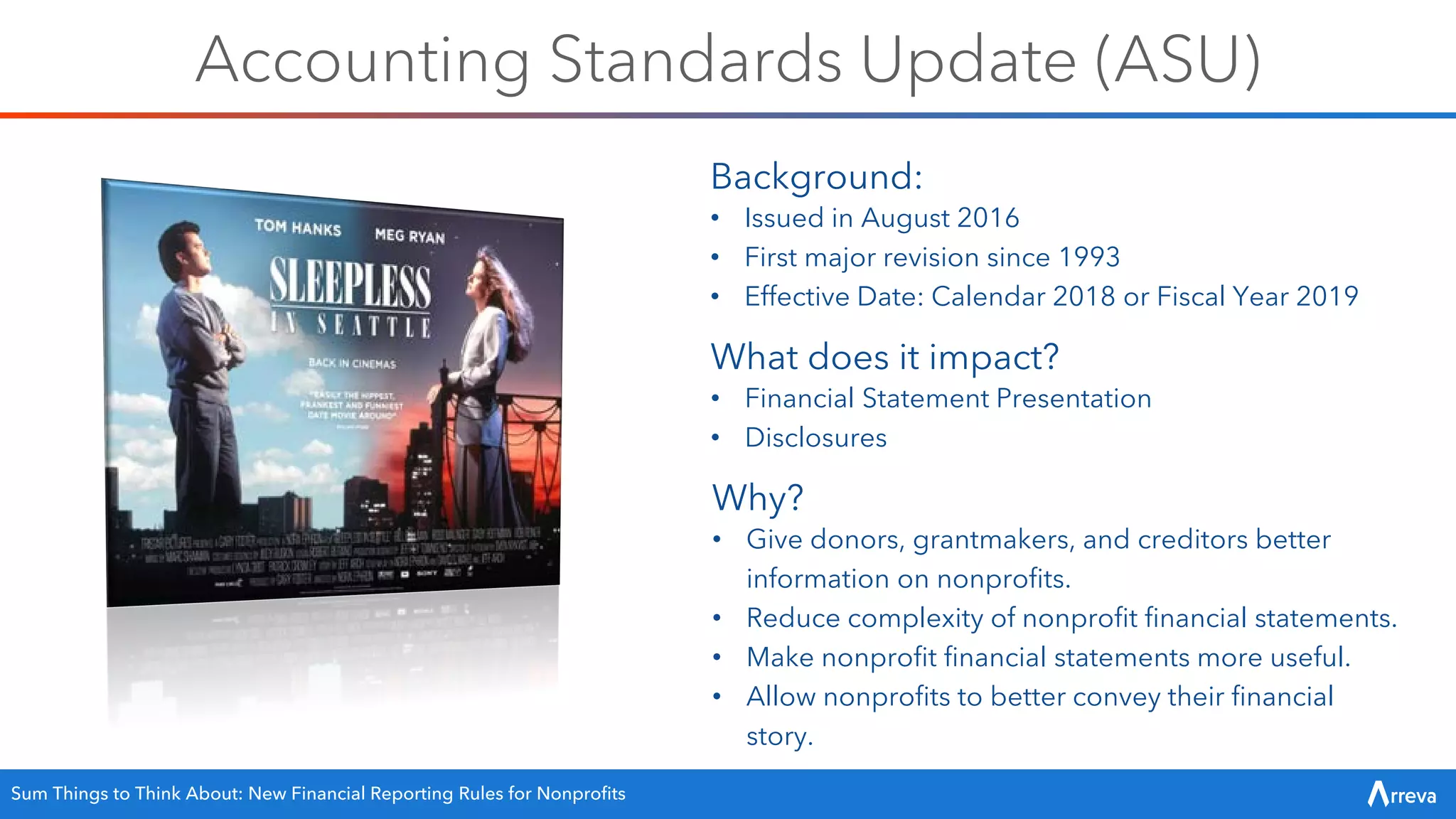
Accounting Standards Update (ASU)
Background:
• Issued in August 2016
• First major revision since 1993
• Effective Date: Calendar 2018 or Fiscal Year 2019
What does it impact?
• Financial Statement Presentation
• Disclosures
Why?
• Give donors, grantmakers, and creditors better
information on nonprofits.
• Reduce complexity of nonprofit financial statements.
• Make nonprofit financial statements more useful.
• Allow nonprofits to better convey their financial
story.
Sum Things to Think About: New Financial Reporting Rules for Nonprofits
Accounting Perspective
An Accountant’s guide to the changes
Andrea Mills MBA, CPA, CCSA, CGMA
Principal, Fiscal Management Associates
Sum Things to Think About: New Financial Reporting Rules for Nonprofits
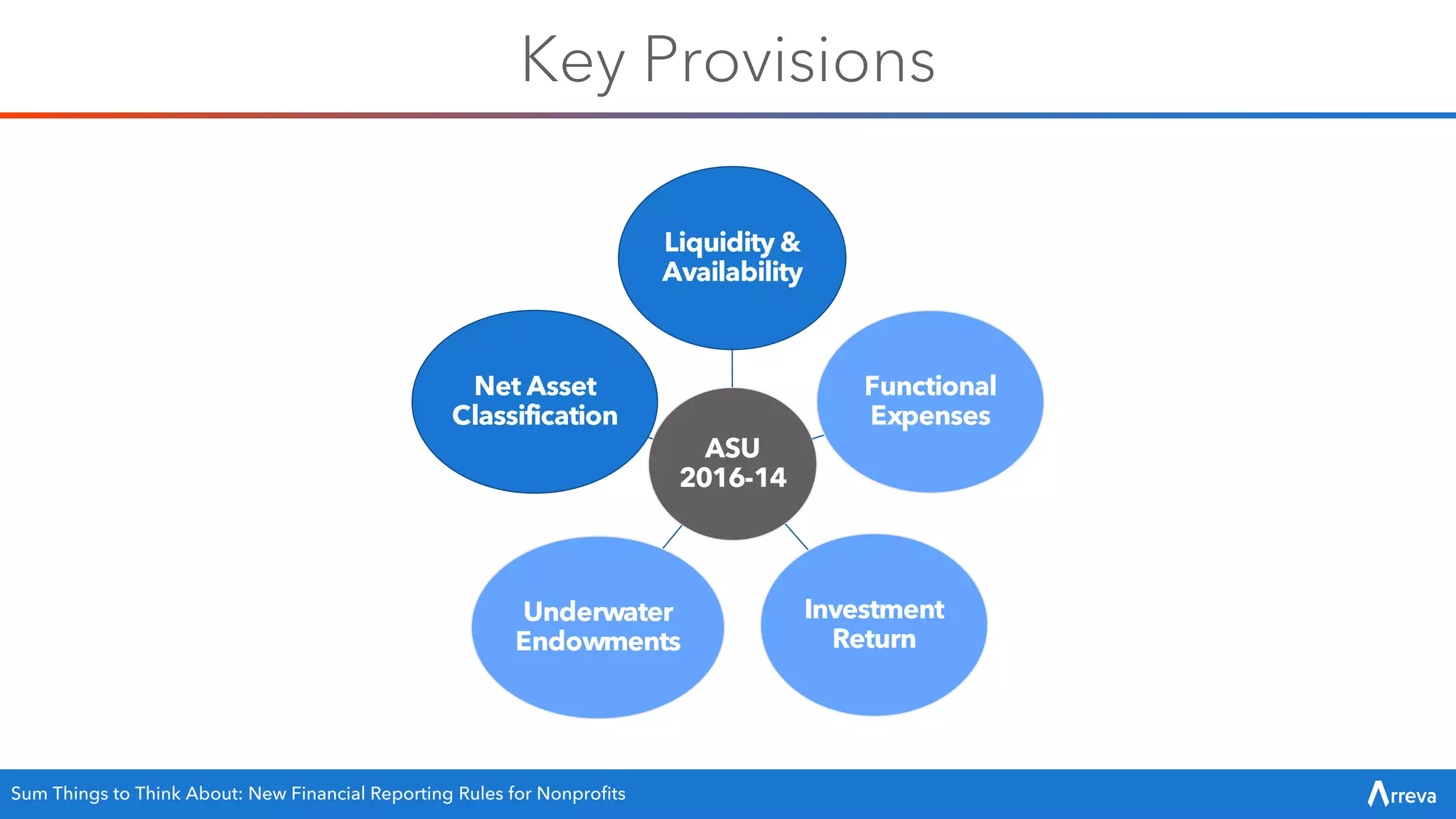
ASU
2016-14
Liquidity &
Availability
Functional
Expenses
Investment
Return
Underwater
Endowments
Net Asset
Classification
Key Provisions
Sum Things to Think About: New Financial Reporting Rules for Nonprofits
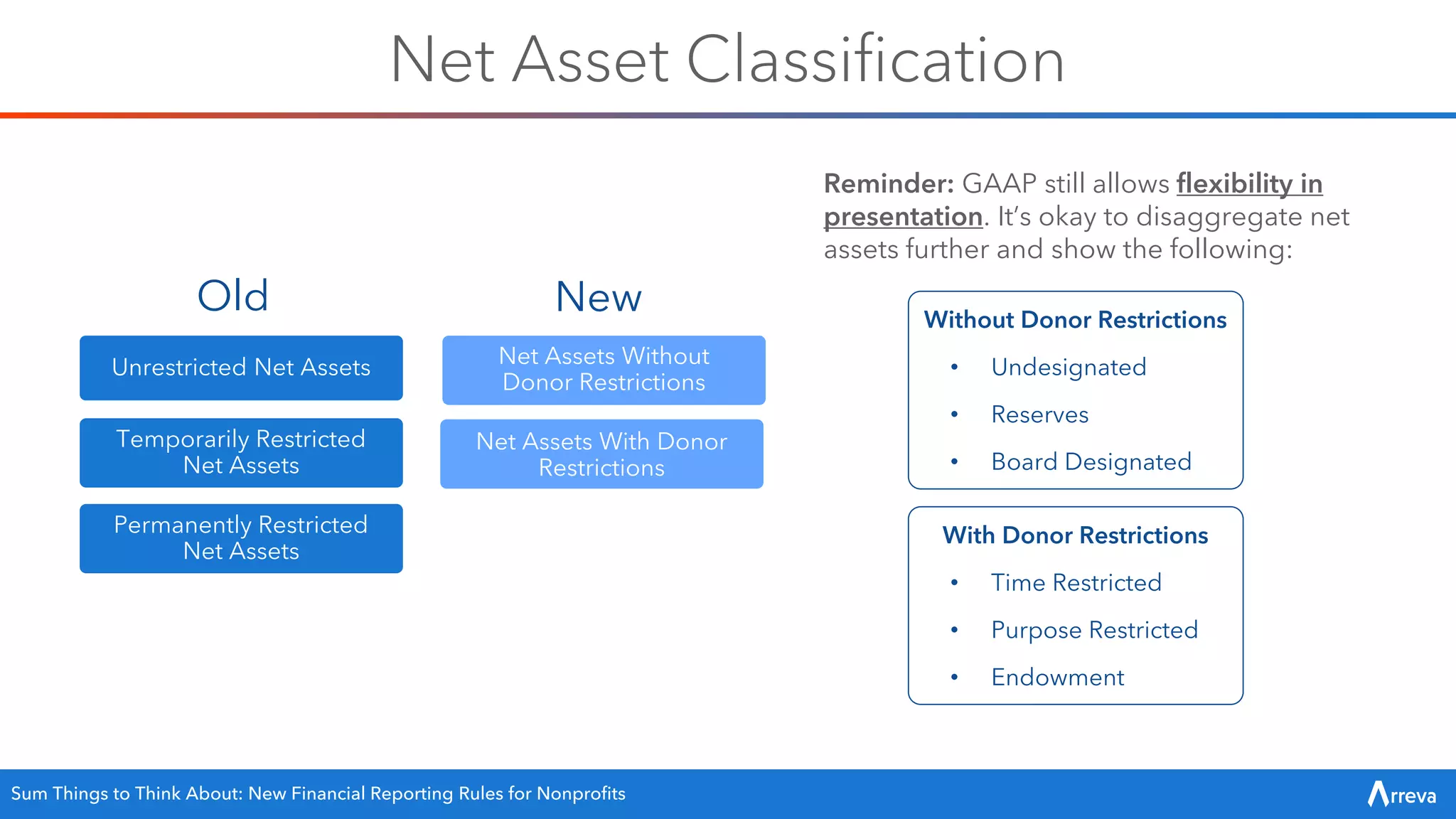
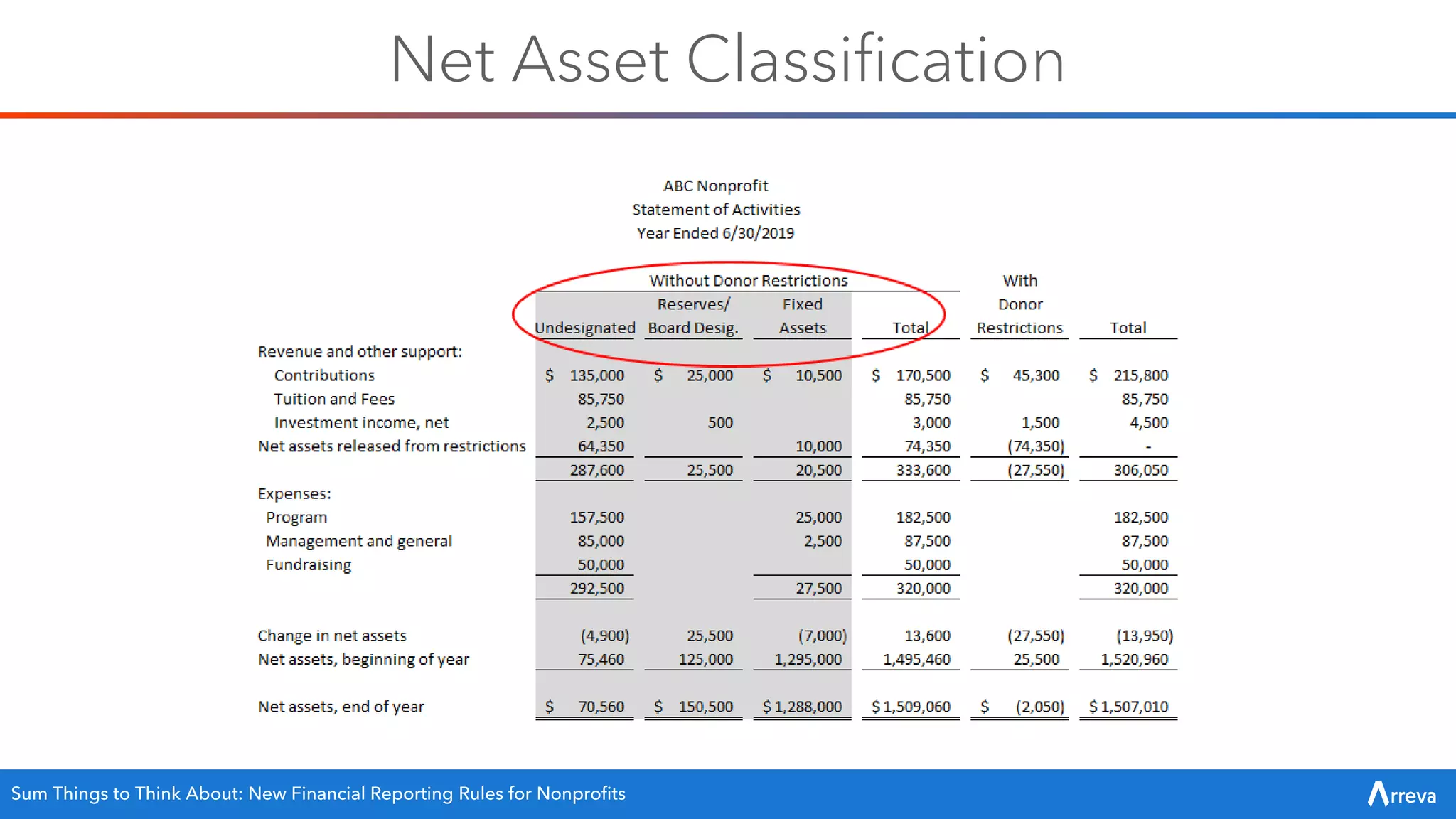
Net Asset Classification
Unrestricted Net Assets
Temporarily Restricted
Net Assets
Permanently Restricted
Net Assets
Old
Net Assets Without
Donor Restrictions
Net Assets With Donor
Restrictions
New
Reminder: GAAP still allows flexibility in
presentation. It’s okay to disaggregate net
assets further and show the following:
Without Donor Restrictions
• Undesignated
• Reserves
• Board Designated
With Donor Restrictions
• Time Restricted
• Purpose Restricted
• Endowment
Sum Things to Think About: New Financial Reporting Rules for Nonprofits
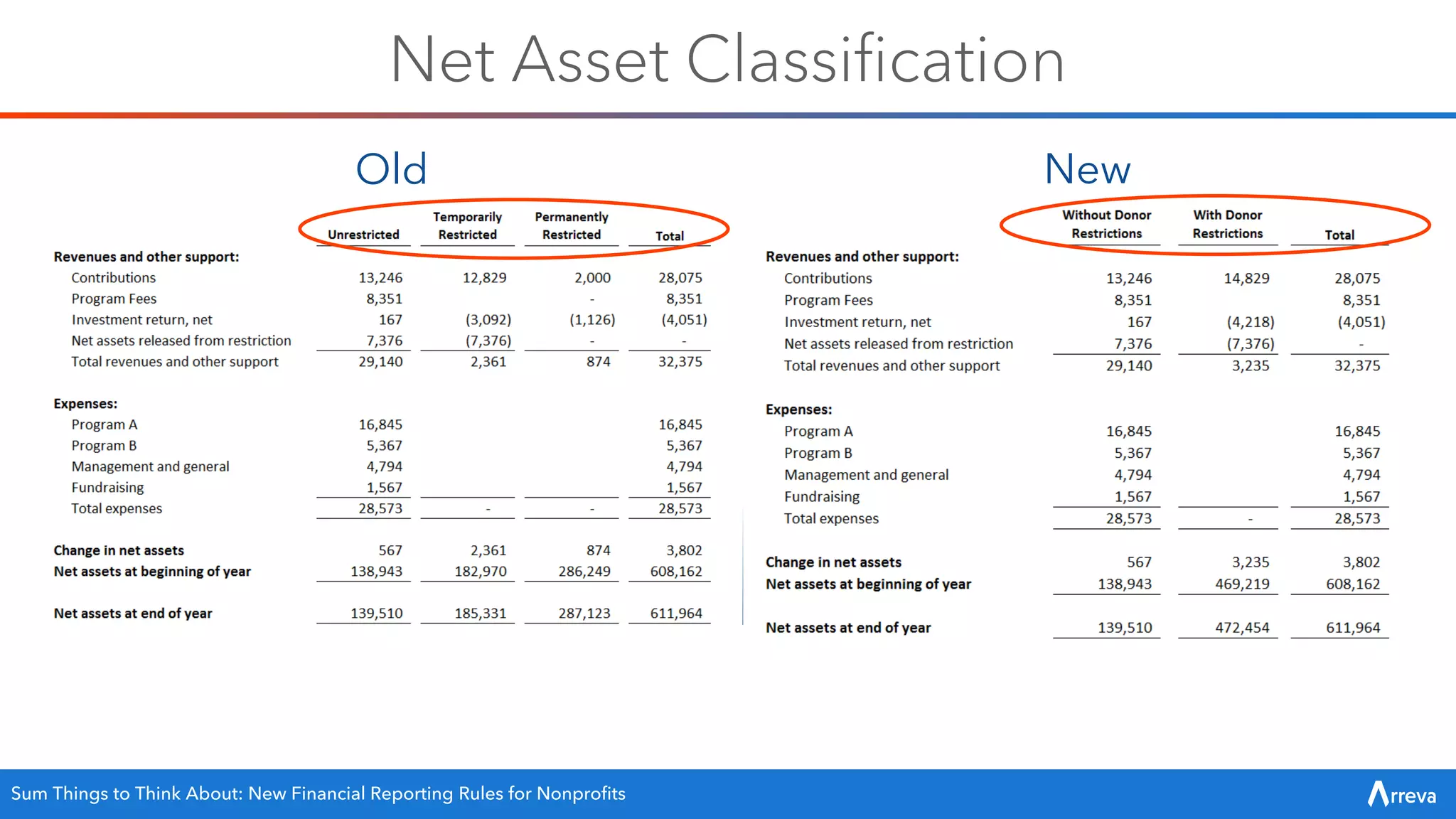
Net Asset Classification
Old New
Sum Things to Think About: New Financial Reporting Rules for Nonprofits
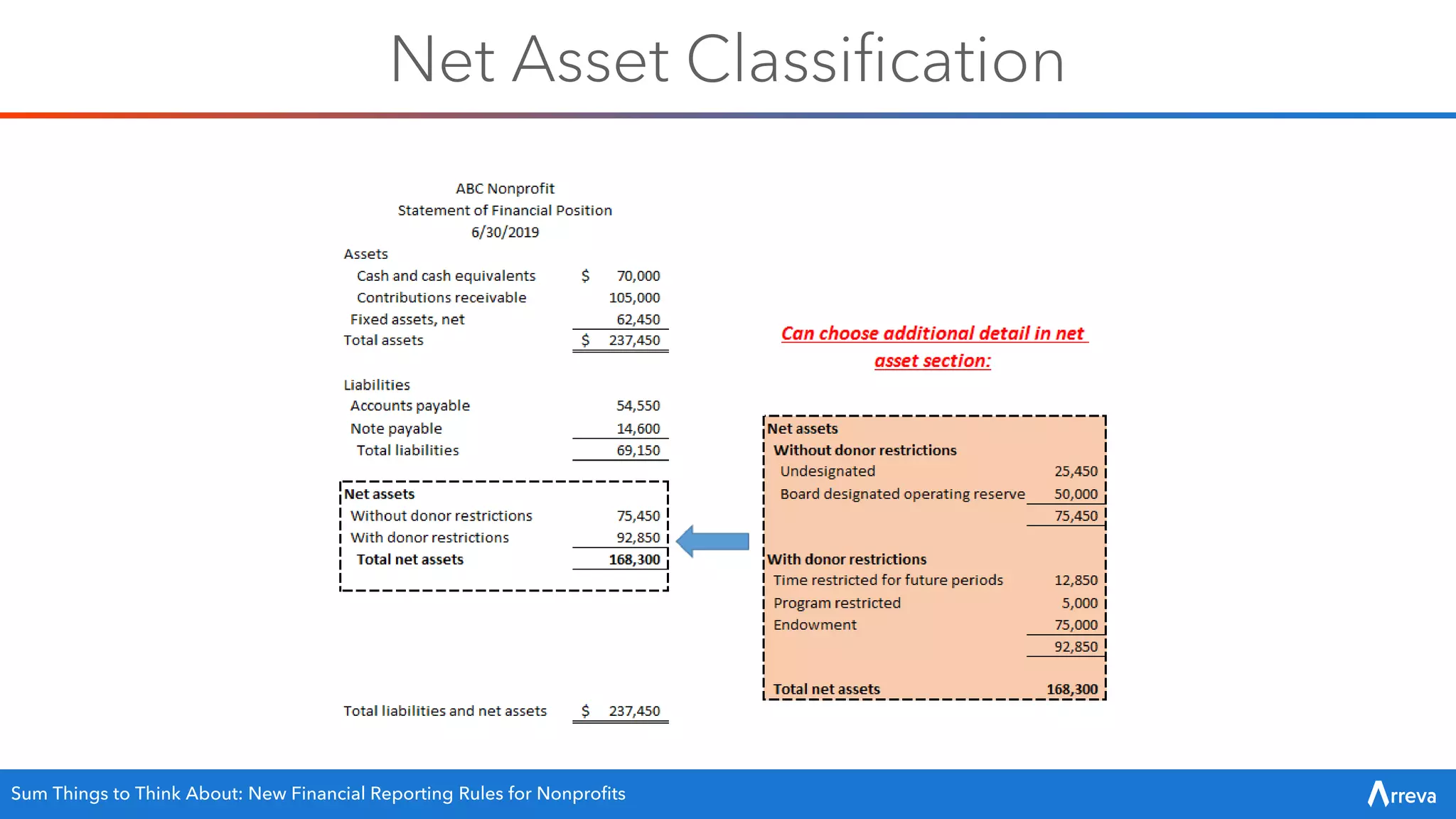
Net Asset Classification
Sum Things to Think About: New Financial Reporting Rules for Nonprofits
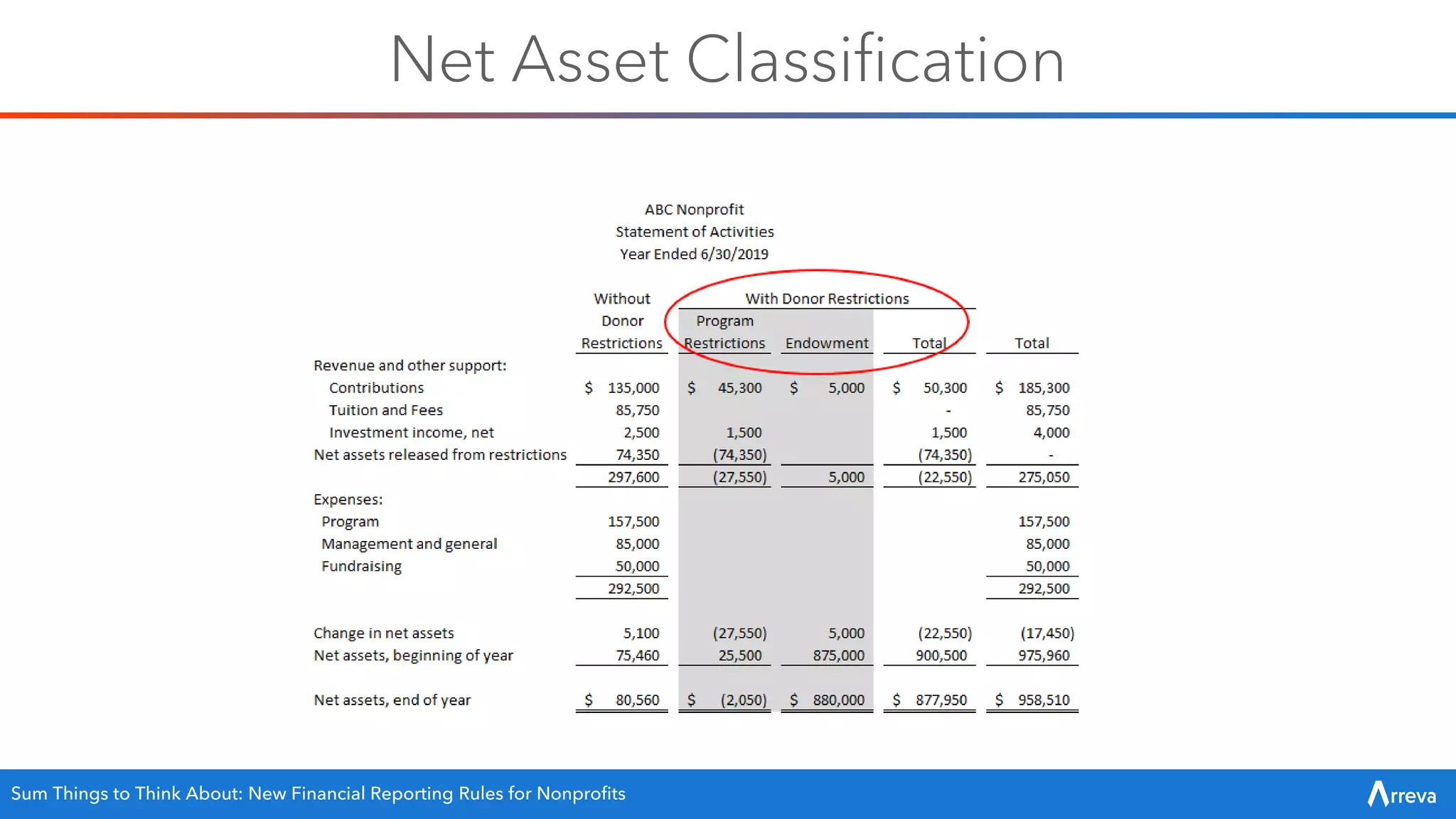
Net Asset Classification
Sum Things to Think About: New Financial Reporting Rules for Nonprofits
Net Asset Classification
Sum Things to Think About: New Financial Reporting Rules for Nonprofits
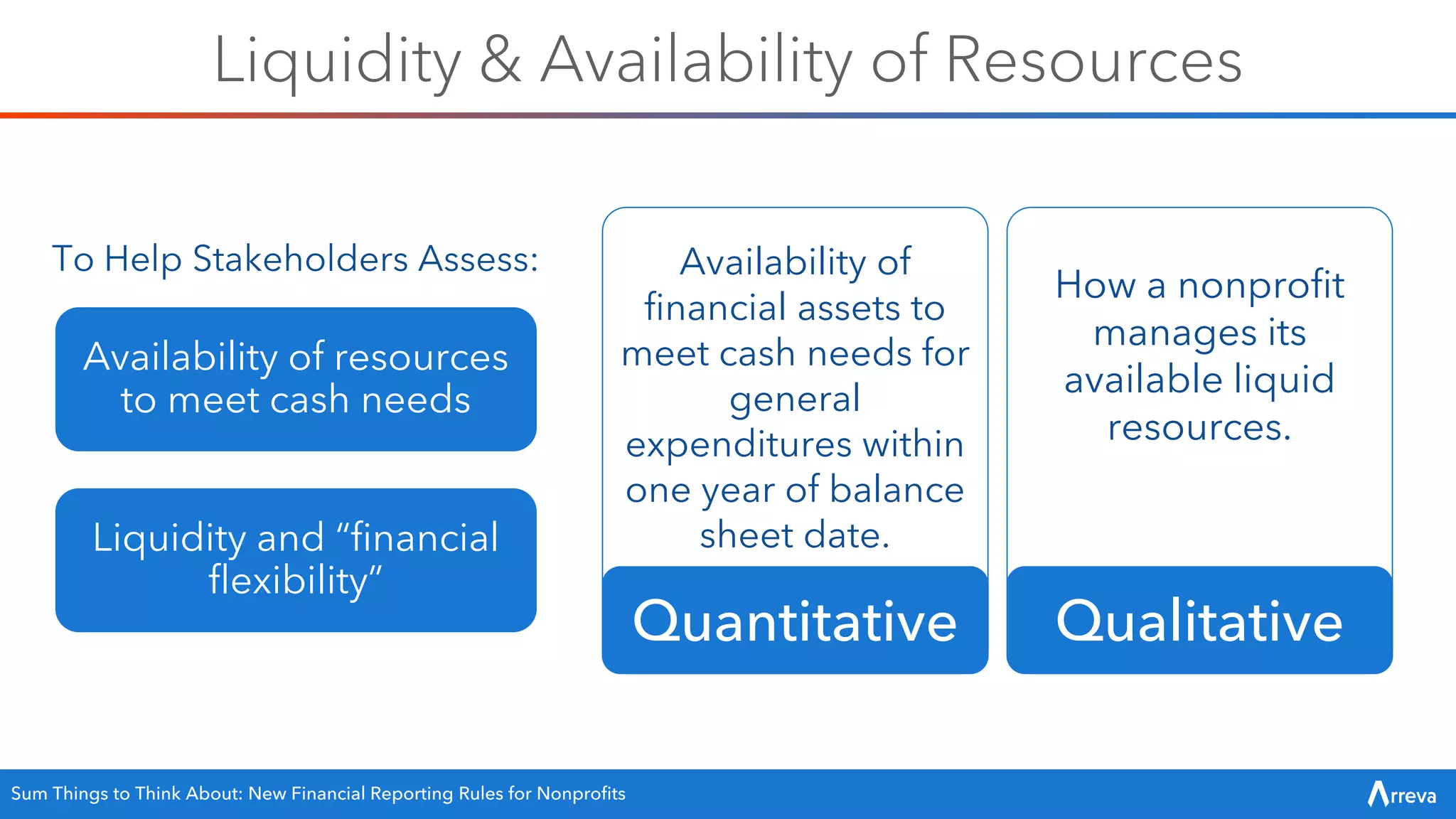
To Help Stakeholders Assess:
Availability of resources
to meet cash needs
Liquidity and “financial
flexibility”
Liquidity & Availability of Resources
How a nonprofit
manages its
available liquid
resources.
Qualitative
Availability of
financial assets to
meet cash needs for
general
expenditures within
one year of balance
sheet date.
Quantitative
Sum Things to Think About: New Financial Reporting Rules for Nonprofits
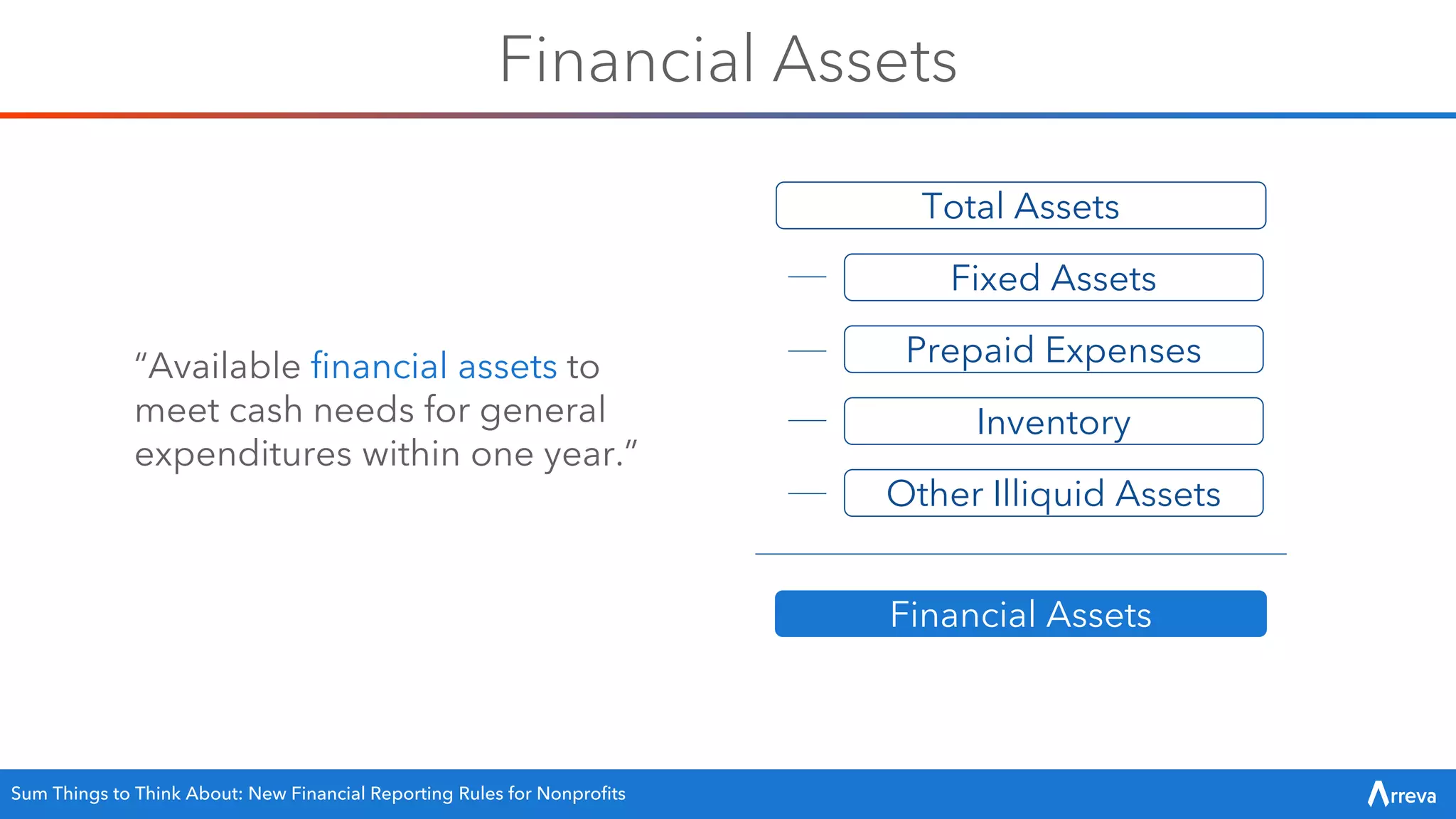
Other Illiquid Assets
Total Assets
Fixed Assets
Prepaid Expenses
Inventory
Financial Assets
“Available financial assets to
meet cash needs for general
expenditures within one year.”
Financial Assets
Sum Things to Think About: New Financial Reporting Rules for Nonprofits
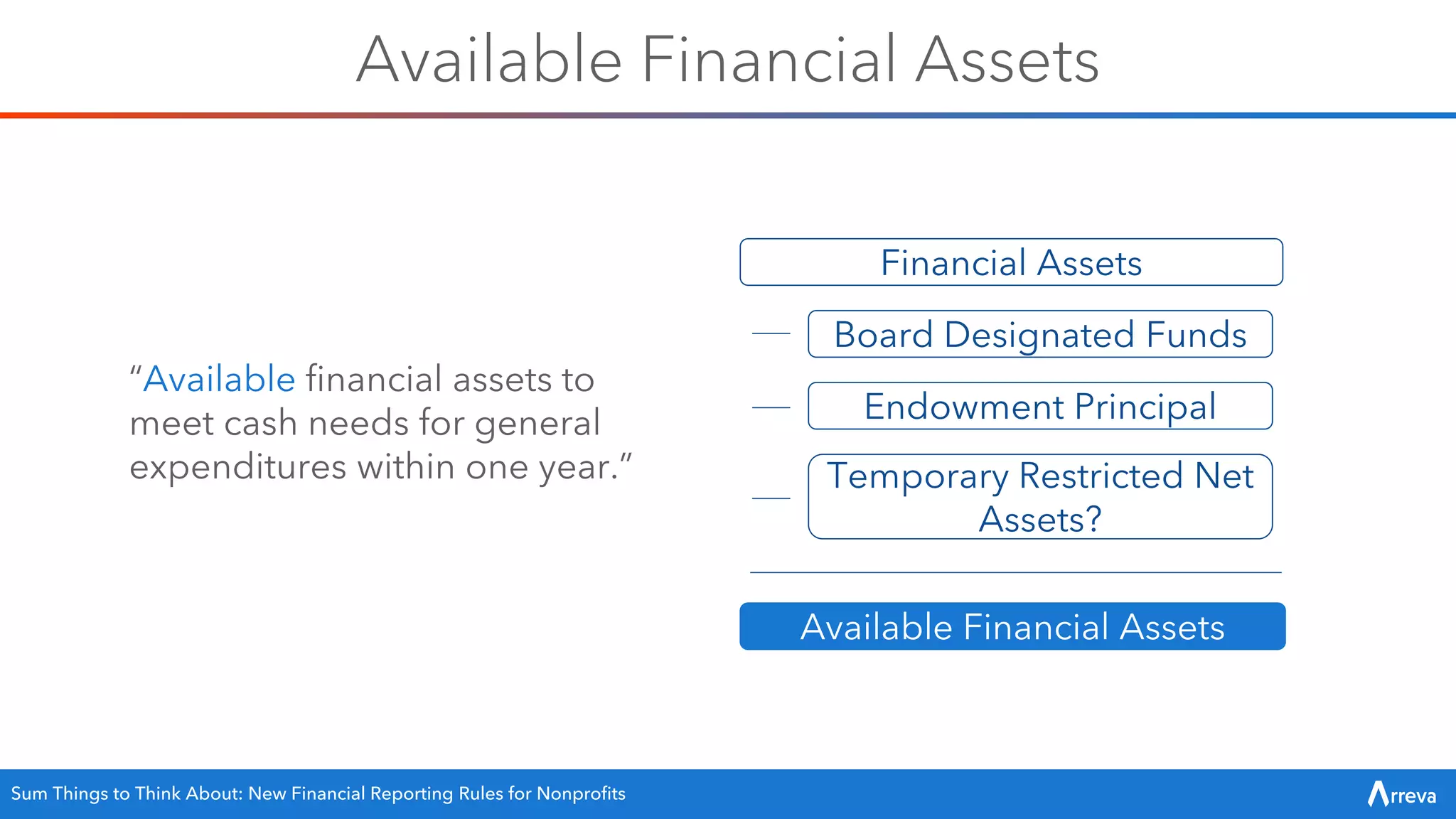
“Available financial assets to
meet cash needs for general
expenditures within one year.”
Financial Assets
Board Designated Funds
Endowment Principal
Temporary Restricted Net
Assets?
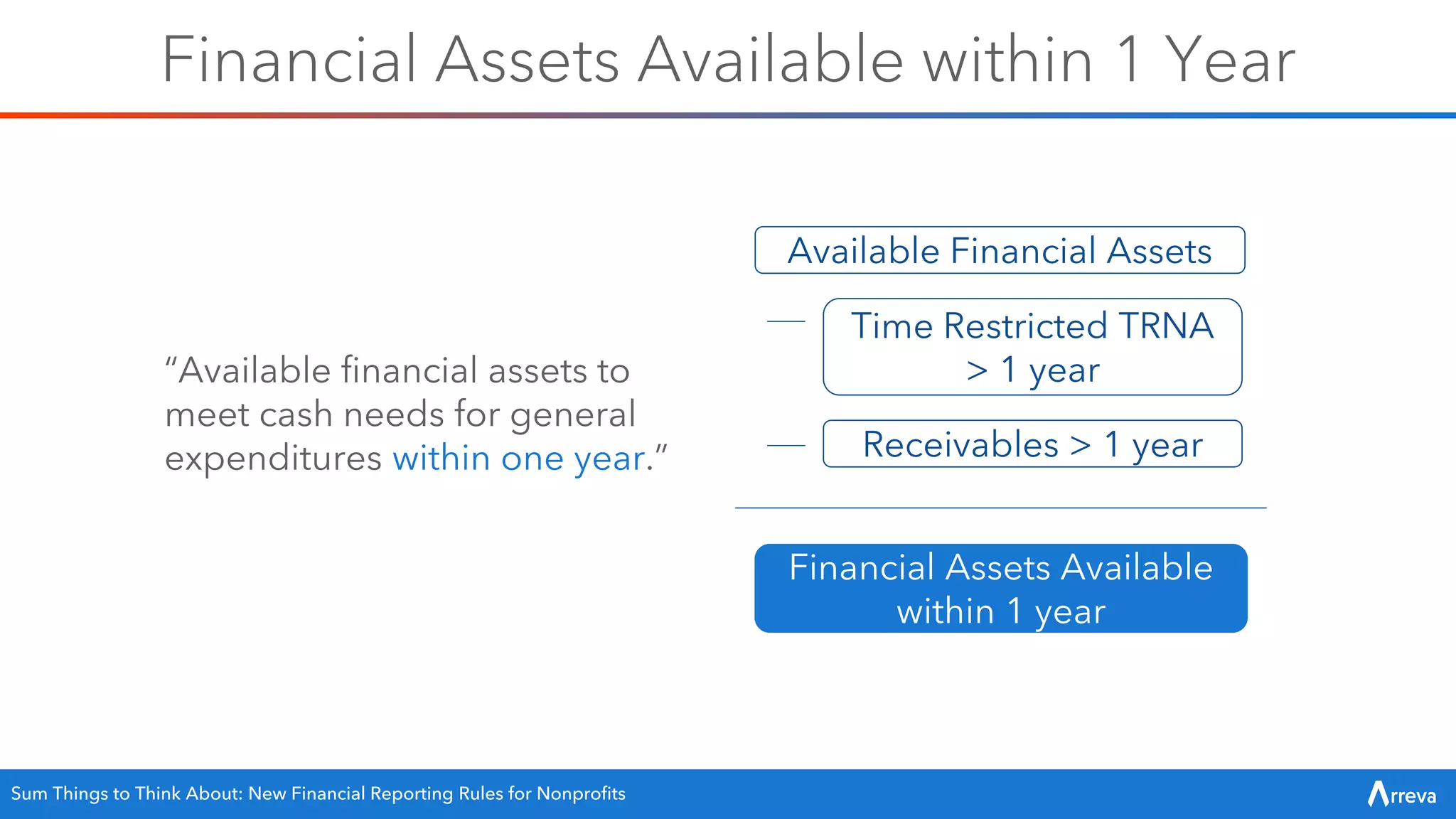
Available Financial Assets
Sum Things to Think About: New Financial Reporting Rules for Nonprofits
Available Financial Assets
Time Restricted TRNA
> 1 year
Receivables > 1 year
Financial Assets Available
within 1 year
Financial Assets Available within 1 Year
“Available financial assets to
meet cash needs for general
expenditures within one year.”
Sum Things to Think About: New Financial Reporting Rules for Nonprofits
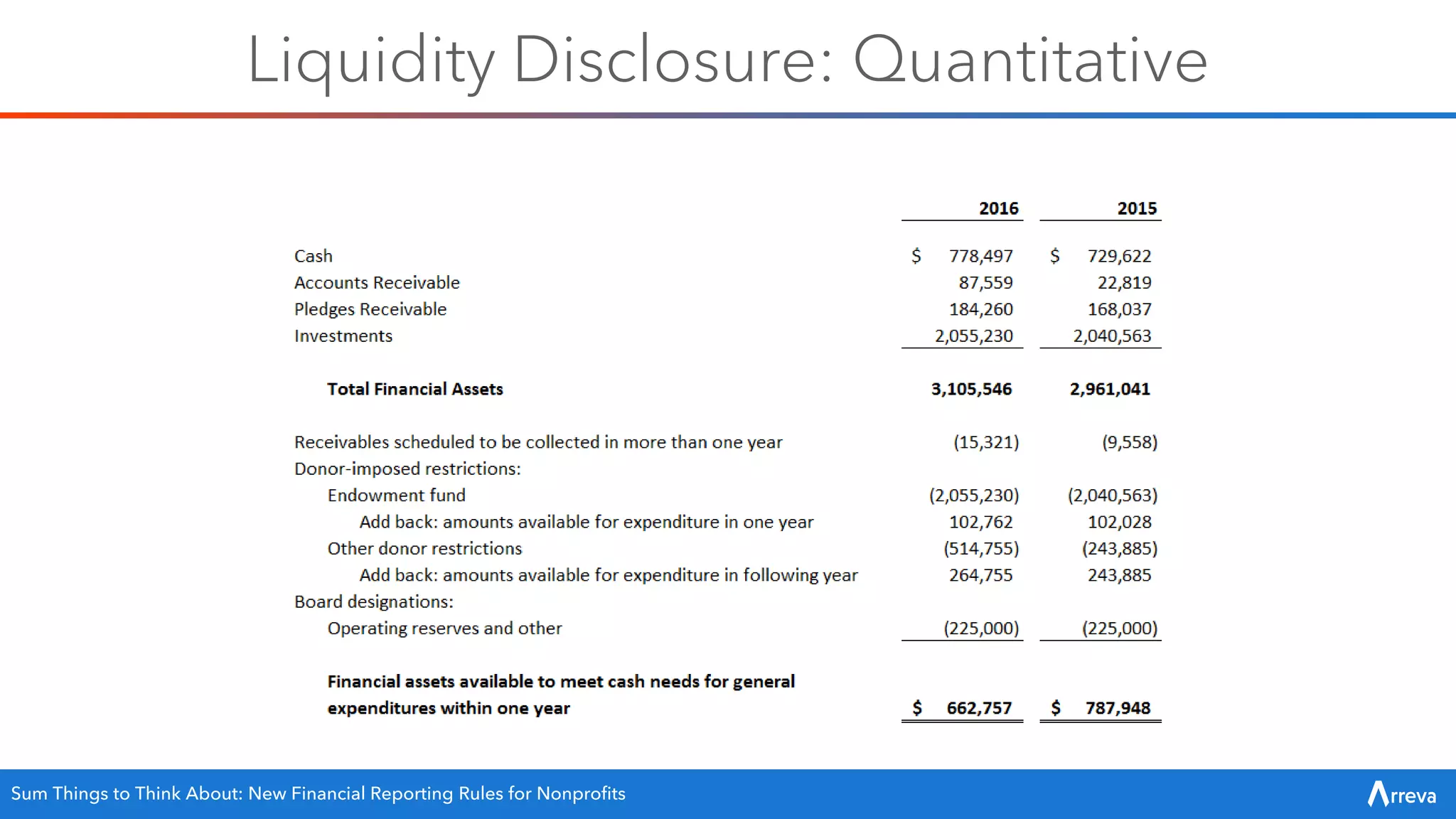
Liquidity Disclosure: Quantitative
Sum Things to Think About: New Financial Reporting Rules for Nonprofits
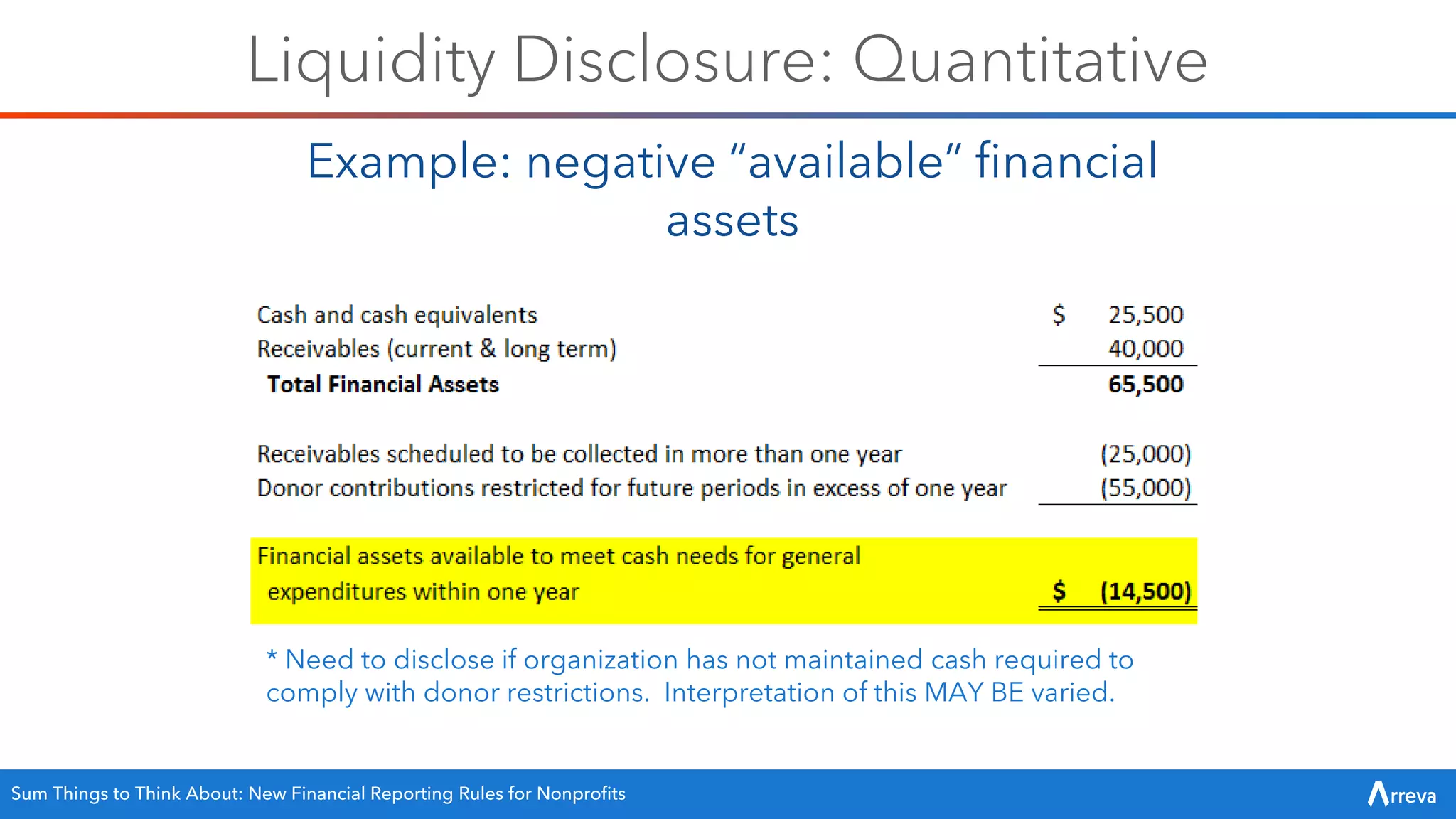
Example: negative “available” financial
assets
* Need to disclose if organization has not maintained cash required to
comply with donor restrictions. Interpretation of this MAY BE varied.
Liquidity Disclosure: Quantitative
Sum Things to Think About: New Financial Reporting Rules for Nonprofits
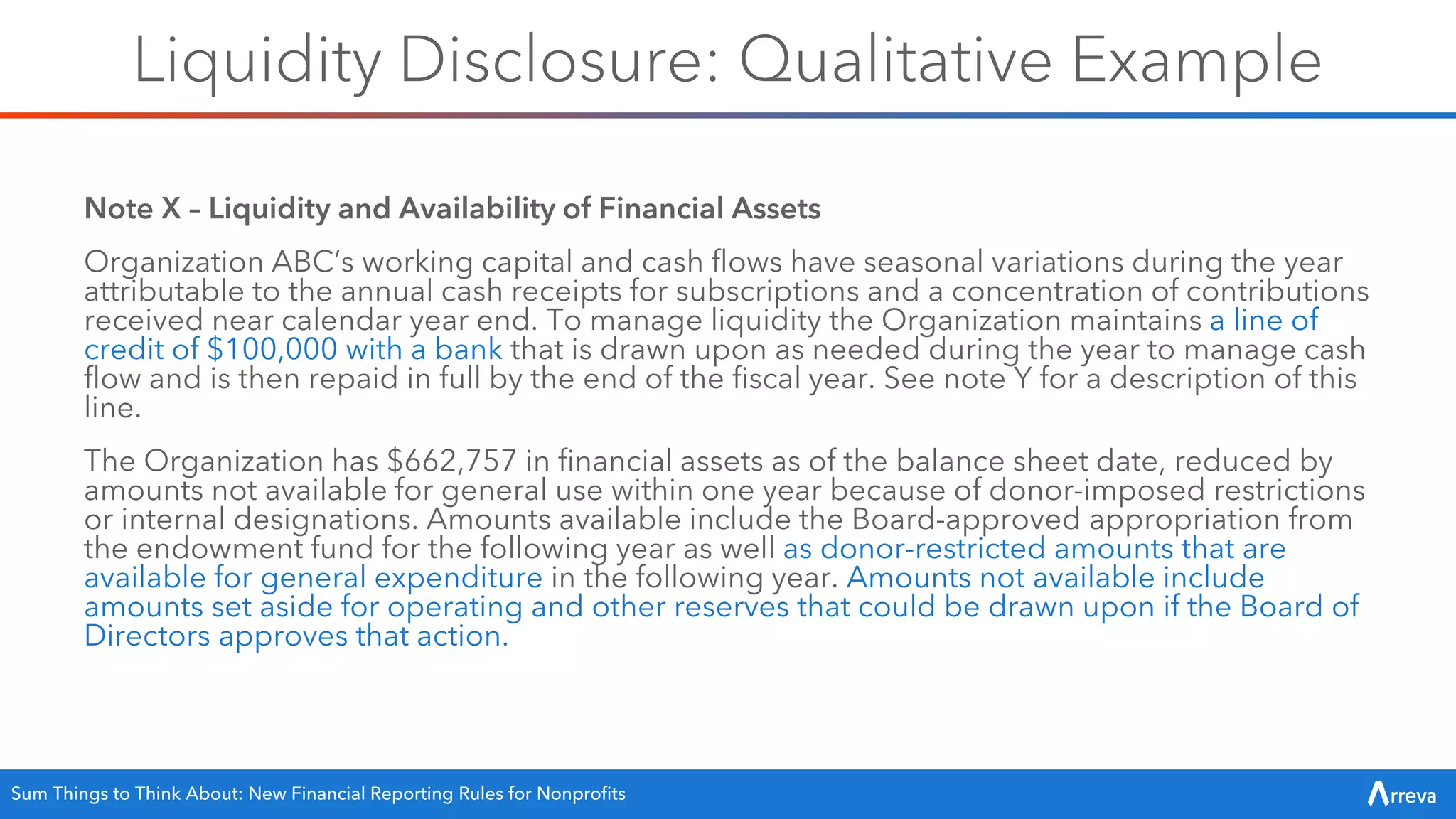
Liquidity Disclosure: Qualitative Example
Note X – Liquidity and Availability of Financial Assets
Organization ABC’s working capital and cash flows have seasonal variations during the year
attributable to the annual cash receipts for subscriptions and a concentration of contributions
received near calendar year end. To manage liquidity the Organization maintains a line of
credit of $100,000 with a bank that is drawn upon as needed during the year to manage cash
flow and is then repaid in full by the end of the fiscal year. See note Y for a description of this
line.
The Organization has $662,757 in financial assets as of the balance sheet date, reduced by
amounts not available for general use within one year because of donor-imposed restrictions
or internal designations. Amounts available include the Board-approved appropriation from
the endowment fund for the following year as well as donor-restricted amounts that are
available for general expenditure in the following year. Amounts not available include
amounts set aside for operating and other reserves that could be drawn upon if the Board of
Directors approves that action.
Sum Things to Think About: New Financial Reporting Rules for Nonprofits
Development Perspective
A Development Director’s guide to the changes
Ryan Erfer
Senior Director of Business Development, Arreva
Sum Things to Think About: New Financial Reporting Rules for Nonprofits
Development Perspective
• Greater transparency to donors and
key stakeholders.
• Guides development strategy.
• Guides communication.
Understand Your Situation
Analyze your financial report to identify
opportunities for:
• Better fund allocation.
• Fundraising initiatives to implement.
• Smoother, better cash flow.
• Increasing reserves and unrestricted funds.
Sum Things to Think About: New Financial Reporting Rules for Nonprofits
Communicating to Stakeholders
• Leadership and staff
• Board members
• Major donors
• Volunteers
Sum Things to Think About: New Financial Reporting Rules for Nonprofits
What Needs to Be Communicated
• Impact to your nonprofit.
• Adjustments to resource development efforts.
• Shifts of roles and responsibilities for staff and
board members.
• Strategic plan and initiatives.
Sum Things to Think About: New Financial Reporting Rules for Nonprofits
What You Can Do
• Diversify revenue streams.
• Increase opportunities to
donate (e.g. pledges, monthly
giving, planned giving).
• Revise fundraising “ask.”
Sum Things to Think About: New Financial Reporting Rules for Nonprofits
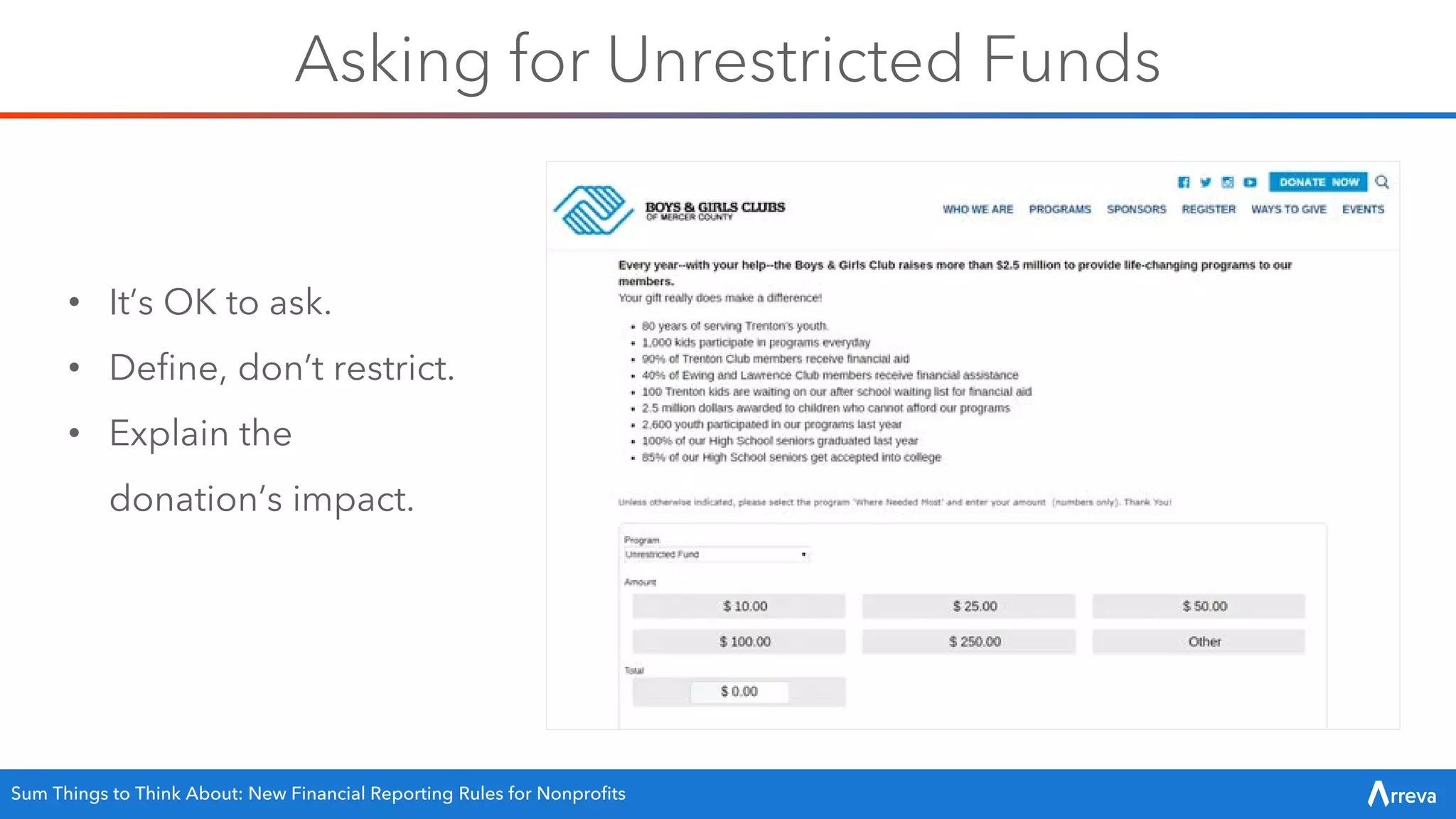
Asking for Unrestricted Funds
• It’s OK to ask.
• Define, don’t restrict.
• Explain the
donation’s impact.
Sum Things to Think About: New Financial Reporting Rules for Nonprofits
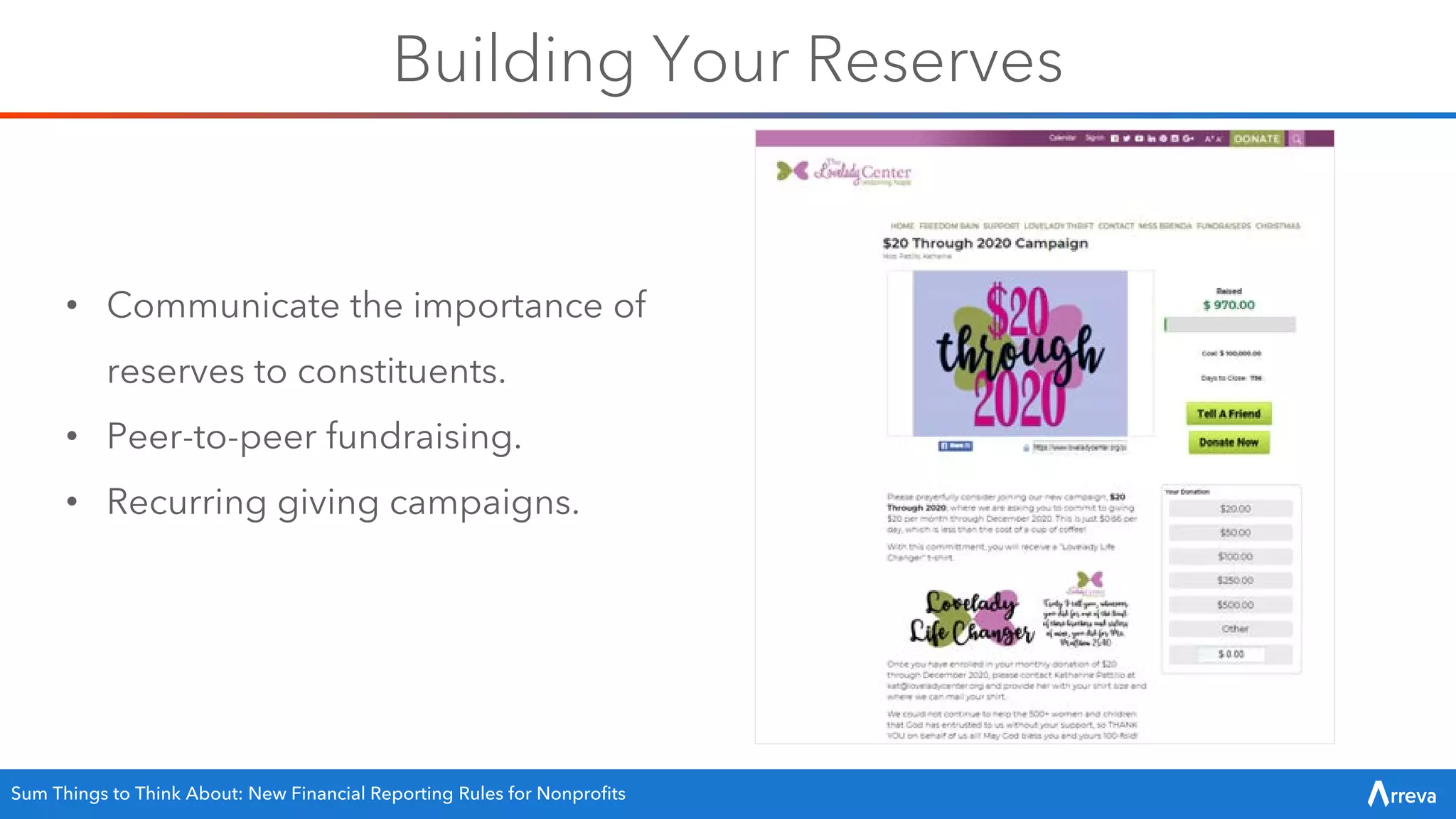
Building Your Reserves
• Communicate the importance of
reserves to constituents.
• Peer-to-peer fundraising.
• Recurring giving campaigns.
Sum Things to Think About: New Financial Reporting Rules for Nonprofits
Summary
Sum Things to Think About: New Financial Reporting Rules for Nonprofits
• Understand the impact and implication of your statement to stakeholders.
• Tailor communication specific to each type of stakeholder, including staff, board members, donors, etc.
• Foster collaboration between Accounting and Development.
• Be proactive and holistic in your approach.
Q&A Ryan Erfer
Arreva
ryan.erfer@arreva.com
800.676.5831 ext. 314
Andrea Mills
FMA
amills@fmaonline.net
212.931.9163
David Jost
Arreva
david.jost@arreva.com
800.676.5831 ext. 317
About Arreva
Arreva, the trusted advisor and industry leader in cloud-based Donor Relationship
Management and Online Fundraising software has offices in Fort Lauderdale, FL and
Palo Alto, CA with a team that has served the nonprofit industry for over three decades.
Arreva’s fully integrated Online Fundraising and Exceed Beyond Donor Relationship
Management Software provide a nonprofit ecosystem that helps thousands of nonprofit
organizations focus on their mission while they build awareness, cultivate and engage
donors, and transform fundraising.
Learn more at: www.arreva.com
About Andrea Mills
Andrea has extensive experience working with nonprofits, individuals, and foundations
helping them make important strategic fiscal decisions. As a sought-after trainer and
speaker, Andrea travels the country presenting on a variety of nonprofit financial
management topics. She is a member of the American Institute of CPAs and The
Institute of Internal Auditors and served as an adjunct professor at Columbia
University’s School of Continuing Education, where she trained Development Directors
on nonprofit accounting issues.
Learn more at: fmaonline.net
Ryan Erfer
Arreva
ryan.erfer@arreva.com
800.676.5831 ext. 314
Andrea Mills
FMA
amills@fmaonline.net
212.931.9163
David Jost
Arreva
david.jost@arreva.com
800.676.5831 ext. 317

Sum Things to Think About: New Financial Reporting Rules for Nonprofits

  • 1.
    Sum Things toThink About: New Financial Reporting Rules for Nonprofits An Educational Webinar
  • 2.
    Agenda 1. Introduction 2 AccountingStandards Update 3. Accounting Perspective 4. Net Asset Classification 5. Liquidity & Availability 6. Development Perspective 7. Understand Your Situation 8. Communicating to Stakeholders 9. What Needs to Be Communicated 10. What You Can Do 11. Q&A Sum Things to Think About: New Financial Reporting Rules for Nonprofits
  • 3.
    Introduction Ryan Erfer Senior Directorof Business Development, Arreva Andrea Mills MBA, CPA, CCSA, CGMA Principal, Fiscal Management Associates David Jost Chief Marketing Officer, Arreva Sum Things to Think About: New Financial Reporting Rules for Nonprofits
  • 4.
    Accounting Standards Update(ASU) Background: • Issued in August 2016 • First major revision since 1993 • Effective Date: Calendar 2018 or Fiscal Year 2019 What does it impact? • Financial Statement Presentation • Disclosures Why? • Give donors, grantmakers, and creditors better information on nonprofits. • Reduce complexity of nonprofit financial statements. • Make nonprofit financial statements more useful. • Allow nonprofits to better convey their financial story. Sum Things to Think About: New Financial Reporting Rules for Nonprofits
  • 5.
    Accounting Perspective An Accountant’sguide to the changes Andrea Mills MBA, CPA, CCSA, CGMA Principal, Fiscal Management Associates Sum Things to Think About: New Financial Reporting Rules for Nonprofits
  • 6.
  • 7.
    Net Asset Classification UnrestrictedNet Assets Temporarily Restricted Net Assets Permanently Restricted Net Assets Old Net Assets Without Donor Restrictions Net Assets With Donor Restrictions New Reminder: GAAP still allows flexibility in presentation. It’s okay to disaggregate net assets further and show the following: Without Donor Restrictions • Undesignated • Reserves • Board Designated With Donor Restrictions • Time Restricted • Purpose Restricted • Endowment Sum Things to Think About: New Financial Reporting Rules for Nonprofits
  • 8.
    Net Asset Classification OldNew Sum Things to Think About: New Financial Reporting Rules for Nonprofits
  • 9.
    Net Asset Classification SumThings to Think About: New Financial Reporting Rules for Nonprofits
  • 10.
    Net Asset Classification SumThings to Think About: New Financial Reporting Rules for Nonprofits
  • 11.
    Net Asset Classification SumThings to Think About: New Financial Reporting Rules for Nonprofits
  • 12.
    To Help StakeholdersAssess: Availability of resources to meet cash needs Liquidity and “financial flexibility” Liquidity & Availability of Resources How a nonprofit manages its available liquid resources. Qualitative Availability of financial assets to meet cash needs for general expenditures within one year of balance sheet date. Quantitative Sum Things to Think About: New Financial Reporting Rules for Nonprofits
  • 13.
    Other Illiquid Assets TotalAssets Fixed Assets Prepaid Expenses Inventory Financial Assets “Available financial assets to meet cash needs for general expenditures within one year.” Financial Assets Sum Things to Think About: New Financial Reporting Rules for Nonprofits
  • 14.
    “Available financial assetsto meet cash needs for general expenditures within one year.” Financial Assets Board Designated Funds Endowment Principal Temporary Restricted Net Assets? Available Financial Assets Available Financial Assets Sum Things to Think About: New Financial Reporting Rules for Nonprofits
  • 15.
    Available Financial Assets TimeRestricted TRNA > 1 year Receivables > 1 year Financial Assets Available within 1 year Financial Assets Available within 1 Year “Available financial assets to meet cash needs for general expenditures within one year.” Sum Things to Think About: New Financial Reporting Rules for Nonprofits
  • 16.
    Liquidity Disclosure: Quantitative SumThings to Think About: New Financial Reporting Rules for Nonprofits
  • 17.
    Example: negative “available”financial assets * Need to disclose if organization has not maintained cash required to comply with donor restrictions. Interpretation of this MAY BE varied. Liquidity Disclosure: Quantitative Sum Things to Think About: New Financial Reporting Rules for Nonprofits
  • 18.
    Liquidity Disclosure: QualitativeExample Note X – Liquidity and Availability of Financial Assets Organization ABC’s working capital and cash flows have seasonal variations during the year attributable to the annual cash receipts for subscriptions and a concentration of contributions received near calendar year end. To manage liquidity the Organization maintains a line of credit of $100,000 with a bank that is drawn upon as needed during the year to manage cash flow and is then repaid in full by the end of the fiscal year. See note Y for a description of this line. The Organization has $662,757 in financial assets as of the balance sheet date, reduced by amounts not available for general use within one year because of donor-imposed restrictions or internal designations. Amounts available include the Board-approved appropriation from the endowment fund for the following year as well as donor-restricted amounts that are available for general expenditure in the following year. Amounts not available include amounts set aside for operating and other reserves that could be drawn upon if the Board of Directors approves that action. Sum Things to Think About: New Financial Reporting Rules for Nonprofits
  • 19.
    Development Perspective A DevelopmentDirector’s guide to the changes Ryan Erfer Senior Director of Business Development, Arreva Sum Things to Think About: New Financial Reporting Rules for Nonprofits
  • 20.
    Development Perspective • Greatertransparency to donors and key stakeholders. • Guides development strategy. • Guides communication.
  • 21.
    Understand Your Situation Analyzeyour financial report to identify opportunities for: • Better fund allocation. • Fundraising initiatives to implement. • Smoother, better cash flow. • Increasing reserves and unrestricted funds. Sum Things to Think About: New Financial Reporting Rules for Nonprofits
  • 22.
    Communicating to Stakeholders •Leadership and staff • Board members • Major donors • Volunteers Sum Things to Think About: New Financial Reporting Rules for Nonprofits
  • 23.
    What Needs toBe Communicated • Impact to your nonprofit. • Adjustments to resource development efforts. • Shifts of roles and responsibilities for staff and board members. • Strategic plan and initiatives. Sum Things to Think About: New Financial Reporting Rules for Nonprofits
  • 24.
    What You CanDo • Diversify revenue streams. • Increase opportunities to donate (e.g. pledges, monthly giving, planned giving). • Revise fundraising “ask.” Sum Things to Think About: New Financial Reporting Rules for Nonprofits
  • 25.
    Asking for UnrestrictedFunds • It’s OK to ask. • Define, don’t restrict. • Explain the donation’s impact. Sum Things to Think About: New Financial Reporting Rules for Nonprofits
  • 26.
    Building Your Reserves •Communicate the importance of reserves to constituents. • Peer-to-peer fundraising. • Recurring giving campaigns. Sum Things to Think About: New Financial Reporting Rules for Nonprofits
  • 27.
    Summary Sum Things toThink About: New Financial Reporting Rules for Nonprofits • Understand the impact and implication of your statement to stakeholders. • Tailor communication specific to each type of stakeholder, including staff, board members, donors, etc. • Foster collaboration between Accounting and Development. • Be proactive and holistic in your approach.
  • 28.
    Q&A Ryan Erfer Arreva ryan.erfer@arreva.com 800.676.5831ext. 314 Andrea Mills FMA amills@fmaonline.net 212.931.9163 David Jost Arreva david.jost@arreva.com 800.676.5831 ext. 317
  • 29.
    About Arreva Arreva, thetrusted advisor and industry leader in cloud-based Donor Relationship Management and Online Fundraising software has offices in Fort Lauderdale, FL and Palo Alto, CA with a team that has served the nonprofit industry for over three decades. Arreva’s fully integrated Online Fundraising and Exceed Beyond Donor Relationship Management Software provide a nonprofit ecosystem that helps thousands of nonprofit organizations focus on their mission while they build awareness, cultivate and engage donors, and transform fundraising. Learn more at: www.arreva.com About Andrea Mills Andrea has extensive experience working with nonprofits, individuals, and foundations helping them make important strategic fiscal decisions. As a sought-after trainer and speaker, Andrea travels the country presenting on a variety of nonprofit financial management topics. She is a member of the American Institute of CPAs and The Institute of Internal Auditors and served as an adjunct professor at Columbia University’s School of Continuing Education, where she trained Development Directors on nonprofit accounting issues. Learn more at: fmaonline.net Ryan Erfer Arreva ryan.erfer@arreva.com 800.676.5831 ext. 314 Andrea Mills FMA amills@fmaonline.net 212.931.9163 David Jost Arreva david.jost@arreva.com 800.676.5831 ext. 317