Understanding Nonprofit Financial
                    Statements
    Presented by: Scott Haumersen, CPA, Managing Partner
In General

• There are different types of nonprofit
  organizations so presentations may vary
  based on unique circumstances
• Differences may exist between internal and
  external Financial Statements
• Generally Accepted Accounting Principles
  (GAAP) apply including SFAS 116 & 117
  along with other accounting industry
  standards
Basic Nonprofit Financial
  Statements According to GAAP

•   The Statement of Financial Position
•   The Statement of Activities
•   The Statement of Cash Flows
•   Notes to Financial Statements

    Optional: Statement of Functional Expense
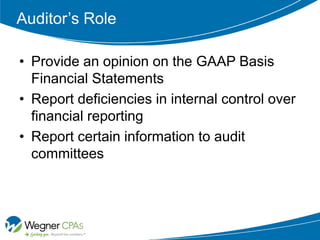
Auditor’s Role

• Provide an opinion on the GAAP Basis
  Financial Statements
• Report deficiencies in internal control over
  financial reporting
• Report certain information to audit
  committees
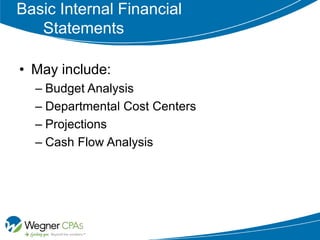
Basic Internal Financial
   Statements

• May include:
  – Budget Analysis
  – Departmental Cost Centers
  – Projections
  – Cash Flow Analysis
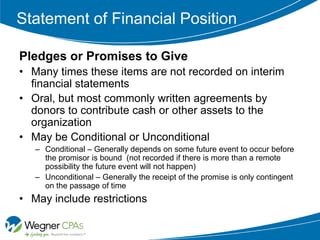
Statement of Financial Position

Pledges or Promises to Give
• Many times these items are not recorded on interim
  financial statements
• Oral, but most commonly written agreements by
  donors to contribute cash or other assets to the
  organization
• May be Conditional or Unconditional
   – Conditional – Generally depends on some future event to occur before
     the promisor is bound (not recorded if there is more than a remote
     possibility the future event will not happen)
   – Unconditional – Generally the receipt of the promise is only contingent
     on the passage of time
• May include restrictions
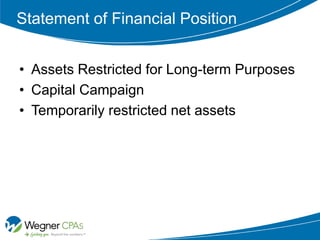
Statement of Financial Position


• Assets Restricted for Long-term Purposes
• Capital Campaign
• Temporarily restricted net assets
Statement of Financial Position


Long Term Debt
• Debt repayments in periods occurring after
  the next fiscal year
• Also would include capital leases
Statement of Financial Position

Net Assets
• Unrestricted – Assets which are not restricted
  either by donors or by law
   – Also includes board designated funds
• Temporarily Restricted - Usage of is limited by
  donor-imposed time or purpose restrictions
• Permanently Restricted – Assets which have been
  restricted by donor or law to be maintained by the
  organization in perpetuity
   – Endowment Funds
The Statement of Activities

•   Revenue Recognition
•   Exchange Transaction
•   Contributions
•   By category of Net Assets
•   Net Assets released from restrictions
•   Functional Allocation
The Statement of Activities

• In-kind or Donated Goods or Services
  – Donated goods are recorded at their fair value
     • Catalogs
     • Vendors
     • Appraisals
  – Donated services also recorded at fair value, if:
     • Specialized – attorney, architect, plumber
     • Would otherwise be purchased by the organization
• Unrealized Investment Income or Loss
The Statement of Cash-Flows


• Non-cash items
• Collections of Contributions restricted for
  long-term purposes
The Statement of Functional
    Expenses

• Required for Voluntary Health & Welfare
  Organizations
• Others may adopt
Notes to the Financial
    Statements
• Required by GAAP to provide additional
  disclosures
• Summary of Significant Accounting policies
• Joint Cost Activities
• Management & General Costs
• Temporarily Restricted Net Assets
• Conditional Promises to Give
• Promises to Give
Ratio Analysis


•   Financial profitability
•   Liquidity
•   Capital Structure
•   Asset efficiency
Thank You!

 Scott Haumersen, CPA, Managing Partner

               Wegner CPAs
              2110 Luann Lane
             Madison, WI 53713
               608.442.1925

    scott.haumersen@wegnercpas.com

Understanding Nonprofit Financial Statements

  • 1.
    Understanding Nonprofit Financial Statements Presented by: Scott Haumersen, CPA, Managing Partner
  • 2.
    In General • Thereare different types of nonprofit organizations so presentations may vary based on unique circumstances • Differences may exist between internal and external Financial Statements • Generally Accepted Accounting Principles (GAAP) apply including SFAS 116 & 117 along with other accounting industry standards
  • 3.
    Basic Nonprofit Financial Statements According to GAAP • The Statement of Financial Position • The Statement of Activities • The Statement of Cash Flows • Notes to Financial Statements Optional: Statement of Functional Expense
  • 4.
    Auditor’s Role • Providean opinion on the GAAP Basis Financial Statements • Report deficiencies in internal control over financial reporting • Report certain information to audit committees
  • 5.
    Basic Internal Financial Statements • May include: – Budget Analysis – Departmental Cost Centers – Projections – Cash Flow Analysis
  • 6.
    Statement of FinancialPosition Pledges or Promises to Give • Many times these items are not recorded on interim financial statements • Oral, but most commonly written agreements by donors to contribute cash or other assets to the organization • May be Conditional or Unconditional – Conditional – Generally depends on some future event to occur before the promisor is bound (not recorded if there is more than a remote possibility the future event will not happen) – Unconditional – Generally the receipt of the promise is only contingent on the passage of time • May include restrictions
  • 7.
    Statement of FinancialPosition • Assets Restricted for Long-term Purposes • Capital Campaign • Temporarily restricted net assets
  • 8.
    Statement of FinancialPosition Long Term Debt • Debt repayments in periods occurring after the next fiscal year • Also would include capital leases
  • 9.
    Statement of FinancialPosition Net Assets • Unrestricted – Assets which are not restricted either by donors or by law – Also includes board designated funds • Temporarily Restricted - Usage of is limited by donor-imposed time or purpose restrictions • Permanently Restricted – Assets which have been restricted by donor or law to be maintained by the organization in perpetuity – Endowment Funds
  • 10.
    The Statement ofActivities • Revenue Recognition • Exchange Transaction • Contributions • By category of Net Assets • Net Assets released from restrictions • Functional Allocation
  • 11.
    The Statement ofActivities • In-kind or Donated Goods or Services – Donated goods are recorded at their fair value • Catalogs • Vendors • Appraisals – Donated services also recorded at fair value, if: • Specialized – attorney, architect, plumber • Would otherwise be purchased by the organization • Unrealized Investment Income or Loss
  • 12.
    The Statement ofCash-Flows • Non-cash items • Collections of Contributions restricted for long-term purposes
  • 13.
    The Statement ofFunctional Expenses • Required for Voluntary Health & Welfare Organizations • Others may adopt
  • 14.
    Notes to theFinancial Statements • Required by GAAP to provide additional disclosures • Summary of Significant Accounting policies • Joint Cost Activities • Management & General Costs • Temporarily Restricted Net Assets • Conditional Promises to Give • Promises to Give
  • 15.
    Ratio Analysis • Financial profitability • Liquidity • Capital Structure • Asset efficiency
  • 16.
    Thank You! ScottHaumersen, CPA, Managing Partner Wegner CPAs 2110 Luann Lane Madison, WI 53713 608.442.1925 scott.haumersen@wegnercpas.com