PetroAcademy
TM
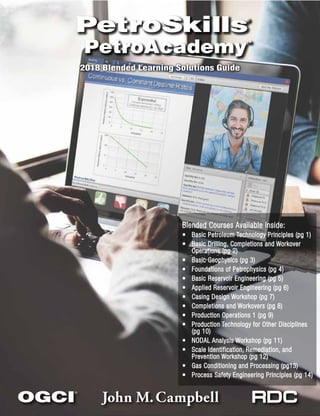
2018 Blended Learning Solutions Guide
Blended Courses Available Inside:
•	 Basic Petroleum Technology Principles (pg 1)
•	 Basic Drilling, Completions and Workover
Operations (pg 2)
•	 Basic Geophysics (pg 3)
•	 Foundations of Petrophysics (pg 4)
•	 Basic Reservoir Engineering (pg 5)
•	 Applied Reservoir Engineering (pg 6)
•	 Casing Design Workshop (pg 7)
•	 Completions and Workovers (pg 8)
•	 Production Operations 1 (pg 9)
•	 Production Technology for Other Disciplines
(pg 10)
•	 NODAL Analysis Workshop (pg 11)
•	 Scale Identification, Remediation, and
Prevention Workshop (pg 12)
•	 Gas Conditioning and Processing (pg13)
•	 Process Safety Engineering Principles (pg 14)
PetroAcademy
TM
PetroAcademy®
Blended Learning Solutions
Reduced time to competency
Eliminated travel expense
Flexibility—less time away from work
Learning applied at point of need
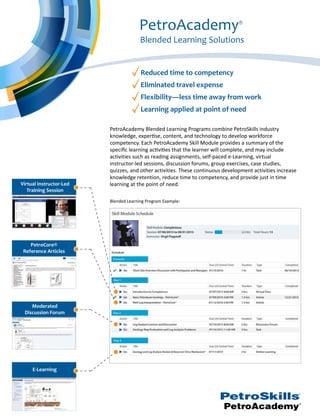
PetroAcademy Blended Learning Programs combine PetroSkills industry
knowledge, expertise, content, and technology to develop workforce
competency. Each PetroAcademy Skill Module provides a summary of the
specific learning activities that the learner will complete, and may include
activities such as reading assignments, self-paced e-Learning, virtual
instructor-led sessions, discussion forums, group exercises, case studies,
quizzes, and other activities. These continuous development activities increase
knowledge retention, reduce time to competency, and provide just in time
learning at the point of need.
Blended Learning Program Example:
Virtual Instructor-Led
Training Session
PetroCore®
Reference Articles
Moderated
Discussion Forum
E-Learning
BLENDED LEARNING LIST OF SKILL MODULES
This course is comprised of the following skill
modules (approximately 4 hours each).
1 E&P Industry andAsset Life Cycle
2 Petroleum Geology
3 Hydrocarbon Reservoirs
4 Rock and Fluid Properties
5 Surface/Subsurface Exploration
6 Drilling Operations andWell Completions
7 Production Operations
Basic Petroleum Technology Principles – BPT
COURSE DESCRIPTION
1
Self paced, can be started anytime
Tuition US$2940
This program is delivered virtually. All
learning activities are self-paced and can
be completed at any time.
This course provides the participant with
an understanding of basic petroleum
technology in the context of the Petroleum
Value Chain, from exploration to
abandonment. The participant will
understand how and when geoscience
and engineering professionals use
technology to find, then determine and
optimize the economic value of an oil and
gas field. This enables the participant to
maximize their professional and
administrative contribution in their
organization.
DESIGNED FOR
Those who need to achieve a context and
understanding of E&P technologies, and
the role of technical departments in oil
and gas operations. An understanding
and use of oilfield terminology is
developed.
To learn more, visit
petroskills.com/virtualbpt
BLENDED LEARNING LIST OF SKILL MODULES
This course is comprised of the following skill
modules (approximately 3 hours each).
1 Drilling Operations andWell Completions
2 DefiningWell Objectives
3 Bit and Hydraulics
4 Drill String and BHA
5 Drilling Fluids and Solids Control
6 Directional Drilling andTrajectory Design
7 Oilfield Casing
8 Primary and Remedial Cementing
9 Onshore ConventionalWell Completion
10 Hydraulic Fracturing
11 Formation Damage and Matrix Stimulation
12 Sand Control
13 Well Intervention
Basic Drilling, Completions and Workover Operations – BDC
COURSE DESCRIPTION
This program is delivered virtually. All
learning activities are self-paced and can
be completed at any time. Approximately
40 hours of self-paced work.
This course presents the basics of drilling
and completion operations, plus post-
completion enhancement (workovers).
Participants will learn to
visualize what is happening downhole,
discover what can be accomplished, and
learn how drilling and completion can
alter reservoir performance.
Learn to communicate with drilling and
production personnel.
DESIGNED FOR
Technical, field, service, support, and
supervisory personnel desiring to gain an
awareness of wellbore operations.
Excellent for cross-training of other
technical disciplines such as reservoir and
facility engineers, geoscientists,
supervisors, service personnel, and
anyone who interacts with drilling,
completion or workover engineers.
To learn more, visit
petroskills.com/virtual-bdc
Self paced, can be started anytime
Tuition US$3930
2
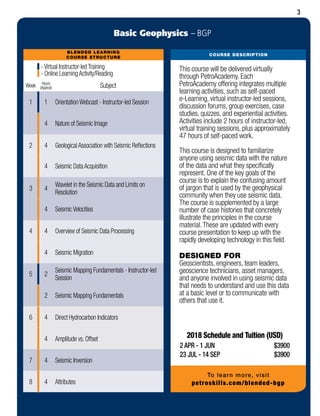
BLENDED LEARNING
COURSE STRUCTURE
-Virtual Instructor-ledTraining
- Online LearningActivity/Reading
Week Hours
(Approx) Subject
1 1 OrientationWebcast - Instructor-led Session
4 Nature of Seismic Image
2 4 GeologicalAssociation with Seismic Reflections
4 Seismic DataAcquisition
3 4
Wavelet in the Seismic Data and Limits on
Resolution
4 SeismicVelocities
4 4 Overview of Seismic Data Processing
4 Seismic Migration
5 2
Seismic Mapping Fundamentals - Instructor-led
Session
2 Seismic Mapping Fundamentals
6 4 Direct Hydrocarbon Indicators
4 Amplitude vs.Offset
7 4 Seismic Inversion
8 4 Attributes
Basic Geophysics – BGP
COURSE DESCRIPTION
3
2018 Schedule and Tuition (USD)
2 APR - 1 JUN	 $3900
23 JUL - 14 SEP	 $3900
This course will be delivered virtually
through PetroAcademy. Each
PetroAcademy offering integrates multiple
learning activities, such as self-paced
e-Learning, virtual instructor-led sessions,
discussion forums, group exercises, case
studies, quizzes, and experiential activities.
Activities include 2 hours of instructor-led,
virtual training sessions, plus approximately
47 hours of self-paced work.
This course is designed to familiarize
anyone using seismic data with the nature
of the data and what they specifically
represent. One of the key goals of the
course is to explain the confusing amount
of jargon that is used by the geophysical
community when they use seismic data.
The course is supplemented by a large
number of case histories that concretely
illustrate the principles in the course
material.These are updated with every
course presentation to keep up with the
rapidly developing technology in this field.
DESIGNED FOR
Geoscientists, engineers, team leaders,
geoscience technicians, asset managers,
and anyone involved in using seismic data
that needs to understand and use this data
at a basic level or to communicate with
others that use it.
To learn more, visit
petroskills.com/blended-bgp
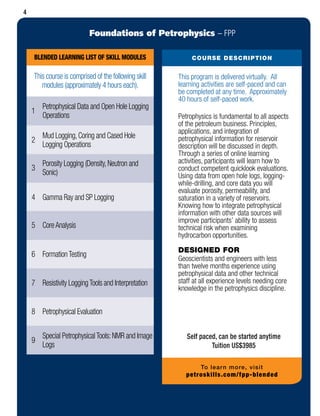
BLENDED LEARNING LIST OF SKILL MODULES
This course is comprised of the following skill
modules (approximately 4 hours each).
1
Petrophysical Data and Open Hole Logging
Operations
2
Mud Logging,Coring and Cased Hole
Logging Operations
3
Porosity Logging (Density,Neutron and
Sonic)
4 Gamma Ray and SP Logging
5 CoreAnalysis
6 FormationTesting
7 Resistivity LoggingTools and Interpretation
8 Petrophysical Evaluation
9
Special PetrophysicalTools:NMR and Image
Logs
Foundations of Petrophysics – FPP
COURSE DESCRIPTION
Self paced, can be started anytime
Tuition US$3985
This program is delivered virtually. All
learning activities are self-paced and can
be completed at any time. Approximately
40 hours of self-paced work.
Petrophysics is fundamental to all aspects
of the petroleum business. Principles,
applications, and integration of
petrophysical information for reservoir
description will be discussed in depth.
Through a series of online learning
activities, participants will learn how to
conduct competent quicklook evaluations.
Using data from open hole logs, logging-
while-drilling, and core data you will
evaluate porosity, permeability, and
saturation in a variety of reservoirs.
Knowing how to integrate petrophysical
information with other data sources will
improve participants’ ability to assess
technical risk when examining
hydrocarbon opportunities.
DESIGNED FOR
Geoscientists and engineers with less
than twelve months experience using
petrophysical data and other technical
staff at all experience levels needing core
knowledge in the petrophysics discipline.
To learn more, visit
petroskills.com/fpp-blended
4
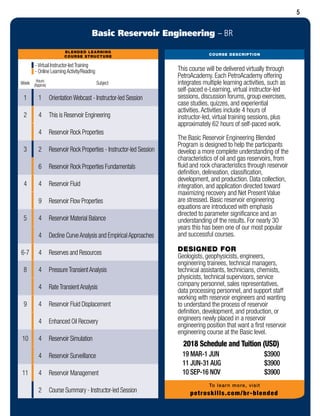
BLENDED LEARNING
COURSE STRUCTURE
-Virtual Instructor-ledTraining
- Online LearningActivity/Reading
Week Hours
(Approx) Subject
1 1 OrientationWebcast - Instructor-led Session
2 4 This is Reservoir Engineering
4 Reservoir Rock Properties
3 2 Reservoir Rock Properties - Instructor-led Session
6 Reservoir Rock Properties Fundamentals
4 4 Reservoir Fluid
9 Reservoir Flow Properties
5 4 Reservoir Material Balance
4 Decline CurveAnalysis and EmpiricalApproaches
6-7 4 Reserves and Resources
8 4 PressureTransientAnalysis
4 RateTransientAnalysis
9 4 Reservoir Fluid Displacement
4 Enhanced Oil Recovery
10 4 Reservoir Simulation
4 Reservoir Surveillance
11 4 Reservoir Management
2 Course Summary - Instructor-led Session
Basic Reservoir Engineering – BR
COURSE DESCRIPTION
5
2018 Schedule and Tuition (USD)
19 MAR-1 JUN	 $3900
11 JUN-31 AUG	 $3900
10 SEP-16 NOV	 $3900
This course will be delivered virtually through
PetroAcademy. Each PetroAcademy offering
integrates multiple learning activities, such as
self-paced e-Learning, virtual instructor-led
sessions, discussion forums, group exercises,
case studies, quizzes, and experiential
activities.Activities include 4 hours of
instructor-led, virtual training sessions, plus
approximately 62 hours of self-paced work.
The Basic Reservoir Engineering Blended
Program is designed to help the participants
develop a more complete understanding of the
characteristics of oil and gas reservoirs, from
fluid and rock characteristics through reservoir
definition, delineation, classification,
development, and production. Data collection,
integration, and application directed toward
maximizing recovery and Net Present Value
are stressed. Basic reservoir engineering
equations are introduced with emphasis
directed to parameter significance and an
understanding of the results. For nearly 30
years this has been one of our most popular
and successful courses.
DESIGNED FOR
Geologists, geophysicists, engineers,
engineering trainees, technical managers,
technical assistants, technicians, chemists,
physicists, technical supervisors, service
company personnel, sales representatives,
data processing personnel, and support staff
working with reservoir engineers and wanting
to understand the process of reservoir
definition, development, and production, or
engineers newly placed in a reservoir
engineering position that want a first reservoir
engineering course at the Basic level.
To learn more, visit
petroskills.com/br-blended
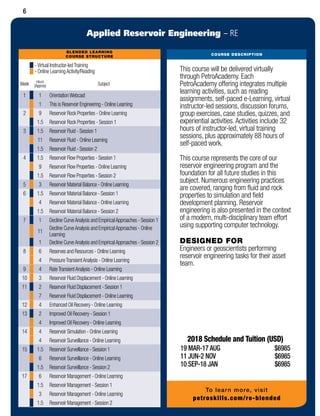
BLENDED LEARNING
COURSE STRUCTURE
-Virtual Instructor-ledTraining
- Online LearningActivity/Reading
Week Hours
(Approx) Subject
1 1 OrientationWebcast
1 This is Reservoir Engineering - Online Learning
2 9 Reservoir Rock Properties - Online Learning
1.5 Reservoir Rock Properties - Session 1
3 1.5 Reservoir Fluid - Session 1
11 Reservoir Fluid - Online Learning
1.5 Reservoir Fluid - Session 2
4 1.5 Reservoir Flow Properties - Session 1
9 Reservoir Flow Properties - Online Learning
1.5 Reservoir Flow Properties - Session 2
5 3 Reservoir Material Balance - Online Learning
6 1.5 Reservoir Material Balance - Session 1
4 Reservoir Material Balance - Online Learning
1.5 Reservoir Material Balance - Session 2
7 1 Decline CurveAnalysis and EmpiricalApproaches - Session 1
11
Decline CurveAnalysis and EmpiricalApproaches - Online
Learning
1 Decline CurveAnalysis and EmpiricalApproaches - Session 2
8 6 Reserves and Resources - Online Learning
4 PressureTransientAnalysis - Online Learning
9 4 RateTransientAnalysis - Online Learning
10 3 Reservoir Fluid Displacement - Online Learning
11 2 Reservoir Fluid Displacement - Session 1
7 Reservoir Fluid Displacement - Online Learning
12 4 Enhanced Oil Recovery - Online Learning
13 2 Improved Oil Recovery - Session 1
4 Improved Oil Recovery - Online Learning
14 4 Reservoir Simulation - Online Learning
4 Reservoir Surveillance - Online Learning
15 1.5 Reservoir Surveillance - Session 1
6 Reservoir Surveillance - Online Learning
1.5 Reservoir Surveillance - Session 2
17 6 Reservoir Management - Online Learning
1.5 Reservoir Management - Session 1
3 Reservoir Management - Online Learning
1.5 Reservoir Management - Session 2
Applied Reservoir Engineering – RE
COURSE DESCRIPTION
2018 Schedule and Tuition (USD)
19 MAR-17 AUG	 $6985
11 JUN-2 NOV	 $6985
10 SEP-18 JAN	 $6985
This course will be delivered virtually
through PetroAcademy. Each
PetroAcademy offering integrates multiple
learning activities, such as reading
assignments, self-paced e-Learning, virtual
instructor-led sessions, discussion forums,
group exercises, case studies, quizzes, and
experiential activities.Activities include 32
hours of instructor-led, virtual training
sessions, plus approximately 88 hours of
self-paced work.
This course represents the core of our
reservoir engineering program and the
foundation for all future studies in this
subject. Numerous engineering practices
are covered, ranging from fluid and rock
properties to simulation and field
development planning. Reservoir
engineering is also presented in the context
of a modern, multi-disciplinary team effort
using supporting computer technology.
DESIGNED FOR
Engineers or geoscientists performing
reservoir engineering tasks for their asset
team.
To learn more, visit
petroskills.com/re-blended
6
7
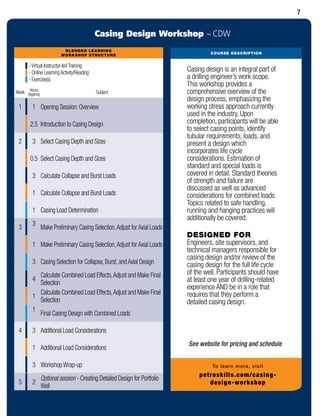
BLENDED LEARNING
WORKSHOP STRUCTURE
-Virtual Instructor-ledTraining
- Online LearningActivity/Reading
- Exercise(s)
Week Hours
(Approx) Subject
1 1 Opening Session:Overview
2.5 Introduction to Casing Design
2 3 Select Casing Depth and Sizes
0.5 Select Casing Depth and Sizes
3 Calculate Collapse and Burst Loads
1 Calculate Collapse and Burst Loads
1 Casing Load Determination
3
3
Make Preliminary Casing Selection,Adjust forAxial Loads
1 Make Preliminary Casing Selection,Adjust forAxial Loads
3 Casing Selection for Collapse,Burst,andAxial Design
4
Calculate Combined Load Effects,Adjust and Make Final
Selection
1
Calculate Combined Load Effects,Adjust and Make Final
Selection
1
Final Casing Design with Combined Loads
4 3 Additional Load Considerations
1 Additional Load Considerations
3 WorkshopWrap-up
5 2
Optional session - Creating Detailed Design for Portfolio
Well
To learn more, visit
petroskills.com/casing-
design-workshop
See website for pricing and schedule
COURSE DESCRIPTION
Casing Design Workshop – CDW
Casing design is an integral part of
a drilling engineer’s work scope.
This workshop provides a
comprehensive overview of the
design process, emphasizing the
working stress approach currently
used in the industry. Upon
completion, participants will be able
to select casing points, identify
tubular requirements, loads, and
present a design which
incorporates life cycle
considerations. Estimation of
standard and special loads is
covered in detail. Standard theories
of strength and failure are
discussed as well as advanced
considerations for combined loads.
Topics related to safe handling,
running and hanging practices will
additionally be covered.
DESIGNED FOR
Engineers, site supervisors, and
technical managers responsible for
casing design and/or review of the
casing design for the full life cycle
of the well. Participants should have
at least one year of drilling-related
experience AND be in a role that
requires that they perform a
detailed casing design.
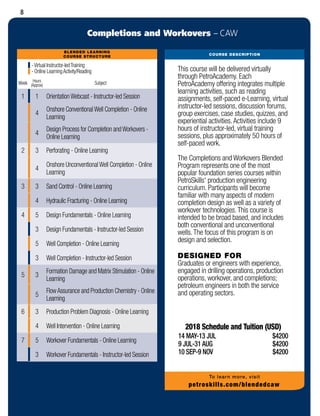
BLENDED LEARNING
COURSE STRUCTURE
-Virtual Instructor-ledTraining
- Online LearningActivity/Reading
Week Hours
(Approx) Subject
1 1 OrientationWebcast - Instructor-led Session
4
Onshore ConventionalWell Completion - Online
Learning
4
Design Process for Completion andWorkovers -
Online Learning
2 3 Perforating - Online Learning
4
Onshore UnconventionalWell Completion - Online
Learning
3 3 Sand Control - Online Learning
4 Hydraulic Fracturing - Online Learning
4 5 Design Fundamentals - Online Learning
3 Design Fundamentals - Instructor-led Session
5 Well Completion - Online Learning
3 Well Completion - Instructor-led Session
5 3
Formation Damage and Matrix Stimulation - Online
Learning
5
FlowAssurance and Production Chemistry - Online
Learning
6 3 Production Problem Diagnosis - Online Learning
4 Well Intervention - Online Learning
7 5 Workover Fundamentals - Online Learning
3 Workover Fundamentals - Instructor-led Session
Completions and Workovers – CAW
COURSE DESCRIPTION
2018 Schedule and Tuition (USD)
14 MAY-13 JUL	 $4200
9 JUL-31 AUG	 $4200
10 SEP-9 NOV	 $4200
This course will be delivered virtually
through PetroAcademy. Each
PetroAcademy offering integrates multiple
learning activities, such as reading
assignments, self-paced e-Learning, virtual
instructor-led sessions, discussion forums,
group exercises, case studies, quizzes, and
experiential activities.Activities include 9
hours of instructor-led, virtual training
sessions, plus approximately 50 hours of
self-paced work.
The Completions and Workovers Blended
Program represents one of the most
popular foundation series courses within
PetroSkills' production engineering
curriculum. Participants will become
familiar with many aspects of modern
completion design as well as a variety of
workover technologies.This course is
intended to be broad based, and includes
both conventional and unconventional
wells.The focus of this program is on
design and selection.
DESIGNED FOR
Graduates or engineers with experience,
engaged in drilling operations, production
operations, workover, and completions;
petroleum engineers in both the service
and operating sectors.
To learn more, visit
petroskills.com/blendedcaw
8
2018 Schedule and Tuition (USD)
9 APR-6 JUL	 $6990
6 AUG-2 NOV	 $6990
10 SEP-21 DEC	 $6990
Production Operations 1 – PO1
COURSE DESCRIPTION
The Production Operations Blended
Program represents the core foundation
series of PetroSkills’ production
engineering curriculum. Participants will
become familiar with both proven historical
production practices as well as current
technological advances to enhance oil and
gas production. Applied skills guide the
participant within a framework to make
careful, prudent, technical oil and gas
business decisions. Activites include 22
hours of instructor-led, virtual training
sessions, plus approximately 87 hours of
self-paced work.
DESIGNED FOR
Engineers starting a work assignment in
production engineering and operations,
production operations staff, reservoir
engineers, facilities staff, drilling and
completions engineers, geoscientists, field
supervisors, managers, and technicians,
service company engineers and managers.
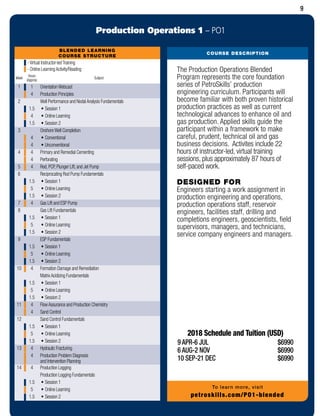
BLENDED LEARNING
COURSE STRUCTURE
-Virtual Instructor-ledTraining
- Online LearningActivity/Reading
Week
Hours
(Approx)
Subject
1 1 OrientationWebcast
4 Production Principles
2 Well Performance and NodalAnalysis Fundamentals
1.5 •	Session 1
4 •	Online Learning
1.5 •	Session 2
3 OnshoreWell Completion
4 •	Conventional
4 •	Unconventional
4 4 Primary and Remedial Cementing
4 Perforating
5 4 Rod,PCP,Plunger Lift,and Jet Pump
6 Reciprocating Rod Pump Fundamentals
1.5 •	Session 1
5 •	Online Learning
1.5 •	Session 2
7 4 Gas Lift and ESP Pump
8 Gas Lift Fundamentals
1.5 •	Session 1
5 •	Online Learning
1.5 •	Session 2
9 ESP Fundamentals
1.5 •	Session 1
5 •	Online Learning
1.5 •	Session 2
10 4 Formation Damage and Remediation
MatrixAcidizing Fundamentals
1.5 •	Session 1
5 •	Online Learning
1.5 •	Session 2
11 4 FlowAssurance and Production Chemistry
4 Sand Control
12 Sand Control Fundamentals
1.5 •	Session 1
5 •	Online Learning
1.5 •	Session 2
13 4 Hydraulic Fracturing
4 Production Problem Diagnosis
and Intervention Planning
14 4 Production Logging
Production Logging Fundamentals
1.5 •	Session 1
5 •	Online Learning
1.5 •	Session 2
To learn more, visit
petroskills.com/PO1-blended
9
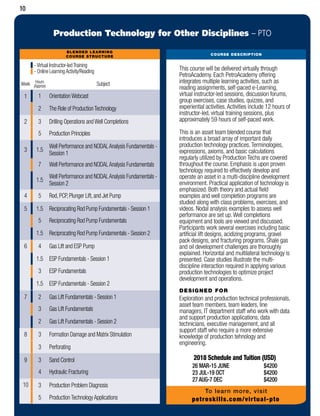
BLENDED LEARNING
COURSE STRUCTURE
-Virtual Instructor-ledTraining
- Online LearningActivity/Reading
Week Hours
(Approx) Subject
1 1 OrientationWebcast
2 The Role of ProductionTechnology
2 3 Drilling Operations andWell Completions
5 Production Principles
3 1.5
Well Performance and NODALAnalysis Fundamentals -
Session 1
7 Well Performance and NODALAnalysis Fundamentals
1.5
Well Performance and NODALAnalysis Fundamentals -
Session 2
4 5 Rod,PCP,Plunger Lift,and Jet Pump
5 1.5 Reciprocating Rod Pump Fundamentals - Session 1
5 Reciprocating Rod Pump Fundamentals
1.5 Reciprocating Rod Pump Fundamentals - Session 2
6 4 Gas Lift and ESP Pump
1.5 ESP Fundamentals - Session 1
3 ESP Fundamentals
1.5 ESP Fundamentals - Session 2
7 2 Gas Lift Fundamentals - Session 1
3 Gas Lift Fundamentals
2 Gas Lift Fundamentals - Session 2
8 3 Formation Damage and Matrix Stimulation
3 Perforating
9 3 Sand Control
4 Hydraulic Fracturing
10 3 Production Problem Diagnosis
5 ProductionTechnologyApplications
Production Technology for Other Disciplines – PTO
COURSE DESCRIPTION
2018 Schedule and Tuition (USD)
26 MAR-15 JUNE	 $4200
23 JUL-19 OCT	 $4200
27 AUG-7 DEC	 $4200
This course will be delivered virtually through
PetroAcademy. Each PetroAcademy offering
integrates multiple learning activities, such as
reading assignments, self-paced e-Learning,
virtual instructor-led sessions, discussion forums,
group exercises, case studies, quizzes, and
experiential activities.Activities include 12 hours of
instructor-led, virtual training sessions, plus
approximately 59 hours of self-paced work.
This is an asset team blended course that
introduces a broad array of important daily
production technology practices.Terminologies,
expressions, axioms, and basic calculations
regularly utilized by Production Techs are covered
throughout the course. Emphasis is upon proven
technology required to effectively develop and
operate an asset in a multi-discipline development
environment. Practical application of technology is
emphasized. Both theory and actual field
examples and well completion programs are
studied along with class problems, exercises, and
videos. Nodal analysis examples to assess well
performance are set up.Well completions
equipment and tools are viewed and discussed.
Participants work several exercises including basic
artificial lift designs, acidizing programs, gravel
pack designs, and fracturing programs. Shale gas
and oil development challenges are thoroughly
explained. Horizontal and multilateral technology is
presented. Case studies illustrate the multi-
discipline interaction required in applying various
production technologies to optimize project
development and operations.
DESIGNED FOR
Exploration and production technical professionals,
asset team members, team leaders, line
managers, IT department staff who work with data
and support production applications, data
technicians, executive management, and all
support staff who require a more extensive
knowledge of production tehnology and
engineering.
To learn more, visit
petroskills.com/virtual-pto
10
To learn more, visit
petroskills.com/nodal-virtual
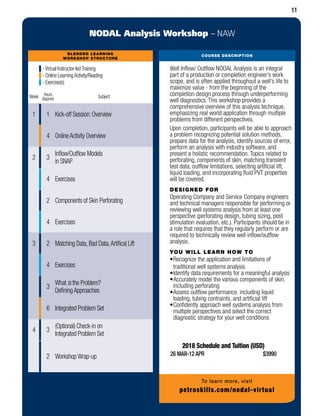
BLENDED LEARNING
WORKSHOP STRUCTURE
-Virtual Instructor-ledTraining
- Online LearningActivity/Reading
- Exercise(s)
Week Hours
(Approx) Subject
1 1 Kick-off Session:Overview
4 OnlineActivity Overview
2 3
Inflow/Outflow Models
in SNAP
4 Exercises
2 Components of Skin Perforating
4 Exercises
3 2 Matching Data,Bad Data,Artifical Lift
4 Exercises
3
What is the Problem?
DefiningApproaches
6 Integrated Problem Set
4 3
(Optional) Check-in on
Integrated Problem Set
2 WorkshopWrap-up
COURSE DESCRIPTION
NODAL Analysis Workshop – NAW
Well Inflow/ Outflow NODAL Analysis is an integral
part of a production or completion engineer’s work
scope, and is often applied throughout a well’s life to
maximize value - from the beginning of the
completion design process through underperforming
well diagnostics. This workshop provides a
comprehensive overview of this analysis technique,
emphasizing real world application through multiple
problems from different perspectives.
Upon completion, participants will be able to approach
a problem recognizing potential solution methods,
prepare data for the analysis, identify sources of error,
perform an analysis with industry software, and
present a holistic recommendation. Topics related to
perforating, components of skin, matching transient
test data, outflow limitations, selecting artificial lift,
liquid loading, and incorporating fluid PVT properties
will be covered.
DESIGNED FOR
Operating Company and Service Company engineers
and technical managers responsible for performing or
reviewing well systems analysis from at least one
perspective (perforating design, tubing sizing, post
stimulation evaluation, etc.). Participants should be in
a role that requires that they regularly perform or are
required to technically review well inflow/outflow
analysis.
YOU WILL LEARN HOW TO
•	Recognize the application and limitations of
traditional well systems analysis
•	Identify data requirements for a meaningful analysis
•	Accurately model the various components of skin,
including perforating
•	Assess outflow performance, including liquid
loading, tubing contraints, and artificial lift
•	Confidently approach well systems analysis from
multiple perspectives and select the correct
diagnostic strategy for your well conditions
2018 Schedule and Tuition (USD)
26 MAR-12 APR	 $3990
11
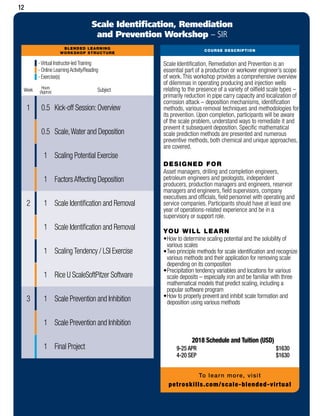
BLENDED LEARNING
WORKSHOP STRUCTURE
-Virtual Instructor-ledTraining
- Online LearningActivity/Reading
- Exercise(s)
Week Hours
(Approx) Subject
1 0.5 Kick-off Session:Overview
0.5 Scale,Water and Deposition
1 Scaling Potential Exercise
1 FactorsAffecting Deposition
2 1 Scale Identification and Removal
1 Scale Identification and Removal
1 ScalingTendency / LSI Exercise
1 Rice U ScaleSoftPitzer Software
3 1 Scale Prevention and Inhibition
1 Scale Prevention and Inhibition
1 Final Project
COURSE DESCRIPTION
Scale Identification, Remediation
and Prevention Workshop – SIR
Scale Identification, Remediation and Prevention is an
essential part of a production or workover engineer’s scope
of work. This workshop provides a comprehensive overview
of dilemmas in operating producing and injection wells
relating to the presence of a variety of oilfield scale types –
primarily reduction in pipe carry capacity and localization of
corrosion attack – deposition mechanisms, identification
methods, various removal techniques and methodologies for
its prevention. Upon completion, participants will be aware
of the scale problem, understand ways to remediate it and
prevent it subsequent deposition. Specific mathematical
scale prediction methods are presented and numerous
preventive methods, both chemical and unique approaches,
are covered.
DESIGNED FOR
Asset managers, drilling and completion engineers,
petroleum engineers and geologists, independent
producers, production managers and engineers, reservoir
managers and engineers, field supervisors, company
executives and officials, field personnel with operating and
service companies. Participants should have at least one
year of operations-related experience and be in a
supervisory or support role.
YOU WILL LEARN
•	How to determine scaling potential and the solubility of
various scales
•	Two principle methods for scale identification and recognize
various methods and their application for removing scale
depending on its composition
•	Precipitation tendency variables and locations for various
scale deposits – especially iron and be familiar with three
mathematical models that predict scaling, including a
popular software program
•	How to properly prevent and inhibit scale formation and
deposition using various methods
2018 Schedule and Tuition (USD)
9-25 APR	 $1630
4-20 SEP	 $1630
To learn more, visit
petroskills.com/scale-blended-virtual
12
COURSE DESCRIPTION
Gas Conditioning and Processing – G-4
The Campbell Gas Course has been the industry standard for more than 50 years, and is now available as a blended program.The first half of the
material will be delivered virtually through PetroAcademy self-paced e-Learning.The second half will be delivered in the classroom during the 5-day
face-to-face portion of the course. Participants must complete the e-Learning portion of the course before the classroom session begins.
The course provides both core and foundation competencies in the areas of gas conditioning and processing. It provides a review of both onshore and
offshore operations, and takes a systems approach to walk through engineering fundamentals and gas processing unit and equipment operations. Both
hands-on methods and computer-aided analysis are applied to examine sensitivities of technical decisions.The approaches used are applicable to both
new designs, and to troubleshooting current facilities operations.
Over 36,000 attendees have taken our G-4 program, considered by many to be the most practical and comprehensive course in the oil and gas industry.
DESIGNED FOR
Facilities engineers, process engineers, senior operations personnel, field supervisors, and engineers who select, design, install, evaluate or operate gas
processing plants and related facilities.
To learn more, visit
petroskills.com/g4blended
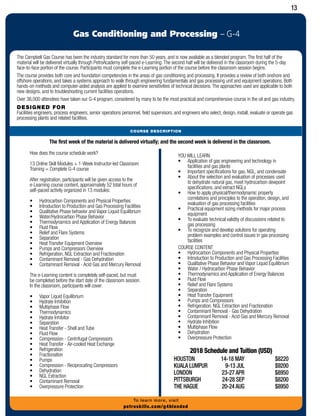
The first week of the material is delivered virtually; and the second week is delivered in the classroom.
How does the course schedule work?
13 Online Skill Modules + 1-Week Instructor-led Classroom
Training = Complete G-4 course
After registration, participants will be given access to the
e-Learning course content, approximately 52 total hours of
self-paced activity organized in 13 modules:
•	 Hydrocarbon Components and Physical Properties
•	 Introduction to Production and Gas Processing Facilities
•	 Qualitative Phase behavior and Vapor Liquid Equilibrium
•	 Water/Hydrocarbon Phase Behavior
•	 Thermodynamics and Application of Energy Balances
•	 Fluid Flow
•	 Relief and Flare Systems
•	 Separation
•	 Heat Transfer Equipment Overview
•	 Pumps and Compressors Overview
•	 Refrigeration, NGL Extraction and Fractionation
•	 Contaminant Removal - Gas Dehydration
•	 Contaminant Removal - Acid Gas and Mercury Removal
The e-Learning content is completely self-paced, but must
be completed before the start date of the classroom session.
In the classroom, participants will cover:
•	 Vapor Liquid Equilibrium
•	 Hydrate Inhibition
•	 Multiphase Flow
•	 Thermodynamics
•	 Hydrate Inhibitor
•	 Separation
•	 Heat Transfer - Shell and Tube
•	 Fluid Flow
•	 Compression - Centrifugal Compressors
•	 Heat Transfer - Air-cooled Heat Exchange
•	 Refrigeration
•	 Fractionation
•	 Pumps
•	 Compression - Reciprocating Compressors
•	 Dehydration
•	 NGL Extraction
•	 Contaminant Removal
•	 Overpressure Protection
YOU WILL LEARN
•	 Application of gas engineering and technology in
facilities and gas plants
•	 Important specifications for gas, NGL, and condensate
•	 About the selection and evaluation of processes used
to dehydrate natural gas, meet hydrocarbon dewpoint
specifications, and extract NGLs
•	 How to apply physical/thermodynamic property
correlations and principles to the operation, design, and
evaluation of gas processing facilities
•	 Practical equipment sizing methods for major process
equipment
•	 To evaluate technical validity of discussions related to
gas processing
•	 To recognize and develop solutions for operating
problem examples and control issues in gas processing
facilities
COURSE CONTENT
•	 Hydrocarbon Components and Physical Properties
•	 Introduction to Production and Gas Processing Facilities
•	 Qualitative Phase Behavior and Vapor Liquid Equilibrium
•	 Water / Hydrocarbon Phase Behavior
•	 Thermodynamics and Application of Energy Balances
•	 Fluid Flow
•	 Relief and Flare Systems
•	 Separation
•	 Heat Transfer Equipment
•	 Pumps and Compressors
•	 Refrigeration, NGL Extraction and Fractionation
•	 Contaminant Removal - Gas Dehydration
•	 Contaminant Removal - Acid Gas and Mercury Removal
•	 Hydrate Inhibition
•	 Multiphase Flow
•	 Dehydration
•	 Overpressure Protection
2018 Schedule and Tuition (USD)
HOUSTON		 14-18 MAY	 $8220
KUALA LUMPUR	 9-13 JUL	 $9200
LONDON		 23-27 APR	 $8950
PITTSBURGH		 24-28 SEP	 $8200
THE HAGUE		 20-24 AUG	 $8950
13
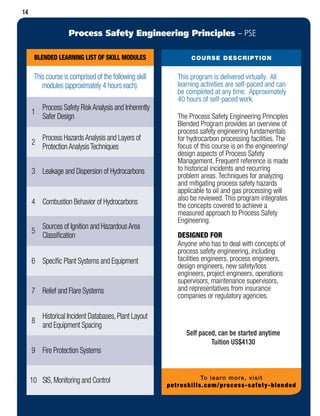
BLENDED LEARNING LIST OF SKILL MODULES
This course is comprised of the following skill
modules (approximately 4 hours each).
1
Process Safety RiskAnalysis and Inherently
Safer Design
2
Process HazardsAnalysis and Layers of
ProtectionAnalysisTechniques
3 Leakage and Dispersion of Hydrocarbons
4 Combustion Behavior of Hydrocarbons
5
Sources of Ignition and HazardousArea
Classification
6 Specific Plant Systems and Equipment
7 Relief and Flare Systems
8
Historical Incident Databases,Plant Layout
and Equipment Spacing
9 Fire Protection Systems
10 SIS,Monitoring and Control
Process Safety Engineering Principles – PSE
COURSE DESCRIPTION
This program is delivered virtually. All
learning activities are self-paced and can
be completed at any time. Approximately
40 hours of self-paced work.
The Process Safety Engineering Principles
Blended Program provides an overview of
process safety engineering fundamentals
for hydrocarbon processing facilities. The
focus of this course is on the engineering/
design aspects of Process Safety
Management. Frequent reference is made
to historical incidents and recurring
problem areas. Techniques for analyzing
and mitigating process safety hazards
applicable to oil and gas processing will
also be reviewed. This program integrates
the concepts covered to achieve a
measured approach to Process Safety
Engineering.
DESIGNED FOR
Anyone who has to deal with concepts of
process safety engineering, including
facilities engineers, process engineers,
design engineers, new safety/loss
engineers, project engineers, operations
supervisors, maintenance supervisors,
and representatives from insurance
companies or regulatory agencies.
To learn more, visit
petroskills.com/process-safety-blended
Self paced, can be started anytime
Tuition US$4130
14
Subsurface
Introductory and Multi-Discipline
Geology
Geophysics
Petrophysics
Reservoir Engineering
Well Construction/Drilling
Production and Completions Engineering
Unconventional Resources
Integrated - Heavy Oil
Petroleum Data Management
Facilities
Gas Processing
Process Facilities
Offshore & Subsea
Pipeline Engineering
Instrumentation, Controls & Electrical
Mechanical Engineering
Reliability Engineering
Procurement/Supply Chain Management
Refining
Operations & Maintenance
Health, Safety, Environment
Petroleum Business and Professional Development
Petroleum Professional Development
Petroleum Business
Project Management
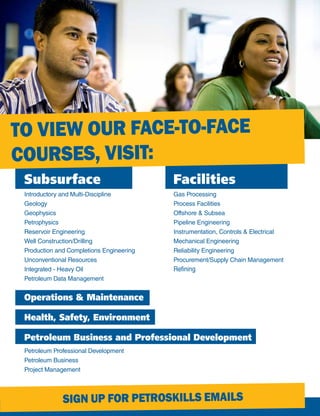
TO VIEW OUR FACE-TO-FACE
COURSES, VISIT:
SIGN UP FOR PETROSKILLS EMAILS

2018 PetroSkills Blended/Virtual Training Guide

  • 1.
    PetroAcademy TM 2018 Blended LearningSolutions Guide Blended Courses Available Inside: • Basic Petroleum Technology Principles (pg 1) • Basic Drilling, Completions and Workover Operations (pg 2) • Basic Geophysics (pg 3) • Foundations of Petrophysics (pg 4) • Basic Reservoir Engineering (pg 5) • Applied Reservoir Engineering (pg 6) • Casing Design Workshop (pg 7) • Completions and Workovers (pg 8) • Production Operations 1 (pg 9) • Production Technology for Other Disciplines (pg 10) • NODAL Analysis Workshop (pg 11) • Scale Identification, Remediation, and Prevention Workshop (pg 12) • Gas Conditioning and Processing (pg13) • Process Safety Engineering Principles (pg 14)
  • 2.
    PetroAcademy TM PetroAcademy® Blended Learning Solutions Reducedtime to competency Eliminated travel expense Flexibility—less time away from work Learning applied at point of need PetroAcademy Blended Learning Programs combine PetroSkills industry knowledge, expertise, content, and technology to develop workforce competency. Each PetroAcademy Skill Module provides a summary of the specific learning activities that the learner will complete, and may include activities such as reading assignments, self-paced e-Learning, virtual instructor-led sessions, discussion forums, group exercises, case studies, quizzes, and other activities. These continuous development activities increase knowledge retention, reduce time to competency, and provide just in time learning at the point of need. Blended Learning Program Example: Virtual Instructor-Led Training Session PetroCore® Reference Articles Moderated Discussion Forum E-Learning
  • 3.
    BLENDED LEARNING LISTOF SKILL MODULES This course is comprised of the following skill modules (approximately 4 hours each). 1 E&P Industry andAsset Life Cycle 2 Petroleum Geology 3 Hydrocarbon Reservoirs 4 Rock and Fluid Properties 5 Surface/Subsurface Exploration 6 Drilling Operations andWell Completions 7 Production Operations Basic Petroleum Technology Principles – BPT COURSE DESCRIPTION 1 Self paced, can be started anytime Tuition US$2940 This program is delivered virtually. All learning activities are self-paced and can be completed at any time. This course provides the participant with an understanding of basic petroleum technology in the context of the Petroleum Value Chain, from exploration to abandonment. The participant will understand how and when geoscience and engineering professionals use technology to find, then determine and optimize the economic value of an oil and gas field. This enables the participant to maximize their professional and administrative contribution in their organization. DESIGNED FOR Those who need to achieve a context and understanding of E&P technologies, and the role of technical departments in oil and gas operations. An understanding and use of oilfield terminology is developed. To learn more, visit petroskills.com/virtualbpt
  • 4.
    BLENDED LEARNING LISTOF SKILL MODULES This course is comprised of the following skill modules (approximately 3 hours each). 1 Drilling Operations andWell Completions 2 DefiningWell Objectives 3 Bit and Hydraulics 4 Drill String and BHA 5 Drilling Fluids and Solids Control 6 Directional Drilling andTrajectory Design 7 Oilfield Casing 8 Primary and Remedial Cementing 9 Onshore ConventionalWell Completion 10 Hydraulic Fracturing 11 Formation Damage and Matrix Stimulation 12 Sand Control 13 Well Intervention Basic Drilling, Completions and Workover Operations – BDC COURSE DESCRIPTION This program is delivered virtually. All learning activities are self-paced and can be completed at any time. Approximately 40 hours of self-paced work. This course presents the basics of drilling and completion operations, plus post- completion enhancement (workovers). Participants will learn to visualize what is happening downhole, discover what can be accomplished, and learn how drilling and completion can alter reservoir performance. Learn to communicate with drilling and production personnel. DESIGNED FOR Technical, field, service, support, and supervisory personnel desiring to gain an awareness of wellbore operations. Excellent for cross-training of other technical disciplines such as reservoir and facility engineers, geoscientists, supervisors, service personnel, and anyone who interacts with drilling, completion or workover engineers. To learn more, visit petroskills.com/virtual-bdc Self paced, can be started anytime Tuition US$3930 2
  • 5.
    BLENDED LEARNING COURSE STRUCTURE -VirtualInstructor-ledTraining - Online LearningActivity/Reading Week Hours (Approx) Subject 1 1 OrientationWebcast - Instructor-led Session 4 Nature of Seismic Image 2 4 GeologicalAssociation with Seismic Reflections 4 Seismic DataAcquisition 3 4 Wavelet in the Seismic Data and Limits on Resolution 4 SeismicVelocities 4 4 Overview of Seismic Data Processing 4 Seismic Migration 5 2 Seismic Mapping Fundamentals - Instructor-led Session 2 Seismic Mapping Fundamentals 6 4 Direct Hydrocarbon Indicators 4 Amplitude vs.Offset 7 4 Seismic Inversion 8 4 Attributes Basic Geophysics – BGP COURSE DESCRIPTION 3 2018 Schedule and Tuition (USD) 2 APR - 1 JUN $3900 23 JUL - 14 SEP $3900 This course will be delivered virtually through PetroAcademy. Each PetroAcademy offering integrates multiple learning activities, such as self-paced e-Learning, virtual instructor-led sessions, discussion forums, group exercises, case studies, quizzes, and experiential activities. Activities include 2 hours of instructor-led, virtual training sessions, plus approximately 47 hours of self-paced work. This course is designed to familiarize anyone using seismic data with the nature of the data and what they specifically represent. One of the key goals of the course is to explain the confusing amount of jargon that is used by the geophysical community when they use seismic data. The course is supplemented by a large number of case histories that concretely illustrate the principles in the course material.These are updated with every course presentation to keep up with the rapidly developing technology in this field. DESIGNED FOR Geoscientists, engineers, team leaders, geoscience technicians, asset managers, and anyone involved in using seismic data that needs to understand and use this data at a basic level or to communicate with others that use it. To learn more, visit petroskills.com/blended-bgp
  • 6.
    BLENDED LEARNING LISTOF SKILL MODULES This course is comprised of the following skill modules (approximately 4 hours each). 1 Petrophysical Data and Open Hole Logging Operations 2 Mud Logging,Coring and Cased Hole Logging Operations 3 Porosity Logging (Density,Neutron and Sonic) 4 Gamma Ray and SP Logging 5 CoreAnalysis 6 FormationTesting 7 Resistivity LoggingTools and Interpretation 8 Petrophysical Evaluation 9 Special PetrophysicalTools:NMR and Image Logs Foundations of Petrophysics – FPP COURSE DESCRIPTION Self paced, can be started anytime Tuition US$3985 This program is delivered virtually. All learning activities are self-paced and can be completed at any time. Approximately 40 hours of self-paced work. Petrophysics is fundamental to all aspects of the petroleum business. Principles, applications, and integration of petrophysical information for reservoir description will be discussed in depth. Through a series of online learning activities, participants will learn how to conduct competent quicklook evaluations. Using data from open hole logs, logging- while-drilling, and core data you will evaluate porosity, permeability, and saturation in a variety of reservoirs. Knowing how to integrate petrophysical information with other data sources will improve participants’ ability to assess technical risk when examining hydrocarbon opportunities. DESIGNED FOR Geoscientists and engineers with less than twelve months experience using petrophysical data and other technical staff at all experience levels needing core knowledge in the petrophysics discipline. To learn more, visit petroskills.com/fpp-blended 4
  • 7.
    BLENDED LEARNING COURSE STRUCTURE -VirtualInstructor-ledTraining - Online LearningActivity/Reading Week Hours (Approx) Subject 1 1 OrientationWebcast - Instructor-led Session 2 4 This is Reservoir Engineering 4 Reservoir Rock Properties 3 2 Reservoir Rock Properties - Instructor-led Session 6 Reservoir Rock Properties Fundamentals 4 4 Reservoir Fluid 9 Reservoir Flow Properties 5 4 Reservoir Material Balance 4 Decline CurveAnalysis and EmpiricalApproaches 6-7 4 Reserves and Resources 8 4 PressureTransientAnalysis 4 RateTransientAnalysis 9 4 Reservoir Fluid Displacement 4 Enhanced Oil Recovery 10 4 Reservoir Simulation 4 Reservoir Surveillance 11 4 Reservoir Management 2 Course Summary - Instructor-led Session Basic Reservoir Engineering – BR COURSE DESCRIPTION 5 2018 Schedule and Tuition (USD) 19 MAR-1 JUN $3900 11 JUN-31 AUG $3900 10 SEP-16 NOV $3900 This course will be delivered virtually through PetroAcademy. Each PetroAcademy offering integrates multiple learning activities, such as self-paced e-Learning, virtual instructor-led sessions, discussion forums, group exercises, case studies, quizzes, and experiential activities.Activities include 4 hours of instructor-led, virtual training sessions, plus approximately 62 hours of self-paced work. The Basic Reservoir Engineering Blended Program is designed to help the participants develop a more complete understanding of the characteristics of oil and gas reservoirs, from fluid and rock characteristics through reservoir definition, delineation, classification, development, and production. Data collection, integration, and application directed toward maximizing recovery and Net Present Value are stressed. Basic reservoir engineering equations are introduced with emphasis directed to parameter significance and an understanding of the results. For nearly 30 years this has been one of our most popular and successful courses. DESIGNED FOR Geologists, geophysicists, engineers, engineering trainees, technical managers, technical assistants, technicians, chemists, physicists, technical supervisors, service company personnel, sales representatives, data processing personnel, and support staff working with reservoir engineers and wanting to understand the process of reservoir definition, development, and production, or engineers newly placed in a reservoir engineering position that want a first reservoir engineering course at the Basic level. To learn more, visit petroskills.com/br-blended
  • 8.
    BLENDED LEARNING COURSE STRUCTURE -VirtualInstructor-ledTraining - Online LearningActivity/Reading Week Hours (Approx) Subject 1 1 OrientationWebcast 1 This is Reservoir Engineering - Online Learning 2 9 Reservoir Rock Properties - Online Learning 1.5 Reservoir Rock Properties - Session 1 3 1.5 Reservoir Fluid - Session 1 11 Reservoir Fluid - Online Learning 1.5 Reservoir Fluid - Session 2 4 1.5 Reservoir Flow Properties - Session 1 9 Reservoir Flow Properties - Online Learning 1.5 Reservoir Flow Properties - Session 2 5 3 Reservoir Material Balance - Online Learning 6 1.5 Reservoir Material Balance - Session 1 4 Reservoir Material Balance - Online Learning 1.5 Reservoir Material Balance - Session 2 7 1 Decline CurveAnalysis and EmpiricalApproaches - Session 1 11 Decline CurveAnalysis and EmpiricalApproaches - Online Learning 1 Decline CurveAnalysis and EmpiricalApproaches - Session 2 8 6 Reserves and Resources - Online Learning 4 PressureTransientAnalysis - Online Learning 9 4 RateTransientAnalysis - Online Learning 10 3 Reservoir Fluid Displacement - Online Learning 11 2 Reservoir Fluid Displacement - Session 1 7 Reservoir Fluid Displacement - Online Learning 12 4 Enhanced Oil Recovery - Online Learning 13 2 Improved Oil Recovery - Session 1 4 Improved Oil Recovery - Online Learning 14 4 Reservoir Simulation - Online Learning 4 Reservoir Surveillance - Online Learning 15 1.5 Reservoir Surveillance - Session 1 6 Reservoir Surveillance - Online Learning 1.5 Reservoir Surveillance - Session 2 17 6 Reservoir Management - Online Learning 1.5 Reservoir Management - Session 1 3 Reservoir Management - Online Learning 1.5 Reservoir Management - Session 2 Applied Reservoir Engineering – RE COURSE DESCRIPTION 2018 Schedule and Tuition (USD) 19 MAR-17 AUG $6985 11 JUN-2 NOV $6985 10 SEP-18 JAN $6985 This course will be delivered virtually through PetroAcademy. Each PetroAcademy offering integrates multiple learning activities, such as reading assignments, self-paced e-Learning, virtual instructor-led sessions, discussion forums, group exercises, case studies, quizzes, and experiential activities.Activities include 32 hours of instructor-led, virtual training sessions, plus approximately 88 hours of self-paced work. This course represents the core of our reservoir engineering program and the foundation for all future studies in this subject. Numerous engineering practices are covered, ranging from fluid and rock properties to simulation and field development planning. Reservoir engineering is also presented in the context of a modern, multi-disciplinary team effort using supporting computer technology. DESIGNED FOR Engineers or geoscientists performing reservoir engineering tasks for their asset team. To learn more, visit petroskills.com/re-blended 6
  • 9.
    7 BLENDED LEARNING WORKSHOP STRUCTURE -VirtualInstructor-ledTraining - Online LearningActivity/Reading - Exercise(s) Week Hours (Approx) Subject 1 1 Opening Session:Overview 2.5 Introduction to Casing Design 2 3 Select Casing Depth and Sizes 0.5 Select Casing Depth and Sizes 3 Calculate Collapse and Burst Loads 1 Calculate Collapse and Burst Loads 1 Casing Load Determination 3 3 Make Preliminary Casing Selection,Adjust forAxial Loads 1 Make Preliminary Casing Selection,Adjust forAxial Loads 3 Casing Selection for Collapse,Burst,andAxial Design 4 Calculate Combined Load Effects,Adjust and Make Final Selection 1 Calculate Combined Load Effects,Adjust and Make Final Selection 1 Final Casing Design with Combined Loads 4 3 Additional Load Considerations 1 Additional Load Considerations 3 WorkshopWrap-up 5 2 Optional session - Creating Detailed Design for Portfolio Well To learn more, visit petroskills.com/casing- design-workshop See website for pricing and schedule COURSE DESCRIPTION Casing Design Workshop – CDW Casing design is an integral part of a drilling engineer’s work scope. This workshop provides a comprehensive overview of the design process, emphasizing the working stress approach currently used in the industry. Upon completion, participants will be able to select casing points, identify tubular requirements, loads, and present a design which incorporates life cycle considerations. Estimation of standard and special loads is covered in detail. Standard theories of strength and failure are discussed as well as advanced considerations for combined loads. Topics related to safe handling, running and hanging practices will additionally be covered. DESIGNED FOR Engineers, site supervisors, and technical managers responsible for casing design and/or review of the casing design for the full life cycle of the well. Participants should have at least one year of drilling-related experience AND be in a role that requires that they perform a detailed casing design.
  • 10.
    BLENDED LEARNING COURSE STRUCTURE -VirtualInstructor-ledTraining - Online LearningActivity/Reading Week Hours (Approx) Subject 1 1 OrientationWebcast - Instructor-led Session 4 Onshore ConventionalWell Completion - Online Learning 4 Design Process for Completion andWorkovers - Online Learning 2 3 Perforating - Online Learning 4 Onshore UnconventionalWell Completion - Online Learning 3 3 Sand Control - Online Learning 4 Hydraulic Fracturing - Online Learning 4 5 Design Fundamentals - Online Learning 3 Design Fundamentals - Instructor-led Session 5 Well Completion - Online Learning 3 Well Completion - Instructor-led Session 5 3 Formation Damage and Matrix Stimulation - Online Learning 5 FlowAssurance and Production Chemistry - Online Learning 6 3 Production Problem Diagnosis - Online Learning 4 Well Intervention - Online Learning 7 5 Workover Fundamentals - Online Learning 3 Workover Fundamentals - Instructor-led Session Completions and Workovers – CAW COURSE DESCRIPTION 2018 Schedule and Tuition (USD) 14 MAY-13 JUL $4200 9 JUL-31 AUG $4200 10 SEP-9 NOV $4200 This course will be delivered virtually through PetroAcademy. Each PetroAcademy offering integrates multiple learning activities, such as reading assignments, self-paced e-Learning, virtual instructor-led sessions, discussion forums, group exercises, case studies, quizzes, and experiential activities.Activities include 9 hours of instructor-led, virtual training sessions, plus approximately 50 hours of self-paced work. The Completions and Workovers Blended Program represents one of the most popular foundation series courses within PetroSkills' production engineering curriculum. Participants will become familiar with many aspects of modern completion design as well as a variety of workover technologies.This course is intended to be broad based, and includes both conventional and unconventional wells.The focus of this program is on design and selection. DESIGNED FOR Graduates or engineers with experience, engaged in drilling operations, production operations, workover, and completions; petroleum engineers in both the service and operating sectors. To learn more, visit petroskills.com/blendedcaw 8
  • 11.
    2018 Schedule andTuition (USD) 9 APR-6 JUL $6990 6 AUG-2 NOV $6990 10 SEP-21 DEC $6990 Production Operations 1 – PO1 COURSE DESCRIPTION The Production Operations Blended Program represents the core foundation series of PetroSkills’ production engineering curriculum. Participants will become familiar with both proven historical production practices as well as current technological advances to enhance oil and gas production. Applied skills guide the participant within a framework to make careful, prudent, technical oil and gas business decisions. Activites include 22 hours of instructor-led, virtual training sessions, plus approximately 87 hours of self-paced work. DESIGNED FOR Engineers starting a work assignment in production engineering and operations, production operations staff, reservoir engineers, facilities staff, drilling and completions engineers, geoscientists, field supervisors, managers, and technicians, service company engineers and managers. BLENDED LEARNING COURSE STRUCTURE -Virtual Instructor-ledTraining - Online LearningActivity/Reading Week Hours (Approx) Subject 1 1 OrientationWebcast 4 Production Principles 2 Well Performance and NodalAnalysis Fundamentals 1.5 • Session 1 4 • Online Learning 1.5 • Session 2 3 OnshoreWell Completion 4 • Conventional 4 • Unconventional 4 4 Primary and Remedial Cementing 4 Perforating 5 4 Rod,PCP,Plunger Lift,and Jet Pump 6 Reciprocating Rod Pump Fundamentals 1.5 • Session 1 5 • Online Learning 1.5 • Session 2 7 4 Gas Lift and ESP Pump 8 Gas Lift Fundamentals 1.5 • Session 1 5 • Online Learning 1.5 • Session 2 9 ESP Fundamentals 1.5 • Session 1 5 • Online Learning 1.5 • Session 2 10 4 Formation Damage and Remediation MatrixAcidizing Fundamentals 1.5 • Session 1 5 • Online Learning 1.5 • Session 2 11 4 FlowAssurance and Production Chemistry 4 Sand Control 12 Sand Control Fundamentals 1.5 • Session 1 5 • Online Learning 1.5 • Session 2 13 4 Hydraulic Fracturing 4 Production Problem Diagnosis and Intervention Planning 14 4 Production Logging Production Logging Fundamentals 1.5 • Session 1 5 • Online Learning 1.5 • Session 2 To learn more, visit petroskills.com/PO1-blended 9
  • 12.
    BLENDED LEARNING COURSE STRUCTURE -VirtualInstructor-ledTraining - Online LearningActivity/Reading Week Hours (Approx) Subject 1 1 OrientationWebcast 2 The Role of ProductionTechnology 2 3 Drilling Operations andWell Completions 5 Production Principles 3 1.5 Well Performance and NODALAnalysis Fundamentals - Session 1 7 Well Performance and NODALAnalysis Fundamentals 1.5 Well Performance and NODALAnalysis Fundamentals - Session 2 4 5 Rod,PCP,Plunger Lift,and Jet Pump 5 1.5 Reciprocating Rod Pump Fundamentals - Session 1 5 Reciprocating Rod Pump Fundamentals 1.5 Reciprocating Rod Pump Fundamentals - Session 2 6 4 Gas Lift and ESP Pump 1.5 ESP Fundamentals - Session 1 3 ESP Fundamentals 1.5 ESP Fundamentals - Session 2 7 2 Gas Lift Fundamentals - Session 1 3 Gas Lift Fundamentals 2 Gas Lift Fundamentals - Session 2 8 3 Formation Damage and Matrix Stimulation 3 Perforating 9 3 Sand Control 4 Hydraulic Fracturing 10 3 Production Problem Diagnosis 5 ProductionTechnologyApplications Production Technology for Other Disciplines – PTO COURSE DESCRIPTION 2018 Schedule and Tuition (USD) 26 MAR-15 JUNE $4200 23 JUL-19 OCT $4200 27 AUG-7 DEC $4200 This course will be delivered virtually through PetroAcademy. Each PetroAcademy offering integrates multiple learning activities, such as reading assignments, self-paced e-Learning, virtual instructor-led sessions, discussion forums, group exercises, case studies, quizzes, and experiential activities.Activities include 12 hours of instructor-led, virtual training sessions, plus approximately 59 hours of self-paced work. This is an asset team blended course that introduces a broad array of important daily production technology practices.Terminologies, expressions, axioms, and basic calculations regularly utilized by Production Techs are covered throughout the course. Emphasis is upon proven technology required to effectively develop and operate an asset in a multi-discipline development environment. Practical application of technology is emphasized. Both theory and actual field examples and well completion programs are studied along with class problems, exercises, and videos. Nodal analysis examples to assess well performance are set up.Well completions equipment and tools are viewed and discussed. Participants work several exercises including basic artificial lift designs, acidizing programs, gravel pack designs, and fracturing programs. Shale gas and oil development challenges are thoroughly explained. Horizontal and multilateral technology is presented. Case studies illustrate the multi- discipline interaction required in applying various production technologies to optimize project development and operations. DESIGNED FOR Exploration and production technical professionals, asset team members, team leaders, line managers, IT department staff who work with data and support production applications, data technicians, executive management, and all support staff who require a more extensive knowledge of production tehnology and engineering. To learn more, visit petroskills.com/virtual-pto 10
  • 13.
    To learn more,visit petroskills.com/nodal-virtual BLENDED LEARNING WORKSHOP STRUCTURE -Virtual Instructor-ledTraining - Online LearningActivity/Reading - Exercise(s) Week Hours (Approx) Subject 1 1 Kick-off Session:Overview 4 OnlineActivity Overview 2 3 Inflow/Outflow Models in SNAP 4 Exercises 2 Components of Skin Perforating 4 Exercises 3 2 Matching Data,Bad Data,Artifical Lift 4 Exercises 3 What is the Problem? DefiningApproaches 6 Integrated Problem Set 4 3 (Optional) Check-in on Integrated Problem Set 2 WorkshopWrap-up COURSE DESCRIPTION NODAL Analysis Workshop – NAW Well Inflow/ Outflow NODAL Analysis is an integral part of a production or completion engineer’s work scope, and is often applied throughout a well’s life to maximize value - from the beginning of the completion design process through underperforming well diagnostics. This workshop provides a comprehensive overview of this analysis technique, emphasizing real world application through multiple problems from different perspectives. Upon completion, participants will be able to approach a problem recognizing potential solution methods, prepare data for the analysis, identify sources of error, perform an analysis with industry software, and present a holistic recommendation. Topics related to perforating, components of skin, matching transient test data, outflow limitations, selecting artificial lift, liquid loading, and incorporating fluid PVT properties will be covered. DESIGNED FOR Operating Company and Service Company engineers and technical managers responsible for performing or reviewing well systems analysis from at least one perspective (perforating design, tubing sizing, post stimulation evaluation, etc.). Participants should be in a role that requires that they regularly perform or are required to technically review well inflow/outflow analysis. YOU WILL LEARN HOW TO • Recognize the application and limitations of traditional well systems analysis • Identify data requirements for a meaningful analysis • Accurately model the various components of skin, including perforating • Assess outflow performance, including liquid loading, tubing contraints, and artificial lift • Confidently approach well systems analysis from multiple perspectives and select the correct diagnostic strategy for your well conditions 2018 Schedule and Tuition (USD) 26 MAR-12 APR $3990 11
  • 14.
    BLENDED LEARNING WORKSHOP STRUCTURE -VirtualInstructor-ledTraining - Online LearningActivity/Reading - Exercise(s) Week Hours (Approx) Subject 1 0.5 Kick-off Session:Overview 0.5 Scale,Water and Deposition 1 Scaling Potential Exercise 1 FactorsAffecting Deposition 2 1 Scale Identification and Removal 1 Scale Identification and Removal 1 ScalingTendency / LSI Exercise 1 Rice U ScaleSoftPitzer Software 3 1 Scale Prevention and Inhibition 1 Scale Prevention and Inhibition 1 Final Project COURSE DESCRIPTION Scale Identification, Remediation and Prevention Workshop – SIR Scale Identification, Remediation and Prevention is an essential part of a production or workover engineer’s scope of work. This workshop provides a comprehensive overview of dilemmas in operating producing and injection wells relating to the presence of a variety of oilfield scale types – primarily reduction in pipe carry capacity and localization of corrosion attack – deposition mechanisms, identification methods, various removal techniques and methodologies for its prevention. Upon completion, participants will be aware of the scale problem, understand ways to remediate it and prevent it subsequent deposition. Specific mathematical scale prediction methods are presented and numerous preventive methods, both chemical and unique approaches, are covered. DESIGNED FOR Asset managers, drilling and completion engineers, petroleum engineers and geologists, independent producers, production managers and engineers, reservoir managers and engineers, field supervisors, company executives and officials, field personnel with operating and service companies. Participants should have at least one year of operations-related experience and be in a supervisory or support role. YOU WILL LEARN • How to determine scaling potential and the solubility of various scales • Two principle methods for scale identification and recognize various methods and their application for removing scale depending on its composition • Precipitation tendency variables and locations for various scale deposits – especially iron and be familiar with three mathematical models that predict scaling, including a popular software program • How to properly prevent and inhibit scale formation and deposition using various methods 2018 Schedule and Tuition (USD) 9-25 APR $1630 4-20 SEP $1630 To learn more, visit petroskills.com/scale-blended-virtual 12
  • 15.
    COURSE DESCRIPTION Gas Conditioningand Processing – G-4 The Campbell Gas Course has been the industry standard for more than 50 years, and is now available as a blended program.The first half of the material will be delivered virtually through PetroAcademy self-paced e-Learning.The second half will be delivered in the classroom during the 5-day face-to-face portion of the course. Participants must complete the e-Learning portion of the course before the classroom session begins. The course provides both core and foundation competencies in the areas of gas conditioning and processing. It provides a review of both onshore and offshore operations, and takes a systems approach to walk through engineering fundamentals and gas processing unit and equipment operations. Both hands-on methods and computer-aided analysis are applied to examine sensitivities of technical decisions.The approaches used are applicable to both new designs, and to troubleshooting current facilities operations. Over 36,000 attendees have taken our G-4 program, considered by many to be the most practical and comprehensive course in the oil and gas industry. DESIGNED FOR Facilities engineers, process engineers, senior operations personnel, field supervisors, and engineers who select, design, install, evaluate or operate gas processing plants and related facilities. To learn more, visit petroskills.com/g4blended The first week of the material is delivered virtually; and the second week is delivered in the classroom. How does the course schedule work? 13 Online Skill Modules + 1-Week Instructor-led Classroom Training = Complete G-4 course After registration, participants will be given access to the e-Learning course content, approximately 52 total hours of self-paced activity organized in 13 modules: • Hydrocarbon Components and Physical Properties • Introduction to Production and Gas Processing Facilities • Qualitative Phase behavior and Vapor Liquid Equilibrium • Water/Hydrocarbon Phase Behavior • Thermodynamics and Application of Energy Balances • Fluid Flow • Relief and Flare Systems • Separation • Heat Transfer Equipment Overview • Pumps and Compressors Overview • Refrigeration, NGL Extraction and Fractionation • Contaminant Removal - Gas Dehydration • Contaminant Removal - Acid Gas and Mercury Removal The e-Learning content is completely self-paced, but must be completed before the start date of the classroom session. In the classroom, participants will cover: • Vapor Liquid Equilibrium • Hydrate Inhibition • Multiphase Flow • Thermodynamics • Hydrate Inhibitor • Separation • Heat Transfer - Shell and Tube • Fluid Flow • Compression - Centrifugal Compressors • Heat Transfer - Air-cooled Heat Exchange • Refrigeration • Fractionation • Pumps • Compression - Reciprocating Compressors • Dehydration • NGL Extraction • Contaminant Removal • Overpressure Protection YOU WILL LEARN • Application of gas engineering and technology in facilities and gas plants • Important specifications for gas, NGL, and condensate • About the selection and evaluation of processes used to dehydrate natural gas, meet hydrocarbon dewpoint specifications, and extract NGLs • How to apply physical/thermodynamic property correlations and principles to the operation, design, and evaluation of gas processing facilities • Practical equipment sizing methods for major process equipment • To evaluate technical validity of discussions related to gas processing • To recognize and develop solutions for operating problem examples and control issues in gas processing facilities COURSE CONTENT • Hydrocarbon Components and Physical Properties • Introduction to Production and Gas Processing Facilities • Qualitative Phase Behavior and Vapor Liquid Equilibrium • Water / Hydrocarbon Phase Behavior • Thermodynamics and Application of Energy Balances • Fluid Flow • Relief and Flare Systems • Separation • Heat Transfer Equipment • Pumps and Compressors • Refrigeration, NGL Extraction and Fractionation • Contaminant Removal - Gas Dehydration • Contaminant Removal - Acid Gas and Mercury Removal • Hydrate Inhibition • Multiphase Flow • Dehydration • Overpressure Protection 2018 Schedule and Tuition (USD) HOUSTON 14-18 MAY $8220 KUALA LUMPUR 9-13 JUL $9200 LONDON 23-27 APR $8950 PITTSBURGH 24-28 SEP $8200 THE HAGUE 20-24 AUG $8950 13
  • 16.
    BLENDED LEARNING LISTOF SKILL MODULES This course is comprised of the following skill modules (approximately 4 hours each). 1 Process Safety RiskAnalysis and Inherently Safer Design 2 Process HazardsAnalysis and Layers of ProtectionAnalysisTechniques 3 Leakage and Dispersion of Hydrocarbons 4 Combustion Behavior of Hydrocarbons 5 Sources of Ignition and HazardousArea Classification 6 Specific Plant Systems and Equipment 7 Relief and Flare Systems 8 Historical Incident Databases,Plant Layout and Equipment Spacing 9 Fire Protection Systems 10 SIS,Monitoring and Control Process Safety Engineering Principles – PSE COURSE DESCRIPTION This program is delivered virtually. All learning activities are self-paced and can be completed at any time. Approximately 40 hours of self-paced work. The Process Safety Engineering Principles Blended Program provides an overview of process safety engineering fundamentals for hydrocarbon processing facilities. The focus of this course is on the engineering/ design aspects of Process Safety Management. Frequent reference is made to historical incidents and recurring problem areas. Techniques for analyzing and mitigating process safety hazards applicable to oil and gas processing will also be reviewed. This program integrates the concepts covered to achieve a measured approach to Process Safety Engineering. DESIGNED FOR Anyone who has to deal with concepts of process safety engineering, including facilities engineers, process engineers, design engineers, new safety/loss engineers, project engineers, operations supervisors, maintenance supervisors, and representatives from insurance companies or regulatory agencies. To learn more, visit petroskills.com/process-safety-blended Self paced, can be started anytime Tuition US$4130 14
  • 17.
    Subsurface Introductory and Multi-Discipline Geology Geophysics Petrophysics ReservoirEngineering Well Construction/Drilling Production and Completions Engineering Unconventional Resources Integrated - Heavy Oil Petroleum Data Management Facilities Gas Processing Process Facilities Offshore & Subsea Pipeline Engineering Instrumentation, Controls & Electrical Mechanical Engineering Reliability Engineering Procurement/Supply Chain Management Refining Operations & Maintenance Health, Safety, Environment Petroleum Business and Professional Development Petroleum Professional Development Petroleum Business Project Management TO VIEW OUR FACE-TO-FACE COURSES, VISIT: SIGN UP FOR PETROSKILLS EMAILS